




Abstract
The purpose of this study was to develop the first English-Arabic occupational therapy dictionary mobile application that could be used by occupational therapy service providers and recipients and help fill the gap in understanding and communicating occupational therapy services. Google Play Store and App Store application stores were searched first to identify any current electronic occupational therapy dictionary. While developing the dictionary concept and structure, end users’ needs, language, and culture were taken into consideration applying a user-friendly design, functionalities, and an easy-to-understand language with illustrative visual representations. Our search for currently available electronic occupational therapy dictionaries did not identify any mobile application on the official application stores for iPhone and Android. As a result, a conceptual model was created to develop a mobile application aiming to develop a comprehensive and user-friendly mobile electronic dictionary with over 2400 scientific terms translated and annotated from English to Arabic, more than 350 illustrative pictures, and special features to assist occupational therapy professionals and occupational therapy services recipients in looking up and understanding terminology used in rehabilitation and occupational therapy in the most convenient, fastest, and easiest way possible. The occupational therapy dictionary mobile application has helped create a unified terminology and a common language of shared understanding, proved to be a helpful tool of communicating important messages between Arab occupational therapy professionals and community members through providing an easy access to up-to-date comprehensive English-Arabic lexicography in occupational therapy. It has become the first digital occupational therapy dictionary worldwide and has been made available for everyone to download from Google Play and App Store on their smartphones, computers, or tablets free of charge. Further research is urgently needed for quality improvement and to further enrich Arabic content in occupational therapy through developing evidence-based mobile tools to be used in occupational therapy practice by Arabic-speaking population.
This white paper introduces the first digital English-Arabic electronic occupational therapy dictionary worldwide and presents an innovative solution to all Arabic-speaking occupational therapy service providers and recipients through making this mobile application available to download from both Google Play and App Store on their smartphones, computers, or tablets free of charge. This new mobile application has helped facilitate understanding and communication between Arab community members and Arab occupational therapists by creating a unified and shared common easy to understand language of communication and providing the latest unified terminology in the field of occupational therapy.
The occupational therapy dictionary mobile application can be used as an educational reference for occupational therapy students during study years and clinical training, a reference guide for occupational therapy professionals in daily practice, an educational resource for other healthcare professionals, a means of facilitating understanding and communication between occupational therapy service providers and recipients, and an educational reference for patients and their families who benefit from occupational therapy services as it provides a simplified Arabic explanations of the most common and widely used vocabulary in occupational therapy.
The present study offers clues to researchers to further develop and utilize mobile technologies in rehabilitation and occupational therapy practice.
Introduction
Background: Occupational Therapy Profession
Occupational therapy is a specialty recognized by the World Health Organization as a healthcare profession represented by the World Federation of Occupational Therapists.1,2 The World Federation of Occupational Therapists was founded in 1952 and is the official international organization that supports and promotes the occupational therapy profession. 3 The primary goal of occupational therapy is to enhance individuals’ ability to engage in occupations they want, need, or are expected to do, and to modify the occupation or environment to better support their occupational engagement. 4 The profession of occupational therapy is considered one of the allied health professions that is based on comprehensive assessment and integrated intervention to improve or maintain daily life skills. It aims to habilitate or rehabilitate the skills and abilities that help in the functional and behavioral adaptation of people of all age groups to participate in daily life activities as independent, safe, and adequate as possible and contributes significantly to improving and empowering individuals’ functional performance. 5 Occupational therapy is an important healthcare profession has been applied in a variety of rehabilitation fields, such as psychiatry, geriatrics, pediatrics, stroke, and spinal cord injury rehabilitation and proved to be effective in managing symptoms and enhancing and/or maintaining functional performance.6,7 Occupational therapists help people of all ages from newborns to the elderly improve their function, health and quality of life and are essential to help people regain their independence and ability to do what they love and enjoy in life. 8 Occupational therapy is no less important than other professions supporting medicine and promoting such effective health-related professions in society is essential and enhances health and quality of life for all people. 9 The knowledge and practice of occupational therapists adopts a comprehensive and dynamic perspective that focuses on the person, function and environment. This integrated practice approach makes occupational therapy’s contribution to rehabilitation, recovery, and health highly effective.10,11 The inclusion of occupational therapists in the multidisciplinary rehabilitation team enhances collaboration and integrated intervention planning. 12 The multiple care needs of patients today require professionals from allied medical specialties working together efficiently as successful rehabilitation depends on well-organized collaboration from different specialties who understand and recognize the role of other members. 13
Importance of Arabic Language to Occupational Therapy
Language is the best means of expressing feelings and needs of the individual and the community. The importance of the Arabic language is clearly visible and comes from the fact that more than 400 million people speak Arabic language daily and contribute to the continuity and perseverance of their mother-tongue language. Arabic is considered a pillar of the cultural diversity of humanity and is one of the 6 official languages of the United Nations. In 1973, the United Nations decided to celebrate International Arabic Language Day on December 18 of each year.14,15 Since the Arabic language gives great scope for brevity and expression of different topics, it is a very flexible language in explaining scientific matters in light of the great abundance of vocabulary and linguistic styles. 16 Arab scientific history is distinguished by containing many scientific works in various scientific fields in the Arabic language, but it is clear that there is a problem in teaching and disseminating science in the current era in the Arabic language due to the adoption of the English language mostly in education in Arab universities and sometimes in schools as well. 14 Because of the weakness of the Arabic content in the new sciences, and the lack of the Arabic scientific aspect of books written in the Arabic language, if it exists sometimes, the scientific content is too old to be taken into account, or it is incorrect or undocumented, despite the fact that teaching sciences in the Arabic language is easier and more enjoyable for Arabic-speaking population. 15
Arabic language has a major and effective role in positively influencing the profession of occupational therapy and facilitating understanding and the process of communication among members of Arab society and occupational therapists by creating a simplified, unified and common language of communication between specialists, patients and their families who benefit from occupational therapy services. 17 Although occupational therapy has a vital role in the multidisciplinary rehabilitation team, it is still not known or understood by many members of the Arab community, even by some healthcare professionals. 18 This is due to the scarcity of specialization in universities in Arab countries, 12 the presence of a handful of Arabic literature, and the need of more references written in Arabic in the field of rehabilitation science and occupational therapy. 19 Therefore, enriching Arabic content to enhance learning and develop knowledge in the field of occupational therapy and to enhance awareness of the services of this important profession among individuals in Arab society is imperative and crucial.20-22
“Enriching Arabic Content of Occupational Therapy” Project
In response to the need of more Arabic occupational therapy resources, and to enhance occupational therapists’ communication with their clients who are the first benefactors and the real motivation behind all our work, the “Enriching Arabic Content of Occupational Therapy Project” was developed and launched in 2020. 18 As part of this project, the “Comprehensive Dictionary in Occupational Therapy” was published in 2021. 19 It is a quick reference dictionary to enrich the Arabic content of the specialty of occupational therapy, as it contains more than 3300 scientific terms translated and annotated from English to Arabic, 25 screening and evaluation tools validated and translated into Arabic, more than 350 illustrative images, and in addition to different appendices in special topics in rehabilitation and occupational therapy. This dictionary can be used as: (1) an educational reference for students of occupational therapy during study years and clinical training, (2) a reference guide for occupational therapists in daily practice, (3) a knowledge resource for health care professionals from other specialties, (4) a means of facilitating understanding and the process of communication between Arab community members and occupational therapists by creating a unified and shared language of communication, and (5) an educational reference for patients and their families who benefit from occupational therapy services, as this dictionary provides a simplified Arabic explanations of the most common and widely used vocabulary in occupational therapy. 19 This dictionary is considered the first Arabic dictionary that provides the latest unified and internationally approved definitions of vocabulary in occupational therapy, taken from reliable resources in the field of health, rehabilitation sciences, and occupational therapy, such as the World Health Organization, the International Classification of Functioning, Disability and Health, the World Federation for Occupational Therapists, the Occupational Therapy Practice Framework, the American Occupational Therapy Association, the Canadian Association of Occupational Therapists, the British Royal College of Occupational Therapists, and many others. 19 The comprehensive dictionary in occupational therapy is also available electronically at Google Books which makes it convenient to use wherever you are at home, university, clinical training place, or workplace.19,21
Methods
Developing the Occupational Therapy Dictionary Mobile Application Version: Emerging Need
Since the development of the comprehensive dictionary in occupational therapy in 2021, it has helped create a unified terminology and a common language of shared understanding and proved to be a helpful tool of communicating important messages between Arab occupational therapy professionals and community members evidenced by highly reported satisfaction rates.19,21 However, some Arab countries and Arab community members were still unable to get either the printed or the electronic version due to different reasons, such as but not limited to restricted access online, financial reasons, high international shipment cost, and unavailability of shipment service and/or carrier to some countries. Furthermore, we could not find any electronic mobile occupational therapy application on the official application stores of iPhone and Android. This opened the opportunity to accomplish this need by developing a mobile occupational therapy dictionary. Therefore, and in order to enhance impact and provide easy access to the comprehensive dictionary in occupational therapy, we have developed the mobile application version to become the first digital occupational therapy dictionary worldwide and made it available for everyone to download from both Google Play and App Store on their smartphones, computers, or tablets free of charge.
Sample Targeted Population and Pilot Recruitment Process
The first prototype developed was pilot tested first before the official announcement and the launch of the mobile application. We selected a random variable sample of 40 users that included occupational therapy students, practicing occupational therapists, occupational therapy researchers and academicians, occupational therapy clients, and other health care professionals to make sure that the mobile application functionalities are working well and that the language used is as simplified as enough with easy to understand explanations of the most common and widely used vocabulary in rehabilitation science and occupational therapy. Per feedback received, we were able to make necessary adjustments and approve the final version before the official launch.
Application Stores Search
The search in the application stores was conducted from January to March 2024. We conducted an electronic search in the model of market research on the official application stores for iPhone (OS; App Store) and Android (Google Play Store) operating systems looking for any current electronic dictionary in rehabilitation science and occupational therapy. Applications stores were searched separately using the terms for “rehabilitation science, and occupational therapy dictionary.” Before application selection, we performed a calibration process to validate our ability to detect rehabilitation and occupational therapy applications by testing the term and other correlated terms for their ability to retrieve application results meeting the inclusion criteria. No language or year of publication restrictions were applied. The inclusion criteria follow the PCC acronym (Population, Concept, and Context).23,24 The software Express VPN (Kape Technologies®) was used to avoid region-related limitations. South American, North American, European, and Asian VPNs were used to search the application stores. Table 1. Summarizes search terms based on the PCC acronym.
Search Terms Based on the PCC Acronym.

Note. PCC acronym (population, concept, and context). Population: Arabic-speaking occupational therapist, occupational therapy students, and Arab community members receiving occupational therapy services. Concept: this search aimed to illuminate the gaps in electronic dictionaries and mobile applications in the field of rehabilitation science and occupational therapy. Context: To be sensitive, this search focused on mobile applications used by occupational therapy service providers and/or service recipients.
This study considered mobile applications as any software installed on mobile electronic devices (eg, smartphones and tablets). We excluded unrelated electronic dictionaries and mobile applications developed exclusively for any other medical field, such as medicine. Ethical approval was obtained from a medical college research committee to conduct this study (approval # RES-2023-0088).
Results
Application Stores Search Findings
Our search for currently available electronic occupational therapy dictionaries did not identify any mobile application on the official application stores for iPhone and Android.
Mobile Application Outcomes: Development of Data Definitions, Design, and Features
As described earlier in this paper, the importance of language to convey meaning and complex meanings is crucial and imperative. Once terminologies defined, a peer review process was followed by both language and content experts in the fields of rehabilitation science and occupational therapy to enhance meaning and applicability of the dictionary definitions and the application of profession specific language and concepts. As a result, more than 2400 scientific terms translated and annotated from English to Arabic and integrated into the mobile application version.
A conceptual model was created by the developers (expert occupational therapist and 3 expert computer engineers) to classify the functionalities of the application based on recent guidelines on electronic dictionaries, digital, and mobile applications.25-28 The model aims to develop a comprehensive and user-friendly mobile electronic dictionary to assist occupational therapy professionals and occupational therapy services recipients in looking up and understanding terminology used in rehabilitation and occupational therapy (see Figure 1).
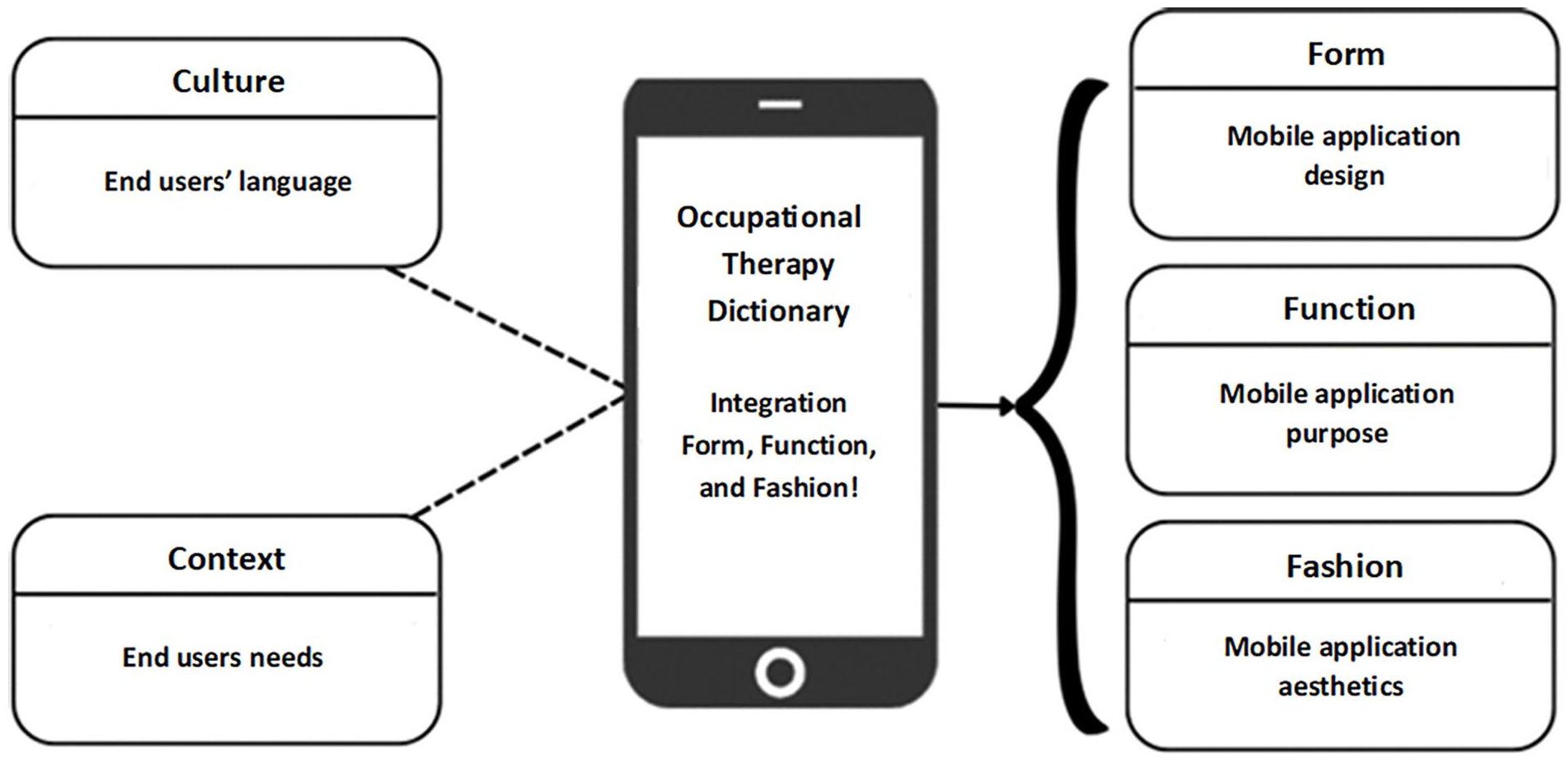
Conceptual model of the occupational therapy dictionary mobile application.
Besides being convenient for looking up words, the occupational therapy dictionary application can be a great way to add to your vocabulary. It is a user-friendly application that has many helpful features. These features are summarized in Table 2. Also, illustrations and captions used in the application with over 350 visual representations helped capture attention, enhance understanding, and create visuals that are memorable and relevant to the dictionary definitions (see Figure 2).
Special Features of the Occupational Therapy Electronic Dictionary Application.


Sample of the illustrative pictures used in the occupational therapy dictionary mobile application.
Discussion
The occupational therapy dictionary mobile application was developed to become the first English-Arabic electronic dictionary available in occupational therapy worldwide for both Arabic-speaking occupational therapy service providers and recipients. Despite the vital role of occupational therapy and the fact that the profession of occupational therapy is more than 100 years old, recent studies have indicated that it is still not well known or understood, and people lack the knowledge and awareness related to the profession of occupational therapy globally and in the Arab world with lack of Arabic content being one of the main reasons behind that.12,18 Therefore, Sarsak 18 study was conducted to identify the need and level of satisfaction of practicing occupational therapists and students in the Arab world about the Arabic content of the occupational therapy profession, identify difficulties, and make recommendations to enhance and enrich the Arabic content in occupational therapy. An online survey was completed by 137 participants from 10 Arab countries, 79.6% were female and 96.4% were in the 18 to 42 age group. Sixty-two percent reported that English is the language of occupational therapy references that they have been using, and more than 36% reported that they face various challenges and difficulties in communicating with patients and their families in Arabic language, such as the difficulty of translating some scientific terms, formulating goals, and explaining the treatment plan in a simplified manner. Furthermore, over 70% expressed a low satisfaction with the Arabic content currently available and more than 92% agreed that there is an urgent need to enrich the Arabic content of the occupational therapy profession. In this study, more than 96% expressed a high interest in obtaining Arabic content in occupational therapy. Results of this study confirmed the importance of enhancing the Arabic content of occupational therapy, the need to find solutions to overcome challenges and develop strategic plans within executable goals, and to encourage researchers and specialists in the field of occupational therapy to publish educational resources and research papers in Arabic language, which will help deliver the information to the largest possible segment of Arab readers. In addition, some previous foreign and Arab studies indicated that a small number of the public, including patients receiving occupational therapy services, know how to describe the role of the occupational therapist and that there is not complete clarity on the important role that occupational therapy plays in helping people with disabilities improve their quality of life.29,30 Another recent Arab study examined perceptions of the occupational therapy profession among medical and health sciences students and indicated a lack of complete understanding of the many occupational therapy services and that the majority of students’ knowledge about the occupational therapy profession is limited. This study reported that only (59.1%) had heard of occupational therapy and that (89.8%) showed interest in education about occupational therapy. This may be due to the scarcity of the occupational therapy specialty, as the occupational therapy specialty is considered one of the modern and rare specialties in the Arab world, as there are currently only 10 bachelor’s programs accredited by the World Federation of Occupational Therapists. 31 This study suggested the necessity of educating the local community about the specialty of occupational therapy through publications written in Arabic on social media and the importance of inter-education in universities with the aim of developing a collaborative practice to provide comprehensive health care centered on the client or patient. 31 The results of other studies indicated that other healthcare professionals have poor knowledge of occupational therapy, its goals, and treatment methods and that occupational therapy services are neither widespread nor well represented or integrated into many rehabilitation services. This may be due to a lack of government and private support, poor promotion, limited public educational campaigns. These studies suggested that in order for the occupational therapy profession to be successful and well-integrated, promoting the profession and educating people using a common language about its services and long-term positive effects is crucial.32-36 Therefore, the occupational therapy dictionary mobile application has been recently developed as part of the enriching Arabic content of occupational therapy project launched in 2020 to (1) enrich the Arabic content of occupational therapy in the Arab world, (2) make it easily accessible to the Arab occupational therapists and the Arab community, (3) raise awareness among Arabic-speaking community members about occupational therapy as part of public education and social responsibility, and (4) promote the profession locally, regionally, and internationally. 18 By bringing passionate collective efforts together to promote occupational therapy in the Arab world, we strived to develop this project to take our rightful place as agents of social change and equality and advocate for the continuity of Arabic literature by integrating Arabic language into occupational therapy practice, education, and research.
With the increase of the usage of mobile devices in recent years, the use of mobile technology and mobile applications has proved to be helpful and useful innovative digital technological solutions. In today’s world smart phones have become ubiquitous due to their attributes such as mobility, instant connectivity, convenience, personalization and have become an imperative part of our lifestyle. Mobile apps have become so popular because of their simplicity, user friendliness, speed, and portability. They make the required information available at the fingertips to the user, wherever and whenever required and have been integrated into many areas including entertainment, advertisement, education, as well as healthcare.37,38 The ease of use of mobile healthcare applications has made them a perfect choice for healthcare professionals and healthcare recipients and they have been revolutionizing the delivery of healthcare services worldwide.39,40
In this paper, the currently developed occupational therapy dictionary mobile application has become the first electronic occupational therapy dictionary worldwide that provides an innovative solution for both occupational therapy services professionals and recipients and offers clues to researchers to further utilize the mobile technology in rehabilitation and occupational therapy profession. On the very first stages of developing the dictionary concept and structure, the developers kept in mind the dictionary end users’ needs, language, and culture applying a user-friendly design, functionalities, and an easy-to-understand language with illustrative visual representations. This electronic dictionary has helped facilitate the process of communication between occupational therapists and the Arabic-speaking beneficiaries by creating a unified common language that is simple, easy to understand and has improved their satisfaction and quality of occupational therapy services provided in our beloved Arab region. Since the development of the “Enriching Arabic Content in Occupational Therapy Project,” we have been applying a variety of innovative ideas and solutions for the purpose of enriching the Arabic content of occupational therapy in the Arab countries. In this project, we have been able to manage restrictions and challenges, find solutions and develop recommendations and proposals within implementable strategic plans, and encourage specialists in the field of occupational therapy to publish educational resources in the Arabic language and make them accessible to the largest possible segment of Arab readers. This project represents an important first step in laying the foundation for future directions, charting the path of knowledge, and promoting the Arabic content of occupational therapy. This project highlights a wide range of recommendations and practical ways on how to enhance and enrich Arabic content for occupational therapy in Arab countries, which we hope will have clear positive outcomes on practice, education, research and the continuity of Arabic literature, research and translation initiatives on a larger scale.
The English-Arabic mobile application occupational therapy dictionary has been utilized to further promote and enrich Arabic content of occupational therapy through (1) incorporating occupational therapy into our daily activities, (2) describing the value and benefits of occupational therapy services to clients and their families, (3) communicating and answering questions about occupational therapy practices and services, (4) utilizing social media platforms and digital marketing to reach a large audience especially nowadays with digital transformation has been on the rise since the COVID-19 pandemic, (5) providing educational illustrative images about occupational therapy, therapeutic tools, and community resources highlighting the benefits of occupational therapy to the public, and (6) advocating for the profession and highlighting its crucial positive contributions to overall health and wellbeing. We look forward to more collaborations, continuity, and support for many future initiatives and we recommend, according to evidence-based practice, that the translation be applied in several stages by adopting the method of knowledge extraction, forward-backward translation, and experimental translation by specialized committees composed of translators specialized in both the Arabic language and occupational therapy, to ensure that the translated content is suitable for Arab and Islamic culture on one hand, while preserving scientific meaning on the other hand.41-43
Limitations and Future Directions
This study had some limitations. Planning the project budget, timeline, and finance management were restrictions as developing the mobile application received no funding. Another main constraint was poor network bandwidth that limited access to some features of the mobile application (such as the illustrative images) in some countries as reported by some users. In addition, launching and marketing the application through social media digital platforms was a challenge and required a lot of effort and time to outreach the global population who might benefit from this digital free service. As considerations for future updates and to overcome such challenges, we are planning to enhance the mobile application features, accessibility, and usability. Images are often the largest and most bandwidth-consuming elements of a mobile app. We are currently working on optimizing images for low bandwidth using emerging data management technologies and techniques such as compression, resizing, cropping, and lazy loading. Compression reduces the file size of an image without compromising its quality too much. Implement features such as clear consistent navigation structures, intuitive menus, and accessible controls to enhance usability. Additionally, we are currently looking for funding resources and applying for grants for the purposes of mobile application development and impactful distribution. For example, while our paper highlights the user-friendly design, further enhancements in enhanced User Interface (UI) and User Experience (UX) are being considered, such as integrating interactive features like quizzes or flashcards to make users’ learning experience more engaging. In addition, to maintain the application’s relevance and accuracy, a system for regular updates will be implemented with incorporated feedback mechanism within the application that will help gather user insights and continuously improve the application. Furthermore, we are planning to integrate the application with other educational platforms or tools, providing a seamless learning experience for students and professionals by linking the application with online courses or webinars to further enrich the educational content. Finally, to make the application more interactive, we are planning to create an interactive discussion board within the application where users can interact, share experiences, and collaborate within a supportive environment. This feature could also facilitate peer learning and professional information exchange and global networking.
Call to Action!
Our call to action is for all occupational therapy professionals in the Arab world, as the best ambassadors to support our profession by promoting the unique value and role of occupational therapy and enhancing societal awareness throughout our beloved Arab countries. Finally, perseverance is essential, and communication is key. We must continue to evaluate whether we are using the correct communicational and promotional tools and how successful our efforts are in terms of increasing our presence and value in the public eye. We have the knowledge, personal connection, and drive to promote occupational therapy and ensure its continuity. We also look forward to publishing more educational resources and conducting more scientific research in Arabic with the participation of a larger number of volunteering Arab occupational therapy professionals to better support our unique profession and use the power of occupation to give us confidence to make a positive significant difference in the lives of others and the whole world. Efforts to integrate mobile applications in the field of rehabilitation and occupational therapy should comprise (1) the inclusion of experts in the development process, (2) adoption of a comprehensive, multidimensional, and person-centered approach, (3) application of the 5 stages of the persuasive communication framework (communication source, message, communication channels, audience characteristics, and settings), and (4) continuous development of mobile applications to achieve better outcomes and provide quality services. 44
Conclusion
Mobile applications to assist occupational therapy professionals in communicating and delivering occupational therapy services are limited. This paper introduced the first digital English-Arabic electronic occupational therapy dictionary worldwide and made it available for both Arabic-speaking occupational therapy service providers and recipients to download from both Google Play and App Store on their smartphones, computers, or tablets free of charge. This new application provides an innovative solution and has helped facilitate understanding and communication between Arab community members and Arab occupational therapists by creating a unified and shared language of communication and providing the latest unified terminology in the field of occupational therapy. It also offers clues to researchers to further utilize mobile technologies in rehabilitation and occupational therapy profession. Further research is needed for quality improvement and to develop even more multifactorial evidence-based mobile tools to be used in occupational therapy practice.
Footnotes
Acknowledgements
On behalf of all Arab occupational therapy service providers and recipients, I would like to express my gratitude and appreciation for my partners who contributed significantly to the development of the mobile application the computer science engineers Dr. Qasem Abu Al-Haija, engineer Rand Adnan Alhayjneh, and engineer Osama Abu Aysheh. This work would never have been possible without your invaluable input and priceless insights.
Author Contributions
Hassan Izzeddin Sarsak: Writing—original draft, review and editing.
Data Availability Statement
The mobile application resources for the occupational therapy dictionary (OT Dictionary) are available for free download as follows:
1. Android version: Sarsak, H. I. (2023). Occupational Therapy Dictionary (Version 1.0) [Computer software]. XXX.
2. iPhone version: Sarsak, H. I. (2023). Occupational Therapy Dictionary (Version 1.0) [Computer software]. XXX.
Declaration of Conflicting Interests
The author declared no potential conflicts of interest with respect to the research, authorship, and/or publication of this article.
Funding
The author received no financial support for the research, authorship, and/or publication of this article.
Ethical/Consent Statement
Ethical approval was obtained from the Batterjee Medical College research committee to conduct this study in December 2023 (approval # RES-2023-0088). Our study did not require consent because it did not contain human subjects and hence there was no direct human contact.
