




Abstract
In the contemporary global context, seafarers persist as the uncelebrated heroes of international trade, despite their substantial contributions. The current estimate places the number of STCW- certified officers at 857 540, reflecting a notable increase of 10.8% since 2015. Nevertheless, there is a growing recognition of the imperative to accord specific attention to seafarers’ mental and physical well-being. During their tenures aboard ships, seafarers confront various challenges, including psychological well-being, work-life imbalance, dissatisfaction, diminished performance, and a sense of mistrust toward the organizational framework. The primary objective of this research is to scrutinize the nexus between work-life balance and work effectiveness, exploring the mediating roles of psychological well-being, organizational happiness, and organizational trust. A questionnaire-based survey is meticulously crafted to achieve this, employing a dataset comprising 420 seafarers engaged in diverse vessel types in Turkey, operating under both Turkish and international flags. Methodologically, structural equation modeling and correlation analyses are executed to assess the formulated research hypotheses rigorously. The empirical findings of this research reveal noteworthy mediating roles: psychological well-being exhibits a complete mediation effect, organizational happiness demonstrates a full mediation effect, and organizational trust manifests a partial mediation effect. These outcomes underscore the nuanced interplay between work-life balance and work effectiveness in the seafaring context. The implications of these findings extend significantly to the maritime sector and industry, accentuating the imperative for targeted interventions to enhance the well-being and performance of seafaring professionals.
Research on seafarers has increased lately after the IMO designated them as key workers in 2019 and the COVID-19 pandemic. Some articles discuss seafarers’ psychological well-being. There is still a need for more research on seafarers in the field. However, organizational happiness, work-life balance, and organizational trust are new concepts to apply to seafarers.
This study addresses a gap in the literature concerning seafarers’ work-life balance and work effectiveness, as well as the mediating role of seafarers’ psychological well-being, organizational happiness, and organizational trust. Such a study has not yet been carried out with similar concepts in the literature.
This paper has implications for practice and policy regarding the use of new strategies by ship owners and ship operating organizations to ensure the work-life balance of seafarers, both on board and on shore. To empower seafarers’ work effectiveness, the mediating role of happiness, trust, and psychological well-being needs to be taken into consideration when applying new implications to life on board, such as offering communication services, recreational activities, and social events, among others.
Introduction
At sea, I learned how little a person needs, not how much. —Robin Lee Graham, American Sailor
Seafarers, though often inconspicuous and nameless, embody indispensable protagonists operating beyond our immediate purview. Given that approximately 90% of global trade is conducted via maritime routes, their role is pivotal in the landscape of international commerce. Seafarers play a critical and foundational role in ensuring the secure and efficient functioning of the global maritime transportation system, a significance further underscored by the advent of the COVID-19 pandemic. Consequently, an escalating imperative exists to meticulously monitor the trajectory of developments within the worldwide seafarer workforce. The reservoir of seafarers possessing certification under the Standards of Training, Certification, and Watchkeeping for Seafarers (STCW), and thus available for deployment in the globally interconnected merchant fleet, has expanded in the aftermath of the 2015 report. Both the cadre of qualified officers and ratings have demonstrated annual increments. The estimated count of STCW-certified officers is 857,540, reflecting a notable surge of 10.8% since 2015. Concurrently, the report posits an 18.5% increase in the number of STCW-certified ratings since 2015. This augmentation in certified crew underscores the escalating significance of the seafaring community within the intricate framework of international maritime activities. 1 On the other hand, the shortage of proficient seafarers on a global scale is attributable to the confluence of factors, namely the compounding effects of the pandemic, an aging maritime workforce, the expanding merchant fleet, and the inherent cyclical nature of the industry. In the global maritime domain, the quantity of seafarers, encompassing both certified officers and ratings, has exhibited an augmentation; concurrently, however, the implementation of autonomous vessels, engendering a diminished workload perception for ship operators, has prompted ship operators to curtail the presence of officers on board as a cost-saving measure in crew expenditure. Therefore, in recent years, a discernible trend has emerged whereby the diminished crew size in the merchant marine fleet, attributed to advancements in modern ship technologies, has precipitated a concomitant escalation in onboard work demands. The curtailed turnaround times, a consequence of these technological developments, have resulted in abbreviated durations of ships’ sojourns in ports, curtailing the opportunities for social interactions between the crew and terrestrial environments. 2 Considerable research efforts have been undertaken within the maritime domain, focusing on the topics of seafarer fatigue and retention, alongside inquiries into the causative factors contributing to shortages of maritime officers.3 -7
The maritime industry is a challenging one and sets itself apart in many ways. Individuals employed in the maritime sector, specifically seafarers, contend with a multitude of challenges. These challenges encompass navigating through extreme and dynamically fluctuating sea and meteorological conditions, adhering to persistent work schedules, residing in confined living quarters, grappling with exceptionally noisy environments, and enduring demanding and exhaustive work shifts.8,9 Employment at sea is associated with distinctive mental, psychosocial, and physiological stressors that defy direct comparison to terrestrial occupations. The working and living conditions prevalent in the maritime industry are distinguished by prolonged separations from family and home, spanning months, economic pressures, and the presence of considerable, at times extreme, psychosocial challenges. 10 Henceforth, a persistent scarcity of proficient seafarers endures within the worldwide maritime sector, with the retention of adept seafarers at sea posing a formidable challenge. One of the causative factors behind the elevated attrition rates among seafarers in merchant fleets is attributed to the prevailing working conditions aboard ships. Notably, factors such as work-life balance (WLB), contractual employment terms, elevated workloads, heightened stress levels, inadequate opportunities for shore leave, and limited prospects for career advancement, among other considerations, collectively contribute to this prevailing circumstance. 11 Bhattacharya 12 scrutinizes the correlation between commitment and seafarer retention while discerning the determinants and impediments to repatriation and sustained retention. Factors impeding seafarer longevity in the profession encompass deficient human resources (HR) practices, challenges related to work-life balance, protracted contract durations, suboptimal conditions within the maritime workplace, elevated workloads, heightened stress levels, insufficient intervals for shore leave between contracts, absence of comprehensive shore support, limited avenues for career advancement, and emotional strain arising from separation from friends and family. The maritime profession demands navigating a spectrum of challenges encompassing physical, social, and psychological dimensions. These challenges include fatigue, insomnia, a cacophonous work environment, perpetual alertness to potential accidents, interpersonal conflicts, adverse weather conditions, prolonged periods of familial separation, extended spans without terrestrial reprieve, discord with colleagues, and communication challenges. 12 For seafarers to perpetuate their careers at sea, they need to have psychological fortitude and resilience. While certain individuals within the seafaring community persevere in their professional pursuits by adeptly managing the aforementioned challenges, others opt to relinquish their maritime occupations due to the demanding and strenuous working conditions at sea, subsequently seeking employment opportunities on land. 13 It is anticipated that seafarers may undergo psychological phenomena, such as depression, stress, unhappiness, work-life imbalances, and diminished work effectiveness (WE), contingent upon the management cadre and ship environment in which they operate. Throughout their tenure at sea, the working milieu transforms into their residential setting, and their colleagues assume the roles of familial associates. Naturally, the interpersonal connections and communication dynamics established among seafarers on board play a pivotal role in shaping their mental well-being, psychological welfare (PW), and work effectiveness. Given the distinctive challenges inherent in the maritime sector as opposed to other industries, the nature of these relationships and interactions, influenced by specific organizational dynamics, may deviate from those observed among employees in alternative sectors. 14 Prevalent impediments to seafarer retention in the maritime domain encompass suboptimal human resource strategies, challenges related to work-life balance, tenure-based contract employment, unfavorable shipboard working conditions, heightened workloads and stress levels, severely restricted opportunities for shore leave, inadequate support from shore organizations, limited prospects for career advancement, and the emotional strain associated with separation from loved ones and close acquaintances. 12
Consequently, upon conducting an exhaustive review of the existing literature, no research has been identified that comprehensively investigates the interconnected aspects of psychological well-being (PW), organizational happiness (OH), organizational trust (OT), work-life balance (WLB), and work effectiveness (WE) among seafarers within a singular study. The formidable challenges intrinsic to occupations in the seafaring industry render this cohort a particularly intricate and demanding workforce, presenting substantial impediments to data collection through survey methodologies, exacerbated by limited internet access. This study endeavors to elucidate the mediating roles of psychological well-being, organizational happiness, and organizational trust in delineating the correlation between work-life balance and work effectiveness among seafarers.
Literature Review
Psychological Well-being, Work-life Balance, and Work Effectiveness
Psychological well-being places emphasis on individual development, functional competence, and overall life satisfaction. It is grounded in the conviction that the realization of one's authentic self contributes to the well-being of the soul, fostering a state of contentment and happiness.15 -17 Barnett 18 defines work-life balance as the attainment of control and flexibility in one’s professional domain, accompanied by the capability to partake in social and personal activities beyond the scope of occupational commitments. On the other hand, Senbursa 19 suggests that the prioritization of non-negotiables, including allocating time for familial responsibilities such as engaging with children, participating in recreational activities with them, and sharing meals together, as essential strategies for preserving work-life balance. The establishment of a robust foundation of trust between managerial figures and employees is deemed critical for fostering effective employee engagement within the social realm of organizational relations. 20 Also, Grant et al 21 uncovers adverse impacts on well-being stemming from excessive work demands and insufficient time for recuperation. The detriment to employees’ well-being resulting from suboptimal work-life balance subsequently exerts an influence on their overall work effectiveness. Gaikwad et al 22 observe a statistically significant positive association in a study involving female IT workers. The identified relationships include the correlation between work-life balance and mental well-being, work effectiveness and mental well-being, as well as work-life balance and organizational commitment. According to Guest, 23 there has been an escalation in work pressure experienced by employees in recent years. Factors contributing to this intensification include advancements in information technology, information overload, the imperative for responsiveness, a heightened emphasis on delivering quality customer service, resultant confusion and adaptations, and the rapid pace of change. These elements collectively consume employees’ time and serve as sources of pressure impacting their personal lives.
On the other hand, Oldenburg and Jensen 24 survey 134 male seafarers working on German-flagged vessels about their living and working conditions at sea. Seafarers assess their individual stress levels associated with 23 distinct stressors encountered during their service on board. As indicated by this investigation, the most prominent stress factors encompass family separation, time pressure/intensive activities, extended daily working hours, elevated temperatures in the engine room, and perceived inadequacies in the skills and experience of fellow crew members. Additionally, noteworthy disparities in the durations of stays on board are identified between European and non-European seafarers in the course of this study. 24 According to the findings of a study conducted by Leitão et al, 25 the experience of feeling supported by supervisors who attentively address their concerns and recognize their contributions, being integral to a positive work environment, and feeling valued both professionally and personally, collectively exert a positive influence on employees’ perception of their contribution to organizational performance. On the other hand, according to Yayla and Eskici İlgin 26 research on the impact of COVID-19 finds that the most salient factor impacting the psychological well-being of nurses is identified as the neglect of personal life. Furthermore, during the COVID-19 pandemic, Coronaphobia exhibits a noteworthy association with nurses’ psychological well-being, as considerations of work-life balance do. Grounded in these assertions, the ensuing hypothesis is posited:
H1: Psychological well-being mediates the relationship between work-life balance and work effectiveness.
Organizational Trust, Work-life Balance, and Work Effectiveness
Diverse definitions of organizational trust are expounded upon in the literature, emphasizing the preference for cultivating a trusting environment to instill a sense of belonging among employees. 19 Given that maritime work operates on the basis of remote supervision by ship management organizations, organizational trust assumes paramount importance for the seamless functioning of onboard tasks. Consequently, fostering positive employee-management relations and instilling a culture of trust within the organization become critical considerations.27,28 Gashi et al 29 underscore that e-workers’ satisfaction with online work is positively influenced by improvements in both work-life balance and work effectiveness, with flexibility showing no discernible impact. Among the variables examined, work effectiveness emerges as the predominant determinant of e-worker satisfaction. Moreover, Van der Berg and Martins 30 reveal a positive correlation between managerial practices, organizational trust, and the quality of work life. On the other hand, Cowart et al 31 find that work-life balance, and treating employees as individuals positively affect employee perceptions of their manager’s ethical behavior. The revelation of a notable and novel association between work-life balance and the treatment of individuals as unique entities emerges as a surprising finding in the literature. The study by Tosun and Özkan 32 provides evidence that supports the idea of organizational trust partially mediating the relationship between work-life balance and job satisfaction. Previous studies28,33 -35 also affirm the correlation between a satisfactory remote work experience and productivity, organizational trust, favorable relations with the organization, and work-life balance. Conversely, promoting employee relationships through encouragement, trust, judicious workload management, and the recruitment of honest, competent, and loyal crew contributes to organizational ownership. Such relationships, grounded in confidence, affection, and harmony, correlate with reduced absenteeism, lower turnover rates, and heightened performance. Consequently, to achieve equilibrium, organizations require to address the constraints posed by employees’ personal and social lives. 36 Finally, in accordance with the findings of Ricardianto et al 37 enhancements in ship officers' leadership style, work-life balance, and organizational commitment at Indonesia National Shipping exert a direct and positive impact on the work effectiveness of the ship crew, thereby supporting the formulation of the subsequent hypothesis:
H2: Organizational trust mediates the relationship between work-life balance and work effectiveness.
Organizational Happiness, Work-life Balance, and Work Effectiveness
The achievement of work-life balance holds the promise of enabling individuals to lead a contented, healthy, and prosperous life. Particularly for those aspiring to attain a high quality of life, work-life balance assumes paramount importance. 38 Diener et al39,40 assert that the broader correlation of subjective well-being with the duration of positive versus negative emotions is influenced by various factors rather than solely the intensity of positive emotions. In the context of work-life balance, the term “work” pertains to one’s professional life and individual exertions, while “life” encompasses aspects related to health, happiness, leisure time, and familial connections. 41 Given the substantial portion of time individuals allocate to their professional pursuits, acknowledging the pivotal role of employment and the workplace becomes vital. This recognition is crucial as it contributes to the cultivation of happiness at both individual and societal levels worldwide. Recent studies 42 indicate that work and employment significantly contribute to fostering happiness, thereby influencing job market outcomes, performance, productivity, and organizational effectiveness.
Several noteworthy prior studies have explored the achievement of workplace happiness through enhanced management practices. 43 The work conducted by Adnan Bataineh 44 in pharmaceutical industries find that a positive and significant influence of work-life balance and happiness on work effectiveness. Fisher 45 conceptualizes Happiness at Work (HAW) as encompassing positive sentiments toward the job, attributes associated with the job, and the organization as a whole, including factors like job satisfaction and organizational commitment. Notably, employees burdened with excessive workloads exhibit compromised work-life balance, reduced occupational integration, and subpar job performance. Stress, particularly in the form of emotional exhaustion, emerges as a dimension affecting the personal well-being of employees, notably 46 impacting the quality of life for hotel employees. Moreover, work-life balance has been identified as a pivotal factor contributing to enhancing employee productivity, thereby positively influencing overall organizational performance. 47 Numerous studies assert that contented employees are more inclined to be productive, generate innovative ideas, and approach tasks with groundbreaking skills to enhance efficiency and reduce time expended. 48 Family-related issues, including conflicts or positive events, have been observed to exert an impact on seafarers, leading to overthinking and, in certain cases, prompting a desire to hasten their return home. 49 Notably, conflicts or events within the family sphere may adversely affect the working capacity of seafarers, prompting a desire to return home. 50 This discussion culminates in the proposal of the subsequent hypothesis.
H3: Organizational happiness mediates the relationship between work-life balance and work effectiveness.
Material and Methods
This investigation is grounded in a research endeavor designed to scrutinize the interconnections among psychological well-being, work-life balance, work efficiency, organizational trust, and organizational happiness within the maritime sector. The study comprises a sample of 420 seafarers engaged in the operation of ships flagged both internationally and under the Turkish flag. Data collection has been conducted between November 2, 2022, and January 31, 2023. The “Psychological Well-Being” scale, developed by Diener et al39,40 for the assessment of socio-psychological well-being and as a supplementary tool to existing well-being measures, was employed in this study. The scale comprises a single dimension encompassing 8 items, and its scoring was implemented utilizing a 7-point Likert scale. The Workplace Happiness scale, devised by the WHO Collaborating Center for Mental Health at the Frederiksborg General Hospital Psychiatric Research Unit, is employed to assess employees’ workplace happiness. This one-dimensional scale comprises 5 items, and its scoring is executed using a 6-point Likert scale. This scale is one-dimensional and consists of 5 items. Its scoring is applied using a 6-point Likert type. “Work-life balance” scale, developed by Netemeyer et al 51 is a 10-item self-report scale that aims to evaluate how work-related factors affect family outcomes. The instrument comprises two 5-item subscales: Work-to-Family Conflict (WIF) and Family-to-Work Conflict (FIW). Scoring is conducted using a 7-point Likert scale. The “Organizational Trust Scale,” devised by Ferres and Travaglione, is utilized in this study. 52 The scale encompasses 11 statements organized into 3 sub-dimensions: trust in the manager, trust in colleagues, and trust in the organization. “Work effectiveness” scale, taken by Sigler and Pearson 53 and Kirkman and Rosen 54 is measured with 4 items. Its scoring is applied in a 5-point Likert type. Valid and reliable Turkish scales have been implemented. The reliability and validity analyses of the Turkish scales were performed in the following papers. For work effectiveness Çöl, 55 Pekcan 56 for organizational trust, Apaydin 57 for work-life balance, workplace happiness scale of Alparslan, 58 psychological well-being scale of Telef. 59 Aforementioned authors demonstrated the reliability and validity via Cronbach’s Alpha coefficients and confirmatory factor analyses. We also presented the reliability coefficients for each scale.
Statistical Analysis
This section of the study presents descriptive data analysis, reliability analysis, correlation analysis, structural equation models, and mediation analysis findings. The normal distribution conformity of the data is assessed using the Shapiro–Wilk test. Spearman correlation analysis is employed to scrutinize correlations between scale scores that do not adhere to normal distribution patterns. The reliability of the 3 scales employed in the study is being evaluated using Cronbach's alpha coefficients. Mediation analyses across the scales are conducted utilizing a bootstrap-based structural equation modeling technique. While the mediation analysis is applied with the structural equation model, the analysis results are obtained by using B = 1000 Boostrap samples with the DWLS estimation technique. Statistical applications are carried out using the lavaan package 60 in the R software. Analysis findings are evaluated at P < .05 significance level.
Socio-demographic variables of the participants
We conducted a cross-sectional survey with a sample size of n = 420 seafarer participants. The sample size is more than 10 times larger than the scale forms used. 61 Among the participants, 94.3% are male, and 5.7% are female. When categorized by age groups, 29.5% of the participants are 25 years old or younger, 16.7% are between 26 and 35, 33.1% are between 36 and 45, and 20.7% are 46 years old or older. Regarding marital status, 48.3% of the participants are married, while 51.7% are single. Among the seafarers who take part in the survey, 46.6% work on container ships, 31.9% on dry cargo ships, 21.2% on tanker ships, and 2.3% on other types of vessels. In terms of income levels, 42.4% of the participants earn below 2000 dollars, 34.4% earn between 2000 and 8000 dollars, and 23.2% belong to the income group above 8000 dollars. The questionnaires are administered to participants using an online survey form, and the data set is transformed into an Excel format.
Results
Correlation Analysis, Descriptive Statistics Findings, and Reliabilities
Table 1 shows the descriptive statistics, reliability coefficients, and correlation results regarding the scale scores used in the study. The data from all the scales are reliable, as all the Cronbach’s Alpha coefficients are >.60. 62 The Cronbach’s Alpha coefficient is relatively low in Organizational happiness scale, but this result does not have a significant impact on our theoretical structure. It is possible to have such a Cronbach’s Alpha which is near to threshold, (ie, .60) because of the participant’s responses.
Descriptive Statistics, Reliabilities and Correlation Results.

PW = Psychological well-being; WLB = Work-life balance; OT = Organizational trust; WE = Work effectiveness; OH = Organizational happiness; M = Mean; SD = Standard deviation; MED = Median; Min = Minimum; Max = Maximum; Alpha = Cronbach’s Alpha reliability coefficient.
P < .001.
According to the correlation analysis, all the relationships between the scales are statistically significant (P < .05). When the correlation coefficients are examined; while an inverse relationship is observed between PW and WLB, a same-directional positive relationship is observed between OT, WE, and OH factors. There is an inverse relationship between WLB and OT, and between WE and OH. On the other hand, there is a positive correlation between OT and WE and OH. Finally, a positive inverse correlation was found between WE and OH.
Mediation analysis
Figure 1 shows graphs for the relational structures used for mediation analysis. Three different structural equation models are created for these relational structures. The mediation hypotheses for each model created are as follows:
It is estimated that there are 3 different SEM models in the context of mediation analysis. In all SEM models, authors check the significance of the items belonging to the latent variables. According to the results, all the items are significantly related to the latent variables with positive loadings.

Structural equation model.
Table 2 shows the fit indices for the structural equation models created for the 3 models. According to the fit indices, the chi-square statistics CHISQ/df ratio of all 3 models is below 5. Results for incremental fit indices are GFI, CFI, AGFI, TLI, NNFI, and all these indices are above 0.90. 63 The fit indices for errors are <0.05, with RMSEA = 0.014 and SRMR = 0.049. 64 The goodness of fit results of this structural equation model, in which the mediating role of critical thinking in the relationship between empathic disposition and human rights attitude is tested, indicates that the model is highly valid. 65
Results of the Goodness-of-Fit Index Values for Each Mediator Model.

CHISQ = chi-squared statistic; df = degrees of freedom; GFI = Goodness-of-Fit Index; CFI = Comparative Fit Index; AGFI = Adjusted Goodness-of-Fit Index; TLI = Tucker-Lewis Index; NNFI = Non-Normed Fit Index; RMSEA = Root Mean Square Error of Approximation.
Table 3 shows the statistical analysis results of the path coefficients, indirect effect, and total effects of the mediation analyses performed with the bootstrap-based structural equation model. The significance of the mediation effects is evaluated over the indirect effect coefficients. According to the analysis results, since the test statistics of indirect effects are significant; psychological well-being, organizational trust, and organizational happiness; have a significant mediating role in the relationship between work-life balance and work effectiveness.
The Results of Effects and Models for the Mediators.
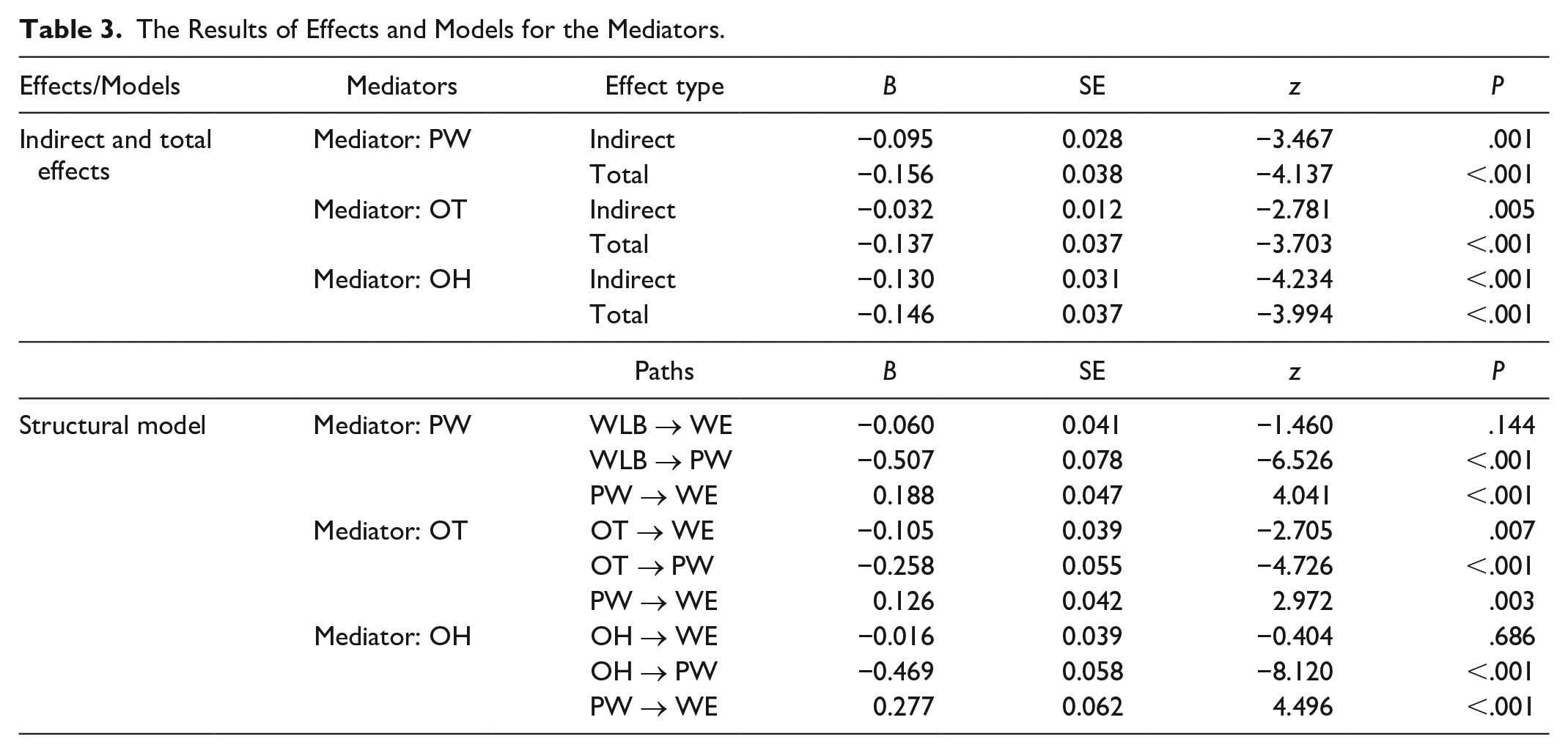
Given the statistically insignificant relationship between work-life balance and work effectiveness as indicated by the path coefficients, it is discerned that the variables of psychological well-being and organizational happiness play a complete mediating role. Conversely, in the mediation model involving organizational trust, where the relationship between work-life balance and work effectiveness is statistically significant, organizational trust assumes a partial mediation role. Overall, all our hypotheses (H1, H2, H3) are statistically supported.
Discussion
This study illuminates the intricate relationship between the work-life balance of seafarers and their work effectiveness within ship owner organizations based in Turkey. Nevertheless, certain limitations characterize the study, notably the underrepresentation of female seafarers and the constrained access to a limited cohort of seafarers, attributed to their maritime duties and resulting in restricted internet connectivity. The findings underscore that psychological well-being, organizational trust, and organizational happiness exert a mediating influence on the correlation between work effectiveness and work-life balance, a pattern corroborated by analogous findings in Shahzadi’s research. 66
H1 findings of the study are consistent with those of Haider et al 67 In a parallel vein, the research conducted by Medina-Garrido and Biedma-Ferrer 68 reveal that family policy initiatives yield an indirect positive impact on work effectiveness, with well-being serving as a mediating factor. Moreover, a noteworthy positive correlation is identified between work-life balance and mental well-being. Additionally, significant positive relationships are discerned between work effectiveness and mental well-being, as well as between work-life balance and work engagement. Nevertheless, mental well-being and work engagement do not emerge as mediators in the direct association between work-life balance and work effectiveness. 22 Secondly, H2 findings of the study are consistent with those of Akter et al 69 As per the outcomes of the study conducted by Akter et al, 69 a climate of trust is identified as a partial mediator in the correlation between employee empowerment and the quality of work life. Notably, Rahal and Farmanesh’s 70 research on faculty members corroborates the statistical significance of the mediating role of trust in a leader, underscoring its relevance in augmenting organizational commitment and fostering work engagement within an academic context. Additionally, Bayhan Karapinar et al 71 find out that organizational trust mediated the link among 4 aspects of work life such as workload, fairness, bonus, and worth and academic emotional exhaustion. Lastly, H3 findings of the study are coherent with those of Sari et al 72 demonstrate that positive feelings in employees, such as enjoyment, happiness, and satisfaction, fully mediate the relationship between work-life balance and work effectiveness. This implies that improving work effectiveness can be achieved by increasing positive emotions. In accordance with the research conducted by Mendis and Weerakkody, 73 the implementation of work-life balance practices is posited to contribute to employees' happiness, given that happiness is construed as a form of positive emotion. Positive attitudes, in turn, manifest a positive and statistically significant correlation with organizational effectiveness. Taylor and Statler 74 reveal that heightened emotional engagement in individuals correlates with increased efficacy in workplace activities. Employees who have more positive feelings are more likely to be satisfied with their jobs and outperform others in the workplace. Research conducted on military personnel within a Swedish Naval Force by Bäccman et al 75 unveil that the military members of the military exhibited a favorable correlation between increased resilience and well-being. All in all, seafarers express a positive experience with increased resilience and well-being. Lastly, in the conducted research 14 on seafarers, it is noted that additional personality traits, namely extraversion, responsibility, emotional stability, and openness to experience, do not yield a statistically significant predictive effect on the psychological well-being levels of Turkish seafarers. Another survey 76 conducted on seafarers employed by maritime organizations in Singapore reveal that superiors’ transformational leadership, social support from teammates, and a well-balanced work system all directly contribute to the advancement of seafarers’ psychological capital. Psychological capital has been identified as exerting both direct and indirect impacts on the safety behavior of seafarers.
In summary, the outcomes of this research delineate a connection between work-life balance and psychological well-being. Therefore, positive correlation is discerned among organizational trust, organizational happiness, and work effectiveness. Upon incorporating happiness, trust, and psychological well-being as mediating variables, work-life balance exhibits a positive and significant association with work effectiveness.
Conclusions of the Study
The study findings underscore the importance of seafarers’ psychological well-being, organizational happiness, and organizational trust perceptions in shaping their experiences during their service at sea. The research discerns the mediating roles of psychological well-being, organizational happiness, and organizational trust in the intricate relationship between work-life balance and work effectiveness among seafarers. Additionally, the robust correlation between work-life balance and employee work effectiveness is incontrovertible. Ship operator/management organizations need to grasp the challenges that seafarers’ mental wellness confronts while on board. Urgent international measures, spearheaded by ship owners, are imperative to mitigate risks such as suicide, mental health problems, depression, and analogous challenges during seafarers' contractual tenures. Essential among these measures is the formulation of strategies ensuring work-life balance and bolstering the psychological well-being of seafarers. Furthermore, it is deemed judicious for seafarers to undergo training addressing psychological challenges (eg, stress, depression, burnout, boredom, isolation) they may encounter during their contracts, coupled with psychological sessions elucidating coping mechanisms before embarking on board. Fostering a sense of value and connection for seafarers is pivotal, achieved through consistent communication with their families. Maintaining seafarers' work-life balance during their tenure on board underscores their continued presence in the lives of loved ones and friends, notwithstanding geographical distances. These actions collectively contribute to cultivating an organizational trust perception among seafarers. Companies should consider offering longer contracts (ie, minimum 1- or 2-year contracts) instead of offering voyage contracts. This strategic shift aims to augment seafarers' commitment to the organization, job belonging, and trust in the organizational culture. Consequently, these multifaceted measures pose considerable challenges for both professionals and researchers. Urgent and contemporary studies are requisite to investigate the efficacy of strategies aimed at enhancing seafarers’ happiness and psychological well-being. This research stands as a valuable resource to guide policymakers and shipping organizations in formulating strategies prioritizing seafarers’ mental well-being and work-life balance.
Recommendations
Given the exceptional prevalence of work-related psychological factors in the maritime industry, pre-emptive occupational and organizational measures must be accorded priority. In light of the findings above, it is imperative to curtail the duration of seafarers’ contracts on board, particularly to alleviate prolonged separation from their families. Emphasis is to be placed on fostering social activities on board, including events such as barbecue parties, sports tournaments, cinema nights, birthday celebrations, and the acknowledgment of outstanding employees. Facilitating internet access, permitting port trips, and minimizing excessively protracted working hours are also crucial. Moreover, online sessions can be implemented to safeguard the psychological well-being of seafarers. Senior management figures on board, such as the master mariners or chief officers, are responsible for keenly observing seafarers’ behaviors. Special attention is required when indicators of conditions such as depression and loneliness manifest, prompting the senior management to initiate contact with the ship operator for potential online sessions. Complementary to lifestyle considerations, seafarers should acquire skills to evade and manage stress, incorporating techniques like controlled breathing and meditation. Furthermore, it is advisable to grant seafarers ample time ashore to cultivate motivation for their contractual obligations, sustaining a harmonious work-life balance. Human resources departments undertake measures, such as restricting excessive work hours, to enhance seafarers’ mental well-being through educational initiatives, online mental well-being sessions, counseling, or psychotherapy, thereby mitigating imbalances in work-life equilibrium.
Footnotes
Declaration of Conflicting Interests
The author(s) declared no potential conflicts of interest with respect to the research, authorship, and/or publication of this article.
Funding
The author(s) received no financial support for the research, authorship, and/or publication of this article.
