




Abstract
This study investigates the complex interrelations between psychological empowerment, conscious mindfulness, and life engagement among active seafarers, explicitly focusing on the mediating and moderating roles of hope and patience. A total of 460 seafarers currently serving on board participated in the study. Demographic variables were collected, including age, marital status, income level, and vessel type. Hope and patience’s mediation and moderation effects on the relationships between psychological empowerment, conscious mindfulness, and life engagement were examined using the PROCESS macro within the IBM SPSS version 27 software. The results indicate that neither hope nor patience significantly mediates the relationship between psychological empowerment and life engagement. However, patience partially mediates the relationship between conscious mindfulness and life engagement, while hope does not. Moderation analyses reveal that hope significantly moderates the relationship between conscious mindfulness and life engagement, enhancing its positive effect. In contrast, patience does not exhibit a significant moderating role. The findings highlight patience as a key psychological factor in amplifying the positive effects of conscious mindfulness on life engagement among seafarers. This study contributes to understanding the psychological mechanisms that influence life engagement in high-stress maritime environments. It suggests that cultivating patience may serve as a valuable strategy to support mental well-being and performance in seafaring professionals.
Keywords
Seafarers face notable psychological challenges due to isolation, long periods at sea, heavy workloads, and limited access to mental health support. Existing research highlights the positive effects of psychological empowerment (PYSEMP) on workplace commitment and performance, as well as the impact of conscious mindfulness (CONMIND) on emotional regulation, well-being, and job engagement. Traits such as hope and patience have also been identified as protective factors that enhance resilience and life satisfaction, while reducing distress. However, no studies have explored the mediating or moderating roles of hope and patience in the relationship between PYSEMP, CONMIND, and life engagement (LIFEENG) among seafarers—a group particularly vulnerable to mental health strain. This highlights a critical gap and the need for research focused on psychological mechanisms that support seafarers’ engagement and well-being.
This study uniquely examines the mediating role of patience and the moderating role of hope in the links between psychological empowerment, mindfulness, and life engagement among seafarers. Findings indicate that patience partially mediates the mindfulness–life engagement relationship, suggesting that mindfulness promotes engagement through increased patience. Hope moderates this same relationship, with more hopeful individuals gaining greater benefits from mindfulness. However, neither patience nor hope significantly affects the link between psychological empowerment and life engagement, suggesting these psychological traits function differently depending on the construct. These insights deepen theoretical understanding and highlight context-specific psychological mechanisms in maritime occupational health.
Theoretically, this study extends the Broaden-and-Build Theory by identifying patience as a mediator and hope as a moderator in the mindfulness–life engagement link, offering more profound insight into psychological resilience in maritime settings. Practically, it highlights the value of mindfulness and patience-building interventions in enhancing seafarers’ life engagement. Programs incorporating mindfulness practices—like meditation and focused attention—alongside strategies to develop patience and hope can strengthen emotional regulation and coping. On a policy level, the findings support the need for tailored psychological support systems in the maritime industry. Maritime organizations and regulators should implement mental health programs that build psychological capital by focusing on mindfulness, hope, and patience to promote a healthier, safer, and more engaged workforce.
Introduction
The concept of maritime business has evolved significantly over time, reflecting the increasing interconnectivity of global trade. At the heart of this industry are seafarers, whose contributions are fundamental to the growth and efficiency of maritime transportation. As of July 2021, around 1.9 million seafarers were employed on vessels within the global merchant fleet, 1 marking a substantial increase from approximately 1.12 million in 2005 2 —a growth of 69% over this period. A seafarer’s journey begins with leaving home, carrying only essential belongings in a suitcase or backpack, underscoring the demands of physical endurance and mental resilience. Regardless of vessel type, seafarers undertake demanding responsibilities under all conditions. Life at sea requires technical expertise and the ability to adapt to prolonged periods away from family and loved ones, fostering a sense of community among crew members.
Beyond serving as a workplace, the ship becomes a living space where seafarers must navigate challenges such as port inspections, cargo operations, vessel maneuvers, onboard procedures, and the continuous responsibility of ensuring personal and vessel safety. 3 However, the nature of life at sea presents significant psychological challenges. Seafarers’ mental health is often affected by factors such as sleep deprivation, fatigue, workplace harassment (mobbing), burnout, and stress. 4 The demanding living conditions onboard exacerbate these issues, making psychological resilience, patience, conscious awareness, hope, and a positive outlook essential to their psychological capital below. 5 The Seafarer Mental Study, conducted by the ITF (International Transport Workers Federation) Seafarers’ Trust and Yale University, revealed alarming findings: 20% of the 1572 participating seafarers reported experiencing suicidal thoughts. In comparison, 28% exhibited symptoms of anxiety or depression. 6 These statistics highlight the urgent need to address seafarers’ mental well-being as an integral aspect of the maritime industry. Current literature has emphasized the importance of conscious mindfulness (CONMIND) in promoting psychological empowerment (PYSEMP) and investigated hope and patience as protective factors in various occupational groups. There is a need to determine the role of patience and hope in the relationship between PYSEMP, CONMIND, and life engagement (LIFEENG) in maritime, a highly sensitive occupational group to preserve mental health. Therefore, this study aims to investigate the role of patience and hope in the relationship between the relevant variables, emphasizing the need for psychological mechanisms that promote participation and well-being in maritime.
The subsequent organization of the study includes a review of previous literature studies using relevant variables, as well as the development of the theoretical framework and hypothesis. The following section presents the scales and statistical results used in the study. The conclusion section offers a comprehensive evaluation of the study, encompassing both its theoretical and practical implications. It also addresses the study’s limitations and offers suggestions for future research.
Literature Review
Senbursa and Dunder 7 conducted a study on the quality of life among Turkish seafarers worldwide, using the General Health Survey to assess physical and mental health. Analyzing data from 955 seafarers, the study found that older seafarers in leadership roles, such as master mariners and chief engineers, exhibited poorer physical health. At the same time, cadets faced significant mental health challenges. Notably, 25.2% of participants reported low physical health scores, and 46.0% exhibited poor mental health scores, emphasizing the need for targeted interventions to improve seafarers’ well-being.
On the other hand, Pauksztat 8 examined job demands in short sea cargo shipping, revealing that workload, circadian disruption, work difficulty, and third-party intrusions impact seafarers’ fatigue and working climate. The study uncovered that job demands influenced outcomes through 2 interrelated mechanisms: directly and indirectly influencing fatigue and the working environment aboard, as well as motivating seafarers and reducing turnover when combined with a favorable working climate. A positive work environment reduced negative emotions while fostering motivation and teamwork. External constraints either reinforced or buffered these effects.
Bhattacharya 9 explored the relationship between employee engagement and seafarer retention, focusing on the impact of turnover and identifying factors that contribute to retention in the maritime industry. The study found that engagement was significantly and positively related to retention levels, with 6 key contributory factors identified through factor analysis. Additionally, it revealed that retention levels did not differ substantially between officers employed directly by ship owners or managers, nor did they vary notably between senior and junior officers.
Wadsworth et al 10 investigated work-related fatigue among seafarers, focusing on its impact during a tour of duty. The research indicated that fatigue upon waking was a more accurate measure of cumulative occupational fatigue compared to fatigue at bedtime, with a noticeable rise from the beginning to the end of a tour, especially in the initial week onboard. This increase was particularly evident among the crew with shorter service periods. The findings suggest that daily fluctuations in fatigue are quantifiable and can differ between specific sub-groups of seafarers, proposing that diary methods could help identify high-risk periods and activities when applied to larger groups.
After thoroughly assessing the current literature, no research has been encountered that examines the mediating role of patience and the moderating role of hope in the relationship between CONMIND, PYSEMP, and LIFEENG among seafarers within a single investigation. The challenges seafarers face, including work overload, isolation from shore life, and psychological struggles, make this group particularly complex and challenging to study. These factors present significant barriers to data collection, particularly due to limited access to reliable internet connectivity. This study is the first to examine the mediating role of patience and the moderating role of hope in the relationship between CONMIND, PYSEMP, and LIFEENG, specifically among seafarers.
Theoretical Framework and Hypothesis Development
As of this section, literature-based explanations related to the variables have been provided. Following the emphasis on the mediating and moderating variables, the materials and methods section is explained. In the subsequent part, the hypotheses specified in line with the research model are tested, and the study is concluded with the findings, discussion, and conclusion sections.
Conscious Mindfulness
Mindfulness is essential in developing psychological well-being characteristics that promote mental well-being. The concept of mindfulness has increasingly attracted research and practical interest across various disciplines. In the view of Kabat-Zinn 11 mindfulness is often described as the intentional, present-moment awareness of experiences as they unfold, with a non-judgmental attitude. Research by Malinowski and Lim 12 suggests that positive affect, hope, and optimism play key roles in linking mindfulness to increased job engagement and well-being, ultimately fostering fully attached employees. A recent study recommends that higher levels of mindfulness may lead to improved workplace outcomes, leading to the development and implementation of programs to improve mindful awareness in occupational settings. 13 When mindfulness levels are high and individuals can disengage from harmful cognitive or emotional reactivity, they are more likely to cultivate a hopeful mindset. Neuro scientific studies have shown that mindfulness is associated with improved attention capabilities, supporting cognitive functions and emotional regulation.14 -16
Life Engagement
As delineated in the theoretical framework, positive emotions and cognitive patterns enhance an individual’s capacity to expand their future expectations, fostering greater hopefulness, and psychological adjustment within their environment, such as increased LIFEENG and positive mood orientation. 17 According to Muyan-Yılık and Demir 18 hope crucially influences LIFEENG, as well as negative and positive effects. Fredrickson 19 proposed that emotions’ broadening and building effects contribute to enhanced subjective well-being in adults. This is further substantiated by evidence suggesting that positive emotions are more likely to predict favorable indicators of LIFEENG. 20 Greater satisfaction with life, emotional intelligence, positive affect, and lower levels of negative affect are pivotal factors influencing well-being. 21
Psychological Empowerment
PYSEMP has garnered remarkable attention among scholars in human resource management due to its profound influence on promoting positive employee outcomes. Pieterse et al 22 defined PYSEMP as an internal psychological state that reflects an individual’s proactive engagement with their work role. When employees feel empowered, they exhibit greater organizational commitment, enhanced motivation to perform, and a stronger ability to contribute meaningfully to their roles and the organization.23,24 From the point of Menon 25 PYSEMP offers several benefits, such as enhancing work performance, increasing workplace dedication, and fostering organizational citizenship behaviors.
Hope as Moderator and Mediator
Researchers have utilized hope as a moderating and mediating variable in studies investigating the relationship among mindfulness, hope, resilience, and well-being. In this context, hope is a vital resource for resilience, offering numerous benefits. 26 Hope is conceptualized as a confident yet uncertain expectation of attaining a future outcome that is both realistically achievable and personally meaningful to the individual. 27 However, when mindfulness levels are elevated and an individual can disengage from detrimental cognitive or emotional responses, it generally results in a more hopeful outlook. 12 Sariçali et al 28 discovered that lower levels of mindfulness are connected to increased feelings of hopelessness. Maintaining a high level of hope is not always effortless; however, mindfulness is an effective mechanism for fostering hope.
Based on this theoretical framework, the following hypotheses were developed based on the existing literature to examine the mediating relationship of patience and the moderating relationship of hope between CONMIND, PYSEMP (independent variable), and LIFEENG (dependent variable) among seafarers.29 -33
Patience as Moderator and Mediator
Patience is a dispositional trait with foundations in both moral and religious thought. 34 It is recognized as a moral virtue encompassing qualities such as perseverance, tolerance, delayed gratification, acceptance, and transcendence, particularly in challenging or adverse circumstances. Hashemi et al 35 explored the mediating role of patience in the relationship between mindfulness and suicidal ideation. A sample of 110 cardiovascular patients from the Imam Reza outpatient clinic in Shiraz, Iran, completed relevant questionnaires. Mediation analysis showed that patience mediated the impact of mindfulness on suicidal thoughts, suggesting that mindfulness reduces suicidal ideation through patience. Likewise, Wang et al 36 conducted a study among 434 company employees in China to examine the relationship between the Dark Triad personality traits (Machiavellianism, psychopathy, and narcissism), life meaning, and patience, finding that the Dark Triad traits were negatively correlated with both patience and meaning in life. The study concluded that a lack of patience could contribute to a reduced sense of meaning in life, offering a deeper understanding of how these traits influence well-being. Research indicates an inverse relationship between this variable and aggression (both verbal and physical), anger, violence, and hopelessness.34,37 Conversely, it is positively correlated with hope. 38
Henceforth, based on this theoretical assertion, a longitudinal study was conducted to test whether patience mediates the relationship between CONMIND, PYSEMP, and LIFEENG among seafarers. Based on this theoretical framework, the following hypotheses have been developed.
Material and Methods
This investigation is grounded in a research endeavor designed to scrutinize the interconnections among seafarers’ dispositional hope, LIFEENG, PYSEMP, CONMIND, and patience. The individuals constituting the research group are individuals aged 18 and over who provide services in the management of Turkish flagged ships. Thus, the study comprises a sample of 460 seafarers engaged in the operation of ships flagged both internationally and under the Turkish flag. Data collection was conducted via online survey between January - February 2025. Written informed consent was obtained from all participating seafarers before data collection. Study has been conducted according to ethical rules. The flowchart is shown in Figure 1.

Flowchart of the study.
Instruments
Dispositional Hope
The Turkish version of the Dispositional Hope Scale (DHS), which consists of 12 items, was used to assess participants’ hope levels. 38 The scale was adapted into Turkish and validated by Tarhan and Bacanlı. 39 It comprises 2 subdimensions: agency thinking and pathways thinking. Participants rated each item on an 8-point Likert scale. Life engagement
The Turkish version of the Life Engagement Test, initially developed by Scheier et al 40 and adapted into Turkish by Uğur and Akın 41 was used to measure individuals’ purpose in life. The scale includes 6 items, rated on a 5-point Likert scale.
Psychological Empowerment
PYSEMP was measured using the Turkish adaptation of Spreitzer’s PYSEMP Scale.42,43 The scale includes 12 items divided into 4 subdimensions: meaning, competence, autonomy, and impact.
Conscious Mindfulness
Mindfulness was assessed using the Turkish version of the Mindful Attention Awareness Scale (MAAS), which includes 15 items.44,45 Participants rated each item on a 6-point Likert scale.
Patience
Patience was measured using the 11-item Turkish version of the Patience Scale developed by Doğan and Gülmez, based on the original framework of Schnitker and Emmons.46,47 The items are rated on a 5-point Likert scale.
Statistical Analysis and Results
In the statistical analysis phase of the study, descriptive statistical analyses, correlation analyses, reliability analyses, mediation, and moderation analyses were applied. Some limitations of this study should be acknowledged. Since the data were collected through a cross-sectional survey, any causal inferences should be made cautiously. In this study, various measures were taken during the sampling, data collection, and analysis phases to minimize potential sources of bias.
In this study, different Likert-type scales were used for other instruments. For each scale, the total score was calculated and analyzed based on its respective scoring system. Since the analyses relied on total scores for each instrument, the use of different Likert-type scales did not pose a methodological issue. Each scale was interpreted independently, ensuring that the differences in response formats did not affect the validity of the statistical analyses.
For reliability analyses, the internal consistency of the scales was evaluated using Cronbach’s Alpha coefficient. In the context of the methodological approach developed by Hayes, mediation analyses were conducted by drawing a bootstrap sample with n = 5000 repetitions, and the significance of indirect effects was tested. 48 Mediation effects were examined based on whether the confidence intervals for the indirect effects contained zero. In moderation effect analyses, z-scores for the variables were calculated, and results were assessed based on the significance of the interaction coefficients. A significance level of P < .05 was adopted for evaluating the findings of the statistical analyses. All statistical procedures were performed using IBM SPSS 27 software and the PROCESS macro. 49 Table 1 presents the descriptive statistics for the demographic characteristics of the participants.
Descriptive Findings Related to Sociodemographic Characteristics.

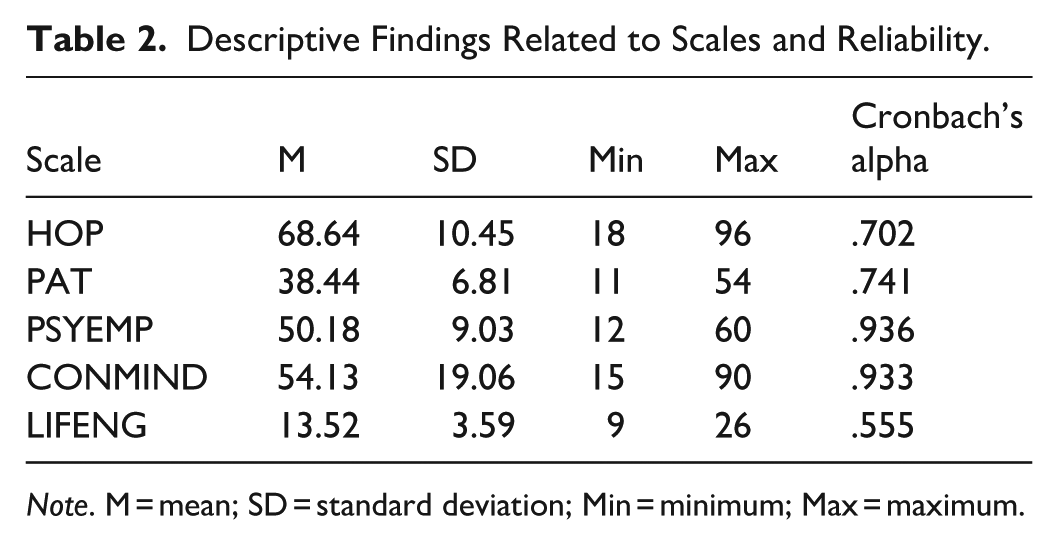
In Table 1, 93.3% of the participants are male, while 6.7% are female. Regarding age categories, 41.5% are in the 26 to 35 age range, 21.1% are 25 years or younger, 20.9% are in the 36 to 45 age range, and 16.5% are 46 years or older. Concerning marital status, 50.9% are single, and 49.1% are married. Findings regarding the scale and reliability of the study are given in Table 2.
Descriptive Findings Related to Scales and Reliability.
Note. M = mean; SD = standard deviation; Min = minimum; Max = maximum.
The general Cronbach Alpha (α > .700) of all scale data is above the acceptable threshold. 50 However, the Cronbach α of the Life Engagement scale is .555. This may be due to the small number of questions, but it is acceptable even if poor. 51 The research model and findings regarding mediation analysis are shown in Figure 2 and Table 3.

General figure for mediation models.
Statistical Findings of Mediation Analyses.

Note. IV = independent variable; MED = mediator variable; DV = dependent variable.
Table 3 presents the statistical findings for the mediation analyses. A graphical representation of the mediation analyses is also provided in Figure 2. According to the mediation analyses, there is no significant mediating role of the factors of hope and patience between PYSEMP and LIFEENG. Between CONMIND and LIFEENG, the hope factor does not mediate significantly, whereas the patience factor does. The significant mediating role of the patience factor, given that the direct effect is also substantial, indicates partial mediation between CONMIND and LIFEENG. The moderator analysis model and findings are shown in Figure 3 and Table 4.

General figure for moderator models.
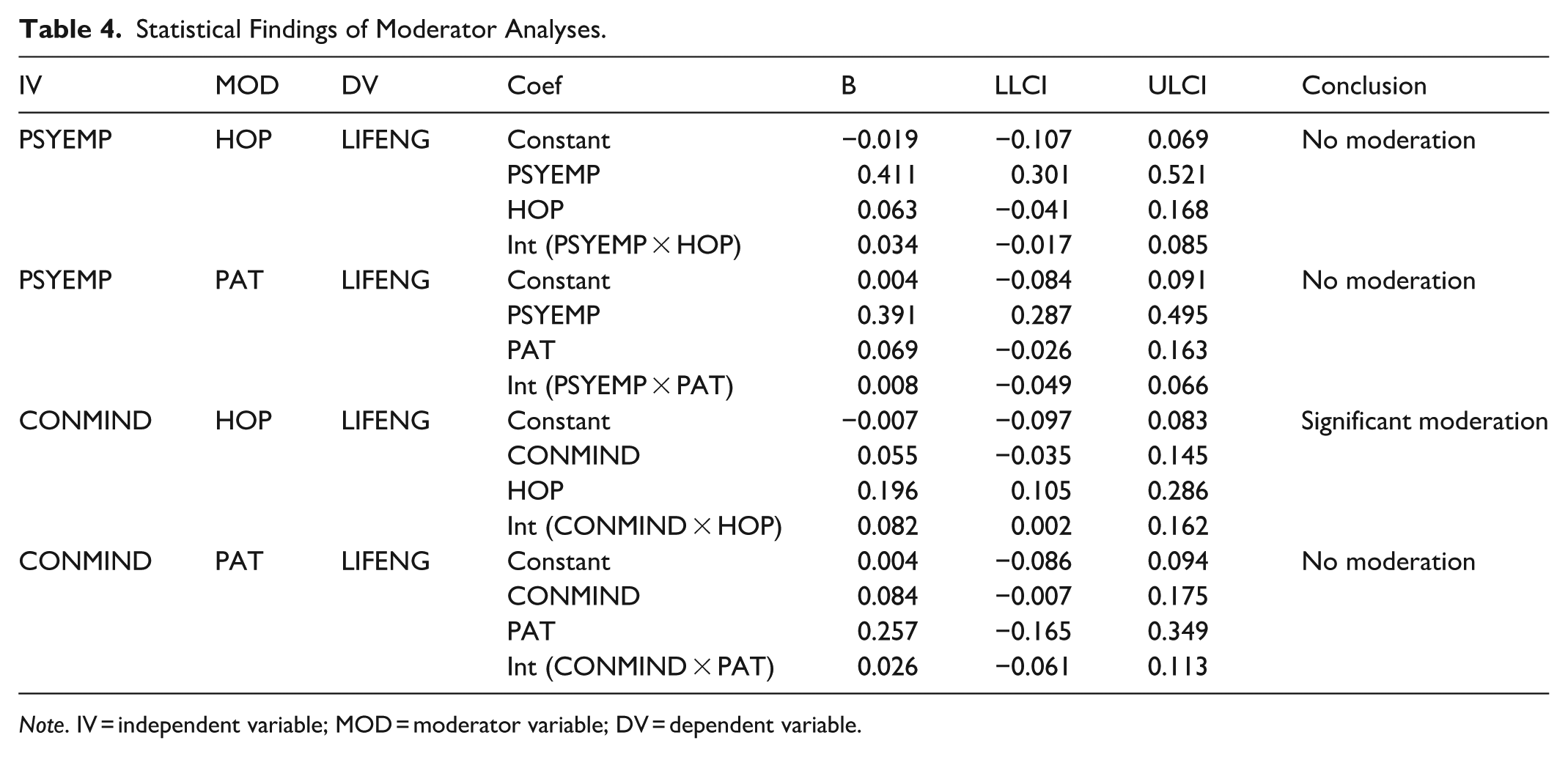
Statistical Findings of Moderator Analyses.
Note. IV = independent variable; MOD = moderator variable; DV = dependent variable.
Table 4 presents the statistical findings for the moderation analyses. Figure 3 provides a graphical representation of the moderation analyses. According to the moderation analyses, neither hope nor patience plays a crucial moderating role in the relationship between PYSEMP and LIFEENG. Hope significantly moderated the relationship between CONMIND and LIFEENG, while patience was not found to have a significant moderating role. The results of the hypothesis test are presented in Table 5.
Results of Hypotheses.

According to the research results, only the H4a and H7a hypotheses were not rejected, but all other hypotheses were rejected due to the lack of statistically significant findings.
Findings
The findings of this study provide important insights into the roles of patience and hope in the relationships between PYSEMP, CONMIND, and LIFEENG among seafarers. The mediation and moderation analyses were carried out to explore the potential indirect and interactive effects of patience and hope in these relationships. The mediation analyses aimed to determine whether hope and patience mediate the relationships between PYSEMP and LIFEENG, as well as between CONMIND and the life commitment of seafarers. The results indicated that neither hope nor patience significantly mediated the relationship between PYSEMP and LIFEENG of seafarers. Specifically, the indirect effect of hope and patience in this relationship was insignificant, as the confidence intervals for the indirect effects contained zero. However, when examining the relationship between seafarers’ CONMIND and LIFEENG, the mediation effect of patience was significant. Patience partially mediated this relationship, as indicated by a significant indirect effect of patience (ab = 0.008, LLCI = 0.014, ULCI = 0.031), coupled with a significant direct effect of CONMIND on LIFEENG (B = 0.015, LLCI = 0.002, ULCI = 0.032). Therefore, a 1-unit increase in CONMIND causes a 0.015-unit increase in LIFEENG through patience. This suggests that patience plays a role in enhancing the effect of CONMIND on LIFEENG, although direct effects still exist. In contrast, hope did not mediate the relationship between CONMIND and LIFEENG, as the indirect effect of hope was found to be insignificant.
The moderation analyses explored whether hope or patience moderates the relationships between PYSEMP, LIFEENG, and between CONMIND and LIFEENG. The results showed that neither hope nor patience significantly moderated the relationship between PYSEMP and LIFEENG. Specifically, the interaction terms in these models were not statistically significant, suggesting that hope and patience do not play a moderating role in this relationship. In contrast, patience did not significantly moderate the relationship between CONMIND and LIFEENG. However, hope significantly moderated this relationship between CONMIND and LIFEENG. The interaction between CONMIND and hope was statistically significant (B = 0.082, LLCI = 0.002, ULCI = 0.162). This shows that higher levels of hope strengthen the positive effect of CONMIND on LIFEENG. A 1-unit increase in CONMIND causes a 0.082-unit increase in LIFEENG through the moderating role of hope.
These findings underscore the significant role of patience in enhancing the effects of CONMIND on LIFEENG, while highlighting the limited role of hope in mediating and moderating these relationships. The results emphasize the importance of psychological factors, particularly patience and hope, in fostering LIFEENG among seafarers, with implications for promoting mental well-being in high-stress occupational environments.
Discussion
The present study’s findings contribute to the growing body of literature exploring the psychological mechanisms underlying mindfulness and LIFEENG, particularly within the maritime context. In line with Malinowski and Lim, who reported that CONMIND positively predicts work engagement and well-being through mediators such as hope and positive affect, the current study also supports the beneficial role of mindfulness in enhancing LIFEENG. 12 However, unlike their findings where hope fully mediated the effects of mindfulness on engagement, our results revealed that hope did not significantly mediate the relationship between CONMIND and LIFEENG among seafarers (H3a). Instead, patience emerged as the sole significant mediator (H4a), suggesting a domain-specific variation where seafarers may rely more on sustained perseverance rather than future-oriented optimism in high-stress environments. Similarly, Ali et al emphasized the mediating role of hopefulness between mindfulness, gratitude, and well-being. 52 Although our findings partially align with their identification of mindfulness as a key predictor of well-being, the non-significant mediating role of hope in our model (H1a, H3a) presents a noteworthy departure. This disparity may stem from contextual differences, such as occupational setting or cultural variables, influencing the expression, and impact of hope. Because people encounter culture when they meet many other people for various reasons. 53 Cultural differences can affect the success of awareness, 54 which occurs when there are conflicts with the person’s needs, desires, and goals.55,56 Senbursa and Dunder also underscored the significance of psychological well-being and empowerment among seafarers, identifying them as mediators in the relationship between work-life balance and job performance. 57 While current study echoes the importance of PYSEMP in predicting LIFEENG, we found no significant mediation by either hope or patience in this pathway (H1a, H2a), diverging from their conclusion. This distinction suggests that PYSEMP may exert its influence through alternative mechanisms when the outcome is LIFEENG, rather than broader indicators of workplace well-being. Aggarwal et al similarly found PYSEMP to mediate empowerment and affective commitment strongly. 58 Contrary to their findings, the current study did not detect any mediating or moderating effects of hope or patience on the link between PYSEMP and LIFEENG (H1a, H2a, H5a, H6a). This indicates that the role of empowerment may vary significantly across professional settings, potentially influenced by occupational structures, perceived autonomy, and levels of environmental stress. In particular, occupational stress is considered one of the factors that cause deterioration in the health and well-being of seafarers and potentially accidents.59,60 Occupational stress is a well-known problem in the high-technology shipping industry. 61 However, occupational stress can worsen seafarers’ physical and psychological health to a degree that cannot be compared to shore work due to its risks and difficulties. 62 In terms of moderation, the findings align with those of Xie et al 63 who demonstrated that hope buffered the adverse effects of negative emotion. Similarly, the current study revealed that hope significantly moderated the relationship between CONMIND and LIFEENG (H7a), suggesting that individuals with higher levels of hope may experience greater benefits from mindfulness in terms of engaging more fully with life. Both studies support the conceptualization of hope as a psychological buffer that strengthens adaptive functioning under stress. On the other hand, patience did not emerge as a significant moderator in this relationship (H8a), indicating that its role may be limited to mediating rather than interacting processes. Moreover, Feng and Yin reported that hope mediates in reducing depression through gratitude among healthcare workers. 64 While both studies highlight the psychological value of hope, our results do not support its mediating role in the maritime domain, pointing to contextual, and occupational variability in how such traits function. Finally, the current study did not observe the moderation role of PYSEMP reported by Ali et al., wherein empowerment enhanced the link between engagement and innovative work behavior. 65 We found no significant moderating effects of hope or patience on the PYSEMP–LIFEENG relationship (H5a, H6a), suggesting that while empowerment may promote performance and innovation in organizational contexts, its influence on personal LIFEENG, especially in high-demand, isolated environments like seafaring, may be shaped by different psychological dynamics. These findings offer nuanced insights into the distinct roles of patience and hope, with patience acting as a key mediator and hope serving as a moderator in mindfulness-related LIFEENG processes.
Managerial Implications
The results of the current study offer potential implications for practitioners. Several recommendations can be made to enhance LIFEENG and mental well-being among seafarers, especially in high-stress occupational environments. Since patience was found to play an important role in enhancing the effect of CONMIND on LIFEENG, interventions aimed at improving patience among seafarers are recommended. Training programs focusing on mindfulness and patience-building exercises can help seafarers better manage stress and improve their interactions with life both at and outside work. The significant effect of CONMIND on LIFEENG suggests that mindfulness-based interventions should be integrated into seafarers’ daily routines. The human factor significantly impacts the quality of communication between stakeholders in the maritime industry and can contribute to the prevention of human errors that lead to maritime accidents. 66 The relationships between digitalization and mental health are also critical. 67 Considering seafarers’ difficulties in maintaining mental well-being during long periods at sea, maritime organizations need to design interventions that support psychological resilience. Accessibility of managers can be considered as a key factor for practical training.68,69 Although hope did not mediate the relationships between PYSEMP, CONMIND, and LIFEENG, it moderated the relationship between CONMIND and LIFEENG. Future training programs should focus on fostering hope as a complement to mindfulness practices. Promoting hope and optimism may help seafarers improve their ability to fully engage with life, especially in challenging or high-stress work environments. Given the unique nature of the maritime profession, organizations should design personalized mental well-being interventions that address seafarers’ specific challenges. These programs should include patience-building and mindfulness-based strategies to increase hope and engagement in daily activities. Although the study did not find a significant mediating or moderating effect of hope and patience on the relationship between PYSEMP and LIFEENG, promoting PYSEMP through leadership, autonomy, and support in the workplace is critical. Promoting an empowering work environment may enhance seafarers’ well-being and engagement. Therefore, the findings provide valuable insights for policymakers and maritime organizations to improve seafarers’ mental health through interventions that foster awareness, patience, and hope.
Limitations and Future Directions
The research has some limitations. The IBM SPSS PROCESS macro was preferred in the study. However, the current study may allow for a more comprehensive methodology for future studies. More complex models can be tested using SEM. The study highlights the importance of patience and hope in supporting LIFEENG. However, the limited role of hope in mediating and moderating these relationships requires further research. Future research can identify additional psychological factors contributing to LIFEENG, such as resilience or self-compassion, to provide a more comprehensive understanding of well-being in high-stress occupations such as seafaring. By focusing on these areas, maritime organizations can create a more supportive environment that improves seafarers’ psychological well-being, reduces stress, and contributes to better LIFE ENGINEERING.
Conclusion
The findings of this study highlight the importance of psychological factors such as patience and hope in enhancing LIFEENG and well-being among seafarers. Patience was found to mediate the relationship between CONMIND and LIFEENG significantly. These results highlight the need for targeted interventions focusing on mindfulness and patience-building strategies to improve the mental well-being of seafarers in high-stress occupational environments. Furthermore, the current study found that hope significantly moderated the relationship between CONMIND and LIFEENG. This suggests that individuals with higher levels of hope may benefit more from mindfulness in terms of participating more fully in life.
Footnotes
Nomenclatures
PYSEMP : Psychological Empowerment
CONMIND: Conscious Mindfulness
LIFEENG : Life Engagement
MAAS : Mindful Attention Awareness Scale
HOP : Hope
PAT : Patience
DHS : Dispositional Hope Scale
ITF : International Transport Workers Federation

Ethical Considerations
The research was conducted in accordance with established ethical guidelines. Ethical approval was obtained as required.
Consent to Participate
Informed consent was obtained from all participants involved in the study.
Author Contributions
Nihan Senbursa: Writing—Original Draft, Conceptualization, Methodology, Validation, Formal Analysis, Resources, Writing—Review and Editing, Data Curation, Software, Visualization, Supervision. Emre Dünder: Methodology, Validation, Formal Analysis, Resources, Data Curation, Software, Visualization. Ali Tehci: Methodology, Formal Analysis, Writing—Review and Editing, Data Curation, Project administration. Ozkan Ugurlu: Conceptualization, Resources, Writing—Review and Editing, Supervision.
Funding
The authors received no financial support for the research, authorship, and/or publication of this article.
Declaration of Conflicting Interests
The authors declared no potential conflicts of interest with respect to the research, authorship, and/or publication of this article.
Data Availability Statement
The data that support the findings of this study are available from the corresponding author upon reasonable request.