




Abstract
In Ghana, malaria remains the number 1 reason for outpatient department visits, making it a major public health problem. Thus, there could be significant lost productivity days as a result of malaria morbidity and mortality, which could negatively affect economic output at the macrolevel. Nonetheless, there is a dearth of empirical evidence of the effect of malaria on macroeconomic output in Ghana. This study therefore aims to provide the foremost empirical evidence regarding the effect of malaria prevalence on macroeconomic output in Ghana using a time series design with data spanning the period 1990 to 2019. Gross Domestic Product (GDP), serving as a proxy for macroeconomic output, is the dependent variable, while the prevalence of malaria (overall, among only males and among only females) serves as the main independent variable. The Ordinary Least Square (OLS) regression is used as the baseline estimation technique and the Instrumental Variable Two-Stage Least Square (IV2SLS) regression is employed as the robustness check estimator due to its ability to deal with endogeneity. The IV2SLS regression results show that a percentage increase in the overall prevalence of malaria is associated with a 1.16% decrease in macroeconomic output at 1% significance level. We also find that the effect of malaria in males on macroeconomic output is slightly higher relative to females. The findings from the OLS regression are not qualitatively different from the IV2SLS regression estimates. There is therefore the need to strengthen efforts such as quality case management, larval source management, mass distribution of long-lasting insecticide-treated bed nets, social behavior change, surveillance (both epidemiological and entomological), intermittent preventive treatment of malaria in pregnancy, research among others, which are important toward eliminating malaria.
While malaria is a major public health problem in Ghana, evidence of the effect of the disease on macroeconomic output can be found elsewhere and not on Ghana as a country.
The study makes important contributions to the literature as follows: i) it is the first study that examines the effect of malaria on economic output at the macrolevel in Ghana, and ii) it is the foremost empirical analysis of the sex dimensions of the effect of malaria on economic output at the macrolevel.
The findings of the study unearth the macroeconomic losses associated with malaria in Ghana, and hence the study is expected to serve as an investment case on the need to bolster efforts toward malaria elimination.
Introduction
In Ghana, malaria is the number 1 reason for outpatient department visits. 1 For instance, in 2021, malaria was responsible for a staggering 21% of all outpatient department cases. 1 Thus, despite some progress chalked in dealing with malaria, Ghana still remains a major contributor to the global malaria burden. It is therefore not surprising that, in 2021, Ghana contributed 2.2% and 2.0% of the global malaria cases and deaths, respectively. 2 In the same year, Ghana had the 12th highest number of malaria cases in the World Health Organization African Region. 2
With health being an important aspect of human capital 3 and human capital being a major driver of economic growth (output),4 -6 the implication is that, the high burden of malaria (morbidity and mortality) in Ghana could deter or reduce the participation of a number of people in economic activities. This can decrease economic productivity at the macrolevel, resulting into low macroeconomic output. 27
Providing estimates of the macroeconomic losses associated with malaria does not only give an overall picture of the negative economic effect of the disease but also, could aid in increasing attention on the importance of deepening interventions and measures aimed at tackling it (malaria). 27 Notwithstanding, while studies on the macroeconomic effects of malaria transmission have been conducted in other settings,7 -14 to the best of the authors’ knowledge, evidence on Ghana in this regard is sparse. Specifically, Orem et al 8 and McCarthy et al 9 found a negative association between malaria morbidity and per capita income in Uganda and sub-Saharan Africa (SSA), respectively. In addition, employing cross-country analyses, Gallup and Sachs 14 found that, countries in which malaria was intensive had a reduction (grew less) of 1.3% in the growth rate of per capita income per year, while Sarma et al, 11 in a cross-country analysis, found that, on average, a reduction in the incidence of malaria by 10% was linked to approximately 0.3% increase in per capita income. In a related study in Kenya, Elnour et al 12 found that, at the end of implementing the Kenya Malaria Strategy (2019–2023), Gross Domestic Product (GDP) was enhanced due to high labor availability. Also, among 26 countries, it was projected that, a dividend of 0.17% of overall GDP will be obtained upon scaling-up the control of malaria. 10 The findings of these past studies, therefore confirm i) the postulation of the human capital model of demand for health that, health is an important aspect of human capital, 3 as well as ii) the role of human capital in enabling economic growth.4 -6
Moreover, while women, especially pregnant women are considered to be more vulnerable to malaria,15,16 among the related-studies, none of them investigated whether the effect of malaria on macroeconomic output differs by sex.
This study therefore examines the effect of malaria prevalence on macroeconomic output in Ghana. The study, to the best of our knowledge, makes important contributions to the literature as follows: i) it is the first study focused on Ghana that examines the effect of malaria on economic output at the macrolevel, and ii) it is the foremost empirical analysis of the sex dimensions of the effect of malaria on economic output at the macrolevel. The findings of the study unearth the macroeconomic output losses associated with malaria in Ghana, and hence are expected to aid in increasing attention on the need to bolster efforts toward malaria elimination.
Methods
Study Design
This study employs a time series design comprising data over the period, 1990 to 2019. Such a design aids in finding out the nature of the relationship between variables over a long period of time, which is important for understanding long-term trends or relationships and policy formulation. The study period is determined by data availability.
Data and Variables
The dependent variable is macroeconomic output (Y) which is measured by GDP. The main independent variable is the prevalence of malaria (M) which is measured by 3 indicators: (i) overall prevalence of malaria, ii) prevalence of malaria among males and iii) prevalence of malaria among females. The control variables are Foreign Direct Investment (FDI), inflation (IF), regulatory quality (R), domestic investment (I), consumption (C), and net exports (X). The selection of these variables is based on existing literature.17 -21 The data on malaria prevalence are obtained from the database of the Global Burden of Diseases (GBD) study, 22 the data on regulatory quality are sourced from the World Bank’s Worldwide Governance Indicators (WB’s WGI), 23 and data on the remainder of the variables are obtained from the World Bank’s World Development Indicators (WB’s WDI). 24 Details of the measurement of these variables and their expected signs can be found in Table 1.
Measurement and Expected Signs of Variables.

Notes. “+”: will increase macroeconomic output; “−”: will decrease macroeconomic output. The definitions are from the respective data sources. However, for net exports, the authors generated it using data on exports of goods and services as a percentage of GDP and imports of goods and services as a percentage of GDP, obtained from the stated data source.
As regards the expected signs, the sign of the prevalence of malaria is expected to be negative. This is because, people affected by malaria are likely to experience at least a reduction with regard to their participation in economic activities which will negatively affect economic output at the macrolevel. The expected sign of FDI is mixed or uncertain because, while FDI on one hand can supplement domestic resources to enhance macroeconomic output, 25 on the other hand, FDI can push domestic firms out of business 26 which could reduce overall investment in an economy, hence, hampering macroeconomic output. 18 In a similar vein, the expected sign of inflation is uncertain. Thus, rising prices could hamper the ability of producers to buy more inputs which would reduce production, but conversely, rising prices could be as a result of demand exceeding supply, which would attract firms to produce more in response to the higher demand, leading to an enhancement in macroeconomic output. 27
The sign of regulatory quality is expected to be positive since an enhancement in regulatory quality will propel the growth of the private sector, which is important for higher macroeconomic output. 27 Similarly, rising domestic investment would increase the availability of resources in an economy, which would end up enhancing macroeconomic output. 18 Conversely, since consumption drains resources out of production, it is expected to have a negative effect on macroeconomic output. 18 Given that a rise in net exports indicates that exports are increasing, the implication is that domestic firms would earn foreign exchange which can be reinvested to enhance macroeconomic output. 27
Statistical Analysis
To examine the effect of malaria prevalence on macroeconomic output, this study specifies the equation below:

where t represents time (year) and all the remaining notations are as defined already (see data and variables sub-section). Nonetheless, for the purpose of this study, equation (1) is respecified in a more estimable form as follows:
(2) Yt=Ω+δMt+ϪFDIt+φIFt+ϖRt+ϑIt+ϣCt+λXt+εt,

where
Regarding estimation techniques, given the continuous nature of our dependent variable, the study employs the Ordinary Least Square (OLS) regression as the baseline estimation technique.28,29 However, there is the likelihood of macroeconomic output equally affecting the prevalence of malaria resulting into endogeneity. For instance, higher macroeconomic output implies higher income, which makes people more capable of affording quality healthcare 27 as well as malaria free environments leading to a fall in the prevalence of malaria and vice versa.
To deal with this potential endogeneity problem, the Instrumental Variable Two-Stage Least Square (IV2SLS) regression is used as a robustness check because of its ability to deal with endogeneity. However, the IV2SLS estimator requires the use of instruments30,31 (variables that can affect malaria prevalence but cannot be affected by macroeconomic output). To do so, the first lag (past year value) of the malaria prevalence indicator and the first lag of gross national expenditure (as a percentage of GDP) are used as instruments. This is because, while the past levels of malaria prevalence and national expenditure can affect the current levels of malaria prevalence and macroeconomic output, the current level of macroeconomic output cannot affect past malaria prevalence and previous level of gross national expenditure. Data on gross national expenditure are sourced from the WB’s WDI. 24
The appropriateness of the IV2SLS estimates is ascertained using the weak identification, underidentification, and overidentification tests. The weak identification test is done using the Kleibergen-Paap rk Wald F test (WID). The underidentification test is performed using the Kleibergen-Paap rk LM test (KPL) while the Hansen test (J) is used to examine overidentification. Moreover, this study tests for endogeneity using the Durbin-Wu-Hausman test (DW). The absence of underidentification is confirmed when the p-value of the KPL is significant, while lesser Stock-Yogo critical values relative to the WID critical value indicates the absence of weak identification. In addition, the insignificance of the P values of J and DW suggests the absence of overidentification and endogeneity respectively.28-33
It should be noted that robust standard errors are used in all our regression estimates in order to deal with serial correlation and heteroscedasticity. In addition, in running the regressions, the dependent variable and the main independent variable (prevalence of malaria indicators) are log-transformed in order to ensure the interpretation of results as elasticities. 34 Prior to the regression results, we present descriptive statistics and correlation analysis of the variables.
Results
This section presents the descriptive statistics of variables, correlation analysis, as well as regression results of the effect of malaria prevalence on macroeconomic output in Ghana.
Descriptive Results
The descriptive statistics of the variables are presented in this sub-section. Over the study period (1990-2019), the average overall prevalence of malaria in Ghana is found to be 0.31%. This prevalence remains relatively consistent among both males and females. The average macroeconomic output in Ghana over the study period is $30.240 billion (Table 2). Descriptive statistics of the rest of the variables can be found in Table 2.
Descriptive Statistics of Variables.
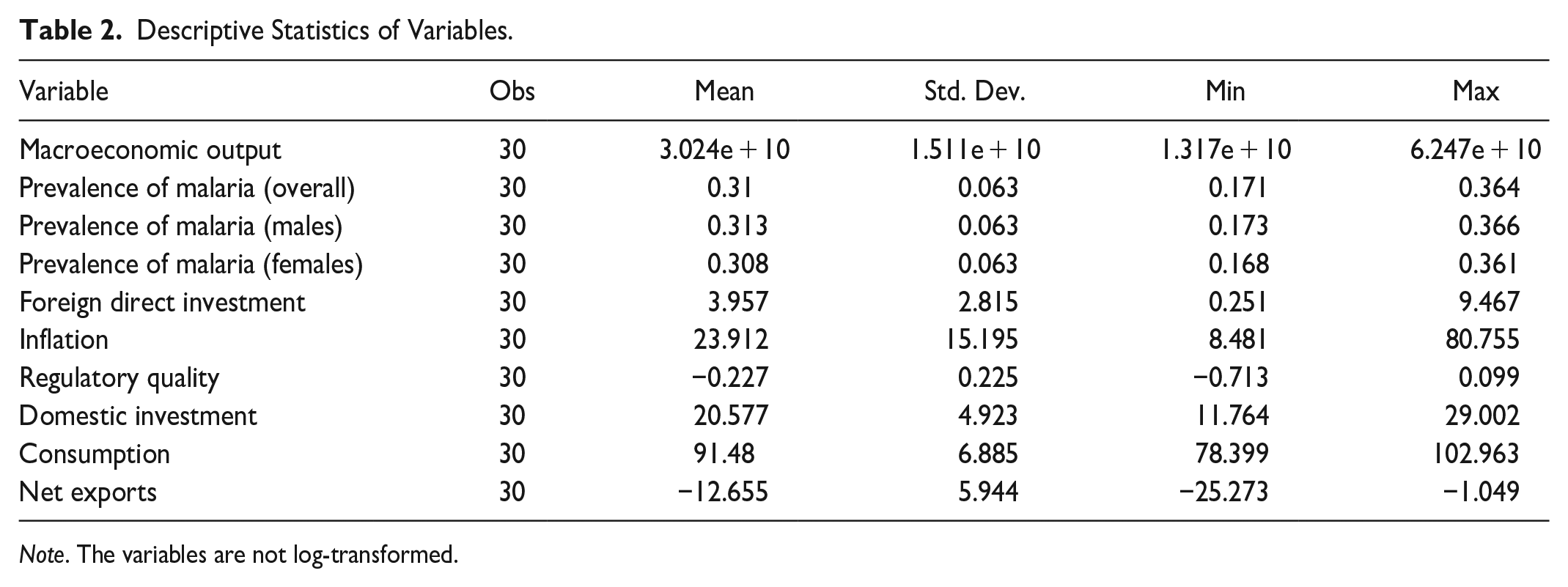
Note. The variables are not log-transformed.
Correlation Results
From the scatter plots in Figure 1, it can be seen that while there exist a positive relationship between the prevalence of malaria in males and that of females, all the prevalence of malaria indicators exhibit a negative relationship with macroeconomic output.
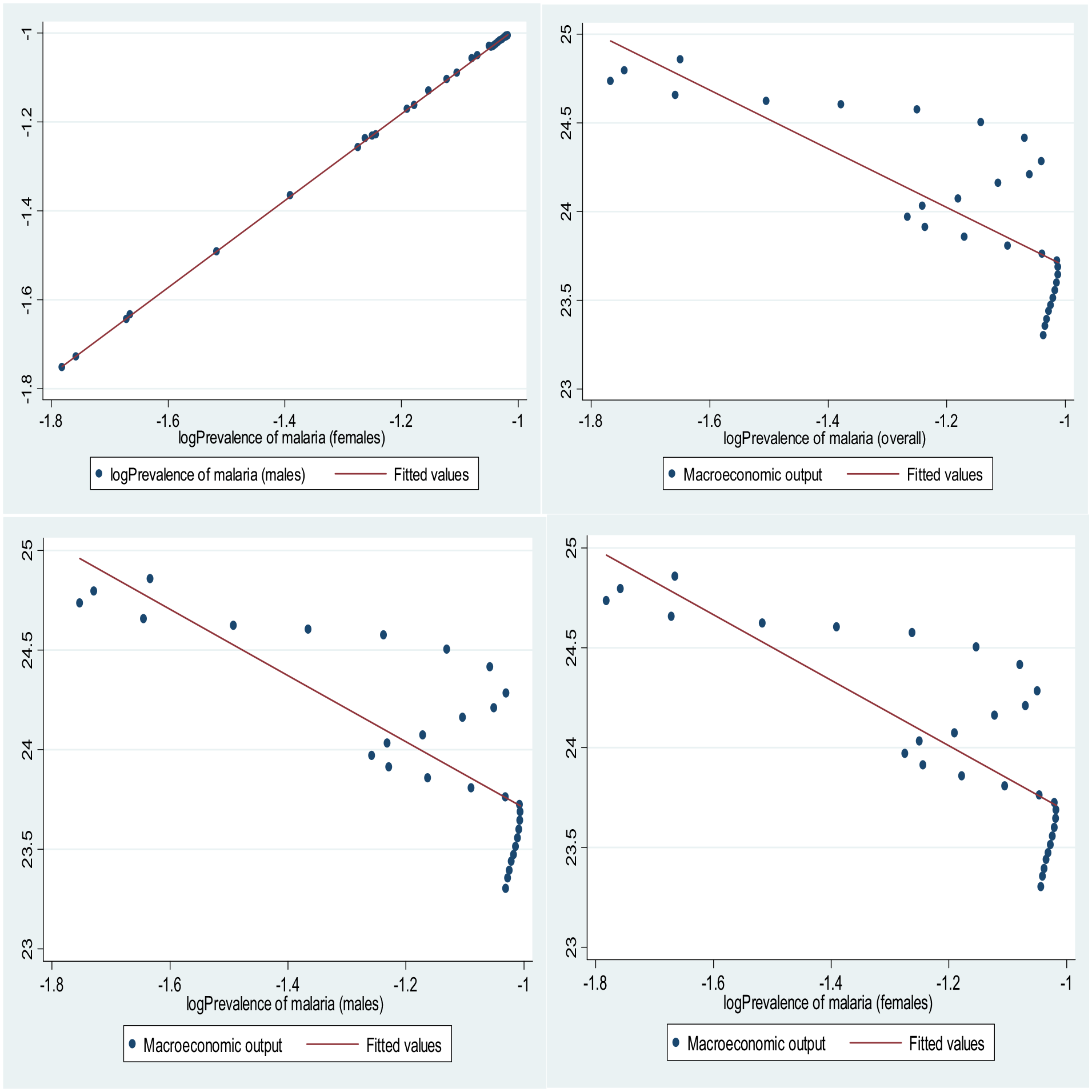
Scatter plot of the relationship between malaria prevalence in males and females as well as malaria prevalence and macroeconomic output.
Regression Results
The OLS and IV2SLS regression estimates of the effect of malaria on macroeconomic output in Ghana are presented in this sub-section.
In Table 3, based on the OLS estimates, the prevalence of malaria shows a negative and statistically significant association with macroeconomic output irrespective of sex. Specifically, a percentage increase in the overall prevalence of malaria is associated with a 1.27% fall in macroeconomic output at 1% level of significance. In addition, a percentage increase in the prevalence of malaria among males and females is associated with a 1.28% and 1.26% decrease in macroeconomic output, respectively, at 1% level of significance.
OLS Regression Estimates of the Effect of Malaria on Macroeconomic Output in Ghana.

Notes. Robust standard errors in parentheses.
P < .1. **P < .05. ***P < .01.
Furthermore, there is a positive and statistically significant association between FDI and macroeconomic output (coefficient:0.04, P < .01) across all models. Likewise, irrespective of the model, regulatory quality shows a positive and statistically significant association with macroeconomic output (coefficient:0.82, P < .01) (Table 3).
In Table 4, regarding the IV2SLS regression, the results are not qualitatively different from the OLS estimates. As regards the main variable of interest, the study finds a 1.16% fall in macroeconomic output to be associated with a percentage increase in the overall prevalence of malaria, at 1% level of significance. Concerning sex disaggregated prevalence of malaria, the study finds a percentage increase in the prevalence of malaria among males and females, respectively, to be associated with a 1.16% and a 1.15% decrease in macroeconomic output, at 1% level of significance.
IV2SLS Regression Estimates of the Effect of Malaria on Macroeconomic Output in Ghana.
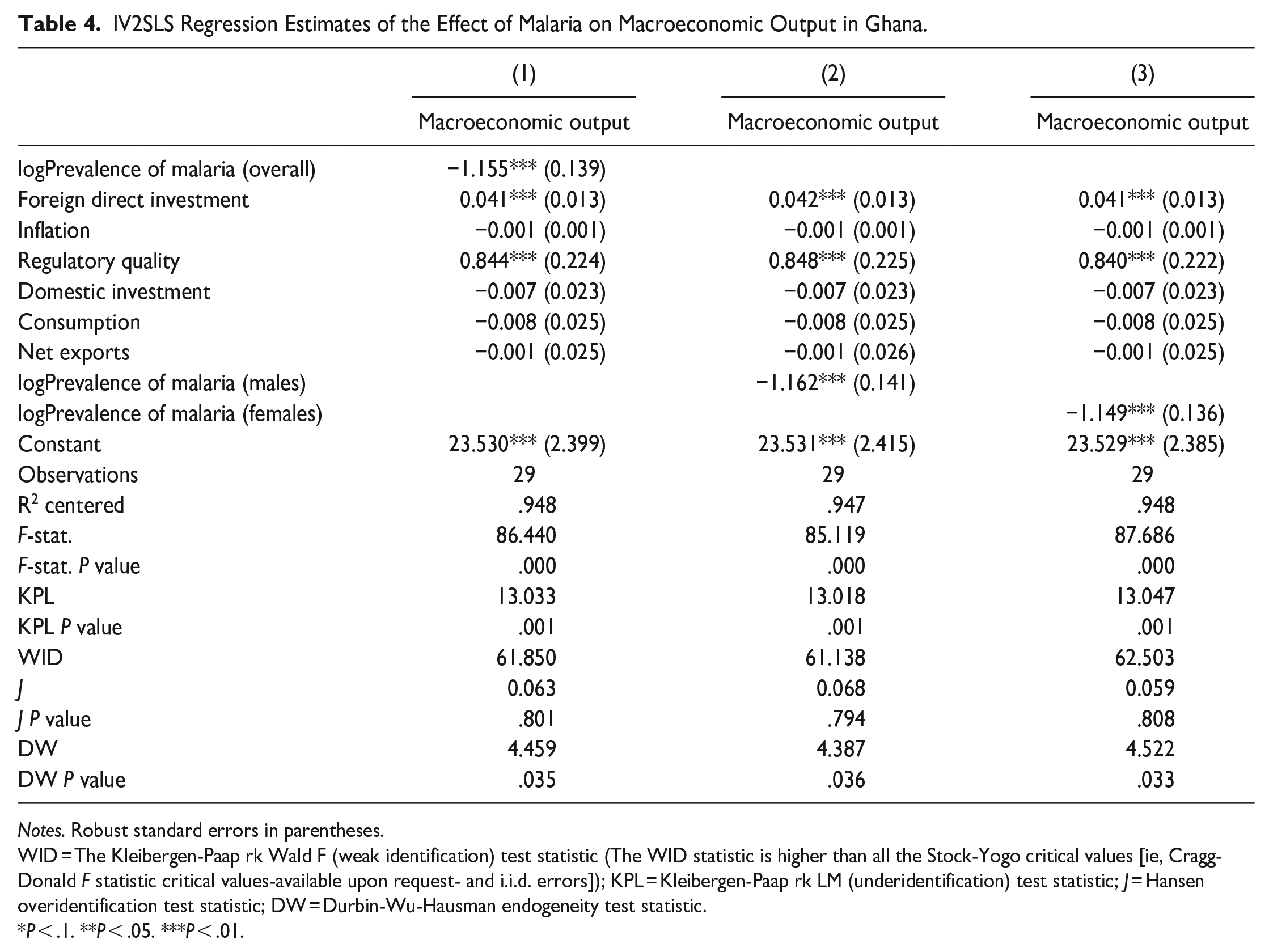
Notes. Robust standard errors in parentheses.
WID = The Kleibergen-Paap rk Wald F (weak identification) test statistic (The WID statistic is higher than all the Stock-Yogo critical values [ie, Cragg-Donald F statistic critical values-available upon request- and i.i.d. errors]); KPL = Kleibergen-Paap rk LM (underidentification) test statistic; J = Hansen overidentification test statistic; DW = Durbin-Wu-Hausman endogeneity test statistic.
P < .1. **P < .05. ***P < .01.
FDI maintains a consistent positive and statistically significant association (coefficient:0.04, P < .01) with macroeconomic output irrespective of how the prevalence of malaria is measured. Similarly, regulatory quality is found to have a positive and statistically significant association with macroeconomic output in all the models (coefficient:0.84, P < .01 (Models 1 and 3); coefficient:0.85, P < .01 (Model 2)) (Table 4).
Discussion
The study finds a consistently negative significant association between malaria and macroeconomic output irrespective of the estimation technique and sex. Specifically, using the average macroeconomic output figure ($30.240 billion, see Table 2) for Ghana over the study period, the 1.16% (from the IV2SLS results) fall in macroeconomic output associated with a percentage increase in the overall prevalence of malaria implies that, from 1990-2019, on the average, a percentage increase in the overall prevalence of malaria was associated with a loss in macroeconomic output of $351 million. This finding is not surprising, given that malaria is a major cause of morbidity and mortality in Ghana, hence would be associated with substantial productivity losses, both in terms of missed workdays and depletion of human capital, culminating into low economic output at the macrolevel.
The slightly higher effect of malaria in males on macroeconomic output relative to females could be due to the fact that, females (especially pregnant women) are targeted for specific malaria interventions in Ghana15,16 relative to males, hence, they would be expected to have higher protection against malaria. Our findings are in tandem with McCarthy et al 9 who found a negative relationship between malaria morbidity and per capita income among countries in SSA. Likewise, Orem et al 8 found a negative association between malaria morbidity and per capita income in Uganda. Further, Gallup and Sachs 14 found that countries in which malaria was intensive had a reduction of 1.3% in the growth rate of per capita income, while Sarma et al 11 found that, on average, a reduction in the incidence of malaria by 10% was linked to approximately 0.3% increase in per capita income across a number of countries.
The findings therefore highlight the need to reinvigorate the implementation of measures outlined in the Ghana Malaria Elimination Plan (2024-2028). 35 The measures include quality case management, larval source management, mass distribution of long-lasting insecticide-treated bed nets, social behavior change, surveillance (both epidemiological and entomological), intermittent preventive treatment of malaria in pregnancy, research among others. 35 In fact, in Kenya, it was found that, at the end of implementing the Kenya Malaria Strategy (2019-2023), GDP was enhanced due to high labor availability. 12 Similarly, it was projected that, a dividend of 0.17% of overall GDP will be obtained upon scaling-up the control of malaria in 26 countries. 10
Concerning the control variables, the positive and statistically significant association of FDI with macroeconomic output could be explained by the fact that, FDI can lead to the transfer of technology as well as augment domestic resources, which would boost domestic production resulting into enhanced macroeconomic output.18,25 Nonetheless, this outcome is contrary to Immurana et al 18 and Sakyi and Egyir 17 who found a negative relationship between FDI and economic growth among African countries. This conflicting outcome could be due to the fact that while the present study focuses on only Ghana, the studies by Immurana et al 18 and Sakyi and Egyir 17 focused on a number of African countries.
Since rising regulatory quality indicates an enhancement in measures geared toward the development of the private sector, 27 and given that the private sector in Ghana plays a major role in job creation and general production, it is not surprising that the study finds a positive association between regulatory quality and macroeconomic output. Immurana et al 36 and Immurana et al 27 found similar positive effect of regulatory quality on macroeconomic output in Ghana and among a sample of African countries, respectively.
Conclusion
This study provides the foremost empirical evidence of the effect of malaria on macroeconomic output in Ghana. Our findings indicate that malaria has a negative significant effect on economic output at the macrolevel and the effect is slightly higher among males relative to females. There is therefore the need to strengthen interventions aimed at tackling malaria in order to help toward its elimination in Ghana, hence, significantly reduce the associated macroeconomic output losses. Such interventions should include quality case management, larval source management, mass distribution of long-lasting insecticide-treated bed nets, social behavior change, surveillance (both epidemiological and entomological), intermittent preventive treatment of malaria in pregnancy, research among others. 35
Footnotes
Acknowledgements
Not applicable.
Authors’ Note
This study employs aggregated data which cannot be linked to any person. All the related scientific guidelines and regulations are observed in the conduct of this study.
Availability of Data and Materials
The data underpinning the findings of this study are available at no charge from the website of the Global Burden of Diseases Study (https://vizhub.healthdata.org/gbd-results/) and the World Bank ( )
)
Declaration of Conflicting Interests
The authors declared no potential conflicts of interest with respect to the research, authorship, and/or publication of this article.
Funding
The authors received no financial support for the research, authorship, and/or publication of this article.
Ethics Approval and Consent to Participate
Consent to participate and ethical approval are not required because secondary data are used for the study.
Consent for Publication
Not applicable.