




Abstract
Intensive Care Units (ICU) workers work in highly stressful conditions that make them prone to professional burnout, which can lead to high turnover rates. This study explores professional burnout levels among ICU workers in Kuwait general governmental hospitals (GGHs), their turnover intentions, and the correlation factors. A cross-sectional self-administered survey study was conducted. Professional burnout level was measured using the Copenhagen Burnout Inventory (CBI), while turnover intention was measured using the Turnover Intention Scale (TIS-6). Data were analyzed using STATA software, and descriptive, correlative, and comparative analyses were performed. Eighty-nine ICU physicians filled out the questionnaire. Most of the participants were males, married, non-Kuwaiti nationals, with 10 to 20 years of experience, and the mean age of respondents was 39.2. The total professional burnout score was high was 54.7 (17.6). There were high total average scores for the personal and work-related domains. Participants who were younger than 35 years of age and graduated before 5 to 10 years had higher levels of professional burnout compared to other groups. More than half of the sample expressed their intention to leave their current job as an ICU physician. However, no association was found between turnover intentions and levels of burnout. High levels of professional burnout of turnover intentions were seen among ICU physicians in Kuwait. Policies should be adopted to reduce and mitigate professional burnout among ICU physicians and increase their retention. Future research should further investigate professional burnout among ICU staff, the associated factors, and its relation to their turnover intention.
Professional burnout can have several negative mental and psychological consequences and adverse physical effects that could be reflected on the turnover among intensive care physicians.
Our research examines the prevalence of professional burnout among ICU physicians in Kuwait and its effects on their intentions to leave their work.
ICU physicians in Kuwait are prone to professional burnout and have high turnover intentions, and this should implicate policymakers to adopt and implement support strategies to protect physicians and help them cope with professional burnout besides considering developing retention policies and strategies.
Background
According to the World Health Organization (WHO), burnout is defined as “a syndrome conceptualized as resulting from chronic workplace stress that has not been success-fully managed” that is applied mainly to the occupational context. 1 Professional burnout has 3 main characteristics: the feeling of anger and exhaustion, negativism of feeling distanced from the job, and the feeling of lack of achievement. 1 Despite its popularity, Kristensen et al 2 criticized the Maslach Burnout Inventory and its definition of burnout, which focuses on emotional exhaustion, depersonalization, and reduced personal accomplishment among individuals who perform people work only. Such criticism led Kristensen et al 2 to develop the CBI, in which burnout is based on the concept of fatigue and exhaustion and has 3 components. The first component, personal burnout, is defined as “the degree of physical and psychological fatigue and exhaustion experienced by the person” 2 (p. 197). The second component is work-related burnout, which is defined as “the degree of physical and psychological fatigue and exhaustion that is perceived by the person as related to his/her work” and the third is client-related burnout that is defined as “The degree of physical and psychological fatigue and exhaustion that is perceived by the person as related to his/her work with clients” 2 (p. 197).
Health professionals are among the susceptible populations to professional burnout. Several studies documented the existence of professional burnout among health workers.3 -7 Professional burnout was found among different workers’ categories,4,8,9 settings or specialties,5,6,10 and different stages of their careers.11 -13 Professional burnout can have several negative mental and psychological consequences, such as depression,8,14 and adverse physical effects, such as cardiovascular disorders, musculoskeletal complaints, prolonged fatigue, and headaches. 14 In addition, negative occupational consequences can result from professional burnout, such as low job satisfaction7,14,15 and lower performance.16,17 Professional burnout can also affect health systems and organizations by adversely affecting the quality of care,7,16 patient safety,3,16 and patient satisfaction. 16
Among the adverse effect of professional burnout is healthcare workers turnover.16,18,19 Turnover is defined as “the conscious and deliberate wilfulness to leave the organisation” 20 (p. 262), which is the definition adopted by Bothma and Roodt 21 in their development of the TIS-6. Studies showed the undesirable effect of health workers turnover on health systems, such as the increase in costs,18,22,23 reduced staff productivity, 22 increased hospitalization rates, 23 and decreased quality of care.7,24 Several healthcare workers suffered from professional burnout during and after the COVID-19 pandemic,6,9,25,26 which also increased health workers turnover.25,27 -30
Intensive care or critical care is a multidisciplinary speciality that provides comprehensive care for patients in life-threatening conditions by a specialized team, including intensivists or critical care physicians. 31 The importance of critical care staff is demonstrated by studies showing that increasing critical care physicians reduces ICU patients’ mortalities, 32 increases the use of evidence-based treatments, 33 improves clinical outcomes, 34 and reduces costs. 34 However, despite their importance, there is a shortage of ICU physicians35 -37 that was increased during the COVID-19 pandemic. 38 In addition, ICU physicians might be more vulnerable to professional burnout,7,19,39 which can be attributed to workload, dealing with end-of-life circumstances, 40 and moral distress. 41 Burnout in ICU physicians is also linked to their turnover.19,39,42 The COVID-19 pandemic aggravated the vulnerability to professional burnout,26,43 resulting in ICU staff turnover. 19
The healthcare services in Kuwait are mainly provided by the public sector through the Ministry of Health (MOH) and funded by the Ministry of Finance, with a minor role for the private sector. Other public sectors also provide healthcare services, such as the military hospital and the Oil Company hospital, but also can be considered limited services compared to those provided by the MOH. Besides providing the service, the MOH is responsible for regulation, performance monitoring, licensing, and education and training. 44 The structure of MOH is divided into health districts, with primary care centers and a general hospital in each health district 44 and specialized hospitals in one health district. 45 Each general hospital has an ICU, and some specialized hospitals also have small ICUs. Besides dedicating beds for acute care in 1949, the first closed ICU was established in 2002 with the arrival of the first Kuwaiti physician specialized in intensive care from abroad training. 46 The development of ICU services in MOH Kept moving forward, with the number of ICU beds increasing from 309 (4.4% of the total beds in MOH) in 2016 to 502 (6% of the total beds) in 2020. 47 The expansion in ICU services also continued with the opening of the new expansion of Farwaniya Hospital, which has 233 ICU beds. 48 Such expansion in the ICU services can be expected to be matched with the increase in the need for ICU physicians.
Kuwaiti ICU physicians are either trained in The Kuwait Institute for Medical Specializations, which has an anesthesia residency program or completed their training abroad. However, as in other Gulf Cooperation Council countries, Kuwait is dependent on non-national health workers, with a shortage of national workers, and experiencing high turnover rates of non-national workers. 49 In 2020, 67.3% of physicians, including ICU physicians, 51.3% of dentists, and 96.5% of nurses in Kuwait were non-nationals. 47 The shortage of healthcare workers intensified during COVID-19, resulting in the Kuwaiti government asking for medical professionals from other countries.50,51 Although studies were done about burnout among physicians in Kuwait, to our knowledge, none focused on ICU physicians.52 -54 Therefore, this study aimed to examine the prevalence of professional burnout among ICU physicians in Kuwait and its effects on their intentions to leave their work.
Methods
This is a cross-sectional study using an online self-administered questionnaire. The target study population was all physicians working in adult ICU units at GGH, excluding those working in tertiary specialized hospitals. The head of the ICU department and/or team members in GGH were approached to know the exact number of ICU physicians working in their units and to help distribute the questionnaire. A sample size calculation was not performed as all the ICU physicians working at GGHs were invited to participate. Text messages via WhatsApp were sent to the ICU physicians through the head of the department or a team member with an anonymous link to the survey on Google Forms. The questionnaire was distributed between July and August 2022, and reminders were sent every 2 weeks. Data were collected anonymously, confidentiality was assured, and participants consented to the study before starting the online questionnaire.
Questionnaire Development
The survey instrument was developed using Google Forms. The questionnaire consisted of 3 sections. The first section comprises 12 questions related to socio-demographics, such as age, years of experience, and practice site. The second section utilized the CBI, a validated instrument to measure burnout. 2 It consisted of 19 questions divided into 3 domains: (A) personal burnout; which reflected the level of physical and psychological exhaustion, (B) work-related burnout; which reflected the level of physical and psychological exhaustion related to a person’s work; and (C) client-related burnout; reflected the level of physical and psychological exhaustion related to the person’s client. All items used a 5-point Likert scale (always, often, sometimes, seldom, and never OR very high degree, high degree, somewhat, to low degree, very low degree). The third section of the survey utilized the TIS-6, a validated scale to measure turnover intentions. 21 It consisted of 6 questions with a 5-point Likert scale (always, often, sometimes, seldom, and never). Participants were asked to add any additional comments at the end of the questionnaire.
Data Analysis
Continuous variables were expressed as means and standard deviation (SD), whereas numbers and percentages were used for categorical variables for descriptive statistics of the study population. We reported the numbers (percentages), mean, and standard deviation of each item of the CBI and the mean and standard deviation of each domain separately. 2 In addition, we reported the numbers (percentages), mean and SD of each TIS item. A CBI score of >50 in any of the 3 domains was considered professional burnout, as reported in other studies in the literature.55 -57
A student t-test or Mann-Whitney U test was used for parametric/non-parametric 2 groups comparison, and one-way ANOVA or Kruskal Wallis test was used for parametric/non-parametric ≥2 groups comparison. A Pearson’s correlation analysis was used to assess the correlation between the 3 burnout domains. In addition, the internal consistency for 3 CBI domains (personal, work, and patient) was assessed using the Cronbach α test. Pearson’s χ2 test was used to compare “intention to leave,” which was defined as a TIS score ≥18, and predictor variables. 21 Statistical significance was considered as a P-value <.05. The data were analyzed using STATA statistical software package (STATA version 17, STATA Corporation, College Station, TX, USA).
Results
Out of the 169 distributed questionnaires, 89 ICU physicians participated (response rate 52.6%). Regarding missing data, there is only one missing item to the question of holding a postgraduate degree. Most respondents were males (71.9%), married (77.5%), non-Kuwaiti nationals (82%), and the mean age of respondents was 39.2. More than half of the sample were either registrars or senior registrars and had 10 to 20 years of experience after graduation from medical school, and around 50% obtained their medical degree from Egypt. Most have a postgraduate degree, and the mean ICU experience was 9.1 years. In terms of the participants’ work experience during the Covid-19 pandemic, the majority worked as ICU physicians for more than 2 years before the pandemic and worked in 1 hospital during the pandemic; Table 1 demonstrates the details of the participants’ demographics.
Participants’ Demographics.

Burnout
The total average score of burnout (SD) was 54.7 (17.6); for the personal domain was 62.0 (19.4); work-related was 59.2 (16.8); and for the patient-related was 36.8 (20.8), Table 2 demonstrates the details of the burnout domains. The highest total burnout was seen among participants who graduated 5 to 10 years back, were divorced, and were less than 35, but no statistically significant associations were found, Table 3.
Distribution of Respondents’ Responses to Questions-Related Burnout Domains. a

Possible score range for all scales is 0 to 100.
Univariate Analysis of Demographics and Professional Profile on Burnout Scores (mean ± SD).

Regarding the personal burnout domain, the highest scores were for those who graduated from medical school between 5 and 10 years, non-Kuwaiti participants, and those with less than 6 months of ICU experience before the Covid-19 pandemic. Participants graduating 5 to 10 years back, working in 3 GGHs during the Covid-19 pandemic, and aged less than 35 had the higher work-related burnout score. In the patient-related burnout domain, the highest scores were among participants who graduated 5 to 10 years back, were divorced, and were less than 35. However, no statistically significant associations were found between the burnout domains and the demographic, professional, or educational variables Table 3.
Correlation Between Burnout Domains
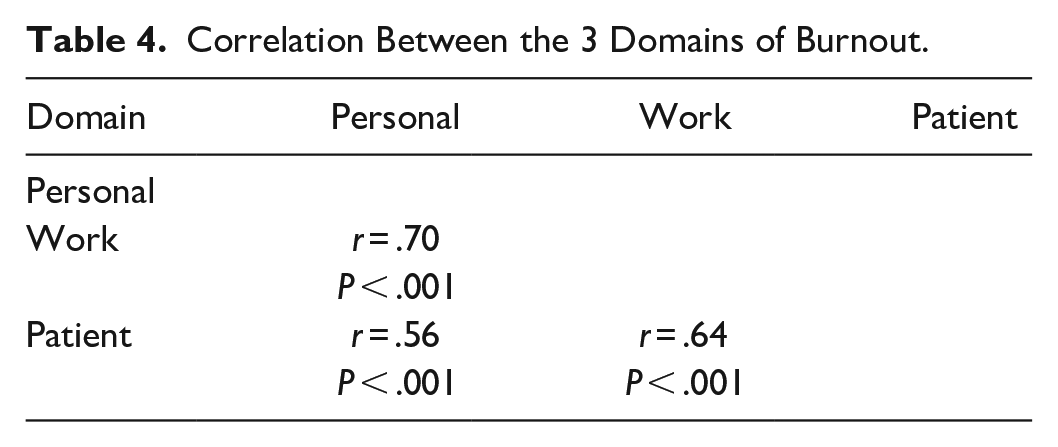
The correlation between the 3 burnout domains was examined (Table 4). The strongest correlation was between the personal and work-related domains (r = .7, P < .001).
Correlation Between the 3 Domains of Burnout.
Turnover Intention
The results of turnover intention showed that more than half of the sample has the intention to leave (Desire to stay = 41 (46%), Desire to leave = 48 (54%)). However, there were no significant associations between the intention to leave and any socio-demographic, professional, or educational factors, Tables 5 and 6.
Mean ± Standard Deviation of Turnover Intention Scale Score. a

Possible score range for all scales is 1 to 5.
Univariate Analysis of Demographics and Professional Profile on TIS [n (%)].

P-values obtained using chi-square or Fisher exact test.
Burnout and Turnover Intention
The association between the professional burnout and turnover intention was explored, and there were no significant associations between the turnover intention and the average total burnout, regression coefficient, 95% CI, P-value:[−0.016, (−0.04,0.0084), .198], the personal burnout domain, regression coefficient, 95% CI, P-value: [−0.002, (−0.024,0.019), .83], work-related burnout domain, regression coefficient, 95% CI, P-value: [−0.023, (−0.049,0.003), .08], and the patient-related burnout domain, regression coefficient, 95% CI, P-value: [−0.0148, (−0.035,0.005), .158].
Discussion
The ICU is a stressful environment as critical decisions about end-of-life care are made on an hourly basis. Several studies also showed that COVID-19 had affected the level of burnout among healthcare workers, including ICU physicians.7,19,26,39,43 Therefore, increased knowledge about this is important as it may affect the quality of care and patients’ safety.3,7,16
With limited data from Kuwait about ICU physicians’ professional burnout and their intention to leave their job, this study aimed to examine the prevalence of professional burnout among ICU physicians in Kuwait and its effects on their intentions to leave their jobs. This study showed that ICU physicians were experiencing professional burnout in all domains except for the patient-related domain. Although more than half of the sample intended to leave, no statistically significant associations were found between professional burnout, including the 3 domains, or the intention to leave with any socio-demographic, professional, or educational factors. Similarly, no association was found between professional burnout and the intention to leave. The small sample size in the study can explain the unavailability of any significant associations. The non-significant results might also be explained by the non-response bias, 58 especially with the study’s response rate. Another factor is the instruments used to measure burnout and turnover intentions. For instance, studies that found an association between burnout and turnover intentions among ICU physicians19,59 used either a single question or a set of 3 questions to measure turnover, which is different from the TIS-6 questionnaire.
The high professional burnout levels seen in this study are consistent with evidence showing high rates of professional burnout among ICU staff.6,19,39 Also, the turnover rates in this study are similar to the literature. 19 Total, personal, work-related, and patient-related professional burnout were high among those with 5 to 10 years of experience after graduating from medical school. Participants who had less than 6 months of ICU experience before the Covid-19 pandemic also had high levels of personal burnout domain. These results are similar to the evidence showing that burnout levels are high among ICU workers with less experience.60,61 Such results can be explained by the fact that more experienced ICU staff are more resilient and can cope better with work conditions.15,62
Younger participants, less than 35 years, have high levels of total, work-related, and patient-related burnout. This result is also consistent with the literature, as some studies showed high levels of professional burnout in younger ICU workers.61,63,64 This can be explained by the fact that younger ICU physicians are more prone to professional burnout. 65 Divorced participants had high levels of total and patient-related professional burnout levels, which is also similar to other studies in the literature.60,63
This study also showed that non-Kuwaiti participants had high levels of personal burnout, which is consistent with the evidence in the literature that non-nationals are more prone to professional burnout. 66 This can be related to the fact that non-national physicians are not receiving professional support and have less work-related well-being than national physicians. 67 This study also showed that participants who worked in 3 GGHs during the Covid-19 pandemic had high levels of work-related burnout, which is also consistent with the evidence on the effect of the pandemic on healthcare workers’ professional burnout.6,26,68
Despite the government’s attempts to enhance ICU physicians’ retention by increasing their salaries by 500 Kuwaiti Dinars (approximately 1600 United States Dollars) in July 2021, 69 the results of this study showed that they still intend to leave their posts, which might indicate that the reason for turnover intention might not be financial. Other studies in the literature have supported this notion. For instance, work conditions, such as the fear of Covid-19, were linked to turnover intentions. 25 Other working conditions, include workload, staff-to-patient ratio, 70 and working hours linked to ICU workers turnover. 71 Other studies identified personal or familial factors influencing ICU physicians’ turnover intentions. 71 Job satisfaction71,72 and career prospect were also factors affecting turnover intentions. 71 The ethical climate and moral distress can be other elements that influence ICU workers’ turnover intentions. 73
Despite being the first study to examine professional burnout and turnover intentions among ICU physicians in Kuwait, this research has some limitations. Due to the cross-sectional study’s methodology, the results cannot be generalized or confirm an association between professional burnout or turnover and other factors. The small sample size is another limitation; however, this study covered more than 50% of the ICU physicians in Kuwait GGHs, which is small due to the country’s context and the size of the services provided. Although a sample size calculation was not performed, which might be seen as a limitation, all the targeted sample were invited to participate in the study. Another limitation was using bivariate association calculations and not adjusting for other factors. Moreover, the sampling period was from July to August 2022, in which Kuwait experienced a mild COVID resurgence after a COVID recovery from a very high March 2022 infection rate. 74 Therefore, one cannot assess the direct possible confounding of Covid exposure on physician professional burnout and intent to leave. Such evidence demonstrates the complexity and multidimensional nature of burnout and turnover intentions.
Implications to the Practice
This study shed some light on potential factors that might affect ICU physicians’ professional burnout and their intention to leave their jobs. Results from this study may support stakeholders in the MOH to investigate the studied factors and adopt policies that prevent and mitigate burnout among ICU physicians. Prevention can be achieved through implementing burnout prevention programs. 75 Reducing the effect of burnout should be on a personal level, such as psychological and peer-support groups, 76 and organizational level, such as reducing working hours. 77
Future Work
Future research may examine the negative mental and psychological consequences of professional burnout. Future studies may also aim to test the relationship and association between burnout and intention to leave using a larger sample of healthcare workers. Moreover, as professional burnout can also affect health systems and organizations by adversely affecting the quality of care, patient safety, and patient satisfaction, more research is needed to assess this effect on the healthcare system in Kuwait.
Conclusion
ICU physicians in Kuwait are prone to professional burnout and have high turnover intentions. Less work experience and younger age are related to higher professional burnout levels. Policymakers should adopt and implement support strategies that protect physicians and help them cope with professional burnout. Also, ICU physicians’ retention policies and strategies should be considered. Future research is needed to confirm the results and explore the associated factors with professional burnout and turnover among ICU physicians.
Supplemental Material
sj-docx-1-inq-10.1177_00469580231206253 – Supplemental material for The Association of Professional Burnout and Turnover Intentions Among Intensive Care Units Physicians: A Cross-Sectional Study
Supplemental material, sj-docx-1-inq-10.1177_00469580231206253 for The Association of Professional Burnout and Turnover Intentions Among Intensive Care Units Physicians: A Cross-Sectional Study by Abdulaziz Alhenaidi, Asmaa Al-Haqan, Hisham Kelendar, Bader Al-Bader, Omar Alkandari and Homoud Al-Zuabi in INQUIRY: The Journal of Health Care Organization, Provision, and Financing
Footnotes
Acknowledgements
The authors would like to thank all ICU physicians who participated in this study.
Contributors
All authors of the paper have contributed to the final manuscript. Conceptualization (Abdulaziz Alhenaidi, Asmaa Al-Haqan, Hisham Kelendar); methodology, (Abdulaziz Alhenaidi, Asmaa Al-Haqan, Hisham Kelendar, Omar Alkandari, Bader Al-Bader); formal analysis (Omar Alkandari); writing—original draft preparation (Abdulaziz Alhenaidi, Asmaa Al-Haqan); writing review and editing, (Hisham Kelender, Omar Alkandari); supervision, (Bader Al-Bader, Homoud Al-Zuabi). All authors have read and agreed to the published version of the manuscript.
Declaration of Conflicting Interests
The author(s) declared no potential conflicts of interest with respect to the research, authorship, and/or publication of this article.
Funding
The author(s) received no financial support for the research, authorship, and/or publication of this article.
Ethical Considerations
The Kuwait Ministry of Health scientific research ethics committee approved this research (Approval: 2022/1966) on May 17, 2022. A consent form was furnished to respondents for review and signature before starting the survey.

Supplemental Material
Supplemental material for this article is available online.
References
Supplementary Material
Please find the following supplemental material available below.
For Open Access articles published under a Creative Commons License, all supplemental material carries the same license as the article it is associated with.
For non-Open Access articles published, all supplemental material carries a non-exclusive license, and permission requests for re-use of supplemental material or any part of supplemental material shall be sent directly to the copyright owner as specified in the copyright notice associated with the article.
