




Abstract
The COVID-19 pandemic changed various lifestyle habits worldwide due to the prevention measures implemented in each country, these changes may affect or benefit people’s health. We aimed to systematically review changes in diet, physical activity (PA), alcohol consumption, and tobacco use habits during the COVID-19 pandemic in adults. Two databases: PubMed and ScienceDirect, were used for this systematic review. The research was limited to open-access, peer-reviewed original articles published in English, French, or Spanish from January 2020 to December 2022 and investigated diet, PA, alcohol consumption, and tobacco use habits before and during the COVID-19 pandemic in adults. Excluded studies were review studies, intervention studies with a sample size of fewer than 30 participants, and poor-quality articles. This review followed PRISMA 2020 guidelines (PROSPERO: CRD42023406524), whereas to assess the quality of the studies, we used the quality assessment tools developed by the BSA Medical Sociology Group for cross-sectional studies and the QATSO for the longitudinal studies. Thirty-two studies were included. Some studies reported changes to promote healthy lifestyles; 13 out of 15 articles reported an increase in healthy diet consumption habits, 5 out of 7 studies reported a decrease in alcohol consumption, and 2 out of 3 studies reported a decrease in tobacco use. On the other hand, the other studies reported changes to promote unhealthy lifestyles: 9 out of 15, and 2 out of 7 studies reported an increase in unhealthy diet and alcohol consumption habits respectively, 25 out of 25 reported a decrease in physical activity, and 13 out of 13 reported an increase in sedentary behavior. During the COVID-19 pandemic, there have been changes to promote a healthy and unhealthy lifestyle; the latter can affect people’s health. Therefore, effective responses are needed to mitigate the consequences.
● Lifestyle has a significant influence on physical and mental health. An unhealthy lifestyle is a risk factor for various diseases, and a healthy lifestyle is recommended for preventing various diseases and maintaining good health.
● This systematic review highlights diet, physical activity, alcohol consumption, and tobacco use habits changes during the COVID-19 pandemic in adults worldwide and shows the changes that may promote healthy or unhealthy lifestyles.
● Following this thread, public health institutions will have evidence-based information to know where to focus efforts that help mitigate unhealthy lifestyles. The strategies could be implemented considering the health consequences in the short and long term.
Introduction
The COVID-19 pandemic was caused by a new coronavirus SARS-CoV-2. 1 Due to its rapid spread and increased morbidity and mortality worldwide, many countries implemented various preventive measures. 2 These actions may affect lifestyle habits, and consequently, the population’s health.
A healthy lifestyle is important for the prevention of various diseases and for maintaining good health. According to the World Health Organization, eating healthy food helps prevent malnutrition and chronic diseases. On the other hand, unhealthy foods such as high-calorie foods, insufficient fruits and vegetables, and low fiber and high salt content consumption have been associated with several chronic diseases. 50 During the pandemic, an increase in stress, anxiety, depression, and insomnia was observed, as well as a decrease in concentration or work performance, and these changes could also affect dietary behavior. A study reported by Ramón-Arbués et al 4 in Spain showed that the presence of anxiety, depression, stress, and low-quality sleep affects food choices and is also associated with an elevated consumption of unhealthy foods such as products high in carbohydrates and fats.
Regular physical activity is beneficial for physical and mental health, preventing various diseases like type 2 diabetes, hypertension, anxiety, and depression, among others. The World Health Organization recommends that all adults perform physical activity for at least 75 min of high intensity or at least 150 min of moderate-high intensity combined per week to be physically active and get this benefits. 51
Alcohol consumption is related to a whole series of health problems, including mental and behavioral disorders. Alcohol dependence is associated with severe non-communicable diseases, such as liver cirrhosis, some types of cancer, and cardiovascular diseases, and is also associated with injuries and deaths due to violence and traffic accidents.52,53
Tobacco use causes a series of widely known alterations, such as coronary heart disease, cerebrovascular disease, and cancers of the lung, oral cavity, larynx, esophagus, stomach, kidney, pancreas, and cervix, among others. 53
It seems that the COVID-19 pandemic had an impact on lifestyle factors such as changes in physical activity, eating behaviors, alcohol consumption, and tobacco use. 3 Confinement at home, coupled with an unhealthy lifestyle, may cause mental health problems such as anxiety, stress, and depression, which may be associated with eating disorders and alcohol consumption.4,5 On the other hand, the pandemic of COVID-19 may promote a healthy lifestyle due to the longer time that people stay at home, compared to the pre-pandemic period. 42 Currently, there is interest in knowing and evaluating whether the various restriction measures due to the pandemic caused lifestyle changes and whether these changes are healthy or unhealthy.
Currently, no systematic review has addressed changes in lifestyle habits comparing the periods before and during the COVID-19 pandemic in adults, nor the type of changes that occurred. Therefore, this review aims to understand to what extent diet, alcohol consumption, tobacco use, and PA habits have changed due to the COVID-19 pandemic and to assess whether these changes are healthy or unhealthy. Following this thread, strategies can be visualized to prevent the health consequences that lifestyle changes may have in a short-, medium-, and long-term period.
Methodology
This review was designed and conducted based on the PRISMA 2020 statement. 6 Additionally, the manuscript was registered in the International Prospective Register of Systematic Reviews database (PROSPERO) (registration number CRD42023406524). The 2 potential electronic databases, PubMed and Science Direct were used by 2 independent researchers. The first researcher applied eligibility criteria, selected studies for inclusion in the systematic review, and performed the data extraction; the second researcher checked the decisions. The disagreements between researchers’ judgments were resolved based on each researcher’s justification and the study’s aim, and Mendeley was used to record the decisions. The data extracted were: authors, publication year, location, study design, participant number, median or range of age, variables evaluated in each study before and during the COVID-19 pandemic related to diet, physical activity, tobacco use, and alcohol consumption habits, and a P value. The Excel spreadsheet was used to record data.
Quantitative and narrative methods were used for data synthesis. The data for each lifestyle reviewed were synthesized separately. In each lifestyle, we analyzed how many articles reported changes to promote healthy or unhealthy lifestyles and whether there was an increase or decrease in variables studied in each article related to diet, physical activity, tobacco use, and alcohol consumption habits reported in articles from before compared to during the COVID-19 pandemic. The measures considered are the means, frequencies, or percentages of variables studied in each lifestyle.
The following keywords were used to find the relevant articles: dietary habits (title/abstract) OR physical activity (title/abstract) OR alcohol consumption (title/abstract) OR tobacco consumption (title/abstract) AND COVID-19 pandemic (title/abstract). Based on these keywords, we reached the following advanced search strategies in PubMed: Search (( OR (alcohol consumption [title/abstract]))((dietary habits [title/abstract]) OR (physical activity [title/abstract])) OR (tobacco consumption [title/abstract])) AND (COVID-19 pandemic [title/abstract]). The full search strategies for all databases are in the supplement material.
The inclusion criteria applied in this study focused on the characteristics of the article, study design, sample size, study population, publication year, and type of lifestyle habit. The research was limited to open access and peer-reviewed original articles published from January 2020 to December 2022 that reported on dietary habits, PA, consumption of alcohol, and tobacco use before and during the COVID-19 pandemic. In addition, participants must be 18 years of age or older, and cross-sectional and longitudinal studies published in English, French, or Spanish, from any country, were allowed. The translation of Spanish and French articles into English was made by the researchers. Studies excluded were those reporting the lifestyle changes mentioned above based on a diagnosed condition, intervention or studies focused on a specific group of people. We excluded studies assessing lifestyle during the pandemic but did not show how the lifestyle habit was before the pandemic. We also excluded qualitative studies, systematic, narrative, meta-analysis review studies, and those that had a sample size of fewer than 30 participants. We also excluded short communication articles.
The quality assessment tools developed by the BSA Medical Sociology Group were used for the quality assessment of cross-sectional studies, where the quality indicators met out of 7: 1 to 2 (low), 3 to 5 (moderate), and 6 to 7 (high). The QATSO was used for the longitudinal studies, where the quality indicators met out of 100%. Studies achieving 67% or more in the score were regarded as “good” quality, 34% to 66% (fair), and below 33% (poor).48,49 The articles of low or poor quality were removed. The PRISM diagram for the systematic review process for identifying articles included in this review is presented in Figure 1.

PRISMA 2020 flow diagram of the study selection process.
Results
A total of 4037 articles from 2 databases were initially identified, and finally, 32 peer-reviewed original articles were selected as eligible to be included in this study (Figure 1). The characteristics of the articles are presented in Table 1. We included 28 cross-sectional studies7,8,10,12-24,26-31,33-38,4 longitudinal studies.9,11,25,32 There is one global study, 38 and 2 or more studies covered different countries: 2 from Saudi Arabia.,7,24 5 from Spain10,25,33,34,36,4 from USA11,14,27,29,2 from the UK17,32,3 from Italy,20,26,37 and 2 from China.13,28 Other countries that were included in one study were Japan, 9 Lithuania, 12 Canada, 16 Germany, 18 Australia, 21 Finland, 22 Hong Kong, 30 Sweden, 31 Rusia, 35 Thailand, 8 Mexico, 15 Brasil, 19 and Turkey. 23
Studies and Participants’ Characteristics.

Note. Ref = Reference; GP = General Population; US = University Students; CS = College Students; UK = United Kingdom; USA = United States of America.
Some studies reported on more than one lifestyle habit. The included studies focused on the habit changes of:
During the analysis of these lifestyle changes, 8 research themes were generated. These include dietary habits changes (food groups recommended for daily consumption and food groups not recommended for daily consumption), PA changes (PA level and sedentary behavior), alcohol consumption changes (frequency and quantity), and tobacco use changes (frequency and quantity of cigarette use habits).
Changes in Dietary Habits During the Pandemic of COVID-19
In this review, we analyzed changes in dietary habits during the pandemic based on the change in consumption frequency of foods, and the number of populations that consumed each food group (the recommended and non-recommended food groups for daily consumption).
Food groups recommended for daily consumption are defined as those for which there is evidence that daily consumption is not associated with chronic diseases or a high risk of being overweight or obese. These groups are fruits, vegetables, legumes, unprocessed meats, water, eggs, and dairy. The food groups not recommended for daily consumption are those whose frequent consumption is associated with a high risk of obesity and overweight, as well as chronic diseases. These groups are fast foods, snacks, processed meats, sweet cereals, sweetened non-dairy beverages, and sweet ened dairy beverages. 39
Fifteen studies reported changes in diet habits during the COVID-19 pandemic (Table 2). Thirteen studies7,10,12,14,16,23-26,30,32,34,36 reported a significant change in the frequency of consumption and the proportion of individuals who consumed food groups recommended for daily consumption. Eleven out of thirteen studies reported changes toward a healthy lifestyle where there was an increase in fruit consumption, legumes, vegetables, adherence to the Mediterranean diet, water, and homemade meals during the pandemic compared to before the pandemic. Mascherini et al 26 reported an increase in consumption frequency per week of fruits, legumes, vegetables, and the Mediterranean diet during the pandemic. These results are supported by 2 other studies.14,30 Sultan et al 7 reported an increase in people who consumed fruits or vegetables every day from 47.2% before the pandemic to 60.2% during the pandemic. This result was supported by 7 other studies that reported an increase in the percentage of individuals consuming fruits, vegetables, legumes, a Mediterranean diet, water, and homemade meals every day during the pandemic.10,12,23-25,34,36 By contrast, only 2 out of 13 studies reported changes toward unhealthy lifestyles, such as a decrease in the consumption frequency of fruits, vegetables, and dairy products during the pandemic of COVID-19.16,32
Changes in Dietary Consumption Habits During the Pandemic of COVID-19 (n = 15).
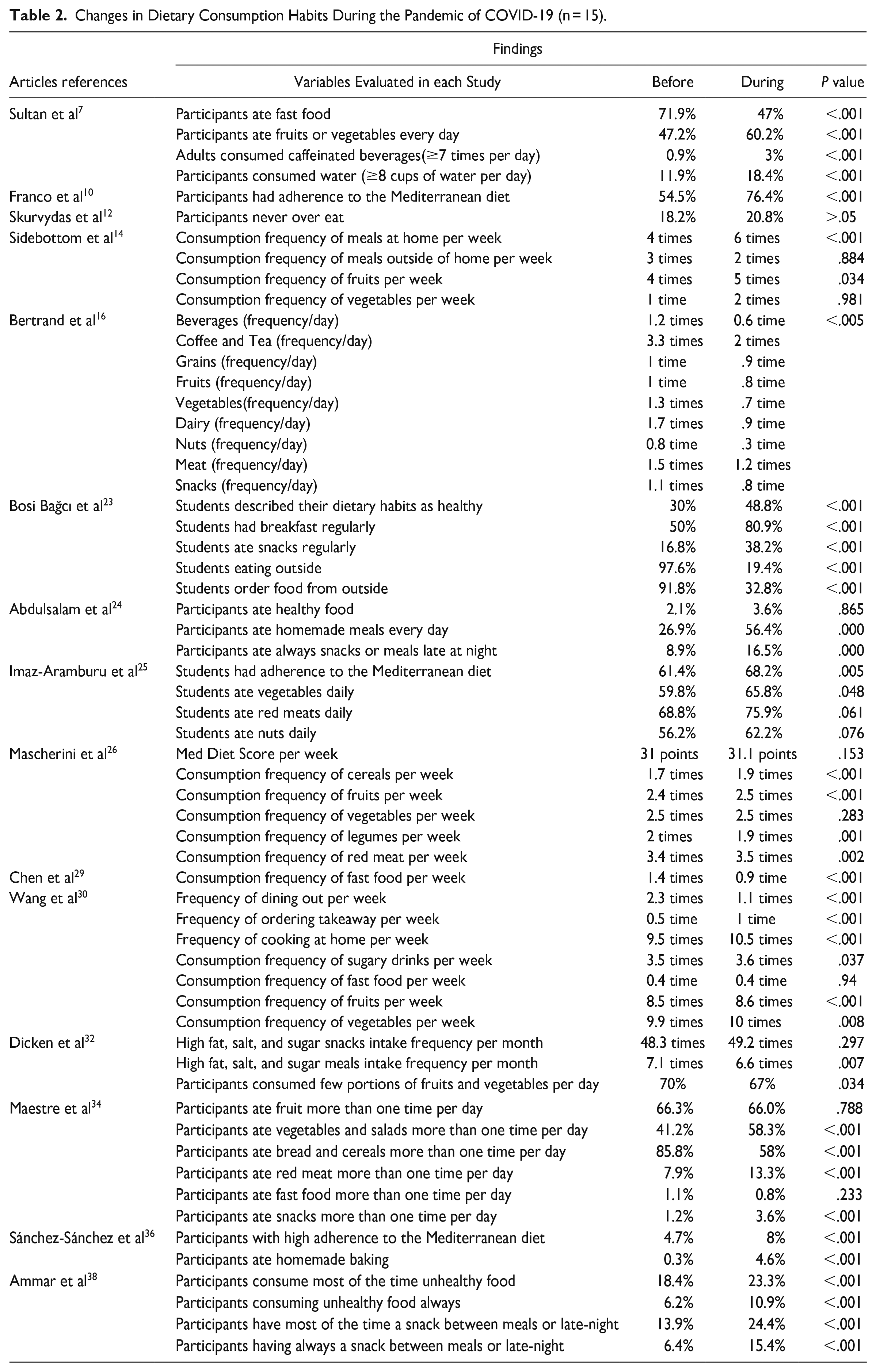
Twelve studies reported a significant change in the frequency of consumption and the proportion of individuals who consumed food groups not recommended for daily consumption.7,14,16,23-26,29,30,32,34,38 Nine of them reported changes toward a healthy lifestyle where there was a decrease in the consumption frequency and proportion of people who consumed fast foods, sweet beverages, red meat, snacks, sweet cereals, and ate outside of the home.7,14,16,23,26,29,30,32,34 Sidebottom et al 14 reported that the frequency of people who consumed meals at home increased significantly during the pandemic. These results are supported by 2 other studies.23,29 Only 2 studies showed a decrease in sweet cereal intake,32,34 and the other 2 reported a decrease in the frequency of consumption of red meat.16,26 Bertrand et al 16 only reported a decrease in sweet beverage intake, snacks, and nuts during the COVID-19 pandemic. On the other hand, 9 out of 12 studies reported changes toward unhealthy lifestyles, such as an increase in the frequency of consumption as well as in the number of people that consumed snacks, sweet beverages, processed meats, nuts, and sweet cereals.7,23-26,30,32,34,38
Ammar et al 38 reported an increase in the proportion of people (13.9%-24.4%) that ate snacks between meals or late at night. These results are supported by 4 other studies that reported an increase in the consumption frequency and in the number of persons that consumed snacks and processed meat during the COVID-19 pandemic.23,24,32,34 Similarly, Imaz-Aramburu et al 25 reported a rise (68.8%-75.9%) in the percentage of individuals that ate processed red meats daily. These data are similar to the results obtained in the other 2 studies.26,34
Changes in Physical Activity During the COVID-19 Pandemic
Changes in physical activity were reported in 25 studies (Table 3). We analyzed the changes in PA habits in 2 ways: (a) changes in PA level and time spent doing PA, and b) changes in time spent in sedentary behavior. Almost all the 25 studies that reported physical activity habits showed the same results: there have been changes in physical activity behavior that promoted unhealthy lifestyles during the COVID-19 pandemic, such as a decrease in PA level, less time spent doing PA, and an increase in sedentary behavior. The decrease in PA level is reported in 13 studies: Franco et al 10 showed a decrease in the proportion of people with low and medium PA in Spain, from 48.8% before to 36% during the pandemic, and similar results are reported in 12 other studies.7,11,12,14,16,18,20,24,25,28,35,36 Fifteen studies reported a decrease in people’s time doing PA during the COVID-19 pandemic: Bertrand et al 16 reported a decrease in time spent in moderate-vigorous PA per week from 85 min before to 65 min during the pandemic; these results are similar to those reported in other 14 studies.8,9,15,19,22,26,28-31,33,35,37,38
Changes in Physical Activity (PA) and Sedentary Habits During the Pandemic of COVID-19 (n = 25).

Note. MET = Metabolic Equivalent of Task, MVPA: Moderate to Vigorous Physical Activity, MPA: Moderate physical activity, VPA: Vigorous physical activity.
The increase in time that people spent on sedentary behavior was reported in 13 studies.9-11,14,16,19,26,29-31,33,37,38 Rees-Punia et al 11 found an increase in the time that people spent sitting per day from 7.46 to 9.19 h before and during the pandemic, respectively. Similar results are reported in the other 12 studies.
Changes in Alcohol Consumption During the Pandemic of COVID-19
Seven studies included in this review were related to alcohol consumption before and during the pandemic (Table 4). Five of them12,14,17,21,22 reported changes to promote healthy lifestyles where there was an increase in people who did not drink alcohol during the pandemic, as well as a decrease in the frequency of alcohol consumption per week and average drinks per day. Skurvydas et al 12 reported an increase in people who did not drink alcohol in Lithuania from 14.5% before to 16.6% during the pandemic. On the other hand, only 2 out of 7 studies reported changes toward an unhealthy lifestyle where there was an increase in people exceeding alcohol drink limits, as well as an increase in the alcohol consumption frequency per week during the pandemic of COVID-19.27,29 Barbosa et al 27 reported in their study an increase in people who exceeded drinking limits from 30.11% before to 36.11% during the pandemic. Similarly, Chen et al 29 reported an increase in the consumption frequency of alcohol from 3.01 to 4.24 times per week, during the pandemic in the USA.
Changes in Alcohol Consumption Habits During the Pandemic of COVID-19 (n = 7).

Tobacco Use Changes During the COVID-19 Pandemic
In this review, we found only 3 studies7,13,29 that estimated tobacco use before and during the pandemic (Table 5). Two of them reported changes to promote a healthy lifestyle where there was a decrease in people who smoked and a decrease in the number of cigarettes used before versus during the pandemic. Sultan et al 7 in their study in Saudi Arabia, reported a decline in people who smoked from 18.3% before to 15.7% during the pandemic. Similarly, Yang and Ma 13 in their study in China reported a decrease in the number of cigarettes smoked per day from 11.02 before to 2.25 during the pandemic. Only one study from the United States of America reported a slight increase in the proportion of individuals who increased their smoking frequency per day, from 9.28% before to 9.8% during the pandemic. 29
Changes in Tobacco use Habits During the Pandemic of COVID-19 (n = 3).

Discussion
This study aimed to systematically review the changes in diet, PA, alcohol consumption, and tobacco use habits before and during the COVID-19 pandemic in adults. The overall quality of studies in the present review is moderate. In general, we found changes in lifestyle habits during the COVID-19 pandemic that may promote healthy and unhealthy lifestyles.
Regarding the changes in dietary habits during the pandemic, we found an increase in the intake of food groups recommended for daily consumption, such as legumes, vegetables, fruits, and water, as well as the Mediterranean diet in most countries. These changes can be explained by an increase in the time people spent at home to prevent COVID-19 propagation. Therefore, people had more time to buy, cook, and eat a healthy diet, which can increase the consumption of fresh and accessible food. 42 Also, there was a decrease in the consumption of food groups not recommended for daily consumption, like high-calorie-rich foods such as fast food; this decrease could be due to the closing of most fast-food restaurants during the pandemic. 44 On the other hand, we found a decrease in the consumption of food groups recommended for daily consumption and an increase in the consumption of food groups not recommended for daily consumption (snacks, sweet beverages, and cereals). This behavior can be explained by the time that individuals spent at home during the pandemic watching movies or doing other sedentary activities. The increase in high-calorie food intake is associated with overweight and obesity, as well as with other chronic diseases.40,41 De Luis Roman et al 43 reported an increase in body weight in people who raised their consumption of snacks compared to people who did not consume snacks during the 7 weeks of the COVID-19 pandemic in Spain.
Regarding physical activity behavior, we found that during the COVID-19 pandemic, the physical activity level and time people spend doing PA decreased, and sedentary behavior increased in most parts of the world. These changes were due to different COVID-19 prevention measures implemented, especially confinement, which may be associated with stress, anxiety, and depression. These mental health problems could also impact eating behavior, which was associated with elevated intake of high-calorie foods and consumption of alcohol and tobacco.3-5 Physical inactivity and an unhealthy diet were also reported to be associated with weight gain, overweight, obesity, and non-communicable diseases. 45 De Luis Roman et al 43 reported an increase in body weight in people who did not perform physical activity compared to people who performed regular PA during the pandemic in Spain.
Changes in alcohol consumption habits during the COVID-19 pandemic were positive in most countries, where there was a decrease in the quantity and frequency of alcohol consumption, except in the United States of America. Social distancing and home isolation could explain these findings and also the possible economic consequences. 46 However, more research is needed in different countries to confirm this hypothesis, as there are only a small number of studies on alcohol consumption before and during the COVID-19 pandemic. The increase in alcohol consumption in the USA can be explained by the rise in alcohol sales by more than 20% during the COVID-19 pandemic in the country.54,55,56
Regarding tobacco use habits during the COVID-19 pandemic, the results show a decrease in the number of people who smoked, the number of cigarettes, and the frequency per day. This decrease may be related to the knowledge that people received from communication media, and also due to economic consequences.46,47 More research is required to know the smoking situation in many countries and the reason behind it, as there are only 3 studies in this review about tobacco use. Thus, this smoking reduction may have a positive health impact not only for those who reduced or stop smoking but also for those who are exposed to secondhand smoke.
Generally, the results in this study show changes in diet, physical activity, alcohol consumption, and tobacco use before/during the COVID-19 pandemic that may promote healthy or unhealthy lifestyles. This information may help public health directors and staff to develop strategies that could prevent the health consequences that changes in lifestyle due to COVID-19 or future pandemics can cause in physical and mental health status in the short, medium, and long-term periods.
Limitations and Strengths of the Study
One limitation is that most studies included in this review were cross-sectional and used online self-reported data, which can lead to misreporting or underreporting. In most of the studies, the people who participated before and during the pandemic were not the same, and the sampling technique was not random. Therefore, the risk of bias, such as sampling bias and self-reporting bias in each study included in this review was high, so the results are difficult to generalize. The other limitation is that only 2 databases were used in this review. As a strength, this review focused on the analysis of 4 lifestyle habit changes during the COVID-19 pandemic. The study not only shows changes that promote unhealthy lifestyles but also shows changes toward a healthy lifestyle. The evidence included in this review is from before and during the pandemic. Another strength is that peer-reviewed articles in English, French, and Spanish were included and came from all over the world.
Conclusion
We found changes before versus during the COVID-19 pandemic, which promote healthy lifestyles, such as an increase in the consumption of the Mediterranean diet, vegetables, and fruits, and a decrease in the consumption of fast foods. Also, an increase in the consumption of homemade diets and a decrease in alcohol intake and tobacco use in most countries. On the other hand, there was an increase in the consumption of processed red meat and caloric-rich food products, a decrease in physical activity, and an increase in sedentary behavior, related to unhealthy behavior. The latter may affect people’s mental and physical health in the short and long term. Emergency responses are needed to mitigate the consequences of an unhealthy lifestyle.
Supplemental Material
sj-docx-1-inq-10.1177_00469580231175780 – Supplemental material for Changes in Diet, Physical Activity, Alcohol Consumption, and Tobacco Use in Adults During the COVID-19 Pandemic: A Systematic Review
Supplemental material, sj-docx-1-inq-10.1177_00469580231175780 for Changes in Diet, Physical Activity, Alcohol Consumption, and Tobacco Use in Adults During the COVID-19 Pandemic: A Systematic Review by Paul Marcel Nindenshuti and Graciela Caire-Juvera in INQUIRY: The Journal of Health Care Organization, Provision, and Financing
Footnotes
Authors’ Contributions
PMN applied eligibility criteria, selected studies for inclusion, extracted data, and wrote the manuscript. GCJ checked the analysis decision and reviewed the manuscript.
Declaration of Conflicting Interests
The author(s) declared no potential conflicts of interest with respect to the research, authorship, and/or publication of this article.
Funding
The author(s) received no financial support for the research, authorship, and/or publication of this article.
Ethics Declaration
Our study did not require ethical board approval because our study is a systematic review.
Informed Consent
Our study did not require informed consent for participants because our study is a systematic review.
Presence of Declarations,and Ethics and Consent Statements
For this systematic review, no ethical/consent concerns were needed. We only checked the available literature in two databases.

Supplemental Material
Supplemental material for this article is available online.
References
Supplementary Material
Please find the following supplemental material available below.
For Open Access articles published under a Creative Commons License, all supplemental material carries the same license as the article it is associated with.
For non-Open Access articles published, all supplemental material carries a non-exclusive license, and permission requests for re-use of supplemental material or any part of supplemental material shall be sent directly to the copyright owner as specified in the copyright notice associated with the article.
