




Abstract
Background
The nationwide lockdown imposed due to the COVID-19 pandemic disrupted daily routines, especially for children. Being at home and attending virtual classes unintentionally precipitated an increase in both academic and nonacademic screen time and probably led to decreased physical activity in children. However, there is lack of evidence related to the physical activity and screen time of school-age children during the COVID-19 pandemic. So this study aimed to investigate the effect of the COVID-19 pandemic and lockdown on physical activity and screen time of children.
Methods
An online survey was used to recruit parents of school-age children through convenience sampling. Parents were asked to compare their child’s physical activity and screen time in the previous week with those in the pre-lockdown and lockdown periods. The global physical activity questionnaire was used to assess physical activity, and a screen time questionnaire was developed and validated. Data collection was done from September 2020 to December 2020.
Results
Data of 104 children were collected from parents’ reports. The average age of parents was 39.1 + 4.8 years for mothers and 40.8 + 6.9 years for fathers. Results revealed a decrease in physical activity from 564.95 min/week before the lockdown to 146.05 min/week during the lockdown, with the absolute decrease of 448.9 min/week. Total screen time increased from 2.42 h/day before the lockdown to 7.41 h/day during the lockdown.
Conclusion
Necessary steps to mitigate the effect of COVID-19 pandemic unintentionally affected children in terms of decreased physical activity and increased screen time.
Background
Physical activity confers many health benefits in children.1–3 The World Health Organization (WHO) defines “physical activity as a bodily movement produced by skeletal muscles that substantially elevates energy expenditure.” 4 It is recommended that children and adolescents should do at least 60 minutes of moderate to vigorous-intensity physical activity per day, throughout the week.
COVID-19 restrictions due to lockdown and closure of schools affected over 32 crore children in India. 5 As a preventive measure against the COVID-19 pandemic, the Government of India ordered a nationwide lockdown on March 22, 2020. 6 Closure of schools due to lockdown and encouraging children to stay safe within their homes affected their daily routines. 7 It may have unintentionally decreased their physical activity and increased their screen time, which could result in negative health consequences. 8
Structured settings like schools play an important role in meeting the physical activity requirement of school-going children. 9 Traveling to school and other activities such as physical education classes, recess, play, dance, games, sports, and so forth help children to meet this requirement. However, most of their sedentary time and sleep are accumulated at home. Although meeting the recommended level of physical activity requirement of children and adolescent was challenging even before the pandemic,10, 11 school closures and physical distancing measures due to the pandemic further affected the opportunities to meet physical activity guidelines. 12
Physical inactivity is also associated with increased screen time and childhood obesity. 13 Screen time is the amount of time spent using a device such as a computer, television, mobile phones, and so on. With an increase in technologies, the use of these devices among adolescents has increased, which has led to a more sedentary lifestyle. Due to the advancement in technologies, outdoor activities have been replaced with indoor activities. Children are more attracted toward screen media usage. Increased screen time has a negative health consequence affecting both physical and mental well-being.14–16
Both physical inactivity and increased screen time were prevalent among children17, 18 even before the pandemic. With screens virtually everywhere, controlling a child’s screen time was challenging even before the COVID-19 pandemic. Nationwide lockdown precipitated the increase in both academic and nonacademic screen time and decreased the physical activity. 19
Evidence suggests that physical inactivity and increased screen time have a negative impact on the health of children. The COVID-19 pandemic may have adversely affected children’s physical activity and screen time. Several studies have been conducted to assess the physical activity of school children. However, we could not find any study related to the physical activity of school-age children during the COVID-19 pandemic. So this study aimed to investigate the effect of the COVID-19 pandemic and lockdown on physical activity and screen time of school children.
Methods
A descriptive cross-sectional study was done to assess the effect of COVID-19 pandemic and lockdown on the physical activity and screen time of school children. A total of 104 subjects were enrolled in the study. Inclusion criteria of the study were as follows: parents of school-going children of all ages who were willing to participate and were residents of Chandigarh. An online survey was used to recruit parents of school-going children through convenience sampling. Parents were asked to compare their child’s physical activity and screen time in the week previous to the pre-lockdown and lockdown periods. An online semi-structured questionnaire was developed by using Google Forms with a consent form appended to it. A tool was developed after reviewing the literature and consulting experts. Content validity of the tool was established by giving it to experts in the field of nursing and community medicine. The link of the online survey was shared through e-mails and WhatsApp messages with the initial eligible contacts of all the investigators. However, the participants were encouraged to forward the link to as many people as possible who fulfilled the eligibility criteria. Data were collected in English, Hindi, and Punjabi languages.
Study Tools
The questionnaire consisted of three sections:
Section I consisted of sociodemographic details, which included age, gender, education, occupation, and so on.
Section II was used to measure the physical activity of school children and consisted of the global physical activity questionnaire (GPAQ) developed by WHO. Cleaning of GPAQ data and calculation of moderate to vigorous MET minutes per week, minutes per day, and sedentary minutes per day were performed according to the WHO GPAQ analysis guidelines. 20
Section III of the questionnaire was developed to assess children’s screen time for both academic (i.e., online classes and school-related work) and nonacademic (e.g., watching movie, computer, or video games and using the internet and other electronic media for leisure)work was assessed. All the screen times were summed up to measure the total screen time.
Parents of school-going children were asked to compare their child’s physical activity and screen time in the last week (of data collection period) with those in the pre-lockdown and lockdown periods. Data of child’s physical activity and screen time in the last week as well as the change in physical activity and screen time from the before the lockdown (before March 22, 2020) to during the lockdown (up to June 30) were collected. Data collection was done from September 2020 to December 2020.
Results
A total of 104 valid responses were received from the parents of school-going children. Among the participating parents, 57% were mothers, 40.9% fathers, and 2.1% local guardians. The average age of parents was 39.1 + 4.8 years for mothers and 40.8 + 6.9 years for fathers. About half of the children in the study were female. Children’s ages ranged from 4 to 16 years with the mean age of 10.71 + 3.92 years.
Physical activity was measured using GPAQ. As shown in Table 1, there was a decrease in physical activity (min/week) from 564.95 min before the lockdown to 146.05 min during the lockdown with an absolute decrease of 448.9 min/week. However, if we compare physical activity during the lockdown to that during the previous week, there was an increase of 227.01 min. The proportion of inactive children also increased from 31.7% before the lockdown to 71.1% during the lockdown. Also, the prevalence of sufficient physical activity (>600 MET) decreased from 50% before the lockdown to 19.2% during the lockdown. However, it increased to 37.5% in the previous week as compared to during lockdown but was not equal to the pre-lockdown period.
Perceived Changes in the Physical Activity and Screen Time of School Children Before and During the Pandemic (N = 104).
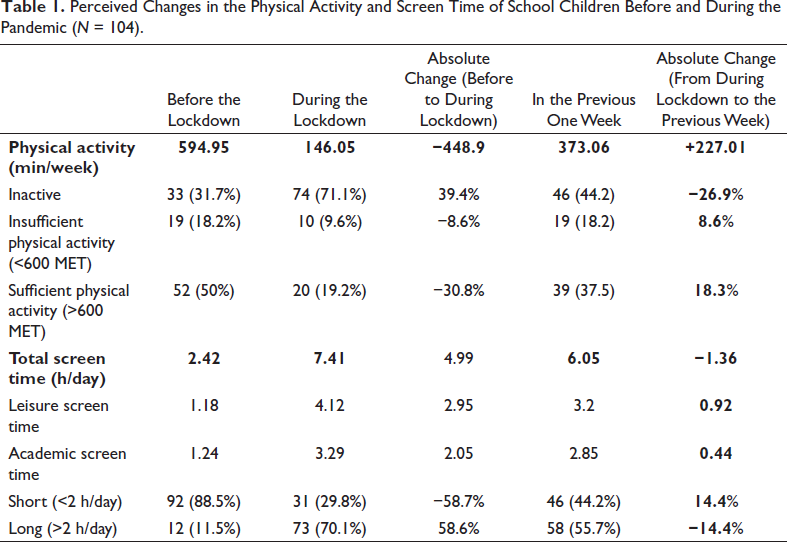
As regards screen time, there was an increase in both academic and nonacademic screen time of children during the lockdown as compared to before the lockdown. Total screen time increased from 2.42 h/day before the lockdown to 7.41 h/day during the lockdown. Screen time in the previous week was reported to be 6.05 h/day. The proportion of children with increased screen time (>2 h/day) increased from 11.5% before the lockdown to 70.1% during the lockdown and was 55.7% in the previous week.
Overall, the parents perceived that the physical activity of children had decreased during the lockdown compared to the pre-COVID times. Although there was some increase in physical activity and decrease in screen time from lockdown to the previous week, it was not the same as in the pre-lockdown times They also reported that there was not much change in the physical activity in the previous week (last seven days) of data collection even when the unlocking process was on.
Discussion
Physical inactivity and sedentary lifestyles are the major risk factors for noncommunicable diseases. 21 Meeting physical activity requirements of children was a challenge even before the pandemic. 22 However, COVID-19 pandemic further affected it because of increased screen time of children. So this study was undertaken to assess the impact of lockdown on the physical activity and screen time of children. Data were collected during the period from September to December 2020, when the unlocking process had already started and there was ease in restrictions that were imposed due to lockdown. However, during this time also, schools remained closed and school-age children stayed in their homes. The mean age of the parents was 39.1 + 4.8 years for mothers and 40.8 + 6.9 years for fathers. Familiarity with and more use of social media by the young population can be a reason for this.
Our study found that there was a decrease in physical activity and increase in the screen time of children as per the parents’ reports. The findings are similar with a study done in the United States, where parents perceived children’s physical activity had decreased, whereas children’s sedentary behavior had increased between the pre-COVID-19 period and the early COVID-19 period. 23 Another study on physical activity and screen time of children during COVID-19 pandemic reported that the median time spent in physical activity decreased drastically, from 540 min/week (before the pandemic) to 105 min/week (during the pandemic), yielding 435 min reduction on average. These findings are similar to that of our study, in which a decrease of 448.9 min/week of physical activity was found from the pre-lockdown period to during the lockdown. The proportion of inactive children also increased from 31.7% before the lockdown to 71.1% during the lockdown in our study, which was similar to the above-mentioned study, where the prevalence of physically inactive students extensively increased from 21.3% to 65.6%. 24
Total screen time increased from 2.42 h/day before the lockdown to 7.41 h/day during the lockdown and remained at 6.05 h/day in the previous week. Our findings are in consensus with the study done elsewhere where the screen time considerably increased during the pandemic in total (+1,730 min [or approximately 30 h] per week on average). 20
Our study reported that there was not much change in the physical activity in the last seven days of data collection even when the unlocking process was on. This may be because during this time also schools remained closed and also because once adopted, these behaviors are difficult to change. So one of the important public health concerns is preventing these changes from becoming permanent. Some of the practical solutions are to incorporate some form of physical activity at home, such as yoga, or to give some activity breaks during online classes for children. A study by Dunton et al. also reported a change in the location and type of physical activity of children during COVID-19 pandemic as a measure to incorporate physical activity in their daily routine.
Limitations
The study also had certain limitations; that is, there may be a possibility of recall bias as the parents were asked to report the physical activity of their children during pre-lockdown and during lockdown, in addition to the last seven days. Moreover, working parents may not be very well aware of their child’s physical activity before the lockdown. The use of convenience sampling limits the generalizability of the study findings. Since the study was limited to people who were using and were familiar with any form of social media, which may represent more educated and privileged population groups, so the results may not be applicable to the whole population. There may be a possibility of social desirability bias due to self-reported data.
Conclusion
Necessary steps to mitigate the effect of COVID-19 pandemic unintentionally affected the children in terms of decreased physical activity and increased screen time. However, necessary measures need to be taken in order to avoid permanent change in the behavior of children.
Footnotes
Declaration of Conflicting Interests
The authors declared no potential conflicts of interest with respect to the research, authorship, and/or publication of this article.
Ethical Approval
Ethical approval was obtained from the Institute Ethics Committee of PGIMER, Chandigarh.
Funding
The authors received no financial support for the research, authorship, and/or publication of this article.
Informed Consent
An online informed consent was taken from the subjects. A consent form was appended with the questionnaire. Consent was the required field, and the subjects were able to proceed to the questionnaire part only after giving their consent.