




Abstract
This study aims to determine the burden of COVID19-induced internet addiction and related psychosocial factors among the Pakistani sample. A web-based cross-sectional survey was conducted from January to March 2021. An analytical cross-sectional survey was broadcast on the internet via a Google form completed by 1145 Pakistanis. Individuals aged 13 years and above with competency to comprehend English or Urdu language, currently residing in any province of Pakistan, having access to the questionnaire, and willing to participate were eligible to participate. Overseas Pakistanis were excluded from the study. The outcome is COVID19-induced internet addiction was measured using the validated tool Young’s Internet Addiction Test (IAT). In addition, symptoms of depression, anxiety, stress, and other psychosocial factors were assessed using the validated tool Depression, Anxiety, and Stress Scale-21 (DASS-21). Adjusted odds ratios with a 95% confidence interval were reported using multinomial logistic regression. Most participants were females and youth (between 20 and 24 years). The prevalence of problematic internet users (PIU) and addictive internet users (AIU) was 27.3% and 11.3%, respectively. The odds of extremely severe anxiety among AIU were approximately three times (Adj OR: 2.6 (1.1-7.1), followed by the odds of having extremely severe stress being about five times higher among AIU (Adj OR: 5.4 (1.6-17.6)) as compared to normal internet users (NIU). Amid COVID-19, the burden of internet addiction has surged among the Pakistani populace. This study identified that gender, marital status, depression, stress, anxiety, work situation, and mood changes during the COVID-19 pandemic are significantly correlated with problematic and addictive internet use. Preventative measures against the addictive use of the internet are needed to avoid or mitigate any serious mental health problems.
Study Summary
Strengths
This was a web-based cross-sectional study conducted during the peak time of the COVID-19 pandemic in Pakistan, reflecting the true impact of the pandemic.
The data collection method used (web-based survey) is an efficient and effective tool for screening public health conflicts.
The tools used (IAT and DASS-21) are previously validated tools in the Pakistani setting.
Limitations
Online surveys have inherent methodological constraints in that respondents with biases may choose themselves for the sample.
Online self-reporting surveys have limited generalizability to solely internet users.
Introduction
The 2019 coronavirus disease (COVID-19), undoubtedly the greatest public health catastrophe of recent times and a universal health concern for the past three years, has brought several challenges for the masses and governments alike.1-5 From 1 h to the next, information transmission through digital means became the only available method for the total non-interruption of social and work collaboration. 6 The COVID-19 pandemic, in addition to having a devastating influence on the healthcare system, has unquestionably impacted worldwide social structures and ties. To counteract the influence of social distancing and lockdown, the internet has become more popular and widespread among people of all social strata. 6 Consequently, internet addiction and behavioral issues have been skyrocketed in these unprecedented times. 7 Literature shows that usage of the internet has markedly increased in this period of lockdown.8,9 Globally, studies done in many European countries have shown an increase of about 50% in the rates of internet addiction during the pandemic when compared to before. 10 Similar trends have been observed in India, where excessive internet usage led to increasing amounts of people playing video games and Binge watching. According to surveys in India, during the pandemic, the number of people playing video games has increased 3 times on the Winzio games platform and 200% on Paytm first games. 11 During the pandemic, several reasons have contributed to the rise in internet addiction. The COVID-19 pandemic has imposed an overwhelming economic strain on communities and triggered emotional reactions among the general public. 7 To combat COVID-19, the government imposed measures such as home confinement, constant lockdown, and the closure of all schools, colleges, universities, offices, businesses, and markets, which resulted in work from home and unemployment, all of which have significantly contributed to the factors that cause internet addiction. 12
Problematic internet addiction is an undue obsession or craving for computer use and internet access. 13 Behavioral addictions like this can take on various hidden and appealing forms. These may appear harmless at first, but they can lead to a vicious circle from which it is difficult to recover, often manifested by an increased compulsion to surf the internet, difficulty in withdrawal, dependability, and uncontrollable desires and may sometimes be associated with other comorbidities such as depression, anxiety, and stress. 14 Kamolthip et al 15 explained that problematic internet use was associated with several health issues in a fraction of the youth population and the COVID-19 pandemic may have led to internet addiction and subsequent health problems. The COVID-19 pandemic has led to an economic burden at the community level and propelled the masses to experience emotional reactions, psychological difficulties, and behavioral changes. 7 The levels of depression, anxiety, and stress showed a rising trend during the past pandemics.16,17 According to several studies, high levels of anxiety, depression, post-traumatic stress disorder, psychological distress, and stress were reported in the general population during the COVID-19 pandemic in countries across the USA, Asia, and Europe.18-23
Regional countries such as developing Asian countries observed similar trends of depression, anxiety, stress, and internet addiction during the pandemic. A study of 7 middle-income countries in Asia showed the highest levels of depression, anxiety and stress in Thailand and the lowest in Vietnam. 24 Studies in China and Iran were conducted to see the prevalence of psychological disorders among their population and concluded that a rise was seen in these among the general population, especially the younger ones.25,26 Chen et al conducted several studies among Chinese population across 3-time points: before, during the initial stages, and in the recovery period of the COVID-19 pandemic. They showed that children with moderate and high levels of problematic internet use had higher levels of fear of COVID-19 and perceived weight stigma.27,28 They also proved that problematic smart phone and social media use served as pertinent mediators in the association between psychosocial distress and internet addiction during COVID-19.29-33
A few studies have been conducted in Pakistan during pre-COVID-19 times to determine the burden of internet addiction and associated factors amongst the general population. A cross-sectional study was conducted among undergraduate students reported a severe internet addiction prevalence of 6.1%, with males having higher scores on IAT as compared to females. 34 Another study from pre-COVID times on youth between 18 and 25 years reported a mean internet addiction score of 48.5 among males and 40.1 among females, showing a higher addiction in males as compared to females. 35 The trend of internet addiction in times of the COVID-19 pandemic has also observed a rise in Pakistan. Various press articles and data from the telecom industry indicated a surge in internet usage. The Pakistan Telecommunication Authority claimed a 15% rise in internet usage, whereas telecom companies reported a 25% increase in data usage.36,37 However, no evidence-based research has been conducted to observe the rising internet addiction during the pandemic and its associated factors. Therefore, it is crucial to understand the impact of the COVID-19 pandemic on the use of technology and whether there is a change in internet addiction prevalence before and after the pandemic. Although a few studies have found psychological and sociological risk factors associated with internet addiction, these studies have investigated only a minimal number of risk factors, which does not allow for full comprehension and understanding of the relationship. Therefore, this study aims to determine the burden of internet addiction among the Pakistani population amidst COVID-19 and the psychosocial factors associated with internet addiction, including sociodemographic, health-related, behavioral and environmental factors.
Methods
Study Design
A cross-sectional survey was carried out to determine the burden of internet addiction during the pandemic and the influence of various psychological factors, including depression, anxiety, stress, and other related factors on internet addiction. This open-linked web-based survey circulated from January 2021 using Google form links. Multiple popular Pakistani Facebook groups were targeted. All the people known to the investigators were sent the Google link, and they were requested to forward the same link to their potential contacts. The link was forwarded through the snowball effect. To ensure adequate survey translation in the local language, the English version was reviewed by the psychiatrist and translated into Urdu, and back-translated into English to substantiate comparability of meaning and context. Electronic consent was obtained from all the participants, including parental consent for participants under 18 years to participate in the study. Assent was further verified by taking the contact information of parents/guardians. Ethical approval was obtained from the Institutional Ethical Review Board.
Study Population
Individuals aged 13 years and above with competency to comprehend English or Urdu language, currently residing in any province of Pakistan, having access to the questionnaire, and willing to participate were eligible to participate. Overseas Pakistanis were excluded from the study.
Measures
Outcome
Internet addiction
The outcome of this study was internet addiction which was assessed by the “
Covariates
Depression, anxiety, and stress
Symptoms of depression, anxiety, and stress were screened using the “
Other covariates
Other variables, including sociodemographic, health-related, behavioral, and environmental factors related to the pandemic, were also collected. Details of study variables are explained in Supplemental Figure 1.
Sample Size and Sampling Strategy
The estimated sample size was a minimum of 1063 for determining the burden and related psychological factors of internet addiction. For the burden of internet addiction (PIU and AIU) among the Pakistani population, the burden was expected in the range from 9.7% to 47% with a 5% confidence interval and the significance level of 5%; found a minimum sample of 383 individuals was required.50,51 For assessing the influence of depression, anxiety, and stress on internet addiction, a minimum sample of 924 individuals was required to achieve 80% power and at a 95% level of significance, with the range of non-diseased (normal internet users) with depression, anxiety and stress ranging from 28% to 33% and an anticipated odd ratio of 1.5.52,53 As it was a web-based study, 15% of refusals and incomplete forms were anticipated. The final sample size was 1063, including 15% of refusals and incomplete forms. A non-probability purposive sampling technique was adopted.
Statistical Analysis
Statistical analysis was done using Stata version 16. Mean and standard deviation were computed for all continuous variables and frequencies, and percentages were computed for all categorical variables. All descriptive statistics were reported based on internet addiction. Overall mean and standard deviation were reported for depression, anxiety, and stress and were stratified based on internet addiction and gender. Multinomial logistic regression was used to assess the relationship of psychological conditions (Depression, Anxiety, and stress) and other factors with internet addiction amidst COVID-19. Adjusted odds ratio, along with the confidence interval of 95% were reported. A P-value of less than 5% was considered significant.
Ethical Considerations
Ethical approval was obtained from the Institutional Ethical Review Board (Aga Khan University Ethical Review Board). Participation was on a voluntary basis and participants were allowed to leave the study at any point in time. A referral list of mental health counseling services was also provided at the end of the questionnaire.
Patient and Public Involvement
The general public of Pakistan was involved in this study as participants via a web-based survey. After the end of the survey, a list of toll-free telephonic counseling services was shared by all participants.
Results
A total of 1145 complete surveys were received from January to March 2021.
Internet Addiction
Among 1145 participants, 703 (61.4%) had IAT score of 39 or below; found to be normal internet users, 313 (27.3%) were problematic internet users (IAT scores of 40-69), and 129 (11.3%) were addictive internet users having IAT scores 70 or above.
Socio-Demographic and Psychosocial Characteristics
The majority of the participants were females (about 60%) in each of the three groups of internet users, and the majority were youth that is, aged 20 to 24 years in each group. Most of the participants were living in urban areas during the pandemic. Among normal internet users, 79.8% were single, that is, never married, whereas, among problematic and addictive users, the proportions of never-married participants were 87.5% and 84.5%, respectively (P < .01). Most of the participants belonged to the nuclear family system, and was not found to be significantly different in the three groups (P = .65). About 21% of the normal users, about 16% of the problematic users, and 18.6% of the addictive users had a post-graduate degree (P = .03). Moreover, 13.2% of the addictive users had a family income of rupees less than 50 000 compared to 23.3% of problematic users and 33.7% of normal users (P < .001) (Table 1). Seven hundred ninety-three (69.3%) study participants were found to be students. Among addictive internet users, 72.1% were students and among problematic internet users, 76.4% were students. As far as depression, anxiety and stress are concerned, among students, 10.3% were severely depressed, 17.7% were extremely severely depressed, 7.8% were severely anxious, 23.5% were extremely severely anxious, 11.10% were severely stressed, and 7.1% extreme severely stressed.
Shows Sociodemographic Factors of Participants (n = 1145).

Indicates F-test statistics to see the association of age with the degree of internet addiction using a one-way ANOVA test.
Nuclear families are comprised of married partners and their offspring, while Extended families include at least three generations: grandparents, married offspring, and grandchildren.
Depression, stress, and anxiety
DASS-21 results showed that 47.3% of the addictive internet users were found to be extremely severely depressed as compared to only 6.8% of the normal internet users. Similarly, 55.8% of the addictive internet users versus 11.4% of the normal internet users had extremely severe anxiety, and 25.6% of the addictive versus 2.3% of the normal internet users were extremely severely depressed. All these differences were found to be highly significant (P < .01) (Table 2)
Shows Health-Related Factors and Behavioral and Environmental Factors of Participants (n = 1145).

Medical and Family History
About 41% of the addictive internet users (vs. 37% of the normal internet users) had a history of mental health problems. Moreover, 27.9% of the addicted users versus 20.7% of the normal users reported that their family members suffered from mental issues during COVID (Table 2).
Behavioral and Environmental Factors
The work situation of the participants was also found to be significantly different (P < .01) among the three groups of internet users, showing 53.5% of the addictive users were not working as compared to 45.7% of the normal users who were not working. Overall, 1.31% (n = 15) of the participants got laid off during the pandemic which was insignificant in terms of the degree of internet addiction. Also, workload and financial impact on the budget due to the pandemic were not found to be significantly different in the three groups (Table 2).
The mood of participants during the pandemic was significantly different (P < .001) in the three groups of internet users, with 74.4% of addictive users having negative moods compared to 45.7% of the normal users (Table 2).
Figure 1 describes the degree of internet addiction with the internet use for different activities from January to March 2020. The majority of the percentage of addictive internet users are found to be those participants that invested their maximum time on the internet for either stock marketing, gaming gambling, or adult entertainment. Participants who used the internet for online classes, educational or work-related activities, shopping, social networking, and recreational activities are comparatively less likely to be found as problematic or addictive internet users.

Graphical representation of the degree of internet addiction in % by the usage of different activities from January to March 2020.
Overall, the mean depression score of participants among addictive users was 23.4 ± 12.9 compared to 18.2 ± 11.4 and 10.5 ± 9.5 in the problematic and normal internet users, respectively. Similarly, the overall mean anxiety score was much higher in addictive internet users than in problematic and normal users (20.2 vs 15.1 and 8.6). Overall mean stress score was also found to be significantly higher in addictive internet users as compared to problematic and normal internet users (P < .01) (Table 3). Moreover, we found that mean scores for depression, anxiety, and stress were significantly higher in females than males (Table 3 and Figure 2).
Showing DASS-21 Scores of Participants as a Function of Gender.

M = male; F = female; SD = standard deviation.
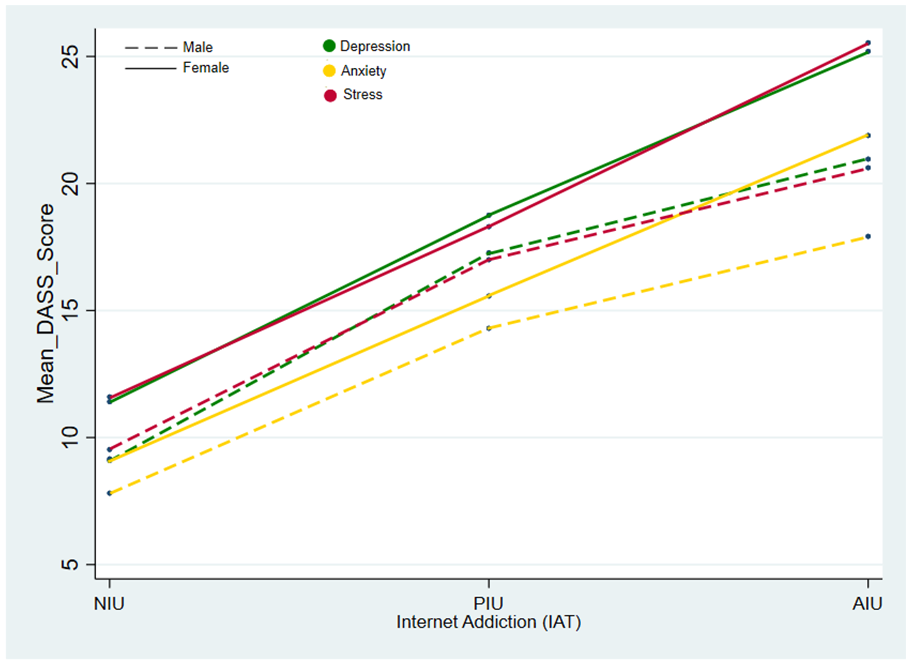
Graphical representation of mean DASS scores of participants as a function of gender.
Our final multinomial logistic regression model showed that gender was significantly associated with internet use. The odds of being male were higher (Adj OR: 1.7 (1.1-2.7)) in addictive users compared to normal users when controlled for other variables. Similarly, being single was found to have higher odds with problematic internet use (Adj OR: 1.6 (1.1-2.5)). Moreover, the odds of having extremely severe depression were 3.1 (95% CI: 1.5-6.4) times greater in problematic users than in normal internet users. Anxiety was also significantly associated with internet use, with the odds of extremely severe anxiety being about three times higher in addictive users (Adj OR: 2.6 (1.1-7.1)) compared to normal users. Stress was also significantly associated with internet use, with the odds of extremely severe stress being about five times higher in addictive users (Adj OR: 5.4 (1.7-17.7)). Furthermore, participants who do not work had greater odds of being addictive users (Adj OR: 2.2 (1.1-4.6)). Mood changes during the pandemic were also significantly associated with internet use, with the odds of negative mood change being greater (Adj OR: 2.9 (1.5-5.6)) in addictive internet users as compared to normal internet users (Table 4).
Shows the Adjusted Odds Ratio (Adj OR) Along with the 95% Confidence Interval (CI) of Factors Associated with Internet Addiction Using Multinominal Logistic Regression.

Indicates results with P < .05.
Discussion
This study indicates that most of participants are normal internet users (61.4%), whereas the prevalence of problematic and addictive internet use is 27.3% and 11.3%, respectively amidst COVID-19. Previous Pakistani studies concluded that the proportion of addictive internet users ranged from 0.6% to 1.1%, and the proportion of problematic internet users ranged from 16% to 37% before the COVID-19 pandemic.54-56 The findings from the current study are showing higher proportions among problematic and addictive internet users as compared to pre-COVID times. The possible reason for the rise in internet addiction could be the measures taken to curb the COVID-19 pandemic such as lockdowns, closure of educational institutions, closure of entertainment clubs, and promotion of work from home practices have led to an increase in time spent at home and have contributed remarkably in increased and possibly addictive use of the internet.8,9,12
The current study shows males to be more addictive users. This finding is consistent with many previous studies50,51,57 with the possible reason that males are more involved in online gaming and are more prone to use the internet for entertainment and leisure activities in comparison to females. However, some studies show females are more addicted to internet use attributing it to online shopping addiction, especially in recent years with the advent of more online shopping websites.56,58
This study further revealed that single participants have greater odds of being addicted internet users. This finding is compatible with a few studies. 59 The possible explanation could be that married life poses certain responsibilities and demands more time toward family, limiting many leisure activities like internet use. On the other hand, unmarried individuals may spend more time on the internet to compensate for family life and social interaction, especially during the lockdown in pandemic where internet use can serve to communicate and develop virtual friendships. However, we also found studies where marital status had no association with internet use. 60
Our results show that severe depression, severe stress, and negative mood changes during a pandemic are significantly associated with addictive internet use. These findings are in line with the literature.61,62 Behaviors like internet addiction may serve as a coping strategy to reduce stress and depression and avoid negative thoughts. 63 The negative impact of addictive internet use on psychosocial distress was identified before the COVID-19 pandemic.64,65 Studies have shown that internet gaming disorder was a significant mediator between self-stigma and anxiety and stress. 66 Other studies have discovered a positive correlation between internet addiction and insomnia and alcohol use. 67 Further, internet gaming has been associated with decreased physical activity and psychological quality of life. 68 The present study extends prior findings to emphasize the importance of taking care of internet addiction during the COVID-19 pandemic. Another finding of this study is that not working situation is significantly associated with addictive use of the internet. Literature shows that unemployment during the COVID-19 pandemic has markedly contributed to the factors responsible for internet addiction. 12
Our study was unique in our settings, with quite a large sample size and considering several variables. However, it has some limitations. Firstly, it was a web-based survey, so the sample may not be representative, and the findings may not be generalized to the entire population. Also, information bias and selection bias cannot be eliminated in a web-based study. Moreover, due to the cross-sectional design of the study, the temporal relationship cannot be studied. Furthermore, the current study uses Young’s Internet Addiction Test (IAT) which cannot distinguish between different forms of internet addiction (eg, social media addiction, gaming addiction) which might impact psychosocial well-being in a different manner. Therefore, future studies are warranted to use internet addiction scales specific to different forms of internet addiction such as Bergan Social Media Scale, Internet Gaming Disorder Scale-Short Form, and Smartphone Application Based Addiction Scale.69-71
However, future research in this area can use perspective and longitudinal designs to establish temporal associations. Literature suggested excellent reliability of DASS21 in adolescents; however, few studies commented on stress/tension items of the tool being questionable. As adolescence is a phase where emotions are constantly emerging, this is why the tool might be considered questionable by certain studies. 47
Conclusion
While the Internet is increasingly becoming an integral part of our lives in the modern era, its excessive use has potentially addictive effects that lead to serious mental health problems. Moreover, with the COVID-19 pandemic, increased use of the internet possibly leads to addictive behaviors that need to be carefully monitored. This study, unique of its kind in Pakistan, identified that gender, marital status, depression, stress, anxiety, work situation, and mood changes during the COVID-19 pandemic are significantly correlated with problematic and addictive internet use. These findings could serve as a preliminary step toward early awareness and the implementation of preventive measures against the addictive use of the internet to avoid or mitigate any serious mental health problems that we may run into, especially during these crucial times of the COVID-19 pandemic.
Supplemental Material
sj-tif-1-inq-10.1177_00469580221138671 – Supplemental material for Demographic and Psychosocial Factors associated with Internet Addiction among the Pakistani Population during COVID-19: A Web-Based Survey
Supplemental material, sj-tif-1-inq-10.1177_00469580221138671 for Demographic and Psychosocial Factors associated with Internet Addiction among the Pakistani Population during COVID-19: A Web-Based Survey by Maryam Pyar Ali Lakhdir, Ayesha Nasir Hameed, Fauzia Basaria Hasnani, Meher Angez, Muhammad Talha Nawaz, Malik Muhammad Hamza Khan, Ghazal Peerwani, Apsara Ali Nathwani and Syed Iqbal Azam in INQUIRY: The Journal of Health Care Organization, Provision, and Financing
Footnotes
Acknowledgements
Special thanks to Wahab Fazal, Fatima Zehra, and Naila Qurban for their participation in the broadcasting of the google link during the data collection process.
Author Contributions
Conception or design of the work: MPL; Proposal development: MPL, ANH, MA, MTN, MMHK; Proposal review: GP, AA, SIA; Data collection: MPL, ANH, MA, MTN, MMHK, GP; Data Cleaning: MPL, ANH, MA, MTN, MMHK, AA, and Data Coding: MPL, ANH, MA, MTN, MMHK, SIA; Data analysis and interpretation: MPL, ANH, FBH; Table formulation: MPL, ANH, FBH; Prepared figure: MPL, ANH; Drafting the article: MPL, ANH, FBH; Critical revision of the article: MPL, GP, SIA; Final approval of the version to be published: MPL, ANH, MA, MTN, MMHK, FBH, GP, AA, SIA. All authors read and approved the final manuscript.
Declaration of Conflicting Interests
The author(s) declared no potential conflicts of interest with respect to the research, authorship, and/or publication of this article.
Funding
The author(s) received no financial support for the research, authorship, and/or publication of this article.
Ethics Approval and Consent to Participate
Ethical approval was taken from The Aga Khan University Ethical Review Committee (2020-5750-15165). All procedures performed in studies involving human participants were in accordance with the ethical standards of the institutional committee.
Informed Consent
Before data collection (access to electronic form), all participants were asked to electronically sign a form of consent to be included in this study.
Consent for Publication
All authors consent for publication of this paper. All authors have read and approved the final manuscript. This manuscript has not been published and is not under consideration for publication elsewhere.
Data Availability Statement
The data that support the findings of this study are available on request from the corresponding author. The data are not publicly available due to information that could compromise the privacy of research participants.

Supplemental Material
Supplemental material for this article is available online.
References
Supplementary Material
Please find the following supplemental material available below.
For Open Access articles published under a Creative Commons License, all supplemental material carries the same license as the article it is associated with.
For non-Open Access articles published, all supplemental material carries a non-exclusive license, and permission requests for re-use of supplemental material or any part of supplemental material shall be sent directly to the copyright owner as specified in the copyright notice associated with the article.
