




Abstract
The COVID-19 pandemic has significantly impacted many sectors, including the education sector. After in-person school activities were suspended due to the pandemic, a number of educational institutions in Indonesia reported concerns in implementing online learning due to the institutions’ unpreparedness. This issue may potentially induce mental health disorders among students and triggers long-term stress. This study aimed to examine factors linked to the psychosocial symptoms of anxiety, stress, and depression in response to the early stage of the COVID-19 pandemic. An online cross-sectional study in Indonesia was conducted with 433 undergraduate and senior high school students aged 15 to 26 years old, both female and male. The self-reported symptoms were analyzed using both bivariate and multivariate linear regression methods. It was found that the percentage of participants with depression symptoms was 66%, while 61% and 43% participants experienced stress and anxiety respectively. The bivariate analysis presented strong correlations between anxiety and gender, learning duration and use of gadgets, internet expenses, and highly-interrupted learning. Furthermore, the multivariate regression revealed that only anxiety was significantly linked to internet expenses. This study indicates that many students are affected by COVID-19, the impacts of which manifest in psychosocial issues in the form of anxiety. We suggest that creating a supportive and positive family environment would help to alleviate some of these issues.
The World Health Organization (WHO) designated COVID-19 as a Public Health Emergency of International Concern, which affects various sectors including educational settings. The impacts of COVID-19 is not only regarding the physical symptoms but also the potential hazards on psychosocial risk such as anxiety, depression, and stress suffered by teachers, students, and parents.
The case of COVID-19 continues to spread. Suspended in-person learning has raised concerns about progress in learning and also mental health impacts. This study is significant because it can help to providing an information to shareholders to response the impact of pandemic among students, particularly in managing mental health during and post-pandemic.
This study found that highly interrupted learning also significantly correlates with reported anxiety among students, therefore it is practically needed online-based mental health support for educational setting around the world. In addition, the government could consider developing a mental health program and policies to minimize psychosocial risks.
Introduction
The world is currently facing an unprecedented global health and socioeconomic crisis due to the ongoing pandemic. Since its appearance in Wuhan, China at the end of December 2019, COVID-19 has evolved into a phenomenon that has changed the fabric of social life around the world. As of September 2022, there have been 230 countries that have reported COVID-19 cases with more than 609 million confirmed cases and a total number of deaths of approximately 64 million worldwide. Indonesia is among the top 20 among 230 countries, with a total number of positive confirmed cases of more than 6.3 million. Indonesia also ranks as 1st and 10th as the country with the highest number of positive confirmed cases in Southeast Asia and Asia, respectively. 1
The surge in positive confirmed cases in Indonesia indicates that the COVID-19 pandemic situation is far from over and will continue to impact on various sectors, ranging from the health to the socio-economic, trade, tourism and education sectors. In the economic sector, Indonesia has the potential for recession due to the poor projection of GDP growth for the past 2 quarters. 2 The education sector also continues to experience detrimental impacts due to COVID-19 with school closures and the difficult transition from face-to-face learning to online learning. This transition has been indicated to have long term impacts, such as the emergence of mental health issues among students. 3
A recent study among university students in Algeria presented that the pandemic has significantly increased social media usage among the students that significantly correlated to the increased insomnia. 4 According to a study in China, middle school students also experienced stress, anxiety, and depression during the pandemic. 5 Another study in Taiwan showed that university students were experiencing anxiety during the COVID pandemic. 6 This study in Taiwan is aligned with recent findings in cross-country study that presented university students in Indonesia, Taiwan, and Thailand had some negative psychological responses to the pandemic, including anxiety and suicidal thought. However, when comparing between the countries, Taiwanese students experienced less substantial effects of pandemic to their daily life than Indonesian students due to the early response by Taiwanese government. 7
Started on May 2020, Indonesian government implemented restriction on community activity and mobility or known as the large-scale social restrictions policy (Pembatasan Sosial Berskala Besar [PSBB]). 8 The restrictions also resulted in the shutdown of the school. 8 Since then, The Indonesian Ministry of Education and Culture has developed several policies in order to address the spread of COVID-19, such as the adjustment of school exams, distance learning and online student registration as per its circular letter No. 4 of 2020 on implementation of education policies in an emergency period. In addition, the Indonesian government through a Joint Decree of 4 ministries, that is, the Ministry of Education and Culture, the Ministry of Religion, the Ministry of Health and the Ministry of Home Affairs, also set up Guidelines for the Implementation of Learning in Academic Years during the COVID-19 Pandemic Period, particularly learning from home or online. 9
The implementation of learning from home system needs to be accompanied by available technology and devices to facilitate the online learning process. Online-based learning aims to provide an innovative experience for students with a personal, open, fun, and interactive approach. 10 A study involving 682 respondents from several public and private universities in Java, Sumatra, Sulawesi, Kalimantan, Maluku, and Papua in an online survey demonstrated that the majority of respondents (62%) agreed that learning objectives were well achieved despite the use of online methods. The positive response on the implementation of this online system has led to the conclusion that online learning has the potential to become the future of education for Indonesia. 11
On the other hand, a different study demonstrated that learning from home with the use of technology brings many challenges, such as the limited ownership of computer/laptop devices and internet access, the inability of teaching staff to use technological devices, the implementation of online learning that lacks interactive discussions, the lack of quality digital learning resources, and the lack of involvement of parents and schools. 12 Although these limitations can be overcome by visiting student’s home and teaching directly, these interactions are considered as risky as they may contribute to the spread of COVID-19. If this situation continues, in the long term, the limited interaction and lack of interaction between teachers and students will indirectly reduce the quality of education since the education is more than simply the acquisition of knowledge, and there are also social aspects such as socialization and acculturation in different social and cultural settings. 13
Recent studies also show that the changes due to the pandemic have had detrimental impacts on mental,14-16 both in children and adults.17,18 The impacts of COVID-19 on health are multidimensional across different populations as the pandemic itself is a complex and multifaceted event. 19 A study among older adults in Thailand showed that the COVID-19 pandemic caused mental stress that related to lower quality of life and well-being. 20 Additionally, vulnerable populations, such as people with mental illnesses and their caregivers found it difficult to cope with new stressful situation caused by the pandemic in addition to pre-existing stigma, unemployment, and poor social support. 21 Social stigma was also a significant issue during the pandemic, particularly among those COVID-19 survivors who were seen as active spreaders. The stigma among people who caught COVID and survived lead them to experience depression and insomnia. 22
For children in school aged years, school closures during the COVID-19 pandemic have disrupted their daily activities. Children might experience prolonged stress that is reflected in more demanding behaviors, such as losing their temper and being easily distracted. These symptoms result in the potential to receive physical and mental abuse from parents who play a very strong role in the family. 23 Several stressors can be felt by students, such as monotonous daily activities, disappointment, lack of face-to-face interactions with peers and teachers, difficulties in finding privacy while at home, family financial problems and difficulty in transitioning from face-to-face traditional classes to online learning from home. These situations have potential to trigger prolonged mental health issues and disorders among students. 24
Furthermore, during the pandemic, students have been identified to be very vulnerable to experiencing phobias and Post Traumatic Stress Disorder (PTSD) due to receiving excessive and inappropriate information from social media.25-27 In addition, students may have problematic social media use or internet used during COVID-19 pandemic, which further increase their mental health problems. It has been reported that problematic internet related behaviors and stigma, particularly perceiving the student’s weight were significantly associated with psychological distress.5,28-33 During quarantined and outside from school or university environment and schedule, students may encounter stress, anxiety, anger, boredom, loneliness, and other emotions. 34 Although in the current situation online learning is the only effective way to continue learning in the formal education system, experts have warned of the potential of over-burdening students. Although there are several educational institutions in Indonesia that have not reported any obstacles in implementing online learning, the number of educational institutions that are unprepared for providing online learning is much higher. 35 This unpreparedness may potentially induce mental health disorders among students as it may trigger long-term stress. 36 Thus, the purpose of this study is to evaluate the psychosocial effects of learning from home during the COVID-19 pandemic on students in Indonesia and to identify the most influencing factors associated with psychosocial symptoms.
Methods
Study Design
A cross-sectional study was designed to analyze factors associated with psychosocial symptoms among students impacted by responses to the COVID-19 pandemic. This study was conducted in April to July 2020 in Indonesia among both high school and bachelor students since these groups are sufficiently mature to understand the impact of pandemic on the education system. The population of this study was high school students and bachelor students living in Indonesia, which was 16 638 724 between 15 and 26 years old. The sample size was calculated with 95% confidence level and 5% confidence limit, resulting in 384. Sampling was then performed according to the inclusion criteria of senior high school and bachelor students living in Indonesia. Students who were home-schooled pre-pandemic were excluded. The online questionnaire using Google Forms was distributed to students using the snowball technique. Informed consents were obtained from participants aged 18 years old and above before they completed the questionnaires. For participants aged under 18 years old, the legal guardians were contacted by the researchers to obtain consents of their children’s participation in the study.
Questionnaire Instruments
Data was collected using an online-questionnaire that divided into 4 sections. The first section is related to demographic information such as age, gender, educational background, type of institution, island of origin, and parent’s incomes. Second section refers to learning activities such as characteristics, subjects, the number of lessons ours, homework, examination, assignments, technology devices, and internet expenses. Thirdly, we developed questions regarding the aspects of perceived impact of learning during COVID-19 consist of interrupted learning, support for learning, social isolation, challenges related to distance learning, and distance learning assistance. The validity and reliability of the questionnaire were statistically tested before data collection with Cronbach’s alpha value of .628, .879, .732, .734, and .613 respectively (Table 1). Furthermore, in the last section of questionnaire, self-reported depression, anxiety and stress levels were also measured using the Depression Anxiety Stress Scale (DASS-42) which consists of 42 questions. DASS is a valid and reliable questionnaire to assess depression, anxiety, and stress established by Lovibond and Lovibond 37 and it has a good validation with Cronbach’s alpha values of .91 for depression; .84 for anxiety; and .90 for stress. The scale, that consists 14 items, is suitable for non-clinical setting and for evaluating normal adults and adolescents. The Stress scale is responsive to levels of chronic non-specific arousal of stress while the Anxiety scale determines the autonomic arousal, skeletal muscle effects, situational anxiety and subjective experience of anxious affect. The depression scale assesses dysphoria, hopelessness, devaluation of life, self-deprecation, lack of interest/involvement, anhedonia, and inertia. In this scale, participants were asked to select from the 4 scale in each item to rate their experience during a week. The scores were then calculated for the relevant items. Table 2 shows the cut-off scores for severity rating scales of depression, anxiety, and stress. In addition, the depressive symptoms for depression, anxiety, and stress symptoms was defined with subscale of ≥10, ≥8, and ≥15 respectively.37,38
Learning Impact During COVID-19 Aspects.

The Cut-off Score Regarding Severity Scales of DASS-42.

Data Analysis
Data collected were first analyzed using the Kolmogorov-Smirnov or Shapiro-Wilk test analysis in the Statistical Package for the Social Sciences (SPSS) version 24 program to determine the normality of research data. The normality of research data determines the cut-off used where average will be used for data that are normally distributed while median was be used for abnormally distributed data. Afterward, a univariate analysis was performed using the percentage data based on frequency while the bivariate data analysis was conducted using chi-square to analyze the association between each item in the demographic factors, academic (learning activities) aspects, and perceived impact of learning during COVID-19 (anxiety, stress, and depression). In the multivariate stage, logistic regression was used to assess the factors that most influenced anxiety, stress, and depression after predictive modeling was performed.
Ethical Considerations
This study was approved under the ethical clearance Number xx issued by the ethics committees of xx.
Results
A total of 433 participants participated in this study. The majority of respondents were 19 to 26 years old (67%), 71.1% were females and 28.9% were males. Most participants were currently students of a higher educational institution (72%). Most participants studied in public schools or universities (73%). All respondents came from Java Island (84.8%) and were almost evenly distributed across parent’s income categories (55.5% vs 44.5%). As an impact of COVID-19, schools closures took place. Our study shows that almost 95% of participants studied from home while the remaining 5% still went to offline learning sessions or studied in their respective university/school campus. The majority of respondents had at least 10 subjects per semester with total lesson hours of less than 6 h per day. Students also indicated that they studied outside the online classes with the majority spent 1 to 3 h of additional studying. During the pandemic, most participants received assignments or homework for more than 4 subjects a week. For tests and examination, most respondents (97%) stated that they still underwent offline examinations or tests with a take home assignment as the most frequent type of test or assessment used (64%). Since the start of online learning, students spent more than 3 h per day on gadgets and 67% of participants spent less than IDR 300 000 (or approximately $19.25) for internet cost while the remaining 37% spent IDR 300 000 ($19.25) (Table 3).
Respondents Characteristics (n = 433).

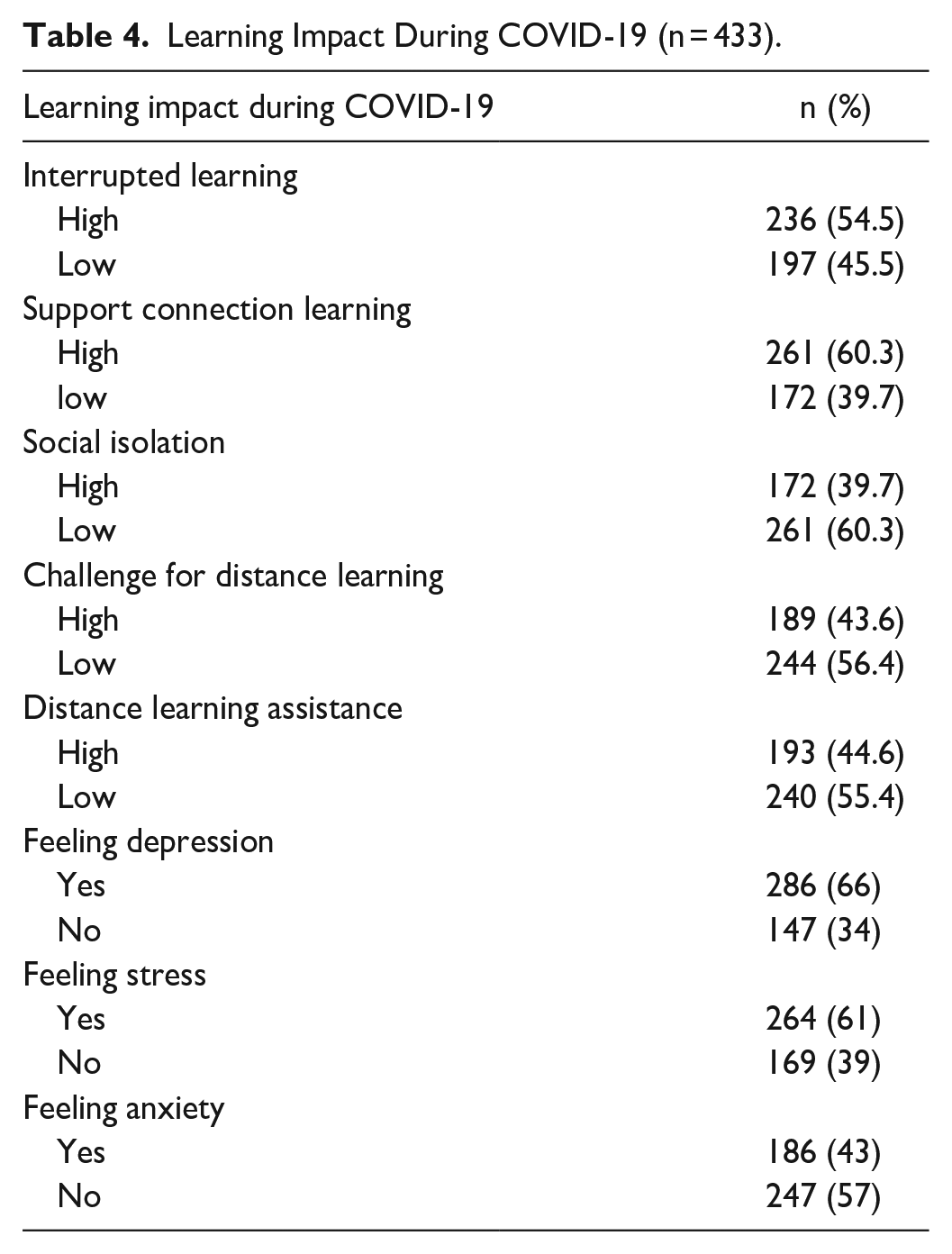
This study also revealed that 54.5% of respondents experienced highly interrupted learning, which led to difficulties in understanding what they learned during lessons from home. However, high levels of support with learning were experienced by more than half of these students (60.3%). Furthermore, 60.3% of students felt a low level of social isolation and 56.4% faced a high level of challenge in distance learning with low perceived distance learning assistance (55.4%). In addition, the majority of participants reported experiencing depression (66%) and stress (61%), while only 43% experienced anxiety (Table 4).
Learning Impact During COVID-19 (n = 433).
Results of the bivariate analysis shows that there was a positive correlation between male gender and the level of anxiety with a P-value of .001 and OR of 1.753 (1.152-2.655). In addition, students who spent their time with gadgets for more than 3 days tended to experience anxiety (P = .002 and OR 0.478 (0.305-0.750)). A similar trend was also seen between high interrupted learning and anxiety with a strong correlation identified between the 2 (P = .004, OR 0.556 (0.378-0.817)) (Table 5).
Bivariate Analysis.

Table 6 illustrates the results of multivariate analysis in identifying the most contributing factors of psychosocial issues. In the final modeling for depression, the difficulties in the learning environment (interrupted learning) were the most influencing factor affecting self-reported depression among students (β (95% CI) .672 (0.448-1.0008)), whereas the internet costs were the most influencing factor for anxiety (β 1.657 (1.098-2.501), P = .016). In addition, the quantity of learning hours outside online lessons was the strongest factor that influenced stress in these students.
Multivariate Analysis.

Discussion
It is apparent that COVID-19 has affected educational settings in Indonesia. Our study shows that learning from home is currently the most adopted learning approach to cope with the pandemic situation. This has changed the characteristics of learning, such as how examinations, task assignments, and teaching are performed using technology. However, this mode of learning can also lead to negative impacts on students, such as difficulties in understanding the lessons conveyed online and feelings of overwhelm caused by additional homework/assignments which are impacted by the home environment, family and facility support, educator support, and lack of social interaction. According to a study from an Arabian countries, 39 European countries, 40 and Asia-Pacific countries, 41 COVID-19 pandemic has indeed affected social and emotional aspects of students.
Our study found the tendency of male students to experience anxiety is 1.75 times higher than female students. This finding is contrary to a study conducted by Sundarasen et al 42 in Malaysia where females experience higher emotional states than males. In addition, female students are identified as more likely to become more anxious than their male counterparts.43-48 In contrast, it was reported in another study that male health worker participants had higher scores for fear, depression, anxiety and stress when compared to female. 49 Our study indicates that male students worry about the impact of COVID-19, particularly with the application of staying at home and mobility limiting policies that curtail their outdoor activities.
The long duration of electronic devices use while the students study from home also caused anxiety. Students spent more than 3 h of their time in front of their gadget, far longer than before the pandemic. This is in line with a previous study stating that the use of gadget during lockdown rises dramatically, particularly for social media, streaming services and gaming, which may lead to addiction. 50 In addition, it has clearly been shown that using gadget in a long duration impacts humans health, 51 which is associated to anxiety and depression among adolescents.52,53 Another previous study also reported that excessive gadget use changes lifestyle, such as limiting physical activities and affecting sleeping patterns. 54
The COVID-19 pandemic also affects the way students learn at home. Our study also identified that almost all students face highly interrupted education, making it difficult to understand the subjects they are learning, when compared to the traditional face-to-face learning. Students feel that more homework or assignments come with online learning, and this significantly links to anxiety among students. The COVID-19 outbreak has affected people’s social networks and mental health, and students are no exception. 43 During the pandemic, there have been large courses conducted through online, which has been potentially contributing to stress among students. 55 Moreover, school closures had a significant impact on learning progress, which slowed during the crisis, especially in developing countries.56,57
The multivariate logistic regression analysis in this study indicates that the internet cost is one of the main factors triggering anxiety among students when studying from home. This can be explained by an interrelated cause-and-effect event where the COVID-19 pandemic has led to studying from home and this increases internet use, both in time and cost. Before the pandemic, the average household internet cost for education in Indonesia was about IDR 100 000. This has increased sharply by 100% to 200% to IDR 200 000 and at times even more than IDR 300 000. 58 It is clear that most students depend on their parents for the cost of education, but our findings also shows that this increase in family budget for online learning also raises concerns among students.
Since the pandemic began, the stability of family incomes for both lower and upper economic status groups have been jeopardized. The unemployment rate has increased by 1.8% points to 7.1% and the underemployment rate increases by 3.8% points to 10.2% in the third quarter of 2020. Moreover, the impact of the pandemic on Indonesia’s economy is still ongoing. 59 It indicates that family consumption, which usually accounts for half of Indonesia’s GDP, is lower, and family financial instability is apparent. During this pandemic, parents of students will prioritize family spending on health and family survival. Thus, a 2-fold increase in internet expenses will raise concerns among students, triggering anxiety linked to school from home. This is supported by a study from China on how family economic situation significantly leads to anxiety experienced among students during the COVID 19 pandemic. 60
Our findings propose an important practical implication. Firstly, early stage of the COVID-19 pandemic affected the educational system in Indonesia in such a way that students must study from home through online learning. This different learning environment and the changes in communication and connection to peer groups affected the psychosocial condition of students and can, particularly, trigger anxiety. Students are expected to have a strong resilience to adapt to any situation changes whilst studying from home. Thus, support must be given to them in this aspect. Secondly, the educational institutions should provide a comprehensive support not only around the implementation of health protocols but also by providing psychosocial support through issuing and implementing relevant policies, providing online support systems and also through counseling. Thirdly, parents should become an integral part of learning and psychosocial supports during studying from home by supervising and communicating with their children in the efforts to create an enabling environment for students to study and to minimize the risk of anxiety, stress, and depression. 61
Nevertheless, not only students faced difficulties in online learning in pandemic COVID-19 situation, but also teachers have similar hardship. Recent study reported that since online teaching need to be conducted as the limitation of face-to-face learning in school, teachers felt low levels of satisfaction, unwillingness to continue online teaching, and negative impacts on the psychological well-being of teachers. There was a negative association of willingness of the teachers to continue online teaching and positive association of burnout after 2 months online teaching. 62 About 320 teachers in Jiangxi province, China experienced post-traumatic stress disorder (PTSD) in period October and November 2020 while nomophobia moderated the effects of fear of COVID-19 scale on PTSD. 63 Another study conducted from 9030 teachers related to Problematic Internet Use (PIU) of teachers during pandemic COVID-19 and demonstrated psychological distress: depression (20.4%), anxiety (26.4%), and stress (10.2%). 64
This study has several limitations. First, data were collected during the early stage of the COVID-19 pandemic in Indonesia. Therefore, it might not reflect the next phase of the pandemic when the number of confirmed cases increased sharply. Second, due to the nature of the cross-sectional design applied in this study, a further study is required by exploring the root cause analysis of psychosocial issues through longitudinal interviews, case control study, experimental study, or observation of students, parents, and teachers. Third, participation in completing questionnaires distributing online due to the pandemic may have resulted in bias. Lastly, the sample size is small and further studies with larger samples are needed to represent the population in general.
Conclusion
Despite some limitations, this study provides empirical evidence that a proportion of high school and undergraduate students in Indonesia report experiencing depression, stress, and anxiety symptoms during the COVID-19 pandemic, with anxiety experienced more by male students compared to female students. Highly interrupted learning also significantly correlates with reported anxiety. To improve students’ involvement in online learning, we suggest that schools and universities in Indonesia consider providing online-based mental health support. 65 Additionally, inclusive online-based educational programs are needed to reach out students living in remote areas with limited access to internet and to the supporting gadgets (eg, computer or laptop) by providing scholarships through educational emergency funds. 66 Finally, the government could consider developing a mental health program for parents and carers. 67 Hence, helping to provide a supportive and positive family environment to ensure students can learn safely from home. 67
Supplemental Material
sj-xlsx-1-inq-10.1177_00469580231155720 – Supplemental material for Factors Associated with Psychosocial Symptoms Experienced by Students in Response to COVID-19 Pandemic: A Multivariate Analysis
Supplemental material, sj-xlsx-1-inq-10.1177_00469580231155720 for Factors Associated with Psychosocial Symptoms Experienced by Students in Response to COVID-19 Pandemic: A Multivariate Analysis by Abdul Kadir, Stevan Deby Anbiya Muhammad Sunarno, Amalia Oktaviana, Aldila Faza Zulfah, Cynthia Febrina Maharani, Nanda Trio Santoso, Fatma Lestari, Dr Dadan Erwandi and Surindar Kishen Dhesi in INQUIRY: The Journal of Health Care Organization, Provision, and Financing
Footnotes
Acknowledgements
Our sincere thanks go to the Department of Occupational Health and Safety Department, Faculty of Public Health Universitas Indonesia.
Declaration of Conflicting Interests
The author(s) declared no potential conflicts of interest with respect to the research, authorship, and/or publication of this article.
Funding
The author(s) disclosed receipt of the following financial support for the research, authorship, and/or publication of this article: This research is funded by Directorate of Research and Development, Universitas Indonesia, Under Hibah PUTI Q2 2022 (Grant No. NKB-1278/UN2.RST/HKP.05.00/2022)
Ethical Considerations
This study was approved under the ethical clearance Number 435/UN2.F10.D11/PPM.00.02/2020 issued by the ethics committees of Research and Community Engagement, Faculty of Public Health, Universitas Indonesia.
Informed Consent Statement
Inform consent was obtained from respondents by agreeing to fulfill the terms and conditions to participate in the study. The researchers applied the informed consent during the study with the principles of beneficial, no harm, confidentiality, justice, and voluntary participation. Hence, several pieces of information should be agreed to by participants prior to data collection. Particularly, those participants under 18 years old, have to ask permission from their parent or legal guardian. If they do not meet the criteria, the system automatically stops the survey.

Supplemental Material
Supplemental material for this article is available online.
References
Supplementary Material
Please find the following supplemental material available below.
For Open Access articles published under a Creative Commons License, all supplemental material carries the same license as the article it is associated with.
For non-Open Access articles published, all supplemental material carries a non-exclusive license, and permission requests for re-use of supplemental material or any part of supplemental material shall be sent directly to the copyright owner as specified in the copyright notice associated with the article.
