



Abstract
This study examined associations between changes in domain-specific sedentary behaviors and changes in health-related lifestyles of Spanish secondary school students (n = 113) to their first year of university. During the transitions from the end of high school to the beginning of university, engagement in sedentary behaviors have emerged as potential additional behavioral risk factors. Understanding how sedentary behaviors interconnect with other (un)healthy behaviors will inform interventions on multiple risk behaviors across this critical life period. A 3-year longitudinal survey assessed associations between domain-specific sedentary behaviors and leisure time physical activity (IPAQ), alcohol and tobacco consumption, and fruit and vegetable intake (24-h dietary recall), using Generalized Estimating Equations. Spending time on sedentary transportation was associated with a greater likelihood of smoking, whereas sedentary weekend homework was associated with a reduced likelihood of consuming alcohol. The lowest and highest tertiles for sedentary screen use and leisure-time PA were also less likely not to meet the recommendations for fruit and vegetable consumption. For specific sedentary behaviors, associations were gender-based or affected by leisure time physical activity. From secondary school to university, specific sedentary behaviors are linked to lifestyle risk factors. Over this transitional period, public health interventions targeting reduced sedentary behaviors may bring multiple benefits by also preventing other harmful behaviors.
The adolescence-university transition is a critical life period to understand how lifestyle behaviors may cluster, to target disease prevention and promote sustainable health-enhancing behavior into adulthood and for the next generations. While time spent sitting and reclining while expending little energy—named sedentary behavior—and engagement in specific sedentary activities have emerged as potential additional behavioral risk factors, observational and interventional evidence investigating how to effectively tackle sedentary behavior in older adolescents and young adults going through this major life transition is limited, with evidence dominated by research in younger adolescents (10-14 years) and physical inactivity. Even less is known about how specific SB domains influence different lifestyle behaviors, a key issue for developing public health interventions that can effectively modify SBs while also influencing other problematic behaviors.
From secondary school to university, specific SBs are associated to lifestyle risk factors some of which are gender-based and/or related to leisure-time PA. Time sitting doing weekend homework was protective against tobacco use in adolescents who spent little time doing leisure PA. In girls, doing sedentary weekend homework also protected against alcohol consumption. Sedentary weekend transport time was associated with higher tobacco consumption while the lowest and highest tertiles for sedentary screen use and leisure-time PA were less likely not to meet the recommendations for fruit and vegetable consumption.
Over this transitional period, implementing public health interventions targeting reduced SBs may bring multiple benefits by also preventing other harmful behaviors.
Introduction
Non-communicable diseases (NCDs) are the biggest cause of premature deaths worldwide. 1 While many NCDs manifest later in adulthood, these are partly the result of behavioral risk factors established over time, which typically begin in adolescence.2,3 In 2019, NCDs in adolescents aged 10 to 24 years accounted for 86.4% of all years lived with disability and 38.8% of total deaths. 4 In this context, it is critical to develop a better understanding of how interventions could effectively be implemented for tackling those behavioral risk factors that drive NCDs in adolescence and continuing into adulthood.2,3,5
In adolescents, NCDs can be prevented by tackling common behavioral risk behaviors, mainly tobacco use, low fruit and vegetable intake, poor diet, physical inactivity, drug use, and harmful use of alcohol.5 -7 Additionally, time spent sitting and reclining while expending little energy—named sedentary behavior (SB)—and engagement in specific sedentary activities such as screen-based behaviors have emerged as potential additional behavioral risk factors for adolescents’ health and well-being. 3 However, observational and interventional evidence investigating how to effectively tackle sedentary behavior in older adolescents and young adults going through this major life transition is limited, with evidence dominated by research in younger adolescents (10-14 years) and physical inactivity.2,3
During this life transition, physical activity (PA) diminishes, driven in part by reductions in active transportation 8 and active commuting to school. 9 Involvement in sport also drops while engagement in sedentary behaviors (SBs) rises, especially due to increased sitting time while socializing, for transport 10 and in recreational screen-time.11,12 Indeed, at universities many young adults report higher sedentary behavior after the COVID-19 pandemic, 13 with prolonged sitting being associated with worse physical and mental health, behavioral conduct, and reduced sleep duration. 14 Just as SBs increase from secondary school to university, 10 so too does alcohol consumption, average daily cigarette consumption 15 and fruit and vegetable intake declines. 16 However, evidence on the influence SB changes have on other modifiable unhealthy behaviors over this life period is scarce.
In this context, monitoring changes of SB patterns over the adolescent-university transition period in association with changes in other behavioral risk behaviors is important for developing public health interventions that can effectively modify SBs while also influencing other problematic behaviors. Given that not all SBs are equally harmful, and that most studies have focused on cross-sectional associations between recreational screen-based sedentary behavior, alcohol use, 17 earlier initiation of cannabis and tobacco consumption, 18 poor diet, 19 and individual sport participation, 10 it is important to understand how specific SB domains influence different lifestyle behaviors. 14
To understand whether SBs displace and/or activate (un)healthy behaviors in the adolescence-university transition, this study undertook formative research to inform public health interventions on how to effectively tackle the behavioral risk factors that jeopardize adolescents into adulthood’ health. The present study examined associations between changes in domain-specific sedentary behaviors and changes in health-related lifestyles of Spanish secondary school students (16-17 years old) to their first year of university (18-19 years old).
Methods
Study Design and Sample Recruitment
A 3-year longitudinal study was designed to assess associations between changes in domain-specific SBs and lifestyle risk behaviors in Spanish adolescents (n = 113) from the county of Osona (Barcelona). Adolescents were followed from secondary school to university (16, 17, and 18 years of age; Year 1, 2, and 3 respectively). From an initial potential sample of 695 teenagers, 662 responded in Year 1 (95% response rate), 480 in Year 2 (69% response rate), and 180 in Year 3 (26% response rate). Only the university undergraduate students (n = 113, 16% of the initial potential sample and 17% of Year 1 respondents) who completed the survey in all 3 years were included. The Ethics Committee of University of Vic-Central University of Catalonia approved the study (2011), and all participants signed a written informed consent every year before completing the survey. Recruitment procedures have been described in detail elsewhere. 10
Data Collection and Variables
Data were collected using a 42-item survey that gathered data on (i) sociodemographic variables (age, gender, height, weight, and place of residence), (ii) domain-specific SBs, and (iii) lifestyle risk behaviors (tobacco and alcohol consumption; fruit and vegetable consumption; and leisure-time physical activity).
Tobacco and Alcohol Consumption
Alcohol and tobacco consumption were recorded using the FRESC questionnaire, which has good reliability for both alcohol (r = .66-.72) and tobacco consumption (r = .79-.82). 20 Alcohol measures included alcohol consumption over the past 12 months (yes/no), and frequency of consumption (daily, weekly, monthly, <monthly, never). Tobacco consumption variables included current cigarette consumption (yes/no), and frequency of use (<1 cigarette a day, 1 cigarette a day, between 2 and 5 cigarettes a day, more than 5 cigarettes a day). Both alcohol and tobacco variables were categorized as weekly alcohol consumption (yes/no) and daily tobacco consumption (yes/no).
Fruit and Vegetable Consumption
Fruit and vegetable consumption was assessed with 2 specific questions: “How many servings of fruit do you eat on a typical day?” and “How many servings of vegetables do you eat on a typical day?” using the 24-h dietary recall data as the gold standard. 21 Cronbach alpha for this measure was .74 among university students. 22 Under-consumption was defined by yes/no responses to an item about eating 5 servings of fruits and/or vegetables a day. 21
Leisure-Time Physical Activity
Leisure-time PA was measured using the Spanish version of the International Physical Activity Questionnaire (IPAQ) long form. 23 The IPAQ assessed min/week of light-intensity PA (LPA), moderate-intensity PA (MPA), and vigorous-intensity PA (VPA) during the last 7 days. The IPAQ has shown good validity for assessing different intensities of PA domains in healthy European adolescents aged 15 to 17 years (Rs = .17-.30). 24 Leisure-time PA was categorized as the sum of time spent in PA at all intensities (min/week) in the following tertiles: (i) less than 180 min/week, (ii) between 180 and 259 min/week, and (iii) more than 360 min/week.
Domain-Specific Sedentary Behavior
The sedentary behavior questionnaire (Active Where? survey—Section R) 25 assessed sitting time (min/day) during weekdays and weekends and across domains 26 : (1) television viewing (television + video); (2) computer use (computer games + internet use); (3) socializing behaviors (sitting with friends); (4) school (school attendance + homework); (5) transport (private + public transport); and (6) sedentary hobbies (reading, playing music, and doing handicrafts). Responses were categorized into 15-min blocks, 30-min blocks, and 1-h blocks, concluding with ≥5 h. The Active Where? survey was designed specifically for youth and has shown good reliability in most sitting domains, with a percentage agreement ranging from 27.1% to 76%. 25 Time spent (min/day) on each SB-domain during weekdays and weekends were categorized into tertiles and “no use” to describe 0 min/day of time spent in that specific SB-domain. A new variable on “screen use time” was described as the sum of SBs spent watching TV and using computers (computer games + internet use) and categorized into 2 groups according to the 24-h movement guidelines for children and teenagers from 5 to 17 years old 27 : less than 120 min/day, or 120 or more minutes/day.
Statistical Analysis
A descriptive analysis of the subjects’ characteristics by year (Years 1, 2, and 3) was performed using proportions according to data type (n = 113). The temporal variation of each lifestyle risk behavior and SB-specific domains across years from secondary school to university was described using proportions by year.
Generalized Estimating Equations (GEE) assessed associations between lifestyle risk behaviors (dependent variables) and each domain-specific SBs (independent variables). 28 This methodology is useful for analyzing repeated measures of the same individual over time, assuming independence between individuals but not within observations of the same individual. Associations between variables were modeled separately; weekdays and weekends. A binomial distribution of the dependent variables (lifestyle risk factors) was assumed and logit was used as the link function. The starting models included each SB-specific domain, adjusted by all possible measured confounders (gender, year, and leisure-time PA, as well as interactions between SB-specific domain and gender and, between SB-specific domain and leisure-time PA).
The final models included only the SB-specific domain and the adjusted variables identified as confounders (ie, those variables that could change SB-specific domain coefficients for more than 10%). 29 Odds Ratios (OR) and 95% CI are shown graphically for SB-specific domains, indicating, in each case, the adjusted variables and the interactions included in the model. The analysis was performed using STATA software 12.
Results
Participants’ baseline characteristics (n = 113) are summarized in Table 1 (year 1).
Patterns of Lifestyle Behaviors and Different Sedentary Domains Across Years.

Temporal Variations in Lifestyle Risk Behaviors, Domain-Specific SBs and Leisure-Time PA
From secondary school to university, the proportion of habitual smokers and weekly consumers of alcohol increased by +2.7% and +8.8% respectively. Similarly, the proportion of adolescents not meeting the recommendations for daily fruit and vegetable consumption increased by +8.3% (Table 1).
The percentage of adolescents doing ≥360 min of leisure-time PA/week decreased by −16.8% from year 1 to year 3 (Table 1). Regarding SB, sitting time at school was high across secondary school years (80.2% spent ≥390 min/day sitting at school and doing homework), with a sharp decrease during the first year of university (40.7% spending ≥390 min/weekday). While adolescents spending >120 min/day screen use during weekends reduced by 17.7%, sitting while socializing and for sedentary weekday transport increased during the adolescence-university transition (Table 1).
Transitional Associations Between Domain-Specific Sedentary Behaviors and Tobacco Consumption
Domain-specific SBs and tobacco consumption during weekdays
During weekdays, adolescents who sat more than 121 min per day in front of a computer and more than 1 h a day socializing showed higher percentages of tobacco consumption than those who did not spent time on it (32.5% vs 22.2% computer, 40.3% vs 17.9% socializing). Higher percentages of tobacco consumption were moderately stable across years (Table 2). On the other hand, adolescents who spent more time on sedentary hobbies like music, arts, and crafts or sitting for school reasons had lower percentages of tobacco use compared to those who did not (22.9% vs 35.2% hobbies, 15.7% vs 31.8% school) (Table 2).
Prevalence of Lifestyle Risk Behaviors in the Specific-Domains of Sedentary Behavior.
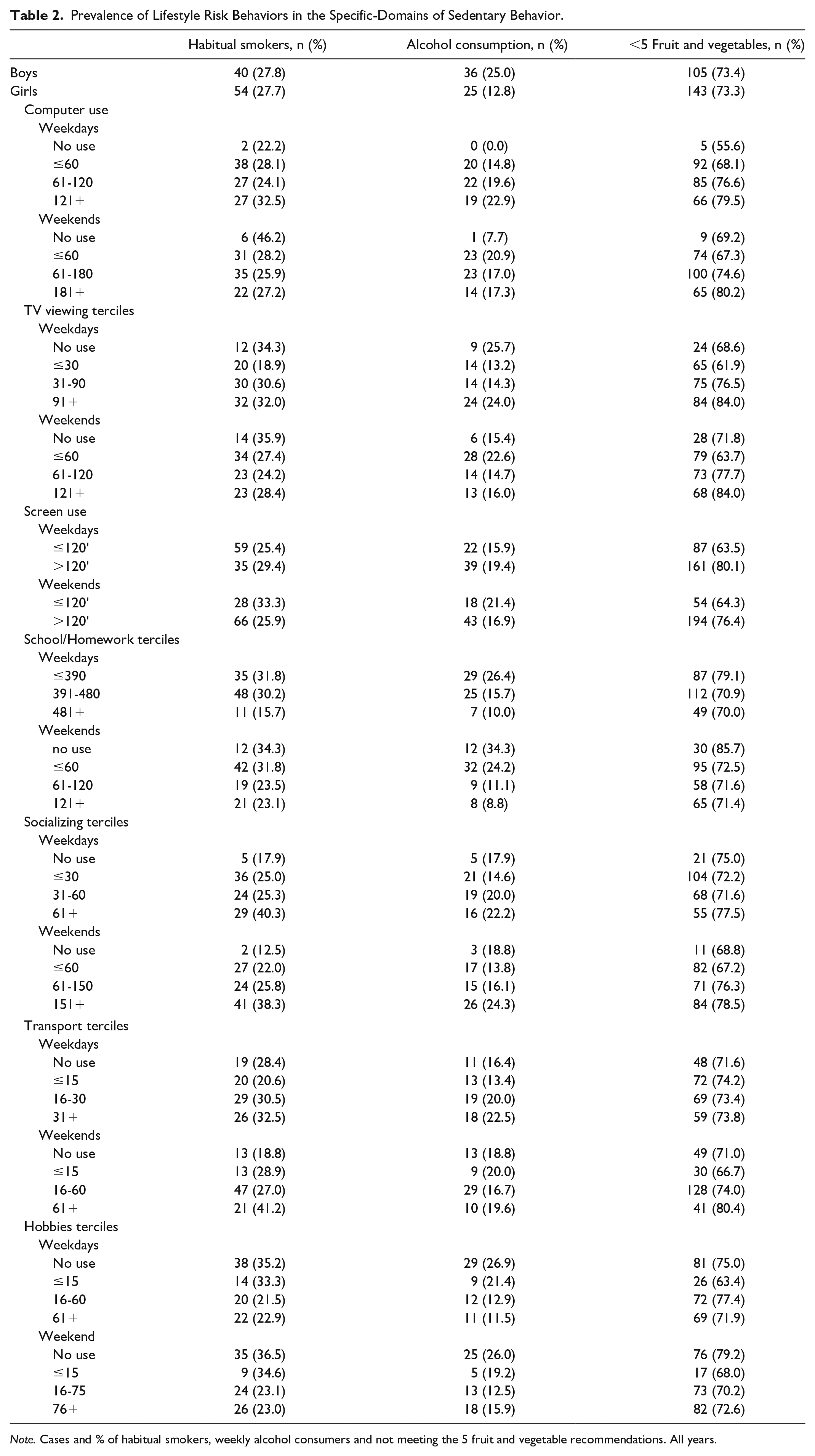
Note. Cases and % of habitual smokers, weekly alcohol consumers and not meeting the 5 fruit and vegetable recommendations. All years.
Domain-specific SBs and tobacco consumption during weekends
During weekends, adolescents with higher levels of SB spent on socialization (151+ min/day) had higher tobacco consumption compared to those who did not spend SB time socializing (38.3% vs 12.5%). Similar results were found with sedentary transport (41.2% vs 18.8%). On the other hand, adolescents who spent more time sitting on the computer, doing homework and hobbies showed lower percentages of tobacco consumption than those who spent less time (27.2 vs 46.2 computer; 23.1% vs 34.3% homework; 23.0% vs 36.5% hobbies) (Table 2). After adjusting for gender, year and leisure-time PA, it was detected that girls who spent a greater amount of time watching TV were less likely to smoke than those who did not watch TV (OR = 0.39, 95% CI 0.16-0.93) (Figure 1a).
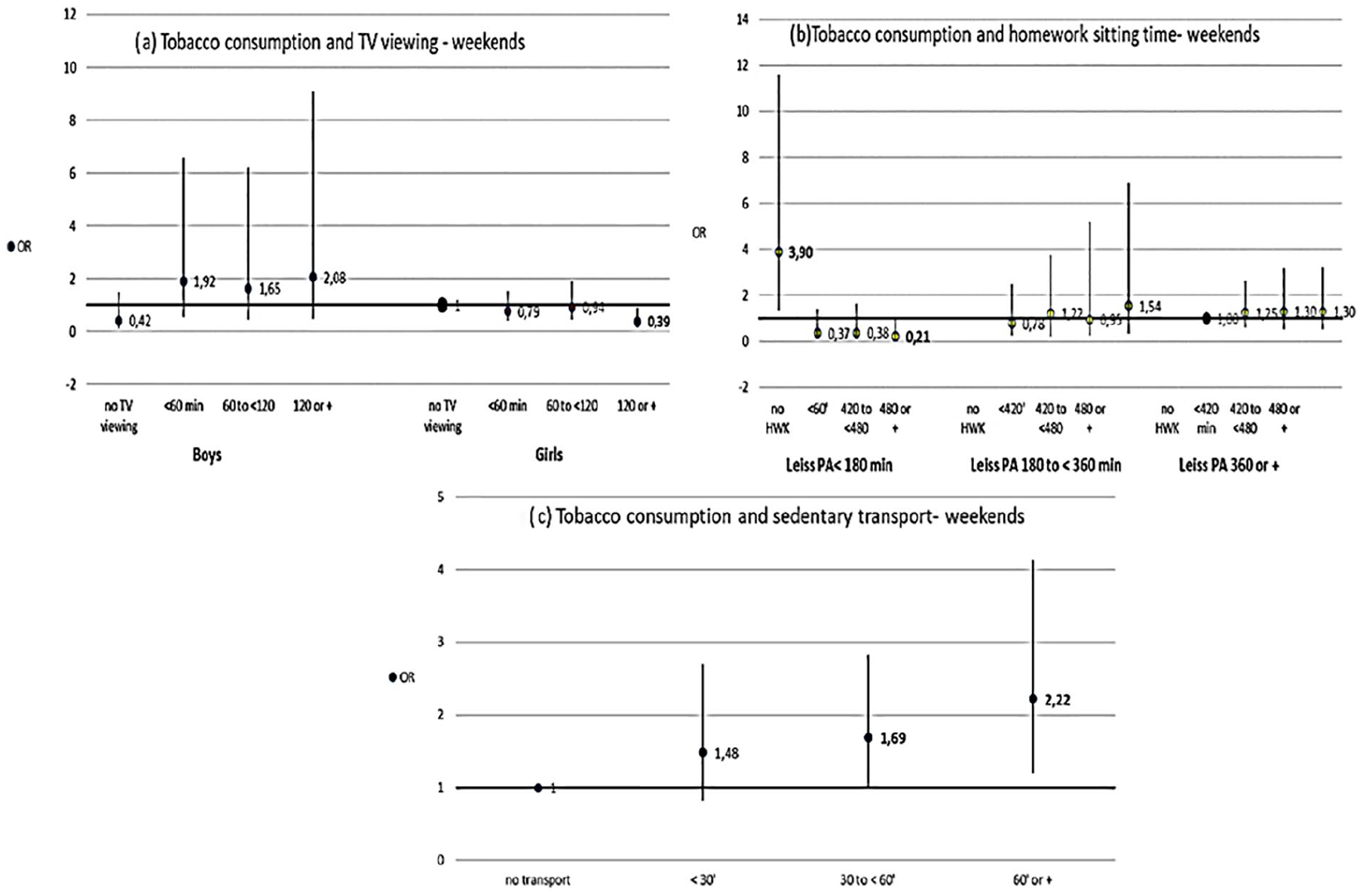
Tobacco consumption risk related to SB-domains. OR (95% CI): Model 1a: tobacco = TV + gender + TV*gender, Model 1b: tobacco = homework + year + leisure PA + homework*leisure PA, and Model 1c: tobacco = transport + leisure PA.
In the most inactive group (<180 min/week of leisure time PA), adolescents spending no sitting time doing homework were more likely to smoke (OR = 3.9, 95% CI 1.31-11.61) compared to those spending no sitting time doing homework and being in the most active group. In contrast, those who spent more time doing homework (≥480 min/day) were less likely to smoke (OR = 0.21, 95% CI 0.03-0.93) (Figure 1b).
Finally, adolescents spending 30 min or more per day sitting in motorized transport showed more likelihood of smoking compared to those who did not use motor vehicles (OR = 1.69, 95% CI 1.01-2.83, 30-60 min; OR = 2.2, 95% CI 1.2-4.12, 60+ min) (Figure 1c).
Transitional Associations Between Domain-Specific SBs and Weekly Alcohol Consumption
Domain-specific SBs and alcohol consumption during weekdays
Adolescents sitting more than 2 h/day in front of a computer and more than 1 h/day socializing had higher percentages of weekly alcohol consumption than those who did not (22.9% vs 0% computer, 22.2% vs 17.9% socializing). On the other hand, adolescents who had higher levels of sedentary hobbies (≥61 min/day) and sitting for school reasons (≥481 min/day), had lower percentages of alcohol consumption (11.5% and 10.0%) (Table 2).
Girls with higher sedentary time spent on TV viewing were less likely to consume alcohol weekly compared to girls who did not watch TV (OR = 0.20, 95% CI 0.05-0.76, <30 min; OR = 0.27, 95% CI 0.08-0.95, 30-60 min; and OR = 0.27, 95% CI 0.07-0.99, 60+ min) (Figure 2a). And adolescents who spent at least 30 min/day doing sedentary hobbies were less likely to consume alcohol weekly compared to those who did not do any sedentary hobby (OR = 0.38, 95% CI 0.17 -0.81, 30-60 min; OR = 0.39, 95% CI 0.17-0.86, 60+ min) (Figure 2b).

Alcohol consumption risk related to SB-domains. Weekdays and weekends. OR (95% CI). Model 2a: alcohol = TV + gender + year + TV*gender, Model 2b: alcohol = hobbies + gender + year + leisure PA + homework, and Model 1c: alcohol = homework + gender + leisure PA + homework*gender.
Domain-specific SBs and alcohol consumption during weekends
During weekends, adolescents with more time spent on sedentary socialization (≥151 min/day) were more likely to have higher alcohol consumption compared to adolescents with less socialization time (≤60 min/day) (24.3% vs 18.8%). On the other hand, those who spent more than 2 h/day doing homework and more than 75 min/day doing sedentary hobbies, presented lower percentages of alcohol than those spending no time on these activities (8.8% vs 34.3% homework; 15.9% vs 26.0% hobbies). Among those spending time in sedentary hobbies, a regular reduction in alcohol consumption was detected (Table 2). After adjusting the model, we observed a protective effect of spending time doing homework in girls: those who spent more time doing homework had fewer opportunities to consume alcohol than those doing no homework (OR = 0.23, 95% CI 0.06-0.88, <30 min; OR = 0.22, 95% CI 0.06-0.85, 30-60 min; OR = 0.13, 95% CI 0.03-0.53, >60 min) (Figure 2c).
Transitional Associations Between Domain-Specific SBs and Fruit and Vegetable Consumption
Domain-specific SBs and fruit and vegetable consumption during weekdays
Adolescents who sat more than 2 h/day in front of the screen were more likely not to meet the fruit and vegetable recommendations compared to those who spent less than 2 h (80.1% vs 63.5%). On those spending more time in front of the computer, a sharp increase in not meeting the recommendations was seen across the years (Table 2).
After adjusting for gender, year and leisure-time PA, adolescents in the most active group (≥360 min a week of leisure-time PA) who sat watching TV 60′ or more per day and spent more than 2 h a day in front of a screen were less likely to meet the fruit and vegetable recommendations (OR = 9.93, 95% CI 1.9-51.96; OR = 3.8, 95% CI 1.72-8.45) respectively (Figure 3a).

Fruit and vegetable lack of consumption risk related to SB-domains. Weekdays. OR (95% CI). Model 3a, less than 5 fruits and vegetables = TV + leisure PA + TV*leisure, Model 3b: less than 5 fruits and vegetables = screen use + year + leisure PA + screen use*leisure PA.
In the most inactive group (<180 min a week of leisure-time PA) adolescents who spent less than 120 days of screen use were also less likely not to meet the fruit and vegetable recommendations (OR = 4.48, 95% CI 1.54-13.03) (Figure 3b).
Domain-specific SBs and fruit and vegetable consumption during weekends
At weekends, adolescents who sat more than 2 h in front of a screen were more likely not to meet the fruit and vegetable recommendations (76.4%). Adolescents who spent no time doing homework and more time using sedentary transport or socializing, also showed higher percentages for not meeting the fruit and vegetable recommendations (85.7% doing homework; 78.5% socializing; and 80.4% sedentary transport) (Table 2). Among those spending more than 1 h/day using sedentary transport, the prevalence of not meeting the recommendations increased across the years (Table 2). After adjusting for gender, year, and leisure-time PA, no relation was observed between fruit and vegetable consumption and SB during weekends.
Discussion
This study investigated the associations between changes in domain-specific SBs and changes in health-related lifestyles across the adolescence-university transition in a sample of Spanish adolescents. Adolescents and university students have more opportunities—and a greater requirement—to spend time sitting in several contexts. 30 This has added urgency, since post-pandemic; sedentary time increased by 52.7% in university students over this period. 31 Given its ubiquity, there is a need to understand whether any increases in SBs in specific contexts spills over to incrementally influence other lifestyle risk behaviors. With scarce longitudinal evidence associating SBs and lifestyle behaviors over this life period, 30 this study shows that SB patterns initiated during this time—rather than because of this time—affected further (un)healthy lifestyle behaviors.
Main Findings of This Study
Three main findings were identified. The first finding highlighted that time spent on doing homework was associated with positive protective lifestyle behaviors. Time sitting doing weekend homework was protective against tobacco use in adolescents who spent little time doing leisure PA. In girls, doing sedentary weekend homework also protected against alcohol consumption. These are relevant findings since alcohol and tobacco consumption have been negatively related to academic performance and increased risk for skipping school among adolescents.32 -35 Similarly, students with higher grades have been reported to be less likely to engage in alcohol consumption behaviors, with males more likely to engage in alcohol consumption behaviors than females. 36 Taking into account previous evidence indicating that time spent in doing homework/study without computer is positively associated with academic performance, 37 our results suggest that time spent sitting doing weekend homework is protective against tobacco and alcohol use. Our findings also suggest the key role leisure time PA plays in the consumption of alcohol and tobacco during this life period.37,38
The second finding highlighted that spending time doing specific SB-domains, like sedentary transportation was negatively associated with lifestyle risk factors. Specifically, sedentary weekend transport time was associated with higher tobacco consumption. Previous research has confirmed the relationship between tobacco consumption and sedentary time in adolescence 39 and also that tobacco use and sedentary transport are risk behaviors that have increased during the last years, especially among girls. 40 Our results confirm that sedentary transport need to be tackled during this transition period, particularly because of the potential role that active transportation might have for behavioral risk factor modification. 41
The third finding highlighted that sedentary TV watching was protective to lifestyle behaviors -weekend tobacco consumption and weekday alcohol consumption—but only in girls. In addition, the lowest and highest tertiles for sedentary screen use and leisure-time PA were less likely not to meet the recommendations for fruit and vegetable consumption. Our results are similar to previous research in identifying associations between screen time and substance use (alcohol and/or cigarettes) among adolescents, 42 highlighting that overuse time spent in front of screens for leisure should be part of future interventions for tackling behavioral risk factors during this life transition period. However, the relationship between screen use and fruit and vegetable consumption followed the “Goldilocks effect”; both extremes (<180 and >360 min/week) may be at risk.
Evidence suggest that the type of screen media adolescents use while being sedentary may affect other lifestyle behaviors such as media that provide information about safe health and practices and behaviors.43 -45 However, our results suggested that screen time associations with lifestyle risk factors were also influenced by gender and leisure-time PA, indicating that gender and levels of leisure-time PA should be considered when designing preventive interventions targeting sedentary screen time. Public Health interventions on the transition from secondary to university should target reductions in SB-specific domains. In doing so they could influence other risk lifestyle behaviors that can begin to incubate their harm during this critical life period. 13
Main Limitations and Strengths
This study used self-report data which can lead to an overestimation of PA levels. 46 Although recall bias is common and would require validation against objective measures (ie, inclinometers or accelerometers), self-report tools allow the description of behavioral context and modes of SB. 47 In the future, self-report and objective methods should be combined to accurately assess the patterns of both SBs and PA across this life period.
Although a larger sample size was preferable and no power calculation was conducted for this longitudinal study, this study presents data based on a medium-sized sample and is one of the first longitudinal studies of Spanish adolescents to address the emergence of SBs in relation to lifestyle risk behaviors. Given that SBs emerge with age, rather than at a given age, it is important to integrate a lifecourse perspective in SB-reduction interventions whenever possible. 47 Future studies could include a wider range of unhealthy behaviors, including fast food and/or sugary drinks.
Conclusions
Given that NCDs often take years to develop, it is important to (i) establish when any unhealthy lifestyles emerge, (ii) identify any (un)healthy behavioral combinations, and (iii) intervene to offset potential long-term harm.48,49 Adolescence signals the initiation of many risk behaviors50 -52 and therefore, the adolescence-university transition represents a critical life period to understand how lifestyle behaviors may cluster, to target disease prevention and promote sustainable health-enhancing behavior 53 into adulthood and for the next generations. Our findings indicate that from secondary school to university, specific SBs are associated to lifestyle risk factors some of which are gender-based and/or related to leisure-time PA. Over this transitional period, public health interventions targeting reduced SBs may bring multiple benefits by also preventing other harmful behaviors.
Supplemental Material
sj-docx-1-inq-10.1177_00469580221118843 – Supplemental material for From Secondary School to University: Associations Between Domain-Specific Sedentary Behaviors and Lifestyle Risk Behaviors
Supplemental material, sj-docx-1-inq-10.1177_00469580221118843 for From Secondary School to University: Associations Between Domain-Specific Sedentary Behaviors and Lifestyle Risk Behaviors by Ignasi Arumi-Prat, Eva Cirera, Jim McKenna and Anna Maria Puig-Ribera in INQUIRY: The Journal of Health Care Organization, Provision, and Financing
Supplemental Material
sj-docx-2-inq-10.1177_00469580221118843 – Supplemental material for From Secondary School to University: Associations Between Domain-Specific Sedentary Behaviors and Lifestyle Risk Behaviors
Supplemental material, sj-docx-2-inq-10.1177_00469580221118843 for From Secondary School to University: Associations Between Domain-Specific Sedentary Behaviors and Lifestyle Risk Behaviors by Ignasi Arumi-Prat, Eva Cirera, Jim McKenna and Anna Maria Puig-Ribera in INQUIRY: The Journal of Health Care Organization, Provision, and Financing
Footnotes
Acknowledgements
Agència de Gestió d’Ajuts Universitaris, Universitat de Vic-Universitat Central de Catalunya, and Centres d’Estudis Sanitaris i Socials. Paul Marshall for his language help and Joan Carles Martori for his preliminary statistical analysis.
Author Contributions
IAP carried out the longitudinal study, reviewed the current literature about our area of interest and drafted the manuscript; EC performed the statistical analysis, wrote the methods section and drafted the manuscript; APR participated in its design and coordination of the study, wrote the discussion part and helped to draft the manuscript. JMcK contributed to the preparation of the manuscript.
Declaration of Conflicting Interests
The author(s) declared no potential conflicts of interest with respect to the research, authorship, and/or publication of this article.
Funding
The author(s) disclosed receipt of the following financial support for the research, authorship, and/or publication of this article: This work was supported by funding from the Agència de Gestió d’Ajuts Universitaris i de Recerca (AGAUR) under grant number 2012 FI_B 00506.

Supplemental Material
Supplemental material for this article is available online.
References
Supplementary Material
Please find the following supplemental material available below.
For Open Access articles published under a Creative Commons License, all supplemental material carries the same license as the article it is associated with.
For non-Open Access articles published, all supplemental material carries a non-exclusive license, and permission requests for re-use of supplemental material or any part of supplemental material shall be sent directly to the copyright owner as specified in the copyright notice associated with the article.
