



Abstract
Background and Objective
Physical inactivity is 1 of the most important cardiovascular risk factors causing higher morbidity and mortality rate worldwide. Thus, the promotion of physical activity (PA) is 1 of the fundamental pillars in the primary prevention of heart disease. Therefore, this study aimed to assess the prevalence of Physical Activity among healthcare Students in the Riyadh region, Saudi Arabia.
Methods
An observational, descriptive, cross-sectional study using paper-based printed questionnaires was conducted among Emergency medical students (EMS) from the Prince Sultan College for Emergency Medical Services King Saud University. To evaluate the physical activity, Global Physical Activity Questionnaire (16-items) developed by the World health organization was used. The questionnaires talk about activity at work (6 items), travel to and from places (3-items), recreational activities (6- items), and sedentary behavior (1-item). Both binary answers (Yes\No) and continuous scales were used to collect the data. Data were descriptively analyzed using a statistical package for social science version 26 (SPSS).
Results
The prevalence of PA among students was 69.9% (n = 123). The most common type of physical activity was walking, accounted for 51.7% (n = 91), followed by Gym/bodybuilding 25% (n = 44), running 24.4% (n = 43). A total of 7.16 mean hours (SD = 11.23) were spent by students doing vigorous-intensity activities on a typical day, while 4.93(SD = 8.84) of mean hours were spent on moderate-intensity activities. Additionally, more than half of the students 55.7% (n = 98) performed vigorous-intensity sports, fitness, or recreational activities that cause large increases in breathing or heart rate (for at least 10 minutes continuously). The mean time spent by the students in this study performing vigorous-intensity sports, and fitness activity were 4.60(SD = 10.22) mean hours per day. The sedentary behavior, like constant sitting, was reported to be 7.33 (SD = 4.24) mean hours per day.
Conclusion
In conclusion, about 3 in ten EMS students are physically inactive, which could be due to study-related actions. Future research among undergraduates should focus on approaches to increase PA is needed.
Physical inactivity is a raising concept of health issue linked to various acute and chronic diseases
The individuals with low PA were more prone to suffer health problems awareness about it is essential among health care students since they would be the role model for their patients
This research found the gap that several healthcare students do not meet the recommended physical activity levels. Thus these finding indicates that prioritizing the undergraduates for indulging in Physical activity through increasing awareness and knowledge about the importance of physical activity, given this population are role model for other individuals if they become active, thereby helping in controlling the risk of CVD.
Introduction
Physical inactivity is a raising concept health issue linked to various acute and chronic diseases and lifestyle conditions which include obesity, diabetes, cardiovascular disease, and gastrointestinal problems which include colon cancers.1,2 It is assumed that relatively a high prevalence of disease was mainly due to a lack of physical activity (PA) among Individuals.2,3 According to recent findings from the World Health Organization, worldwide 1 in 4 adults does not fulfill PA requirements.4,5 Furthermore WHO recommended at least 150-300 minutes of moderate-intensity aerobic PA for adults or 75-150 minutes of vigorous-intensity PA or a combination of it is needed throughout the week. 5 Although the previous report suggested that lack of PA is directly responsible for 5.3 million deaths annually. 6 In addition, WHO, reported that Physical inactivity is 1 of the ten major causes of mortality in the world and imposes a significant financial burden, estimated to be 11% of total healthcare spending in the United States, per year. 7 In Saudi Arabia, a recent report estimated the health care costs associated with lack of physical activity were found to be $869,019, representing 1.71% of the total healthcare costs. 8
Physical activity is defined as any bodily movement that requires energy expenditure and is performed by skeletal muscles. Furthermore, energy expenditure associated with PA is measured in Kilocalories. 5 Physical activity promotes increased oxygen consumption in comparison to the relaxing stage of the human body, to meet the required energy during this procedure, the skeletal system of the body uses its storage of free fatty acids and triglycerides, thereby the supply of blood to the whole body are remarkably well maintained, which in turn leads to the healthy body after the Physical activity. 9 WHO reported multiple benefits of regular physical activity, which includes improvement in muscle movements of the body and cardiorespiratory fitness, helps in maintaining healthy bones and skeleton system. 5 Furthermore, PA activity also helps in reducing the risk of heart attaches and cardiovascular diseases.5,10-13 Other studies reported improvement in the mental ability of the individuals and overall quality of life. 10 The individuals with low PA were more prone to suffer health problems than those who are active physically. Physical inactivity is significantly associated with the high risk of cardiovascular disease, endocrine disease, elevated levels of cholesterols and triglycerides, and risk of development of various cancers and, increased risk of weight gain.5,9-13
Despite the high prevalence of smoking and unhealthy eating habits, and an increasingly sedentary lifestyle among adolescents and university students, activities involving sitting, reclining, or lying down is more prevalent. 14 Although studies also highlighted that university students were present with a relatively higher prevalence of overweight and obesity compared to the general population. 15 Additionally, there was evidence that undergraduates were reported to have a higher consumption of unhealthy drinks and fast food, and dietary supplements to cope with the stress associated with their lifestyle and academic routine.16-20
Multiple previous studies demonstrated level of PA was not sufficient among students throughout the world.21,22 In Saudi Arabia, recent literature found that majority of the adolescents including college students were not active to meet the required guidelines for moderate PA. 23 The prevalence of physical inactivity was reported differently in various studies, for instance, it was 34.8% among health care professionals in Saudi Arabia, 24 the highest prevalence of 82.6% was reported among the public in Saudi Arabia 25 while it was 49% among Malaysian medical students. 26 The prevalence of physical activity was measured using the WHO stepwise questionnaire.24,25 Overall, PA among individuals is crucial for maintaining a healthy life. Despite the wealth of literature about PA behaviors in the general public in Saudi Arabia and other countries.23-25 There is a scarcity of research on the health care’ students toward physical activity. The present study aims to evaluate the prevalence of physical activity, among pharmacy students in Riyadh, Saudi Arabia.
Methods
Study Design, Participants, and Settings
A cross-sectional questionnaire-based study was conducted between December 2021 to February 2022, among emergency medical service (EMS) students from the Prince Sultan College for Emergency Medical Services in King Saud University, Riyadh, Saudi Arabia. The targeted population included EMS students aged ≥18 years, speaking Arabic or English, and willing to participate in the study by signing the consent. The participants were assured that the data would be used only for research and would be maintained confidential throughout the study. Others who do not match the inclusion criteria were excluded.
Questionnaire Design
The questionnaires used for this study were prepared after an extensive review of similar studies published elsewhere. 25 (Appendix 1) Furthermore, the WHO stepwise questionnaire was also used to assess the PA. 26 The questionnaire was divided into 2 sections. The first section included demographic items that assessed participants' characteristics like age, gender, and information about their PA status. The second section contained 16 items divided into 4 sub-sections. Subsection 1 consisted of 6-items about activity at work., The second subsection talks about travel to and from places (3-items), recreational activities 6- items, and sedentary behavior 1-item. Both binary answers (Yes\No) and continuous scales were used to collect the data. In this study, the prevalence of physical activity (walking, cycling, bodybuilding, running, or any sports-related activity) was determined, by individuals or students who practice any kind of physical activity on weekly basis.
The questionnaire was translated into Arabic by a certified Arabic speaker. The questionnaire was evaluated by a research team, to ensure the readability and accuracy of the content. Furthermore, a pilot study was conducted among a randomly selected sample of EMS students (n = 20). The results of the pilot study reveal the length of the time of the survey, which was estimated to be 7 minutes. Additionally, the result of the pilot study was not included in the final analysis. The reliability of the questionnaire was determined using Cronbach’s Alpha value of (.85), indicating that questionnaire was reliable to carry out the study.
Data Collection
The data were collected using the convenience sampling method. The final study questionnaire was distributed by visiting personally each year the students, who were currently enrolled and present at the time of data collection. Paper-based printed questionnaires were used to collect the data. To collect the maximum number of responses students were followed by a team of researchers (1 researcher and a chief investigator). To avoid response duplications, participants were instructed to fill out the questionnaire once despite the method through which they received it.
Data Analysis
The data were analyzed using the Statistical Package for the Social Sciences (SPSS) version 26 for Windows (SPSS Inc, Chicago, Illinois). Descriptive statistic was used to summarize the demographic characteristics. For the continuous data values were presented in the form of mean and standard deviation.
Results
Demographic Characteristics Among Healthcare students (n=176).

Type of physical activity among participants.

When we asked about the Reasons for physical inactivity among them, the majority of the students reported a lack of time 47.2% (n=83), followed by an unwillingness to practice physical activity 21.6% (n=38) and injury10.2% (n=18). Furthermore, detailed information on the Reasons for physical activity of the respondents was shown in Figure 1. Reasons for physical inactivity
In this study 7.16hours (SD=11.23) of the meantime were spent by the health care students doing vigorous-intensity activities at work on a typical day (Median (2)), while 4.93(SD=8.84) of mean hours were spent on moderate-intensity activities at work (Figure 2). Slightly less than half of the students 40.6% (n=71) used bicycles for at least 10minutes continuously to get to and from places. Additionally, more than half of the students 55.7% (n=98) performed vigorous-intensity sports, fitness, or recreational activities that cause large increases in breathing or heart rate like [for at least 10 minutes continuously. The mean time spent by the students in this study performing vigorous-intensity sports, and fitness activity were 4.60(SD=10.22) mean hours per day. Sedentary behavior like constant sitting was reported to be 7.33 (SD=4.24) mean hours per day (Figure 2) (Table 3). Amount of time spent doing physical activity on a typical day. Time and characteristics of different types of PA in a typical week. aSignificantly associated with the year of study (P=.036).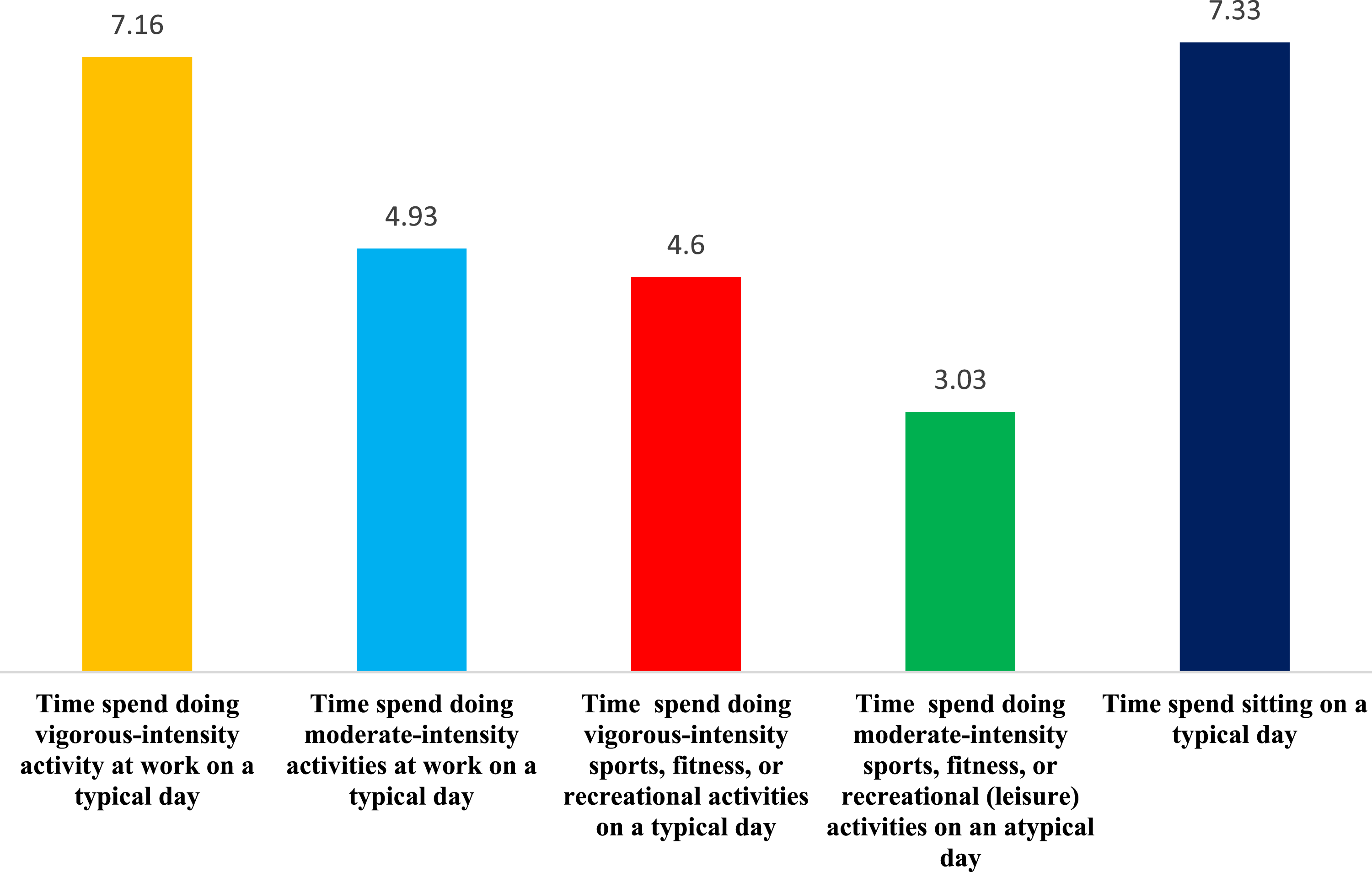

Days spend on doing different types of PA in a typical week.

Discussions
The physical activity of the body has been associated with significant benefits to the individuals and was widely established in the previous literature,25-29 and it was encouraging to discover in our study that the majority (69.9%) of health care students are regularly active physically. This study results were higher than the previous study by Naim et al among medical and non-medical students in Malaysia (51%), 30 among practicing health care professionals by Banday et al (20.88%), 24 among medical students in Southern Thailand by Wattanapisit et al (49.5%)31, among female college students by Alzamil et al 32 in Saudi Arabia (50%). However, these results were lower than previous studies published by Marques-Sule et al among health care professionals (96%). 29 The prevalence of PA may differ from 1 study to another and may be influenced by several factors including the study method, types of respondents, and demographics of the subjects. However, in many developed and developing countries. Physical inactivity is increasing and is reported to be a common practice among students, due to the increased sedentary lifestyle.
Although in the current study the work-related vigorous-intensity activity was found to be 54%. Similar results were reported by Marques-Sule et al among health care professionals who reported most of the participants were physically active at their workplace, during their spare time. 29 Similarly, a previous Study by Al-Zalabani et al, in Saudi Arabia reported 18.3% of work-related PA. 33 However, according to a recent systematic review, the prevalence of physical inactivity among young Saudis was 71%. 23 Lack of PA is significantly associated with obesity and hypertension, hyperlipidemia, and glucose intolerance are the first harmful effects of obesity to appear in a population in a socioeconomic transition state, while coronary heart disease and long-term diabetes complications, such as kidney failure, appear later. Although previous studies concluded that health care professionals were found to be physically inactive in comparison to other populations. 32
In this study walking, running, bodybuilding and playing games were the types of PA performed by Saudi health care students. However, the most common justification to avoid physical activities was lack of time. Similar results were reported by Awadalla et al among health college students, by Al Reshidi in 2016 among residents.34,35 Although Wattanapisit et al reported lack of social support was another potential barrier that influence the PA behavior of the students. 29 Additionally, studies found that the type of PA activity among students was mainly supported by environmental, social, psychosocial, and cultural characteristics.29,36
Cumulatively and not surprisingly in this study, the average amount of time spent constantly sitting was 7.33 hours. Although the World Health Organization (WHO) recommends that individuals engage in at least 75-150 minutes of vigorous-intensity aerobic PA per week or an equivalent combination of moderate- and vigorous-intensity activity throughout the week. 5 In the current findings, 7.16 mean hours were spent by health care students doing vigorous-intensity activities at work on a typical day. While moderate-intensity sports, fitness, or activity was reported to be 3.03 hours. Unsurprisingly, undergraduates were less engaged than other people. This could be because that is the current study’s healthcare students spent a lot of time in hospitals conducting clinical rotations or practical cessations, and their free time was dominated by study-related activities. Physical exercise among future healthcare practitioners would assist them in role modeling and promoting PA among their patients. Knowing the scope of physical activity would aid in the development of policies to promote it regularly among individuals living in Saudi Arabia and other countries, and keeping sufficient knowledge and awareness of PA in current study participants who are regarded as future professionals would aid in providing counseling services to their patients. In terms of the importance and usefulness of PA methods among participants, despite being physically active, the majority of students did not fully understand the importance and effectiveness of PA methods according to WHO recommendations. Additionally, it is important to incorporate education about PA programs or raise awareness of PA into their academic lives to improve their knowledge of PA methods. According to a previous study in Saudi Arabia, increased cardiovascular diseases and obesity, are other interventions to reduce physical inactivity prevalence in Saudi Arabia and other countries. Our research has a few limitations. First, the design of the research was a based-cross sectional self-reported survey, potentially rendering our results less reliable. However, because the survey was anonymous and completely voluntary, 1 can assume that PA status was reliably captured. Secondly, the study was conducted on a single university’s students limited to EMS, hence results cannot be generalized to all health care students in Saudi Arabia. Lastly, this study was conducted without determining the power analysis for the sample size estimation.
Conclusion
Our study highlights an increasing trend of Physical inactivity with low levels of minimum PA among health college students living in the capital of Saudi Arabia, Riyadh. More importantly, the prevalence of physical inactivity is on a rise compared with both national and international studies, which may potentially associate with negative consequences on public health. Therefore, we advocate the implementation of programs or workshops that educate students about the harmful outcomes surrounding physical inactivity and their consequences on overall health. An Inter-professional approach to education that addresses the importance of using PA could be the most practical way to address such a complex issue.
Footnotes
Acknowledgments
The The author(s) extend appreciation to the Deanship of Scientific Research at King Saud University for funding the work through the research group project No. RG-1438- 050. In addition, the authors thank the Deanship of Scientific Research and RSSU at King Saud University for their technical support
Author Contributions
The work done in this study is solely accounted by the author mentioned in this study
Declaration of conflicting interests
The author(s) declared no potential conflicts of interest with respect to the research, authorship, and/or publication of this article.
Funding
The author(s) disclosed receipt of the following financial support for the research, authorship, and/or publication of this article: This study was supported by Research group Project, King Saud University, Saudi Arabia, (RG-1438-050) who provided funding for this work.
Availability of data and materials
The datasets used and analyzed during the current study are available from the corresponding author on reasonable request.
Institutional Review Board Statement
This study was exempted from the ethical approval.

Appendix
Table 5. Appendix 1.
Assessment of Physical Activity Among Health Care student’s in Saudi Arabia- a Cross-Sectional Study
1. Age (in years):□ 18-25 □ 26-30 □ 31-35 □ >36
14. In a typical week, how many days do you do moderate-intensity activities as part of your work? (Write number of days) في الروتين الأسبوعي، كم عدد الأيام التي تمارس فيها أنشطة معتدلة الشدة كجزء من عملك؟ (اكتب عدد الأيام) (…………..)
2. Gender:□ Male □Female
3. Year of study:□ 1st year □ 2nd year □ 3rd Year□ 4th year □ 5th year □ Final year
15. How much time do you spend doing moderate-intensity activities at work on a typical day? (Please write the number of hours) في الروتين اليومي، كم تقضي من الوقت في ممارسة الأنشطة متوسطة الشدة في العمل ؟ (اكتب عدد الساعات) (…………..)
Ems student Yes/No
16. Do you walk or use a bicycle (pedal cycle) for at least 10minutes continuously to get to and from places? هل تمشي أو تستخدم دراجة لمدة 10 دقائق على الأقل بشكل مستمر للتنقل من وإلى الأماكن؟ □ Yes □ No
5. Marital Status:□ Married □ Unmarried/Single □ Widowed/Divorced
17. In a typical week, on how many days do you walk or bicycle for at least 10 minutes continuously to get to nd from places? (Please write a number of days في الروتين الأسبوعي، كم عدد الأيام التي تمشي فيها أو تستخدم الدراجة لمدة 10 دقائق متواصلة للوصول من وإلى الأماكن؟ (يرجى كتابة عدد الأيام) (…………..)
6. Monthly household income over the last 12 months?□ SAR >5000 □ SAR 6000-10,000□ SAR 11,000-20,000 □ SAR <21,000
7. Do you do any type of physical activity on weekly basis?هل تمارس أي نوع من الأنشطة البدنية بشكل أسبوعي؟□ Yes □ No
18. Do you do any vigorous-intensity sports, fitness or recreational (leisure) activities that cause large increases in breathing or heart rate like [running or football,] for at least 10 minutes continuously? هل تمارس أي رياضات شديدة أو تتطلب لياقة بدنية أو أنشطة تسبب زيادة في التنفس أو في معدل ضربات القلب مثل [الجري أو كرة القدم] لمدة 10 دقائق على الأقل بشكل متواصل؟
□ Yes □ No
8. What type of physical activity do you do?ما نوع النشاط البدني الذي تقوم به؟□ Walking □ Running □ Swimming □ Football/Volleyball□ Gym/Body Building □ Others, ……………. .□ I don’t active physically
19. In a typical week, on how many days do you do vigorous intensity sports, fitness or recreational (leisure) activities? (Please write number of days في الأسبوع العادي ، كم عدد الأيام التي تمارس فيها الرياضات القوية أو التمارين البدنية أو الأنشطة الترفيهية؟ (يرجى كتابة عدد الأيام) (…………..)
9 Reasons for not practicing physical activities?ماهي أسباب عدم ممارسة الأنشطة البدنية؟□ Unwillingness to practice physical activity (عدم الرغبة في ممارسة النشاط البدني)□ Lack of time (قلة الوقت)□ Lack of facilities in the district where I live (عدم وجود مرافق في المطقة التي أعيش فيها)□ Injury (إصابة)□ Others, …………….
20. How much time do you spend doing vigorous-intensity sports, fitness, or recreational activities on a typical day? (Please write the number of hours كم تقضي من الوقت في ممارسة الرياضات الشديدة أو التمارين البدنية أو الأنشطة الترفيهية في يوم عادي؟ (الرجاء كتابة عدد الساعات)
(…………..)
21. Do you do any moderate-intensity sports, fitness or recreational (leisure) activities that causes a small increase in breathing or heart rate such as brisk walking, (cycling, swimming, volleyball) for at least 10 minutes continuously? هل تمارس أي رياضة أو تمارين بدنية أو أنشطة ترفيهية متوسطة الشدة تسبب زيادة طفيفة في التنفس أو معدل ضربات القلب مثل المشي السريع (ركوب الدراجات ، السباحة ، الكرة الطائرة) بشكل متواصل لمدة 10 دقائق على الأقل ؟
□ Yes □ No
10. Does your work involve vigorous-intensity activity that causes large increases in breathing or heart rate like [carrying or lifting heavy loads, digging or construction work] for at least10 minutes continuously?هل يتضمن عملك نشاطًا بدنياً يسبب زيادة كبيرة في التنفس أو معدل ضربات القلب مثل [حمل أو رفع الأثقال ، أعمال الحفر ، أعمال البناء] لمدة 10 دقائق على الأقل بشكل متواصل؟□ Yes □ No
22. In a typical week, on how many days do you do moderate-intensity sports, fitness or recreational (leisure)activities? (Please write number of days) في الروتين الأسبوعي، كم عدد الأيام التي تمارس فيها الرياضات متوسطة الشدة أو التمارين البدنية أو الأنشطة الترفيهية؟ (يرجى كتابة عدد الأيام)
(…………..)
11. In a typical week, on how many days do you do vigorous-intensity activities as part of your work? (Write number of days)في الروتين الأسبوعي، كم عدد الأيام التي تمارس فيها أنشطة شاقة كجزء من عملك؟ (…………..)
23. How much time do you spend doing moderate-intensity sports, fitness or recreational (leisure) activities on atypical day? (Please write number of hours ex:1 or 2 or 3 or more في الروتين العادي، امقدار الوقت الذي تقضيه في ممارسة الرياضات متوسطة الشدة أو التمارين البدنية أو الأنشطة الترفيهية؟ (يرجى كتابة عدد الساعات) (…………..)
12. How much time do you spend doing vigorous-intensity activities at work on a typical day?في الروتين، ما مقدار الوقت الذي تقضيه في ممارسة الأنشطة عالية الشدة في العمل؟ (…………..)
24. How much time do you usually spend sitting on a typical day? (Please write a number of hours ex:1 or 2 or 3 or more) في الروتين اليومي، كم تقضي من الوقت عادة جالسًا ؟ (يرجى كتابة عدد الساعات)
(…………..)
13. Does your work involve moderate-intensity activity that causes small increases in breathing or heart rate such as brisk walking [or carrying light loads] for at least 10 minutes continuously?هل يتضمن عملك نشاطًا متوسط الشدة يسبب زيادات طفيفة في التنفس أو معدل ضربات القلب مثل المشي السريع أو حمل الأحمال الخفيفة] لمدة 10 دقائق متواصلة على الأقل؟□ Yes □ No