




Abstract
Background. Coronavirus disease (COVID-19) is a highly communicable virus that continues to interrupt livelihoods, predominantly those of low-income segments of society. For the prevention of respiratory infections like the current COVID-19 outbreak, face masks are considered an effective approach.
Objective. This study intended to assess the knowledge, attitude, and practice of public transport drivers towards face mask use amid the COVID-19 pandemic in Gondar, Ethiopia.
Methods. A cross-sectional study was conducted among 412 public transport drivers in Gondar town from July to September 2021. The study subjects were recruited using a simple random sampling technique after proportionally allocating the sample size from the total number of public transport drivers, and finally, study subjects were selected using the convenience sampling method to select the participant drivers working in Gondar Town. The data were collected by face-to-face interview administered questioners and an on-the-spot observational checklist.
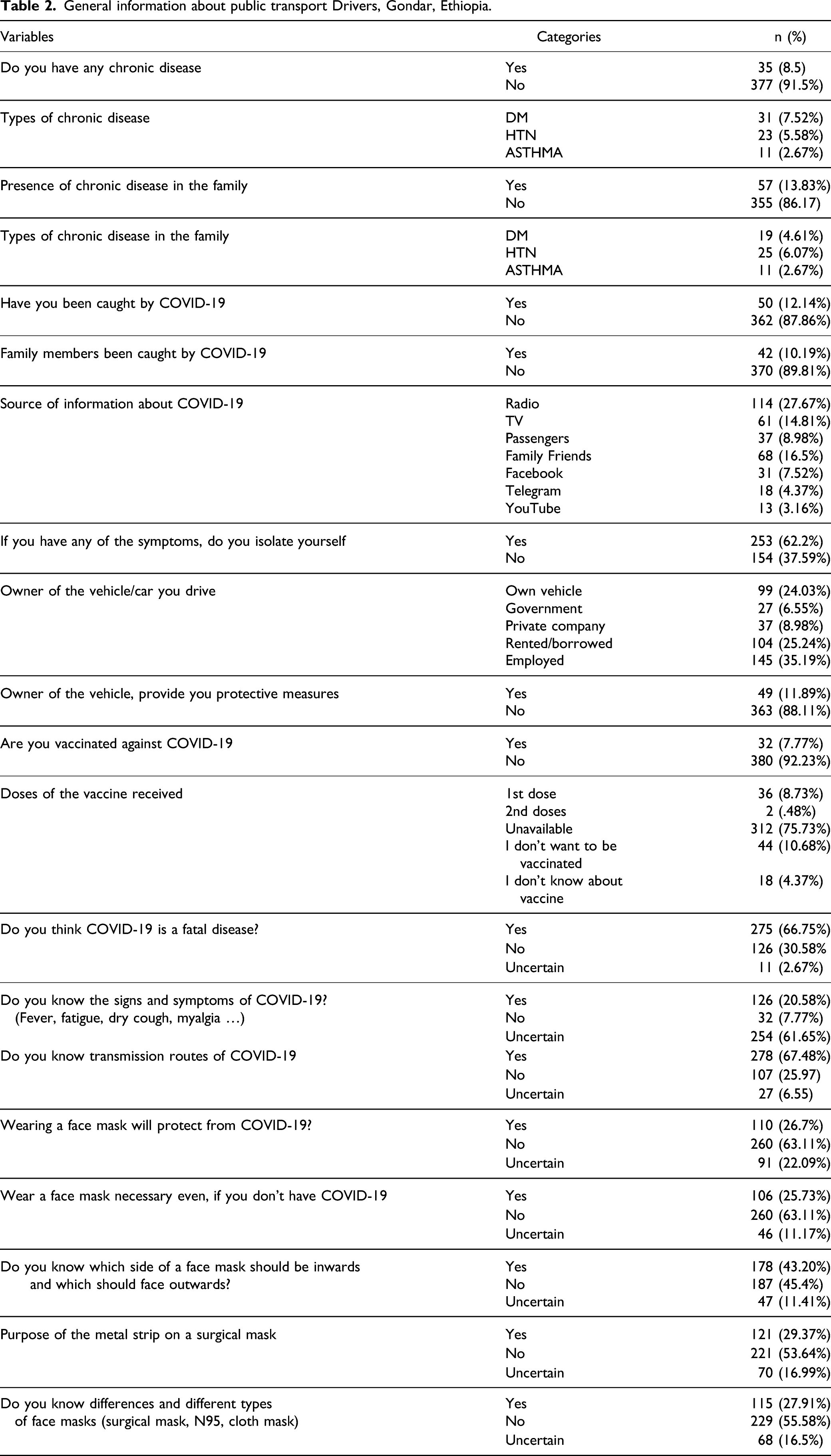
Results. A total of 412 public transport drivers have participated in the study. The mean age of the respondents was 32.75 years (±8.75 years). The majority of the participants were Bajaj drivers 193 (46.84%). Among the responders, 114 (27.67%) of them use radio to gather information about the pandemic and 50 (12.14%) of them had reported being caught by COVID-19. Meanwhile, only 32 (7.77%) were vaccinated against COVID-19. Drivers that had a diploma level of education were found to be 87.7% less knowledgeable than degree holders (AOR .123, 95% CI = .026, .573). Respondents that had good knowledge about COVID-19 and face masks were found to have 1.7 times more positive attitudes than those that had poor knowledge (AOR = 1.728, 95% CI = 1.150, 2.596). drivers whose family members have ever been caught by COVID-19 were found 2 times more likely to use face masks whenever they are working/driving (AOR = 2.173, 95% CI = 1.015, 4.652) than their counterparts.
Conclusion. This study revealed a very low Knowledge, attitude, and practice of face mask use among public transport drivers in Gondar town. Periodic reinforcement and training programs are needed for all public transport drivers in each level for proper understanding and adherence to COVID-19 prevention protocols and the use of face masks.
Coronavirus Disease (COVID-19) is a highly communicable virus that continues to interrupt livelihoods, predominantly those of low-income segments of society The current study will contribute to the existing data and will fulfill the paucity of research in this area. Thus, the findings of the study will fill the gaps on proper reinforcement measures from local government bodies to strictly monitor the practice of mask-wearing. The findings of the study will guide periodic reinforcement and training/orientation programs for all levels of drivers for adherence with appropriate knowledge, attitude, and use of face mask during his or her working or driving time through the respective Driver’s Association, awareness creation campaigns in co-operations with local FMs and Gondar Health Office, and proper reinforcement measures from local government bodies to strictly monitor the practice of mask-wearing.What do we already know about this topic?
How does your research contribute to the field?
What are your research’s implications for theory, practice, or policy?
Introduction
COVID-19 is a transmissible disease caused by severe acute respiratory syndrome coronavirus 2 (SARS-CoV-2). 1 The disease mainly affects the lungs and is associated with neurological and mental manifestations among others.2-4
Most COVID-19 patients experience cough, fever, anorexia, fatigue, and shortness of breath. 5 Though, other nonspecific symptoms may include sinus headache, sore throat, nausea, diarrhea, vomiting, and congestion. Evidence showed that the 2 key routes of transmission of the COVID-19 virus are contact and respiratory droplets. 6 Transmission of COVID-19 can occur through direct, indirect, or close contact with secretions, such as respiratory secretions and saliva or respiratory droplets, expelled from a COVID-19 infected patients.7-9
The widespread usage of face masks can help reduce virus transmission between individuals who are infected with the virus but have not yet acquired symptoms, as well as between individuals who do not have symptoms but are infected with the virus. 10 In Ethiopia, the number of people infected with COVID-19 has been increasing dramatically.11,12 According to the most recent data, up to March 26, 2022, the number of confirmed cases in Ethiopia reached 469,604, of which 7,491 were dead and 431,244 were recovered. 13 COVID-19 precaution measures such as wearing a mask are 1 of the main and easy-to-use prevention measures. However, it was not known previously to what extent drivers who have frequent daily contact with community members during the provision of transportation service were perceived to know about the efficacy of prevention measures. 14
Several types of vaccines have been used worldwide to prevent and control the pandemic. However, the clinical setups and level of supportive measures employed vary across countries and it mainly depends on economic status.
15
Despite these efforts, the primary preventive measures, which are very feasible and adaptable and remain mandatory. The best option is wearing Personal Protective Equipment (PPE) in resource-limited settings. Washing hands, wearing face masks, staying home, and maintaining physical distance were the main measures suggested to avert the disease worldwide.
16
The use of face masks has been recommended and accepted worldwide as a tool for COVID-19 prevention since the outbreak in China. Depending on the type, masks can be used either to prevent onward transmission or for the protection of healthy persons.17,18 A study conducted at Phenikaa University had a positive attitude and good practice scores towards COVID-19 prevention measures.
19
In a similar study conducted in western Uganda, most participants were confident enough to correctly put on a face mask; believed that face mask can protect against COVID-19 and most of the participants had never shared their face mask.
20
A study conducted in Dire Dawa City, Ethiopia revealed that sex, marital status, income, history of chronic disease, history of substance abuse (khat chewing), knowledge, and attitude about COVID-19 were associated factors with COVID-19 preventive practices.
16
(Figure 1) Conceptual frameworks to assess knowledge, attitude, and practice towards face mask use amid the COVID-19 pandemic among public transport drivers in Gondar town, Ethiopia, 2021.
Due to their nature of work, some groups of the population such as health care workers and public transport drivers are particularly vulnerable to the pandemic. However, although many studies were conducted on different aspects of the disease on health care workers, only a few studies were conducted on public transport drivers. In addition, studies examining the association of driver’s PPE use with the acquisition of COVID-19 is needed to protect public transport drivers and decrease inappropriate PPE use.20,21 Consequently, the current study will contribute to the existing data and will fulfill the paucity of research in this area. Thus, this study intended to assess the knowledge, attitude, and practice of public transport drivers towards face mask use amid the COVID-19 pandemic.
Methods and Materials
Study Design, Setting, and Period
A cross-sectional study was conducted among public transport drivers in Gondar town, Gondar, Northwest Ethiopia. Gondar town is located 732 km away from Addis Ababa (capital city of Ethiopia). As of 2016, Gondar has a population of 299,969 having 12 sub cites which consisted of 21 kebeles. There are 8 health centers, 1 referral hospital, and 21 private clinics in the town. At the time of the study, there were 5260 public transport drivers in Gondar town. The study was conducted from July 2021 to September 2021.
Source Population
All drivers that work in Gondar town were the source population.
Study Population
All public transport drivers that were working at the Mini, Long-run bus stations, taxi/Bajaj stands of Gondar town during the data collection period were the study population.
Inclusion Criteria
All drivers that drive Taxi, Bajaj, long-run bus, long-run minibus, and public service buses in Gondar town and that were volunteered to participate were included in the study.
Exclusion Criteria
Those who work temporarily, drivers who were not available during the data collection period.
Dependent Variables
These include knowledge of drivers towards the use of face masks; attitude of drivers towards the use of face masks, and practices of drivers towards the use of face masks.
Independent variables
These include the socio-demographic characteristics of the participants and related environmental factors.
Sample Size Determination
A single population proportion formula
Sampling Technique
Eight government sector bus drivers, 1 bus station (Arada station), and 10 Bajaj/taxi waiting for stations/“Fermata” (stands) were selected using the lottery method. Therefore, 177 taxies and Bajaj drivers and 30 Long run-bus and Minibus drivers were recruited. Then, the daily average drivers who attended those stations and waiting areas units were estimated. Finally, based on their drivers’ load, the sample was allocated proportionally. Finally, data were collected from eligible subjects using face-to-face interviews and observation.
Simple random sampling technique (5 selected Transportation) and proportional samples
The calculation used to proportionally allocate is:
Formula ni= n*nj/N
N=nj1=nj2=nj3=nj4=nj5=5259
N = 422
Data collection tool and procedures
An English version of the face-to-face interviewer-administered questionnaire was adapted from different works of literature.7,22,23 The questionnaire was then translated into Amharic language to make it easier for study participants to understand. It contained 7 parts: socio-demographic characteristics, general knowledge of the participant, attitude towards the use of face masks among participants, face mask use practice, and behavioral factors affecting face mask wearing. The final sections consist of questions to be filled by the interviewer via observation. Three pharmacy professionals were involved in the data collection.
Data Quality Control
The questionnaire was pre-tested on 5% of the total sample size. Based on the feedback all necessary amendments were conducted accordingly and the questionnaire was assessed for its clarity completeness and validity. Close supervision was also made during the data collection and appropriate feedback was provided.
Operational Definitions
Face Mask Wearing
Using a reusable or disposable device that creates a physical barrier between the nose and mouth of the wearer. 24
Good Knowledge
Those study participants whose number of correct answers was above or equal to the mean score to 9 knowledge questions about COVID-19. 11
Poor Knowledge
Those study participants whose number of correct answers was below the mean score to 9 knowledge questions about COVID-19. 11
Positive Attitude
Those study participants whose number of correct answers was above or equal to the mean score to eleven attitude questions about taking precautions against the transmission of COVID-19. 25
Negative Attitude
Those study participants whose number of correct answers was below the mean score to eleven attitude questions about taking precautions against the transmission of COVID-19. 25
Practice
Application of knowledge to the subject matter.
The Proportion of Face Mask Wearing
The number of drivers who were wearing a face mask that covered the nose, mouth, lower jaw, and facial hair at the time of data collection was divided by the total number of study participants. 24
Fermata
A taxi station/stand.
Bajaj
A three-wheel city drive used for transporting up to 3 people.
Statistical Analysis
The data was checked for its consistency, completeness, and validity. After checking the collected data, it was entered into Statistical Package for the Social Sciences (SPSS) version 20 statistical software for analysis. Descriptive analysis was computed and results were presented using texts, graphs, diagrams, and tables. The multivariate and univariate logistic regression analyses were computed to identify associated factors. Variable to be contained within the multiple regression model, must be significantly correlated with the main outcome in the univariate analysis. Odds ratios and their corresponding 95% confidence intervals were determined. Statistical significance was set at a 95% confidence interval using a P-value of ≤.05 as a cutoff point.
Ethical Considerations
Ethical clearance was obtained from the ethical review board of the School of Pharmacy of the University of Gondar with an approval number of UOG -SOP262/2021. An additional support letter was sought from the Gondar town administration health bureau, and a permission letter was obtained from each Keble administration. Oral and written informed consent was obtained from the study participants before commencement of the data collection and confidentiality of the information was ensured throughout the study. In addition, any personal identifiers were omitted from the questionnaire.
Results
Socio-Demographic Characteristics of Study Participants
A total of 412 drivers, with a response rate of 96.4% participated in this study. The mean and median age was 32.75 years (± 8.75 years) with the majority being in the age range of 26-35 years 186 (45.15%). The majority of the respondents 193 (46.84%) were high school leaver`s in their educational status and over half of the respondents, 247 (59.96%) were orthodox Christians. Bajaj drivers constitute the majority of the study participants 193 (46.84%) followed by taxi 167 (40.53%) and long run bus 22(5.34%). The majority of drivers have driving experience of 5 years or less 279 (67.72%), and more than half of the participant’s monthly income was between 1000-5000 Ethiopian birr 266 (64.56%). Out of the total study subjects, 35 (8.5) of respondents reported having a chronic disease, in which 31(7.52%), 23 (5.58%), and 11 (2.67%) have diabetes mellitus (DM), hypertension (HTN), and Asthma respectively. More than one-third 145 (35.6%) of the drivers were employees, while only 94 (23.1%) drive their own vehicle. Among the employed participants only 12% of the employers were reported to provide protective measures.
Socio-demographic characteristics of public transport Drivers, Gondar, Ethiopia,2021.

Knowledge of the Study Participants
General information about public transport Drivers, Gondar, Ethiopia.
Attitude of the Respondents
The study showed that the overall attitude of the students was 160 (38.83%). About 104 (25.24%) of the participants believed that a cloth face mask is as effective as a regular surgical face mask or N95 in limiting the spread of COVID-19. Moreover, the majority of responders 253 (61.41%) believe that it’s difficult for others to see their facial expressions when wearing a face mask, and 289 (70.15%) respondents responded that they experience breathing difficulty when wearing a face mask.
Attitudes of drivers about COVID-19 working at Gondar Town, Ethiopia.

Practice of drivers about wearing a mask to prevent transmission of COVID-19.
Practice of drivers about COVID-19, Gondar, Ethiopia.


Face mask disposal practice of the study participants.
Behavioral factors affecting face mask wearing.
Behavioral factors affecting face mask wearing from drivers, Gondar, Ethiopia.

Factors affecting respondents’ knowledge towards facemask use
Bivariate and multivariate logistic regression of knowledge of public transport drivers towards face masks and associated factors in Gondar, 2021 (N=412).

N.B. *=P-value<.05, COR=Crude Odds Ratio; AOR= Adjusted Odds Ratio.
On the other hand, drivers with a family size of 5-10 were found to be 1.6 times more knowledgeable than those with less than 5 household sizes (AOR = 1.638, 95% CI = 1.050, 2.556). (Table 6)
Factors Affecting Respondents’ Attitude Towards Facemask Use
Bivariate and multivariate logistic regression of attitude of public transport drivers towards face mask use and associated factors in Gondar, 2021 (N=412).
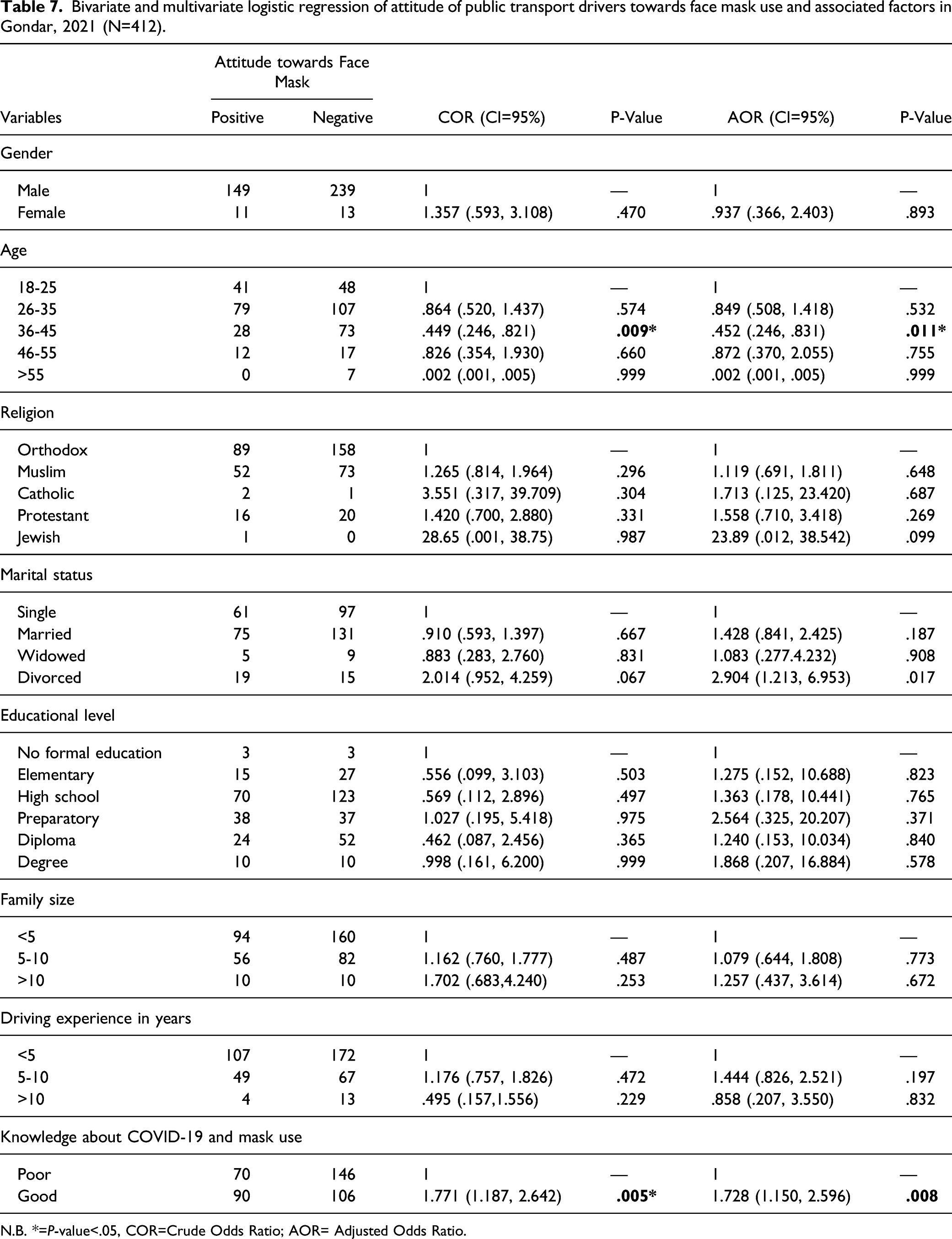
N.B. *=P-value<.05, COR=Crude Odds Ratio; AOR= Adjusted Odds Ratio.
Factors Affecting Respondents’ Practice Towards Facemask Use
Bivariate and multivariate logistic regression of face mask use and associated factors of public transport drivers in Gondar, 2021 (N=412).
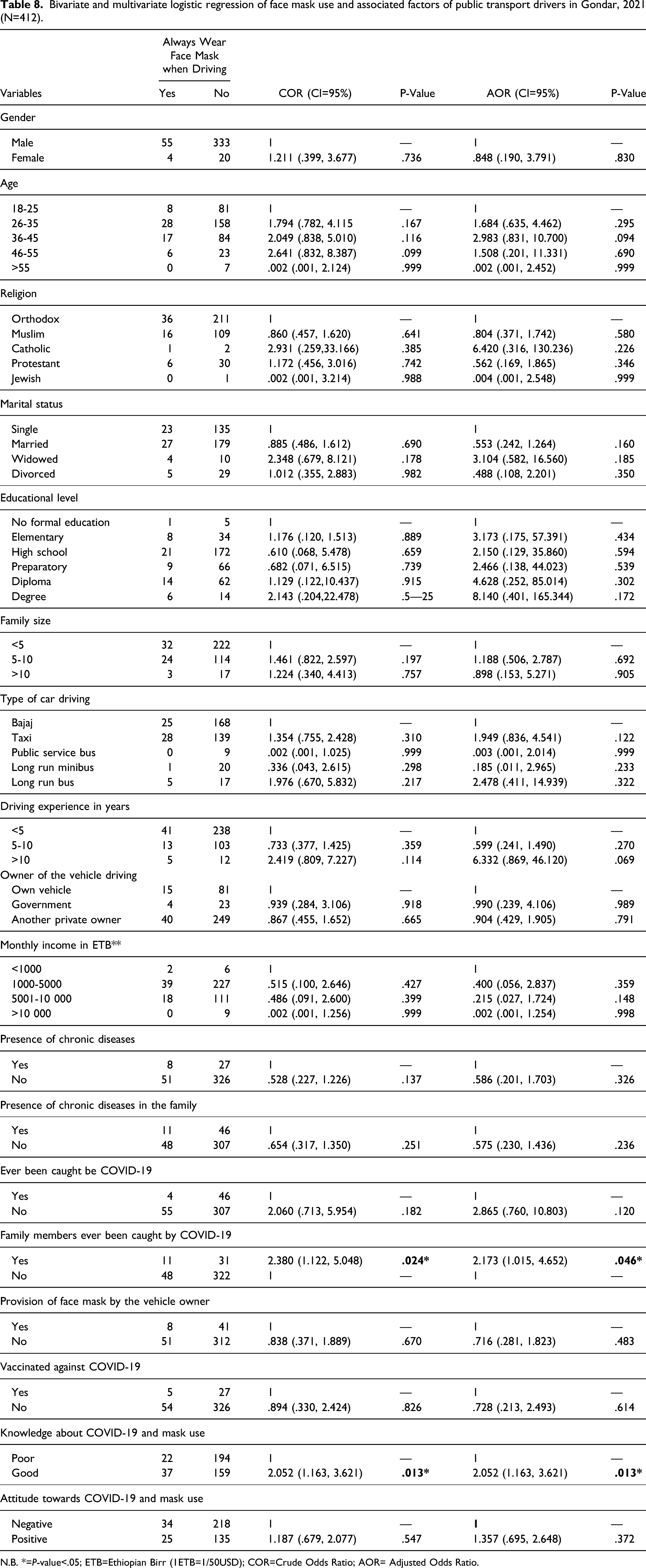
N.B. *=P-value<.05; ETB=Ethiopian Birr (1ETB=1/50USD); COR=Crude Odds Ratio; AOR= Adjusted Odds Ratio.
Discussion
COVID-19 has been an ongoing global threat.26-29 The world is still under constant waves of uncertainties leaving drivers at even higher risks on daily basis than the general population.30,31 The risk of contracting the disease among drivers gives further enhanced if it is accompanied by poor attitude, knowledge, and practices of PPE especially face masks. Hence, in order to mitigate the spread of this infection this cross-sectional study was conducted to assess the knowledge, attitude, and practice (KAP) face mask utilization and additional behavioral factors that affect face mask wearing among public transport drivers (Taxi, Bajaj, Public service bus, Long-run bus, and Long-run minibus) in urban areas of Gondar town.
Given the increasing evidence of the efficacy of COVID-19 preventive measures,32-35 warranting community compliance with these preventive measures remains of vital importance. 36 The current study revealed that the overall average knowledge, attitude and practice proportions of drivers were low. This finding was a bit lower than a similar study conducted in Dessie and Kombolcha, 37 Addis Ababa, 38 and Hossana. 23
Proper use of face masks by healthcare and non-healthcare workers can lower the risk of respiratory virus infection by 80%. 39 In the present study, only 59 (14.32%) of the respondents reported always wearing face masks properly when working or driving. The majority of respondents 166 (40.29%) reported wearing their face masks by the order of security officer (traffic police). In a similar study conducted in Dessie and Kombolcha towns, the proportion of taxi drivers that wear a face mask was 54.68%. 37 This could be due to better access to PPE in Dessie and Kombolcha towns, and/or due to strict regulations in these towns as they are the major business routes in the country and with strict security regulations. Similarly, the overall utilization of face masks was higher in studies conducted in Hong Kong, 40 Addis Ababa, 38 Malaysia, 36 Dessie, 41 and Saudi Arabian, 42 than in the current study.
A study conducted in Dessie and Kombolcha revealed that the majority of the drivers were using cloth face masks, followed by N95,37 while in the current study surgical mask was the commonest type of mask used. Similarly, the majority of the respondents were wearing medical face masks in Malaysia, 43 and Hong Kong. 44 This could be attributed to the knowledge differences among drivers in the 2 study areas and/or affordability issues because there are price differences on face masks in different areas in the country. Cloth face masks are usually hand-made (at home), while surgical face masks are available on purchase. This could have an impact on the type of face mask to use.
In the present study, about 12.14% of the drivers reported that they have been caught by COVID-19. This is very worrying given the number of people they would have in contact with and their attitude towards implementing preventive measures. It can be referred that only 7.77% of them are vaccinated and almost two-thirds of them (63.11%) believe that wearing a face mask will not protect them from Covid-19.
A study in the USA where face mask wearing significantly improved from 41% to 90% among some groups following government pressure. 45 In the current study, about 53.16% of the participants do not think the government pressurize them or feel enforced into wearing a face mask. However, this was opposite to the finding in Dessie and Kombolcha towns in which almost three-fourths (72.2%) of the taxi drivers felt that the presence of local government pressure helped them to wear a face mask. 37 Moreover, this finding is also inconsistent with studies conducted in Japan, 46 Hong Kong, 47 and Mexico City public transportation during the influenza outbreak. 48 This could be a sign of a lower level of commitment from the responsible government agencies in Gondar town. Although the drivers should take the responsibility of wearing a face mask by themselves without any pressure, amid the degree of the risk and related consequences, the local government should take stringent measures to ensure proper utilization of PPE’s among public transport drivers in Gondar town. In general, compared to the study conducted in Dessie and Kombolcha, 37 this study revealed a higher score of knowledge, but lesser degree of attitude and practice towards face mask utilization.
Drivers with good knowledge about COVID-19 and the importance of face masks were found twice more likely to use face masks during their working hours than those with poor knowledge (AOR=2.052, 95% CI = 1.163, 3.621). This finding is consistent with a study conducted in Wachemo. 23 This could be due to a lack of understanding, and those students with good knowledge would try to use the face mask properly. The diverse study demographics, sample size determination, and operational definition could all play a role in this disparity.
Conclusion
The utilization pattern of face masks among public transport drivers in Gondar town was found to be inadequate. A very low level of vaccination status and poor attitude towards the implementation of personal protective measures was also revealed. Authorities in areas that are in danger of a COVID-19 pandemic should plan and implement public awareness and education initiatives.
Limitations of the Study
The lack of sufficient literature to compare the results with was the major limitation of the study. The other limitation of the study is the study design itself in which the study was a cross-sectional study that captures data points at a given time and hence might not be accurate as time progresses. Respondent bias could also be noted.
Recommendation
Based on the study findings, to improve driver’s knowledge, attitude, and practice as well as to mitigate the spread of COVID-19, the following measures are recommended: (1) Periodic reinforcement and training/orientation programs for all levels of drivers for adherence with appropriate knowledge, attitude, and use of face mask during his or her working or driving time through the respective Driver’s Association (2) Awareness creation campaigns in co-operations with local FMs and Gondar Health Office. (3) Proper reinforcement measures from local government bodies to strictly monitor the practice of mask-wearing.
Supplemental Material
Supplemental Material - Knowledge, Attitude, and Practice Towards Face-Mask Use Amid the Coronavirus 2019 Pandemic Among Public Transport Drivers in Gondar Town, A Cross-Sectional Study
Supplemental Material for Knowledge, Attitude, and Practice Towards Face-Mask Use Amid the Coronavirus 2019 Pandemic Among Public Transport Drivers in Gondar Town, A Cross-Sectional Study by Dawit Kumilachew Yimenu, Asfaw Jejaw, Ehit Haylu, Semira Kassahun, and Zemene Demelash in INQUIRY
Footnotes
Declaration of Conflicting Interests
The author(s) declared no potential conflicts of interest with respect to the research, authorship, and/or publication of this article.
Funding
The author(s) received no financial support for the research, authorship, and/or publication of this article.
Availability of Data and Materials
Most of the data is included in the manuscript. Additional can be found from the corresponding author based on reasonable request.

References
Supplementary Material
Please find the following supplemental material available below.
For Open Access articles published under a Creative Commons License, all supplemental material carries the same license as the article it is associated with.
For non-Open Access articles published, all supplemental material carries a non-exclusive license, and permission requests for re-use of supplemental material or any part of supplemental material shall be sent directly to the copyright owner as specified in the copyright notice associated with the article.
