



Abstract
Objective
Fitness applications are becoming a tool for users who want to exercise and diet. This study examines what factors affect users’ intention to use fitness applications and how they depend on users’ health status.
Methods
An online survey was conducted on 428 potential fitness application users from South Korea. For this study, the extended unified theory of acceptance and use of technology (UTAUT2) was applied, and structural equation models were used for the data analysis.
Results
The results showed that for potential fitness application users, performance expectancy, effort expectancy, hedonic motivation, and perceived privacy protection were significant variables; however, social influence was insignificant. Factors influencing users’ intention to use fitness applications will vary depending on health status.
Conclusion
This study provides the following implications for health researchers, fitness application designers, and marketers. When trying to use fitness application, values such as performance expectancy, effort expectancy, hedonic motivation, and perceived privacy protection should be emphasized. In particular, for users with chronic diseases, the performance expectancy of fitness apps is more critical than any other factor.
What do we Already Know About this Topic?
We are already aware of changes in the behavior of users due to the increased use of fitness applications.
How does your Research Contribute to the Field?
This research contributes to the following: First, this study verified the motivation for; using fitness apps, which are expected to increase in the future due to COVID-19, and this; study also suggests the following practical implications.
What are your Research’s Implications towards Theory, Practice, or Policy?
In this study, the intention to use fitness apps was verified based on the UTAUT2 model, and in terms of practical implications, health professionals, fitness application designers, and marketers can refer to this study when designing and marketing fitness apps
Introduction
Recent advances in mobile devices, such as smartphones, have fundamentally changed how people work and communicate with each other. 1 As such, continuous developments of mobile devices enabled the rapid spread of smartphone applications (apps) that provide users with numerous services.2,3 In personal health management, the importance of management at all times has been emphasized, and always-on management was possible through mobile smartphone apps. 4 According to recent medical trends, many health professionals and researchers were increasingly interested in mobile health, known as mHealth, because mHealth has enormous potential to strengthen healthcare systems through better access to information. 5 Although mHealth use has widely increased due to its low price and ease of use, mHealth’s effectiveness still needed to be verified. 6
Positive changes were occurring in the effective use of mobile health. With significant advances in advanced information and mobile technology, we were witnessing accelerated digitization patterns in numerous health areas, such as health management.7-9 Chronic diseases such as heart disease, cancer, chronic respiratory diseases, and diabetes were also on the rise due to an aging population and lack of physical activity.10-12 Most chronic diseases could be prevented by personal health management, such as proper exercise and diet.13,14 Due to the recent coronavirus disease 2020 (COVID-19) pandemic, almost all countries around the world were taking measures such as restrictions on movement, quarantine, and closure of public facilities, and these measures have a significant impact on the financial and nonfinancial behavior of users.15-17 During the COVID-19 pandemic, users' behavior has changed from exercising in public places such as fitness centers to exercising at home or outdoors with a fitness app using a smartphone. 16 In addition, before the COVID-19 pandemic, users' behavior has also changed from receiving in-person medical treatment from a doctor at a hospital to receiving remote medical treatment using a smartphone or wearable device.16,18 In the field of digital healthcare, the importance of telemedicine using mHealth apps has been emphasized, and telemedicine is temporarily permitted in countries such as South Korea, where it was previously banned. During the COVID-19 pandemic, athletic facilities have been closed in many countries as part of “physical distancing” policies. Due to their characteristics of a closed environment, publicly shared equipment, and close contact between users, exercise facilities were considered high-risk environments. 19 Older people in particular must isolate themselves because of their high risk of serious complications from COVID-19, so mobile fitness apps provided useful tools to help older users exercise at home instead of using fitness centers.18-20mHealth and fitness applications (apps) are currently one of the key app categories in the mobile app market.21,22 Mobile fitness apps and types of mHealth apps have become important tools for controlling weight and managing chronic diseases. 9 In particular, fitness apps provided smartphone users with tools and emotional support to increase their exercise knowledge and skills to maintain their physical activity.23,24 Previous studies on fitness apps have mainly focused on user satisfaction with fitness app function and design, such as physical exercise planning, record measurement, and exercise gamification.25-27 Despite research on these technologies, there were significant differences between using health apps and the current understanding of these technologies. In particular, these studies often did not reflect individual differences among users who use fitness apps such as health status.2,8,22,28,29 Although it is important for fitness app developers and researchers to understand users’ intention and individual differences in the fitness app design, these areas have not been sufficiently addressed by previous studies. In addition, research on users’ intention of fitness apps could have significant implications in terms of public health policy in the near future. Therefore, this study examines what factors affect users’ intention to use a fitness app because their understanding of mobile fitness apps can provide significant implications for the public healthcare industry.
User Acceptance
The technology acceptance model (TAM) is a widely utilized framework for user acceptance when a new technology emerges.30,31 Venkatesh presented the unified theory of acceptance and use of technology (UTAUT), which explains user acceptance of IT using the following 4 factors: performance expectancy, effort expectancy, social influence, and facilitating conditions. 32 The original UTAUT model was then extended to the UTAUT2 model by adding the following 3 constructs: hedonic motivation, price value, and habit. Individual differences such as age, gender, and experience were also added as moderating variables.33,34 Unlike previous models, the extended UTAUT model includes individual differences among users affecting behavior intention by adding a user context to the model. 33 Because of these characteristics, UTAUT2 has been widely utilized in various fields to determine the acceptance of new technologies, such as various devices. In this study, based on the existing UTAUT2 model, we developed a research model using health status as a moderator that show individual differences among users.35-37
Performance Expectancy
Performance expectancy is defined as “the degree to which an individual believes that using the system will help him or her to attain gains in job performance”.
32
Performance expectancy was considered as a core factor in the following models and was used under a different name: perceived usefulness in TAM and extrinsic motivations in the motivational model (MM).31,38 Performance expectancy is regarded as one of the most influential variables of user acceptance related to information technology and is also known to have a positive effect on a user’s intention to use a smartphone.33,39 It has been confirmed that performance expectancy is a significant indicator in the healthcare area that manages user health via fitness apps.
40
These studies define performance expectancy as the degree to which users believe that using fitness apps will improve their health and fitness. Therefore, the following hypothesis is proposed: H1: There is a positive relationship between performance expectancy and behavioral intention to use mobile fitness apps.
Effort Expectancy
Effort expectancy is defined as “the degree of ease associated with the use of the system”.
33
Effort expectancy was used as the term for perceived ease of use in the TAM.
31
Effort expectancy was originally used in the TAM and has since been used in many studies.30,34 Effort expectancy has since been used as a key indicator to predict user behavior intention in other studies such as media services, Internet banking, and chat services.41-43 As healthcare technology has gradually developed, effort expectancy related to new technologies and systems has also become a significant factor in mHealth systems.
44
In other words, mHealth and fitness apps are being designed to be more user-friendly and easier to manage.
45
Therefore, it can be estimated that the higher the degree of effort expectancy, the higher the users' intention to use the fitness apps. Based on these concepts, the following hypothesis is proposed: H2: There is a positive relationship between effort expectancy and behavioral intention to use mobile fitness apps.
Social Influence
Social influence is defined as “the degree to which an individual perceives that important others believe he or she should use new system”.
33
Social influence can have a critical impact on an individual’s behavioral intention as tested by the UTAUT2 model.32,46,47 Teo and Pok reported that social influence plays a significant role in using mobile phones.
48
Social influence is also a significant factor in using the Internet via various devices.
49
Fitness app users can share diet activity or health status through mobile apps and chat with other users by sharing their own exercise progress.
8
Thus, it can be assumed that potential users of fitness apps can follow others’ opinions when trying to utilize fitness apps. Hence, the following hypothesis is proposed: H3: There is a positive relationship between social influence and behavioral intention to use mobile fitness apps.
Hedonic Motivation
Hedonic motivation is defined as “the fun or pleasure derived from using a technology”.
33
Hedonic motivation was used as the term perceived enjoyment in extended TAM.
50
Many prior studies have found that hedonic motivation is considered a core intrinsic motivation.38,51,52 Hedonic motivation was also considered a key factor in user acceptance and as an index of users’ intention to use a new system.
33
Since the appearance of smart devices, although diverse apps have been released, most app users have tended to primarily use games or entertainment-related apps.
53
Furthermore, recent research on smartphone apps has demonstrated that using gamification functions in mHealth apps has become common.
54
Based on previous studies, in this research, hedonic motivation is presumed to have a positive effect on users' intentions to use fitness apps. Therefore, the following hypothesis is proposed: H4: There is a positive relationship between hedonic motivation and behavioral intention to use mobile fitness apps.
Perceived Privacy Protection
Perceived privacy protection is defined as users’ perceptions that a service provider that manages their personal information is safeguarding their data.
51
Personal information-related issues are mainly caused by the unauthorized use of user information entered during online transactions by service providers or third parties.55,56 Perceived privacy protection is a significant factor because a vast amount of information is exchanged through mobile devices such as smartphones.
29
Although perceived privacy protection is a fundamental factor, mHealth and fitness service providers often do not offer mobile application privacy policies to app users.
57
According to prior research, it can be assumed that perceived privacy protection has a positive impact on fitness app users’ acceptance of new technologies or services.29,51 Therefore, the following hypothesis is proposed: H5: There is a positive relationship between perceived privacy protection and behavioral intention to use mobile fitness apps.
Health Status
Moderator variables are generally used to strengthen or weaken relationships between independent and dependent variables.
58
This study examines each individual difference among users such as health status as a moderator. Mobile fitness technology aims to drive users to healthy behavior and eventually improve their health status. When adopting mobile fitness apps, users’ health status becomes one of the important variables.
59
Two main theories explain human health-related behaviors: the health belief model (HBM) and protection motivation theory (PMT).
60
According to the HBM, perceived benefits and barriers have a positive impact on a user’s attitude toward mHealth services. However, PMT is used more widely for mobile health adoption because PMT uses frequency statistics such as threat appraisal.
61
In general, people diagnosed with chronic diseases pay more attention to their health status and are motivated to use high-performance mobile health devices.
62
This study introduces user health status to test moderating effects on the proposed relationships between independent and dependent variables as previously described. H6: Health status will moderate the effect of (a) performance expectancy, (b) effort expectancy, (c) social influence, (d) hedonic motivation, and (e) perceived privacy protection on behavioral intention to use mobile fitness apps such that the effect will be stronger for individuals with chronic diseases.
Methods
Research Model
This study focused on identifying factors that affect users’ intention to utilize fitness apps. Based on UTAUT2, this research model was developed to ascertain how the following 4 constructs of performance expectancy, effort expectancy, social influence, and hedonic motivation have dissimilar effects on intention to use fitness apps. Perceived privacy protection was also used as a construct because a user’s personal information is shared with their service provider when using fitness apps. User health status was used as a moderator. The following research models, illustrated in Figure 1, were examined to validate the proposed hypotheses. Research model.
Data Collection
This study is related to human subjects. Prior to conducting the study, data such as a research proposal and an online survey plan were submitted to the Institutional Review Board (IRB) to request exemption from deliberation. The IRB approved the exemption from deliberation because it is not a study conducted through interactions such as personal contact using the online survey method and does not collect personally identifiable information that can identify the study subject. Hence, this study was conducted after the IRB approval.
In this study, an online survey was conducted to collect sample data. First, potential fitness app users were screened through online questions. Second, pretests were carried out twice to refine and finalize the survey items. The survey was conducted in April 2021 through a professional research corporation, Embrain Company of South Korea. Embrain used 1.32 million panels, similar to the South Korean gender and age ratio. Respondents from South Korea were randomly selected and ranged in age from 20 to 70. The research company sent email and text message invitations to potential respondents to invite them to participate in the online survey. After the survey responses were screened, the research company provided coupons of a certain amount to all respondents who faithfully completed the survey. The questionnaire consists of 4 main parts: screening questions, life experience-related questions, questions related to perception of fitness app services, and background questions. The questionnaires were written in Korean after translation from English questionnaires in the literatures.
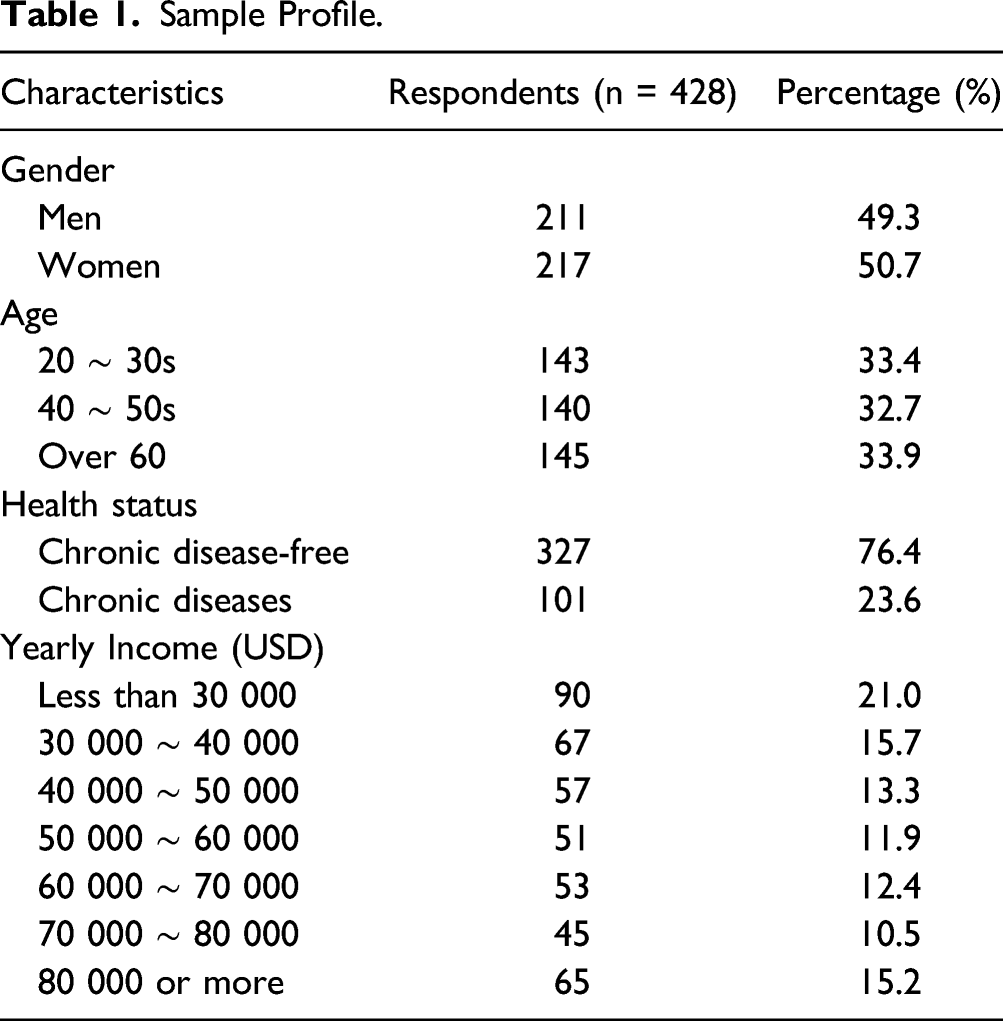
An online survey was emailed to 5189 respondents, and 1323 accessed it. Of 1323 respondents, 450 respondents were dropped from the analysis because they did not recognize the fitness application, and 380 respondents were also excluded from the analysis because they gave up on the survey halfway. Overall, 493 out of 1323 respondents fully completed the online survey. After excluding 65 inadequate and unverifiable surveys, 428 responses were used for the final questionnaire analysis.
Sample Profile.
Measurement Items
The survey items were used based on previous studies. The 23 measurement items were represented by 6 latent constructs: performance expectancy, effort expectancy, social influence, hedonic motivation, perceived privacy protection, and behavioral intention. Performance expectancy was measured for 4 questions. We adopted and modified the measurement items from Liang et al. (2011) and Lim et al. (2011) to suit this study. Effort expectancy was measured for 4 questions. We modified the items for this paper based on Davis (1989) and Wilson (2004). Three questionnaire items regarding social influence were measured. The items were adopted and modified to suit this study from Venkatesh et al. (2012) and Beh et al. (2019). Hedonic motivation was measured for 4 questions. The items were modified for this paper based on Shin (2007) and Shaw & Sergueeva (2019). Perceived Privacy Protection was measured for 4 questions. The items were adopted and modified to suit this study from Smith et al. (1996) and Shaw & Sergueeva (2019). Finally, behavioral intention was measured for 4 questions. Shin (2007) and Venkatesh et al. (2012)’s measurement items were modified for the study. All of the survey items were measured using a seven-point Likert scale from “strongly disagree” (1) to “strongly agree” (7). Detailed measurement items are presented in Appendix A.
Common Method Bias
Since all of the variables were measured at the same time using a questionnaire, there might be a possibility of increased type II errors. Therefore, we examined whether common method variance (CMV) existed using confirmatory factor analysis (CFA) with a marker variable.65,66 Some measurements of benefit administration were used as a marker variable (“I know some benefits provided by an organization I work for” and “It is hard for me to explain which benefits are provided by an organization I work for”). Moreover, 5 models were tested to assess the presence of CMV. The first model was examined using a CFA model with the marker variable. All of the factor loadings between the marker variable and substantive factors were fixed to 0. The second model was the baseline in which the correlations between the marker variable and substantive variables were constrained to 0. The unstandardized regression weights and variances for the marker variable were set to the results from the analysis of the first model. All of the factor loadings from the marker variable to the substantive variables were set to “a”, which indicates that all of the factor loadings were equal. However, in the fourth model, all of the factor loadings were analyzed without constraints. We set the covariances of substantive factors from the fourth model to the values obtained from the second model. A model fit index for each of the models is shown in Appendix B. Model-U had a better fit than Model-C, but there was no significant difference between Model-R and Model-U. Therefore, the overall results indicate that CMV was not present and did not affect the relationships among latent variables.
Validity and Reliability
As a first step in the scale development and verification process, to ensure data consistency, all of the items were measured using Cronbach’s alpha, an index of reliability (Hatcher, 1994) with SPSS 22. All of the variables had Cronbach’s alpha values greater than .8, which is higher than the commonly used criterion of .7 (Hatcher, 1994). In addition, as a result of the multicollinearity test, the VIF value of each independent variable was 3 or less, which was generally accepted as 10 or less, indicating that there is no multicollinearity. 67 A CFA was then conducted to finalize items to be used for analysis through Amos 22. The standardized factor loadings for each item were all higher than .7, the standard criterion (Fornell and Larcker, 1981). The average variance extracted (AVE) percentages were greater than .5, and the construct reliability (CR) scores were all higher than .7 (Hair, 2010). Discriminant validity was acceptable because the square roots of the AVE estimates were greater than the relevant interconstruct correlation estimates. The CFA results demonstrated that the data showed strong reliability and validity (Hair et al., 2010) (see Appendices A and C).
Results
Hypotheses Testing.

Hypothesis Testing by Health Status Group.

Note: Path significant: *P < .05, **P < .01, ***P < .001.
Third, a multigroup analysis was conducted to confirm whether there was a significant difference in the path coefficient between groups. As a result of a comparison between the unconstrained and constrained models, there were no significant differences between paths (see Appendix F).
Discussion
The purpose of this research was to identify the constructs that affect a user’s intention to use fitness apps and to understand whether a moderator variable such as user health status represent personal differences. Several key findings were elucidated in this study. First, for potential mobile fitness app users, performance expectancy, effort expectancy, hedonic motivation, and perceived privacy protection were significant variables; however, the social influence value was insignificant. As expected, when trying to use fitness apps, potential fitness app users perceived performance expectancy as the most effective indicator of intention to use fitness apps. These results were consistent with the outcomes of previous studies showing that performance expectancy plays an essential role when trying to use mobile fitness apps.22,28,51 Effort expectancy was also a significant factor because potential users will try to use fitness apps when the fitness apps are easy to use. These findings support the general belief that for potential fitness app users, effort expectancy is a significant motivation for using fitness apps.30,33,45 Third, when trying to use fitness apps, hedonic motivation appeared to be a substantial factor. These results were consistent with outcomes on gamification in prior mobile fitness app studies. In particular, research has shown that gamification characteristics for using fitness apps have a considerable impact on motivation and engagement for trying to use fitness apps.8,53,68 Perceived privacy protection was a significant variable in this research. These results were consistent with the outcomes of previous studies showing that perceived privacy protection plays an essential role because privacy information is exchanged through fitness apps.29,69 However, social influence had no significant relationship with the intention to use fitness apps, unlike some empirical studies on exercise gamification about social influence.8,27,53 These results are presumed because potential fitness app users who want to use fitness apps first consider the fitness app’s performance, ease of use, and enjoyment of app use to be significant, but once people use fitness apps, social influence is a significant factor in the continued use of fitness apps.8,27
This study attempted to identify individual differences depending on user’s health status as a moderator when using fitness apps. We examined whether health status differences affect the relationship between performance expectancy, effort expectancy, social influence, hedonic motivation, and perceived privacy protection as independent variables and intention to use fitness apps as a dependent variable. This study was conducted through a comparison between groups diagnosed with chronic diseases such as heart disease and chronic disease-free groups. For the chronic disease-free group, performance expectancy, effort expectancy, hedonic motivation, and perceived privacy protection were significant as an entire group except for social influence, whereas in the chronic disease group, only performance expectancy was a key factor for trying to use fitness apps. These results were consistent with prior studies that reported that those who have been diagnosed with chronic diseases pay more attention to their health and are motivated to use high-performance mobile health devices directly linked to improving their health. 62
This study contributes to the following: First, the need for personal healthcare using a fitness app is increasing due to the recent surge in the number of people with chronic diseases. Hence, this study verified the motivation for using fitness apps, which are expected to increase in the future due to COVID-19. In this study, the intention to use fitness apps was verified based on the UTAUT2 model. The results showed that for potential fitness app users, performance expectancy, effort expectancy, hedonic motivation, and perceived privacy protection were significant variables, but the social influence value was insignificant. In addition, in this study, the UTAUT2 model was extended using a moderator variable such as health status to identify individual differences between users. As mentioned earlier, this study finds that users’ behavioral intention to select a fitness app changes depending on their health status. In conclusion, in this study, the existing UTAUT2 model was applied to the intention to use a fitness app, and it was confirmed that intention to use a fitness app varies depending on health status, expanding the applicability of the existing UTAUT2 model.
Second, this study also suggests the following practical implications. The COVID-19 pandemic has increased the risk of contact between people, so most people now exercise at home instead of at a fitness center; thus, understanding what characteristics of a fitness app are significant to potential fitness app users is critical. Hence, health professionals, fitness application designers, and marketers can refer to this study when designing and marketing fitness apps. When trying to use fitness apps for the first time, values such as performance expectancy, effort expectancy, hedonic motivation, and perceived privacy protection should be emphasized. In particular, for users with chronic diseases and the rapidly growing populations of aging and obese individuals, the performance expectancy of fitness apps is more critical than any other factor.
Although these are useful implications, there are some considerations for further studies. First, although this study’s sample collection was conducted by a professional South Korean research company, it is difficult to reflect on country differences because the sample was recruited only in South Korea. Therefore, future studies should use global comparisons to generalize the results. Second, this study does not reflect the continued use of fitness apps because we focused on potential users’ intention to use fitness apps. Hence, future research should focus on the factors needed to continue using fitness apps for actual fitness app users.
Conclusion
The results of this study provide empirical evidence of the UTAUT2 model in the intention to use health-related fitness apps. The information gained from this study enables fitness app professionals and developers to understand what actually affects an individual’s decision to use fitness apps. Furthermore, due to the COVID-19 pandemic, more people are using fitness apps, so this type of research can provide relevant and opportune social contributions. By focusing on the values found in this study that affect the intention to use fitness apps, fitness app marketers and developers can create fitness apps that meet the expectations of app users. The results of the study will help potential users choose fitness apps to help them maintain a healthy lifestyle. In addition, this study found that there are individual differences in the intention to use fitness apps. Therefore, the research and development of fitness apps should be appropriately targeted to individual user situations.
Supplemental Material
Supplemental Material - What Factors Affect a User’s Intention to Use Fitness Applications? The Moderating Effect of Health Status: A Cross-Sectional Study
Supplemetary Material for What Factors Affect a User’s Intention to Use Fitness Applications? The Moderating Effect of Health Status: A Cross-Sectional Study by Byongjin Kim and Euehun Lee in INQUIRY: The Journal of Health Care Organization, Provision, and Financing
Footnotes
Declaration of Conflicting Interests
The author(s) declared no potential conflicts of interest with respect to the research, authorship, and/or publication of this article.
Funding
The author(s) disclosed receipt of the following financial support for the research, authorship, and/or publication of this article: This study was supported by the National Research Foundation of Korea, project number N01200926.

Supplemental Material
Supplemental material for this article is available online.
Constructs and Measurements

| Constructs | Items | Cronbach’s Alpha | FL | CR | AVE |
|---|---|---|---|---|---|
|
|
Fitness app can be useful in managing my daily health. | .91 | .86 | .92 | .73 |
| Fitness app can be advantageous in better managing my health. | .87 | ||||
| Fitness app could improve the quality of my healthcare. | .85 | ||||
| Fitness app improves my capability of managing my health. | .84 | ||||
|
|
It will be easy to get accustomed to using the fitness app. | .93 | .84 | .93 | .76 |
| It will be easy to use the fitness app well. | .89 | ||||
| I Will find it easy to get the fitness app to do what I want it to do. | .89 | ||||
| My interaction with the fitness app will be clear and understandable. | .86 | ||||
|
|
People who are important to me think that I should use the fitness app. | .88 | .80 | .88 | .72 |
| People who influence my behavior think that I should use the fitness app. | .90 | ||||
| People whose opinions that I value prefer that I use the fitness app. | .83 | ||||
|
|
I am interested in using the fitness app. | .91 | .88 | .92 | .74 |
| I Will find the fitness app to be enjoyable. | .90 | ||||
| The actual process of using the fitness app will be pleasant. | .88 | ||||
| I have curiosity about using the fitness app. | .76 | ||||
|
|
Fitness app service providers would protect my personal health information. | .93 | .82 | .93 | .77 |
| Fitness app services providers would not share my personal health information with a third party. | .83 | ||||
| Fitness app services providers would guarantee protection for my personal health information. | .94 | ||||
| Fitness app services providers would not leak my personal health information. | .91 | ||||
|
|
I intend to use the fitness app in the future. | .94 | .93 | .94 | .81 |
| I intend to use the fitness app as much as possible. | .93 | ||||
| I Will always try to use the fitness app in my daily life. | .92 | ||||
| I plan to use the fitness app frequently. | .81 |
Note: FL: factor loadings, CR: composite reliability, AVE: average variance extracted.
Model Comparison Tests of Common Method Variance.

| Model | x2 (df) | CFI | RMSEA (90%CI) | Likelihood ratio of △x2 | Comparison |
|---|---|---|---|---|---|
| CFA with marker variable | 739.366 (329) | .960 | .054 (.049,.059) | ||
| Baseline | 875.585 (343) | .948 | .060 (.055,.065) | ||
| Common |
749.585 (342) | .960 | .053 (.048,.058) | 126 (1), P < .001 | Baseline |
| Unconstrained |
660.752 (319) | .966 | .050 (.045,.055) | 88.833 (23), P < .001 | Method-C |
| Restricted |
681.705 (334) | .966 | .049 (.044,.055) | 20.953 (15), P = .138 | Method-U |
Note: DF: degree of freedom, CFI: comparative fit index, RMSEA: root mean squared error of approximation.
Mean,Standard Deviation,and Discriminant Validity.

| Variables | Mean | SD | VIF | CR | AVE | PE | EE | SI | HM | PPP | BI |
|---|---|---|---|---|---|---|---|---|---|---|---|
| PE | 4.92 | .94 | 2.76 | .92 | .73 |
|
|||||
| EE | 5.05 | .99 | 1.67 | .93 | .76 | .61 |
|
||||
| SI | 4.68 | 1.09 | 1.78 | .88 | .72 | .59 | .58 |
|
|||
| HM | 4.93 | .96 | 2.54 | .92 | .74 | .82 | .57 | .57 |
|
||
| PPP | 4.28 | 1.25 | 1.51 | .93 | .77 | .51 | .42 | .56 | .47 |
|
|
| BI | 4.77 | 1.20 | - | .94 | .81 | .84 | .62 | .59 | .78 | .53 |
|
Note: SD = Standard deviation, VIF = Variance inflation factor, CR = Composite reliability, AVE = Average variance explained, PE = Performance expectancy, EE = Effort expectancy, SI = Social influence, HM = Hedonic motivation, PPP = Perceived privacy protection, BI = Behavioral intention.
Goodness-Of-Fit Results.

| Normed Chi-Squared Test | GFI | CFI | NFI | RMSEA | TLI | IFI | |
|---|---|---|---|---|---|---|---|
| Measurement model | 1.87 | .91 | .98 | .95 | .05 | .97 | .98 |
| Structural model | 2.14 | .91 | .97 | .95 | .05 | .97 | .97 |
Note: GFI: goodness of fit index, CFI: comparative fit index, NFI: normed fit index, RMSEA: root mean squared error of approximation, TLI: Tucker-Lewis index, IFI: incremental fit index.
Measurement Equivalence Tests Between Health Status Groups.

| Chi-Square | DF | P-Value | Normed Chi-Square | CFI | NFI | TLI | IFI | RMSEA | |
|---|---|---|---|---|---|---|---|---|---|
| Unconstrained model | 881.49 | 556 | .00 | 1.59 | .97 | .92 | .96 | .97 | .04 |
| Constrained model | 895.13 | 575 | .00 | 1.56 | .97 | .92 | .97 | .97 | .04 |
| Comparison test | 13.65 | 19 | .80 |
Note: DF: degree of freedom, CFI: comparative fit index, NFI: normed fit index, TLI: Tucker-Lewis index, IFI: incremental fit index, RMSEA: root mean squared error of approximation.
Path Coefficient Difference Between Health Status Groups.

| Chi-Squared Test | DF | △Chi-Squared Test/DF | P-Value | Decision | |
|---|---|---|---|---|---|
| Unconstrained model | 745.80 | 430 | |||
| Performance expectancy →behavioral intention | 746.06 | 431 | .26 | .611 | Not supported |
| Effort expectancy → behavioral intention | 746.03 | 431 | .23 | .628 | Not supported |
| Social influence → behavioral intention | 747.40 | 431 | 1.61 | .205 | Not supported |
| Hedonic motivation → behavioral intention | 745.97 | 431 | .17 | .680 | Not supported |
| Perceived privacy protection → behavioral intention | 745.82 | 431 | .03 | .873 | Not supported |
Note: DF: degree of freedom, Path significant: *P < .05, **P < .01, ***P < .001.
References
Supplementary Material
Please find the following supplemental material available below.
For Open Access articles published under a Creative Commons License, all supplemental material carries the same license as the article it is associated with.
For non-Open Access articles published, all supplemental material carries a non-exclusive license, and permission requests for re-use of supplemental material or any part of supplemental material shall be sent directly to the copyright owner as specified in the copyright notice associated with the article.
