



Abstract
Administrative staff at healthcare facilities, who are not either doctors or nurses, coordinate, facilitate patient care, and account for 18–20% of human resources in hospitals. Their contribution to the value chain of healthcare service is crucial, but they are not well recognized either by hospital managers and healthcare staff or by patients. Low recognition may cause low job motivation and repeated tasks may cause boredom for them. Our study aimed to assess the level of job motivation among administrative staff in 2 hospitals of Ho Chi Minh city, Vietnam, and explore the influencing factors to job motivation. The exploratory mixed methods design was used in our study with an initial quantitative study with a designed questionnaire and then followed by a qualitative study with focus group discussions. The job motivation index of the administrative staff in our study was not high (4.0). Positive factors were extra income, higher education, healthcare benefits, and a good working environment. Negative factors were low salary index, less chance of higher education, and no separated key performance indicator criteria. The low job motivation index of the administrative staff at public hospitals in our study warns of the negative impact on hospital income in terms of patient satisfaction. In the future, hospitals should have a new strategy in human resource management specifically for administrative staff by maintaining the positive factors and step-by-step overcome the negative factors such as developing separated key performance indicator criteria.
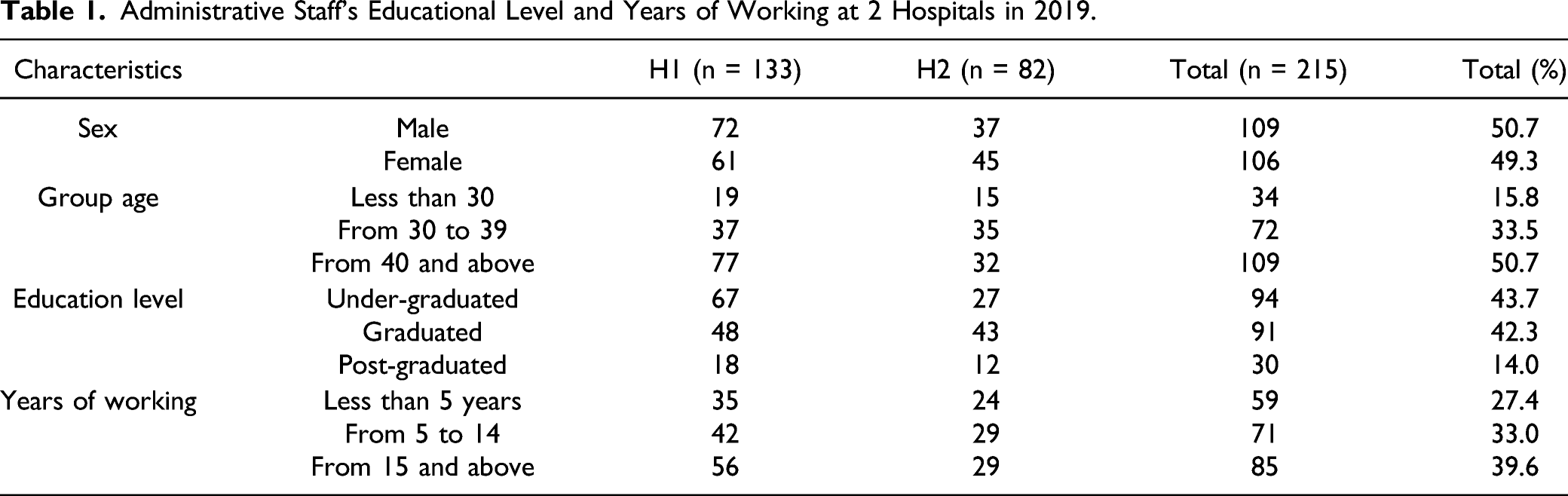
Most research on human resources in healthcare settings focuses only on doctors and nurses. The administrative staff account for 18–20% of staff at hospitals and play important roles in running healthcare services. The shortage of administrative staff for public hospitals is caused by the low recognition of the administrative staff value, and the boredom and repeated tasks. Our study explored the level and influencing factors of job motivation among administrative staff, and we found that their job motivation index was equal to the cut-off of 4.0, and it is at risk of decreasing when there are some negative factors having impacts on job motivation such as low salary index, less chance of higher education, and no separated key performance indicators. Public hospital managers should keep on maintaining the positive factors and step-by-step overcome the negative factors by having appropriate human resource strategies, such as developing separated key performance indicators for administrative staff. Administrative Staff’s Educational Level and Years of Working at 2 Hospitals in 2019. Job Motivation Average Score of Administrative Staff at 2 Hospitals in 2019.Highlights
What do we already know about this topic?
How does your research contribute to the field?
What are your research’s implications toward theory, practice, or policy?

Introduction
Studies on analyzing human resources in the healthcare sector, for example, policies play a crucial role in helping to improve in depth, scope, and quality as the requirement of the health care reform. 1 Employees’ motivation helps an employee attaches to the job, engages their success with the company’s goals, and empowers them to complete daily works. Job motivation can be affected by extrinsic or intrinsic factors, meaning an employee’s motivating factors can come from internal or external sources. Job motivation is the key to successfully obtain personal and/or organizational goals. The motivational behavior of employees could be explained by “what” motivates a person and “how” a person is motivated by the working environment; however, the importance and placement of similar needs are different for every individual with an inbuilt element of high subjectivity. 2 There are many influencing factors to job motivation mentioned in previous studies, such as a person’s current behavior influenced by past actions, specific incentive schemes targeted at workers, the whole range of health sector reforms that potentially affect organizational culture, reporting structures, channels of accountability, salary, job security, interesting job, working environment, and professional relation with coworkers, links between organization activities, and the external consequences of such activities for employee motivation.3-5
Administrative or clerical staff at healthcare facilities, who are not either doctors or nurses, coordinate and facilitate patient care. They schedule appointments, answer phones, greet patients, keep medical records, handle medical billing, fill out insurance forms, arrange for laboratory or other diagnostic services, and handle financial records. In Vietnamese hospitals, Administrative staff account for 18–20% human resources and their job titles are (1) Clinic Coordinator; (2) Administrative Medical Assistant; (3) Medical Records Specialist; and (4) Financial Counselor. 6 Their contribution to the value chain of healthcare service is crucial, but they are not well recognized either by hospital managers and healthcare staff or by patients. Low recognition may cause low job motivation and repeated tasks may cause boredom for them.
Under increased societal demand for effective healthcare services, it has become a challenge for hospital administrators to motivate employees and at the same time fulfill the expectations of patients. Currently, only clinical staff (doctors and nurses) are being motivated in order to assure the treatment quality, so the patients’ satisfaction is low due to low quality in administrative services at hospitals. Our study aimed to assess the level of job motivation among administrative staff at public hospitals and explore the influencing factors in order to have good strategies in improving the patients’ satisfaction.
Research Methods
Study Design
The exploratory mixed methods design was used in our study with an initial quantitative study with a designed questionnaire and then followed by a qualitative study with focus group discussions.
The quantitative study was done with the cross-sectional method on 215 administrative staff from 2 hospitals. They answered the designed questionnaire by Patrick M Mbindyo, 4 described in the study instrument. The focus group discussions were used to collect data for the qualitative study on administrative staff with the 5 planned topics, described in the study instruments.
Sampling
All administrative staff (215) at 2 hospitals were recruited to answer the designed questionnaire on job motivation including 133 staff (code H1_Otology, Rhinology Hospital) and 82 staff (code H2_Traumatology and Orthopedics Hospital). And 03 group discussions for administrative staff (32 staff) were performed from March to October 2019.
Study Instrument
The questionnaire consisted of 2 parts: Part 1 (personal profile) and Part 2 (statement of job motivation). Job motivation was measured as the degree to which an individual possessed identified 3 motivation domains like “Job satisfaction,” “Commitment,” and “Devotion.”4,7
The focus group discussion questions consisted of the following topics: (1) Salary system; (2) Key performance indicators (KPIs); (3) Staff training plan; (4) Working environment (coworkers, facilities, and management); (5) and Organizational culture.
Data Analysis
Quantitative data was analyzed with statistical package (Stata 12.0). Three domains were represented by 12 statements. The responses were assessed on a Likert-based scale, namely, strongly agree, agree, normal, disagree, and strongly disagree with corresponding score weightage of 5, 4, 3, 2, and 1, respectively. Motivational index was worked out with following formula: motivational index = ∑Mean score ((Job satisfaction) + (Commitment) + (Devotion)/3. To assess the level of motivation, the respondents were grouped into 2 classes: low (less than or equal 4.0) and high (greater than 4.0). The class intervals were derived based upon the minimum and maximum scores of the motivational index of respective individuals.
Qualitative data were recorded and transcripts were processed by content analysis. All the transcripts were read through at least 3 times before coding and categorizing manually and inductively, in stages. The first stage consisted of identifying meaning units, where phrases in the transcript were underlined and then restated in the margins as codes. In second stage, categories were developed from codes and then further compared and merged into a theme.
Results
Administrative Staff’s Characteristics
The gender ratio was equal between male and female (50.7% and 49.3%) in administrative staff. Most of them were in group age from 40 and above accounting for 50.7%. They had more than 5 years of working experience (72.6%). The proportion of having post-graduated education was 14%.
Job Motivation Index
The job motivation index (4.0) was not high (equal the cut-off value). The index of “Job satisfaction,” “Commitment,” and “Devotion” had a mean score of 4.1, 3.9, and 4.0, respectively. And the scores were the same between 2 hospitals.
Influencing Factors to Job Motivation
Positive influencing factors to job motivation: Extra income; financial support for higher education: being internal customers; and good working environment
Healthcare staff receive salary according to national salary index and extra income which depends on hospital monthly revenue. The extra income improves healthcare staff’s salary in total. “The internal payment for extra income based on parameters such as professional qualifications, postgraduates with coefficients from 1.2 to 1.4, graduated with coefficients from 0.8 - 1,1 and a college degree or lower have a coefficient of 0.5 - 0.7. This partially improved employee income” (an administrative staff).
Higher education helps to have more chance for promotion at work. The administrative staff are all encouraged for higher qualifications to meet their work requirements:
“After 3 year-working, we received the financial support to improve our qualifications. This will help us to obtain post-graduated education in hospital management” (an administrative staff).
Working hospital is often hard with stressful and overload, so the working environment plays as a neutral factor to ease the stress. Hospital colleagues share, listen, and have little conflict or argument. “In general, in hospitals or administrative divisions, our colleagues have mutual support at work. Everyone listens or acquires opinions to work effectively. When there is a need for people with experience, skills or training, they will not hesitate to share and support those in need” (an administrative staff).
Being internal customers of the hospitals, administrative staff receive the financial support for themselves or their relative. “To tell you the truth that I sometimes get sick or my relatives and I often ask for help from my colleagues at clinical departments for intensive care” (an administrative staff).
Negative influencing factors to working motivation: Low-index in salary system, less chance for higher education for non-managerial staff, and shared KPI criteria in evaluating the work performance of the support staff.
The administrative staff have high qualifications but the less years of working, so they have lower income than the moderate-level staff who have more years of working. This is an inadequacy salary for administrative personnel, which greatly affects the motivation of the employees. “At present, we do not take into account the positional parameters, the role of the functional departments when calculating the additional income payment. Besides, there is no coefficient to attract highly qualified staff” (a hospital manager).
Most of the employees pay for their study if they are not in the personnel plan for promotion. This is also a factor affecting the motivation of employees, creating the situation of not willing to study higher. “The hospital has financial support for staff studying, but only 50% for some staff. In addition, when we want to study, we do not know whether we are eligible or not, how is the application process” (a support staff).
Key performance indicators for “Hospital’s Excellent Staff” title is inappropriate, discouraging employees to strive to achieve when using the same for all staff even though their work is totally different. “The KPI, we think it is not appropriate, when it is applied for all staff, administrative staff and clinical staff” (a support staff).
Discussion
“KPI is a quantifiable measure used to evaluate the success of an organization, employee, etc. in meeting objectives for performance” according to Oxford’s Dictionary definition, and KPIs were merely applied for healthcare management and assessed through case studies or interviews with healthcare experts. 8 However, they are mainly based on a generic framework of screening effective indicators for performance measurement. So there is a lack of articulation of the cause and effect relationships between performance indicators when implemented for performance improvement. Consequently, many hospitals dilute the efforts of their performance measurement systems because of basic mistakes in a mapping staff positions as well as their tasks. 9 Different positions would have different indicators for assessment. In Vietnam, most hospitals apply same KPIs for all health staff by following general guidelines from Ministry of Health. Even if having different coefficients, healthcare KPIs are still inappropriate, for example, the “Doing medical research” indicator which is rarely be done by administrative staff. Hospital managers should create a modified KPI having common criteria and specific ones regarding tasks (clinical and non-clinical) in order to increase staff’s satisfaction on KPI application. In our study, most participants shared the high concerns on KPIs that they had to follow for many years. Administrative staff are not medical researchers, so they never meet the score of the “Doing medical research” as in the hospital KPIs. They are rarely considered as “Hospital’s Excellent Staff.” Hence, the common KPIs may cause the low job motivation of the administrative staff at public hospitals in Vietnam.
“Pay-for-Performance,” “Results Based Financing,” “Performance Based Financing,” or “Performance Based Contracting” has been being applied in high income countries since the last decade, and these schemes have been considered as lessons learnt in order to apply in low- and middle-income countries where performance incentives are advocated as a means to improving key health indicators and increase access to care. 10 According to Keovathanak Khim, financial incentives influenced health workers job motivation since it accounted for a significant part of health workers’ income. 11 Although these findings were found on clinical healthcare staff (doctors and nurses), they are same as our findings on administrative staff at hospitals. Currently, their job motivation index is at the cut-off (4.0) and considered low level and then they are still working for hospitals more than 5 years of working (72.6%), so the salary may cover their expenses monthly or they have other income. The job motivation index is similar in 2 different hospitals and similar with some previous studies in Vietnam such as Dao’s study (3.53) and Mai’s study (3.84).12,13 A person working in Health and Medical in Vietnam typically earns around 25,700,000 VND (1117 USD) per month. Health staff salaries (public and private sectors) range from 5,380,000 VND (234 USD—lowest average/month, administrative staff) to 76,900,000 VND (3343 USD—highest average/month, experienced doctors, and managers). This is the average monthly salary including housing, transport, and other benefits. 14 Understandably, the salary would not be a reason to take a job because they are now working and they had known that salaries in the public sector are low in general, especially non-medical jobs at hospitals.
According to the Law of Examination and Treatment in Vietnam (2009), medical professionals must have 48 hours of continuing medical education every 2 years to maintain their professional license. This helps doctors keep their skills up to date. “CME is an essential part of the national strategy to improve the capacity of health care workers in Vietnam” (not applying for administrative staff). 15 Training not only requires extra budgets for capacity development but also a good system for monitoring and analyzing training needs and for coordinating capacity-building activities at hospitals. With low budgets, most hospitals support clinical staff only, not administrative staff. This policy may cause negative impact on the job motivation of the administrative staff who want to have promotions with higher qualifications.
From our focus group discussions, we found that administrative staff received some other benefits as rewarding, for example, (1) financial support and allowance for higher education and (2) financial support when using medical services for themselves and relatives. In general, patients have to pay for hospital fees without compensation or support (excepting poor patients under hospital social support). Being hospital staff, they receive the support as internal customers receiving support from clinical colleagues. Thus, this factor could be one of the positive factors to attach them with their current job as administrative staff at hospitals. This factor was also mentioned in a previous study on the nexus between internal marketing in hospitals and organizational commitment showing that internal marketing is a significant positive factor on the commitment of health workers. It also has a positive effect on job tenure, which means that internal marketing enables employees to increase job security and spend more years on the job. 16
The study was done at 2 different public hospitals in order to check whether the administrative staff’s job motivation was different or not. The results showed that there was no difference in the job motivation scores of the 2 hospitals. It means that the administrative staff of public hospitals have the same score and share similar factors for job motivation. Our findings could be used as an evidence-based reference for other public hospitals when improving human resources for health, especially administrative staff.
Conclusion
The low job motivation index of the administrative staff at public hospitals in our study warns of the negative impact on hospital income in terms of patient satisfaction. In the future, hospitals should have a new strategy in human resource management specifically for administrative staff by maintaining the positive factors and step-by-step overcome the negative factors such as developing separated key performance indicator criteria.
