




Abstract
This study aimed to elucidate the experiences of home care nurses who had continued working a single agency, to gain insight into the prevention of premature turnover. We adopted a grounded theory approach to qualitative exploration of the experiences of 26 Japanese nurses working in a home care agency, using semistructured interviews and participant observation. Nurses’ experience progressed through three phases: “encountering difficulty,” “enjoying the fruitfulness,” and “becoming dissatisfied.” Nurses’ cognitive rounding involving these phases was conceptualized as “cycle of sustaining meaningfulness.” To move from encountering difficulty to enjoying the fruitfulness, nurses needed to discover the meaningfulness of practice, and to move from becoming dissatisfied to encountering difficulty, they needed to requestion their practice. During their time at the agency, nurses progressed through the phases of the cycle of sustaining meaningfulness repeatedly. Knowing the point at which nurses are in the cycle and assisting their further progress could aid in their retention.
Nurse turnover is a serious problem on a global scale. High turnover harms the productivity of nursing agencies (Jones, 2008) and quality of client care (Castle, Engberg, & Men, 2007). Higher turnover rate is associated with adverse patient outcomes (Kim & Han, 2018) and an increased likelihood of medical error (O’Brien-Pallas, Murphy, Shamian, Li, & Hayes, 2010). High turnover leads to an insufficient workforce, which can increase mortality and failure to rescue considerably (Aiken, Clarke, Sloane, Sochalski, & Silber, 2002).
Care settings have recently expanded because of the shift to long-term home care settings and the growing aging population (World Health Organization, 2015). Home care settings can be burdensome to nurses, because patients have various conditions such as congestive heart failure, cancer, or schizophrenia (Martinson, Widmer, & Portillo, 2002). Home care settings also present ethical problems that are not usually faced by hospital nurses (Asahara et al., 2013). Therefore, understanding nurse turnover in home care settings is important.
In Japan, the home care nurse turnover rate has reached 15.0% (Japanese Nursing Association, 2009), which is high relative to that of hospital nurses (10.9%; Japanese Nursing Association, 2015). Home care nursing services are covered by the medical insurance system and the long-term care insurance system. Under the long-term care insurance system, home care contracts stipulate the duration of care provision (e.g., 20, 30, or 60 minutes) but not the type of care required. Care provided for clients includes a wide variety such as infusion, care for pressure ulcers, palliative care, family support, and custodial care (Yamamoto-Mitani, Igarashi, Noguchi-Watanabe, Takemura, & Suzuki, 2015). Most home care nurses belong to home care agencies (Japanese Nursing Association, 2015) and generally have experience in hospitals or other health care facilities (Sakai, Naruse, & Nagata, 2016). The staff of home care agencies mainly consists of registered nurses and some rehabilitation professionals (Yamamoto-Mitani et al., 2015). The number of full-time-equivalent nurses in an agency averages to 4.7 (Japanese Nursing Association, 2015). This number indicates that the majority of home care nursing agencies are rather small. This vulnerable characteristic should be considered when determining why nurses remain at their current home care agencies.
Many studies have examined hospital nurse turnover and its related factors (e.g., age and unpaid work; Delobelle et al., 2011; Stewart et al., 2011). Theoretical models for hospital settings, such as the causal turnover model based on 11 influencing factors (e.g., work environment and job satisfaction), have also been developed (Price & Mueller, 1981). However, this model accounts for barely 10% of the variance in turnover (Irvine & Evans, 1995). Few studies have examined nursing turnover in home care. However, one study identified job satisfaction, job tenure, and average area wage rates as predictors of turnover (Ellenbecker, Porell, Samia, Byleckie, & Milburn, 2008), and another study classified these factors into categories (e.g., work structure and relationship/communication; Tourangeau et al., 2013). Job satisfaction could mediate the relationships between other factors and turnover (Ellenbecker & Cushman, 2012). However, none of these studies clarified the mechanism via which these factors affect nurse turnover.
To create a model for home care nurse turnover, factors unique to this environment should be identified via in-depth exploration of nurses’ own words (Flinkman, Leino-Kilpi, & Salanterä, 2010). Therefore, this study sought to determine the process via which home care nurses continued to work at the same agency using in-depth interviews and observations. This article is part of a study that aimed to examine why nurses continue working at the same agency. A study using the same data has been published, which focused on collegial workplace support that affected their decision to remain with the same agency (Noguchi-Watanabe, Yamamoto-Mitani, & Takai, 2016). The present focus is on describing the nurses’ perceptions while working at the same agency. We defined a “nurse” as a registered nurse working at a home care agency.
Method
Participants and Recruitment
The participants were nurses who had worked in the same home care nursing agency for at least 1 year. Upon receiving an invitation to participate in the study, nurse managers of 12 home care nursing agencies in Tokyo discussed the study with staff nurses. The first author then contacted staff members who expressed interest in participation, and explained the study in detail, including the voluntary nature of participation. Written informed consent was obtained from participants prior to conducting interviews. Verbal consent for observation was obtained from all staff members at the agency. We have had all study procedures examined and approved by the University of Tokyo Ethical Review Board (3904).
Participants were recruited gradually, as the data collection process progressed over the course of a year. We used theoretical sampling, initially employing the following criteria to select agencies: (a) being described as an agency that provides high-quality care by one of the four expert home care nurses with over 10 years’ management experience, and (b) a turnover rate of less than 10% in the preceding year. The nurse managers recommended two nurses with different backgrounds from their agencies, to determine whether nurses’ experiences were most closely related to the agency or their own characteristics.
We initially recruited nurses with at least 4 years’ work experience, and as the study progressed, we began recruiting participants with 1 year’s experience at the same agency, to confirm whether the diagram fit nurses with less experience. Participants with previous experience of resigning from other agencies were also recruited, to allow comparison between the nurses’ previous and current agencies. Twenty-six nurses were ultimately recruited from 12 home care agencies.
Data Collection
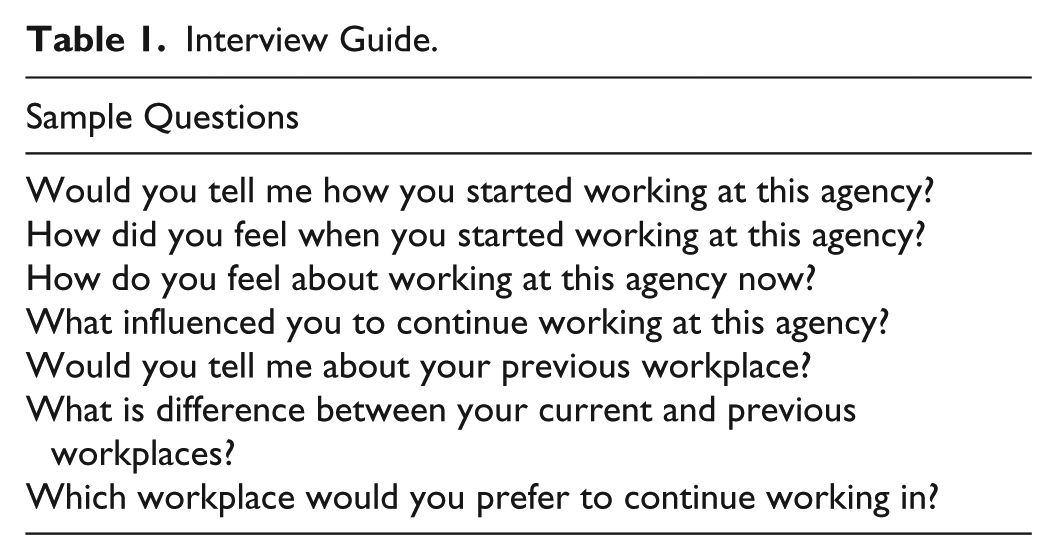
We used grounded theory, as it is suitable for the development of theories to explain complex phenomena (Corbin & Strauss, 2008). Data were collected via semistructured interviews and participant observation between October 2012 and August 2013. We conducted 26 semistructured interviews, focusing on factors that encouraged participants to remain at their agencies. Sample questions are shown in Table 1. Each participant was interviewed individually by the first author, and the interviews lasted 40 minutes to 90 minutes. All interviews were audio recorded. Field notes were taken following the interviews, to record general impressions and immediate reflection.
Interview Guide.
Prior to the interviews, the first author, who had worked in a home care agency, observed participants, to obtain firsthand insight into the activities and work environment at each agency and gather data regarding collegial support for participants. Collegial support that had been observed during participant observation was explored further in interviews. Field notes were taken during observation. Of the 26 interview participants, 23 consented to the observation, and three declined for privacy reasons. Overall, participants were observed for approximately 24 hours.
Data Analysis
In accordance with standard grounded theory procedure, we performed constant comparison (Corbin & Strauss, 2008). All interview transcripts and field notes were typed verbatim, read carefully, and coded based on content meaning. Codes were sorted and classified into categories via constant comparison where each incident in the data is compared with other incidents for similarities and differences (Corbin & Strauss, 2008). The properties and dimensions of these categories were identified to enhance our understanding of the categories and relationships between them. Some categories were replaced by newer categories that represented the data more accurately, and the relationships between the categories were used to develop a conceptual framework. Throughout the analysis, memos and diagrams were created to capture thoughts, insights, and ideas regarding the data analysis process. The memos were used to provide written records of analyses, whereas diagrams were used as visual devices depicting the relationships between concepts (Corbin & Strauss, 2008). When diagrams did not fit the data, we searched for alternative representations that fit the data more closely.
Charmaz’s (2006) framework was used to ensure the credibility, originality, resonance, and usefulness of the results. Data triangulation (interviews and observations) and self-reflective memos were used to ensure credibility and originality. Member checking, peer debriefing, and external auditing were used to ensure credibility, resonance, and usefulness. Member checking was conducted by asking participants to read the report and comment on whether the findings reflected their experiences accurately, and their feedback suggested that this was the case. The first author created frequent memos concerning her reflections and feelings, to minimize researcher bias. Multiple researchers with experience in grounded theory or working in home care agencies joined the research group and engaged in continuous discussion during the data analysis.
Results
Overview
The analysis revealed a cycle that nurses followed continuously, which we called “sustaining meaningfulness.” When nurses began to work for home care agencies, most encountered various difficulties because of the differences between home care and hospital settings. Specifically, most clients do not get well despite nurses’ efforts, the environment was uncontrollable, and nurses were unsure about what to do but required to make all decisions themselves. The nurses eventually progressed to “enjoying the fruitfulness,” whereby they could see tangible responses and achieve recognition of their usefulness and growth. For nurses to move from the “encountering difficulty” phase to the enjoying the fruitfulness phase, they needed to discover meaningfulness in practice by accumulating skills, rediscovering nursing’s unique contribution, and redefining their practice. The enjoying the fruitfulness phase gradually faded into a becoming dissatisfied phase because of the loss of novelty and lack of new discovery. They could re-enter the encountering difficulty phase if they successfully requestioned their practice by reflecting on practice taken for granted and identifying challenges. As long as they continue working, nurses continuously follow the cycle of sustaining meaningfulness. Nurses could resign from their agencies if they remained in either the encountering difficulty or “becoming dissatisfied” phase for a protracted period, but they tended to remain at their agencies when experiencing sustaining meaningfulness (Figure 1). In the following sections, details related to each category are provided.

The cycle of sustaining meaningfulness: The process via which nurses continue to work at the same home care agency.
Encountering Difficulty
In the interviews, most nurses reported that at the beginning of their work as home care nurses, they experienced various situations that did not proceed as expected, and they considered their work difficult. The reported difficulties were classified as follows:
Clients do not get well
In hospital settings, observing remarkable recovery in patients often leads to joy in providing care and surprises nurses. However, most home care clients were elderly, and their physical function and health conditions often failed to improve, despite nurses’ best efforts. This caused nurses to experience difficulty in perceiving their own contributions as fruitful.
No change in clients’ situations after a few months may be one of the factors homecare nurses leave an agency. (ID 15)
Uncontrollable environment
Nurses perceived that clients/family members in home care settings held all the decision-making power. It seemed that care provision became largely indirect via family caregivers, rather than the nurses directly providing care to clients. Nurses also became involved in family issues that could affect the client’s lives, but they felt that they had little say in these situations. Therefore, what nurses believed they could do in home care settings was limited, and they ultimately felt incompetent despite their clinical experience: I felt my ability was limited. All I can do is give them advice (and I cannot determine what they will do). (ID 16)
Not knowing what to do
Many nurses had rich hospital experience but little understanding of home care prior to working in this setting. One nurse said that she could not imagine providing home care because she had not learned about home care nursing at nursing school, as it has been part of basic nursing education in Japan only since 1997.
Some nurses felt unable to care for home care clients. Although they felt able to aid client recovery in critical situations, this was often unnecessary in home care settings. Home care contracts stipulate the duration of care provision (e.g., 20, 30, or 60 minutes) but not the type of care required, and care needs vary substantially between clients and over time. Thus, nurses were occasionally unsure about what to do with extra time after completing medical procedures and providing other skilled care. Nurses with previous experience only in acute care settings experienced greater difficulty in home care, leading to uncertainty as to whether they were providing suitable or optimal care: Actually, I did not do anything; I just checked vital signs and came back to the agency, I felt…guilty. Did I provide the best care? (ID 25)
Making all decisions themselves
Home care requires nurses to improvise. When nurses in hospitals are unsure about what to do, they can consult senior nurses and other health care professionals. However, in home care settings, while some care is not urgent, nurses were required to make all care-related decisions themselves, which caused anxiety because of insecurity: Only I can see the client and family, and only I can assess the client and family. Umm, no healthcare professionals are at the client’s home, except me. So, I do not feel secure. (ID 4)
Remaining in this phase for a prolonged period could prompt nurses to leave the workplace. Four of the six nurses with experience in other home care agencies said that they had left their previous agencies because they were unsure about the care they provided: I am not sure what I did was homecare nursing [in the previous workplace]. (ID 2)
Discovering Meaningfulness in Practice
After encountering difficulty, many nurses gradually discovered meaningfulness in practice by accumulating skills, rediscovering nursing’s unique contribution, and redefining nursing.
Accumulating skills
Nurses gradually accumulated skills through their daily work in home care settings including applying their knowledge of pathophysiology to clients, assessing clients’ conditions, and explaining the necessity of certain procedures to clients/families. As nurses accumulated skills, they provided additional nursing services for clients/families.
Home care services are covered under medical and long-term care insurance in Japan; therefore, the home care nurses required sufficient knowledge of both types of insurance. They also required particular expertise, such as understanding client’s needs, managing costs, and the frequency of service reimbursement by long-term care insurance (where needed), and advising clients on living comfortable daily lives, in home care settings.
Accumulating skills also involves obtaining help from managers/colleagues. Through discussion with managers/colleagues regarding home visits and care, nurses learned the strengths of each manager/colleague and whom they should ask about particular issues. In emergency situations, nurses would call their managers/colleagues for consultations; otherwise, they consulted them upon returning to the agency: I understand each nurse’s strengths . . . I can ask the nurse who definitely has helpful hints about my issue. So, I feel very secure. That’s why I continued working at this agency for 11 years! (ID 9)
Rediscovering nursing’s unique contribution
Two pathways led nurses to rediscovery of the benefits of nursing: practicing by themselves and watching others. Nurses began to recognize the impact of their care on the daily lives of clients/families and the importance of home care nursing. This type of nursing involved allowing clients to not only stay at home but also feel secure and comfortable in doing so. For example, soiling was burdensome for clients/families, and nurses’ skills in digital disimpaction helped them feel comfortable and reduced the family care burden considerably.
Some nurses, particularly those who were inexperienced, realized the impact of nursing care by observing supervisors/colleagues. One nurse said that she was moved when she observed how her supervisor’s care had relieved a client’s pain dramatically: I saw the supervisor carefully knead the client’s back, and the client went to sleep without medication. I was really moved by her skills and the power of nursing care! (ID 4)
Redefining nursing
In parallel with rediscovering nursing’s unique contribution, nurses engaged in redefining nursing. Although nurses might have possessed a vague understanding of nursing based on their basic education and hospital experience, this gradually changed through daily home care practice. This began as a feeling of puzzling discomfort regarding their definitions of nursing, which prompted them to think about them: I think I used to see nursing under the category of medical care when I worked at the hospital. I regret I didn’t provide enough nursing care for each patient. (ID 12)
In managing this sense of discomfort, nurses’ ideas regarding nursing and its boundaries shift. This could have occurred via discussion regarding practice before/after home visits and daily meetings or during consultations with managers/colleagues about care plans.
[A manager told me] I think it’s also nursing, I mean listening to the clients without medical/physical care is also nursing. (ID 3)
Nurses’ expectations of care outcomes also changed with the shift in nursing boundaries. They began to consider both full recovery and the maintenance of status quo as valid outcomes. Nurses with considerable work experience in long-term care settings, such as nursing homes, lacked this discomfort, as their ideas concerning nursing did not require redefinition. Throughout this process, nurses shifted from encountering difficulty to enjoying the fruitfulness.
Enjoying the Fruitfulness
This phase represented how nurses gradually came to enjoy their jobs. It contained the following three categories:
Seeing tangible responses
Nurses began to enjoy providing care, because they could observe clients’ and family members’ responses to their care, such as changes in condition, feelings of happiness, and attitudes toward nursing and other services. In perceiving even the smallest change, nurses recognized that their practice exerted a significant impact on clients’ and family members’ lives. One nurse talked about clients and families who wished to stay at home. She learned that her assistance fulfilled this desire, and she enjoyed witnessing the clients’ facial and verbal expressions of delight and happiness.
I read clients’ and families’ facial expressions as well as verbal expressions such as “thank you” and “nice.” I can see how a client looks happy because they are home. (ID 26)
Nurses determined which services were necessary and established the appropriate amount of care for each client/family. Moreover, they were often the first to suggest certain home care services to prevent hospitalization or institutionalization. However, some clients and their families refused such suggestions, largely because they did not recognize their need for the services. However, these attitudes changed as nurses provided services: One client used to say “You don’t have to come!” but I visited his home anyway and provided care no matter what. Now, I think he welcomes me. (ID 8)
Growth recognition
Recognition of their growth as both professionals and human beings helped nurses to enjoy their jobs. Professional growth referred to nurses’ ability to provide specific nursing skills, communicate effectively with clients/families, and support clients while skillfully collaborating with other professionals. Human growth referred to personal enrichment and the development of a broader perspective via encounters with the ways of life of numerous clients/families. Nurses often discussed life philosophies with clients/families in making certain decisions (e.g., care locations), particularly at the end of life. These discussions helped nurses to broaden their own philosophies: I’m thinking about what I value in my life. . . these experiences of working as a homecare nurse have added something good to my life. (ID 15)
Recognition of one’s usefulness
Nurses often described their enjoyment in witnessing the outcomes of their care, which profoundly influenced their recognition of their own usefulness. In providing care to clients and confirming positive consequences directly, nurses experienced deep satisfaction and joy in working as home care nurses: The clients provide feedback to me directly. [Because] it is easy to see the client’s change, I enjoy homecare nursing very much! (ID 4)
Nurses also observed the usefulness of colleagues and other health care professionals. Most home care nursing clients used services other than nursing, such as home help, rehabilitation, case management, and physician home visits. Nurses’ also reported recognizing their own usefulness when their collaboration with colleagues and health care professionals helped to solve clients’ and family members’ problems.
In summary, nurses who enjoyed their work were likely to continue working at the same agency. However, this phase eventually gave way to becoming dissatisfied.
Becoming Dissatisfied
Even when nurses enjoyed working in home care nursing, their perspectives gradually shifted toward the becoming dissatisfied phase, which comprised categories of the getting used to care and getting bored.
Getting used to care
Home care frequently involved constant provision of the same care, because clients were usually stable. The nurses ultimately experienced a sense of getting used to care when visiting the same clients and providing the same care. They became less sensitive to minor changes and positive signs in clients and family members, which used to thrill them. In addition, they failed to see new challenges in the monotony of care provision: It’s a kind of mannerism; every week, every day is the same. (ID 13)
Becoming bored
In getting used to their work, nurses came to thoroughly understand their work and adapt to their workplace environments. However, some nurses, particularly those without a partner or children, became bored with their workplaces and considered moving to a new environment. In addition, nurses in their 20s and 30s considered their own growth and potential as professionals constantly, which could prompt consideration of a move. Nurses who created new sources of stimulation and change did not grow bored; rather, they created new workplace roles or began caring for new clients. Sudden deterioration or changes in clients’ conditions also stimulated nurses’ interest. Therefore, some nurses bypassed the becoming dissatisfied phase entirely.
Protracted periods in this phase seemed to be associated with turnover. Some nurses reported resigning from a previous workplace because of stagnation during this phase: I left my job when I got bored with the workplace. (ID 19)
However, requestioning their practice helped nurses to progress through becoming dissatisfied and continue working in their current agency.
Requestioning
In requestioning their practice, nurses could shift away from becoming dissatisfied. Requestioning included reflecting on practice taken for granted and clarifying challenges.
Reflecting on practices taken for granted
Nurses referred to moments when they recognized something that they missed completely. Nurses might find care practices so mundane and routine that they perform them mindlessly. However, upon recognizing an issue with their practices, nurses are forced to reconsider what constitutes good nursing care.
Such revelations might occur when managers/colleagues ask nurses about their care, when client/family situations change drastically, or when they care for end-of-life clients. End-of-life care in particular requires individually tailored care and provides opportunities for nurses to be self-conscious. For example, one nurse reported explaining to a family about the process of death when she recognized that she was giving a standard explanation without considering the family’s situation: Well, I recognized I had said the same words in the same way to the previous clients. I felt I was a poor nurse. (ID 18)
Identifying challenges
Some nurses wondered whether the care provided was appropriate for each client/family. For example, one nurse realized that she had provided rehabilitation care (i.e., supporting the patient in getting up and down) to the same client for 7 years, prompting her to reconsider whether this care was appropriate.
I’ve visited him (the client) for over 7 years! The client’s situation was basically the same, and care did not change. From time to time, I would doubt whether my care ensured the best practice for him. “Is this care OK? Is this care good for him?” (ID 21)
Upon realizing problems regarding their nursing practice, nurses began to identify, or question, their care, which returned them to the encountering difficulty phase. This often occurred when nurses began to provide care to a new client, identified new questions about the care of a long-term client, or the client’s situation had changed.
Summary
Nurses who requestioned their practice ultimately returned to the encountering difficulty phase, from which they progressed to the other phases, repeatedly experiencing a cycle of sustaining meaningfulness. The idea of the cycle originated from a nurse interviewed during member checking: when she saw our draft diagram, which was a linear process, she noticed that the process was cyclical: I imagine there are various phases in a circle, and I’m moving from the enjoying the fruitfulness to the becoming dissatisfying phase, and then the encountering difficulty phase. I repeatedly go round and round these phases like a ball. (ID 10)
Nurses resigned from their jobs when they could not progress through the cycle. A nurse reported resigning from her previous workplace because she had stopped progressing through the cycle and remained in the encountering difficulty phase for a protracted period.
I quit my ex-workplace, because it was boring me for a long time. I did not understand what I should do. I was very insecure about my job (when I worked at my ex-workplace). (ID 22)
One nurse compared this cycle with a role-playing game in which players acted via a process of structured decision making and character development. According to her, fighting against a weak character (e.g., “slime”) in the game and a boring workplace were similar; she described this similarity as follows: For me, continuing to work at an agency is like a role-playing game. Only fighting against slime is boring me, but I’m getting strong through playing the game. (ID 19)
Ensuring that nurses face new challenges in care provision helped them to progress through the cycle, and they did not need to cease their exploration. This appeared in nurses who remained at a single agency over time, as they did not need to change their workplace to experience anything new, because they faced new challenges in their current jobs. The nurse who compared her job with a role-playing game said that she was able to continue in her job for as long as she could fight strong enemies: Fights against stronger enemies help me to enjoy my job and continue my job. (ID 19)
Discussion
The study revealed that home care nurses were engaged in the three phases of sustaining meaningfulness in their practice: encountering difficulty, enjoying the fruitfulness, and becoming dissatisfied. In addition, if nurses remained in either the first or final phase for a protracted period, this led to nurse turnover. Existing theories regarding nurse turnover could not provide a sufficient explanation regarding nurses’ intention to leave or actual turnover (Parasuraman, 1989; Reitz, Anderson, & Hill, 2010). Our findings suggest that another possible reason for this insufficiency is that these theories all described linear, rather than cyclical, models. Although the limitations of linear models in explaining nurses’ turnover have been noted, no alternative theory has been proposed until now (Lee & Mitchell, 1994; Lee, Mitchell, Wise, & Fireman, 1996).
The Conservation of Resources Model (Hobfoll, 1989) is also a cyclic model. According to this model, individuals who hold greater resources are more capable of resource gain, and enrichment of resources in these individuals results in a cycle in which existing gains beget future gains, generating “gain spirals” (Hobfoll, 2011). Resources contributing to these gains include object, condition, personal, and energy resources (Hobfoll, 1989). Our cyclic model showed “accumulating skills,” which could be similar to personal resource gain in the conservation of resources model. However, the four types of resources included in the model do not capture the resources inherent in the nursing experiences (e.g., redefining nursing) described by participants in this study. Because the resource gain spirals have received relatively little attention, the relationship between gain spirals and turnover has not been explored. Our cyclical model could provide new insight into nursing turnover theory.
In this study, sustaining meaningfulness was indispensable for encouraging nurses to continue working. Recently, meaningfulness has been identified as one of the factors related to home care nurse turnover, regardless of work experience (Tourangeau, Patterson, Saari, Thomson, & Cranley, 2017). Meaningfulness is defined as a sense of return on investments of self in role performance, and its experimental components are reported as feeling worthwhile, valued, and valuable (Kahn, 1990). However, the specific actions involved in the cycle of sustaining meaningfulness have been unclear until now.
This study demonstrated that certain actions, such as accumulating skills and task identification, promoted this cycle in detail. Many studies have attempted to elucidate nurses’ turnover. To understand the complex phenomenon of nurses’ turnover in professional nursing practice, the Nursing Job Demands-Resources (NJD-R) model was developed (Keyko, Cummings, Yonge, & Wong, 2016) based on the Job Demand-Resources model (Demerouti, Bakker, Nachreiner, & Schaufeli, 2001). The NJD-R model described the way that organizational climate, job/professional/personal resources, and job demands are related to work engagement, which is associated with care performance (Keyko et al., 2016). However, this framework has not proposed a useful action guideline for nurses. Our results could be used as a guideline by nurse managers, to support staff nurses in home care settings and thereby prevent nurse turnover.
Given that nurses tended not to resign from their jobs in the enjoying the fruitfulness phase, it could be similar to work engagement, which is defined as “a positive, fulfilling, work-related state of mind that is characterized by vigor, dedication, and absorption” (Schaufeli, Salanova, Gonzalez-Roma, & Bakker, 2002, p. 74). However, work engagement is considered a stable concept (Mauno, Kinnunen, & Ruokolainen, 2007), but none of the participants in the study remained in the enjoying the fruitfulness phase indefinitely and eventually progressed to the becoming dissatisfied phase. Therefore, the stability of the enjoying the fruitfulness phase and work engagement could differ. However, the concept of day-level work engagement, which changes daily, was proposed recently (Xanthopoulou, Bakker, Demerouti, & Schaufeli, 2009), although its mechanism has not been explained. The ways in which the enjoying the fruitfulness phase results from encountering difficulty and ultimately transitions to the becoming dissatisfied phase could provide new insights into the dynamics of work engagement.
Our cyclical model of sustaining meaningfulness could help nurse managers to understand and advise nurses. Nurse managers could identify the phase each nurse is in and the support strategies they should use to help nurses progress to the subsequent phase. This could help reduce nurse turnover. Existing guidelines of general training for home care nurses (Japan Visiting Nurse Foundation, 2011) do not clearly explain how nurses can achieve their objectives, and provide only a list of vague objectives (e.g., “creating a workplace in which staff nurses can work comfortably” or “acting as a risk manager”). Our model could be superior because it clearly shows nurse managers how to support nurses. If nurses are encountering difficulty, a nurse manager could advise them to accumulate skills to progress to the enjoying the fruitfulness phase. This strategic support could allow staff nurses to cycle through the model and continue working at their current workplaces.
Furthermore, our cyclical model could be used as a self-learning or self-development tool for nurses, to aid them in assessing their current phases and act to avoid stagnation in the encountering difficulty or becoming dissatisfied phase. This cyclical model could, therefore, be useful in helping nurses see the way forward and encourage them to continue working at their current workplaces.
The study has some limitations. The main limitation was that we did not compare interview data between nurses who did and did not remain at the study agencies; however, we endeavored to include those with experience of resigning from other home care agencies and compare their experiences between their previous and current agencies. Further research could benefit from further exploration of nurses’ reasons for resigning from home care agencies.
Conclusion
Nurses who continued to work at home care nursing agencies progressed through the cycle of sustaining meaningfulness, which comprises phases of encountering difficulty, enjoying the fruitfulness, and becoming dissatisfied. Remaining in the encountering difficulty or becoming dissatisfied phases for protracted periods was associated with higher risk of nurse turnover. To promote progression through this model, nurses should discover the meaningfulness of practice and requestion their practice. Nurse managers and colleagues could use this model to enhance their understanding of nurses’ situations and share their own objectives. Further research is required to examine the relationships between each phase and actual turnover.
Footnotes
Acknowledgements
The authors express appreciation to the participants for their cooperation. They would like to thank Drs. Masako Kageyama, Kana Sato, Takako Iwasaki, Yoshie Yumoto, Riho Iwasaki, and Atsushi Matsunaga for their great support.
Declaration of Competing Interests
The authors declared no potential conflicts of interest with respect to the research, authorship, and/or publication of this article.
Funding
The authors disclosed receipt of the following financial support for the research, authorship, and/or publication of this article: This study was supported by the Fumiko Yamaji Trust for Academic Nursing Education and Research, Tokyo, Japan.
