



Abstract
Clinical activities at dental premises after the COVID-19 lockdown period or post-COVID-19 are likely to be a challenge for all practicing dentists. To assess the impact of the COVID-19 pandemic on dentists and change in dental practice following lockdown, a total of 1150 participants were approached through online survey forms registered on www.surveys.google. A link containing details of the questionnaire and a consent form was sent to dentists through emails and social media forums. The questionnaire included 3 domains comprising of seventeen questions. The first section focused on demographics. The second section inquired about the change in dental practice, that is, clinical hours, use of PPE, type of treatment, and patient flow. The third section investigated the impact of COVID-19 on dentistry. Means, standard deviation, and percentages were calculated using descriptive statistics. Chi-square was used to find an association between different variables. The response rate was 87%. Demographic factors revealed participants aged from 20.45 to 40.55 years. The data showed around 89.6% (896) of dentists have altered their clinical working hours post lockdown and, approximately, 59.7% (597) of dentists provided only emergency treatments. 88.1% (881) of the dentists wore PPE during dental procedures. Overall, a huge negative impact of the COVID-19 pandemic was observed among practicing dentists in terms of the dental supply chain, cost, and availability of dental equipment, treatment cost, and bill payments.COVID-19 pandemic compromised dental care. Though dentists were taking precautionary measures and have changed their practice according to the guidelines provided by the ADA and World Health Organization, they were still experiencing monetary loss due to decrease patient influx post lockdown.
Keywords
The COVID-19 pandemic has greatly impacted dentistry and dental care professionals. There is work already published, but the outcomes are heterogenous and subjective. Also, there is not much work-related dentistry. Most of the work is on health care professionals, although dentistry and dental care professionals are at high risk of getting the disease. The present research targets dental care professionals and inquires about the problems they faced and how the disease has impacted their quality of life and finances. This research may help in forming a policy or guidelines on how patients need to be treated using precautionary measures during COVID-19 and in what way to overcome problems faced by dentists keeping them safe in this situation after lockdown.Highlights
What do we already know about this topic?
How does your research contribute to the field?
What are your research’s implications towards theory, practice, or policy?
Introduction
Coronavirus disease 2019 (COVID-19) emerged as a global pandemic. The disease has resulted in the morbidity and mortality of millions of people around the globe.
1
With its high contagious index, the virus is responsible for causing pneumonia-related acute respiratory distress syndrome (ARDS
With its fast global spread, high mortality rate, and resistance against most antiviral regimes, the disease has led us alteration of lifestyle incredibly. 8 In fear and to limit the spread of disease, countries have locked down through introducing curfews, closed their borders, and enforced social distancing and isolation procedures.9,10 Traveling through the air and by other means has been ceased worldwide. Businesses are facing unprecedented challenges, economies have slowed down and all this has consequently impacted different sectors of healthcare, particularly dentistry.11,12
The frontline medical health care providers are at a higher risk to get infected as they are treating sick individuals.7,13 Dentists practicing or treating patients share an equal level of risk, due to its mode of transmission. 14 In dentistry, most of the procedures require rotary drills and ultrasonic scalers.15,16 The aerosols produced during such treatment process may cause viral dispersion, therefore, exposing the working dentist. Therefore, to minimize the risk the ADA, WHO, and other international authorities, that is, the Centers for Disease Control and Prevention (CDC) and the Australian Dental Council (ADC), 16 have developed guidelines for dentists to provide only emergency treatment and postponing all elective procedures. This has resulted in a huge descend in dental revenue among dentists working or owning private practices. 17
In this context, numerous questions arise regarding the need to alter current biosafety norms by dental professionals during and after the pandemic due to the characteristics and transmission modes of COVID-19. 18 Strict disinfection protocols have been followed after the COVID-19 pandemic, which is favorable to the patients who are getting treated. 19 Whereas, lack of easy accessibility of urgent oral care increases the incidence of oral disease. 19 Also, due to fear and anxiety among patients and limitations of treatment provided by the dentist, they are an increased probability of a decline in oral health, with a possible finding the middle ground in systemic health of patients. 20
Apart from oral health, a crippling loss due to closed dental practice is predicted. According to a recent report, dental practices in many developed countries like the United States of America (USA) and the United Kingdom (UK) are experiencing economic losses and have been permanently or temporarily closed due to nonpayment of salaries to their employees. 21 Therefore, to our knowledge from existing indexed literature, there is limited evidence on COVID-19 impact assessment on oral health and change in dental practice post lockdown. Therefore, the present study aimed to assess the impact of COVID-19 on dental care professionals and change in dental practice following post lockdown.
Material and Method
A cross-sectional study was approved by the ethical and review committee of Foundation University, Islamabad under ethical review number (FF/FUCD/7414). The duration of the current study was 2 months, that is, August 1 to September 30, 2020.
The present study was conducted amongst dentists of Pakistan to evaluate the post lockdown effect of COVID-19 and its impact on clinical dental practice. A sample size of 1150 participants was considered appropriate at a 95% confidence interval, 5% margin of error, and 80% power of the study using open epi statistical software. 22 Participants were approached through online survey forms registered on www.surveys.google. A link containing details of the questionnaire and a consent form for voluntary participation was sent to dentists through emails and social media platforms (WhatsApp, Facebook, and Twitter). The email addresses were obtained from the portal of the Pakistan Medical Council (PMC). Confidentiality was carefully assured among all the participants. Reminder weekly emails and WhatsApp messages were sent periodically to improve the response rate.
A structured, self-administered questionnaire comprised of 3 sections with seventeen questions in total was used. For all the items of the questionnaire, an intraclass correlation coefficient (ICC) >.80 was considered satisfactory. In cases of items with ICC values <.80, the questionnaire was edited to increase ICC. To obtain information about the validity of the tool and items, we conducted a pretest in a sample of 22 dentists who were asked to evaluate its clarity, writing style, question sequence, and internal consistency. The reliability of the questionnaire was assessed through retest reliability in which the questionnaire was administered with a group of respondents and later the survey was repeated with the same participants later on.
Three domains of the cross-sectional survey comprised of questions focused on demographics, that is, age, gender, designation, marital status, and clinical experience. The second section inquired about the change assessment related to dental practice, that is, clinical hours, PPE, type of treatment, and patient flow. The third section was designed to investigate the impact of COVID-19 on dental practice. Some questions were sourced from the work by Ghani 23 and included in the study with minor modifications.
A single investigator to minimize bias evaluated all the responses. Data were analyzed using Statistical Package for the Social Sciences (SPSS Inc, software version 21 Chicago, IL, USA). Means, standard deviation (SD), and percentages were calculated using descriptive statistics. Chi-square was used to find an association between different variables.
Results
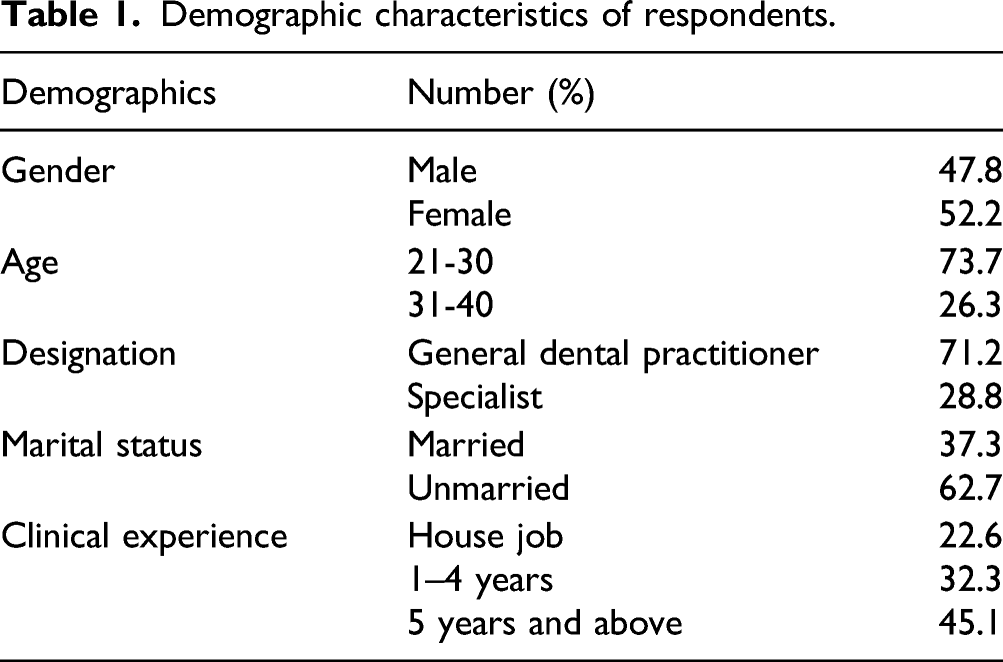
A total of 1150 dentists were sent a questionnaire out of which 1000 dental professionals responded to the survey, displaying a satisfactory response rate of 87%.
Socio-Demographic Analysis
Demographic characteristics of respondents.
Assessment of Changes in Dental Practice Following Lockdown
Assessment of change in dental practice following lockdown (n = 1150).


Assessment of change in dental practice following lockdown.

Effect of post lockdown on patient flow.
Impact of COVID-19 Pandemic on Dentistry
Assessment of the impact of COVID-19 pandemic on dental practices.

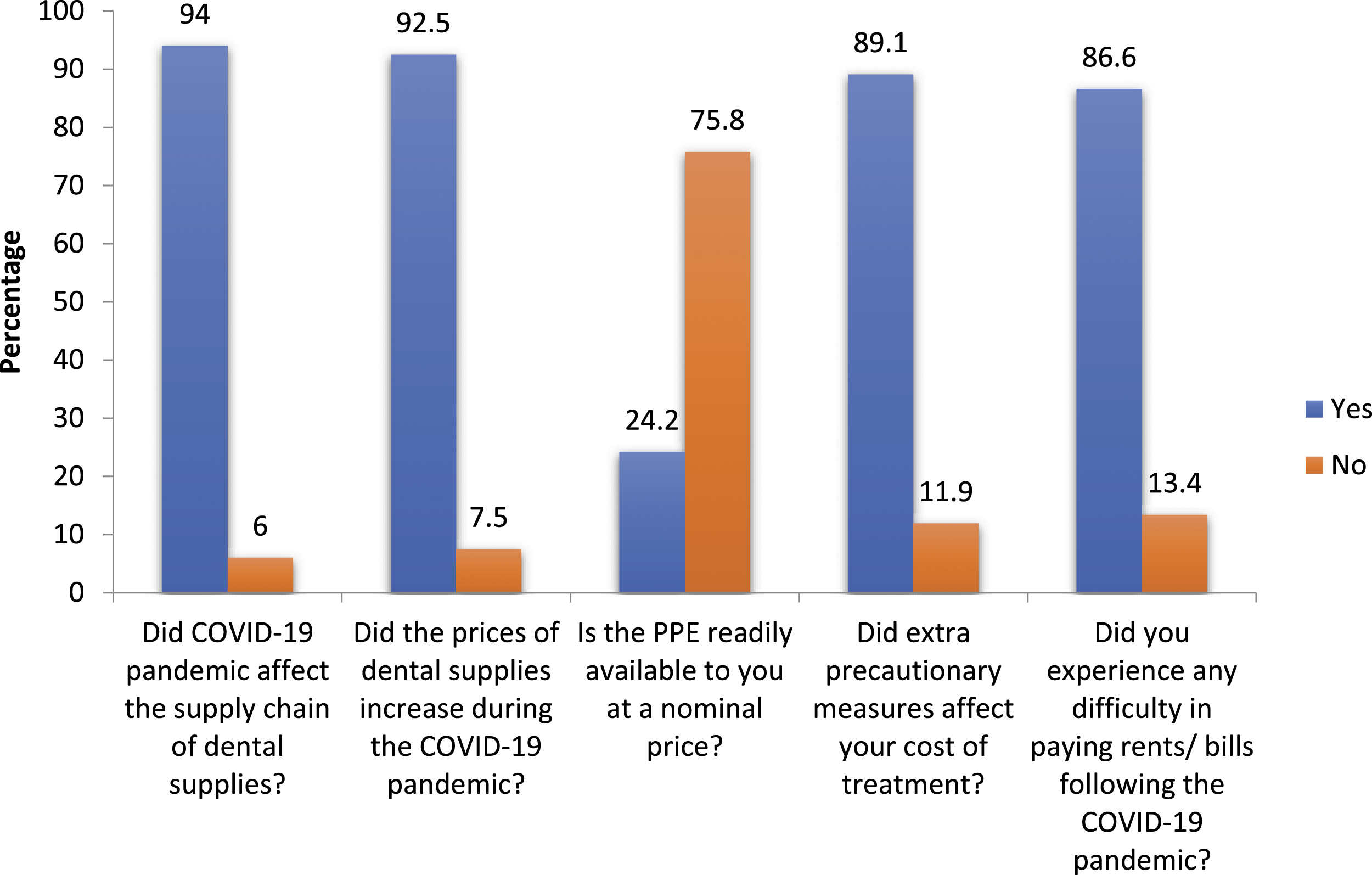
Assessment of impact of Covid-19 pandemic on dental practice.
Discussion
The present cross-sectional study provides a unique assessment of the post lockdown effects of COVID-19 on clinical dental practice. To our understanding, this is a unique survey that assesses the impact of the pandemic on dentistry and the changes made in the clinical practice post lockdown. The response rate of the present study was approximately 87%, which was found to be satisfactory. Moreover, it presents participants’ eagerness to contribute towards data-driven decision-making. 24
A cross-sectional approach was adopted as the design is easy, simple to perform, along with being cost-effective, and has fewer risks of loss to follow up. Moreover, it helps in generating a hypothesis for investigation which can be investigated further, using a much more complex study design. 25 Data was collected using a questionnaire generated through online Google forms, as the method is more accurate, less biased, and convenient, compared to a manual survey. 21 Questionnaire-based studies are generally renowned for the data collection on the topics, that is, preferences, attitudes, opinions, and experience of participants. However, data collection and interpretation need careful consideration. 26
The outcomes of the present study indicated that the overall impact of the pandemic on constantly changing clinical dental practice was astounding. The majority of the response showed that dentists are determined towards committing to the best practices issued by ADA and other dental regulatory bodies. This change in clinical practice is due to the nature of the disease and its mode of transmission. 27 The results displayed dentists' concern towards their patients and their health. In addition, it was observed that 59.7% (597) of the dentists provided emergency treatment with a decrease in patient flow 64.2% (642) post lockdown. The reason for treating only emergency dental cases is adherence to the WHO guidelines and to a fact that these cases may become a burden on the health care system if left unattended. 24 In a similar survey conducted in Beijing, China, they also observed a drop in emergency patient flow up to 38%. 28 This might be because people are reluctant to visit dental clinics during the pandemic due to fear. Hence, it is of utmost importance that dentists follow the guidelines issued by the Center for Disease Control (CDC) and WHO, act diligently, and provide appropriate care to their patients to limit the spread. 20
When asked about extra precautionary measures implemented by the dentists during patient treatment, that is, change of cling films, the response from the participants was affirmative. Surface contamination occurred during aerosol-generating procedures, these droplets can be deposited on the nearby surfaces acting as a source of transmission of the virus to other patients. 29 A recent study by Ahmed and Jouhar stated splatter and aerosols are produced 12, 24, and 36 inches distance immediately after cavity preparation and 30 min after cavity preparation. 30 Therefore, it is advisable to refrain from removing the personal protective barriers immediately after the procedure within the vicinity of the dental practice. 30 Previous evidence had revealed that human coronaviruses, that is, severe acute respiratory syndrome (SARS) and the Middle East respiratory syndrome (MERS), persist on non-living surfaces for up to 9 days. 31 Nevertheless, their spread can be limited by using various alcohol and hydrogen peroxide (H2O2) based disinfectants.32,33 PPE provides a major part of protection to the health care workers and in control of the disease. Similarly, most of the dentists around 88.1% (881) in the present study were aware of its importance, following the recommended guideline by WHO and other dental regulatory bodies.34,35
On the assessment of the impact of the COVID-19 pandemic on dentistry, the results were not conclusive. When inquired about the prices and difficulty in getting dental supplies during the pandemic. The majority of the dentists complained of not getting appropriate equipment along with disruption in the supply chain. A study conducted by Edward Livingstone al. exhibited that manufacturers were not ready to fulfill the increased demand of PPE due to pandemics which interns lead to shortages and high prices of PPE. 36 Moreover, providing only emergency treatment lead to the extensive monetary loss experienced by dentists.37,38 Furthermore, participants of the current study proclaimed that they faced difficulty in paying their rent and bills. A recent survey conducted by Imran Farooq and Saqib Ali 19 reported that one-fifth of the dentists have completely closed their practices. In addition, it was also found that three-fourth of practicing dentists have suffered from a financial loss of up to 70% during a pandemic. 6
One of the limitations of the present study was the small sample size so the generalizability of the study is limited. Similarly, the selection of study design might have also impacted the results because we could not determine the cause-effect relationship. Furthermore, data from the present study were collected in 2 months. This short period may have an impact on validating results. A cohort study design will be best suited to answer questions that were left unexplored in the current study.
Conclusion
COVID-19 pandemic impaired dentistry and dental practice. Most of the dentists followed guidelines approved by the ADA and WHO. Dentists experienced huge monetary constraints during this pandemic.
Footnotes
Declaration of Conflicting Interests
The author(s) declared no potential conflicts of interest with respect to the research, authorship, and/or publication of this article.
Funding
The authors are grateful to the Researchers supporting project at King Saud University for funding through Researchers supporting project No. (RSP-2020-240)
