



Abstract
Guided by Fanon’s constructs of racial epidermal schema, this study explored youth’s experiences with anti-Asian racism (AAR) and their perspective on how AAR is formed and maintained. We recruited 36 Asian youth (age range 14–23 years) residing in a metropolitan city in Canada to attend a semi-structured focus group. Results from the reflexive thematic analysis indicated the tenuous lines of invisibility and visibility of AAR—in a Whiteness dominant racial schema. When Asian youth are objectified within the boundary of Whiteness norms, AAR is pervasive but inconspicuous, happening early and frequently in their life but unrecognized. When they are objectified as threats to Whiteness dominance such as during the COVID-19 pandemic, AAR is visible in forms of overt discrimination, violence, and hate against Asians. Youth attributed roots of AAR to White supremacy and critically discussed their racialization process. Their reflexive insights serve as a form of resistance to AAR.
Keywords
Introduction
The surge of anti-Asian racism (AAR) incidents during the COVID-19 pandemic serves as a poignant reminder of the long-standing bigotry and prejudice against Asians in Canada (Guo & Guo, 2021; Kong et al., 2021). Not only were there drastic increases of hate crimes against Asian people since the pandemic began (Statistics Canada, 2022a), but incidents of AAR and xenophobia have continued to increase, impacting children and adolescents in particular (Chinese Canadian National Council Toronto Chapter and Project 1907, 2022). Against the backdrop of anti-Asian hate in Canada and the negative effects associated with racism on youth (Berry et al., 2021; Liu & Suyemoto, 2016; Trent et al., 2019), this study is interested in understanding Asian Canadian youth’s experiences with and perspective on AAR.
AAR is notably invisible at various levels (Hsieh & Kim, 2020; Kao, 2021; Muramatsu & Chin, 2022; Yip et al., 2021). Both historical and ongoing structural racism against Asians is often left untold in public discourse (Coloma, 2012; Muramatsu & Chin, 2022). Public attention to racism and discrimination experienced by Asians appeared to have been renewed only after the emergence of the pandemic, as overt forms of racism rose in prominence, exhibited through xenophobic and Sinophobic (i.e., anti-Chinese sentiment) rhetoric and sentiments towards those of Asian descent on news media, social media, and other forms of public discourse (Cheah et al., 2020; Reny & Barreto, 2022; Roberto et al., 2020; Wang et al., 2021; Wu et al., 2020). Part of the cause behind the lack of awareness about AAR is that racial issues in America tend to be discussed under the binary Black/White paradigm (J. Y. Kim, 1999; Sue et al., 2007). Moreover, a large body of literature attributes the invisibility of AAR to the model minority stereotype (S.-Y. Chen et al., 2021; Chou & Feagin, 2015; S. J. Lee et al., 2017; Sue et al., 2007), as Asians are often seen as free of oppression and challenges relative to other racialized groups. The stereotype leaves unfair treatment of Asians discounted.
There is also a limited understanding of how AAR manifests in Canada and the stories and voices of Asian Canadian youth remain unheard. Canada has incorporated multiculturalism in its federal policy since 1971 and multiculturalism was seen as “the nail in coffin of White supremacy” (Kagedan, 2020, p. 118). In the multicultural “mosaic” society, diversity is supposed to be celebrated, and newcomer and racialized groups are expected to preserve their group identity (Peach, 2005). However, critics argue that Canada’s multiculturalism is superficial and has in fact politically functioned to uphold the legitimacy of White supremacy (Fleras, 2014; E. Lee & Johnstone, 2021). Such observations were particularly validated during the COVID-19 pandemic: despite Canada’s claim of multiculturalism, racialized “others,” such as Asians, were conveniently targeted during the crisis. This othering practice directly challenges the multicultural, post-racial ideal (E. Lee & Johnstone, 2021).
The Present Study and Its Theoretical Orientation
To explore Asian youth’s experience of AAR in the Canadian “multicultural” context, the study is guided by Fanon’s (1952/2008) racial epidermal schema. Originally used to understand and critique the subjection of Black bodies, racial epidermal schema theorizes the psychological and social experience of racialized bodies, where the existence of racialized bodies is restricted and encapsulated within a White dominant racial order. Fanon articulated how the White gaze, regardless of its explicit or implicit presence, operates by permitting and/or limiting the very existence of racialized bodies. From the perspective of racial epidermal schema, we argue that Asian bodies have been objectified by the dominant White gaze in a specific form of racialization from yellow peril in the 19th century, model minority discourse in the 20th century, to disease carriers during COVID. The White gaze renders Asian bodies to be invisible as long as they are non-intrusive and stay within the norm of Whiteness, and to be visible when they go beyond the boundaries of Whiteness (Jeong, 2022). We argue the objectification of Asian bodies—both invisibilized and hypervisiblized—in fact operates within the same racial schema. In this study, we examine how the rhetoric of in/visible Asians and the in/visibility of AAR has shaped Asian Canadian youth’s experiences and perspectives of AAR. Approaching Asian bodies as a site of oppression, this study poses two research questions: (1) how do Asian Canadian youth experience AAR? and (2) how do Asian Canadian youth make sense of AAR?
Methodology
This qualitative study used semi-structured focus groups. To allow greater participation, youth who could not attend the focus group were interviewed individually with the same set of interview guide. Both focus groups and individual interviews can generate meaningful conversations on sensitive and personal subject matter in qualitative inquiry (Guest et al., 2017) and therefore are considered suitable for the present study. Our team used reflexive thematic analysis (TA) (Braun & Clarke, 2019, 2022a) to analyze study data, as this approach values meaning making and understands qualitative research as context- and position-bound. The reflexive TA allows flexibility and fluidity, and is compatible with our theoretical orientation and research questions, as it helps develop patterns of meanings (i.e., themes) across a dataset to tell “stories” that could have been buried otherwise.
Researcher Description
In reflexive thematic analysis, researcher subjectivity is considered as a resource to knowledge construction, rather than a threat to research rigor (Braun & Clarke, 2019, 2022a). Therefore, it is critical to make our positionality transparent. Most authors are first or second generations of Asian Canadians with various ethnic backgrounds from Hong Kong, Korea, Philippines, and Taiwan who have had lived experiences of AAR and/or have worked with Asian youth. One of the authors is a first-generation Canadian of Eastern European and Middle Eastern descent who has previously worked with racialized youth in a research capacity. She has lived experiences of as an immigrant youth, and approached the research through the lens of allyship and intersectional solidarity. All authors were closely engaged throughout the research process, collecting and interpreting the data while actively reflecting and unpacking our own positionalities throughout. Altogether, the diverse backgrounds and experiences of the research team helped to enhance data collection and analysis.
Study Participants and Procedures
We collaborated with a community agency and its youth advisory committee (YAC) in finalizing the scope of the study, the eligibility criteria, the recruitment strategies, and the interview questions. Youth who were aged between 12 and 25 years, self-identified as Asian, and lived in the Greater Toronto Area (GTA) were eligible to participate in the study. Youth were recruited from May to August 2021 via ads and postings on various social media platforms and our project website, and through community outreach. Each youth received a $25 gift card or cash compensation (in Canadian dollars) based on their preference, as a token of our appreciation for their time. The study was approved by the university’s and the community agency’s research ethics boards.
Shown in Table 1, 36 Asian youth participated in the study. The mean age of participants was 18.80 years old (range 14–23 years). Most youth identified as women and Chinese. Youth assent and parental consent were obtained for those who were younger than 16 years old, following the consent guidelines of the Government of Canada (2022). We conducted eight focus groups and two individual interviews (Table 2) over Zoom. All sessions were recorded with participants’ consent. Given the developmental differences, the focus groups were divided into three age groups: 15 years and younger, 16–18 years, and 19 years and older. Each focus group was conducted by a minimum of two facilitators and ranged from 90 to 120 minutes.
Participant Background (N = 36).
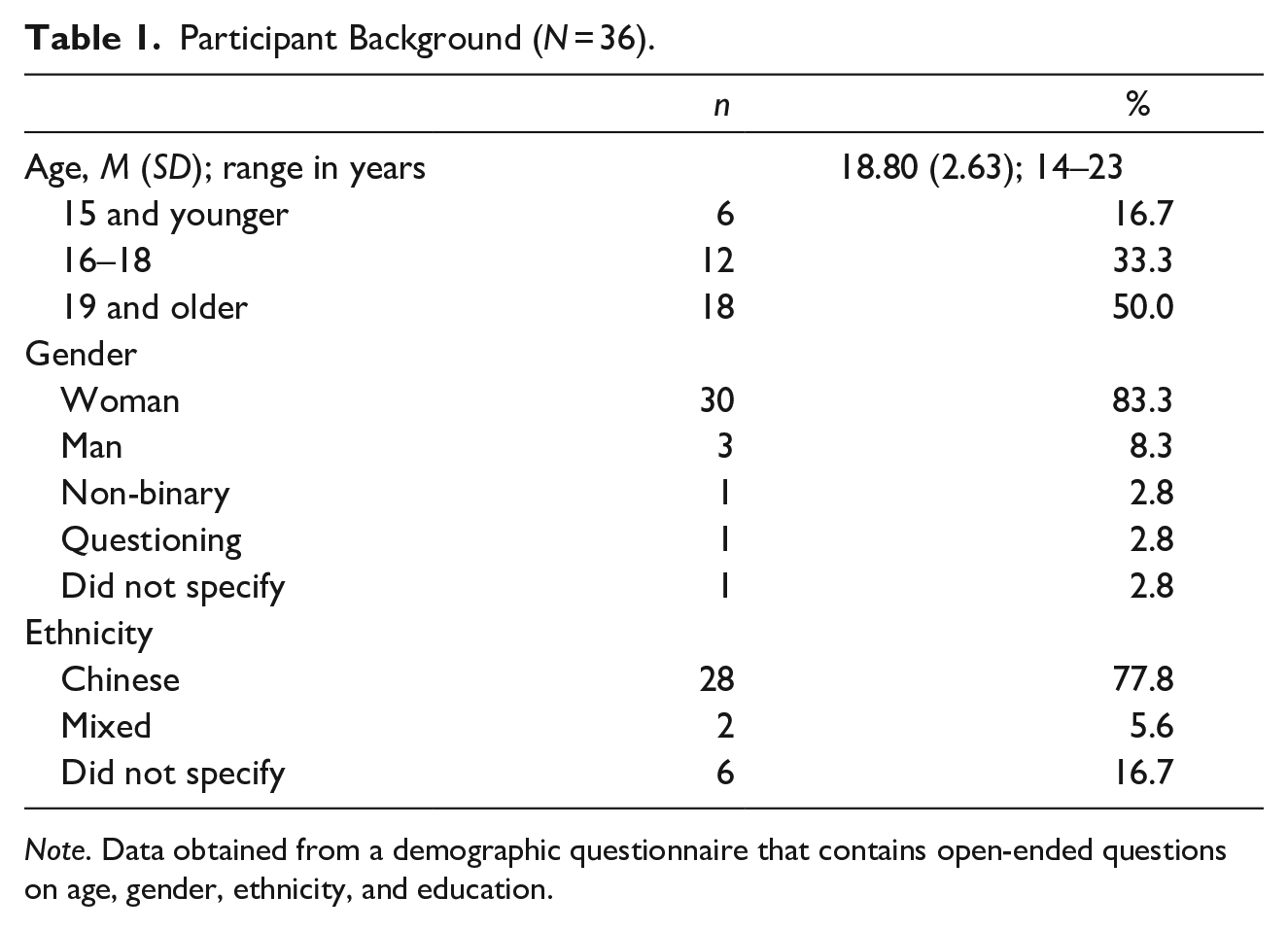
Note. Data obtained from a demographic questionnaire that contains open-ended questions on age, gender, ethnicity, and education.
Number of Focus Groups (N = 8) and Interviews (N = 2) by Participant Age Group and Preferred Language.
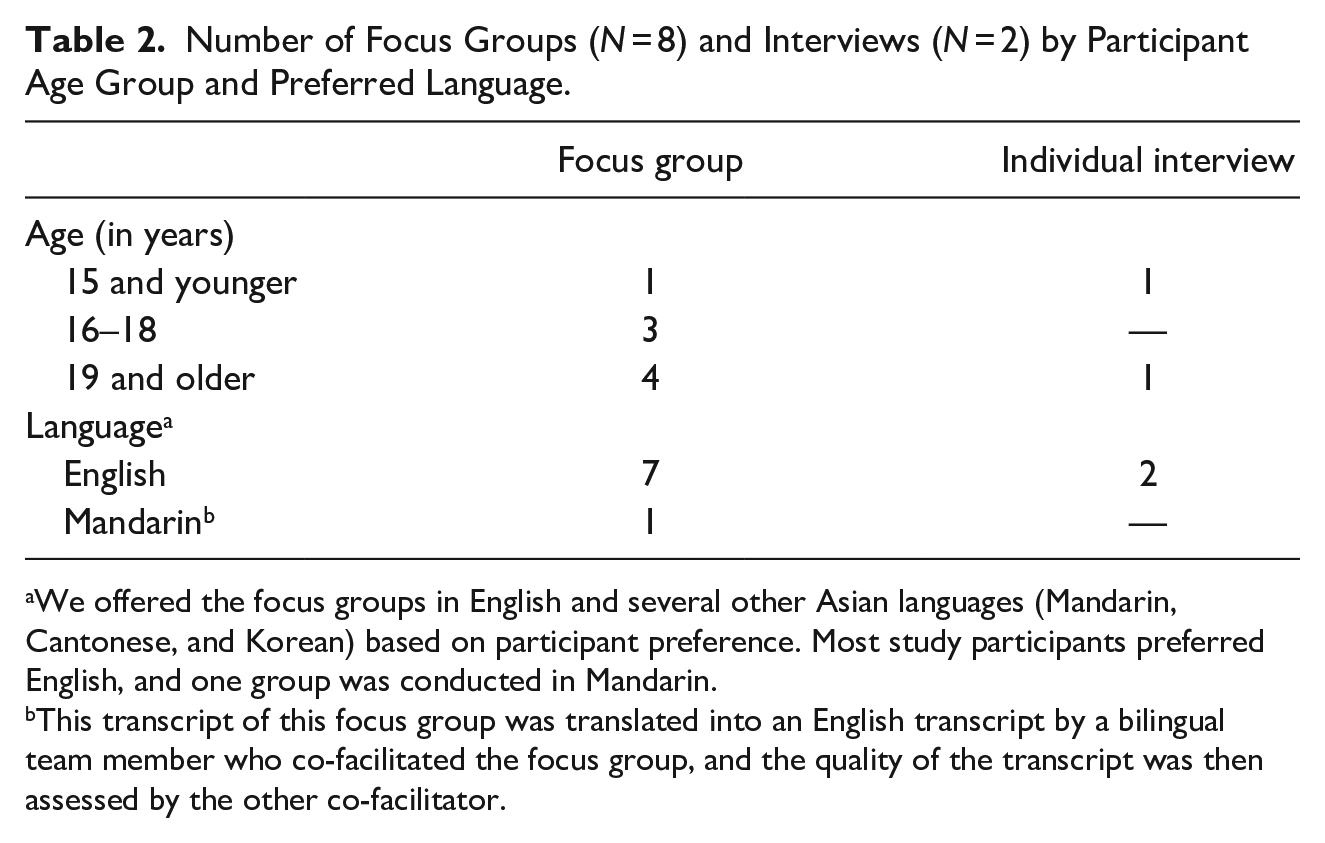
We offered the focus groups in English and several other Asian languages (Mandarin, Cantonese, and Korean) based on participant preference. Most study participants preferred English, and one group was conducted in Mandarin.
This transcript of this focus group was translated into an English transcript by a bilingual team member who co-facilitated the focus group, and the quality of the transcript was then assessed by the other co-facilitator.
Data Analysis
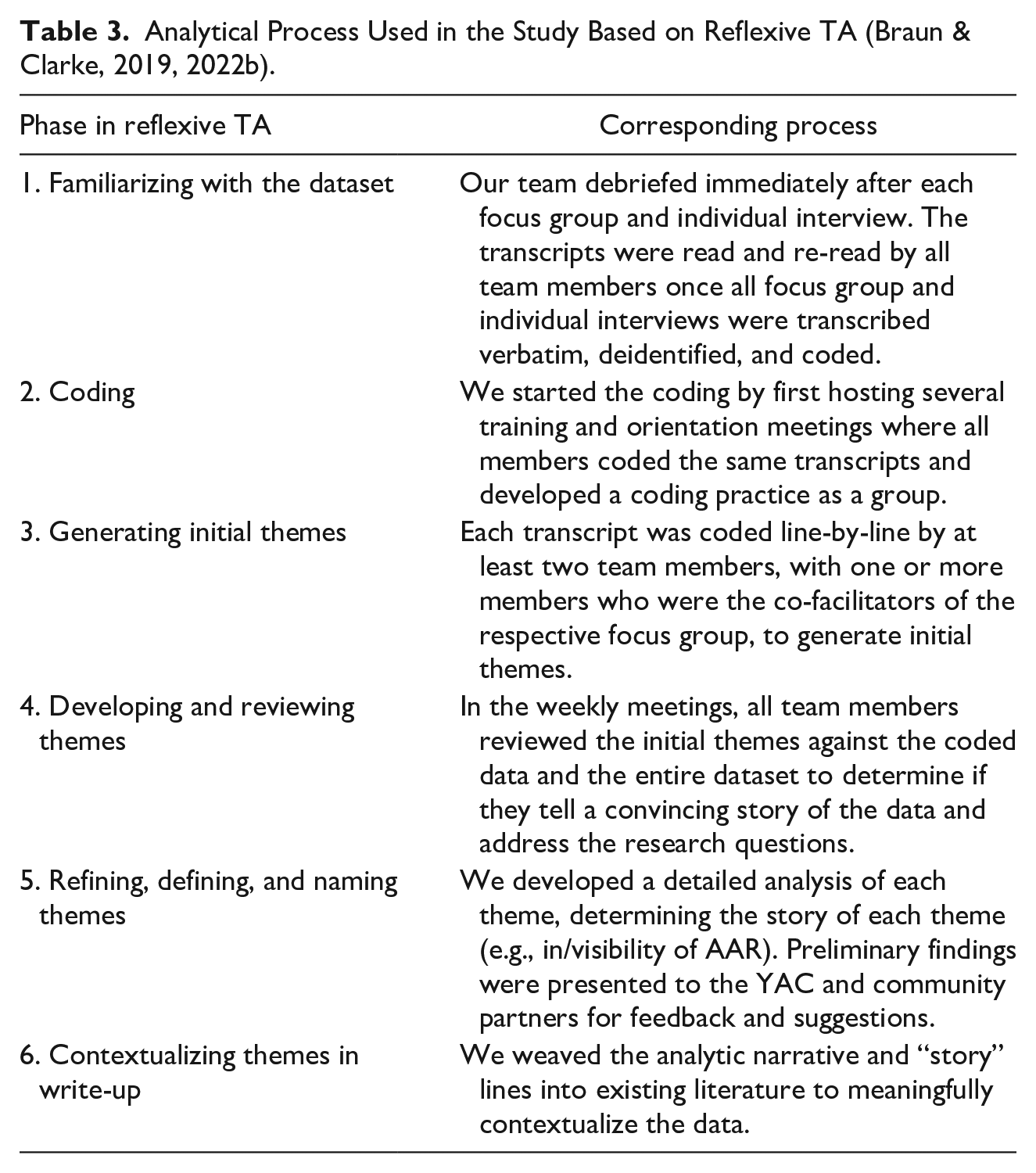
Data analysis and collection occurred in an iterative, recursive manner. Table 3 describes our processes based on the six phases for reflexive TA analysis (Braun & Clarke, 2022b). Memos, facilitator debriefs, and audit trails were used to facilitate the analysis throughout. We used NVivo to manage the study data and coding. To exercise researcher reflexivity, we critically reflected on and unpacked our own positions and understanding of AAR by setting aside time to discuss the lens we each had as we conducted the focus groups and as we engaged with the data and analysis. These deliberations helped us consider different perspectives as we made sense of the data and generated themes. Moreover, we presented the preliminary findings to the YAC and community partners for member checking. Their suggestions and feedback helped confirm the themes generated by the research team, and they encouraged us to present the findings to the broader community.
Analytical Process Used in the Study Based on Reflexive TA (Braun & Clarke, 2019, 2022b).
Findings
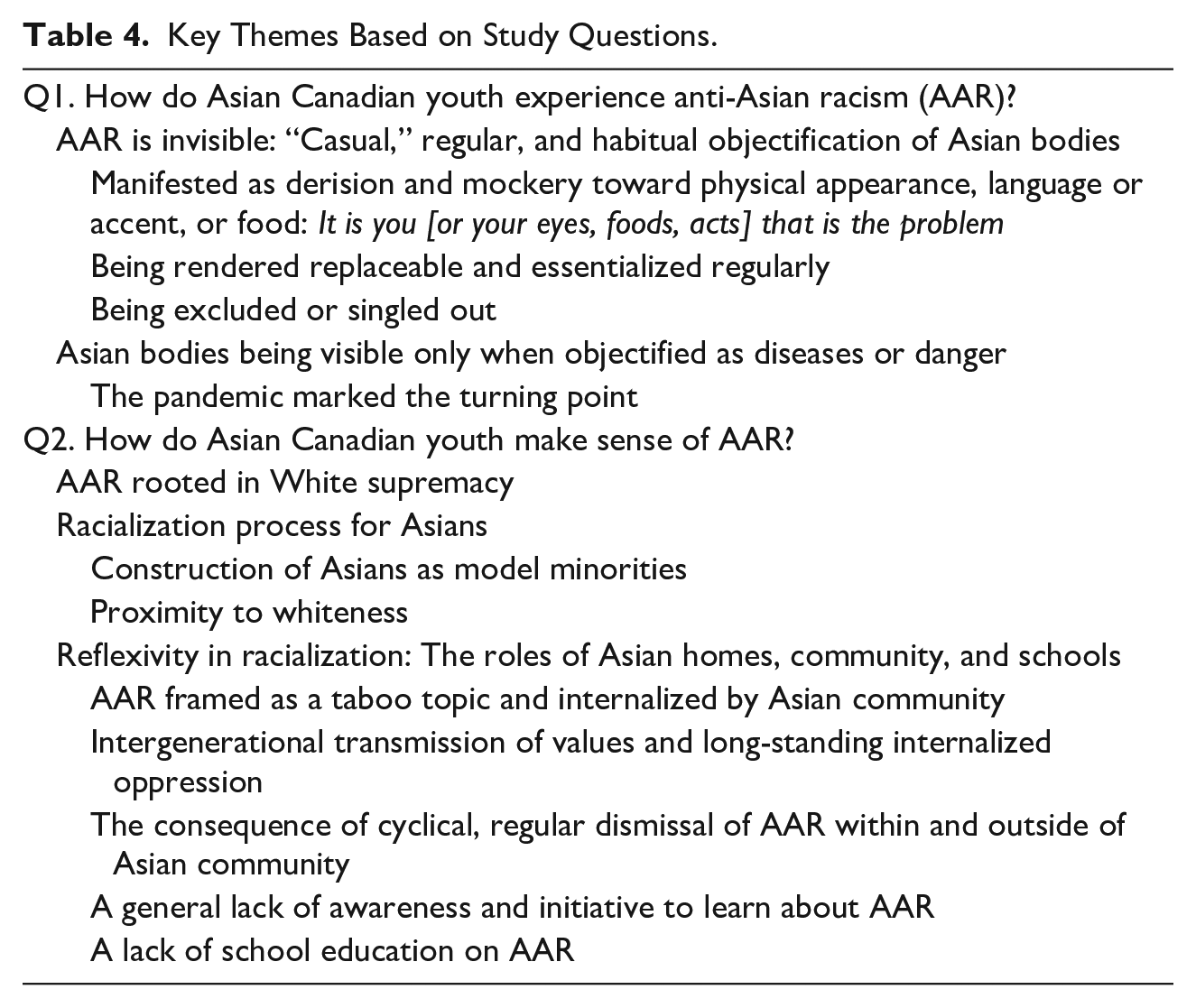
Study themes were presented in Table 4. Our first research question concerns participants’ experience with AAR. The main theme arose around the negotiation between the invisibility and visibility of AAR. Youth characterized their encounters with AAR as a “casual” occurrence that is often manifested through microaggressions and discriminatory attitudes, thus unnoticed and unvoiced. While commonplace and pervasive, their experiences of AAR, including the felt sense of AAR and its impacts on them and Asian Canadian communities, became visible during the pandemic.
Key Themes Based on Study Questions.
Invisible Anti-Asian Racism: “Casual” Objectification of Asian Bodies
Several youth named the habitual form of AAR as “casual racism.” They described these forms of AAR such as hearing jokes about their food, eyes, or language, being stereotyped or mixed up with other Asians, and being singled out from their peers. These incidents occurred as early as elementary school. For example, one of the most common experiences shared by youth involved offhand remarks about their school lunches. Participant 5 (20 y.o.) stated: I used to like bring like dim sum or like some those food to school and a lot of people would be like my food smells, and look weird. I think that used to make me hyper aware of the dishes that my parents would make.
These incidents impacted their choice of food, and consequently, youth would avoid eating lunch due to fear of being judged. A few participants also recalled their parents making conscious attempts to help by packing foods that are “less traditional.”
Many participants also recounted mockery about their Asian features and physical traits, such as their eyes, in the school setting, an environment where stereotypes about Asian students are actively perpetuated: “I remember that vividly being a memory in class. People would like joke about it, and like oh, if you slant [eyes] up, you’re Chinese, if you slant [eyes] down, you’re Japanese or Korean or whatever” (Participant 25, 18 y.o.). In another example, Participant 36 (18 y.o.) shared an incident that was perpetrated by a teacher in an art class: one time, we had to do the self-portrait of ourselves, and I was like drawing my face and then she came up to me and she was like, oh your eyes are too big, like this is Caucasian eyes, and this is not your eyes. And she grabbed the pencil and drew a line across my eyes and just like oh that’s your size.
AAR is also manifested as derision and mockery toward language or accent. For example, Participant 8 (20 y.o.) described an experience at summer camp when other White-passing campers mocked Cantonese—the language she spoke at home—as “weird,” “not a real thing,” and “gibberish.”
These excerpts highlight a process of how one becomes an outsider to one’s own body (i.e., objectifying one’s body) and how external and internalized racism restricts one’s daily existence. Imagine youth having to pay attention to how their eyes are shaped, the choice of foods they are taking for lunch, ways they say things, activities they do, and so on, at the risk of subjection to being corrected, disciplined, and/or even punished (Foucault, 1980). To avoid notice, correction, or ridicule, youth have to re-pack their lunch, re-draw their self-portrait, and re-think the language they speak. This series of self-monitoring, questioning, and correcting falls within Fanon’s (1952/2008) description of experience under the White gaze that transforms racialized others’ existence: the White gaze reduces racialized others’ subjectivity to racist representations within colonial ideology—turning racism into the racialized body as the locus of their being-in-the-world (e.g., It is you [or your eyes, foods, acts] that is the problem) (Song, 2017).
Being objectified also means having little subjective meaning and distinction from one another, thus being rendered replaceable and essentialized. For example, experiences of AAR comprised being mistaken for someone else, being called by the wrong name, having a name mispronounced or misspelled, and having to use a different name to accommodate western pronunciation. Youth characterized these instances as regular and habitual, something they have come to expect and endure as part of the landscape of their daily life.
for the longest time in my life, if I used my Chinese name, it’s kind of - I don’t feel very comfortable with it, because they would just skip it. . . . a lot of people would just call out other people’s names and would just skip me. That’s something I wanted to avoid. . . my name [redacted] was spelled wrong in my high school yearbook, and that made me really, really sad. . .. But even with [the English name], I got called Angela, Ashley, and I got mixed up with other Asian girls in class at high school, and at [university]. (Participant 31, 23 y.o.)
Here, this participant articulates being made invisible through the mistreatment of either her Chinese or English name and yet objectified as an Asian body that has little individual agency to be one’s own self different from other Asian girls. Altogether, Asians are invisible and essentialized.
Even the term invisibility, we argue, is a misnomer since AAR is invisible to the White gaze yet so visible to a point that is degrading and violent for Asian youth. For example, some participants reported being called names and racial slurs that were highly noticeable to them. These were continuous, “casual” experiences that occurred on a regular basis. For example, Participant 34 (17 y.o.) said, “At my old school, I got name called. And I really didn’t like it, because, um, it would keep happening, always happening. The person who did it would not stop even when I told them many times to stop.”
Among other instances of insidious racism, youth reported being excluded or singled out in school settings based on their Asian identity, and experiencing differential treatment from coworkers, peers, or teachers. For example, Participant 35 (16 y.o.) said, “the popular kids, they were mainly Caucasian, and they wouldn’t like to hang out with us. Because like, we were a different. . . we weren’t Caucasian, . . . and we weren’t cool.” The subtlety of being singled out left youth questioning whether their racial identity was at the root of these incidents. “I don’t know if it was because I’m Asian, or if I’m Chinese, she would never talk to me. She would look annoyed if I talked to her. But when she’s talking to others. . ., it was nothing like that” (Participant 27, 22 y.o.). Thus, the White gaze falls upon the psyche of racialized individuals and redefines who they are from outside (Fanon, 1956/1986; Foucault, 1980).
Asian Bodies Being Visible Only When Objectified as Diseases or Danger
The pandemic marked the turning point of many participants’ experiences with AAR. The virus’s emergence in China fueled the rise of violence and racist rhetoric perpetrated against people of Asian descent, which youth observed both in person and online. As Participant 35 (16 y.o.) stated, “everyone started to blame Asians for the virus.” During the pandemic, many participants had firsthand experiences with AAR, in forms of explicit physical and verbal aggression, or witnessed it perpetrated against Asian people they know, and these incidents happened in public spaces, their neighborhood, school, or online. Participant 9 (22 y.o.) explicitly noted how disgusting it was to be a receiver of racist remarks as follows: “During the pandemic, some White guy told me I killed more people than the Holocaust, and that ‘I ate bats’ or whatever.” Participant 31 (23 y.o.), who was born and raised in Canada, was told to “go back to where you came from” and was shouted with “you brought the virus here” when postering for a COVID vaccine pop up clinic.
Here, we see a colonial racial schema in place—a longstanding theme of locating racialized bodies as a site of disease and thus danger as noted in earlier discourse of yellow peril as risk and fear (Pfaelzer, 2008). The common note around statements like “you should go back” also reflects the ongoing struggle of racialized bodies figured as forever foreigners to maintain a sense of belonging in their own country (C. J. Kim, 1999; Tuan, 1998).
In summary, prior to the pandemic, AAR was pervasive but mostly invisible to youth themselves and the larger society, thus making it challenging to identify, declare, and problematize its existence and combat against it. Participant 9 (22 y.o.) said, “looking back, I can realize that there are lots of racist things that happened in the context that I grew up in—I just didn’t read it as that.” Youth explained that while these incidents “happen more than you would think” (Participant 25, 18 y.o.), they did not register as racism because these incidents were not perceived as explicitly violent or aggressive and were easily “swept under the rug.” Many youth doubted and questioned whether their experiences could classify as racism, thus making AAR invisible. Participant 21 (19 y.o.) concluded, “Compare it with other brands of racism, and I think it’s very sneaky in the way that it goes about affecting people. It goes under the radar and. . . it’s hard to find a community in it.”
White Supremacy and the Racialization Process for Asians
Our second research question concerns youth perspectives on how they understand and make sense of AAR. Many participants noted how increased violent incidents of AAR and the related news coverage on the subject sparked their awareness and renewed reflection on the topic, thus shaking racial orders that they have internalized. With their heightened awareness of AAR, youth touched on (1) what they thought as the origin of AAR—that is White supremacy—and (2) what contributed to the ongoing racial discrimination and racism towards Asians—that is a racialization process, such as the impact of model minority myth and racial hierarchy of Asians’ proximity to Whiteness.
Some youth named White supremacy as the root cause of anti-Asian racism and the overarching problem. A youth said, “if you think about it all this racism that we face is because of White supremacy! . . .. ‘Oh, I don’t know why I feel so bad being Asian.’ It’s because Whiteness is the standard and the norm” (Participant 14, 20 y.o.). In youth’s view, identifying as “White” signifies power and superiority. For example, Participant 9 (22 y.o.) stated, “especially for people who identify as White, Whiteness—to me—is more of a signifier of power instead of anything to do with a background.” They recognize that White supremacy is reflected in some groups having more privileges than other racial groups, as those who are White do not need to face racism like others. Thus, youth explicitly challenged the norm of White supremacy.
Several youth also noted the model minority myth as a source of their racialization process. A participant defined the model minority as such: There’s an impression that all Asians are docile and submissive. We are great students at school, and we have some great achievements in this society. But it was the same. . . smooth and quiet sort of. . .like we never make a big deal. It’s a very standard way of life. (Participant 29, 22 y.o.)
This participant further articulated how the model minority myth played a role in objectifying the Asian community and reduced Asians to merely “tools that add value in the society.” Relating it to women’s objectification, they stated, “When a community is objectified enough, it became okay to treat them badly,” echoing similar dynamics to Fanon’s description of the process of racialization.
Some youth revealed the damaging effect of the model minority myth while discussing the lack of collective action against racism in the Asian community, particularly in comparison to the Black community. Participant 21 (19 y.o.) said, “I surround myself with [those who] are very vocal about the Black Lives Matter movement and doing what we can to help with those issues. . .. Then, when it comes to anti-Asian racism, we were like, don’t talk about it.” Participant 21 interpreted how the model minority myth may have impacted Asians to endure racism while keeping the status quo around the racial order: “Culturally we don’t want to make trouble, or we are under the impression that we are so privileged already that we shouldn’t be complaining anymore about other things.” Another youth also said, It drives such a wedge between the Asian community and the Black and the Indigenous communities. It makes people think that we’re like the closest race to being White, which is very harmful. Then people are like, “Oh, you don’t need anti-Asian hate programs, they don’t need assistance” or stuff like that. (Participant 1, 17 y.o.)
Youth suggested that such a myth incites anti-Asian hate in other racialized groups and creates a false impression that Asians are unaffected by racism.
An associated theme related to the model minority myth is Asians’ “proximity to Whiteness,” a term coined by Participant 14 (20 y.o.). Youth indicated that those who identify as Asian can benefit from their proximity to Whiteness in terms of skin complexion, social mobility, and general socioeconomic status. Participant 27 (22 y.o.) said, “even if there’s [a] history of oppression, it wasn’t highlighted or seen. . . Some people would tell me Asians are the second most-privileged group to White people.”
Youth also shared that they may not recognize their attempts to be in closer proximity to Whiteness. At a young age, they have disconnected from their Asian culture to appeal to western culture. Referring to their childhood days going to Chinese school on Saturdays, Participant 21 (19 y.o.) said: I remember all those little Chinese kids learning Chinese on Saturday. It was cool to not pay attention and to do bad on purpose. That was cool. And now I’m thinking about it. . . the reason why it’s cool was because you’re trying. . . to be western.
Both subthemes of the model minority myth and the proximity to Whiteness imply Asians are unaffected by racism and privileged next to White people, thus supporting a post-racism logic that reifies Whiteness (Eng & Han, 2018).
Reflexivity in Racialization: The Roles of Asian Homes, Community, and Schools
Youth shared their reflexive observations around how AAR is framed as a taboo topic and internalized by Asian community, which installs the invisibility of AAR. Difficulty in speaking up about AAR is amplified due to structural barriers such as one’s immigration status and the pressure to assimilate into Canadian society, as well as deploying cultural norms upheld by Asian families. Youth shared that they did not discuss their own experiences of racism with their parents. As Participant 23 (18 y.o.) stated, “[AAR] was always real but it’s something you don’t talk about especially in Asian culture.” Youth recounted that mentions of AAR would be dismissed at home: “oh you know, just brush it off,” “just keep your head down, pretend that didn’t happen,” “don’t stir anything up,” and it’s like. . . why are we still doing that? I think it’s a big issue in the Asian community as well, like just not really speaking up and then feeling like you don’t want to rock the boat. (Participant 14, 20 y.o.)
Several participants observed that the intergenerational transmission of values and long-standing internalized oppression contribute to the challenge of confronting AAR as their parents came as immigrants and had a so-called “immigrant mentality” that is associated with being docile and non-confrontational. Participant 1 (17 y.o.) said, “that’s how, you know, my parents were raised, we come to this country with like no money and you just keep your head down and you just keep working.” These observations highlighted the generational enduring of AAR and how current mis/representations of Asian bodies have been constructed and reinforced.
Several youth delineated how this cyclical, regular dismissal of AAR makes AAR difficult to detect and recognize. Participant 33 (15 y.o.) stated, “I always just felt that was normal. It was kind of normal for people to just tease each other and say those things.” Consequentially, people, Asians included, question if AAR even exists. For example, Participant 3 (18 y.o.) said: I’ve heard like so many times like in school, in like community settings, or like in a workplace where it’s like we’re talking about Asian racism and anti-Asian racism and there’s so many times, where it’s like how do Asians . . . how are [Asians] racialized? Is [anti-Asian racism] even a thing?
These youth explicitly reflected that the dismissal of AAR was itself normalizing Whiteness and mirroring the erasure of Asians’ existence by the White dominant racial order.
Youth also astutely noted that a general lack of awareness and initiative to learn about AAR was related to a disinterest in racial issues outside of one’s own: “I don’t think many people take the initiative to understand another race, culture, or community” (Participant 27, 22 y.o.). Some participants mentioned that racism was perpetrated by Asian communities as well. For example, Participant 20 (22 y.o.) noted that his own family members made racists remarks toward others due to a lack of exposure to other cultures before they moved to Canada and being influenced by dominant racial stereotypes: The people who grew up in Asia, like because they didn’t have that exposure to so many different like other ethnic groups, . . . they either never learned or they weren’t educated or they just like were fed these stereotypes [by] their own family members, so. . . they just kind of jump ship on to the stereotypes and act upon it.
In addition, given that youth in our study experienced AAR as early as elementary school, they cited the lack of school education as one of the underlying causes of racism and worried that the closure of schools during the pandemic worsened the situation. Participant 35 (16 y.o.) said, “because education has stopped. . . They’re more focused about getting educated on their studies, rather than the “non-essential” things like how people call racism and stuff.” This youth critically reflected on a lack of education for anti-racism and how education on AAR has been treated as non-essential compared to academic materials.
Discussion
Although Canada is the first nation that legislated multiculturalism as a national policy, our study with Asian Canadian youth indicates that AAR remains pervasive. Their experiences, though persistent and habitual, are largely invisible in institutional and societal discourse. We argue the tactic of making racism invisible is itself a new, colorblind form of racism (Bonilla-Silva, 2022), upholding White-dominant racial orders and post-race discourse in society. Our data ties in Fanon’s schema and reflects White normativity. Stories from youth show that their experience with AAR tended to be hidden and unrecognized to not only others but, often, themselves. Even when facing overt instances of AAR, youth expressed a sense of confusion, having difficulties to recognize and name their experiences. The ambiguous nature of these encounters becomes the main reason why some youth hesitate to speak up against perpetrators of racism.
COVID-19 served to lift the thin veil on more explicit acts of verbal and physical racial violence toward Asians. Our findings echo Jeong’s (2022) analysis, where Asians are tolerated and permitted as long as it remains in the periphery of the White norm. During a crisis such as the pandemic, Asian bodies become a hypervisible symbol of racialized threat, a violent intrusion to the white-dominated spaces. Notably, we also noticed that the pandemic became an impetus for youth awareness of AAR and motivated youth to reflect on their own experiences. Such reckoning may be a resource for youth to develop resistance, both individually and collectively, in the face of ongoing inequality towards people of color.
Youth’s insight on the attribution of AAR is critical in developing strategies for resisting and dismantling the pervasive impact of racism. In a recent study that used critical discourse analysis of tweets with the #VeryAsian hashtag, Oh (2023) found the lack of explicit anti-racist critiques while pursuing pan-ethnic pride as Asian Americans and questioned if it is partly due to internalized White racial logic where one is willfully negligent to seeing structural racism and assuming its demise. Contrary to Oh’s findings, youth in our study explicitly attributed AAR to structural, community, and family level causes, naming White supremacy as the key contributing factor. Model minority, in which Asians are figured as exemplary as long as they are not questioning and disturbing the status quo but staying proximal to White norms, is a socially constructed imagination and serves as a site for reifying Whiteness. Youth participants not only were aware of the harmful impact of the model minority myth, as it functioned to mask AAR and is a source of division between Asians and other people of color, but they also discussed “proximity to Whiteness” as a by-product of the model minority narrative. Similar to the connotation of “honorary Whites” (P. Lee, 2020; Tuan, 1998), proximity to Whiteness discourse implies that racial oppression can be overcome through assimilation and serves to hinder the struggle of Asians against White hegemony.
The “do not rock the boat” stance in Asian homes and community, as observed by youth participants, points to the future direction of assessing how the collectivist Asian cultural value that promotes social harmony and respect of authority (B. S. K. Kim et al., 2001), coupled with the sense of precariousness deep in immigrant community’s psyche (Cheng & Chang, 2021), may not only weaken the development of community voice but also be deployed to condone and maintain racism against Asians. AAR being a taboo topic in Asian homes and the lack of education and awareness around AAR both within and outside the Asian community mirror the impacts of pervasive Whiteness on racialized communities, interfering with community support and disenabling meaningful dialogues that can resist and combat AAR.
Noteworthy is how youth’s awareness of these attributes is an important element for critical consciousness, which can pave the way for civic engagement and social action against racism, and for taking an active stance to advocate and advance a social justice agenda (Aldana et al., 2019). Youth named the racialization process that takes place in family, peer interactions and school, which constitute some of their most immediate contexts. Their reflections highlight the role that family and school can play in raising awareness about AAR and creating a positive environment for youth to have dialogues on race and racism. There have been emerging efforts to support Asian parents with knowledges and skills in supporting their children, such as the resource guide created by William James College (2020). To continue developing Asian-centered resources for Asian parents, community-based participatory approaches that meaningfully engage, enable, and empower parents to reflect on their needs and to envision and create resources needed for parents to discuss race and racism at Asian homes may be particularly suitable as the most powerful changes come from within the community. As for school settings, where there have been attempts to develop resources for teachers (e.g., E. Chen et al., 2021), we would like to see educators to discuss AAR in the regular curriculum, incorporating the historical context of AAR in Canada and the contemporary issues related to AAR, as well as developing a learning environment that is conducive to addressing and resisting different forms of oppression and supporting allyship.
Study limitations. While generalizability is not an expected objective for this qualitative research, we wish to highlight a few limitations within the study sample and setting to contextualize our findings and to inform future research on AAR in Canada. First, our work was built on community engagement where our community partner in the GTA assisted with participant recruitment. Although the study benefited from a meaningful community engagement, study findings are limited to perspectives of Asian Canadian youth who reside in metropolitan areas, where the majority of Asians in Canada reside (Statistics Canada, 2022b). Future studies may want to explore and unpack the experiences of Asian youth who live in non-urban areas that have a smaller Asian population. As well, most of study participants identified themselves as ethnic Chinese, and therefore we knew less about how AAR is perceived and experienced by other communities. Despite that ethnic Chinese is one of the largest Asian groups in Canada (Statistics Canada, 2022a) with the highest relative risk of being discriminated among all Asian groups in Canada (Statistics Canada, 2022c), it would be important for future studies to further understand experiences with AAR with other ethnic groups given the heterogeneity within the Asian community. In addition, most study youth identified themselves as women, thus we lacked the perspectives from other genders. The over-representation of women is common in qualitative research (Polit & Beck, 2008). Although semi-structured interviews has been the standard for qualitative research, Affleck et al. (2013) indicate that long interviews may not be suitable for male participants on topics that are difficult to discuss or emotionally sensitive, and they suggest that investigators should consider other creative methods when working with men. Incorporating these methods may encourage the participation of other genders and allow an intersectional analysis. Lastly, it was challenging to recruit younger youth, despite multiple attempts. While young people notice both overt and covert discriminations in early adolescence (Killen et al., 2016; Spears Brown & Bigler, 2005), they have more sophisticated and independent understanding of racial identity and the implications of stereotypes and racism by late adolescence (Quintana & McKown, 2008; Umaña-Taylor et al., 2014). Future research should consider developing approaches to meaningfully engage youth in the early adolescence to speak about racism.
Limitations notwithstanding, this study contributes to amplifying the voices of Asian Canadian youth from different developmental stages. Racism is historically and geopolitically situated, imagined, and embodied in individual, institutional, and structural levels (Sussman, 2014; Trent et al., 2019). Using Fanon’s racial epidermal schema, the study exposes the White normativity behind the in/visibility of AAR and highlights structural, community, and family factors that serve to in/visibilize AAR. The critical consciousness youth displayed in the study will enable the de-racialization and establishment of subjective racial consciousness which challenges the White gaze.
Footnotes
Acknowledgements
The authors would like to express their sincere gratitude to Hong Fook Mental Health Association and its Youth Advisory Committee for their guidance and support throughout the process of this study. The authors would also like to thank Emma Chea for co-facilitating focus groups for this study. Our heartfelt appreciation is extended to Asian youth who generously participated in the study and shared with us their experiences and insights.
Correction (February 2024)-
The “acknowledgment” section is included to this article.
Data Availability Statement
Full dataset is not available as study participants did not give consent for their full interviews to be shared outside of the research team, and due to the sensitive nature of the research.
Declaration of Conflicting Interests
The author(s) declared no potential conflicts of interest with respect to the research, authorship, and/or publication of this article.
Funding
The author(s) disclosed receipt of the following financial support for the research, authorship, and/or publication of this article: The study was supported by the Richard B. Splane Applied Social Policy and Social Innovation Fund, Faculty Research Grants, Factor-Inwentash Faculty of Social Work, University of Toronto.
