




Abstract
Sustainable Development Goal 5 challenges governments to address child marriage, which may inhibit girls from developing an agentic self. This paper assesses the direct influence of community gender norms on adolescent agency, and the normative contexts in which gender gaps in adolescent agency are larger or smaller in Nepal. Using baseline data for adolescent girls, adolescent boys, and adults in 54 clusters participating in the CARE Tipping Point Trial, multilevel analysis tested whether: adolescent boys had higher agency than girls; and community gender norms among adults partly accounted for or modified gender gaps in adolescent agency. Gender gaps in agency disfavoring girls were common. Community gender norms were more positively associated with intrinsic agency among girls than boys, and more negatively associated with instrumental and collective agency among girls than boys. Enhancing girls’ agency while promoting gender-equitable community norms may empower girls’ transition to adulthood.
Keywords
Introduction
Gender equality and women’s empowerment have been part of global development agendas for decades (Sachs & McArthur, 2005; Weiland et al., 2021). Despite trends toward reduced gender gaps in domains like education and health (World Economic Forum, 2021), outcomes remain worse for women and girls than for men and boys in other domains, including the transition to marriage (Gastón et al., 2019). The prevalence of child marriage before age 18 is almost five times higher for women (21.2%) than men (4.5%) 20 to 24 years, and the average annual rate of decline has been six times faster for men (3.0%) than women (0.5%; Gastón et al., 2019). Child marriage for adolescent girls contributes to adverse outcomes into adulthood, including reduced marital empowerment (Yount et al., 2018), higher risks of partner violence (Kidman, 2017; Yount et al., 2016), and poorer health (Raj et al., 2018). Sustainable Development Goal 5 challenges governments to close gender inequalities in childhood and adolescence, including for harmful practices, like child, early, and forced marriage (CEFM; United Nations, 2015).
Feminist critics have argued that gender-equality targets may not be realized for two reasons (Kabeer, 2005). First, “cultural or ideological norms may deny either that inequalities of power exist or that such inequalities are unjust” (Kabeer, 2005, p. 14). Second, repressive gender norms restrict girls’ choices, their development of agentic selfhood, and their collective capacities during this critical period. Accordingly, the full participation of women and girls in change processes is seen as the only means to realize gender equality (Kabeer, 2005).
This paper focuses on gender gaps in agency among girls and boys 12 to 16 years, a critical risk period for CEFM when girls are developing a sense of self that is related to their capacity for agency (Hansen & Jessop, 2017). The paper tests the direct influence of community gender norms on multiple dimensions of agency in adolescence, and the moderating influence of community gender norms on gender gaps in agency. Data come from the baseline survey of a three-arm, parallel randomized controlled trial of the CARE Tipping Point Initiative in Kapilvastu and Rupandehi districts of Nepal (Yount et al., 2021). The survey measured girls’ intrinsic (power within), instrumental (power to), and collective (power with) agency (Yount et al., 2021), and boys received a subset of these scales, permitting novel comparisons of gender gaps in agency in early-to-mid adolescence. Data on social norms about gender, honor, and CEFM come from independent community samples of adults 25 years or older. Available data on potential multilevel confounders permit a rigorous assessment of the adjusted influence of community gender norms among adults on adolescent agency and gender gaps in adolescent agency in a setting where CEFM remains prevalent (Bergenfeld et al., 2019; Yount et al., 2021). Findings provide insights about the multilevel change processes needed to position adolescent girls for an empowered transition to adulthood.
Background
Agency in Adolescence
Our conceptualization of agency in adolescence is adapted from theories of empowerment (Kabeer, 1999). Empowerment is “the expansion in people’s ability to make strategic life choices in a context where this ability was previously denied. . .” (Kabeer, 1999, p. 437). Empowerment involves the dynamic inter-relationship of resources, agency, and achievements. Resources are the human, material, and social conditions that may expand the opportunities available to exercise choice. Agency is “the ability to define. . .goals and act upon them,” and achievements are the possible outcomes of exercising agency (Kabeer, 1999, p. 438), such as a later age at first marriage.
This paper focuses on multiple dimensions of agency in adolescence, given their centrality for change processes related to transitions to adulthood. Agency in adolescence is conceptualized to have three inter-related dimensions. Intrinsic agency during adolescence involves the development of an expanded sense of control over one’s own life (Bandura, 1989); a critical awareness of one’s rights, capabilities, and aspirations (Freire, 1972); more gender-equitable attitudes (Miedema et al., 2018; Yount et al., 2016); and an internal motivation to secure one’s rights, to cultivate one’s capabilities, and to pursue one’s aspirations (Bandura, 1989; Deci & Ryan, 1985; Ryan & Deci, 2000). Instrumental agency during adolescence reflects the increasing development of one’s authentic and assertive voice (Vagos & Pereira, 2019); influence in salient life-course decisions, and actions “to affect the pattern of outcomes,” despite the pressures of repressive gender norms (Kabeer, 1994, p. 224; Lukes, 1974, p. 15), such as those related to girls’ sexuality, family honor, and marriage (Ghimire & Samuels, 2014a, 2014b; Marcus et al., 2015). Instrumental agency in adolescence also involves enhancing connectedness, trust, and the capacity to negotiate with family members, peers, and community members who support the adolescent’s agency-building process. Collective agency during adolescence involves building solidarity, or mutual support and unity of feeling, in larger more gender-equitable, action-oriented peer networks and groups; fostering participation and leadership in community actions; building girl-centered movements; and fostering community support for gender-norm change (Yount et al., 2021). These forms of agency are co-constitutive and reciprocally causal (Bandura, 2001). They extend Kabeer’s theory of empowerment by integrating concepts from positive youth development (Lerner et al., 2005) and social cognitive theory (Bandura, 2001) related to intrinsic agency (e.g., self-confidence, sense of competence or capacity, and personal values; Geldhof et al., 2015), instrumental agency (e.g., respect-based assertive voice and behavior; Vagos & Pereira, 2019), and trust-based connectedness to supportive members of the family, peer groups, school, and/or community (Geldhof et al., 2015; Lerner et al., 2005).
Gender Gaps in Adolescent Agency
In low- and middle-income countries (LMICs), dimensions of agency have differed for girls and boys during the critical risk period for CEFM (Espinoza Revollo & Portela, 2019). In the Youth Lives cohorts of Ethiopia, India, Peru, and Vietnam, gender gaps in self-efficacy (an aspect of intrinsic agency, as defined above) emerged in late adolescence, widening from ages 15 to 19 years to favor boys (Espinoza Revollo & Portela, 2019). For gender gaps in locus of control (another aspect of intrinsic agency, as defined above), change was more heterogeneous in these cohorts; widening from 12 to 15 years, favoring boys in Ethiopia and India and favoring girls in Peru and Vietnam. However, by age 22 years, the gaps favoring girls closed in Peru and reversed in Vietnam to favor boys. In India, gender gaps in both measures of intrinsic agency were undetectable at age 12 but widened to favor boys throughout the risk period for CEFM (Espinoza Revollo & Portela, 2019). Thus, girls in these cohorts and settings have experienced widening deficits in aspects of intrinsic agency, which may be necessary for other dimensions of agency to emerge (Kabeer, 2005). Despite the above insights, this multi-country study failed to measure instrumental and collective agency in adolescence, which may be critical for transformational change (Kabeer, 2005).
Influence of Repressive Community Gender Norms on Choice and Agency
Social cognitive theorists identify the imposed, selected, and constructed environments as relevant for agency (Bandura, 1997). These environments represent gradients of changeability requiring different scopes and foci of personal agency. Gender-inequitable norms and structural biases are elements of the imposed environment that may constrain choice and agency among women (Kabeer, 2005) and adolescent girls (Berhane et al., 2019). Structural biases have included, for example, marriage laws that perpetuate gender discrimination in the legal ages at marriage for girls and boys and that legitimize the norm of CEFM for girls (Arthur et al., 2018). In more than half (52%) of 191 countries as of 2018, marriage before age 18 years was permissible based on the general minimum age at marriage in civil law, or exceptions to civil law based on religious law, customary law, or the consent of parents or guardians (Arthur et al., 2018).
At the community level, gender norms among powerful constituents may influence adolescents’ perceptions of the choices available to them (Kabeer, 2005), directly influencing all dimensions of their agency. Also, gaps in the dimensions of agency between boys and girls may be larger or smaller, depending on prevailing gender norms in the community. In Nepal, son bias and gendered expectations of girls and boys may reinforce girls’ lower status and domestic responsibilities (Marcus et al., 2015). Boys are widely expected to provide for their parents, wives and children; whereas, girls are expected to maintain family honor through hard work, minimal interaction with boys and men outside the household, particularly after the onset of menstruation, and service to in-laws (Ghimire & Samuels, 2014a, 2014b). These expectations serve to control a girl’s sexuality, to preserve her and her family’s reputation, and ultimately, to position her for an optimal marriage (Nidal et al., 2016).
In the Young Lives cohorts of adolescents in four countries, urban/rural context mattered for levels of and gender gaps in adolescents’ intrinsic agency (Espinoza Revollo & Portela, 2019). In most cases, rural girls showed the lowest self-efficacy and locus of control across all four countries during the risk periods for CEFM (Espinoza Revollo & Portela, 2019). This study did not examine the influences of direct measures of community gender norms, which could inform the content of multilevel programs beyond the locales where girls are most at risk. An important question, therefore, is whether multiple dimensions of agency during adolescence, and gender gaps therein, vary across communities in which less and more gender-equitable norms prevail among adults. A focus on community gender norms among adults is relevant, given the power that parents and guardians have in many settings about the decision for girls to marry.
Summary and Hypotheses
Thus, agency in adolescence includes intrinsic, instrumental, and collective dimensions, which reflect felt and enacted capacities to define and to pursue aspirations as individuals and collectives. Proximal contextual factors—like imposed community gender norms among adults—influence the pursuit of these aspirations. Together, these adolescent capacities and proximal contextual factors define bounded agency. Accordingly, the past and imagined future possibilities of adolescent actors, alongside their perceptions of the choices available and gender norms to be negotiated, influence their agency in the present.
This discussion motivates three hypotheses to be tested among adolescents in Nepal. First, adolescent boys will have higher intrinsic, instrumental, and collective agency than girls, overall. Second, the direct influence of community gender norms among adults on adolescent agency will partly account for gender gaps in adolescent agency. Third, gender gaps in adolescent agency will depend on prevailing community gender norms among adults. Specifically, gender gaps in adolescent agency favoring boys will be larger in communities where gender norms are less equitable, and smaller or even reversed in communities where gender norms are more equitable.
Methods
Setting
The study sites were Rupandehi and Kapilvastu districts in Lumbini Province of Western Nepal. Human development in Lumbini Province has been lower than the national average for decades (Institute for Management Research, Radboud University, 2022). In 2019, Lumbini’s lower human development than Nepal manifested in a lower life expectancy at birth (68.8 vs. 69.7), lower schooling attainment for adults 25 years or older (5.0 vs. 5.2 grades), and lower mean gross national income per capita (2,086 vs. 2748 in 2011 purchasing power parity [PPP] United States dollars; Government of Nepal & United Nations Development Program, 2020). Schooling attainment has increased overall in Lumbini province, but gender gaps in attainment favoring men are expected to increase from 0.2 grades (4.9 women; 5.1 men) to nearly 1.0 grade (12.2 women; 13.1 men) due to faster expected gains among boys than girls. Also, despite similar labor force participation rates among women (70.0%) and men (72.1%) 15 years or older, the gender gap in per capita income is high (1,488 for women; 2,751 for men in 2011 PPP US$). The median age at first marriage for women 25 to 49 years is 17.7 years, the third lowest across provinces (Ministry of Health et al., 2017).
Sample
To identify the baseline sample, wards (the lowest governmental administrative unit in Nepal) were combined or segmented to create clusters of roughly 200 households. From this frame, 27 clusters were selected each from Kapilvastu and Rupandehi districts with probability proportional to size. Enumerators mapped and conducted a pre-baseline household census in each selected cluster. Census data were used to generate lists of eligible adolescent girls, adolescent boys, and adults.
Eligible adolescents were never-married girls and boys 12 to 16 years at baseline. For adequate power in the parent trial (Yount et al., 2021), 23 eligible girls and 23 eligible boys were enrolled at baseline in each cluster, for total sample sizes of 1,242 girls and 1,242 boys across clusters. The total required sample size of adult women and men was determined to be 540 (270 women; 270 men; Yount et al., 2021). The final baseline sample on which this analysis is based included 1,134 never-married adolescent girls, 1,154 never-married adolescent boys, and 540 adult community members across all 54 clusters.
Data Collected
The pre-baseline household census collected household-level information on caste/ethnicity, spoken language, religion, occupation of the head, and amenities and resources (Innovations for Poverty Action, 2013), including materials in the walls and roof of the house, presence of kitchen in the residence, cooking and toilet facilities, ownership of agricultural land, and telephone/mobile phones in the household. Data also were collected on each member’s gender, age, marital status, age at marriage, and school enrollment/attainment. The household census took place April 15 to May 31, 2019.
In the baseline survey, 20 modules captured five constructs related to intrinsic agency, instrumental agency, collective agency, social networks and norms, and discrimination and violence as a barrier to change (Yount et al., 2021). Adolescent girls received all modules except the one pertaining to discrimination and violence. Adolescent boys received 16 modules, and community adults received five modules (Yount et al., 2021). Similarity of the modules across samples facilitated comparisons. Survey data were collected June 10 to July 9, 2019.
Outcome Measures: Agency in Adolescence
Intrinsic agency
Five summative scales were developed to measure intrinsic agency (Yount et al., 2021). For SRH (Sexual and Reproductive Health) knowledge, six items, each scored 0 (incorrect) or 1 (correct), were summed to have a theoretical range of 0 to 6. An example item was “A woman can get pregnant the first time she has sexual intercourse.” SRH attitudes were captured using four items, each scored 0 (fully agree), 1 (partly agree), 2 (partly disagree), or 3 (fully disagree) and reverse-coded, as needed, to have a more agentic valence. An example item was “A mother can discuss menstruation with her daughter.” The summative scale had a theoretical range of 0 to 12. Attitudes about gender were captured using nine items, each scored 0 (fully agree) to 3 (fully disagree) and reverse coded, as needed, to have a more agentic valence. An example item was “A woman must have a husband or sons or some other male kinsman to protect her.” The summative scale had a theoretical range of 0 to 27. Aspirations about marriage and education were measured using seven items. Four items were scored 0 (when she/he reaches puberty, after completing his/her study, after she/he started to earn money, when the parents decide) or 1 (after she/he is 20 years of age). Two items were scored 1 (yes) or 0 (no), and one item for desired educational level was scored 1 (grade 10), 2 (grade 12), 3 (college), and 4 (master’s degree or above). An example item was “When do you think is the best time to have guana?” The summative scale had a theoretical range of 1 to 10. For self-efficacy, 11 items scored 0 (not at all confident), 1 (somewhat confident), or 2 (very confident), were summed to have a theoretical range of 0 to 22. An example item was “You can achieve the goals in your life, despite challenges.”
Instrumental agency
Two summative scales were developed to measure instrumental agency (Yount et al., 2021). Communication and negotiation with parents was measured using six items, scored 0 (fully disagree) to 3 (fully agree) and summed to have a theoretical range of 0 to 16. An example item was “I am willing to listen to my parent/guardian’s opinions.” Leadership competence was measured using nine items, scored 0 (fully disagree) to 3 (fully agree). An example item was “I am often a leader in groups.” The summative scale had a theoretical range of 0 to 27.
Collective agency
Three summative scales were developed to measure collective agency. For group membership, nine items scored 0 (not involved), 1 (yes, member), or 2 (yes, leader) were summed to have a theoretical range of 0 to 18. An example item was “social or cultural organization club or association?” For cohesion, solidarity, and mobilization skills, five items scored 0 (fully disagree) to 3 (fully agree) were summed to have a theoretical range of 0 to 15. An example item was “Girls and others in your community could prevent child marriage.” For participation in events four items scored 0 (no) or 1 (yes) were summed to have a theoretical range 0 to 4. An example item was “In the past 12 months, have you spoken out in public about a problem that affects someone else?”
Exposure Measure: Community-Level Gender Norms
Community-level gender norms (hereafter also “norms”) were measured by computing the cluster-level mean summative score for responses to 16 items among adults in each cluster. Each item was coded 0 (fully agree) to 3 (fully disagree), or reverse coded to ensure a more gender-equitable valence across items. An example item was “Most people in my village will approve if a married woman goes out of house to work.” Items were summed for each adult and averaged across all adults in each cluster to capture cluster (community-level) gender norms. Higher average scores indicated more gender equitable norms among adults in the cluster.
Control Measures
Individual-level control measures included age in completed years (Espinoza Revollo & Portela, 2019), grades of schooling, literacy (read and/or write, neither [reference]), vocational training (yes, no [reference]), religion (Hinduism, Muslim and other [reference]), caste (advantaged, disadvantaged [reference]), and household poverty level (Espinoza Revollo & Portela, 2019). Household poverty was measured using eight items from the Nepal 2010 Poverty Probability Index (PPI; Innovations for Poverty Action, 2013). Items included the male head’s/spouse’s job type worked the most hours in the past seven days, number of bedrooms in the residence, main construction material of outside walls and roof, in-home amenities (type of stove mainly used for cooking; type of toilet used; number of telephone sets/cordless/mobile owned), household ownership of agricultural land (own, sharecrop-in, mortgage-in) and, if yes, whether irrigated. Variably scored items were summed to have a theoretical range of 0 to 61. This scale was inversely proportional, such that a higher score represented a lower poverty likelihood and a score of 25 or below indicated a high poverty likelihood.
Community-level control measures included the cluster-level proportion of households from an advantaged caste, proportion of households being Muslim, average household PPI score, mean grades completed for women 25 years or older, and gender gap in mean grades completed for adults 25 years or older (men’s mean grades–women’s mean grades). These measures were computed using data from the pre-baseline household census, so measures reflect the average for the entire population of households or adults 25 years or older in each cluster.
Analysis
We first performed univariate analysis to assess the distribution and missingness of individual items that comprised each agency- and gender-norms scale. Second, we computed alpha reliabilities for each agency-related item set for girls and boys separately and for the gender-norms item set for women and men separately and all adults combined. Third, we computed summative scores for each agency scale for all adolescents and a summative score for the community-gender-norms scale for all adults 25 years or older in the sample. Fourth, we compared the demographic characteristics and mean agency scores for girls and boys, using a t-test for continuous measures and a χ2 test for categorical variables. Standard errors and p-values accounted for the stratified, multistage, cluster-sample design.
Fifth, we assessed the means, ranges, and Pearson pairwise correlations for all community- (cluster-) level characteristics. High correlations would indicate potential multicollinearity among community-level variables, for consideration in the estimation of multivariate models.
Finally, we estimated multilevel linear regression models to assess whether any unadjusted gender gaps in measures of adolescent agency (hypothesis 1) were accounted for by variation in community-level gender norms, adjusted for individual-level characteristics, community-level characteristics, and district (hypothesis 2). To address hypothesis 3, concerning moderation of the adolescent gender gap in agency by community gender norms, we added to each model a cross-level interaction between adolescent gender and the mean adult community gender norms. All differences reported were marginally significant (p < .10) or significant (p < .05). All analyses were performed using SAS Version 9.4 (SAS Institute Inc., 2016).
Results
Characteristics of Adolescent Girls and Boys
At baseline, girls and boys in the sample were almost 14 years old, on average (Table 1). Boys could read or read and write more often than could girls (94% vs. 91.7%). Over 94% of boys and girls had ever attended school. Girls more often than boys had attended government schools (72.4% vs. 65.5%); whereas, boys more often than girls had attended private schools (27.7% vs. 19.8%). Although girls and boys had completed a similar number of grades of schooling (6.0 vs. 5.8), girls were still attending schooling less often than were boys (80.0% vs. 84.6%) and had received vocational training more often (5.9% vs. 4.2%). Boys came from Muslim households marginally more often than did girls (10.7% vs. 8.2%); whereas, girls came from Hindu, Buddhist, or Christian households marginally more often than did boys (91.3% vs. 89.2%). Boys, more often than girls, were living in households from disadvantaged or Dalit castes (26.1% vs. 23.6%). Household PPI scores for girls (40.3) and boys (41.6) indicated high levels of poverty.
Demographics for Unmarried Boys and Unmarried Girls 12 to 16 Years, Kapilvastu and Rupandehi Districts, Nepal, 2019 (N = 2,288).
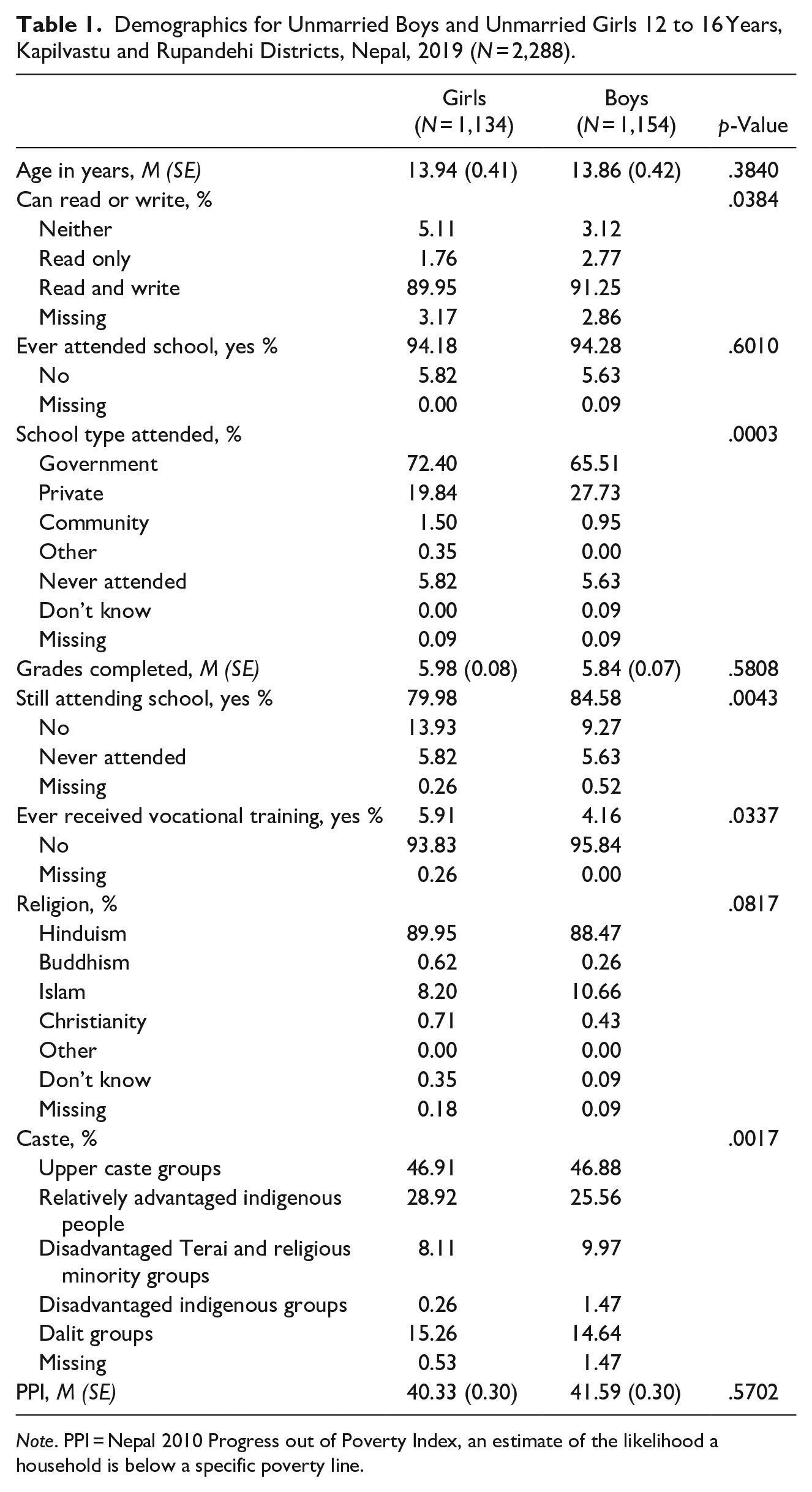
Note. PPI = Nepal 2010 Progress out of Poverty Index, an estimate of the likelihood a household is below a specific poverty line.
Agency of Adolescent Girls and Boys
Except for low alpha reliabilities for two agency scores (SRH attitudes for girls at .55; group membership for boys at .46), all alpha levels were adequate (.60–.79) or good (≥.80) for girls and boys (Table 2). Mean scores for most dimensions of agency were lower for girls than boys (Table 2). Compared to boys, girls reported a similar mean level of SRH knowledge (2.94 vs. 3.07), more equitable mean attitudes about SRH (7.70 vs. 6.04) and gender (13.59 vs. 12.44), lower mean aspirations for marriage and education (5.72 vs. 6.11), and lower mean self-efficacy (12.94 vs. 13.37). Girls reported a lower mean ability than boys to communicate and negotiate with parents (15.50 vs. 16.57) and lower mean leadership competence (15.83 vs. 18.81). Compared to boys, girls reported a similar mean skill level in building cohesion, solidarity, and mobilization (11.02 vs. 11.01) but a lower mean group membership (0.44 vs. 0.72) and lower mean participation in community events (0.06 vs. 0.17).
Agency Outcomes for Never-Married Adolescent Girls and Boys 12 to 16 Years, Kapilvastu and Rupandehi Districts, Nepal, 2019.
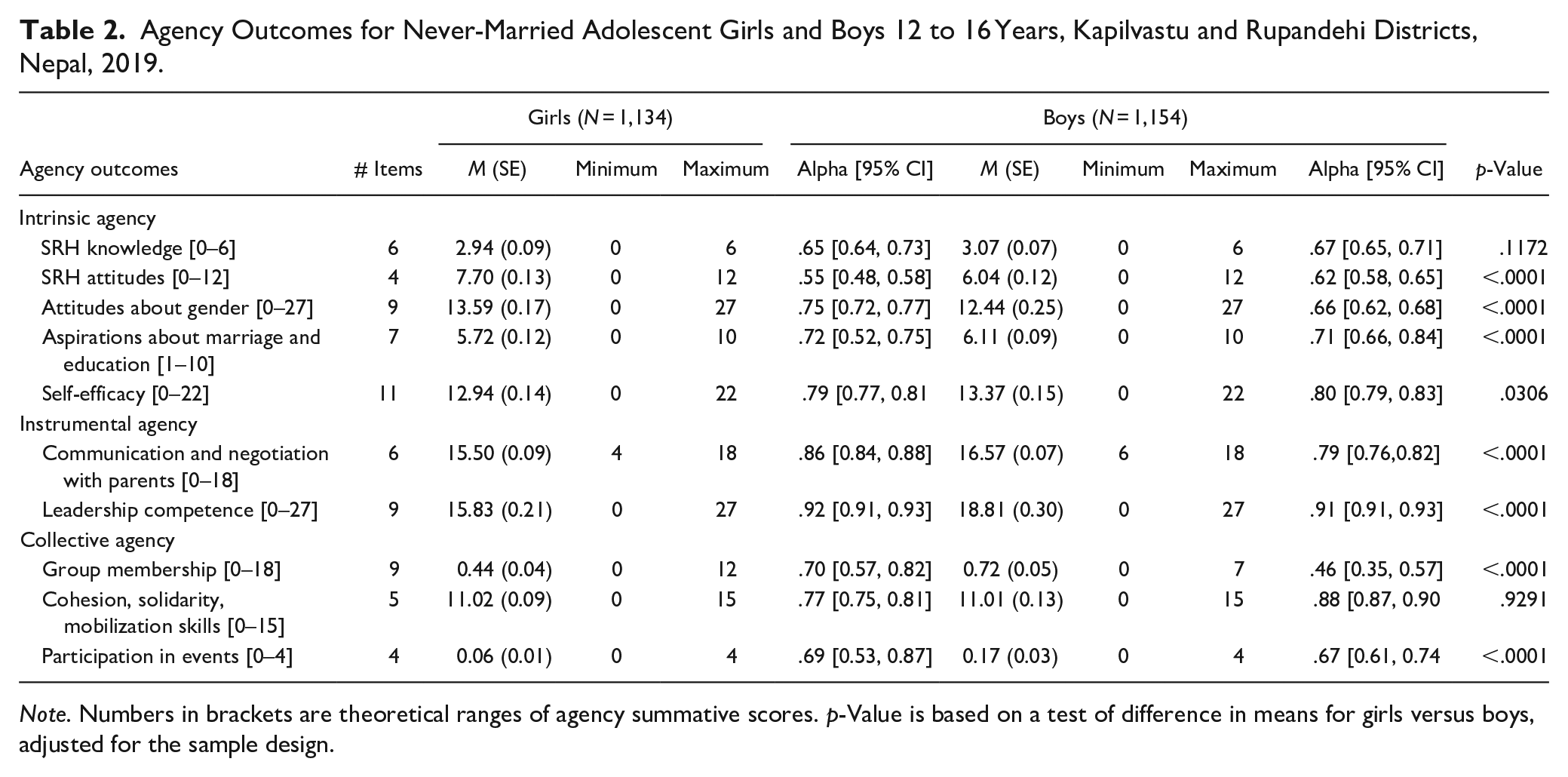
Note. Numbers in brackets are theoretical ranges of agency summative scores. p-Value is based on a test of difference in means for girls versus boys, adjusted for the sample design.
Community Gender Norms and Characteristics
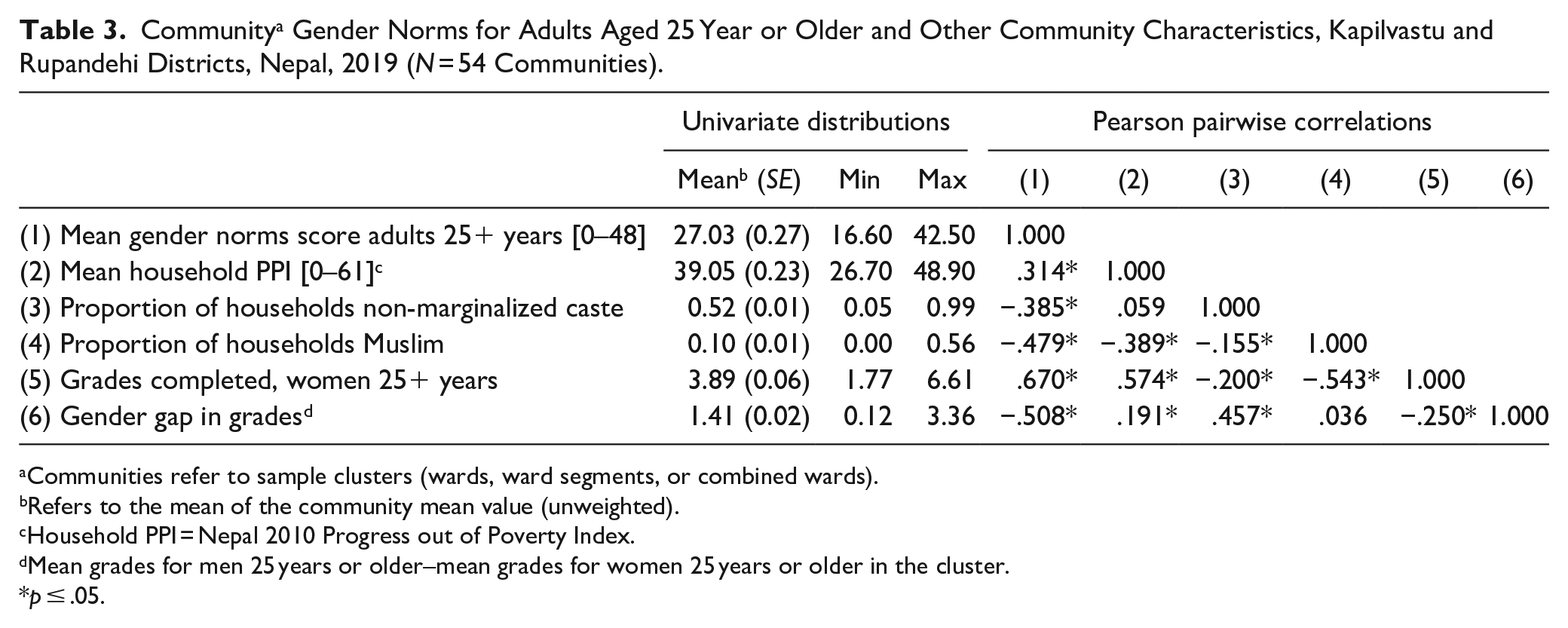
The average mean community-gender-norms score among adults was 27.0; however, this mean varied across communities from much less gender equitable (16.6) to much more gender equitable (42.5; Table 3). (Alpha reliabilities at the individual-level were good: .92 for women, .86 for men, .91 for all adults). Communities generally were poor (mean household PPI score 39.1, range 26.7–48.9). The mean proportion of households in the community from marginalized castes was 0.52 (range 0.05–0.99), and the mean proportion of households in the community that were Muslim was 0.10 (range 0.00–0.56). The community mean grades of schooling was low among women 25 years or older (3.89 grades, range 1.77–6.61), and was 1.41 grades higher among same-aged men (range 0.12–3.36 grades higher).
Community a Gender Norms for Adults Aged 25 Year or Older and Other Community Characteristics, Kapilvastu and Rupandehi Districts, Nepal, 2019 (N = 54 Communities).
Communities refer to sample clusters (wards, ward segments, or combined wards).
Refers to the mean of the community mean value (unweighted).
Household PPI = Nepal 2010 Progress out of Poverty Index.
Mean grades for men 25 years or older–mean grades for women 25 years or older in the cluster.
p ≤ .05.
Pearson pairwise correlations between community-level characteristics ranged from −0.54 (between adult women’s completed grades and the proportion of households Muslim) to 0.67 (between adult women’s mean completed grades and the mean community gender norm score; Table 3). All correlations were significant at p < .05 except two (between the mean household PPI and the proportion of households from a marginalized caste; and the gender gap in completed grades and the proportion of households that were Muslim).
Multilevel Analysis Results
Table 4 presents results for the primary explanatory variables—adolescent gender and community gender norms—from multilevel models for agency-related outcomes (Supplemental Tables 1–3 provide full results). Interactions between adolescent gender and the mean community gender norm (at specific values for other covariates) are presented in Supplemental Figure 1.
Linear Multilevel Models of the Associations of Adolescent Gender, Mean Community-Level Gender Norms (CGN), and Gender-by-Norm Interactions with Adolescent Intrinsic, Instrumental, and Collective Agency Outcomes, Never-Married Adolescent Girls (N = 1,134) and Boys (N = 1,154) Ages 12 to 16 Years in Kapilvastu and Rupandehi Districts, Nepal, 2019.
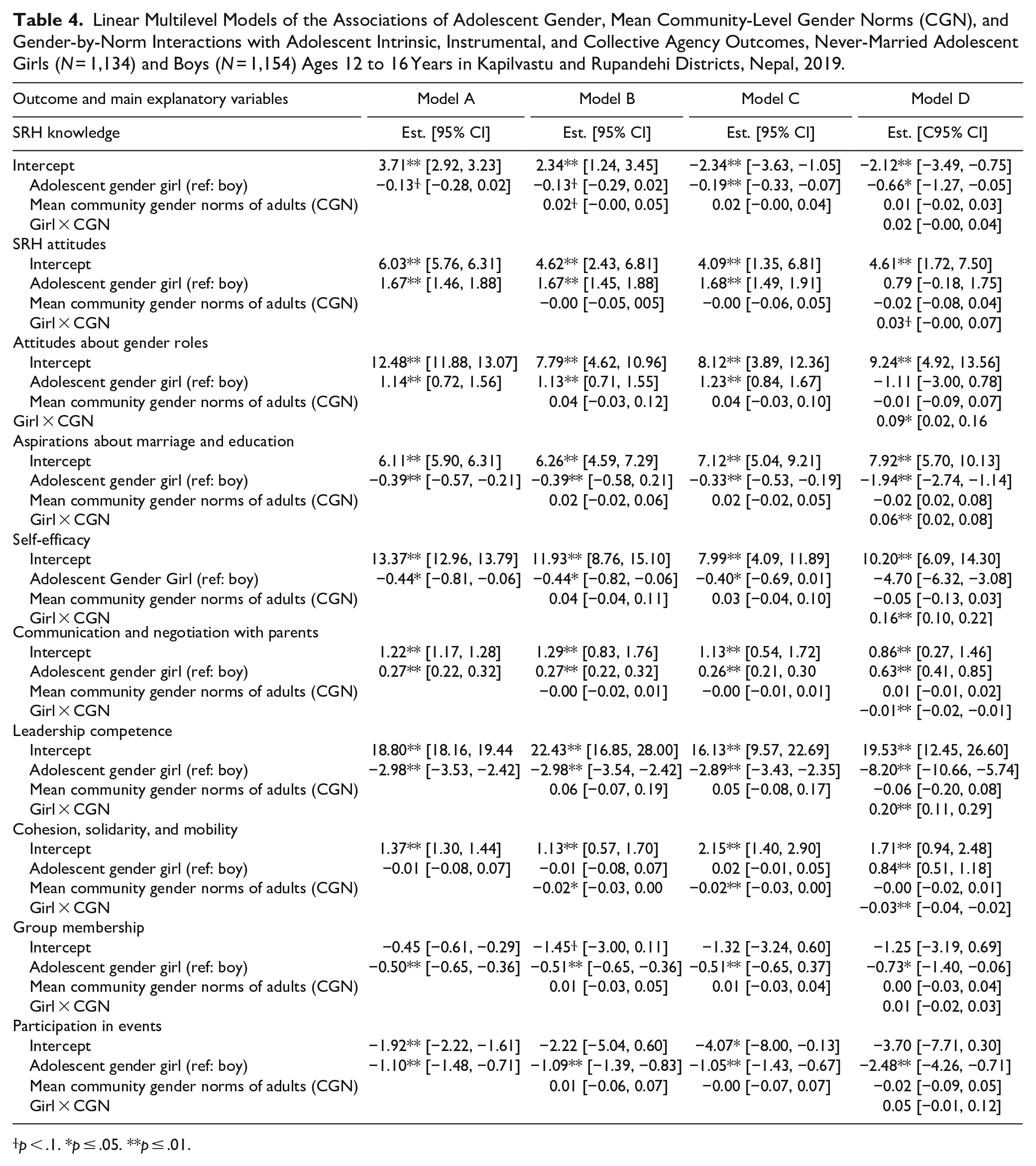
p < .1. *p ≤ .05. **p ≤ .01.
Intrinsic agency outcomes
Knowledge
Compared to boys, girls had lower SRH knowledge (unadjusted Model A, est. −0.13, p < .10; adjusted Model C, est. −0.19, p < .01). Community gender norms were marginally, positively associated with adolescent SRH knowledge in partially adjusted model B (est. 0.02, p < .10), but this relationship was attenuated and became non-significant in adjusted Model C. The interaction of adolescent gender and community gender norms was not significant (Model D).
Attitudes
Compared to boys, girls had more equitable SRH attitudes (unadjusted Model A est. 1.67, p < .01; adjusted Model C est. 1.68, p < .01). Community gender norms were not associated with adolescent SRH attitudes in unadjusted or adjusted models, and its interaction with gender was not significant. Compared to boys, girls also had more equitable attitudes about gender (unadjusted Model A est. 1.14, p < .01; adjusted Model C est. 1.23, p < .01). Community gender norms were not associated with attitudes about gender in unadjusted or adjusted models; however, the norms-by-gender interaction was significant, such that more equitable community gender norms were more strongly positively associated with the gender attitudes of girls than boys (Model D, est. 0.09, p < .05).
Aspirations
Compared to boys, girls had lower aspirations about marriage and education (unadjusted Model A est. −0.39, p < .01; adjusted Model C est. −0.33, p < .01). Community gender norms were not associated with adolescents’ aspirations in unadjusted or adjusted models; however, the norms-by-gender interaction was significant, such that more equitable community gender norms were more strongly positively associated with the aspirations of girls than boys (Model D, est. 0.06, p < .01).
Self-efficacy
Compared to boys, girls had lower self-efficacy (unadjusted Model A est. −0.44, p < .05; adjusted Model C est. −0.40, p < .05). Community gender norms were not associated with adolescents’ self-efficacy in unadjusted or adjusted models; however, the norms-by-gender interaction was significant, such that more equitable community gender norms were more strongly positively associated with the self-efficacy of girls than boys (Model D, est. 0.16, p < .01).
Instrumental agency outcomes
Compared to boys, girls had higher unadjusted and adjusted scores for communication and negotiation with parents (Model A est. 0.27, p < .01; Model C est. 0.26, p < .01). Community gender norms were not associated with adolescents’ scores for communication and negotiation in unadjusted or adjusted models; however, the norms-by-gender interaction was significant, such that more equitable community gender norms were more strongly negatively associated with the communication and negotiation score of girls than boys (Model D, est. −0.01, p < .01).
Compared to boys, girls had lower unadjusted and adjusted scores for leadership competence (Model A est. −2.98, p < .01; Model C est. −2.89, p < .01). Community gender norms were not associated with adolescents’ leadership competence in unadjusted or adjusted models; however, the norms-by-gender interaction was significant, such that more equitable community gender norms were more strongly positively associated with the leadership competence of girls than boys (Model D, est. 0.20, p < .01).
Collective agency outcomes
Adolescent girls and boys had similar unadjusted and adjusted scores for cohesion, solidarity, and mobility (Table 4). Unexpectedly, community gender norms were negatively associated with adolescent cohesion, solidarity, and mobility (Model C, est. −0.02, p < .05), and the norms-by-gender interaction was significant and negative, suggesting that norms were more strongly negatively associated with girls’ than boys’ cohesion, solidarity, and mobility. Compared to boys, girls had lower unadjusted and adjusted group membership scores (Model A, est. −0.50, p < .01; Model C, est. −0.51, p < .01). Community gender norms were not associated with adolescent group membership, and the norms-by-gender interaction was not significant. Finally, compared to boys, girls had lower unadjusted and adjusted scores for participation in events (Model A est. −1.10, p < .01; Model C est. −1.05, p < .01). Community gender norms were not associated with event-participation scores, and the norms-by-gender interaction was not significant.
Influences of other individual and community characteristics
Some patterns of association between other individual and community characteristics and adolescent agency outcomes are notable (Supplemental Table 1). Adolescent’s age had mixed associations with agency outcomes; whereas, adolescent grades completed was positively associated with 8 of 10 agency outcomes. Household PPI was positively associated with 4 of 10 agency outcomes. The community mean grades completed among adult women was positively associated with adolescent attitudes and cohesion/solidarity/mobility but was negatively associated with adolescent leadership competence. Mean household PPI in the community tended to be negatively associated with adolescent agency outcomes.
Discussion
Summary and Interpretation
In sum, compared to adolescent boys, adolescent girls had similar knowledge-related capacities and more gender equitable attitudes/aspirations, but lower confidence to negotiate with parents. Girls also generally fared worse than boys in negotiating with parents, leadership, group membership, and participation in events. The interacting influence of these forms of agency are notable (Bandura, 2001). On the one hand, enhancing girls’ self-efficacy may help to reduce deficits in other, relational forms of agency. On the other hand, engaging girls in groups and events outside the family may expose them to ideas and support, which enhances self-efficacy to negotiate aspirations at home (Kabeer, 1999, 2011). For these reasons, measuring the multiple dimensions of agency in adolescence is essential.
In adjusted models, community gender norms among adults were not directly associated with measures of adolescent intrinsic agency (knowledge, gender-related attitudes, marital and educational aspirations, self-efficacy); however, more equitable community gender norms were more positively associated with the attitudes, aspirations, and self-efficacy of adolescent girls than of boys. Thus, gender gaps favoring girls in less gender equitable communities were even wider in more gender-equitable communities, and gender gaps favoring boys in less gender equitable communities reversed to favor girls in more gender equitable communities. These findings underscore the importance of community gender norms among adults for reversing girls’ disadvantage in self-efficacy at this age. Also, given that prevailing community gender norms have tended to favor sons in this setting and others (Marcus et al., 2015), more equitable community gender norms may be expected to benefit the intrinsic agency of girls (Supplemental Figure 1).
Similarly, community gender norms among adults were not directly associated with adolescent instrumental agency (communication/negotiation skills with parents and leadership competence), but more equitable community gender norms were more strongly positively associated with the leadership competence of girls than boys. However, more equitable community gender norms were more strongly negatively associated with communication and negotiation scores for girls than boys. In less constrained communities that exhibit more equitable gender norms, girls may not have to exercise those skills as often as do girls in less equitable communities. This interpretation also may explain the negative association between more equitable community gender norms and adolescent cohesion, solidarity, and mobility skills, a measure of collective agency. In communities where gender norms among adults are more equitable, adolescent girls may not need to exercise those skills as often because the community is more favorable to the equal treatment of girls and boys. This interpretation corroborates the argument that empowerment is the process of expanding choice and the capacities for agency in contexts where these choices have been denied (Kabeer, 1999).
Limitations and Strengths of Study Design and Analysis
This study assessed the influence of community gender norms on gender gaps in agency during adolescence. It integrated theories of empowerment (Kabeer, 1999), positive youth development (Waid & Uhrich, 2019), and agency in social context (Bandura, 2001). The study is novel in its attention to multiple dimensions of agency and its inclusion of multiple measures for each dimension. The study design and analysis were rigorous. Separate probability-based samples of adolescent girls, adolescent boys, and adults allowed for independent reporting on comparable agency-related outcomes and norms-related exposures. Multilevel models were estimated with a large number of clusters to investigate the influences of area-level phenomena. Low alpha reliabilities for the measures of SRH attitudes among girls and group membership among boys may have affected the validity of the measures for each group and the measurement of gender gaps in these outcomes (Greco et al., 2018). Wide confidence intervals for some alpha reliabilities (Table 2) may have had a similar influence. In general, low alpha reliabilities also may attenuate effect estimates for exposure variables (Greco et al., 2018), such as community gender norms in this analysis. Thus, the estimates presented here may represent minimum bounds for gender gaps in agency and the direct and modifying effects of community gender norms. Still, adequate to good alpha reliabilities for most measures of agency, the general consistency of the findings, and their alignment with theories of agency in adolescence, suggest that the impact of this limitation on study interpretations may be modest.
Implications for Research and Policy
Since many of the agency-related measures were developed for this study, continued exploration of their reliability and validity in Nepal and other settings is advised. Additional targeted cognitive interviewing with the two item sets that had low reliability in the present study may inform revisions to existing items or may identify new items that improve the reliability and content validity of these scales in adolescents. In addition, factor analysis and invariance testing may offer further insights into the validity of the scales among adolescents and their comparability across subgroups of adolescents in Nepal and elsewhere.
Longitudinal research on community gender norms and adolescent agency would help to explore the reciprocal influences of multilevel change processes over time. Insofar as “people are producers and products of social systems” (Bandura, 2001), the expanded agency of girls could influence the social systems that historically have constrained their life choices. To make causal inferences, community randomized controlled trials of social-norms and agency-building programs, like the Tipping Point Initiative in Nepal, are critical to understand whether concurrent multilevel investments foster the coordinated change processes needed to support girls’ healthy transitions to adulthood. Extended follow-up to understand the sustained effects of such programmatic investments are needed.
These findings also have implications for policies and programs that seek to address CEFM and other practices that are rooted in girls’ low agency in adolescence. The observed deficit in girls’ self-efficacy supports the testing of programs that bring girls together in mentored peer groups to share experiences and to strengthen their self-confidence to act collectively on shared knowledge, attitudes about gender, and aspirations for more schooling and later marriage. Girls’ deficits in instrumental and collective agency, likewise, suggest that spaces are needed where girls can practice negotiating with peers and mentors, so girls are better able to negotiate their interests within their families while they build affiliations outside their families, in age-appropriate organizations and social networks. Girls’ greater knowledge, attitudinal, and aspirational intrinsic agency suggest that, if they were able to mobilize their families and communities around these aspirations, they could contribute to gender transformative changes in their communities. Approaches that build competencies in collective planning and action and that shift agenda-setting power and resources to adolescent girls should be tested.
The significant moderating influence of community gender norms on gender gaps in adolescent agency highlights the need to invest concurrently in community-based gender-norms change. Communities with more restrictive gender norms initially may be slower and more resistant to change, so anticipating backlash and committing to do-no-harm principles may be needed so girls experience increases in their agency, and its positive effects, without reinforcing histories of marginalization and neglect in these communities.
The CARE Tipping Point evaluation aims to test the effects of girl-led movement building alongside activities with community members to change the gender norms that underlie CEFM and to foster allyship with emerging adolescent activists. These approaches are expected to close gender gaps in the multiple facets of agency in adolescence by enhancing girls’ agency, even where gender norms initially are less equitable. Evidence that the CARE Tipping Point program is effective in these ways would have implications for combined social-norms and movement-building initiatives as a transformative pathway to reduce CEFM.
Conclusion
Based on findings in Kapilvastu and Rupandehi districts of Nepal, community-based programs that invest in girls’ agency while working to promote more gender-equitable norms among parents and community stakeholders show promise to empower girls for a healthier transition to adulthood.
Supplemental Material
sj-docx-1-yas-10.1177_0044118X221140928 – Supplemental material for Community Gender Norms and Gender Gaps in Adolescent Agency in Nepal
Supplemental material, sj-docx-1-yas-10.1177_0044118X221140928 for Community Gender Norms and Gender Gaps in Adolescent Agency in Nepal by Kathryn M. Yount, Robert L. Durr, Irina Bergenfeld, Cari Jo Clark, Zara Khan, Anne Laterra, Pankaj Pokhrel and Sudhindra Sharma in Youth & Society
Supplemental Material
sj-docx-2-yas-10.1177_0044118X221140928 – Supplemental material for Community Gender Norms and Gender Gaps in Adolescent Agency in Nepal
Supplemental material, sj-docx-2-yas-10.1177_0044118X221140928 for Community Gender Norms and Gender Gaps in Adolescent Agency in Nepal by Kathryn M. Yount, Robert L. Durr, Irina Bergenfeld, Cari Jo Clark, Zara Khan, Anne Laterra, Pankaj Pokhrel and Sudhindra Sharma in Youth & Society
Footnotes
Declaration of Conflicting Interests
The author(s) declared no potential conflicts of interest with respect to the research, authorship, and/or publication of this article.
Funding
The author(s) disclosed receipt of the following financial support for the research, authorship, and/or publication of this article: The Nepal Tipping Point Trial is supported through a research grant from the Kendeda Fund to CARE USA and sub-awarded to Emory University (PI Yount).

Supplemental Material
Supplemental material for this article is available online.
Author Biographies
References
Supplementary Material
Please find the following supplemental material available below.
For Open Access articles published under a Creative Commons License, all supplemental material carries the same license as the article it is associated with.
For non-Open Access articles published, all supplemental material carries a non-exclusive license, and permission requests for re-use of supplemental material or any part of supplemental material shall be sent directly to the copyright owner as specified in the copyright notice associated with the article.
