



Abstract
This study examines how various actors deal with increasing mothering diversity in collective discourses and how they construct social norms around motherhood. Both questions address research gaps in the sociological literature. Theoretically conceptualized as relational behavioral rules, social norms around motherhood concern mothers who are expected to behave accordingly, and other actors, that is, mothers and others, who expect certain behaviors. Findings from a qualitative in-depth analysis of 24 gender homogeneous and heterogeneous focus groups in Austria (n = 173) explicate how mothers and others collectively expected mothers to be child-centered and present. They constructed three types of mothers who did not fully adhere to these norms and employed corresponding strategies: Discussants responded to prevented mothers with rehabilitation strategies, to optimizing mothers with concession strategies and to ignoring mothers with refusal strategies. These collective strategies reproduce and enforce social norms around motherhood, although diversified mothering practices prove their utopian and relational character.
Introduction
Social norms of motherhood, originating in the powerful ideals of the nuclear family and of gendered roles (Begall et al., 2023; Chesley & Flood, 2017; Smith, 1993), have been challenged by feminist movements and neoliberal upheavals in Western and industrialized countries. A plethora of studies have addressed corresponding changes and resulting diversity in mothers’ practices as well as normative aspects around mothering (Chesley & Flood, 2017; Dillaway & Paré, 2008; Elliott et al., 2015; Ennis, 2014; Nomaguchi & Milkie, 2020; O’Reilly, 2023; Schmidt et al., 2023; Valiquette-Tessier et al., 2019). However, to our knowledge, no empirical study has examined systematically how this mothering diversity is dealt with in collective practices and discourses. Furthermore, the collective nature of the process through which social norms around motherhood are constructed in mother’s reference networks has not been investigated in depth. In this paper, we address these research gaps and understand social norms as common rules for expected and appreciated behavior, conceptualized as collectively shared and socially constructed moral standards (Bicchieri & Mercier, 2014). As such, social norms concern those individuals who are expected to behave in accordance with them (mothers), as well as the actors who belong to an individual’s reference network, and expect certain maternal behaviors (mothers and others) (Bicchieri, 2006, 2017).
Informed by this theoretical conceptualization, this study examines how various actors collectively construct social norms around motherhood and how they deal with related mothering practices in collective discourses. The methodological approach conceives social norms as constructed, actualized, and validated in group discussions (Mannheim, 1982). Accordingly, 24 focus groups (Morgan, 2012) with n = 173 participants were conducted in Austria, a neoliberal Central European country with a familialist conservative welfare state and a traditional normative context (Leitner, 2003; Österle & Heitzmann, 2020; Schmidt et al., 2019; Schmidt & Berghammer, 2020). The in-depth analysis, based on the documentary method (Bohnsack, 2014) and hermeneutic techniques (Oevermann, 2001; Wernet, 2014), yielded collective constructions of behavioral expectations for mothers, and the nuances of how mothers and others deal with and legitimize mothering practices that do not fully correspond to these expectations.
Motherhood Norms and Mothering—Setting the Scene
The idea of functionally differentiated gender roles in the family was taken for granted by the broader population and family researchers in many countries, including, but not restricted to, industrialized European and Anglo-American countries (Daly, 2016; Smith, 1993; Valiquette-Tessier et al., 2019), and has shaped social norms around motherhood and mothering until today (Chesley & Flood, 2017; Nomaguchi & Milkie, 2020). Various developments in recent decades—that is, women’s participation in education and the labor market, greater cultural heterogeneity, new medical technologies, digitalization, and expansion of institutional childcare—have blurred normative expectations and have diversified mothering practices in these countries (Begall et al., 2023; Kaufman & Bair, 2021; Leitner, 2017). With the spread of neoliberalism after the turn of the millennium (Connell, 2009; Tronto, 2013), mothers have been expected to comply with the ideal of the active, self-optimizing, and self-responsible citizen and to maintain their economic productivity after transitioning to motherhood (Rodriguez Castro et al., 2020; Schmidt et al., 2023; Zimmermann, 2020). At the same time, mothers are still expected to ensure that their work commitments do not reduce the time and energy they have available for their children to ensure their successful development as optimized future citizens (Collins, 2021; Hertz et al., 2020; Lister, 2003).
Given that mothering is shaped by intersectional inequalities and often non-egalitarian heterosexual partnerships (Cowdery & Knudson-Martin, 2005; Evertsson & Grunow, 2019; May, 2008), most mothers face challenges in fulfilling ideals of intensive parenting that involve prioritizing their children’s needs, investing substantial temporal and emotional resources into meeting them (Diabaté & Beringer, 2018; Elliott et al., 2015; Hulen, 2021), and reconciling these endeavors with their paid work in accordance with neoliberal ideals of self-optimization (Kaplan et al., 2020; Lankes, 2022; Lo Cricchio et al., 2019; Walls et al., 2016). Consequently, on the one hand, many mothers feel that their efforts are never good enough because they could always try harder and experience increasing levels of time pressure, feelings of guilt, regret, and inadequacy (Collins, 2021; Gunderson & Barrett, 2017; Johnson & Pétursdóttir, 2023; McDonnell et al., 2019; Moore & Abetz, 2018). On the other hand, intersectional inequalities among mothers have led to increased diversity in mothers’ practices and various responses to persistent social norms of motherhood (Bermúdez et al., 2014; Christopher, 2012; Cooper, 2021; Navarro-Cruz et al., 2021; Verduzco-Baker, 2017). However, to date, knowledge on the impact of this diversity on collective constructions of motherhood norms and collective strategies of dealing with mothering diversity is still scarce.
Contemporary Austria, the country of this investigation, is a promising context for addressing this research gap: In Austria, neoliberal developments are mirrored in family policies that have increasingly focused on offering individuals the freedom to choose how they organize their professional and family lives, while still holding them responsible for their individual success in a competitive free market (Adkins, 2018; Auer & Welte, 2009; Ausserladscheider, 2022; Leitner, 2017; Österle & Heitzmann, 2020). The welfare and leave policies have been considered as being conservative and genderizing as they explicitly support familialism through an underdeveloped infrastructure in early childhood education and care, and as they earmark less than 10% of paid parental leave for fathers (Auer & Welte, 2009; Finch, 2021; Leitner, 2003; Saxonberg & Szelewa, 2021; Schmidt & Schmidt, 2023). These policies fall on fertile ground of cultural values and widespread beliefs that young children suffer when their mother is employed (Schmidt & Berghammer, 2020). Consequently, work distribution between mothers and fathers has remained markedly unequal and gendered: after the birth of a child, most mothers (84%) take parental leave and do not share childcare tasks with the father, and of the mothers who return to employment, the majority (up to 60%) work on a part-time basis of around 20 hr per week for years (Riederer & Berghammer, 2020; Schmidt, 2022; Schmidt & Schmidt, 2023). Moreover, institutional childcare is uncommon among children younger than three years, for whom the average attendance rate is 29%, compared with children aged 3–6 years, for whom the attendance rate is 94% (Statistik Austria, 2023).
Theoretical Approach
This analysis of social norms around motherhood is based on a normological concept that defines social norms as rules of behavior that individuals accept and prefer to conform to (Bicchieri, 2006, 2017). They guide or constrain individuals’ behavior often in an implicit way to as it needs to align with two forms of rather internalized social expectations: first, individuals must have empirical expectations that they believe most people in their social reference network conform to a behavioral rule; and, second, individuals must rely on normative expectations that they believe most people in their reference network expect them conform to a behavioral rule. Social norms are socially constructed and collectively shared within a particular social reference network or context (Bicchieri, 2006, 2017; Horne, 2014). Thus, they concern mothers who are expected to conform to behavioral rules and other people who hold these expectations. These various actors are mothers and others, who may differ in terms of their gender, age, parental status, or family role; and who may have various relationships to a mother, and thus constitute her social reference network.
Social norms capture different interrelated levels of relationality: First, they appear in the individual lives, behaviors, and affective dimensions of the relational person (Roseneil & Ketokivi, 2016). Social norms of motherhood stand in relation to mothers’ individual desires, thoughts, beliefs, and processes of the self. This relationality can, for example, surface when the social expectation that mothers have natural childcare abilities is translated into individual mothering practices (Cowdery & Knudson-Martin, 2005). Still, individuals are conceived as equipped with agentic reflexivity (Nordqvist, 2021) they might use to purposefully manage a social norm and to develop strategies in responding to a social norm (Goldspink, 2014), either when displaying or observing behavior that is either consistent or inconsistent with behavioral rules. Second, social norms are related to interactions in different kinds of significant social relationships (Finch & Mason, 2003; Nordqvist, 2021), including more or less intimate social groups (Horne, 2014; May & Nordqvist, 2019; Smart, 2007). In these relationships and collective settings, behavioral expectations are shared, negotiated, and constructed in everyday interactions, and certain behavior might be endorsed, favored, or sanctioned (Bicchieri, 2006; Bicchieri & Mercier, 2014). Third, social norms are embedded in a wider normative frame, in wider social, cultural, economic, and spatiotemporal contexts (Horne, 2014; Roseneil & Ketokivi, 2016; Smart, 2007), including societal structures of power and domination (Budgeon, 2014). Motherhood norms are, for example, related to norms of gendered responsibilities (Evertsson & Grunow, 2019; Schmidt et al., 2019; Schmidt & Berghammer, 2020) or of the ideal worker (Christopher, 2012; Rodriguez Castro et al., 2020).
The collective and relational nature of norm construction and norm enforcement makes social norms subject to change (Bicchieri, 2006, 2017; Bicchieri & Mercier, 2014). However, with regard to motherhood this issue is still not comprehensively understood, apart from findings based on discourses in the media (e.g., Bergnehr & Henriksson, 2021; Dillaway & Paré, 2008; Pedersen, 2016; Rosier & Cassels, 2021) or on women’s perspectives (e.g., Hulen, 2021; Johnson & Pétursdóttir, 2023; Kaplan et al., 2020; May, 2008). This paper therefore shifts the sociological gaze from the individual agentic mother to the interactions, relationships, and processes that frame mothers’ individual behavior (Roseneil & Ketokivi, 2016). It focuses on a mother’s wider and closer network, consisting of other mothers and various other actors, thus on mothers and others who hold empirical and normative expectations, who construct social norms around motherhood, enable norm enforcement, and have to respond to mothering behavior (Bicchieri, 2006; Bicchieri & Mercier, 2014; Horne, 2014). This normological approach has methodological implications, which are elaborated in the following sections.
Data and Methods
Our methodological approach departed from the theoretical framing of social norms as relational behavioral rules and expectations (Bicchieri, 2006, 2017) that are collectively shared, negotiated, validated, and thus actualized in social settings like group discussions (Bohnsack, 2010, 2014; Mannheim, 1982). Correspondingly, with the aim of accessing and improving our understanding of this “conjunctive knowledge” (Mannheim, 1982), we conducted focus groups (Morgan, 2012) with mothers and others who were conceived as actors and members of mothers’ social networks, and as being embedded in and actualizing a specific society’s normative frame.
In line with the qualitative paradigm, a purposive and theoretically informed sampling strategy was applied. In general, we sought to maximize variation and within-country heterogeneity of the participants. Within each focus group however, we grouped participants that have similar backgrounds with regard to gender or education, based on the theoretical foundations which explicate that focus group participants ideally share a “conjunctive” space of experience (Mannheim, 1982). Furthermore, we strived for groups with participants who did not know each other, based on the assumption that this would encourage free and open discussions and minimize participants’ concerns about the potential repercussions of discussing their attitudes and beliefs (Bohnsack, 2010; Morgan, 2012).
Sample and Group Composition.
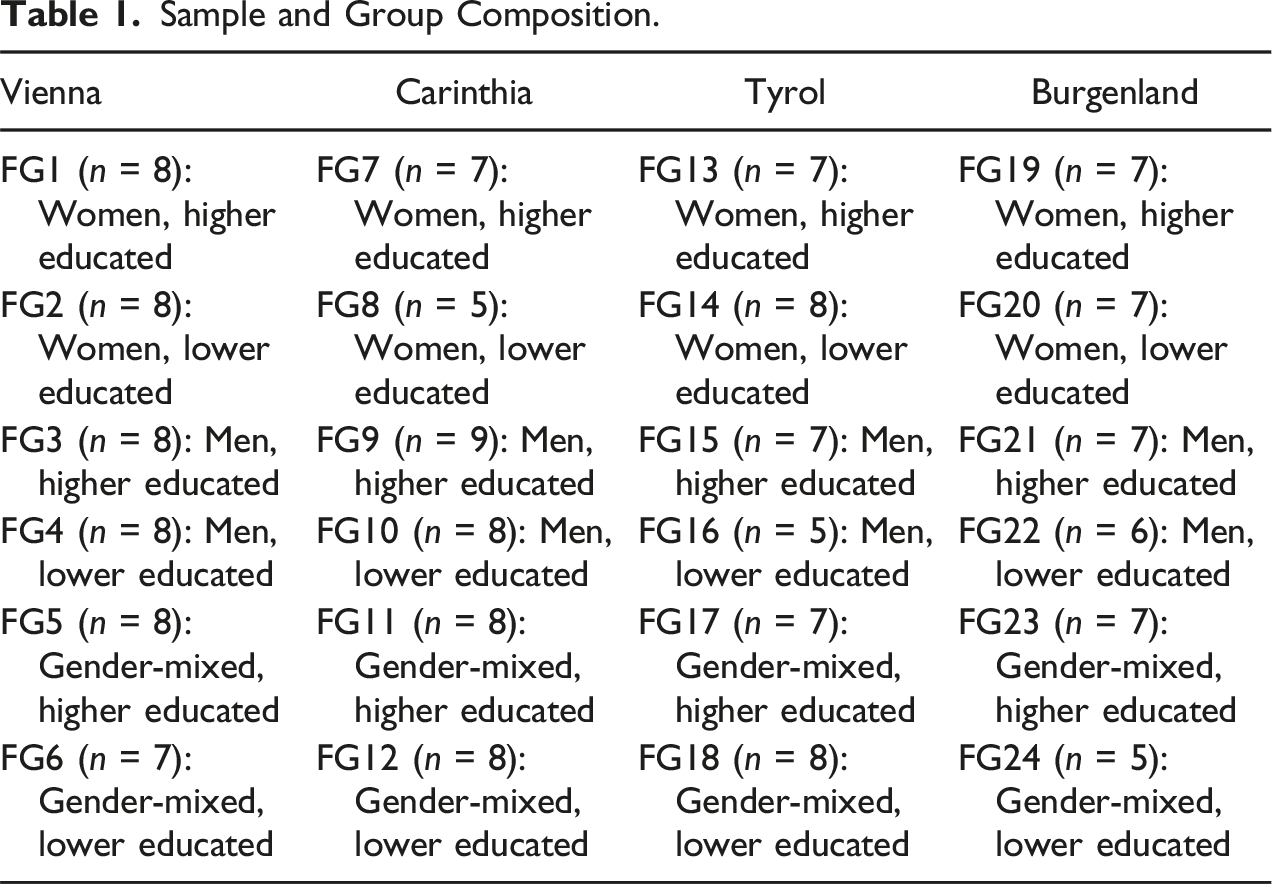
In each focus group, participants were invited to discuss their views on and experiences with motherhood, moderated by a female researcher (20 focus groups by the first and four by the second author), and accompanied by at least one female assistant (one of the authors). Every discussion was flexibly oriented toward a discussion guideline that allowed participants to spontaneously introduce issues and encouraged them to debate, challenge, and criticize each other’s opinions, arguments, and justifications. In a warm-up part, the study, the researchers, and the schedule for the discussion were presented, and all participants introduced themselves. The first part of the discussion served as an ice-breaking and brainstorming session and included questions like what it means to become and to be a mother today, what defines a good mother, or what people might expect from mothers in different contexts.
Later, participants were invited to respond to qualitative vignettes. Vignettes in qualitative research involve texts, images, or other forms of stimuli, often consisting of short written stories about a hypothetical person or scenario (Hughes & Huby, 2004). The vignettes presented in the discussions were developed by the research team and captured two different scenarios with regard to a mother’s age, profession, parental leave, division of labor, childcare institutions, family background, working hours, and future plans. Participants discussed these fictitious mothers’ experiences, beliefs, everyday lives, and future prospects. The first vignette was about Kristina, a typical mother in Austria who was described as follows: “Kristina is 32 years old and lives with her husband and their children, a seven-year-old son and a nearly two-year-old daughter, in a house in the vicinity of a small town. For nearly two years, Kristina has been on parental leave. Her husband took his annual leave after the daughter’s birth, and has since been working 40 hours per week at his job as a product manager. If her daughter is admitted to the local daycare, Kristina intends to return to her job as a clerk soon, initially for 10 hours per week, and in another department than the one she worked in before. She is considering later expanding the number of hours she works to 20 hours per week, as she did before the birth of her second child.”
The second vignette was about Elena, a mother with a very different story: “Elena is 38 years old and lives with her partner and her son and daughter in an apartment in the vicinity of her parents. Her partner is on parental leave to care for the couple’s eight-month-old son. Elena’s leave ended after four months. Since then, she has been working 35 hours per week as an office administrator in a big company. Her daughter is nearly three years old and attends the local kindergarten until early afternoon every day. Her son is going to attend this kindergarten as well, shortly after his first birthday. At that time, Elena’s partner will return to work as a radiographer on a schedule of 30 hours per week. Elena is also considering reducing her working hours to 30 hours per week at that time.”
The researchers produced detailed memos after every discussion. The focus groups lasted between 100 and 150 min and were transcribed verbatim, with each speaker being identified individually. All participants were anonymized alphabetically and with their self-identified gender. Participant IDs are displayed together with the respective focus group ID (e.g., Bf:FG14 refers to the female participant B in focus group #14). Quotations were translated during the final language editing conducted by an external native speaker.
The reconstructive in-depth analysis was based on the transcripts, the respective recordings, and memos. Informed by the documentary method (Bohnsack, 2014) and by hermeneutic techniques (Oevermann, 2001; Wernet, 2014), the aim was to reconstruct tacit knowledge about the empirical and normative expectations that shape everyday practices and discourses. To this end, four working steps were applied with the aid of MAXQDA software. (1) After thematic coding of the manifest contents, (2) the thematic course of the discussion in each focus group and the manifest contents of the sequential text passages were summarized, (re-)formulated, and paraphrased. At this stage, the focus was on answering the question of what was discussed.
Subsequently, (3) the analysis aimed at reconstructing and decoding implicit “patterns of orientation” (Bohnsack, 2014) and “latent meanings” for each focus group (Oevermann, 2001; Wernet, 2014). Based on the first two analytical working steps, passages in which there were very intense discussions, or in which significant topics were raised, were identified; for example, passages with the thematic code “dealing with external assessments of mothering.” At this stage, the analysis focused on answering the question of how certain topics were discussed and narrated by particular participants and why they were voiced in a particular way. The latter question could be answered in a twofold way: first, by reconstructing under which preconditions (including not only the real setting but also the more general cultural frame) something could be said and discussed in a particular way; and, second, by comparing a certain statement with as many other formulations as theoretically possible in order to extract the implicit meaning of the particular statement. This “reflecting interpretation” (Bohnsack, 2014) and the in-depth analysis of the latent meaning were at the core of this reconstructive analysis and were performed by answering questions like the following: “What facilitates this particular statement or discussion?”, “What do the participants take for granted?”, and “What collectively shared meaning or notion lies behind a statement?”. By answering these questions, the hypotheses were constantly formulated and reformulated.
Finally, (4) the comparative analysis aimed for the abstraction of the shared patterns of orientation both within each group and across different groups. For this purpose, the existing hypotheses were constantly enriched, differentiated, refuted, confirmed, complemented, or replaced by new ones in the course of analyzing further discussion passages and statements. This procedure enabled the researchers to identify emerging theories, and thus to discern the “documentary” sense (Bohnsack, 2014) and “objective meaning” (Oevermann, 2001) in order to gain an understanding of the implicit but highly relevant social norms regarding motherhood and of the corresponding strategies.
Results
Across all focus groups, the discussants implicitly and explicitly expressed their support for social norms around mothering by collectively sharing their expectations about what a mother ought to do, is expected to do, and wishes to do. These norms represented an important reference point in the focus groups when the various participants that constitute a mother’s reference network discussed about mothers who did not fully adhere to these expectations and were required to find strategies for dealing with these mothers. Although this referencing was characterized by considerable homogeneity, the reconstructive analyses revealed the nuances in the collective strategies for dealing with different types of mothering. The quotations were carefully chosen for exemplifying collectively shared expressions and well-illustrating respective analytical results, that uncovered very little systematic variation. The groups only differed—albeit not systematically—in the level of detail in their explicit expressions of the social norms, as well as in the extent of their explicit critiques of those who violated them. Examples of these accounts will be elaborated below.
A Bundle of Social Norms Around Child-Centered Mothering
The reconstructive analysis showed that mothers were expected to engage in child-centered behavior over both the short and the long term: mothers should happily and lovingly care for and pay close attention to their child as much and as long as possible after the child’s birth and throughout his or her childhood. This was characterized as grasping the “sense and purpose” (Bm:FG9, Bf:FG11, Ef:FG14, and Cm:FG18) of being a mother, as fulfilling the child’s needs and facilitating the child’s “successful” (e.g., FG1, FG11, FG21, and FG8) and “unproblematic” (e.g., FG18, FG22, and FG24) development. As the primary and central caregiver of the child, the mother was constructed as being the supreme and natural entity who was endowed with the ability to establish a symbiotic relationship with the child that was considered necessary for caring adequately for the child; thus, being optimally positioned to recognize the child’s needs, to know what was best for the child, and to assess whether the child’s needs were fulfilled and her or his well-being was ensured. Performing this child-centered mothering was considered to be possible almost exclusively if the mother was physically present in home and was attentive to, available for, and together with the child. The discussants equated the time of being present and accessible for the child with “being a mother” (Cm:FG5, Df:FG13, Am:FG18, and Bf:FG12) and contrasted this time spent on mothering with the time the mother spent elsewhere, for example, being at work “on the side” (Gf:FG14 and Am:FG22) or having “time for herself” (Hf:FG20).
The expectation of being child-centered and present in their children’s lives was expected to evoke joy and contentment in mothers: a mother should be “absolutely” (Gm:FG3) desperate to and was supposed to freely choose for the “most pleasant task a woman can undertake in her life” (Cm:FG21:85 and Df:FG5:40) and the “dreamlike” state (Ef:FG1:102) of prioritizing being at home with the child over (all) other areas of her life: “I think if you want it from your heart, you want it so much when you decide to have a child or several children, that you then love to give up all or almost all hobbies for 10, 15 years. [...] If I want that [motherhood], then absolutely, and almost only that, otherwise I won’t do it” (Bf:FG8:5).
Although mothering was expected to be exhausting, a mother was nonetheless expected to be happy with her child-centeredness; to be contented, serene, and not overburdened; to have a positive and relaxed attitude; and to have enough tranquility to be able to deal with all of these strains positively. Thus, a mother was expected to “regard raising her child like a [pleasurable] hobby, and to accept all of the hardships that come with it” (Hm:FG10:10). Accordingly, future mothers were expected to understand that fulfilling their desire to have a child was not some mundane activity like “buying a new vase” (Bf:FG24:12), to be aware that having a baby would “turn their everyday lives upside down” (Af:FG20, Gm:FG21, and Ef:FG1), and to desire to joyfully spend time with and to intensively care for the child, as if mothering itself was her “vocation” (Am:FG18). Mothering consistent with these social norms did not require legitimation by the discussants, unlike mothering that diverged from these norms, as shown in the following section.
Collective Strategies for Dealing With Three Different Types of Mothers
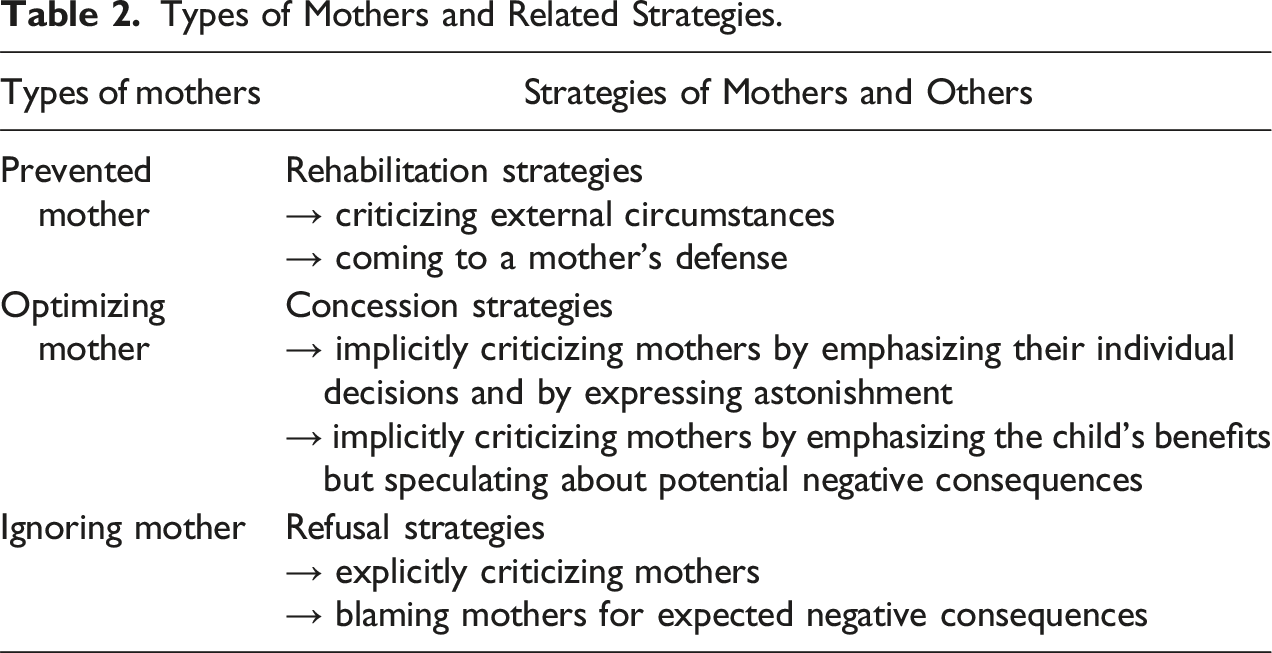
Types of Mothers and Related Strategies.
Rehabilitation Strategies
Rehabilitation strategies were based on the assumption that prevented mothers strongly wanted to perform child-centered mothering but were prevented from doing so, particularly in terms of being present. Rehabilitation strategies thus aimed at excusing their actions. The discussants considered this mothering behavior legitimate because prevented mothers had to (but did not want to) be this type of mother. They conceded that a prevented mother would act to “the best of her knowledge and belief” and “the best of her ability”; therefore, they did not regard “making mistakes” (FG1, FG3, FG6, FG12, FG14, FG15, FG20, and FG23) as the mother’s own fault—even though her absence was clearly not considered ideal. Two distinct rehabilitation strategies were employed: one focusing on external circumstances and the other on the mother’s burdens.
The first strategy of rehabilitation was to criticize the external circumstances that prevented mothers from adhering to the desired and expected child-centered approach to mothering. Thus, instead of blaming a prevented mother on an individual level, her behavior was seen as not based on her individual and free decisions. In the discussions, the participants criticized the “brutal,” “hostile,” and “scary” circumstances faced by mothers today, mainly involving “hard as nails” employment and financial decisions (Cm:FG3). These circumstances were constructed as immutable, incontestable, objective, mandatory, and not ignorable. Her family’s difficult financial situation could impose the obligation on a mother to be employed in order to make ends meet. Prevented mothers were supposed to feel “cornered” (Ff:FG8), as they were “forced” (e.g., FG9, FG12, FG13, FG16, and FG18) to be employed against their wishes. Thus, external circumstances prevented them from spending enough time with their children and from serving as a “calm center” in their family (Cm:FG18). Against this background, a prevented mother’s integration into the labor market was constructed as an inherent and unavoidable necessity and was thus regarded as an unhappy fate rather than as a choice. The discussants also decried the “disastrously” (Dm:FG9) unfair consequences that mothers would face if they “did their best” to adhere to social expectations, which might include their career “crashing dramatically” (Cm:FG4), or being placed on the professional “sidetrack” (Cm:FG16). By expressing their regret about these circumstances, mothers and others rehabilitated prevented mothers. As part of this strategy, it was suggested that another actor in the mother’s web of relationships, usually her partner or the state, should provide for her and her child’s financial needs during the years when she was on parental leave or working part time only in order to enable her to mother in a child-centered way without experiencing financial losses. Thus, the discussants argued in favor of policy measures that support mothers in their efforts to spend time with their children, demanding that the state should “honor” (Am:FG18) their efforts by providing them with at least a “small amount of pocket money” (Am:FG16). One participant recommended that the state offer a “basic income so that more women can decide to stay at home more easily or to send their children to kindergarten only half day” (Ff:FG7).
The second rehabilitation strategy was mirrored in the participants’ attempts to come to the prevented mothers’ defense. The discussants constructed prevented mothers as struggling and as experiencing negative emotions and burdens when they were not able to live up to the expected present and child-centered mothering behavior but nevertheless wanted to spend quality time with their child and to engage in child-centered mothering. Accordingly, the discussants talked about mothers as “suffering” when they were not present; as “being overstrained,” “feeling guilty,” and “being stressed;” and, ultimately, as having “too little energy left” (Df:FG5) for the child and “losing their nerve” (Gf:FG19). This expected overload resulted from workplace demands and from the expectation that mothers would be responsible not just for childcare tasks but also for housekeeping and cooking. In this strategy, mothers and others expressed understanding for the prevented mothers’ suffering, stress, and guilt and therefore rehabilitated them. The discussants urged these prevented mothers to not put too much pressure on themselves and strived to reassure them that they were still good mothers by arguing that the mere quantity of time spent with the child was “not everything” and that “quality comes before quantity” (e.g., FG4, FG11, FG12, and FG17). The participants also sought to rehabilitate the prevented mothers by advising them to aim to spend happy quality time with their children during the periods they had left, to “do their best” (e.g., FG2, FG13, FG15, FG20, FG23, and FG24), to use all their strengths and resources, and to improve and learn from their mistakes. These rehabilitation efforts made it nearly impossible for the different participants in the focus groups to explicitly judge or to criticize these mothers’ behavior. Correspondingly, they did not tolerate any negative judgements or critiques of prevented mothers and thus avoided classifying them as bad mothers.
Concession Strategies
In the focus groups, various participants adopted concession strategies when they assumed that it was a mother’s intention to renounce the normative expectations by being present and child-centered only temporarily because of her self-optimizing aspirations—for example, regarding her career, her well-being, or her health—in accordance with neoliberal norms. Strategies of concession aimed at tolerating these aspirations, while also implicitly criticizing these optimizing mothers. Two distinct strategies of concession that were detected either addressed mothers’ individual decisions or focused on the child’s benefits.
The first concession strategy emphasized an optimizing mother’s individual decisions (e.g., FG4 and FG23), her freedom to choose and increased leeway (e.g., FG5), her individual “need for variety” (FG3, FG5, FG9, and FG20), or her “desire for some color in her life” (Hf:FG20). In this strategy, participants conceptualized the optimizing mother the central figure who made conscious and well-planned decisions regarding her mothering. Implicit critique was included in this strategy through expressions of incomprehension. The discussants expressed their astonishment at and their lack of understanding for an optimizing mother’s rationale of intentionally opposing the norm of being child-centered and present. They assessed her decisions as being very uncommon and almost unthinkable, and emphasized that their own preferences were completely different. They had “no idea” (Hf:FG2) how to explain “why she doesn’t want to be with her children” (Bf:FG24) when a mother returned to full-time work some months after birth and raised questions like: “How can it be that a woman throws herself into her job again so quickly?” (Hm:FG21). Other participants wondered how such a mother could experience “happiness in life” (Dm:FG23) apart from her mothering. Accordingly, they expected an optimizing mother to be able to individually justify her intentions and conscious decisions that defied normative expectations around motherhood. The mother’s wishes, rationales, and ways of justifying—in the participants’ words—the “good goal” (Af:FG2), “the reasons” (Bm:FG16 and Cm:FG21), or the “motives behind” (Cm:FG4) her mothering were crucial for this concession strategy. In reference to child-centered and present mothering, the discussants conceded that optimizing mothering could be seen as good mothering “as well”; that “good mothering is surely also possible this way” (Cf:FG2); and that optimizing mothers “can also be good parents” (Bm and Dm:FG15) or can “nevertheless” be good mothers (Gm:FG22). Unlike in the case of prevented mothers, whose mothering behaviors they defended, various discussants implicitly criticized optimizing mothers by speculating about the potential negative consequences of their individual decisions these mothers would face. For example, optimizing mothers were urged to evaluate how they would “get along” (Dm:FG21) with these consequences and to reflect on what they could “afford” (Ef:FG1), “bear” (Ef:FG8), and “handle” (Ff:FG1). It was evident that individuals in a mother’s reference network expected optimizing mothers to eventually suffer, feel guilty, and regret their individual decisions at a later stage of life. Unlike in the rehabilitation strategies, the discussants framed these burdens and forms of suffering as an optimizing mother’s own fault and individual responsibility and did not come to her defense.
A second concession strategy was to emphasize the needs, benefits, and desires of an optimizing mother’s child. The participants admitted that, for example, children might also benefit from early institutional education, from being in contact with other children, from having more freedom, from having more caregivers, and from having experiences independent of their mother. They admitted that optimizing mothers’ children ultimately “did not miss out on anything” (Bf:FG8) and would likely end up becoming well-educated, successful adults who were still in close contact with their mother and who would nevertheless assess them as being the “best mum in the world […] even if outsiders disagree” (Df:FG13). In contrast to rehabilitation strategies, in which it was assumed that mothers were forced to be employed, the participants assumed that an optimizing mother derived happiness from her choice to engage in professional work and tolerated this happiness only to the extent that it served as a means to further the child’s well-being and happiness: “As long as the children are happy, a happy mother is a good mother” (e.g., Ff:FG13, Ef:FG24, and Ef:FG23). Mothers and others expected optimizing mothers to intentionally renounce being child-centered. They implicitly criticized these mothers by speculating about the potential negative consequences for the child’s well-being that would be traced back to their individual decisions and would be their individual responsibility. Unlike in the rehabilitation strategies, they argued that the quantity of time spent with the child rather than money was essential for being a good mother. Correspondingly, various discussants advised optimizing mothers to reduce their working hours and their standard of living to be more available to their child, and thus to forego their career aspirations and their desire to earn a higher income. Thus, they implicitly criticized these mothers’ individual decisions for being not child-centered enough.
Refusal Strategies
A mother not being child-centered, and ignoring her child’s needs to focus on her own desires, represented a red line for the discussants. Such ignoring mothers were considered self-centered and not legitimate, regardless of how much time they spent with their child or whether they were in employment. The discussants adopted two different refusal strategies that aimed at denying this type of mother the status of a good mother.
The first refusal strategy was to explicitly judge and criticize ignoring mothers. In that vein, ignoring mothers were expected to prioritize their own needs over their child’s needs. This behavior was explicitly criticized as being “irresponsible” (Cm:FG23), “tragic” (Am:FG23), “perverse” (Am:FG18), or a “catastrophe” (Am:FG16). On the one hand, the discussants expected these mothers to strive to be “away, away, away” (Dm:FG16) from their child because, for example, they preferred having leisure time to being with their child. On the other hand, they accused ignoring mothers of not being present and of being “away too long” (Ef and Cm:FG23) if, for example, they went back to work within weeks of the birth, or they were working full time during the child’s early childhood without having the reasons they ascribed to the prevented or optimizing mothers. Accordingly, the participants explicitly criticized these mothers, with one even accusing them of being “actually a silly cow” (Cm:FG16). They predicted that the children of such mothers would suffer greatly, as being cared for by “strangers” (Cm:FG23, Bf:FG24, and Bf:FG13) or being “passed on through too many hands” (Am and Bm:FG18) was considered detrimental for their development. Women in the focus groups tended to criticize this kind of mothering as “sad” (Hf:FG2), “frightening” (Df:FG2), or “tough” (Bf:FG12), whereas men offered more concrete criticisms resulting from their experiences with ignoring mothers. They argued, for example, that a mother “shouldn’t have a child if she doesn’t care for or educate or do anything for her child herself, but only outsources it” (Em:FG11) or that “nobody should be a parent if they just give their children away and see them only now and then” (Cm:FG23). In general, the focus group participants constructed ignoring mothers as not loving, comforting, caring well enough for, or paying enough attention to their child, even when they were together with their child or stayed home with the child for several years. In the discussions, they illustrated this construction by mentioning examples of mothers who were not engaged with their children on the playground but were instead chatting with other mothers; mothers who forced their children to stay in their room while meeting their own friends at home; or mothers who preferred to meet their friends in a café regularly rather than picking up their children from daycare. They also accused ignoring mothers of needing distraction and engaging in self-centered digital activities and criticized them even for having children (Bm, Cm, and Fm:FG4).
The second refusal strategy for dealing with ignoring mothers enabled the discussants to refuse to absolve these mothers by explicitly blaming them for the expected negative consequences of their actions. These consequences concerned their children’s behavior, well-being, development, or future success. The focus group participants accused ignoring mothers of neglecting their children, using violence, harming their children’s well-being, and laying the groundwork for detrimental consequences, which included the children becoming unhealthy, ill-bred, unsuccessful, addicted, unhappy, or violent. In addition to these consequences for their children, ignoring mothers were also held accountable for “huge societal problems” (Am:FG18:37) because various actors had to deal with these children. Overall, the refusal strategies were the only ones in which group differences could be observed: explicit criticisms of these mothers were mainly expressed by men, by participants from rural areas, and by participants with lower education.
Discussion and Conclusions
This study examined how the various actors in a mother’s social reference network collectively constructed social norms around motherhood and how they dealt with different mothering behaviors in collective discourses. It used as a starting point evidence indicating that intersectional inequalities and neoliberal disruptions are reflected in an increasing variety of mothering practices and behavioral responses to social norms of motherhood (Nomaguchi & Milkie, 2020; Schmidt et al., 2023; Valiquette-Tessier et al., 2019). However, the existing research has concentrated on mothers’ perspectives and practices but did not answer the question of how this diversity has impacted collective constructions of social norms around motherhood.
Theoretically, this study complemented a normological approach with a relational perspective that conceptualized social norms as being relational, that is, as concerning those individuals who are expected to behave according to social norms (in this study: mothers), as well as the actors who expect certain maternal behaviors (in this study: mothers and others) (Bicchieri, 2006, 2017; Horne, 2014; May & Nordqvist, 2019; Smart, 2007). Accordingly, this study considered mothers and others to constitute a mother’s social reference network; to construct, enforce, and shape norms of motherhood; to expect, reward, and sanction certain behaviors of mothers; and to develop strategies for dealing with the behaviors they observed or discussed. To date, the existing knowledge on how individuals in mothers’ reference networks (mothers and others) respond to various mothering practices and how they collectively construct and enforce social norms around motherhood is highly fragmented.
The theoretical framing of social norms’ interactional relationality informed the methodological approach of this study that considered social norms of motherhood as constructed, actualized, and validated in focus groups with mothers and others (Bohnsack, 2010; Mannheim, 1982; Morgan, 2012). Data from 24 focus groups with various participants (n = 173) were collected in Austria, a Central European country with both neoliberal and traditional characteristics. With an in-depth, qualitative, and reconstructive procedure (Bohnsack, 2014; Wernet, 2014), data were analyzed along the following questions: How do mothers and others collectively construct social norms around motherhood, and how do they deal with related mothering practices in collective discourses?
The reconstructive in-depth analysis identified a bundle of social norms around child-centered mothering in the context of Austria, including caring adequately for the child, being happily present and available for the child, and prioritizing the child’s needs over the mother’s needs. However, due to neoliberal demands, and markedly efficacious, this bundle of social norms appeared to be utopian to fulfill. Accordingly, discussants constructed three different types of mothers who did not fully adhere to these norms, reflecting an implicit hierarchy based on a mother’s desire to adhere to the social norms, and on her level of child-centeredness. This hierarchy was also reflected in the respective criticisms of these mothers, as expressed in three related collective strategies proposed by mothers and others: First, the prevented mother was expected to be highly child-centered but prevented from fulfilling corresponding social expectations, which led the discussants to apply rehabilitation strategies (criticizing external circumstances and coming to a prevented mother’s defense). Second, the optimizing mother was expected to be child-centered only temporarily and in accordance with her neoliberal self-optimizing behavior (e.g., regarding her career, her well-being, or her health). This mothering was tolerated by means of concession strategies that contained implicit critique (emphasizing the optimizing mother’s individual decisions but expressing astonishment about them, and emphasizing the benefits for the child but speculating about the potential negative consequences). Third, ignoring mothers were expected to not be child-centered and to prioritize their individual desires over their child’s needs. In response to this type, mothers and others adopted refusal strategies in which they criticized such mothers overtly and blamed them for all of the expected harmful consequences for their children, and even for society.
In this hierarchy, the mothers’ sources of happiness were crucial, which refined the more general motherhood norm of being happy that has been identified in the literature (Collins, 2021; McDonnell et al., 2019; Schmidt et al., 2023). The social norms uncovered in this study linked mothers’ happiness to their child-centeredness and presence, as reflected in the assumption that the prevented mothers suffered when they were not able to engage in these behaviors. Optimizing mothers, by contrast, were expected to derive their happiness from practices in addition to being present and engaging in child-centered mothering, which was tolerated only to the extent that their happiness was expected to benefit the child. In neoliberal contexts characterized by apparently endless possibilities (Adkins, 2018; Auer & Welte, 2009), the focus groups reflected a high degree of permissiveness on an explicit level. Criticisms were directed more toward external circumstances than toward prevented mothers, or were shifted to an implicit level when referring to optimizing mothers.
Two conclusions can be derived from these findings: First, the results illustrate that to date, neither neoliberal demands nor the related diversity in empirically observable mothering practices appear to have had a substantial impact on the collective construction of social norms around motherhood in the Austrian context. Instead, the identified types of mothers and the corresponding collective strategies for dealing with these types tended to reinforce or even glorify longstanding social norms around child-centered mothering and continuously reflected all of the associated expectations. Although the notion that only a happy mother can be a good mother (Schmidt et al., 2023) gives some leeway to mothers, and might make their mothering behavior tolerable for others, it does not change the expectation that a mother be child-centered.
Second, the results underline the relevance of the various actors in a mother’s reference network for collective processes of norm construction and enforcement, and contribute to the scholarly knowledge on the three levels of relationality of social norms around motherhood (Bicchieri & Mercier, 2014; Horne, 2014; May & Nordqvist, 2019; Nordqvist, 2021): (1) The level of interactions refers to when various actors shared in the discussions different strategies for dealing with a mother’s behavior in relation to her child, her partner, or her family and network members. (2) Social norms’ relationalities also concern the level of the individual. The concession strategies, for example, reflected how mothers and others had internalized the behavioral expectation that mothers strive to be child-centered and were consequently puzzled about optimizing mothers’ intentions, beliefs, and emotions. (3) Motherhood norms stand in relation to various wider social, political, and cultural frames. For example, they relate to norms of gendered parental responsibilities (Evertsson & Grunow, 2019; Schmidt et al., 2019), which was evident, for example, in discourses that showed that a father was not considered to be the main or an equally child-centered caregiving parent. Moreover, motherhood norms strongly relate to neoliberal norms. For example, prevented mothers were presented as not being able to fully adhere to the social norm of engaging in child-centered, due to neoliberal norms of the ideal worker and of being economically independent, activated, and autonomous (Rodriguez Castro et al., 2020; Schmidt et al., 2023). Also, constructions of optimizing mothers reflected neoliberal norms of individual self-optimization and self-fulfillment (Adkins, 2018; Connell, 2009; Tronto, 2013).
This study contributes to the analysis of collective constructions of social norms around motherhood and traces the nuances in collective discourses and practices of dealing with diversity in mothering. However, as for all empirical work, it does not come without limitations, and more remains to be done. Although the focus groups aimed at maximized variation and were carefully sampled in terms of gender, region, and education, we retrieved only moderate differences in relation to the respondents’ backgrounds. This raises three fields of advancement: First, the retrieved homogeneity in the collectively constructed norms may be country-specific, and future studies in other societal and cultural contexts may lead to other findings. Second, differences regarding sociodemographic characteristics in collective norm construction and enforcement may be revealed by employing other methods of data analysis, for example, procedures that focus on the analysis of manifest content, like content analysis. Third, other issues related to motherhood may be subject to more heterogeneity in collective constructions, for example, questions concerning mothers’ everyday lives, notions of education, or individually experienced structural barriers. Furthermore, our results also call for the need to empirically assess if various crises (i.e., the COVID-19 pandemic, the wars in Europe and Middle East, the inflation, and the climate crisis) might intensify processes of reinforcing longstanding motherhood norms or might lead to changes on a normative level.
Footnotes
Declaration of Conflicting Interests
The author(s) declared no potential conflicts of interest with respect to the research, authorship, and/or publication of this article.
Funding
The author(s) disclosed receipt of the following financial support for the research, authorship, and/or publication of this article: Austrian Science Fund, P 32745-G.
