




Abstract
With Brexit done and the desire to alter U.S. trade policy in the wake of the election of President Donald Trump, both British Prime Minister Boris Johnson and President Trump were optimistic that a trade agreement between the United Kingdom and the United States could be swiftly negotiated. This proved not to be the case despite the efforts of both leaders. We use an Open Economy Politics lens to examine the political and economic forces at work in both the United Kingdom and the United States during the tenure of the Trump administration that led to the initiative being stillborn and why the original optimism was misplaced.
Both Prime Minister Boris Johnson and President Donald Trump expressed optimism that a trade agreement could be reached between the United Kingdom (UK) and the United States before the end of 2020. On the surface there appeared to be a convergence of interests that had the potential to move the negotiations forward quickly. With Brexit freeing the UK to make independent trade deals and the Johnson government promising new trade deals that would help offset any declines in trade volumes with the EU (Jackson and Shepotylo 2018; Hestermeyer and Ortino 2016), a trade agreement with the United States appeared to be a great prize (Oxford Analytica 2021). 1 For the Trump administration, the departure of a major economy from the EU would weaken the European trade bloc to the benefit of the United States (Brattberg and Rome 2018). 2 Further, ensuring the UK prospered outside the EU might encourage other members to act in ways that further weakened the EU (Kerr 2018). 3 The UK–US trade agreement appeared as a win-win opportunity for both the Johnson government and the Trump administration.
The formal UK–US trade negotiations, which had to await the UK leaving the EU, commenced in June 2020 after a delay due to the COVID-19 outbreak. 4 After four rounds of remote talks and 130 informal sessions, the UK's hopes of clinching a deal by the end of 2020 faded with the election of President Joe Biden as the new U.S. administration had made it clear that reaching a deal was no longer a priority. April 2021 was seen as a crucial date for an agreement because the U.S. administration's authority to negotiate would end in June 2021. 5
The United States set out its proposed Free Trade Agreement (FTA) negotiating mandate in March 2019, and the UK listed its objectives in March 2020. The results of a formal economic modeling exercise projected that the UK–US FTA would have added £3.4 billion, or 0.16 percent, to the UK economy over the 15-year timeframe (Department for International Trade 2020). 6 This size of the economic benefit brings into question the economic premise and rationale for the proposed FTA, and how the economics of trade policy, domestic interests, and politics interact. 7 We argue that understanding trade partnerships requires an examination, from an international political economy (IPE) perspective, of how domestic interests and politics shaped the partners’ objectives and how the interaction between the governments shaped the outcome of the negotiation.
Using Oatley's (2019) Open Economy Politics (OEP) framework on the dynamics of trade policy making, this article firstly provides insights on domestic concerns in light of new aggregations of interests in the partner countries and how these affect policy choices. The study examines how new aggregations of interests in both countries impacted on the outcome of the trade talks. We argue from an OEP perspective that the rejection of the EU in the UK following the Brexit vote and the election of President Trump in the United States represented radical shifts arising from changes to the aggregations of interests that determine trade policy. 8
The article is structured as follows: we first contextualize the importance of UK–US trade and applies the OEP framework to developments in trade policy making to comment on the weakening of the ruling international trade paradigm. We then discuss the importance of the partnership and examine the proposed negotiations through the OEP lens focusing on interests, ideas, and interactions. Conclusions are presented in the final section.
The Open Economy Politics Framework and the Evolution of the Trade Policy Paradigm
The OEP model provides “a closer examination of how international institutions and policies structure and change the interest of actors within countries that are now taken as exogenous” (Lake 2009, 219). Oatley (2017, 2019) examines the global economy through the IPE lens by focusing on government policies and contemporary developments. He examines first, how exactly does politics shape the decisions that businesses and society make about how to use the resources available? Second, what are the consequences of these decisions? Thus, the OEP framework is concerned with understanding the circumstances whereby countries choose to enter, or not, into the global economy through the trans-border movement of goods, services, individuals, and financial flows.
The OEP framework runs counter to pure economic models, which take as a given that increased openness is welfare enhancing (Perdikis and Kerr 1998; Khorana et al. 2010). Instead, the OEP framework suggests that individuals have vested interests that may benefit from altering economic arrangements such as the removal of trade barriers or equally may lose value from such changes. Where one is situated as a potential winner or loser from globalization will determine how one will be motivated to influence the making of trade policy. Walter (2016) acknowledges the usefulness of the OEP framework through its ability to focus on domestic interests and institutions in explaining foreign economic policies. Lake (2009) eloquently explains that OEP, unlike its predecessors, adopts the assumptions of neoclassical economics and international trade theory, connects economics with political science, and accords a central explanatory role to institutions at both the domestic and international levels. Further, the framework emphasizes the formation and characteristics of international institutions (that is, why do states create and join international institutions?). Our interest in the OEP approach is motivated by Oatley's (2017) identification of interests, institutions, and interactions as factors impacting on the context and formulation of trade policy, and adapting these to explain the context of the proposed UK–US FTA. 9 The OEP framework has been employed to analyze topics—from regulation to governance (Mattli and Woods 2009), which include analyzing Brexit (Owen and Walter 2017; Farrell and Newman 2017) and international cooperation in financial crises (Walter 2016).
Oatley (2017) sets out a model that starts with individuals and progresses through domestic institutions (individuals, firms, or sectors) and aggregates these interests and preferences through domestic political institutions before progressing to an international level to examine how the aggregated interests influence the interactions (that is trade policy interactions among countries). 10 The framework suggests that the heterogeneity of firms within industries and their differential integration into the global economy complicates the definition of interests across sectors. This assumes that interests interact with the domestic political institutional context, through lobbying and other means of interest representation, such that these result in policy outcomes. Domestic political dynamics lies at heart of OEP (Bates 2014). Finally, policy outcomes interact at the international level through inter-state bargaining, which is itself also framed by international institutional rules, such as those of the World Trade Organization (WTO).
Given the spectrum of the potential trade policy outcomes faced by the vested interests of individuals, some form of aggregation of their interests takes place. Domestic institutions, broadly defined, are responsible for this aggregation. Depending on the particular form that the aggregation takes, pro- or anti-globalization trade policies arise. These then inform the international interactions among states at the bargaining table where state-to-state trade regimes are hammered out. Oatley (2017, 708) states: System level trade politics constitute the final stage of the OEP causal chain. It is in international forums that competing international policy preferences generated by domestic institutions that have in turn aggregated individual preferences are (sometimes) transformed into trade agreements. These international agreements entail specific trade policy commitments—reduce tariffs, limit and prohibit subsidies, protect intellectual property and so on.
One of the problems with obtaining predictions from OEP is that the international trade landscape has been relatively stable over a long period meaning there had been no change with which to test the theory. 11 Radical shifts in the aggregations that affect trade policy bargaining through institutions have not existed. The rejection of the EU in the UK following the Brexit vote and the election of President Trump in the United States represent radical shifts attributed to changes to the aggregations of interests that determine trade policy. 12
Applying OEP for Brexit and Trump-era U.S. Trade Policy
Prior to the Brexit vote and the election of President Trump, the last major realignment of interests regarding trade policy took place at the end of the Second World War (WWII). The General Agreement on Tariffs and Trade (GATT) of 1947 became the de facto multilateral trade organization until it was replaced by the World Trade Organization (WTO) in 1995. The preamble to the GATT 1947 sets out what became the ruling international trade policy paradigm succinctly. The member countries of the GATT (1947), Recognizing that their relations in the field of trade and economic endeavor should be conducted with a view to raising standards of living, ensuring full employment and a large and steadily growing volume of real income and effective demand, developing the full use of the resources of the world and expanding the production and exchange of goods,
Being desirous of contributing to these objectives by entering into reciprocal and mutually advantageous arrangements directed to the substantial reduction of tariffs and other barriers to trade and to the elimination of discriminatory treatment in international commerce.
Subsequent GATT negotiations had considerable success in lowering trade barriers in the early rounds of negotiations and expansion in international trade outstripped economic growth (Kerr and Perdikis 2014). In general, individuals saw their vested interests aligned with the ruling paradigm, and several international institutional forms were accepted within the GATT, including preferential trade agreements.
The UK was at the forefront of the development of the international trade policy paradigm and had a prominent part in the negotiations to establish the GATT. The EU is an institution that takes its inspiration from the ruling paradigm (Kerr and Viju-Miljusevic 2019). While the UK did not initially join the pre-cursors to the EU, and there were many individuals that did not see their interests aligned with joining, the lure of gaining additional benefits in line with the paradigm was strong. Given a direct opportunity to express their preferences in a referendum, the interests aggregated in support of joining prevailed and the UK acceded in 1973. While there were always a substantial number of individuals who perceived their interests as being best served by being outside the EU, from Prime Minister Edward Heath through to Prime Minister David Cameron they were never in a position to influence policy as all governments, of either party, were supporters of the EU as the institution to fulfill the promise of the paradigm. Certainly, UK governments varied in their enthusiasm for the European project, but those who perceived their interests as lying outside the EU were never able to outweigh those who saw their interests as being part of the EU. Owen and Walter (2017) highlight that the Brexit referendum forcefully demonstrated that integration is not a one-way street, and that disintegration can and does happen.
The United States had been the main architect of the international trade institution proposed at the end of the Second World War (U.S. Department of State 1945). Being the global hegemon among market economies, it was able to shape and foster the trade policy paradigm. Until near the end of the Clinton administration it followed a program whereby to gain improved access to the U.S. market, countries had to work through the multilateral GATT/WTO (Kerr and Hobbs 2006). In other words, the United States did not engage in formal bilateral or regional trade agreements—the only exceptions being the 1988 Canada–US Trade Agreement (expanded to include Mexico in 1995) and an agreement with Israel. 13 Once WTO exclusivity was abandoned in favor of a three-pronged approach to trade agreements—bilateral, regional, and multilateral—a number of trade agreements followed starting with Jordan during the Clinton presidency. President Bush's administration continued the three-pronged approach. 14 All U.S. administrations from that of President Truman at the end of WWII to President Obama's administration followed the ruling paradigm. Although the degree of enthusiasm for the paradigm and its institutions varied among administrations, all espoused its aims. 15 Sufficient numbers of individuals saw their interests aligned with the ruling paradigm so that there was inadequate political force to change trade policy.
There were some who questioned the paradigm and thought their interests lay in a different approach to trade policy. For example, writing in Foreign Affairs, Robert Reich (1983, 773) articulated an alternative approach to trade policy: The United States is now engaging in a divisive debate over international trade. On the one side are disciples of the principles of free trade… Free traders argue that the interests of the United States, and of the world, continue to lie in reducing barriers, subsidies and other government interventions which distort the natural pattern of specialization and trade among countries. On the other side are those calling for policies to protect American industry from foreign competition. Protectionists argue that imports are causing massive unemployment and eroding the nation's industrial base.
The two camps have recently found common ground in the view that the United States must ‘get tough’ with trading partners that protect or subsidize their own industries. By threatening to close American markets or subsidize American traders if other nations fail to abandon their own interventions, free traders and protectionists can both serve their concerns.
This view persisted until it became the underpinning of trade policy with the election of President Trump (Kerr 2020b).
As in the UK, those with similar preferences when aggregated could not seize the trade policy agenda from those who saw their interests served by the ruling paradigm. That changed dramatically in both the UK and the United States in 2016. The Trump administration announced an aggressive bargaining approach, strict enforcement of all existing trade agreements, and favoring bilateral over multilateral trade negotiations. The pronouncements of some Brexit supporters claim that the UK has taken back control and is free to define its own trade policy. These changes reflect new aggregations of interests in trade policy making. 16
Figure 1 presents a stylized representation of the use of the OEP framework in the context of the UK and U.S. trade policy changes leading to the UK–US trade deal negotiations. The OEP model starts by aggregations of individual preferences by domestic institutions. A change starts with changing individual preferences leading to new aggregations—the black aggregating arrows in Figure 1. Original preferences are shown by gray arrows. An individual with both a gray and a black arrow emanating from them shows a change in preferences with the black arrows indicating new aggregations. The aggregating institutions lobby governments on trade policy. Responding to lobbying, governments develop trade policies. In the case of the UK, trade policy in the wake of Brexit led to the abandonment of trade policy making as part of the European Commission's DG Trade and replacing that institution with the new Department of Exiting the European Union and the new Department of International Trade. The Department of International Trade was responsible for developing a negotiating strategy for the proposed UK–US trade agreement.
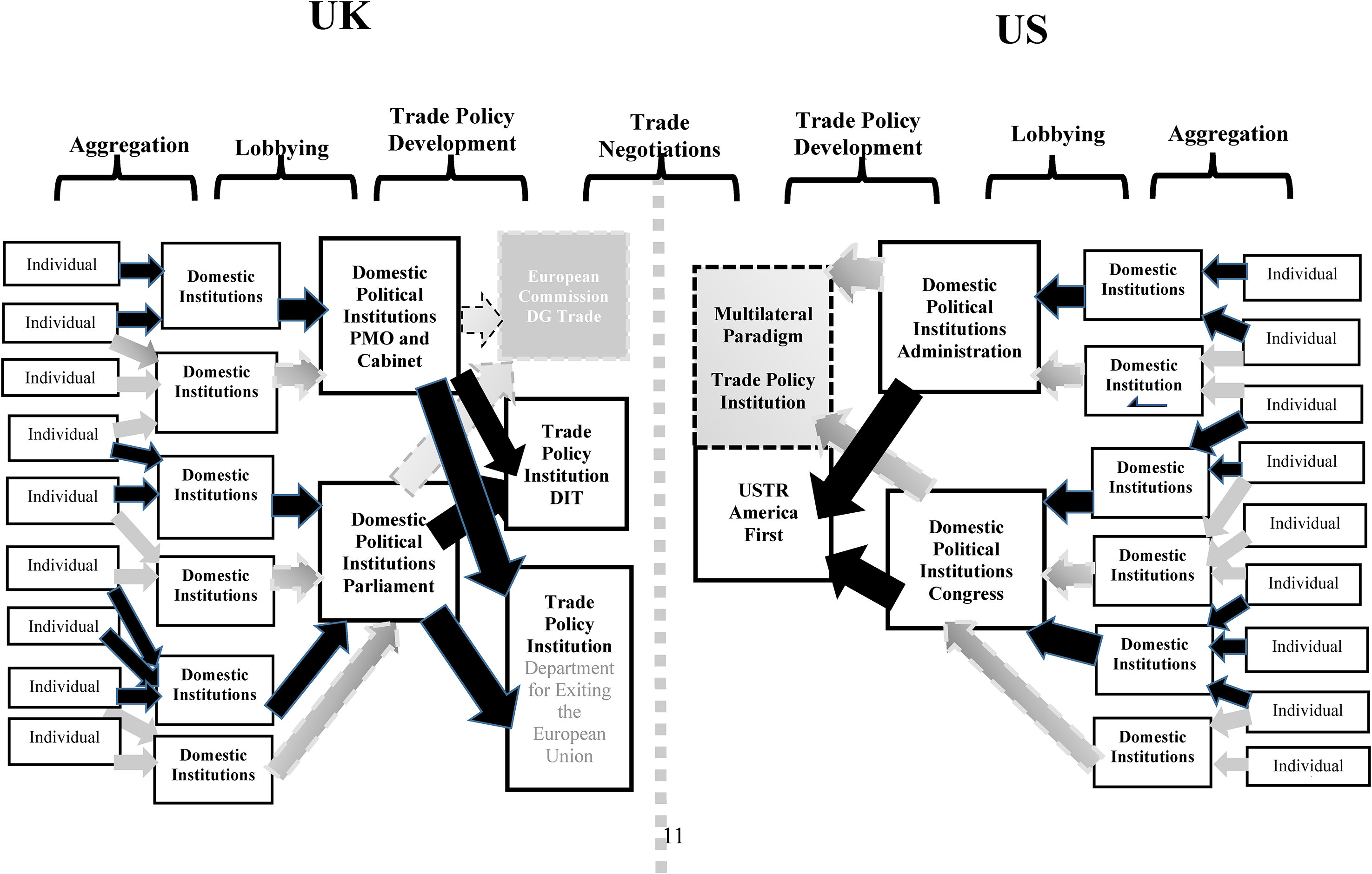
Trade policy development within the OEP framework.
In the case of the United States, the same process of changes in aggregation of individual preferences took place with different domestic institutions being more influential in lobbying efforts. The Trump administration moved away from the multilateral paradigm (seen in gray in Figure 1) with a re-orientation of the Office of the U.S. Trade Representative to an America First policy orientation. The newly focused USTR developed the negotiating strategy of the United States toward the UK–US trade agreement.
Examining the UK–US Trade Deal through the OEP Framework
Current Trade Relationship
Conceptualizing the trade negotiation dynamics through the OEP lens requires an understanding of trade between the UK (through the EU) and the United States, which is currently conducted under WTO rules. An examination of US and UK tariffs (EU Common External Tariff—CET) shows that tariffs are low on average, around three percent, although some tariffs are high in sectors such as chemicals and agriculture. For example, trade-weighted tariffs for industrial goods average 1.6 percent for both the EU (and therefore the UK) and the United States. By contrast, EU agricultural tariffs are 8.5 percent on a trade-weighted basis, while U.S. agricultural tariffs amount to 3 percent on the same basis (Balls et al. 2018).
The UK ranks as the seventh largest goods trading partner for the United States, while the UK was the fourth largest export destination for U.S. exports in 2018. The U.S. exports and imports were US$125.9 billion and US$110 billion, respectively, to and from the UK. While the United States is the UK's largest export market, America enjoys a net surplus (US$15.9 billion in 2017) in goods and services trade. A closer examination of U.S. exports to the UK shows chemical products are the largest, representing 21 percent of total exports, followed by transportation (20 percent) and machines (19 percent). Of UK exports to the United States, the most important are machines representing 25 percent of the total, followed by transportation (15 percent) and precious metals (12 percent). Trade in services with the UK (exports and imports) totalled an estimated US$134.8 billion in 2018. Services exports were US$74.1 billion; services imports were US$60.7 billion. The U.S. services trade surplus with the UK was US$13.3 billion in 2018. Financial services is the largest service sector being traded between the United States and UK, representing around 17 percent of exports to the United States, and about 21 percent of imports from it. The United States is the top destination for UK foreign direct investment (FDI), accounting for 20 percent of the total UK outward FDI stock, and U.S.-based companies invested around £350 billion in the UK in 2017. The United States is also the top investor in the UK, accounting for 26 percent of the total UK inward FDI stock, around US$541 billion, in 2017 (ONS 2017).
The Paradigm of Power and Ideas
Ideas are “a coherent set of beliefs about cause-and-effect relationships” that focus on policies and economic outcomes, which are driven by societal and business interests (Oatley 2019, 40). Power, conceptualized as economic strength, 17 is a critical component of national power and “allows governments to compete to attract and maintain desired industries” (Oatley 2019, 37). Thus, the power-ideas linkage explains how interest groups interact with and influence government policies and political institutions, and how these potentially impact the outcomes and the overall economy.
Within the context of UK–US FTA talks, power is interpreted in terms of a partner's weight in the global economy, which is an important driver of trade talks and enables a country to take the lead in launching FTA negotiations and in proposing FTA rules (Wang 2019, 440). The U.S. economy is approximately seven times larger than that of the UK, and while the United States is the UK's largest trading partner outside of the EU, the importance of the UK as a trade partner is small for America. There is a substantial difference in economic terms, and the imbalance between the UK and United States in the magnitude of trade flows and economic size gave the U.S. trade negotiators an advantage (Garcia 2004, 304).
The U.S. NAFTA-based FTA template has evolved since the 1990s with the revised template rebalancing investment protection and the state's regulatory power (Taylor 2009, 588). The United States has been willing to abandon FTA negotiations rather than accepting any significant deviation from its template (Vandevelde 2009, 121). During the Trump administration, the United States employed an aggressive approach to trade negotiations, as evidenced by the U.S.–Mexico–Canada Agreement (USMCA), as well as issues with China and the EU, which can be interpreted as tactics to coerce partners. 18 The UK–US FTA was a test of this U.S. approach to FTA negotiations. Unlike the United States, the UK has no precedent of negotiating a FTA, and recent evidence from talks with the EU concerning the Withdrawal Agreement suggest that the UK's approach is primarily distributive 19 and lacked clear asks. The negotiating approach changed once Boris Johnson became prime minister in July 2019, from distributive to aggressive with clarity on negotiation objectives, but lacking experienced negotiators. 20
The UK government is vigorously pursuing a Global Britain strategy that is intended to establish a trade network by successfully establishing bilateral FTAs with Japan and Australia and pursuing future agreements with the EU, India, and New Zealand as well as the United States. Using a UK–US FTA to promote the Global Britain strategy was particularly attractive as the UK–EU relationship post-Brexit has proved difficult. The conclusion of FTAs with major trade partners would give the UK a strategic advantage as the hub of a trade network, allowing for a sizeable economic advantage and diplomatic influence. 21 Thus, the UK perceived the United States as a “top priority and cornerstone… in the strategic partnership across the defense area, including the very important area of nuclear, and the intelligence relationship” (House of Lords 2017, 15).
Interests
The central actors in the political system and in the economy—individuals, firms, labor unions, non-government organizations (NGOs), other interest groups, and governments—have goals or policy objectives that they want to use foreign economic policy to achieve. Lake (2009, 226) defines interests as “how an individual or group is affected by a particular policy.” Oatley (2017, 698) highlights that firms and trade associations impact on FTA talks and, hence, governments have to negotiate not only with their partners but also with a complex web of domestic interests. Owen and Walter (2017, 183) suggest micro-level interests are aggregated through national institutions to produce a policy position for the international bargaining that then occurs. In focusing on interests, the adapted OEP framework assumes that individuals and the interest groups that represent them prefer economic policies that raise incomes. A compromise is thus required to be made across groups within a country and across countries in the FTA. Further, a society-centered approach that argues that trade policy objectives are shaped by politicians’ responses to interest groups’ demands needs to be recognized.
Explanations for countries’ interest in pursuing trade agreements include addressing differences in factor endowments, increasing market size, firm competitiveness (to benefit from profit shifting externalities), and cross-border trade (Kawai and Wignaraja 2009; Baldwin and Jaimovich 2012; Antras and Staiger 2012; Maggi 2014). Non-traditional explanations include increasing policy predictability, signaling openness to investors and achieving deeper commitments (Baier and Bergstrand 2004; Maggi 2014; Khorana et al. 2018). Yet others highlight political interests (i.e., integration, domestic interests, democracy, institutions, and diplomacy), while others discuss political economy determinants (such as fear of ‘losing out to neighbors’), assert ability to set international norms and rules, and use trade as a foreign policy instrument (Ravenhill 2003; Baldwin and Jaimovich 2012). Some emphasize strategic interests (e.g., geopolitical and security factors) as a lock-in-mechanism for liberalization reforms and for leveraging foreign direct investments (Maggi and Rodriguez-Clare 2007; Woolcock 2013; Bagwell and Staiger 2011; Khorana, Kerr, and Mishra 2014; Villareal and Fergusson 2015). While the macro interests are taken into account, the micro-level interests are often missed, something the OEP framework seeks to address through its aggregation of individual interests approach.
The Trump administration's determination to renegotiate NAFTA and other FTAs was a response to specific demands made by domestic economic groups of workers and firms. The vote for Brexit appears to reflect the interests of those who do not feel they have directly benefitted from membership in the EU and who perceive that membership puts pressure on social services and national health service (NHS) resources—whether this is a true picture is disputable. Most of the domestic opposition to Brexit and to the Trump administration's re-evaluation of America's trade deals emerges largely from domestic economic groups that benefit from trade agreements (Oatley 2019, 27). In the United States, one of the electoral promises (and slogans) of the Trump campaign was to drain the swamp once elected. The swamp is the class of professional policy makers that holds sway in an area around Washington, D.C. known as the Beltway—bureaucrats, lobbyists, think tanks, and other institutionally housed expertise that has grown up to support the policy making process of the federal government. The elitism of its members is an anathema to those that comprise President Trump's base of supporters. Trade policy makers are part of the swamp. While the institutions remained, many in the trade policy machinery of the federal government such as those housed in the Office of the U.S. Trade Representative were dismissed and few replacements appointed during President Trump's time in office—although the USTR did continue to function. 22 It was difficult for the Trump administration to find people with expertise who they felt they could trust (that is, who were not members of the swamp) (Kerr 2020a). While the Trump administration indicated that it wished to negotiate a number of trade agreements, very little other than the NAFTA re-negotiation and attempts to bring China to heel were initiated. 23
For a UK–US FTA, the Trump administration's priority was to secure guaranteed access for its firms into the UK market and ensure the services and investment rules that protect access would be as strong as possible (Office of the United States Trade Representative and the Executive Office of the President 2019, 5). The UK's objective was to negotiate “an ambitious and comprehensive FTA with the US that strengthens the economic relationship with our largest bilateral trading partner, promoting increased trade in goods and services and greater cross-border investment” (Department of International Trade 2020). The vision of Prime Minister Johnson was to ‘drive a hard bargain to boost British industry’ and reduce ‘red tape for small businesses, cut tariffs for products from dairy to cars.’ Further, in political terms, striking a FTA with the United States was seen as a great prize by Brexit advocates that would increase economic and trading ties between both countries.
Institutions
Nation states establish institutions based on the calculations of self-interest and relative gains, so institutions are not independent variables but are decided by the power structure and shaped by powerful states to increase their share of world power (Wang 2019, 437). Further, political institutions determine which groups are empowered to make choices and establish the rules these choosers operate within by providing the rules that support collective decision making. In domestic political systems, democratic institutions promote participation in collective choices; in international affairs, governments make decisions (Oatley 2019, 37). In short, the domestic institutional context shapes how interests are aggregated, and the influence of particular groups on policy outcomes. Therefore, different domestic institutions are likely to produce different policy outcomes (Owen and Walter 2017, 186).
It is widely known that, at the time, the UK had limited negotiating capacity as, until Brexit, trade negotiations were undertaken by the European Commission. Although negotiating capacity is being built through the development of an institutional set-up for negotiating FTAs in Department for International Trade (DIT), as well as increasing staff significantly, accomplishing this put immense pressure on Whitehall resources (Dunton 2019). The need-for-speed in the UK–US negotiations meant institution building in the UK was not yet complete and that they had to take place at the same time as negotiations over the future relationship with the EU. The UK's National Audit Office (2019) report acknowledged that overseeing several trade negotiations simultaneously would require engagement with multiple bodies at different stages, severely taxing the available resources.
Historically, the United States has had strong and well-developed institutions for trade policy making. The U.S. constitutional arrangements, however, complicate trade policy making and negotiations. The executive branch negotiates trade agreements but Congress must approve them. Congress authorizes the negotiation of trade agreements and puts limits on what the executive branch can negotiate. There is a well-developed lobbying industry aimed at influencing the Congress. The executive branch has technical expertise in, for example, the Office of the U.S. Trade representative at its disposal. The reality is that trade policy making is a negotiation between the executive branch and the Congress. This changed with the Trump administration's focus on draining the swamp—eschewing the advice of trade experts. While the institutional arrangements to lobby Congress remained in place, the relationship between the Congress and President Trump was very acrimonious thus limiting the ability to compromise. In the negotiations with Mexico and Canada leading to the USMCA, the United States seemed poorly prepared relative to past negotiations. The United States did not put a long list of economic asks on the table and there was a considerable delay in any being brought forward (Kerr 2020a, 130). It is clear that a few interest groups 24 had the executive branch's ear but that the normal broad-based lobbying channels were not operating.
In the UK, as is typical in parliamentary democracies, it is the government that establishes and undertakes trade policy. In post-Brexit: As it stands now, the executive branch (Government) holds most of the negotiations and trade policy prerogatives through the Department for Exiting the European Union (DExEU), the Department for International Trade (DIT) and the Department for Business, Energy and Industrial Strategy (BEIS). One can only note that statutes do not stipulate close coordination among departments, while DIT concentrates most trade competencies” (British Chamber of Commerce and London School of Economics 2018, 20).
Interaction Between Interests and Institutions
From an IPE perspective, “political and economic forces” interact in defining “states and their capabilities and choices” (Lairson and Skidmore 2016, 48) and the state takes on the role of a broker and assembles the positions of non-state actors, in particular business interests, which are affected by the need to defend a country's economy from competition with producers in other states (Sicurelli 2020, 61). The OEP framework envisages domestic and international interactions. At the domestic level, businesses and NGOs interact in trade negotiations, especially when the trade deal under negotiation touches upon issues relevant for civil society, and this may prove successful when allied with powerful corporate actors (DeSombre 1995, 60). The different objectives of the negotiating mandates suggest that, on the one hand, the United States has a Buy American (protectionist) agenda (Office of the United States Trade Representative and the Executive Office of the President 2019) unlike the UK that is aiming for a “comprehensive agenda” (free and fair trade) (Department for International Trade 2020, 8). The America First objective meant that “The United States seeks to support higher-paying jobs in the United States and to grow the U.S. economy by improving U.S. opportunities for trade and investment with the UK” (Office of the United States Trade Representative and the Executive Office of the President 2019). On the other hand, the UK's priority is to “secure an agreement which works for the whole of the UK and takes appropriate consideration of the UK's constitutional arrangements and obligations” and to “secure appropriate provisions to promote open and fair competition between businesses” (Department for International Trade 2020, 9). These objectives are conflicted, unlike negotiations under the ruling paradigm where compromise was at the heart of progress toward trade liberalization—suggesting there was insufficient common interest to reach an agreement.
The difference in objectives hints that the shape of any FTA would have gone beyond the uncertainties that arise from a simple process of trade negotiations. The UK and U.S. negotiators followed a distributional logic approach; that is, entering negotiations with pre-determined positions that have been developed without consideration of what might be possible for the partner country. To reach an agreement both countries would have had to have a “good understanding of their own preferences and priorities, to communicate those to their counterpart and integrate information about each other's preferences and priorities into their own understanding of the problem at hand” (Odell 2000, 17). As this was not the case, varying demands of domestic lobbies impacted the pace of the negotiations. If the UK–US FTA was to succeed, an integral requirement of the negotiations should have been to ensure transparency not only toward domestic constituents but also the negotiating partner.
With Brexit and President Trump's election, trade policy making and negotiating strategy was altered radically (Oatley 2019, 10). The U.S. negotiation approach was characterized by a combination of integrative and distributive strategy, unlike the UK's pure distributive negotiating strategy and only limited and delayed engagement with stakeholders (Simões 2011, 355). What set the UK–US FTA negotiations apart was that both the United States and the UK adopted a somewhat distributive negotiating strategy, also referred to as ‘competitive’ and ‘positional bargaining’ strategies (Elgström and Jönsson 2000, 690; Odell 2000, 23) which aims to increase the negotiating country's gains. Prior to the Trump administration, the United States followed an integrative strategy to negotiating FTAs, often referred to as ‘problem-solving,’ ‘collaborative,’ ‘win-win,’ or ‘principled negotiation’ strategies (Fisher and Ur 1981, 22; Lax and Sebenius 1986, 22; Elgström and Jönsson 2000, 691; Odell 2000, 14) that aimed at increasing the joint gains for all negotiating parties. In the re-negotiation of NAFTA, where the intent of the Trump administration was to re-balance any new agreement so that it provided the United States more favorable terms, both Mexico and Canada were put on the defensive attempting to retain as much of the NAFTA as possible. Other than re-shoring automotive jobs from Mexico, the primary U.S. objective was to remove the constraints on trade policy embedded in the NAFTA—in particular the disputes settlement system and absence of a sunset clause as well as no new benefits for Mexico or Canada (Kerr 2020a, 132).
Issues Where No Concessions Were Possible in the UK–US Negotiation: The Recipe for Failure
The main stumbling blocks in the UK–US negotiations were always going to be in agriculture, manufacturing, and pharmaceuticals.
25
Any progress in these areas was going to require concessions that were unlikely, if not impossible, right from the outset. Disagreements over digital taxation, state support for airlines, and steel and aluminum tariffs as well as tariffs on British imports including Scottish whisky, and the threat of tariffs on UK gin and vodka added additional contemporary stumbling blocks. The priorities of the partners varied—the language of the U.S. negotiating mandate was ‘aggressive’ and explicit in demanding concessions, a policy consistent with America First (Kerr 2018, 80). The negotiating interest diverged, with the UK manufacturing associations voicing concerns that the UK could be flooded with U.S. goods if the UK agreed to U.S. standards. Similarly, the UK food industry called on the government to protect food standards. Busch et al. (2018, 6) provide an assessment of the resistance to concluding the UK–US agreement: the major sticking points are likely to be regulatory. In turn, these sticking points are likely to have a significant bearing on the extent to which British public support endures, particularly if the UK government pushes forward with an approach that jars with public perceptions of sovereign decision-making or sensitivities around food standards and health but which are consistent with US approaches. It all goes back to the UK media commentary on chlorine-washed chicken and hormone raised beef. I believe the controversy is as strong as it was back then. DEFRA has made it clear they will not accept a deal which lowers food standards for the sake of a deal. If you apply this logic to other sectors, I am doubtful of the ability of both governments to work through the domestic politics and challenges of this deal.
The concerns also followed from divergence in the negotiating mandates. For example, the U.S. negotiating mandate mentions the science-based approach to regulation. The UK, on the other hand, suggested it would “uphold the UK's high levels of public, animal, and plant health, including food safety” (Department for International Trade 2020, 9). The UK also wanted to enhance access for its agri-food goods into the U.S. market by seeking commitments to improve the timeliness and transparency of U.S. approval processes for UK goods. Despite similar objectives of conservation, food, human, animal, and plant health regulations, both partners have differences in their approach to risk management; that is, the UK continuing to use the EU's precautionary approach rather than the science-based approach of the United States. The UK's precautionary approach allows regulators to take a wide range of evidence (e.g., economic, social, and environmental impacts) as well as scientific evidence into account, permitting action in the absence of incontrovertible scientific evidence that a substance or process is harmful (Smyth, Kerr, and Phillips 2017, 180). The U.S. perspective involves the use of a science-based approach by regulatory agencies when regulating, explaining decisions, and considering if regulation is needed. Contrary to the UK's approach, which places the onus on the producer, under the U.S. system, regulators need to prove a product is harmful in order to ban its sale. Chlorinated chicken and hormone-treated beef could have become sticking points in discussions.
Regulatory differences in goods and services requires companies to demonstrate (that is, through additional tests) that products meet the requirements of both the country of origin and the importing country. While there are different mechanisms for deepening regulatory cooperation and minimizing non-tariff barriers, the most common are regulatory cooperation mechanisms that include mutual recognition, harmonization, equivalence, or substitutional compliance, as well as bodies to continue regulatory dialogue and coordination. The UK currently has retained most EU standards, but the effect of Brexit might result in regulatory standards divergence between the EU and UK, but there is lack of clarity on this issue. With regards to standards and conformity, the EU and U.S. approaches to standardization (that is the process by which technical standards for goods and services are defined) and conformity assessments differ in similar respects. The EU's standardization process is centralized, whereas the U.S. system is decentralized and, unlike the EU, the private sector in the United States plays an important role in standards-setting (Hobbs et al. 2014). Further, EU and U.S. regulators have different approaches to the conformity assessment for specific products and risks. The United States requires third-party testing or certification for a number of products. On the other hand, the EU requires only a supplier’ declaration of conformity. Given these differences there could be two options for how the UK and United States could possibly have approached regulatory cooperation. These include, first, full alignment with the United States, which would remove the costs of the non-tariff barriers between partners. Second, the UK could choose to remain aligned with the EU's regulatory model, although this seems unlikely. While pursuing a comprehensive FTA with the United States, including on regulatory matters, may have benefits for the UK, it could also have given rise to regulatory barriers with the UK's other major trading partners, including the EU.
Enhanced access for healthcare companies to the NHS was another demand that the United States would likely have put forward which was a red line for the UK. Opposition to opening the NHS to US health service providers was where the most vociferous reactions were manifest by both the public (Kerr and Viju-Miljusevic 2020) and those institutions lobbying for their vested interests in the NHS. As reported by Mahase (2019, 2), Chaand Nagpaul, British Medical Association (BMA) council chair, called the idea that that the NHS would be part of trade talks “alarming,” saying that it must not be allowed to become a reality.
He said, “Despite previous assurances from Mr Johnson, … we now need cast iron guarantees from all parties that the health service will form no part of negotiations around future trade deals, and that the health of the British public will not be put at risk by commercial motives or lower standards.
While the U.S. mandate made no direct reference to the UK's NHS, it calls for “specialized sectoral disciplines, including rules to help level the playing field for US delivery services suppliers in the UK” (Office of the United States Trade Representative and the Executive Office of the President 2019), which comes close to demanding access to health services.
The UK has long-standing demands, such as enhanced access for food manufacturers and financial services and the easing of retaliatory tariffs against it when it was a member of the EU—related to subsidies to Airbus (Bishop 2020). 26 Government procurement was also likely to be an interest where the UK was on the offence, and sub-federal procurement regulation was likely to be a key common impediment to the liberalization of the U.S. procurement market. Further, the U.S. negotiating mandate stated in unambiguous terms its aim was to increase opportunities for U.S. firms to sell products and services to the UK, while simultaneously restricting access for the UK (for example, through keeping domestic preferential purchasing programs at state and local government levels) (Office of the United States Trade Representative and the Executive Office of the President 2019).
The liberalization of the U.S. services market was a key offensive interest for the UK in the FTA setting given that the UK and United States have an established relationship regarding trade in services and investment. Trade in UK services, however, faces regulatory and market access barriers and increased market access for UK service providers would have been a key win in a FTA deal. The barriers faced by UK services are explicit, such as restrictions on foreign ownership, scope of business of foreign services providers or corporate form, or discrete, which stem from different approaches to regulation. Implicit barriers include quantitative restrictions, regulations such as qualification and licensing requirements. Further, the federal system of government in the United States confers legislative powers on both federal and state levels of government. This means that UK service providers trading in the United States may confront regulatory barriers at both levels. An added complication is that state governments could potentially contest enshrining services liberalization in the federal market access schedules, which could have impacted on the progress of talks. From the U.S. perspective, it is noteworthy that the UK's de facto open services economy limits the menu of concessions that it can offer in services to the United States as evidenced by the OECD Services Trade Restrictiveness index (STRI) that ranks UK as the tenth most open market for services, hence limiting any scope for further liberalization.
The re-focusing of U.S. trade policy toward the America First approach championed by presidential advisors Peter Navarro, Steve Bannon, and Wilbur Ross, meant the objective of trade agreements was to maximize the benefit to the U.S. economy with an emphasis of retention of U.S. manufacturing jobs and re-shoring manufacturing activities (Johnson 2018). As a result, increased access to the U.S. market for manufactured goods was no longer a carrot that could be offered to any significant degree in trade negotiations. This was evident in the re-negotiation of the NAFTA where Mexico and Canada were offered virtually no additional market access and had to agree to concessions that that would stop the relocation of production facilities to Mexico and to re-shoring jobs in the automotive sector to the United States (Kerr 2020a). Hence, the U.S. automobile industry was able to successfully lobby to retain barriers to British-made cars being given more market access. The steel and aluminum industries already had the ear of President Trump as they received additional tariff protection early in the Trump administration. They lobbied hard for the retention of these tariffs in any new trade deals. A wide range of U.S. industries were able to garner protection under the guise of America First.
In the case of the United States, the decline in enthusiasm for a UK–US trade agreement did not arise, however, from increased protectionist pressures. Although protectionist interests in manufacturing as well as sugar, financial services and government procurement made their voices heard (Dragunova and Gari 2021), most of the input regarding the agreement came from U.S. industries pushing for better access to the UK market. In agriculture, where strict EU SPS regulations still applied, U.S. firms and producer organizations wanted, in the best-case scenario, complete harmonization with the U.S. system. Failing that, they wanted a considerable revision of the standards for sanitary procedures related to chicken processing and production methods such as the use of hormones to stimulate growth in beef animals and the use of genetically modified organisms (GMOs) (Bromund 2020). The United States also wanted changes to the drug purchasing policy of the NHS (Dragunova and Gari 2021). There was also considerable resistance to allowing UK firms improved access to government procurement both nationally and at the state level.
When it became clear, once formal negotiations started, that the UK would not be willing to bargain seriously regarding the major U.S. ambitions for the agreement, interest waned. If there was not to be a quick and adventageous agreement for the United States, President Trump had other priorities he wished to pursue—in particular, hobbling China.
In sum, areas of possible compromise appear scarce. While the new aggregations of trade interests that allowed for Brexit and the election of President Trump at the outset appeared to offer a route to a new trade agreement, the actual focus of those interests meant a divergence in the objectives of trade policy—and one that could not be bridged. From the OEP perspective, this suggests that the realignment of interests in both countries allowed for a change in trade policy—from following the ruling paradigm and being a member of the EU to Brexit and Global Britain for the UK. In the United States it meant eschewing the ruling paradigm in favor of an aggressive pursuit of an America First agenda. These were clear breaks from the past and are consistent with OEP. With both countries having new freedom of action, Prime Minister Johnson and President Trump thought they could capitalize on that new freedom to quickly achieve a UK–US FTA. The new alignments, however, did not allow for such an opportunity.
Discussion
The results tend to support the OEP framework providing insights into the development of interest in negotiating a UK–US trade agreement and why it did not come to fruition. These are summarized in Table 1. In both the EU and the United States, there was clearly some change in individual preferences—the smoking guns being the Brexit vote and first the selection of candidate Trump and second his election—which arose from new aggregations of interests. 27 The lobbying by those institutions aggregating new individual preferences spurred changes in government trade policy institutions. In the case of the UK, the trade making body of the EU, the international trade division of the European Commission—DG Trade—was replaced by the domestic Department of International Trade (and the Department for Exiting the European Union). In the case of the United States and the Office of the U.S. Trade Representative it led to re-orientation from pursuing mutually supportive trade agreements to maximizing the benefit received by the United States in trade agreements.
Summary of the Results
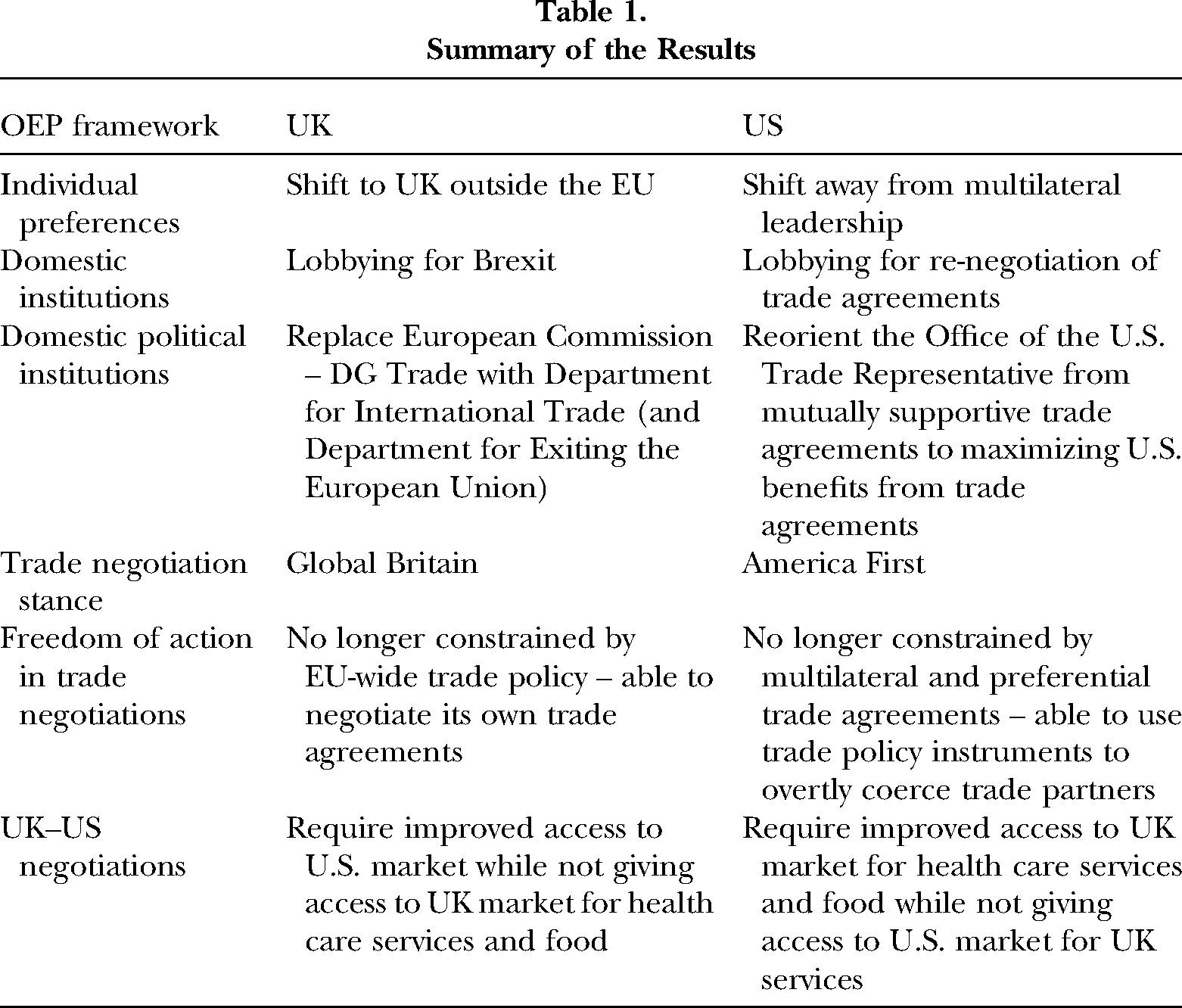
These newly formed or reoriented domestic trade institutions began formulating trade negotiation strategies that were no longer constrained by previous trade arrangements. OEP suggests that new institutions will arise in the wake of changing preferences, and while the new trade institutions were established, or existing institutions reoriented, they were not fully formed at the time negotiations were required. The UK's Department of International Trade had to recruit inexperienced staff as trade policy making and negotiating expertise had previously resided in Brussels and the European Commission. In the United States, the USTR had been staffed by individuals steeped in the multilateral paradigm as were the trade supporting institutions of the Beltway—the swamp to supporters of America First. It was difficult for the Trump administration to find knowledgeable trade people they could trust, and many positions remained unfilled. While these new and reoriented institutions were able to develop trade policy unincumbered by the previous constraints, these new negotiating positions did not converge and instead conflicted. As a result, the negotiations did not move forward to a successful conclusion despite apparent the enthusiasm of the Johnson and Trump administrations. Boris Johnson retained his enthusiasm for the potential trade agreement with the United States but, in the face of drawn-out negotiations, the Trump administration concentrated their efforts on other trade issues.
Conclusion
In light of the divergent negotiating stances of the parties it is unlikely that the UK–US FTA negotiations would have been along traditional lines of reciprocal concessions. To get the deal over the line trade-offs would have been required between sectors. The analysis of the proposed UK–US trade deal hints that, while economic theory strongly supports free trade and outward-oriented trade agreements, trade policy is decidedly in the political realm and economic arguments constitute only one—albeit essential—dimension of trade negotiations. Economic power and domestic interests affect policy choices but with stumbling blocks in agriculture, manufacturing, pharmaceuticals and health care services, significant trade-offs would be required. With those not forthcoming, the talks lost dynamism even before the defeat of President Trump in the November 2020 election. The optimism of Boris Johnson on the accomplishment of a quick deal with the United States appears to have been based on the perception that the only thing holding the UK back was being part of the EU and once Brexit got done anything was possible—however, there were other constraints (Griswold and Salmon 2020). In the case of President Trump, the belief was that previous administrations had agreed to constraints on U.S. trade policy that allowed the United States to be taken advantage of by trade partners. His administration would no longer be constrained in its trade policy making and that the UK leaving the EU presented an opportunity for a new America First style agreement—however, there were other constraints (Kerr 2018). 28
It took a new configuration in the aggregation of interests in the UK and United States to bring about Brexit and the election of President Trump. Given these new alignments, which approach trade through a much more distributive lens, different priorities emerged in both countries. With the new focus in the United States on bolstering a self-centered America First policy through trade agreements and the UK wishing to pursue Global Britain to offset the costs of leaving the EU, the trade objectives of the two parties were not aligned. While the rhetoric emanating from Downing Street and the White House during the tenure of the Trump administration was enthusiastic about the speedy negotiation of a UK–US FTA, the reality was that the new alignment of interests that allowed the election of both Boris Johnson and Donald Trump did not open a space where there was a mutual alignment of those interests. As a result, the UK–US trade deal was never concluded.
The present study suffers from absence of information on the discussions that led to the establishment of new, or reoriented, trade institutions and the formulation of new trade policies and negotiating strategies. These will only be revealed over time, if ever. It is also difficult to disentangle trade policy from the other changes in individual preferences such as those toward immigration, regional job losses attributed to trade agreements, the rise of China, being left behind, etc. Trade relations are only a small part of how individual preferences are formed. As OEP does not require that there is a major shift in preference, only a sufficient shift to lead to new aggregations, ex-post observation of such a change in trade policy is the only evidence that such a shift in preferences has taken place. Further, whether the shifts preferences are permanent or just a temporary phenomenon cannot be known.
The implications of this research depend on the ‘permanents' of the shifts in preferences. If the shifts are permanent, then international trade and the benefits that flow from it will suffer because finding a mutually beneficial space for successful trade agreements will be difficult. If the shifts are only transient and there is a return to the ruling paradigm of international trade then there will be a focus on cooperative trade relationships and, while progress in trade liberalization is always slow, progress is possible. OEP can provide insights into the process of trade policy formulation.
Footnotes

About the Authors
Professor
Professor