




Abstract
This article tests Poguntke and Webb’s theory of ‘electoral presidentialization’ through a comparison of Silvio Berlusconi and Boris Johnson. Johnson and Berlusconi stand as particular examples of ‘electoral presidentialization’, where dominance lies in power as an election ‘winner’ and ‘mediatised leader’. This approach is highly contingent and reliant on continuous validation, and, as a result, both leaders failed to translate electoral ‘autonomy’ into concrete and lasting change. Utilising the three presidentialization ‘faces’, we identify three crucial weaknesses. First, their own electoral and mediatized focus created a pressure to permanently campaign and generate conflict, driving a ‘politics of spectacle’ that distracted from the politics of governing. Second, the centrality of their personality left them exposed to personal scrutiny, which increasingly focused on corruption, wrongdoing, and irregularities. Third, despite electoral command, their ‘presidentialized’ style rested on fragile party and coalition dynamics, leading to volatility and internal conflict.
Keywords
Comparing electoral presidentialization
He was the great communicator and election winner. One starstruck journalist praised his ‘energy’ and saw in his ‘unprecedented majority’ a ‘huge opportunity to proclaim his vision’. He had, it was said, the Midas touch and could reach out to voters beyond the normal range of a politician. His informal style, risqué jokes, and off-colour comments, which often tipped into racism and offence, gave him the flavour of an ‘outsider’. Despite coming to power amid deep crisis, his sunny optimism promised change. Love him or hate him, and plenty did both, he dominated all political discussion. Yet he ran aground amid growing economic crisis and wave after wave of personal and moral scandals. As support in the legislature collapsed, he won a confidence vote, but not by enough to survive.
The politician was, of course, Silvio Berlusconi, three-time Italian Prime Minister, and the starstruck journalist was Boris Johnson. During a visit to Berlusconi’s villa in 2003, Johnson himself tried to capture the contradictions of a highly presidentialized leader who ‘had a huge opportunity to enact what he proclaimed was his vision’ (Johnson and Farrell, 2003). While Johnson wrote gushingly about his charisma and popularity, he doubted whether Berlusconi could convert electoral victory into political change.
The temptation is to draw parallels with the two leaders. The premierships of Silvio Berlusconi and Boris Johnson represent presidentialization of a particular and extreme kind, examples of ‘electoral presidentialization’ rooted in the dominant leader as the ‘election winner’, campaigner, and as ‘communicator in chief’ (Helms, 2012; Poguntke and Webb, 2005). Both leaders, at various points, claimed ‘personal mandates’ and drew on a combination of personalisation, performance, and populism.
However, underneath the broad similarities, close comparison reveals the different contingencies driving their premierships. We find that that their ‘electoral presidentialization’, which appeared to be a source of strength, hid three key weaknesses, which differed between the two cases (Bale, 2023; Stille, 2007). First, their own electoral and mediatized leadership created a tendency to permanently campaign and generate populist conflict. Yet Berlusconi’s power and control were far more extensive than Johnson’s, and he was able to create a huge ‘regime mediatico’ (‘media-driven regime’) as part of an almost unique ‘attempt to combine media control and political power’ (Ginsborg, 2004; Travaglio and Gomez, 2011). Second, the centrality of their personality left them exposed to scrutiny and questioning, which focused increasingly on their corruption, wrongdoing, and irregularities, although, again, Berlusconi’s business and personal relations were far more complex than any other politicians, comparable perhaps only with leaders such as Donald Trump or Thaksin Shinawatra. Such issues of personal conduct came to dominate, and finally overwhelm, their premierships. Third, despite their electoral command, their ‘presidentialized’ style sat atop rather different types of fragile party relations. The internal dynamics of Berlusconi’s coalitions and Johnson’s divided a single party became volatile and conflictual.
The comparison also throws into sharp contrast the differing legacies: Berlusconi was an election winner who dominated Italian politics for two decades, managing to reshape Italian politics while protecting, successfully, his vast business empire (Baldini and Ventura, 2024). Johnson, by contrast, governed for just over 3 years, with a single election victory and a chimerical, temporary re-ordering of UK electoral politics (Bale, 2023; Honeyman, 2023).
Presidentialization
Berlusconi and Johnson are part of a Europe-wide tendency towards presidentialization and executive predominance, identified by Poguntke and Webb (2005). Presidentialization concerns the ‘leader centeredness’ of electoral, executive, and party politics: a result of the interacting dynamics of ‘greater power for the head of the executive within the executive’, ‘greater mutual autonomy of leader and (parliamentary) party’, and ‘more leader-centered electoral processes’ (Poguntke and Webb, 2013: 648). Poguntke and Webb (2005) identified a systematic strengthening of executives and enhanced personalised leadership across a range of countries. More recently, there is growing evidence that ‘the pendulum of power has swung in the direction of the executive’ (Andeweg et al., 2020; Elgie and Passarelli, 2020; Müller-Rommel et al., 2022; Rullo, 2021: 196).
Poguntke and Webb’s (2005) original case studies traced an unfolding dynamic from partified to presidentialized modes of governing. This dynamic was then explored in several key country studies beyond the original 14 (see, e.g. Iwasaki, 2023; Passarelli, 2015; Venturino, 2001). The model has however been contested (largely in a UK context): exactly how, where, and when ‘presidentialization’ happens remains unclear (Dowding, 2013). Dowding argued that any behavioural shifts have little structural basis. For all the sound and fury of ‘presidential’ styles, prime ministers remain rooted in their parties, and the model presents a misleading analogy (Heffernan, 2013; Rhodes, 2013). Such exchanges draw on the lively debate over prime ministerial power in the UK touching on whether it is presidential, personalised, predominant, or ‘stretched’. Heffernan (2013: 644) warned that, prime ministerial power ‘waxes and wanes’ with context, and a leader is at their most powerful if they ‘marry predominance to their pre-eminence’.
Poguntke and Webb (2005: 7) warn that such presidentialization is ‘highly contingent’, as it depends on victory and ‘the continued ability of the leader to substantially validate their personal mandate’, a point underscored by Heffernan (2013: 643). There are some assumptions around ‘presidentialization’ that may not survive contact with reality, such as the idea that media dominance, or ‘personalisation by the news media’, inevitably strengthens the power of the prime minister. In fact, the media can make a ‘strong prime minister strong and weak one appear weak’ (Heffernan, 2013: 643). Such contingency and fragility remind us that there is a hidden weakness and that presidentialist logics or dynamics can flow backwards and collapse into fragmentation and crisis (Palladino, 2015). Crucially, prime ministers can, unlike those they emulate, still face removal by their party (Samuels and Shugart, 2010). Indeed, the autonomy they cultivate from the party may leave them more vulnerable to removal, having acted ‘past their parties’.
The cases of Johnson and Berlusconi represent variants of a leadership that blends personalism and electoral presidentialism (Elgie and Passarelli, 2020: 365). Their premierships are held up as exemplars of the idea that ‘personality influences election outcomes, voting behaviour . . . and government’ and ‘that personalities do matter’ (Elgie and Passarelli, 2020: 364; Poguntke and Webb, 2005; Venturino, 2001). However, while their personalities were vital, the governing environment, legitimising context, and institutional flexibility (or inflexibility) were key parts of the story.
In this article, presidentialization is a ‘shorthand’ for the construction of a more autonomous form of leadership. Johnson and Berlusconi did not become presidents, even though Johnson appeared to think in these terms, and Berlusconi tried to make himself one in 2006. Both leaders did, however, display many presidential traits across the three faces. We use the model as an analytical framework to make a structured comparison between the two leaders.
Our comparison follows other careful, structured comparisons of ‘presidentialized’ leadership in two or more country cases (see Bennister, 2012; Bennister and Heppell, 2016; Campus, 2010; Körösényi and Patkós, 2017). Although we are comparing across different political systems, we can identify similarities that help us to understand the personalised phenomenon and its flaws, especially when the two systems are becoming more similar (see below) (Helms, 2020; Müller, 2021). Such comparisons can also guide us towards the common drivers that allow certain forms of leadership to come to the fore and stretch the political system to, and sometimes beyond, its limitations.
Table 1 adapts one of the few structural comparisons of the administrative and political dimensions of the UK and Italy over time (Pizzimenti and Calossi, 2020). The differences make for two different governing environments for a leader. The UK represents a relatively stable single-party-dominant system, whereas Italy, until recently, was marked by large, sometimes unwieldy, coalitions. Both electoral systems delivered advantages for those in charge, with a formal governing ‘bonus’ in Italy and majoritarian system skewed towards large parties in the UK. Until Brexit, the UK’s system was relatively stable, whereas Italy famously suffered a ‘polarised pluralism’ (something Berlusconi would change).
The three faces in the UK and Italy.
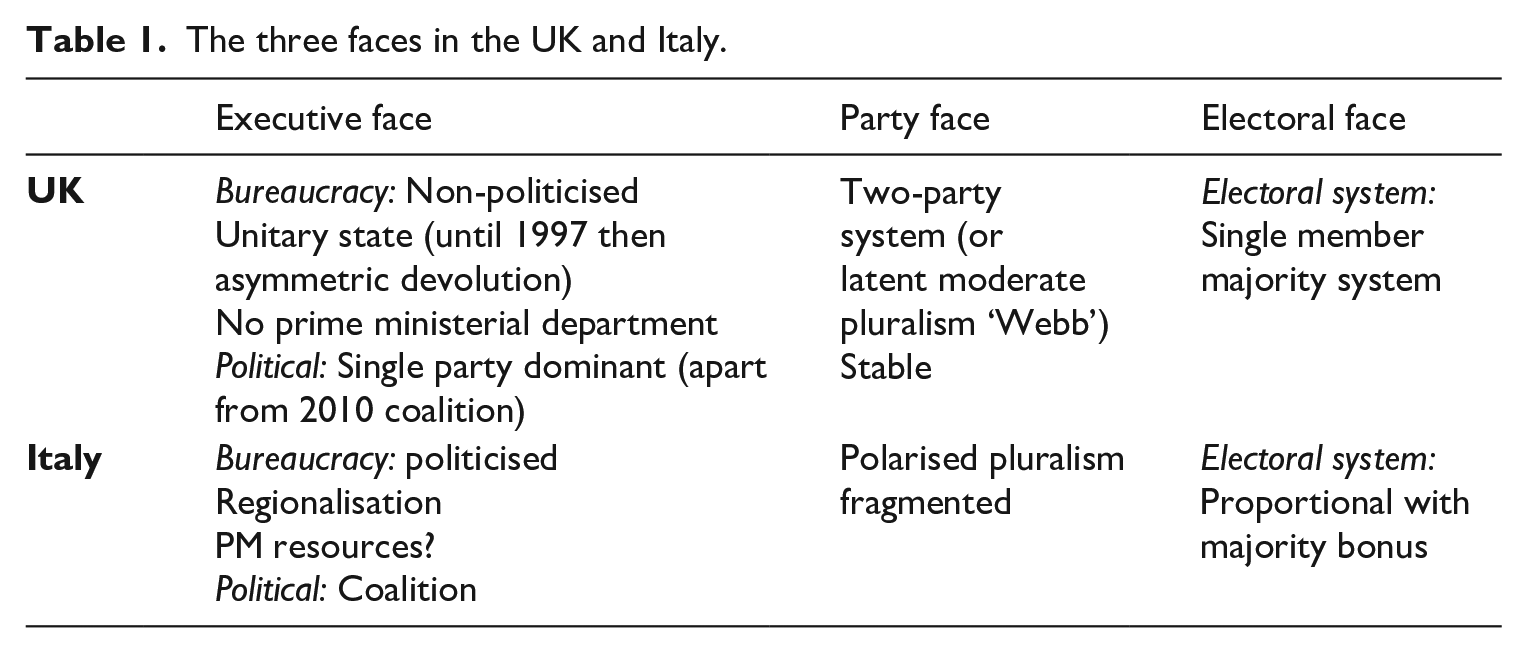
This means any Italian prime minister sits atop a far more fragmented party system, with less inherited power and a greater need to build and maintain a coalition. King’s (1991) argument that much power lies in party leadership means both Italian and British prime ministers can control by virtue of being party leaders, but the former must then build and hold coalitions, whereas the latter need not but must merely ‘look over their shoulder’.
However, both Italy and the UK were under pressure when the two leaders arrived. The party system collapsed in Italy just before Berlusconi’s arrival, while two partyism in the UK has been challenged by devolution and then Brexit (Pizzimenti and Calossi, 2020). As Table 1 illustrates, although there have been some systemic shifts and convergence, substantial differences remain across the two cases. Italy and the UK offer most different systems, as a basis for a considered and structured comparison (Esser and Vliegenthart, 2017).
The presidentialization of prime ministers in the UK and Italy
Historically, Italian prime ministers are underpowered, and UK prime ministers are over-mighty. Over recent decades, both systems show how prime ministers ‘accrue . . . extra powers through their behaviour’, and through new resources at their disposal (Poguntke and Webb, 2013: 651).
The Italian prime minister was long characterised as a marginal figure with weak powers, trapped in a ‘headless’ system dominated by parties (‘partitocrazia’; Elgie, 1995). In the First Republic, ‘heads of government were caretakers and conflict managers’ (Elgie, 1995: 162).
This began to change from the 1990s onwards, when Italy began to develop ‘all the main features of the presidentialization process . . . present over the past twenty years’ (Calise, 2005: 88; Musella, 2020). A slew of institutional reforms, alongside electoral and media pressure, created a far more ‘presidentialized’ model (Calise, 2005; Campus, 2006; Musella, 2015, 2020; Rullo, 2021). Leaders gained increasing control of their parties and, once in power, over the machinery of government (Calise, 2005) just as, electorally, Italian politics became ‘dominated by highly personalized campaigns’ (Campus, 2010: 224; Palladino, 2015; Venturino, 2001).
There were two main drivers for the change: the tangentopoli (‘bribesville’) corruption scandal of the early 1990s, which fragmented the old ‘partitocrazia’, and the Mattarella electoral reforms of 1993 (Bull and Newell, 1995; Jones, 2023; Newell, 2010). Tangentopoli exposed widespread corruption with, at one point, ‘251 members of Parliament under investigation including four ex-prime ministers [and] five ex-party leaders’ (Newell, 2010: 33). The Mattarella law of 1993 then created a shift to a single member plurality electoral system, driving personalisation, leader dominance, and ‘the growth of political communications and ‘campaign events . . . organized around the leaders’ (Campus, 2010: 224; Jones, 2023). Underneath these existential crises, and shifts in the political landscape, was a slow-moving accrual of institutional power as successive prime ministers acquired greater legislative control (Calise, 2005; Elgie, 1995).
By the time of the Second Republic in 1994, prime ministers were increasingly ‘campaigners and often party leaders; heads of government; mediators between their respective coalition partners [and] communicators-in-chief’ (Campus and Pasquino, 2006: 25). By 2005, Italy witnessed the ‘emergence of a presidentialized political executive . . . still formally under a parliamentary regime’ (Calise, 2005: 96). In the space of two decades, partly because of Berlusconi, it had become an ‘ideal type’ system (Musella, 2014a: 5).
In the UK, claims of over-mighty predominant leaders date back to Lloyd George or even further (Blick and Jones, 2016; Elgie and Passarelli, 2020: 359). What this means for the office, and the prime minister-cabinet dynamic, has been debated with claim and counter claim from Foley (2013), Jones (1991), as well as Heffernan (2005, 2013) and Dowding (2013). Few would argue that Tony Blair’s successors were presidential but all ‘helped ‘stretch’ both the prime minister and the party leader ‘away’ from other party and parliamentary colleagues, helping further empower or to personalise him or her (Heffernan, 2013).
Debate over the broader strengthening of the executive has coexisted with newer reformulations of notions of leaders as ‘strategic actors’ (Bennister, 2023; Byrne et al., 2021). Much is predicated on, and complicated by, the sheer flexibility of the office, which potentially gives the office and the incumbent a strong potential dominance (Bennister, 2023: 37). The British prime minister, in ‘normal’ times, has ‘surprising freedom to be and do what he or she wants’ (Seldon, 2021: 146). However, notably since Brexit, the premiership has seemed less presidentialized and resembled the weak, revolving door premiership of Japan (Bennister, 2023).
Berlusconi and Johnson: Personality, performance, and populism
Comparing any two political leaders is complex, given shifting contexts and different trajectories (Müller-Rommel et al., 2022; Rhodes and ‘t Hart, 2014). Prime ministerial tenures not only vary between themselves, but ‘there is variety within the lifetime of a single premiership’ (King, 1991: 43). There are, however, clear reasons for a considered and structured comparison, which can ‘bring a unique and broader perspective’ (Bennister, 2012: 27).
The Italian and UK political systems are distinct, and an Italian prime minister is clearly limited in ways a UK one is not: structurally, by asymmetric bi-cameralism, and constitutionally, by the powerful checks from the Constitutional Court and, increasingly, the President (Newell, 2010). Any Italian prime minister must engage in complex coalition building and maintenance with partners with their own bases, balancing in a way no UK prime minister would need to.
There are, however, convergences. Italian prime ministers have accrued growing power over the legislature, as well as increased power resources, directly inspired by the UK (Calise, 2005; Elgie, 1995). More broadly, the Italian electoral system has moved away from the ‘pure’ proportional representation of the coalition system and is working, in fact if not in theory, more as a majoritarian bi-polar system (Jones, 2023; Newell, 2010). From the other side, the UK’s growing backbench rebellions since the 1990s created executive-party relations that are more unstable (King, 1991; Wager et al., 2022: 957).
Within their own political systems, Berlusconi and Johnson were regarded as ‘unique’ and ‘different’ politicians, although it is unclear, as Ginsborg (2004) argued of Berlusconi, if they were an ‘exception or a prototype’. At their height, they invited (and often made self-declared) comparisons with Mussolini, Disraeli, and Churchill (Ginsborg and Asquer, 2012; Saunders, 2022). There have been cross-comparisons too, with one UK commentator claiming that ‘Boris Johnson and Brexit are Berlusconifying Britain’ (Davies, 2019).
The two leaders have been viewed through similar lenses by scholars. Berlusconi has been seen as an anti-politician (Campus, 2010); a ‘failed’ populist (Newell, 2018); an inspirational leader (Körösényi and Patkós, 2017); or a toxic one (Allum, 2011). Johnson too has been portrayed as a type of populist (Alexandre-Collier, 2022; Margulies, 2019); hypermasculine (Waylen, 2021); or anti-elite (Tomkins, 2020). Their legacies continue to be debated (Baldini and Ventura, 2024; Honeyman, 2023).
Berlusconi and Johnson’s electoral appeal rested on combinations of personality, performance, and populism. First, the two leaders were exemplars of a highly personalised style, generating leadership capital and mandates through direct appeals to the electorate. While all politicians have become increasingly mediatised, the two leaders developed an extreme form of ‘candidate centred’ and personalised campaigning (Campus, 2010; Poguntke and Webb, 2005). Both created negativity and attacked key parts of their political strategy, something which has been shown to generate media and TV coverage (although the impact on voters is ultimately negative; Poljak, 2024).
Both were ‘celebrity politicians’ (Street, 2004), or more accurately ‘superstar politician celebrities’ of different kinds (Wood et al., 2016). Berlusconi was already a powerful figure, with a background as a property developer and then media mogul, and was one of Italy’s richest men (Campus and Mazzoni, 2021; Street, 2004). By contrast, Johnson was always a politician and more an ‘Everyday Political Celebrity’ who used ‘the forms and associations of the celebrity to enhance their image and communicate their message’, burnishing his brand through the satirical news show Have I Got News for You and his newspaper column (Street, 2004; Wood et al., 2016). In office, both performed as ‘spontaneous and gaffe prone’ politicians, using non-traditional two-way media to show themselves ‘as inevitably flawed’ but equally ‘authentic’, rooting their appeal in ‘their radicalism and anti-establishment appeal’ (Wood et al., 2016: 586). Central to both, in different ways, was their media personality and image (Ginsborg, 2004; Honeyman, 2023).
Second, this meant that their ‘performance’ became key (Gaffney, 2014; Street, 2004). The narrative was invariably about themselves, and both became archetypal ‘spectacle politicians’ (Jennings et al., 2021: 309). They displayed an acute sense of ‘authenticity and credibility’ and used the power of the media to continue a ‘performance of representation’ (Street, 2004: 449). Berlusconi represented ‘a new type of public figure . . . being at once an actor, a comedian, a politician and a media personality’ (Davies, 2019). By ‘means of his irreverence and flaunted wealth, Berlusconi takes the personalization of politics a step further than other politicians’, constructing a ‘regime by media’ made up of, as Ginsborg (2004) called it, ‘television, power and patrimony’ (Ruzza and Balbo, 2013: 166; Travaglio and Gomez, 2011). Johnson’s approach, while still more rooted in formal two-party politics, too was an ‘affront to serious people’s idea of how politics should be conducted’ (Gimson, 2016).
Third, both borrowed heavily from populist approaches, drawing on what Müller (2017) calls the ‘moralistic imagination’ of ‘dividing people and elites and standing firmly with the former’. Berlusconi was seen as a harbinger of many populist tactics, with his frequent appeals to ‘the people’ and attempts to reject, bypass, or battle various elites (Fella and Ruzza, 2013; Musella, 2014b). Castaldo and Verzichelli (2020) argued that Berlusconi was a ‘technocratic populist’ merging the idea of running government as a firm with anti-elite and anti-political rhetoric. Johnson was far more of an ideologue and remained located in the Conservative party but did also draw on the ‘the rhetoric and style of populism’ (Margulies, 2019). Like Berlusconi, Johnson ‘branded himself as the representative of the people, targeting Parliament or the judges as the enemies whom he placed on the side of the elite’ (Alexandre-Collier, 2022: 11).
Crucially, both leaders also governed in crisis and came to power by taking advantage of severe crises they helped to create, whether Britain’s Brexit or Italy’s tangentopoli. Both were elected, in part, because they promised to solve them. Berlusconi and Johnson can be seen, at least in intent and rhetoric, as ‘reconstructors’, leaders ‘opposed’ to ‘vulnerable regimes’, who had the ‘rare opportunity to transform the political order’ (Nichols and Myers, 2010: 807). Both came at a ‘reconstructive moment’ where ‘political time is reset periodically by a great repudiator . . . who carries an insurgent opposition to power’ (Skowronek, 2011: 19).
Yet beyond these broad similarities, there were important difference of context and structure. First, the nature of the crises they faced differed. The context of Brexit does not fit the complete party system collapse of Italy in the early 1990s, not least because the Conservative party and Johnson helped to prevent it (Hayton, 2021). Covid, again, was a challenge unlike any other.
Second, the nature of their party power. Johnson tried to tilt the Conservative party towards his personalised leadership but ultimately failed. Berlusconi had already created a personal party (Musella, 2014b). Indeed, Musella (2014b: 224) argued that ‘Silvio Berlusconi’s party represents the personal party par excellence’ and a ‘new type of party-political organisation where personalisation, professionalisation and centralisation represented the keys to success’.
Third, there were differences around the resources each leader was able to draw on. While Berlusconi directly controlled large parts of the media through his ownership and position as the prime minister, Johnson did not, although he enjoyed high levels of sympathy and support as a former journalist (Honeyman, 2023; Stille, 2007).
Finally, Johnson’s electoral appeal appeared far shorter lived and shallower than Berlusconi’s. Berlusconi dominated Italian politics for 20 years, and his actions and strategies had a ‘profound’ impact on the electoral politics of the Second Republic (Baldini and Ventura, 2024; Jones, 2023: 1). He staged a series of victories and comebacks, in 2001 and again in 2008, which Johnson has, so far, failed to match. Johnson sought to comeback in late 2022, briefly running for the leadership of the Conservative party after his successor, Liz Truss, resigned and again in January 2023 (BBC, 2023).
Keeping these similarities and differences in mind, this article examines in turn the three faces of presidentialized leadership (Poguntke and Webb, 2005). It does so by taking them in a particular order, beginning with the electoral face on which Berlusconi’s and Johnson’s reputations were built. The analysis then moves to the executive face, where the two leaders broadly failed to make use of the autonomy and flow of power granted to them by the electorate, and finally to the party, where their initial dominance of what were fragile parties or coalitions gave way to unease, resistance, and rebellion. It is in the failure to translate the ‘electoral presidentialization’ into executive outcomes or party dominance that Berlusconi and Johnson fell.
Electoral face: Fragile coalitions
Silvio Berlusconi and Boris Johnson were ‘presidentialized’ in a very particular way, as ‘communicator(s) in chief’ or ‘mediatised leaders’ (Campus, 2010; Helms, 2012). Their election-winning abilities were central to their claim to leadership, and their personality and style dominated debate. As such leaders, Johnson and Berlusconi managed to bring together, sometimes seemingly by force of their own personality, unwieldy voter coalitions across the North and South of their countries. However, in using their own personality so centrally in this endeavour, they became distracted from governing. They tied their fortunes to their ability to win and subsequently attracted greater (negative) attention to themselves.
At the heart of their electoral power lay an ability to successfully communicate to new audiences. Berlusconi’s leadership was ‘inextricably linked with the process of mediatization of politics’ (Campus, 2010: 270). He ‘was an exceptional communicator’ who could ‘dominate election campaigns . . . by riding the tide of real or alleged emergencies’ (Palladino, 2015: 116). Johnson’s ‘unique oratorical style’, supposedly developed early in life, blended humour, logic and ‘political theatre’ (Bower, 2020; Dommett, 2016). The two were marked by similar ‘self-parodying political style(s)’, which blended ‘rhetorical exaggeration, comic turns, and the knowing look down the camera’, and both became known for frequently ‘breaking down the fourth wall of performance that separates actor from audience’ (Saunders, 2022: 18–19).
However, this continual emphasis on communication meant that politics and policy became media driven, and the direction and policy of the government were thought of in terms of short-term headlines rather than long-term outcomes (Helms, 2012). While all leaders face deepening communication pressure, Johnson’s background as a journalist and Berlusconi’s as television entrepreneur made them particularly susceptible to the drama and distraction of the media, with implications for policy (see below) (Helms, 2012)
In their roles, the two styled themselves as ‘radicals’, ‘outsiders’, and anti-elitists. Berlusconi, famously ‘coming on the pitch’ amid a deep political scandal, masqueraded as an ‘anti-establishment candidate, far removed from the soiled politicians of the past’ (Broder, 2020; Jones, 2019). Johnson, too, despite his more conventionally elitist background and political career, portrayed himself as an ‘anti-politician’ (Tomkins, 2020). The two leaders were clowns and jokers, causing controversy with off-hand and sometimes racist comments that were explained away as part of an ‘act’. As Jones (2019) explained ‘a strange feedback loop occurred whereby Berlusconi regularly insulted minorities, was duly admonished and attacked, and thus cast himself as a victim of those minorities’. Both leaders, at different times, made racist comments about Barack Obama (Saunders, 2022).
In the case of Berlusconi, his vast media ownership gave him a significant level of direct control of media outlets, which he exploited ruthlessly (Stille, 2007). Johnson, as an ex-journalist, found a largely supportive press and was one of the very few politicians in the UK to be known by his first name (Bale, 2023; Honeyman, 2023). The two shared a ‘peculiar strategy . . . to set the media agenda through the construction of a sequel of spectacular events in which [they] always play the role of the leading actor’ (Campus, 2010: 228). Both leaders were perceived by supporters and allies to have a unique ability to ‘reach’ parts of the electorate other politicians could not, although whether Johnson did or not is less clear (Jennings et al., 2021; Orsina, 2014).
As presidentialized and mediatised figures, both leaders attempted to reach across and beyond their parties with highly personalised promises, ‘bypass[ing] . . . the traditional intermediary role of parties’ (Campus, 2010: 227; Poguntke and Webb, 2005: 7). Berlsuconi’s reach and ability to do so was far more pronounced than Johnson’s, due to his media ownership and party control (Stille, 2007). In 2001, Berlusconi signed a five-point ‘contract with the Italian people’ live on television, promising to not run again if he did not achieve at least four of them, and famously sent a personalised brochure of his life story to several million Italian homes (Newell, 2018). Johnson’s promise to complete Brexit included a highly personalised series of promises to get it ‘done’, and a defining image of his 2019 election campaign was when Johnson ‘drove a Union flag branded digger with ‘Get Brexit Done’ emblazoned on its front through a wall of boxes at the JCB factory in Uttoxeter’ (Jennings et al., 2021: 309).
The two leaders’ reputations rested on the promise of unending victory. Berlusconi was a businessman bringing his ‘acumen to politics’ and based his career and reputation on a model of business success (Andrews, 2005: 20; Pasquino, 2014). If, as some argued, Berlusconi entered politics initially to escape prosecution in tangentopoli, much of his legislative and policy success was defensive and personal in nature, as he passed laws to protect his business interests and curb scrutiny (Stille, 2007).
Johnson’s path was more conventional and political, and his claim to electoral prowess was based on his reputation as a twice ‘winner’ of a Labour-supporting city when he won the London Mayoralty in 2008 and 2012 (Bale, 2023; Worthy et al., 2019). As the Mayor, Johnson supposedly governed London as a ‘post-ideological politician’, with pro-immigration and liberal positions (Yates, 2010; 34). Johnson’s flaws in City Hall were the same as in Downing Street, with a litany of promises and media events undermined by a lack of attention to detail (Worthy et al., 2019).
The exact influence on their respective electorates is an important point of difference. Berlusconi’s influence, whether he won or lost, was clear in 2001 and 2006 and again when he unexpectedly bounced back in 2008 (Campus, 2006, 2010). He used each victory to build (and rebuild) coalitions and voter alliances, in ways which profoundly reshaped Italian politics (Jones, 2023).
Johnson’s reputation rested on rather less. Johnson was a key influence in winning the Brexit referendum in 2016, and the 2019 majority in the General Election was, to a large extent, his personal victory (Ford et al., 2022). However, he ‘was not an especially popular leader’ and benefitted from a weak opposition party and having the ‘pull’ factor of his ‘iconic’ link to the Brexit vote (Ford et al., 2022; Wager et al., 2022). He influenced the 2019 election in a narrower way than many claimed, attracting particular voters in certain seats (Ford et al., 2022; Jennings, 2023). His polling boost in office came mainly in the first few months of his leadership election from July to August 2019, while his polling lead was modest, and from a low base (Evans et al., 2023). While he did reunite largely disparate groups of Leave supporters (who would otherwise have been UK Independence Party (UKIP) or Brexit party voters), he did not create a great ‘re-alignment’ election in the way that Berlusconi did (Ford et al., 2022; Hayton, 2022b; Wager et al., 2022).
Berlusconi’s and Johnson’s victories left them atop unusual coalitions, which stored up trouble for their leadership. Berlusconi united the North and South of Italy around the traditionally ‘Red’ centre, building an unusual coalition with the far-right Lega Nord and Allianza Nationale. This coalition united around traditional right-wing issues such as immigration and constituted a mixture of right-wing and centrist voters, with some previously disengaged (Jones, 2023; Orsina, 2014). Johnson’s 2019 election carved similar unusual geographies, tying Red Wall voters in former Labour seats in the Midlands and North with traditional voters in the south of England (though this was very much an English coalition). Arguably, these new electoral alignments were the major short-term achievement of both Berlusconi and Johnson (Donovan, 2016; Ford et al., 2022; Newell, 2018). In Italy, it also allowed the far right and neo-Fascists into power, with consequences still apparent today (Jones, 2023).
Their significant victories and perceived personal mandates came, however, at a cost. First, their electoral skills led to a ‘permanent campaign’, and both continued their divisive attacks in office rather than focusing on policy (Campus and Pasquino, 2006). Berlusconi’s governments were defined by the ‘politics of announcements . . . a politics of style over substance [and] of declarations of principles over the implementation of policies’ (Ruzza and Balbo, 2013: 164). Johnson’s government too was seen to over-promise and under-deliver (Jennings et al., 2021). Their styles were rooted in the ‘politics of spectacle’ (Edelman, 1988).
Second, for both leaders, ‘electoral presidentialization’ proved highly contingent and dependent on continued success and ‘winning’ (Poguntke and Webb, 2005). For some time, it proved beneficial, as the leaders created a ‘coattails effect’. For Berlusconi especially, leading a party of his creation meant his ‘popularity . . . parallel[ed] quite closely that of his government, with a similar trend of highs and lows’ (Campus and Pasquino, 2006: 34). By contrast, Johnson’s eventual removal in 2022 was caused by his own falling personal poll ratings and the loss of two seats in by-elections which represented both ends of his increasingly fragile coalition (Hayton, 2022a; YouGov, 2022). For both, declining opinion polls for the governing party triggered plotting, dysfunction, and division within Berlusconi’s coalition and Johnson’s Conservative party.
Third, being leaders that were ‘irreplaceable focal point(s)’ also meant being leaders who quickly became ‘overexposed’ (Orsina, 2014: 132). Their ‘personality became a political question’, and their political futures ‘linked to [their] personal and legal affairs’ (Orsina, 2014: 132). Berlusconi entered office with an ‘intense and dense conflict of interests’, including vast media ownership and alleged links to the mafia (Fabbrini, 2013: 140; Mancini, 2011). Despite promising to resolve them all in his first 100 days, he instead sought to pass a series of controversial laws to protect himself, some of which were blocked by the Constitutional Court and President (Palladino, 2015). While Johnson had fewer scandals, he carried with him a reputation for untruths, gaslighting critics, and smearing opponents (see Gaber and Fisher, 2022; Judge, 2022). As time passed, Johnson also developed a growing series of personal and political entanglements (Judge, 2022).
Their capacity to lead was undermined by a succession of ‘personal’ crises ‘largely of their own making’ (Hayton, 2022a). While all leaders face scandals, Johnson’s and Berlusconi’s personal scandals were so deep and pervasive that it broke apart their governing coalitions just as their promises became unfulfilled and crisis arrived. Johnson and Berlusconi’s parties (or coalitions) were destabilised more quickly by their own actions and inactions than most. For both leaders, formal investigations, journalistic inquiries, and questions of integrity rolled around their premierships and slowly came to dominate. Both displayed remarkable resilience and capacity for ‘strategic lying’, reversal, and position shifting as the pressure began to build (Judge, 2022). Berlusconi’s scandals rapidly gathered momentum, revealing a toxic mix of personal, political, and financial impropriety (Newell, 2018; Stille, 2007). Johnson faced slow-moving allegations around the financing of his flat in ‘Wallpapergate’, a succession of lobbying and sex scandals from within his own party, and finally, ‘Partygate’ and the holding of parties in Downing Street during the Covid lockdowns (Hayton, 2022b). Both leaders ended their time in office having broken the law and being forced from their legislature. Berlusconi was convicted of tax fraud and (later) illegally obtaining wiretaps, and Johnson receiving a Fixed Penalty Notice for holding parties during the Covid lockdowns and was found by a parliamentary inquiry to have misled the Commons (Hayton, 2022b; Newell, 2018). Berlusconi was suspended from the Senate, while Johnson stepped down in the face of a probable recall election.
In populist style, both leaders sought to distract and blame elites for the ‘plots’ against them. Nevertheless, the scandals created a drip feed of negativity that undermined trust and support and eroded any reputation for competence and ‘doing’ that both leaders may have promised (Hayton, 2022b). The radical ‘outsiders’ came to be seen as ‘decadent, self-serving and out-of-touch’ (Jennings et al., 2021: 310).
Executive Face: Failure to deliver
Berlusconi and Johnson came to office promising to personally ‘solve’ the crises they faced, and electoral success should have given them a greater stock of leadership capital to do so (Poguntke and Webb, 2005). As ‘outsiders’, the two leaders promised radical reform and change, whether a new ‘Italian miracle’ or ‘levelling up’ the UK. Berlusconi ‘incarnated a message of hope and asked the Italian people to entrust him with the realization of their dreams’ while Johnson promised a new ‘boosted’ post-Brexit, global Britain (Campus, 2010: 227; Harrois, 2018). However, both failed to make good on their promises, through a combination of poor application, a lack of policy vision, and growing resistance. Even on the world stage, a seemingly perfect arena for their performative leadership, both achieved little.
Their electoral dominance gave them power over their Cabinet and the mandate, space, and ability to push ‘personalised’ policies and initiatives. Berlusconi, uniquely in modern Italian history, even became his own Foreign Minister for a short period (Walston, 2007). In 2021, Johnson was described by journalist Tim Shipman (2021) as
squatting like a giant toad across British politics . . . expanding the Overton window in both directions. Praising bankers and drug companies, while tight on immigration and woke history. Cheered for lauding the NHS and pro-LGBT. Where does Labour find a gap?
Both leaders failed to use the great ‘autonomy and larger sphere of action’ that lay, apparently, within their grasp (Poguntke and Webb, 2005: 7). First, because the two leaders were simply unable to apply themselves. Berlusconi proved hesitant and obsessed with short-term gain, and his leadership style proved ‘strikingly ineffective on almost all counts’ as he ‘never mastered the details of day-to-day governing’ (Fabbrini, 2013: 140; Newell, 2018). Johnson too displayed a ‘cautious decision-making style’ (Peele, 2021: 410). Berlusconi’s style of rule was compared by a scholar of Machiavelli to that of a corrupt and servile Renaissance court (Viroli, 2011). Johnson’s Number 10 operation was chaotic and dysfunctional, and he was unable to establish a sustainable and reliable set of political advisors.
Political problems worsened this tendency. All leaders face ‘events’, but both leaders, as ‘good time’ and optimistic politicians, faced crises for which they were ill-prepared. Neither were able to cope with crisis, which happened at different speeds – the slow burn of Berlusconi’s interests, private life, and economic crisis 2008–2011 versus Johnson’s Covid ‘mega crisis’. Berlusconi was undone by a combination of corruption scandals and ‘an inability to act’ in the face of the 2008 economic crisis (Fabbrini, 2013: 167). Johnson, when confronted with the Covid pandemic, simply froze, and a later report concluded that the government’s lack of response ‘was one of the UK’s worst ever public health failures’, brought about by ‘fatalism’, groupthink, and an ignorance of practice elsewhere (House of Commons Health and Social Care Committee and Science and Technology Committee, 2021). Johnson’s personal response to Covid was seen as inadequate and uncaring, especially when claims were leaked of his alleged comment that bodies ‘be allowed to pile high’ (Bale, 2023). Johnson’s exit too was determined by the long-term erosion of his popularity and inability to deal with the ‘return of political economy’ in the form of the 2022 energy crisis and spiralling inflation (Saunders, 2022: 19).
Second, there was the problem of political vision. The two leaders mixed a reputation for pragmatism with a contradictory and vague philosophy. Johnson’s central policy concerned Brexit, although his statist approach on public spending and ‘levelling up’ sat uneasily with being ‘tough on crime and immigration’ (Heppell, 2020). Berlusconi, leader of a self-created party, was even more opaque: ‘no one ever really knew . . . whether he was a free marketeer or a protectionist, part of a revolution or a restoration, a libertarian or a cryptofascist, a joker or a gangster’ (Ginsborg and Asquer, 2012; Jones, 2019). Over time, ‘what gradually emerged . . . was that there was no real program, no deep policy objectives, no real ideology other than a generic anti-communism and a commitment to economic freedom’ (Stille, 2007: 292). Berlusconi’s approach was labelled as one of ‘politics without policy’ (Fabbrini, 2013 167). Marco Travaglio (in Ginsborg and Asquer, 2012: xi) argued that, unlike Mussolini, Berlusconism was not primarily ideological, but a system to ‘conserve and promote the interests of the founder’. 1 Ginsborg (2004) agreed that Berlusconi had no economic policy, and no ideology aside from a ‘corrosive combination’ of beliefs in negative liberty and personalised democracy. The policy he had was, Ginsborg (2004) argued, primarily concerned with stopping the forces of justice ‘directed at himself’.
As a result, numerous promised policies lacked coherence, lacked detail, or simply did not appear. Both leaders often promised grandiose and lavish infrastructure projects, particularly offering to build bridges, whether across the Straits of Messina or between England and Northern Ireland, or England and France, none of which were built. Johnson had form with his grand projects that never came to fruition as London Mayor (Worthy et al., 2017). Johnson’s much promised ‘levelling up’ amounted to mostly symbolic changes and reallocation of funding and was an ‘agenda . . . driven by electoral calculation’ (Jennings et al., 2021; Tomaney and Pike, 2020: 43). Even Brexit left a series of unresolved problems, from the status of Northern Ireland to chaotic customs checks, due in part from Johnson reneging on his own promises (Saunders, 2022).
Third, their personalised style bought personal and institutional clashes. Significantly, both sought to undermine the influence of their legislatures. Berlusconi’s tightly controlled party allowed him to use a combination of party attendance, his own wealth or patronage, and executive instruments to weaken and circumvent legislative power and checks (Musella, 2014a; Stille, 2007). Johnson controversially prorogued the UK Parliament in 2019, a decision which triggered a controversial Supreme Court case. He publicly refused to obey laws and sought to avoid scrutiny wherever possible (Judge, 2022).
The judiciary too became a target. Berlusconi railed against ‘left-wing’ judges investigating him and passed legislation to limit their power (Andrews, 2005; Stille, 2007). While Johnson’s reforms of the judiciary never happened, during Brexit, the supportive press had labelled judges ‘enemies of the people’. He ended his premiership claiming to have ‘seen off’ the President of the Supreme Court Baroness Hale (HC, 2022).
As a further drain on their time and focus, the institutions fought back with resistance and vetoes. The Italian constitutional court twice blocked Berlusconi’s controversial immunity laws and the President of Republic vetoed, and more subtly manoeuvred against him, on a series of high-profile policies (Fabbrini, 2013). At various points, the UK Supreme Court and House of Lords sought to hinder Johnson’s action and legislation, and his high-profile and hugely controversial policy of sending illegal immigrants to Rwanda was blocked by the European Court of Justice (ECJ) (Saunders, 2022).
Despite – or perhaps because of – the growing resistance, neither leader proved able or willing to carry out the large-scale political reform they promised. Berlusconi’s attempts to strengthen the Office of the Prime Minister and create what amounted to a French-style semi-presidential system were stopped in 2006 by a referendum (Stille, 2007). Johnson’s promised far-ranging ‘Democracy Commission’, seen as a ‘radical departure’ from previous patterns of constitutional reform, simply fizzled out amid indecision and lack of priorities (Schleiter and Fleming, 2023).
Foreign policy should have been the ideal place for their ‘presidentialized’ approach. Both promised decisive, radical breaks from old orthodoxies, driven by nationalism, Atlanticism and Euroscepticism (Brighi, 2006). Both sought to ‘domesticate’ international politics, bringing the ‘abroad’ closer to ‘ordinary’ voters’, something Johnson did over his promise in 2019 to ‘Get Brexit Done’ and his personalised meetings to ‘solve’ the difficulties around the status of Northern Ireland (Lacatus and Meibauer, 2022: 437). They also took a highly personal approach based on supposed ‘friendships’: Berlusconi famously ‘made friendship a central tenet of his foreign policy’ with Blair, Putin, and George W. Bush, just as Johnson attempted to do with Zelenskyy (Giacomello et al., 2009).
Ultimately, both leaders failed to fulfill their promises of radicalism and change. Berlusconi’s attempts to reshape Italy’s role in the world, whether over the Middle East or the European Union (EU), were ‘much ado about little’, which left the ‘fundamental pillars’ of foreign policy intact (Brighi, 2006; Croci, 2005: 59; Walston, 2007: 123). Johnson’s attempt to create a ‘Global Britain’ similarly fell short, with opportunities hindered by his poor reputation and relationship with the EU (Saunders, 2022). Only in the Ukraine was Johnson able to play a Churchillian role in the way he hoped (Sky News, 2022). Just as Berlusconi was torn between his Atlanticism and his reluctance to be involved in Iraq, Johnson was torn between his own Atlanticism and a need to distance himself from Donald Trump (Farr, 2022). Their foreign policy style also undermined their aims. Berlusconi’s so-called ‘Peekaboo diplomacy’ captured ‘his jocular appearances’, when he ‘would hide behind pillars or put-up fingers behind someone’s head’, but also the ambiguity of his ‘now he’s with you, now he’s not’ shifts of position (see Jones, 2019). Johnson was stymied by his history of racist remarks and ‘track record of misrepresenting and offending foreign peoples, leaders, and entire countries’ (Połońska-Kimunguyi and Kimunguyi, 2017: 325).
Party face: From dominance to discontent
One key tension in presidentialization lies between parties and their individual leaders (Poguntke and Webb, 2005: 7). Here, Berlsuconi’s wealth and party creation gave him a unique sway, whereas Johnson had temporary dominance without complete control.
Their electoral dominance and skills should have given Berlusconi and Johnson almost complete control of parties and groupings (Pizzimenti and Calossi, 2020). For Berlusconi in particular, control of his party, and the sway as the largest party in the coalition, did give him an influence few Italian prime ministers had before (Vercesi, 2013). For Johnson, his large electoral win gave him, at least, significant influence and opportunity to shape the party direction and organisation (Saunders, 2022). Over time, Berlusconi faced growing criticism from his allies while Johnson’s dominance, by contrast, gave way to the growing habits of rebellion in the UK, which limited and then submerged his premiership. Berlusconi and Johnson eventually faced the most unpresidential threat of confidence votes in their legislatures, which they won, but not by enough to survive (Samuels and Shugart, 2010).
In terms of party relations, Berlusconi was an ‘irreplaceable figure’, and his ‘power flowed from control of coalition and party’ (Vercesi, 2013: 13). He famously created Forza Italia from scratch, a ‘postmodern political party’ and a ‘catch all party . . . without an ideology’ (Andrews, 2005: 19; Pasquino, 2014: 553). Berlusconi had total control and used it ruthlessly as a vehicle for dominance and patronage (Stille, 2007). His reforms of the electoral system in 2006 also gave him greater power over candidates (Pasquino, 2014).
To a lesser extent, Johnson too appeared dominant in 2019. He saved and ‘remade’ the Conservative party, preventing its collapse while neutralising the threat from UKIP (Hayton, 2021). Under his leadership, his party successfully performed ‘most delicate of political manoeuvres and regenerated itself in mid-term’ (Saunders, 2022). Like Berlusconi, he sought to ruthlessly enforce discipline, and in 2019, he removed the whip from 21 largely pro-EU members of parliament (MPs) who had voted against him, including Winston Churchill’s grandson, and forced other MPs to sign a pledge to vote for Brexit (Alexandre-Collier, 2022).
However, as Berlusconi’s and Johnson’s popularity weakened, their dominance began to buckle. Increasingly uneasy partners and supporters lost faith with both leaders over their corruption and inaction, as the fragile electoral alliances that supported them came under pressure (Orsina, 2014).
While Berlusconi could control his own party almost completely, his later coalitions, especially after 2008, proved far more volatile (Musella, 2014a). His ministers, for example, proved easy to appoint but hard to sack, and other party leaders in his coalition threatened vetoes or exits to get their way (Vercesi, 2013). Tensions in his coalition created a ‘considerable hurdle’ between 2001 and 2006. Although Berlusconi reformulated his alliances, his coalition parties became increasingly critical, especially the Allianz Nationale leader Fini, both over Berlusconi’s immorality and inability to act from 2008 onwards (Fabbrini, 2013: 167). Berlusconi’s high-handed executive dominance over the legislature further undermined the loyalty of his supporters, and his new post-2008 coalition began to fall apart amid ‘widespread popular discontent, lack of party discipline and parliamentary revolt’ (Musella, 2014a: 6).
Towards the end of his time in power, Berlusconi was forced increasingly to use the age-old tactics of ‘trasformismo’ and patronage to hold together shifting groups of independent MPs to make up lost numbers (Musella, 2014a; Pasquino, 2014). Amid growing economic crisis and a lost budget vote, Berlusconi called a confidence vote which he won, but floor-crossing MPs and cabinet members forced his resignation (Musella, 2014a). Newell (2018: 200) concludes that Berlusconi was stymied ‘partly because of his own lack of enthusiasm, partly because of the doubtful effectiveness of some of the reforms . . . but mainly because of his lack of power as the leader of a coalition government’.
Johnson too became subject to the ‘over the shoulder politics’ of unhappy MPs in his own party (King, 1991). Despite the supposed unifying victory of Brexit, Johnson’s Conservative party was also ridden with splits, schisms, and groups (Peele, 2021). Under Johnson, the party began to fracture over a combination of ‘competence, ideological division and abuse of power’ (Roe-Crines, 2022: 336). As his popularity began to wane, Johnson, with his supposedly ‘safe’ 80-seat majority, found a succession of major and minor policies, from planning reform to lockdowns, blocked and limited by his own MPs. Saunders (2022: 20) spoke of how ‘when the government has made choices, it has either been forced to retreat . . . or exposed deep fissures in its electoral coalition’. Again, like Berlusconi, economic crisis and scandal triggered a confidence vote which Johnson won, but by too small a margin to survive.
Conclusion: Chaos, controversy, and lost chances
A comparison of Berlusconi and Johnson, as two cases of ‘mediatized leaders’ within very different systems, confirms quite how ‘contingent’ and uncertain electoral presidentialization can be. Their trajectories traced similar arcs, with both premierships moving from radical promise to self-preservation, as scandal and crises undid them, gradually for Berlusconi and rapidly for Johnson. Both leaders showed resilience in fighting a rising tide of scandal and problems, but left office widely regarded as ‘bad leaders’, carrying a reputation as being ‘ineffective’ and ‘unethical’ (Kellerman, 2004 in Helms, 2012: 3).
The structured comparison also helps reveal why it is so and why such agency-focused and personalised styles are so vulnerable (Poguntke and Webb, 2005: 7). In the cases of Johnson and Berlusconi, failure appeared to hinge on leadership style, growing resistance, and declining support.
First, all leaders face constant media pressure and must obey its logic (Helms, 2012). In the case of Berlusconi and Johnson, their extreme mediatization meant they were constantly propelled away from governing and towards campaigning and contingency. The habit of simply creating ‘media events’ was self-reinforcing and hard to shake. Johnson’s and Berlusconi’s personalities and skills created an almost irresistible pull towards ‘spectacle politics’ and away from governing. However, a personalised media focus can eventually turn on the person and expose weaknesses rather than reinforce strengths (Heffernan, 2013).
Second, for Berlusconi and Johnson, the very centrality of a leader and personality for the two created the forces that unravelled them. ‘Leader centrism’ creates loyalty in victory but can encourage resistance and formal and informal investigations that distract and, eventually, drive allies and voters away. Their premierships become an exercise, increasingly, in self-preservation.
Third, crucially, is how success was built on weak coalitional or party foundations. The fragility of their electoral coalitions meant their awkward parties and coalitions became increasingly uneasy with their inability to deliver and the deepening scandal around them. Their failure is underlined by the two leaders’ legacies. Berlusconi’s major achievement was to win, repeatedly, and in doing so construct new majority coalitions in Italian politics (Jones, 2023). He also helped create a ‘series of smaller, self-made parties’ and triggered ‘micro-personalisation’ at all levels of Italy’s other major parties (Baldini and Ventura, 2024; Musella, 2020: 414–415). The shape of Italian politics in 2023 under Meloni was strikingly similar to Berlusconi’s dissonant coalition politics of more than a decade before (Baldini and Ventura, 2024; Jones, 2023).
However, beyond the frozen politics and protecting his own empire, Berlusconi failed to rearrange the institutions or create a new ‘regime’, particularly the semi-presidential system he vowed to introduce, and instead left a dysfunctional legacy (Jones, 2023). Distrust and support for populism may be his only wider-lasting influence (see Daniele et al., 2023).
Johnson’s premiership left even less. The new electoral ‘realignment’ Johnson utilised to gain power in 2019 was swept away by Labour’s 2024 landslide (Surridge, 2021; Wager et al., 2022). Brexit meant ‘a profound period of political change’ with ‘new patterns of party competition fundamentally redefining the Labour and Conservative parties as internal coalitions’ (Wager et al., 2022: 957). However, voters returned, at least in part, to older patterns, and Johnson’s successors struggled to hold together his coalition (Wager et al., 2022). No new ‘regime’ has so far been created by Brexit or ‘levelling up’, with emergent signs of a closer relationship with the EU rather than a bold transformation away.
The comparison does highlight significant differences, leaving open questions about how institutions and contexts shape the duration and longevity of ‘electoral presidentialization’. Given the reliance on ‘personality’ and party, how viable is electoral presidentialism? Berlusconi was one of the longest serving postwar premiers and won multiple times by re-creating his electoral coalitions. His victories continue to influence Italian politics (Baldini and Ventura, 2024; Jones, 2023). Despite his many structural advantages, Johnson managed just over 3 years in office. How was Berlusconi able to thrive, while Johnson rapidly fell?
There are several answers. First, Berlusconi’s unique wealth and media control gave him a unparalleled power to bolster his position and weaken opponents: under Berlusconi, ‘TV doesn’t control the Prime Minister: the Prime Minister controls the TV’ (Travaglio and Gomez, 2011). This was reinforced by his complete ownership of his own party, which he established as the lynchpin of his (surprisingly durable) coalitions (Newell, 2018).
Second, arguably, Berlusconi proved himself a more capable politician and herestician, who time and again was able to exploit opposition’s weaknesses while holding together his various groups, in a system where small margins were the difference between victory and defeat (Riker, 1986). Johnson, by contrast, was a far poorer manager of his party, who took it for granted repeatedly, then rapidly lost touch with it.
Third, Berlusconi’s electoral prowess was, perhaps, underrated, and Johnson’s overrated. While Berlusconi was genuinely popular and a winner, Johnson’s popularity was much more limited and was largely about perceptions and hopes than reality. Johnson’s victory in 2019, and getting Brexit ‘done’, proved short-lived, especially when Covid undermined his reputation and soured relations with his own party.
Finally, arguably, their governing context is key (Heffernan, 2013). Berlusconi was fortunate to come to power after a huge, system-ending scandal and then govern in the relative boom and stability of the early and mid 2000s. Johnson, by contrast, exploited a unique but chaotic set of circumstances around Brexit. He then governed in an extraordinarily difficult context of a global pandemic, which rapidly revealed both his incompetence and his immorality (Ford et al., 2022; Jennings, 2023).
