



Abstract
This article critically analyzes the role of confidence-building measures (CBMs) in the evolution of relations between Pakistan and India. Relations between these two nuclear-armed states remain in turmoil even after 73 years of independence. The study begins with an overview of the relations/conflicts and a brief history of diplomatic engagements between the two countries since independence from British rule in 1947. We explain the theoretical framework of CBMs by analyzing the strengths and weaknesses of the CBMs approach. Subsequently, we analyze several significant confidence-building initiatives between the two countries in various domains of bilateral relations and identify the spoilers affecting relations between the two countries. Research suggests that Pakistan and India require a comprehensive and integrated approach for CBMs in political, military, economic, environmental, and social domains to foster an environment of mutual trust and peaceful coexistence.
South Asia is historically a conflict-prone region with diverse intra-state and inter-state conflicts owing to a wide range of issues including ethnicity, religion, economics, autonomy, border disputes, and many more. The conflict between Pakistan and India is one of the most protracted conflicts of contemporary times (Michael 2018, 1). The primary reasons for the Pakistan–India conflict concern the deep-rooted disputes which emerged at the time of independence due to the complex dynamics of partition and diversity of opinion (Paul and Hogg 2005, 251). Azad and Haider (2020, 296) argue that “the process of faulty partition and associated violence sowed the seeds of enmity between India and Pakistan in the shape of the disputed territories and unjustified distribution of state resources.” Relations between these two nuclear-armed states remain in turmoil even after 73 years of independence. There have been numerous efforts on the diplomatic front comprising CBMs, dialogues, pacts, and agreements to resolve the conflict. However, Pakistan and India could not achieve any concrete results except a few brief periods of relatively peaceful coexistence. Nevertheless, the role of diplomacy has expanded in manifold areas due to the changing dynamics of the international strategic landscape and there is a renewed interest in research relating to different instruments of diplomacy. Diplomats, academics, and policy makers are interested in exploring the role of CBMs to mitigate contemporary and future challenges in the field of conflict resolution. Reviewing these developments, this article analyzes the role of CBMs in evaluating the evolution of relations between the two South Asian nuclear powers. We offer a specific analysis of the role played by CBMs in the evolution of the India–Pakistan relationship that can assist diplomats, academics, and policy makers to isolate the spoilers in relations in order to build a comprehensive CBM framework for promoting peaceful relations between the two countries. Additionally, we highlight the way forward for both countries to bring peace and prosperity to the region.
Overview of Relations and Diplomatic Engagements
Multiple wars, major crises, and innumerable exchanges of fire along the line of control (LoC) over 70 years of independent coexistence constitute an unenviable record for any pair of neighboring countries. Michael (2018, 1) notes that the Pakistan–India conflict is one of the longest enduring conflicts of contemporary times. Pakistan and India have common threads of history, culture, and language, but both countries are divided by ideology, territorial disputes, and conflicts. Pakistan and India, so-called democracies, have had approximately 15 conflicts and crises of varying intensity since their independence from British rule in August 1947 (Chari et al. 2009, 15). The rationale for the phrase “so-called democracies” is based upon the fact that Pakistan has seen spells of the military rule while the track record of Indian democracy is also not encouraging because of misgovernance and the denial of democratic rights to citizens (Chari et al. 2009, 213). Pakistan is well known for its unstable democratic governance and for the imposition of military rule from its early years after independence (Oldenburg 2010).
The prominent conflicts include the First Kashmir War (1947–1949), the September 1965 War, the 1971 War, and the 1999 Kargil Conflict, which is also known as Operation Koh-e-Paima (Zehra 2018, 21). The significant reasons for this hostility are deep-rooted in the decolonization process. The issues include territorial disputes, unjustified distribution of resources between the two newly created states, migration issues that displaced around 11 million people, and security concerns right from the beginning. Pakistan and India have also taken a hard stance for control over the economically and strategically vital valley of Kashmir, which has provoked a perpetual conflict in South Asia. The Kashmir conflict has affected the relationship between both countries in all aspects of social life and there is no prospect for peace in the foreseeable future (Paul 2005, 3). Makeig (1987, 271) noted that the rivalry between Pakistan and India compels them to employ their limited resources in countering the perceived and actual threats. The populist narrative in Pakistan is that India is an expansionist and hegemonic state while Indians perceive Pakistan as a revisionist, theocratic, and extremist state. These perceptions foster an environment of conflict—influencing political elites, the military, and the general public. Moreover, the media in both countries further build narratives of hatred and violence, which consolidates the existing perceptions of distrust.
Zehra (2018, 39) has summed up the issue by claiming a nationalist narrative has been programmed into the DNA of the people of Pakistan and India to perceive each other as enemies. The “built into the DNA” argument is further consolidated by Kadir and Jawad (2020, 249): the “Hindu–Muslim conflict can be viewed as a wrestling match between both communities to win over the Indian family headship and resources after the British departure. However, as per local family dynamics, peoples’ inability to live peacefully as one unit leads to a separation between family branches.” Basically, these perceptions and narratives stem from background dynamics where family members perceive that they are being wronged by other members. These narratives have been exploited by the political and military elites to fuel conflicts and violence to pursue their personal aims as well as national political and security objectives. Kadir (2019) recently highlighted a new perspective of enmity between the two countries based upon a psycho-cultural analysis of the Pakistan–India conflict grounded on the culture of “Sharike-Bazi” (culture of conflict). This suggests that “peoples’ conflict behaviors in Pakistan and India are rooted in their earliest socialization within primary kinship institutions” (Kadir 2019). The argument is convincing as the Sharike-Bazi culture is deep-rooted in South Asian traditions and goes beyond family bonds—augmenting Zehra’s (2018) view regarding the relationship between national narratives and DNA. Kadir (2019) further contends that the Pakistan–India rivalry is an emotion-laden and asymmetric rivalry that is a constant source of conflict in the region in line with the model of Sharike-Bazi. Peaceful relations between the two countries seem ever more elusive over the last couple of years owing to the rise of the right-wing Hindu nationalist Bhartiya Janta Party (BJP) in India. Iqbal (2019, 45) claims that “The fall from democratic glory continues unabated as the BJP secured a second landslide victory in 2019 on a purely communal and ultra-nationalist agenda known as ‘Hindutva.’” Iqbal (2019) further highlights the background relationship between Rashtriya Swayamsevak Sangh and the BJP which is shaping Indian policies on the domestic and external front, especially toward Pakistan and Kashmir. The BJP government's tougher stance toward Pakistan and Kashmir is a leading cause of enduring conflict in the region.
Effendi and Choudhry (2016, 187) highlight that Pakistan and India have taken several bilateral and internationally brokered measures over the last seven decades to resolve the conflicts, but could not achieve any breakthrough for final settlement. Most of the diplomatic engagements in the past came up due to a specific set of prevailing or emerging circumstances for crisis and conflict management and were primarily affected by the variables existing at that particular juncture of history. The key variables that have an impact on diplomatic engagements include domestic political environments, the attitude of the political and military leadership, and the role played by external actors like the United States, Russia, and China. Interestingly, both states concluded the most historic and significant agreements at the end of major conflicts. These agreements were mainly aimed toward ceasefires, adjustments in the territories gained or lost during the conflict, and promises for serious commitments in the future (Makeig 1987, 272). Most of the Pakistan–India agreements, with the exception of the Simla Accord of 1972, did not talk much about the significant issues, including the burning question of Kashmir—a central element in Pakistan–India relations. Both countries showed a willingness and a commitment to negotiations to resolve the conflicts but both governments hold different interpretations of the agreement (Ashraf 2018). The Simla Accord was a promising way forward for settling the issues between the two countries. However, the problem remained due to the poor implementation of agreed agendas on both sides of the fence.
The Indus Basin Water Treaty of 1960 was the most critical agreement signed by both countries under the auspices of the World Bank without any war and despite concerns from both sides. This Treaty prevails to date. Table 1 lists an overview of the major diplomatic agreements and negotiations between the two countries along with their outcomes—which are mostly not encouraging (see Makeig 1987; see also Effendi and Choudhry 2016; Khawaja 2018). Moten (2019, 578) believes that Pakistan and India have engaged in various dialogues which could not produce any substantial outcomes except “Cold Peace.” The firefighting nature of CBMs between Pakistan and India is a classic example of “Cold Peace” as most of the CBMs came at critical junctures to procure ceasefires or to harness the conflicts without any long-term planning. Khan (2010, 109) also points out that major CBMs between Pakistan and India emerged after crises and wars. In qualitative terms, most of the CBMs between Pakistan and India embody negative connotations instead of a positive outlook (French 2019; Khan 2010). From Table 1 it can be deduced that Pakistan mostly looked for external players to intervene in favor of CBMs while India preferred bilateral agreements based on the logic of the asymmetric relationship between both countries. Keeping in mind this turbulent history of relations and failed attempts for peace, it is pertinent to review the role of CBMs in the evolution of peaceful relations in the future. The next section focuses on the theoretical perspectives of CBMs.
Major Diplomatic Engagements Between Pakistan and India.
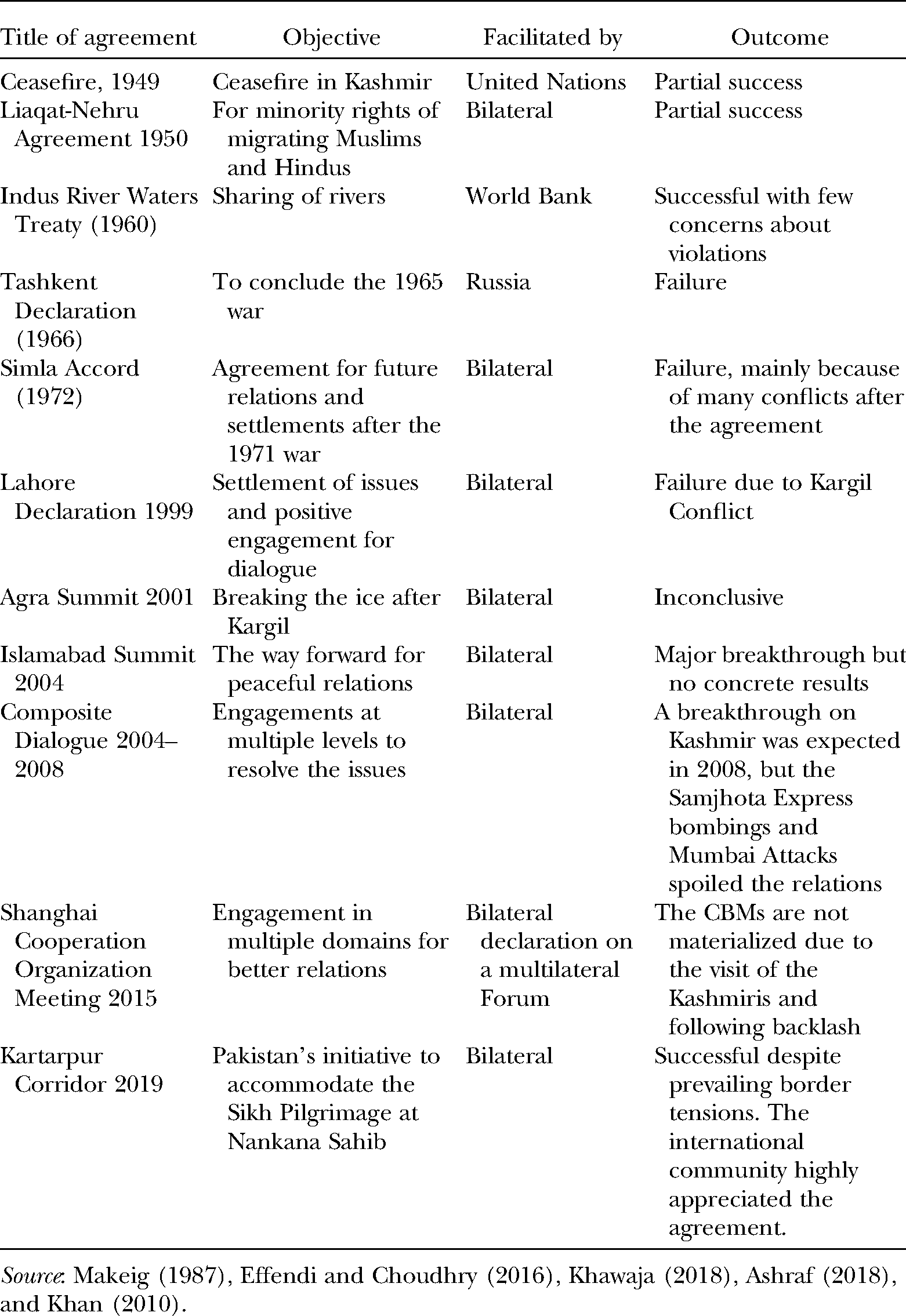
Source: Makeig (1987), Effendi and Choudhry (2016), Khawaja (2018), Ashraf (2018), and Khan (2010).
Confidence-building Measures: Theoretical Perspectives
CBMs are regarded as alternatives to traditional diplomatic business which can halt due to numerous factors including (but not limited to): a trust deficit, security concerns, and stalemates in negotiations. The phrase “Confidence Building Measures” was first used in the Conference on Security and Cooperation in Europe (CSCE) held in Helsinki in 1975. The origins of CBMs can be traced back to the Helsinki final act, the Vienna document, and the Stockholm document on confidence and security-building measures (OSCE Secretariat’s Conflict Prevention Centre 2012, 5). CBMs gained momentum during and after the Cold War period and mainly aimed to build confidence among the two major powers, the United States and the USSR, on issues like arms control, war prevention, conflict resolution, and nuclear proliferation. Khawaja (2018, 4) argues that the post-Cold War strategies of CBMs aimed at multidimensional approaches for conflict resolution at the state as well as the domestic level. Alford (1979, 1) contends that demilitarization mechanisms for the Rhineland in the aftermath of the First World War and the establishment of a hotline between the former USSR and the United States in 1963 fall under the umbrella of CBMs. Therefore, while CBMs are not new to the world, rapid advancements in technology and expanding layers of interaction between states have meant that the scope of CBMs has significantly enlarged in contemporary times.
In stark contrast to the other instruments of foreign policy where theories precede practice, practice preceded theory in the case of CBMs (Desjardins 2014, 7). In consequence, there is no universal definition and theoretical framework for CBMs, so we instead focus upon various definitions of CBMs to design a conceptual framework for the present study. The 1975 Helsinki conference aimed for three significant goals through CBMs: restrain actions causing tension, reduce the possibility of wars due to misconceptions, and foster an environment of confidence and cooperation (Desjardins 2014, 7). Additionally, the United Nations Office of Disarmament Affairs (2002) defines CBMs as “planned procedures to prevent hostilities, to avert escalation, to reduce military tension, and to build mutual trust between countries. They have been applied since the dawn of civilization, on all continents.” The United Nations’ definition mainly focuses on security issues and conflict resolution, while neglecting the non-military aspects of CBMs. Desjardins’ (2014, 5–6) definition of CBMs comprises actions like two-way communication enhancement, exchange visits and inspections, setting rules for military exercises, social and cultural measures, and cooperation in various domains.
Holst (1983, 2–4) defines CBMs as “arrangements designed to enhance … assurance of mind and belief in the trustworthiness of states … confidence is the product of much broader patterns of relations than those which relate to military strategy. In fact, the latter has to be woven into a complex texture of economic, cultural, technical and social relationships.” Holst’s (1983) and Desjardins’ (2014) definitions are interlinked as they describe various aspects of CBMs other than the security domain. The above-mentioned definitions reveal that the Cold War CBMs mostly focused on security-related issues to avoid any circumstances which can lead to a catastrophe and paid little attention to cooperation in other fields. Only a few scholars like Holst (1983) and Desjardins (2014) have talked about the social, cultural, and economic domains of CBMs. Landau and Landau (1997, 100), for instance, note that: CBMs can be grouped into four general categories: those that demonstrate a willingness to talk, those that demonstrate a willingness to listen, those that demonstrate a willingness to meet the needs of the other party, and those that demonstrate a willingness to improve the long-term relationship with the other party.
Landau and Landau (1997) base their arguments on bringing conflicting parties to negotiations through means other than direct negotiations which may give some results in a short time but might not sustain for longer.
Adding to the picture these definitions are beginning to paint, the OSCE Secretariat’s Conflict Prevention Centre (2012, 9–10) categorizes CBMs into military and non-military domains and identifies five sublevels of non-military CBMs. These comprise military, political, economic, cultural, and societal arenas. CBMs can be employed in multiple domains like measures to diffuse or restrain tensions, conflict resolution, encouraging willingness for cooperation, transforming attitudes, and finally achieving sustainable peace between the conflicting parties. Vohra and Ansari (2003, 7–8) argue that CBMs are defined more comprehensively in the South Asian perspective as these should include not only the military domain. Instead, CBMs should also equally focus on soft, non-military issues like economics, the environment, education, water, shipping, power, and technology. These arguments take into account both military and non-military CBMs as integral parts of the peace process. CBMs are long-term efforts and may not yield immediate results like traditional diplomacy, but they are aimed at achieving ultimate objectives in the longer run.
CBMs are nevertheless not a zero-sum game and are considered easy to negotiate and generally apply to all states involved. CBMs adopt a bottom-up approach and start with smaller issues—in contrast to the top-down approach in traditional diplomacy. However, the critiques of CBMs doubt the effectiveness of CBMs vis-à-vis their promotional advertisement. This argument is usually based on the fact that the West European states that suggested CBMs at the CSCE did not trust the East European states in the Warsaw pact (Desjardins 2014, 4). The success of CBMs regarding arms control and security issues thus remained marginal given the mutual trust deficit among different players. Moreover, the capacity of CBMs to achieve the desired military results depends upon the willingness of adversaries who lack confidence in each other but are open to avoiding conflict (Alford 1979, 13). Based on the above discussion, the present research adopts the definition of CBMs given by Vohra and Ansari (2003) and focuses on the following domains to evaluate relations between Pakistan and India:
CBMs in the military and nuclear domain. CBMs in the political and conflict resolution domains. CBMs in the economic domain. CBMs in the societal and cultural domains.
Critical Analysis of CBMs Between Pakistan and India
There have been numerous efforts to restore confidence among both these adversaries through various mechanisms. No concrete results have, however, been achieved over the past 73 years excepting a few brief periods of negative peace. Negative peace implies the absence of conflict, aggression, violence, and war but alludes to the fact that relations were not cordial either (Liebovitch et al. 2020). The idea of positive and negative peace stems from Johan Galtung's positive and negative peace thesis where positive peace means states have confidence in each other while negative peace implies the lack of confidence (Syed 2020, 11). India and Pakistan have also addressed each other with proposals for joint defense, CBMs, no-war pacts, friendship treaties, and other arrangements aimed at achieving peace. However, most of these initiatives have been diplomatic gamesmanship—some of it sincere, perhaps—but peace in South Asia remains as uncertain as war. The processes of CBMs between Pakistan and India are complex owing to a fractured history rooted in issues like land disputes, water resources, suspicion, security, the arms race, and threat perception (Jabeen et al. 2010). Both the countries have devised CBMs in good faith to address various issues, but implementation remains the major challenge given the diverging interests and trust deficit. We now focus on the specific areas outlined in the theoretical framework.
CBMs in the Military and Nuclear Domains
CBMs in the military domain—also known as military confidence-building measures—comprise a variety of actions including the exchange of vital information, notifications regarding exercises and tests, observation measures, arms controls, and reduction measures (United Nations Office of Disarmament Affairs 2002). Multidimensional issues between the two countries hindered the success and progress of CBMs in both military and nuclear domains. Accordingly, the unresolved territorial disputes and associated security concerns have played a significant role in shaping and projecting the force postures of Pakistan and India toward each other. The ensuing action–reaction cycle has compounded the situation as the increase in capabilities of one country undermines the security of the other—classic realist thinking. Pakistan and India's strategic anxieties toward each other also play a substantial role in shaping their bilateral relations and the implementation of military CBMs. The Indo-Pak region is termed the second nuclear flashpoint of Asia after the Korean Peninsula, where the chances of escalation from conventional to nuclear war remain high. Chari (2005, 211) also argued that South Asia was the most dangerous place on earth, and Kashmir was the nuclear flashpoint in South Asia. Developments in the wake of the Pulwama attacks in 2019 (see BBC News 2019), which brought the two countries at brink of nuclear war, further consolidate Chari's argument since it was published in 2005.
Pakistan and India have engaged in military and nuclear CBMs on numerous occasions, despite non-cordial relations. The first step in the military CBMs was the establishment of a hotline between the militaries in 1971 following the model of the United States’ and USSR's military communications in the same timeframe (Ahmar 2001, 87). However, the hotline between the Director Generals of Military Operations of both countries remained symbolic, and no practical advantages were effectively achieved for maintaining peaceful relations. The hotline works well during peacetime while it gets suspended during crises build-ups, rendering it, in essence, useless. The sitting prime ministers of both countries, Benazir Bhutto and Rajiv Gandhi, signed the next major CBM under the umbrella of the Nuclear Threat Initiatives. This CBM aimed to prevent attacks on each other's nuclear facilities but does not provide any prevention against foreign allies attacking such installations. This measure enabled the exchange of a list of nuclear facilities between both the countries in 1992 (Shahid-ur-Rehman Khan 1992) which helped to build trust and both the nuclear rivals respected the arrangements during the peace as well as during times of increased crisis. In 1991, Pakistan and India's CBMs progressed further as they signed an agreement for prior notification regarding military exercises and air space violations, especially near the LoC. This set of CBMs opened further channels of communication in the military and diplomatic domains to avoid the repetition of earlier crises but it could not achieve the desired results owing to the non-availability of implementation structures.
The next CBM milestone was the 1992 agreement on the complete prohibition of chemical weapons—both countries declared that they do not possess any chemical weapons. However, these CBMs suffered a considerable setback once India declared its chemical weapons arsenal under the Chemical Weapons Convention (Nuclear Threat Initiative 2011a). Such incidents created further suspicion between both countries—which were already having problematic relations—and halted the advancement in the process of confidence building. Pakistan considered the incident as a violation of the bilateral agreement which widened the gulf in trust deficit between the two countries. In the wake of this incident, no further progress was achieved until 1999. Later, Nawaz Sharif and Vajpayee concluded the Lahore Accord in 1999, which was a milestone agreement for peacebuilding following the nuclear tests in 1998. This agreement incorporated the concept of developing and employing CBMs in both the conventional military and nuclear domains to avoid any untoward nuclear weapons launch situations and to reduce the prospects for future conflicts (Nuclear Threat Initiative 2011b). Unfortunately, this set of CBMs was undermined by the Kargil Conflict, which started a few months after the declaration. This time it was the Pakistani side that undermined the peace efforts as political and military leaderships were not on the same page. Here the political leadership tried to put some mechanisms in place for peaceful coexistence, but the military institution spoiled these efforts. This problem necessitates the requirement of structures that can implement and sustain CBMs without significant interference from any state institution, military in particular.
From 1999 to 2003, tensions remained high between both the states due to large-scale deployments along the LoC, plus terrorist attacks in Srinagar and on the Indian parliament. The UN General Assembly session of 2003 carved out a route toward a ceasefire and later on to direct negotiations between the political leadership of both countries (Khawaja 2018, 120–121). A new set of military and nuclear CBMs was then worked upon which included the reduction of troops along the LoC, no further development of military posts, and prior information regarding the testing of ballistic missiles (Krepon 2017). The composite dialogue process constituted a major step forward which aimed to resolve the issues between both countries through a strategy that satisfies the demands of both countries (Padder 2012). This dialogue process provided the opportunity to discuss the peace process through a diverse range of domains including the Kashmir issue. However, all these CBMs halted in 2008 (Gul 2007) after the terrorist attacks in Mumbai for which India blamed Pakistan. Later, very few efforts were initiated in 2014 and 2015, but those did not work due to pre-existing notions of trust deficit and further accusations of terrorist attacks.
The primary issues in the implementation of the military and nuclear CBMs are the non-availability of a framework, transparency issues, and lack of trust. Political aspects will also play a significant role in the success of any military and nuclear CBMs, yet military and security concerns continue to undermine political will between these two states. While Pakistan and India are so-called democratic countries, they do not have liberal democratic structures and the separation of powers remains a contentious issue. Additionally, the policies adopted through CBMs proved to be thoroughly incompatible with follow-up actions because the military and political leadership in both countries remained suspicious of each other. These issues obstructed the implementation of military and nuclear CBMs in both letter and spirit. The recurring crises between Pakistan and India after the Pulwama attacks of 2019 highlight the shortfalls of the concept of nuclear deterrence between both South Asian neighbors. Cyberspace also provides a new domain for waging wars and there are no existing agreements between Pakistan and India in this domain. A cyber-attack may prove disastrous in provoking an unintentional war in the region (Yamin 2019).
CBMs in the Political and Conflict Resolution Domains
The political leaderships of both countries have engaged in multiple layers of CBMs to create an environment for (potentially) resolving the conflicts. However, the CBM processes became undermined by non-flexible red lines set by the respective governments and state institutions. The very first CBM was the signing of an agreement for the protection of the people migrating from both sides as many atrocities had happened, especially regarding women and children. Nevertheless, this process stalled very soon due to transparency issues and a lack of supporting mechanisms. Most of the diplomatic initiatives mentioned in Table 1 failed to achieve the desired results for similar reasons. Political will is the most significant factor in the implementation of any type of CBMs. Khan 2010, 109) argues that the significant treaties between Pakistan and India emerged after crises and wars. This argument implies that crisis management was the primary objective of the CBMs, while both sides did not exert the necessary incremental efforts to achieve sustainable peace. The Indus Basin Water Treaty was signed because of conflict over the division of water, and many political and conflict resolution CBMs like the Simla Agreement came in the aftermath of the war of 1971.
There are numerous CBMs in the political domain, but only a few gave some peace dividends to both countries. The Musharraf, Vajpayee, and Manmohan regimes can be regarded as more encouraging for the implementation of political CBMs, but the Mumbai attacks of 2008 undermined the viability of all CBMs in this domain. The Kashmir issue was on the point of resolution when the Mumbai attacks stalled the process. The latest set of CBMs was agreed upon between the prime ministers of both countries during the Shanghai Cooperation Organization summit in Ufa, Russia in 2015 (French 2019, 121). A diverse range of measures was agreed upon in the military, political, economic, and societal domains, but the visit of Kashmiri leaders to the Pakistan High Commission in India undermined the implementation of this important deal. The political elite and the media in both countries played a vital role in debilitating the way forward. Both countries engaged in a vicious cycle of the blame game, causing further deterioration in relations.
CBMs in the Economic Domain
The growth of economic cooperation in South Asia is not encouraging, owing to several inter-state and intra-state conflicts. The South Asian Association for Regional Cooperation (SAARC) also failed to achieve its mandate of regional cooperation in various domains because both its key players, Pakistan and India, created problems in the effective functioning of the organization. India is among one of the major growing economies of the world while Pakistan is still struggling economically as it recovers from the aftershocks of the global war on terror. Naz (2012, 12) shows that the conflicting political aspirations of both countries are significant barriers to economic integration. Both countries retain a vast potential for bilateral trade and engagement in other activities vital for economic growth, but the enduring rivalry undermines this significant aspect of bilateral relations. Economic cooperation has, in effect, been held hostage to the political turmoil and misconceptions rather than furnishing a free-market economy to create a win–win situation for both countries (Khawaja 2018, 150). The Kashmir issue and its underlying politics have also had a detrimental effect on economic cooperation between the two countries. Gopinath (2012, 23), for instance, examines the complicated economic relationship between Pakistan and India and characterizes it as a multidimensional stockpile of layers of mutual mistrust and sentiments emerging from shared cultures.
There have been numerous trade agreements and economic CBMs between both countries but with no viable improvement in the economic landscape. During the early years after independence, both countries agreed on several economic pacts mainly aimed to avoid double taxation while facilitating trade in general and the food and goods trade, the banking sector, and air services in particular (Mahmood 2013, 20). Yet the growth in trade over the first two decades of the twenty-first century has not been overwhelmingly encouraging and closing borders on trivial matters has become a norm in bilateral relations between the two countries. The imposition of reciprocating tariffs is also a regular practice to discourage the trade of products from each other—culminating in a vicious cycle that challenges CBMs in the economic domain.
Three distinct phases emerge as important for analyzing the economic interactions and CBMs between Pakistan and India (Khawaja 2018, 159). The first phase lasted from 1947 to 1956, where Pakistan and India were the most significant trading partners because of existing arrangements and the low intensity of the conflict at the time. Some level of mutual trust existed and perceptions of each other were generally positive. The second phase occurred in the decade after the 1965 war and is recognized as the worst in terms of economic cooperation—it decreased to minimal. There was an agreement in 1974, and certain CBMs were adopted, but no significant improvement occurred due to misconceptions and the breakout of two wars in a short period of six years. A Joint Commission for the promotion of economic cooperation was established in 1983, but the ensuing crises, including the Siachin Glacier Dispute and Operation Brasstacks (see Wirsing 1988), undermined this initiative.
The third phase started in the 1990s with a relative improvement in bilateral trade, and India granted Most Favored Nation (MFN) status to Pakistan in 1996. However, real benefits could not be reaped as Pakistan did not reciprocate the MFN status for India. Thereafter, the composite dialogue process (2004–2008) provided an excellent platform for negotiations on the improvement of the bilateral economic relationship. Subsequently, 2011 marked a breakthrough year for the improvement of economic relations due to CBMs, where both countries agreed on the implementation of the South Asia Free Trade Agreement (Zulfqar 2013). Rajesh (2017, 119) notes that “Officially, bilateral trade between India and Pakistan amounts just 200 million dollars in 2004 and it has risen to 2.7 billion dollars in 2011 and is slated to touch 6 billion dollars in next three years.” This phase of CBMs helped both countries to build strong economic relations and many new ventures, like the Wagah-Attrai Crossing, opened for cross-border trade. The people associated with trade and commerce in both countries played a decisive role in the implementation of CBMs supported by the respective political leaderships. The Iran–Pakistan–India gas pipeline was also a significant project agreed upon through CBMs but is still in turmoil owing to mutual distrust between India and Pakistan.
Recent developments in the region after the Pulwama attacks in 2019 have, however, seriously harmed the economic ties between the two countries. Pakistan halted diplomatic ties with India following the attacks and border trade between the two countries was ceased which seriously undermined bilateral economic linkages. Both countries did not exert further efforts to reduce tensions surrounding India's revocation of the semiautonomous status of Kashmir and most of the existing CBMs were suspended. Yet “a gradual thawing of relations,” at least economically, occurred in March 2021 when Pakistan lifted its two-year import ban on cotton and sugar from India to improve supply and combat soaring domestic prices (Gul 2021). Indeed, the economic interdependence between the two countries could and should play a significant role in conflict resolution, as suggested in the theory of complex interdependence.
CBMs in the Societal and Cultural Domains
Civil society plays a vital role in influencing and shaping how individuals, communities, institutions, and states behave with each other. CBMs promoting people-to-people contacts play a significant role in developing an environment for cordial relations and conflict resolution. Societal and cultural CBMs based on humans can be very useful in countries like Pakistan and India, where the state narratives are generally built to perceive others as the enemy. Cultural and societal CBMs aim for new ventures and common grounds to develop a sense of “belongingness” while keeping in mind the respective cultures and authorities.
Pakistan and India concluded the Cultural Cooperation Agreement in the early 1990s along with a set of military CBMs. Both the governments established a joint commission under this agreement to formulate strategies for improving relations and cooperation in fields including education, art, culture, sports, and the mass media (Khan 2010, 137–138
Major Spoilers in Pakistan–India Relations
CBMs between Pakistan and India have been designed alongside the inherent mindset of conflicting ideologies, antagonizing perceptions, and security dilemmas. The CBM playing field is complicated owing to parochial dimensions caused by a multitude of factors like mutual distrust, suspicion, a troubled socio-political history, and paranoia toward each other. Some small progress, such as the opening of the trade in sugar and cotton in 2021, could be forthcoming in a post-coronavirus future for the people who merely want to live in peace. Yet recent reports on public opinion in both countries—driven by nationalist political and media campaigns—showed a less than optimistic mutual perception in 2019 (Devlin 2019, 9; Sriram 2019). Based on the above discussion, we now identify the following main spoilers in Pakistan–India relations.
One of the major spoilers in the political domain is the exploitation of the votebank, especially in India, where domestic politics has consistently undermined relations between both countries. Politicians adopt the narrative to take a stricter stance against the other country as Prime Minister Modi did before the elections of 2019. It resulted in an exchange of airstrikes and the shooting down of fighter aircraft (see France24 2019). The countries reached the brink of nuclear war due to the political spoilers being played by the BJP to win elections. Military and nuclear CBMs were adopted to avoid conflicts and miscalculations regarding nuclear weapons, but a terrorist attack could bring both nations to the brink of a nuclear/conventional war. Non-state actors have played a fundamental role in undermining relations and peace efforts between both countries. Azad (2016, 68) has highlighted that “terrorist groups can provoke the situation by their terrorist activities in the region.” Terrorist attacks and other such incidents occurring in India are perceived to be orchestrated by Pakistan and vice versa owing to the trust deficit. For example, terrorist attacks on the Indian Parliament on December 13, 2001 resulted in military standoff in 2001–2002 and the later Mumbai attacks in November 2008 present a glimpse of a worst-case scenario (Azad 2016, 60). Non-state actors have exploited the lack of trust and non-availability of transparent communication channels between both countries. The incumbent governments in both countries have devised short-term state policies of violence, especially once the parties with an extreme nationalist ideology, like the BJP, come to power. Such parties have adopted a rigid stance on bilateral issues to undermine bilateral relations to a great extent (see Sriram 2019). The violation of already agreed upon agreements and CBMs also remains a significant impediment to, and spoiler for, existing and future CBMs. The agreement on nuclear and biological weapons, Ceasefire violations along the LoC, and the Indus Basin Water Treaty violation are classic manifestations of this particular issue. Several specific issues, like Indian lobbying efforts for the inclusion of Pakistan on the Financial Action Task Force (FATF) grey list and the exposure of the EU Disinfolab (Indian Chronicles) Indian network established to tarnish Pakistan's image on the international front, further sabotage the peace process between the two countries (Haider and Azad 2020).
The Way Forward for Sustainable Peace Through CBMs
The South Asian region is finding it extremely difficult to broker a sustainable peace due to a lack of confidence that has consistently undermined efforts for peaceful coexistence between the two enduring rivals. The prospects for permanent peace between India and Pakistan are of the utmost concern for security, stability, and prosperity in the region. Currently, a deadlock persists between the two countries due to a series of issues in the past few years. Effendi and Choudhry (2016, 188) suggest that “a purposeful set of CBMs entails efforts and initiatives that help parties to open up and continue communication, bringing a good level of trust in the relationship and promising sustainability of the measures in future.” In light of the problems, events, and spoilers highlighted in this article, it is suggested that Pakistan and India adopt the following broad measures to foster more peaceful relations:
The presence of weapons of mass destruction on the military inventories of both countries necessitates the CBMs framework which, if effectively used, could reduce the chances of the use of such weapons. The existing CBMs in this domain are good candidates for revision as per the prevailing environment to ward off the threat of nuclear escalation. Both countries need significant efforts to build trust in this particular domain for regional as well as international peace and security. The dynamics of military CBMs mainly depend upon four pre-conditions: continuous negotiations and talks, consistent implementation, transparency of sharing information, and cooperation in other domains including economic, political, and social policies. Pakistan and India need to devise military CBMs in line with this framework to gain maximum benefits. Multiple credible channels of communication should be established at various levels and between numerous organizations like Air Forces, the Navy, the Coast Guard, and National Security Advisers to build and maintain credibility. Such communication channels would enhance the exchange of information to remove suspicion and reduce the effectiveness of spoilers in the information domain. Both countries should seriously consider introducing CBMs in visa regimes to support tourism, businesses, art, culture, and sports. These measures would, in turn, enhance social interaction to deconstruct established notions of animosity toward each other. Doing so is, we believe, a clear precondition for peaceful relations. CBMs relating to the environmental protection and climate change domains are also essential and can play a significant role to mitigate the crisis. COVID-19-related CBMs may also prove very effective to bring both countries closer. In the first part of 2021, India suffered a shortage of oxygen and medicines during the deadly third wave of the pandemic in that country. Pakistan may support India during these circumstances as its recently reiterated offer to send medical aid to India indicates (Times of India 2021). Similarly, India can support Pakistan by providing the vaccines being produced in India under international agreements. Pakistan and India finally need to develop a range of CBMs in the cyber domain to control malicious cyber behavior and avert an inadvertent war
Conclusion
Pakistan and India signed several accords and agreed on numerous CBMs, but none of these efforts restored confidence and misperceptions prevailed. Relations between Pakistan and India are sabotaged by several factors that yield to the failure of the many CBMs adopted, less flexibility toward rapprochement, and numerous episodes of trust-shattering incidents. As this article has highlighted, most of the CBM initiatives failed in the past due to strategic anxieties, lack of transparency, weak political will, and the non-availability of implementation structures. The CBMs were largely negotiated after major conflicts while both sides made no further efforts to adopt innovative approaches for building confidence. Moreover, people on both sides of the border share many commonalities and have a strong desire to live in peace. Therefore, Pakistan and India require a comprehensive and integrated approach for CBMs in the political, military, economic, environmental, and social domains to foster an environment of mutual trust and peaceful coexistence. Both countries need to make sincere efforts to restore confidence and cooperate closely on the issues which create a trust deficit. The prevailing COVID-19 environment may also play a pivotal role in reshaping the peaceful relations between both countries and future research in this particular area is most definitely warranted. Well structured, pragmatic, and institutionally implementable CBMs can bring peace to the region which has seen seven decades of antagonism between the two countries.
Footnotes
Declaration of Conflicting Interests
The authors declared no potential conflicts of interest with respect to the research, authorship, and/or publication of this article.
Funding
The authors received no financial support for the research, authorship, and/or publication of this article.
