




Abstract
Understanding children’s travel distance to school is essential for promoting educational equity and well-being. In China, the hukou (household registration) system, which regulates access to education and other public services by place of official registration, shapes the distribution of educational resources. Yet little research has examined school travel distance in this context or the individual and contextual sources of its variation. This study employs nested and cross-classified multilevel models to analyse how individual and contextual factors affect pupils’ travel distances, as well as exploring interactions between these factors, and link these findings to hukou-based enrolment. By simultaneously considering multiple geographies, this study reveals that children’s travel distance is shaped by both individual-level factors and contextual-level determinants at both origins and destinations. Individual and contextual variables are not isolated in this process, with hukou status as a key individual factor, school type mediating the relationship between hukou and travel distance, and a cross-level interaction also existing between neighbourhood population density and hukou status. Those findings indicate that hukou-based school enrolment plays an important role in shaping pupils’ travel distances, making reform of related enrolment policies a priority for advancing educational equity and guiding future planning.
Introduction
Educational equity concerns not only the fair distribution of educational resources, but also their spatial accessibility. Distance travelled from home to school plays an important role in reproducing, exacerbating, or reducing educational inequality in different school systems in different countries (Hamnett and Butler, 2017). This is because travel distance is a key determinant of school accessibility, often favouring those who live in advantaged areas and thereby contributing to unequal distribution of educational resources between areas, regions and social groups (Solem and Vaughan, 2023; Wilson and Bridge, 2019). Travel distance is also a practical indicator of the spatial dimension of educational (in)equity. Long travel distances may impose burdens on families, disproportionately affecting children from disadvantaged backgrounds and influencing extracurricular time (Holloway and Pimlott-Wilson, 2014; Kelly and Fu, 2014), academic achievement (Mora-Gonzalez et al., 2017), and also health and well-being (Friedman et al., 2020; Voulgaris et al., 2019). Therefore, better understanding of distance travelled to school has important implications for improving children’s well-being, equality of access to education opportunities and for future planning.
In many education systems, parents’ school choices are shaped by institutional arrangements governing school admission, such as catchment areas, enrolment quotas, and admission priorities, and by households’ socio-economic resources (Ball, 2003; Boterman, 2019). These institutional and socio-economic conditions structure who is able to attend particular schools, and at what spatial cost (Boterman et al., 2019; Easton and Ferrari, 2015). In China, these dynamics are further shaped by the hukou system, which plays a central role in regulating access to basic education (Chen and Yeh, 2019). This contrasts with other contexts such as the UK, where families may gain access to preferred schools through residential location, often facilitated by higher housing costs (Orford, 2018). Local and non-local hukou holders differ not only in their socio-economic resources, such as income and social capital, which shape their capacity to access educational opportunities, but also in their institutional status, as many admission rules explicitly prioritise the allocation of public educational resources to children with local hukou. While hukou-related inequalities in educational opportunities are well documented, less attention has been paid to how these institutional constraints, together with family characteristics, translate into children’s school travel distances, with most existing studies focusing either on residential contexts or on school characteristics. However, residential location and school destination are not independent, as hukou status interacts with school admission policies, housing tenure, and neighbourhood characteristics to produce differentiated patterns of school access and mobility, particularly for migrant and non-local families (Bi and Zhang, 2016; Ming, 2013; Sun et al., 2025). School travel distance is therefore an inherently origin–destination outcome, jointly shaped by where families live and which schools children are able or permitted to attend. Analyses that fail to model residential and school contexts simultaneously may risk misattributing variation in travel distance to neighbourhood or school effects alone, thereby obscuring the institutional mechanisms that generate unequal travel burdens.
To address this gap, using detailed pupil-level data from Zhongshan, China, this paper employs nested and cross-classified multilevel models (Shuttleworth and Gould, 2010; Thomas et al., 2015) that simultaneously situate pupils within both residential origins and school destinations. This modelling framework allows us to disentangle sources of variation in school travel distance across individuals, schools, neighbourhoods and towns, and to examine how individual-level factors (e.g. hukou status), and contextual factors (e.g. school type and population density), jointly shape school travel distance. By doing so, we aim to enhance understanding of how children’s school travel distance is shaped under the hukou system, contribute to broader insights into educational (in)equity, and provide evidence to support fairer educational provision both within and beyond the Chinese context. This paper provides three key contributions. Firstly, we apply nested and cross-classified multilevel models to identify individual and geographical sources of variation in children’s school travel distance, which in turn helps to clarify how inequalities in educational access emerge across multiple levels. Secondly, and notably, we consider both places of origin (neighbourhoods) and destination (schools) simultaneously. This is both a methodological and conceptual contribution which acknowledges that we should not conceive of origins and destinations separately (Thomas et al., 2015). Third, it examines how individual-level characteristics, most notably hukou status, interact with higher-level contextual conditions, such as school type and neighbourhood population density, to shape school travel distance. Distinguishing between these pathways helps to clarify how hukou-related institutional constraints are translated into everyday travel outcomes.
The rest of article is structured as follows: the next section reviews literature on determinants of school travel distance and the impact of China’s hukou policy; the ‘Data and research methods’ section describes the data and methods used; whilst the results are presented in the ‘Statistical modelling results’ and ‘Mediation and cross-level interaction results’ sections; and discussion and conclusions are provided in the final section.
Determinants of school travel distance
Individual, household and contextual characteristics
Children’s distance to school is shaped by household socio-economic status, the spatial and institutional context of schools and residential areas (Easton and Ferrari, 2015; Xiang et al., 2021). At the household level, parents make trade-offs between commuting distance and factors such as school quality and cost, with preferences varying across socio-economic groups (Burgess et al., 2014; Hastings et al., 2005; Hofflinger et al., 2020). High social economic status (SES) families tend to prioritise school quality and reputation, actively choosing better schools and thus increasing commuting distances (Goldring and Phillips, 2008; Hofflinger et al., 2020). In contrast, low-SES families, constrained by time and financial resources, are more likely to enrol their children in nearby schools (Andersson et al., 2012; Andre-Bechely, 2007; Burgess et al., 2019).
At the contextual level, the spatial distribution and density of schools, together with population density and clustering, directly condition home–school distances and patterns of daily mobility (Van Goeverden and De Boer, 2013). Institutional contexts, particularly school choice policies, may complicate parental choice and commuting patterns (Wilson and Bridge, 2019; Yang et al., 2012). Catchment-based systems restrict mobility and keep distances short, while greater freedom of choice expands access but often increases both segregation and commuting distances (Bonal et al., 2021; Elacqua, 2012; Taylor, 2009). Private schools amplify these processes, as their reputational advantages and flexible admissions enable advantaged families to bypass local schools, typically at the cost of longer commutes (Courtioux and Maury, 2020; Jähnen and Helbig, 2023).
However, educational outcomes are not the simple additive result of household socio-economic conditions and geographical or institutional contexts, but emerge from their complex interactions (Cordini, 2019; Oberti and Savina, 2019). Household preferences are filtered through spatial inequalities in provision and institutional arrangements (Boterman, 2019), which may mediate or in some cases decouple school outcomes from residential and social structures (Andre-Bechely, 2007; Boterman et al., 2019; Butler and Hamnett, 2007; Holloway and Jöns, 2012). Understanding these interaction mechanisms is therefore essential for explaining why households with similar characteristics may face very different school access outcomes across institutional and spatial contexts. Despite this, interaction processes have rarely been examined under hukou-based school enrolment systems. As a result, it remains unclear how institutional constraints embedded in the hukou system condition the conversion of household resources into school access and everyday commuting outcomes.
Chinese hukou-based school enrolment policy
China’s hukou system, established in the 1950s to control population movement and allocate scarce resources, registers each citizen at birth. Access to public services, including education and healthcare, is closely tied to hukou status, with city authorities prioritising those with local hukou status (Gersovitz, 2016). With rising levels of rural-to-urban migration, hukou-based educational inequality has become increasingly evident (Zhou and Cheung, 2017), prompting some cities to introduce reforms aimed at more equitable enrolment (Huang, 2016).
Zhongshan, located in Guangdong Province in southern China, is one of the country’s fastest-growing regions in terms of both economic development and migrant in-flows (Li, 2023). It was also one of the earliest cities in China to introduce systematic policies aimed at allocating public education resources to children without local hukou. Zhongshan implements a school zoning policy whereby each public elementary school is associated with a defined catchment area, and all local hukou children residing within it are allocated a place. Remaining school places are allocated to non-local hukou status applicants using a ‘points-based enrolment’ system. After meeting a series of basic requirements such as stable employment and payment of social security, non-hukou applicants can apply in towns where parents work or their home is located. Towns then score and rank the applicants according to a series of indicators (applicant’s literacy level, residency status, insurance contribution, talent positions, patent innovations, social contributions, etc.), and the higher ranked applicants are granted a public-school place. For non-local hukou children who are not granted public school places, the government provides a limited subsidy to partially cover the tuition fees of private schools, which parents are free to choose without any restrictions (Zhongshan Municipal People’s Government Office, 2020).
Under this enrolment regime, hukou-related inequalities in access to schooling are well recognised, whereas inequalities manifested through school travel distance remain less visible. Public schools, characterised by higher spatial density and constrained by zoning rules, generally entail shorter commutes, and the prioritisation of local-hukou children in public school allocation therefore translates hukou status into systematic differences in travel distance. For non-local families, access to nearby public schools depends on the availability of surplus places within catchment areas, making them more vulnerable to spatial displacement into more distant public or private schools, particularly in densely populated neighbourhoods. These patterns indicate that school travel distance emerges from the interaction of individual characteristics, residential origins and school destinations rather than from any single factor in isolation.
Data and research methods
Data
The following data are used: (1) Baidu-map Point-of-Interest (POI) data; (2) Baidu residential population distribution data and (3) Zhongshan city residents’ traveling survey data. Baidu is a Chinese technology company, similar to Google, which provides internet services including mapping and population data. The Baidu-map POI is utilised to locate schools and retrieve names of institutions, while the Baidu residential population distribution data is used to calculate population density for each community/village. The reliability of Baidu data has been verified in other studies (Ling et al., 2024).
The travel dataset is a large, government-commissioned cross-sectional survey conducted in April 2019 by a professional survey company, covering 47,500 respondents across all age groups in Zhongshan. The survey adopted a random, multi-stage sampling design, in which the city was first divided into small spatial units (traffic analysis zones), and individuals were then randomly selected within each zone. Sampling within zones covered all age groups and household types, thereby avoiding systematic concentration in particular neighbourhoods, age cohorts, or household categories. Our study focuses on primary school pupils and therefore restricts the analysis to respondents in the corresponding age cohorts from this survey. Owing to the original sampling design, this pupil sample retains representativeness and does not introduce systematic selection bias. We identified 1864 primary school pupils with valid information on home and school locations, as well as individual and family characteristics, including age, hukou status, gender, average annual household income, car ownership, and parents’ occupation and educational level. Data on individual or household characteristics are missing for 110 pupils (approximately 6% of the sample). Consequently, Models 4–6, which include household-level covariates, are estimated using a restricted analytical sample, excluding these observations. To assess potential selection bias, we re-estimated Models 1–3 using the same sample; the results (not shown) remained consistent, confirming the robustness of our primary findings.
Table 1 reports descriptive statistics for the variables used in the analysis. The sample includes 1864 primary school pupils, with average school travel distances generally ranging from about 1.3 to 1.7 km across subgroups, while median distances are consistently lower, typically between 1.0 and 1.2 km; minimum values range from 50 to 70 m and maximum values from 9 to 10 km. Pupils with local hukou travel shorter distances on average (1363 m) than those without local hukou (1454 m). Travel distance also increases with household resources: pupils from higher-income households and those with access to private cars tend to commute longer distances, with average distances rising from approximately 1273 m among households without a car to over 1756 m among households owning two cars. Clear spatial differences are also evident. Pupils living in villages travel longer distances on average than those in communities, and pupils attending private schools commute substantially farther (1743 m) than those attending public schools (1332 m).
Variables used in multilevel modelling.

Note. Bold font denotes modal categories.
To further characterise the distributional patterns underlying these average differences, Figure 1 presents boxplots of school travel distance by key household, neighbourhood and school characteristics. The boxplots reveal substantial within-group variation across all categories, indicating considerable heterogeneity and skewness in pupils’ commuting distances even among groups sharing similar observed characteristics. For this reason, we model logged distance in the statistical models to be presented later. Differences in median travel distance are evident across hukou status, household income and car ownership, while the wide interquartile ranges and overlapping distributions suggest that no single attribute fully determines commuting distance. Higher-income households and households with greater car ownership tend to exhibit higher medians and longer upper tails, reflecting greater dispersion and the presence of long-distance commuters. Pronounced distributional differences are also observed by neighbourhood and school type, with village residents and private school pupils displaying both higher central tendencies and wider spreads. Taken together, Table 1 and Figure 1 indicate substantial variation in school travel distance across individual, neighbourhood and school contexts, underscoring the importance of accounting for both average differences and within-group heterogeneity using a multilevel analytical framework.

Boxplots of travel distance by individual and contextual characteristics.
Multilevel models
We fitted multilevel linear regression models (Jones, 1991) using both children’s place of residence (origin) and school attended (destination). Multiple geographies were handled using strictly hierarchical models and also cross-classified multilevel models (Jones, 1991; Shuttleworth and Gould, 2010). In line with China’s administrative structure, neighbourhoods represent the smallest administrative unit and include both residential communities in urban areas and villages in rural areas, which are nested within towns at the next administrative level. The analysis specifies three multilevel model structures. In the origin-based hierarchical model, 1864 pupils (Level 1) are nested within 227 origin neighbourhoods (Level 2), which are in turn nested within 24 origin towns (Level 3). In the destination-based hierarchical model, the same pupils are nested within 225 destination schools (Level 2) and 24 destination towns (Level 3). The cross-classified multilevel model simultaneously incorporates all origin- and destination-related units across these hierarchical levels. The corresponding model specifications can be written in general form as:


where
Null variance component models – empty models with no covariates – were fitted first for the two strictly hierarchical model and then the cross-classified model to assess the distribution of variance across levels and determine the necessity of multilevel modelling. After this, covariates are included for appropriate levels. All models were calibrated using the ML-winN software (Rasbash et al., 2024). Parameter estimates were first obtained using the Iterative Generalised Least Squares (IGLS) algorithm (Goldstein, 1986), and improved final estimates were obtained using the Markov Chain Monte Carlo simulation (MCMC; Browne and Draper, 2006). Additional software tools were used for evaluating and interpreting models, including Wald tests for significance and residual calculations (Goldstein, 2011; Rasbash et al., 2024). Cross-level interactions between individual-level and neighbourhood-level covariates were examined using first- and second-order polynomial terms and visualised using MLwiN’s prediction tool (Gould, 2009; Jones and Duncan, 1995).
Statistical modelling results
Multilevel estimation results
Variance component models
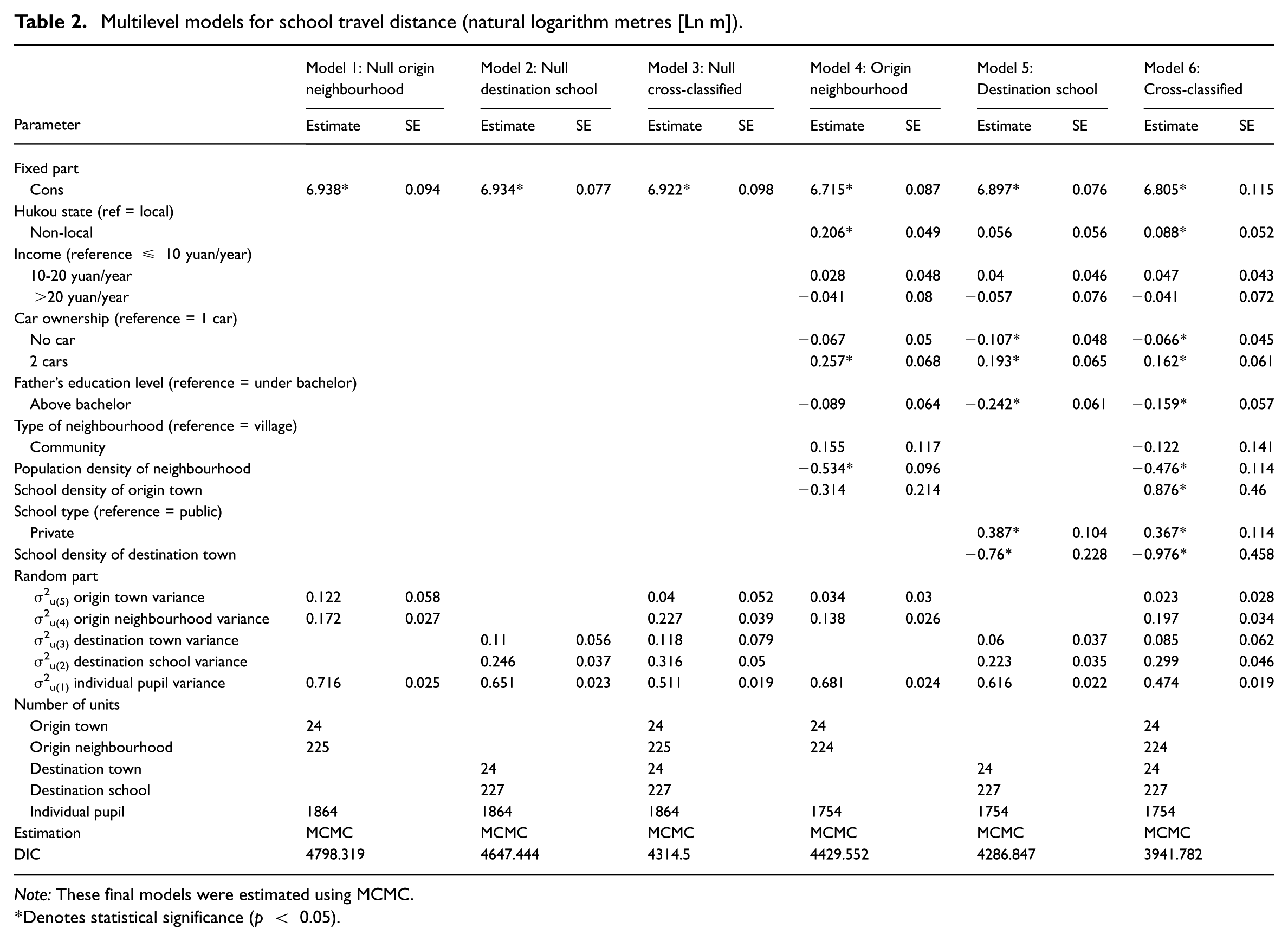
Table 2 reports variance component models that reveal how children’s school travel distance is structured across individual and contextual levels. In the hierarchical specifications (Models 1 and 2), variation is dominated by individual-level differences, accounting for 71% 1 and 65% of total variance, respectively, with neighbourhoods, towns, and schools jointly explaining the remainder. However, the cross-classified model (Model 3) provides a superior fit, as indicated by a lower deviance information criterion (DIC), and substantially reshapes the variance decomposition. In this specification, the individual-level share drops to around 42%, while origin neighbourhoods and destination schools emerge as important sources of variation, explaining approximately 26% and 19%, respectively; origin and destination towns contribute relatively little. Overall, this underscores the need for a multilevel framework that simultaneously considers individual-level variation as well as origin- and destination-based contexts when analysing school travel distance, and provides a clear baseline for subsequent models with explanatory covariates.
Multilevel models for school travel distance (natural logarithm metres [Ln m]).
Note: These final models were estimated using MCMC.
Denotes statistical significance (p < 0.05).
Including covariates
Introducing individual- and sub-district-level covariates in Models 4–6 substantially improves model fit relative to the null specifications, with marked reductions in DIC. These improvements are accompanied by declines in the corresponding variance components, indicating that added covariates explain part of the observed heterogeneity in school travel distance.
In Model 4, children with non-local hukou travel considerably farther than those with local hukou (approximately 1.2 times the distance). Household car ownership is strongly associated with commuting distance: children in two-car households travel about 1.3 times farther than those in one-car households, 2 while those in households without a car travel slightly shorter distances. Higher neighbourhood population density is associated with shorter travel distances, with a 1% increase in density corresponding to an average reduction of about 0.23% in travel distance. 3 By contrast, family income, father’s education, neighbourhood type, and school density show weak or statistically non-significant effects.
In the Model 5, the hukou effect becomes statistically non-significant. Attending private schools is associated with substantially longer commutes, with travel distances around 1.47 times greater than those of public-school students. Higher school density in destination towns reduces commuting distance, with a 1% increase in density linked to an average decrease of about 0.33%. 4 Car ownership remains a robust predictor, and father’s education becomes statistically significant, with children whose fathers do not hold a bachelor’s degree travelling approximately 1.27 times farther.
The cross-classified specification (Model 6) provides the best overall fit among all estimated models, with a further and statistically significant reduction in DIC compared with Models 4. All key covariates – hukou status, car ownership, father’s education, neighbourhood population density, school type and school density – remain statistically significant, with effect directions consistent with earlier models.
Results from Models 4–6 consistently indicate that children’s school travel distance is shaped by the interplay between individual characteristics and contextual covariates. While individual-level differences remain an important source of variation, contextual factors related to both where children live and where they attend school play a substantial role. Incorporating these origin- and destination-based covariates, particularly through a cross-classified structure, substantially improves model fit and highlights the necessity of jointly considering residential and school contexts when analysing school commuting patterns.
Influence of individual and socio-spatial contextual variables
Pupil individual characters
We modelled four key individual-level variables – hukou status, family income, car ownership, and father’s education. Hukou status is statistically significant in our analysis, but its effect on children’s travel distance varies across cities. Xiang et al. (2021) found no significant effect of hukou status on children’s school travel distance in Beijing. One possible explanation, as suggested by Xiang et al. (2021), lies in how hukou status is defined in Beijing: the ‘local hukou’ group contains two types – hukou within a sub-district and hukou outside a sub-district but within the same district. The latter group may have similar travel patterns to non-local hukou holders, inflating the average travel distance of the ‘local’ group and masking potential disparities. By contrast, in Zhongshan, all local hukou holders are granted priority access to public schools, resulting in consistently shorter commutes.
Families with higher incomes typically have more school choices and are more willing and able to commute further (Waters, 2017). However, in Models 4, 5 and 6, family income is not statistically significant, likely because local residents are generally affluent, and wealthier locals may have little incentive to seek distant schools when high-quality public schools are available nearby. Families with cars have better access and a stronger tendency to seek quality schools, leading to longer school commutes (Ball et al., 1995; Zhang, 2013), and this aligns with our model results. Father’s education reflects a family’s cultural capital, which often motivates families to forgo nearby enrolment and seek more distant, higher-quality schools, particularly in contexts with strong information exchange and ‘intergenerational closure’ (Coleman, 1988; Fast, 2020; Sampson, 2003). However, our study finds that children of highly educated fathers travel shorter distances. This may be because those with a bachelor’s degree or higher have an advantage in public school admissions, securing nearby places.
Contextual school and neighbourhood variables
In both Models 5 and 6, school type has a statistically significant effect. This can be attributed to Zhongshan City’s implementation of a single school district system, whereby each district contains only one public primary school. Under this system, the commuting range for public schools is typically constrained by the geographical boundaries of the school district. In addition, public primary schools are much more densely distributed than private schools, further limiting travel distances. By contrast, private schools are not subject to such spatial enrolment restrictions and can generally admit students from across the entire city.
Neighbourhood characteristics including population density and type are important. Although rural areas in China generally lag behind urban areas in both the quantity and quality of basic education (Xiang and Stillwell, 2023; Zhang et al., 2015), neighbourhood type is not statistically significant in Models 5 and 6. This may reflect the high level of urbanisation in the Pearl River Delta, where many so-called villages are in fact densely populated and highly urbanised. As population density increases, children’s travel distances tend to decrease. Urban planning policy in Zhongshan requires that school provision keep pace with population growth, leading to the construction of additional schools to meet enrolment demand. At the same time, higher population density results in smaller public-school catchment areas, both of which contribute to shorter commuting distances for local pupils.
Mediation and cross-level interaction results
Mediation: How does hukou affect pupils’ travel distance?
In Model 5, after including both hukou and school type, the effect of hukou on children’s travel distance becomes statistically insignificant. This pattern suggests that school type may act as a mediating variable in the individual-level relationship between hukou and travel distance, which is theoretically plausible given the hukou-based enrolment policy. To formally test this mediation pathway, we apply the causal steps approach (Baron and Kenny, 1986). In testing whether the variable M is a mediator between variable X and the dependent variable Y, and is undertaken in three steps. Firstly, in the case of a single-level regression model (and ease of presentation here), one first establishes the regression equation between X and Y (equation (1)), before considering the regression equation between X and M (equation (2)), and finally determining the regression equation between X and M together as independent variables with effects on Y (equation (3)).


Where:
Y is logged school distance;
X is hukou status, coded one if an individual has local status, and zero otherwise;
M is the mediator variable school type;
c is a slope term associated with hukou status in equation (1);
a is a slope term associated with hukou status in equation (2);
b is a slope term associated with the mediator variable school type in equation (3);
c’ is a slope term associated with hukou status in equation (3);
i 1–i3 are intercepts terms associated with each equation;
ε1–ε3 are three sets of residuals associated with each equation.
If there are other control variables, they are placed in each of the three equations. For the conditions of the mediation effect to hold, all the following criteria must be met: (i) the slope term c must be statistically significant in equation (1); (ii) the slope term a is statistically significant in equation (2); (iii) the slope term b is statistically significant in equation (3) and (iv) |c’| < |c|, that is the absolute value of the slope term c’ will be less than the slope c. Given the enrolment policy structure, hukou status may affect the type of school a child attends, and this in turn extends to influencing travel distance. Testing for mediation helps clarify how hukou shapes children’s school travel distance. The approach can also be applied to multilevel models.
Based on Model 5, the school type is removed and the hukou is retained (Model 5.1), at this time, the hukou variable is statistically significant; whilst hukou is not, after both hukou and school type variables are included in Model 5 (but school type remains statistically significant) – see Table 3. When school type is taken as the dependent variable and hukou is taken as the independent variable (Model 5.2), hukou is statistically significant, and the coefficient of hukou in Model 5 is 0.056, which is smaller than the coefficient estimate of 0.121, in Model 5.1. According to the casual steps approach, school type is the mediating variable for hukou (and a fully mediated effect).
Mediation effect test for school type on intercepts for school travel distance (natural logarithm metres [Ln m]).
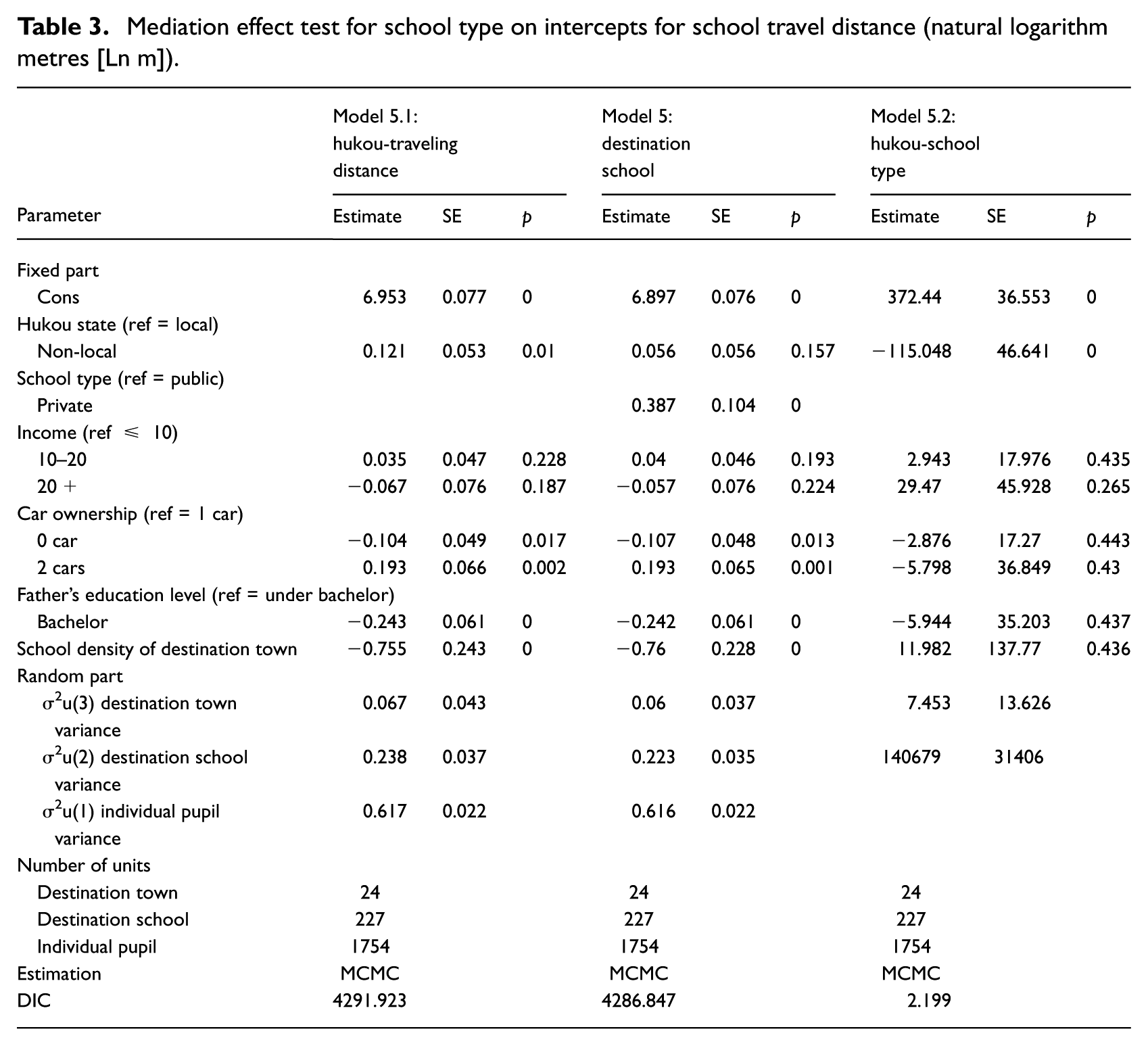
Our results indicate that hukou status does not exert a direct effect on pupils’ school travel distance once school type is taken into account, but instead operates primarily through a mediating pathway via school type. This mediation reflects the institutional logic of Zhongshan’s enrolment policy, under which local-hukou pupils are prioritised in access to public schools, while non-local pupils who fail to secure a public-school place are more likely to attend private schools. Because public schools are constrained by catchment boundaries and are more densely distributed than private schools, pupils attending public schools typically travel shorter distances. As a result, hukou status shapes school travel distance indirectly by influencing school type choice under existing enrolment rules, family school choice behaviour, and local school supply conditions. Previous studies have paid limited attention to such mediating pathways and may therefore underestimate the role of hukou in shaping children’s educational accessibility through everyday mobility.
How population density and hukou jointly shape travel distance
The cross-level interaction effects between variables at different levels can also be assessed (Gould, 2009; Jones and Duncan, 1995). If the relationship between a Level 1 (individual) and Level 2 (origin neighbourhood) variable is statistically significant it is considered to be a cross-level interaction effect. Building on Model 4, Model 4.1 incorporates a nonlinear polynomial interaction between origin neighbourhood population density (Level 2) and hukou (Level 1). As shown in Table 4, the interaction coefficients are statistically significant between population density, hukou, and predicted travel distance, confirming a non-linear association.
Interaction of hukou (Level 1) and village population density (Level 2) on intercepts (modelled school travel distance, natural logarithm metres [Ln m]).
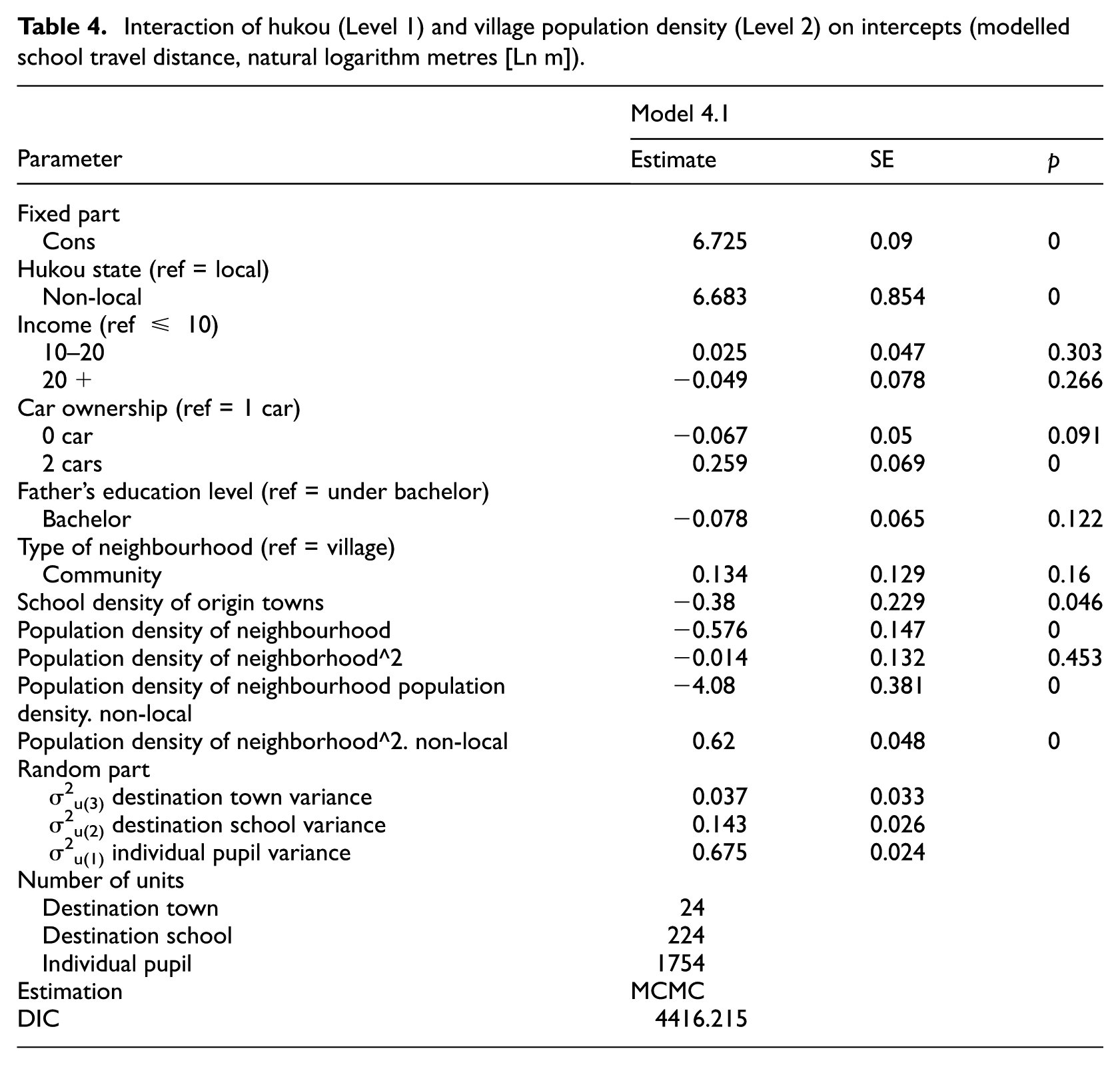
Figure 2 visualises this relationship, illustrating how the effect of population density on travel distance differs between local and non-local hukou individuals. Local hukou children mainly enrol in public schools within the school district. As population density increases, the school district area decreases, and the travel distance of children to school decrease accordingly. Whether non-local residents can attend public schools depends on the number of public-school places left after the local hukou students are enrolled. At low population density, public schools have available places for most non-local children, while increasing density shrinks school districts, further reducing travel distance. When population density exceeds a critical point, public schools within the catchment area can no longer accommodate all students, forcing some non-local children to enrol in distant private schools outside the district, increasing their travel distance. Increasing population density is at the expense of non-local children being excluded from schools close to their homes.

Cross-level interaction of and hukou status (Level 1) and population density (Level 2).
This differentiated impact of population density and hukou status on travel distance also helps explain the patterns observed in school type. Studies in Western countries show that private school students often travel further because families with higher socio-economic status actively choose more distant, higher-quality schools (Butler et al., 2013; Ruijs and Oosterbeek, 2019). In Zhongshan, the longer travel distance of private school students is not only due to families with higher socio-economic status and wealth actively selecting specific private schools, but also because some disadvantaged non-local families are systematically marginalised in the public school enrolment system and are left with no choice but to attend more distant private schools.
Discussion and conclusion
This article constructs nested and cross-classified multilevel models that simultaneously incorporate two geographical dimensions – origins (neighbourhood and town) and destinations (school and town) – to examine how individual- and contextual-level factors, both directly and through their interactions, shape children’s travel distance under hukou-based enrolment. The results indicate travel distance is shaped by the combined effects of individual factors (e.g. hukou status, father’s education and family car ownership) and contextual factors (e.g. population density and school type), including their cross-level interaction. Similar interactions between individual and contextual characteristics have been documented by Fast (2020) in studies outside the Chinese context, but remain underexplored in analyses of school travel distance under hukou-based enrolment in China. Hukou status, in particular, influences travel distance through complex interactions with contextual factors. Building on previous multilevel analyses of school travel distance in China that focus primarily on residential contexts (e.g. Xiang et al., 2021), this study extends existing work by jointly modelling places of origin and destinations, thereby revealing an indirect pathway through which hukou status influences travel distance via school type, alongside cross-level interactions with neighbourhood population density. Whilst this article uses a case study of Zhongshan, China, it has wider implications for understanding inequalities in access to schooling and other public services by demonstrating the importance of jointly considering individuals, places of origin, and destinations within a single analytical framework. More broadly, the findings suggest that school enrolment optimisation and equitable planning should move beyond single-scale or purely distance-based criteria to reflect how institutional arrangements and socio-spatial contexts jointly shape families’ educational mobility and opportunities.
This study has several limitations. Contextual variables for neighbourhoods, towns and schools are constrained by data availability, which may not fully capture factors such as socio-economic conditions or transport infrastructure. Although our modelling strategy distinguishes between individual- and contextual-level characteristics and incorporates cross-level interactions to mitigate confounding, potential endogeneity between hukou status, family socio-economic background, and school travel distance cannot be fully eliminated. Future research could address these limitations by drawing on richer longitudinal or quasi-experimental data, as well as mixed-methods approaches (e.g. social surveys and interviews) to better examine the dynamics of school choice and commuting, and their implications for educational access and the (re)production of urban social inequality.
Footnotes
Acknowledgements
We would like to thank the three anonymous reviewers for providing very useful comments on an initial draft of the article. Any errors remain the authors’ own.

Funding
The authors disclosed receipt of the following financial support for the research, authorship, and/or publication of this article: This study was supported by the National Natural Science Foundation of China (No. 42271208) and Chinese Scholarship Council (No.202306010168).
Declaration of conflicting interests
The authors declared no potential conflicts of interest with respect to the research, authorship, and/or publication of this article.