



Abstract
While age-friendly initiatives increasingly recognise the importance of play for recreational well-being in later life, its conceptualisation and the specific mechanisms driving it remain significantly underexplored, particularly among female older adults (FOAs). Addressing this critical gap, our study focuses on FOAs in Hong Kong’s high-density public housing estates (PHEs), a vital yet overlooked demographic in urban ageing research. Drawing on semi-structured interviews with 52 participants, we integrated thematic analysis with fuzzy-set Qualitative Comparative Analysis (fsQCA), guided by the Stimulus-Organism-Response (S-O-R) framework. This approach elucidates the complex interplay of factors facilitating FOAs’ playful engagement, with a specific focus on the roles of ageism and the built environment. Our findings reveal a multi-dimensional framework of FOA play, delineating five primary dimensions: Embodied Health Instrumentality, Collective Participation, Organisational Dependency, Generational Temporalities, and Implicit Playful Mindset. FOAs conceptualise play as a dual-purpose pursuit, bridging functional imperatives (e.g. health maintenance, cognitive stimulation) and recreational vitality (e.g. social engagement, emotional regulation). The fsQCA results yielded six distinct configurations that enable play, highlighting health aspirations and collective participation as core enablers, frequently synergised with an implicit playful mindset. Peripheral yet significant factors encompass favourable environmental quality, financial freedom, and the absence of loneliness or ageism. Beyond dismantling ageist stereotypes, this research establishes play as a critical missing element in contemporary age-friendly urban discourse. These findings offer transformative insights for reimagining inclusive urban environments that authentically accommodate diverse recreational expressions and combat the pervasive loneliness crisis among older adults in high-density contexts.
Introduction
The global population aged 60 and over is projected to double by 2050, reaching 2.1 billion (United Nations, 2024). This demographic wave has precipitated a parallel crisis in social isolation and loneliness among older adults (OAs), now recognised by the World Health Organization (WHO) as a critical public health emergency (Yeung et al., 2025). Amidst this shift, pre-existing spatial and social disparities, ranging from unequal access to healthcare and housing to exclusionary public spaces and limited mobility, have become increasingly pronounced (Jian et al., 2021; Mo et al., 2025). With many municipalities ill-equipped to manage these profound infrastructural and social demands (Paumelle et al., 2026), urban governance has witnessed a global proliferation of ‘age-friendly’ initiatives. These strategies actively align with the WHO’s core domains to foster more inclusive environments for older residents (Zou et al., 2026).
The Age-Friendly Cities (AFC) paradigm, however, is undergoing a critical conceptual shift. Traditional approaches heavily prioritised macro-level physical infrastructure (Bhuyan et al., 2020; Jian et al., 2025; Mo et al., 2026; van Hoof et al., 2021), often marginalising social connectivity and authentic participation (Buffel and Phillipson, 2025; Menec and Brown, 2018). Reflecting the WHO’s (2018) expanded focus on social and recreational engagement, recent research has pivoted towards micro-scale environments that directly shape older adults’ well-being (Zou et al., 2026), particularly through spaces that foster recreational activities (Lei et al., 2026; Wang et al., 2025) and intergenerational leisure (Zhong et al., 2022). Simultaneously, the AFC discourse has broadened to navigate complex urban dynamics, such as adapting policies to the unique contexts of shrinking cities (Paumelle et al., 2026) and integrating climate resilience to build a more sustainable age-friendly future (Zhong et al., 2022). This evolution underscores that genuinely age-friendly environments demand deliberate interventions that transcend basic physical support to facilitate meaningful activities and enhance overall quality of life.
Within this expanded focus on recreational well-being, play is increasingly recognised as a fundamental, yet overlooked, component of quality of life in later years (Hartt, 2023; Kwon et al., 2019; Mahdjoubi and Spencer, 2015). Play represents the quintessential modality for realising this well-being. It triggers a potent bottom-up spillover effect, where specific recreational satisfaction cascades upwards to significantly boost overall life satisfaction and subjective well-being (Sirgy et al., 2017). Beyond immediate psychological benefits (Burr et al., 2019), play serves as a profound vehicle for constructing personality and imbuing existence with meaning, facilitating a form of existential liberation in later life (Hartt, 2023). This emancipatory potential is particularly salient for women, who often face disproportionate domestic constraints; for them, play fosters a vital sense of autonomy, offering a sphere of control and freedom that is otherwise restricted (Kwon et al., 2019). Ultimately, these psychological and existential processes are spatially grounded (Stevens, 2007). Play transforms static physical spaces into dynamic arenas for interaction (Hartt and Vincent, 2024), implying that environments designed for recreational well-being must actively support positivity, creativity, and spontaneity (Amati et al., 2024).
Despite play being a lifelong pursuit that evolves with age (Burr et al., 2019), academic discourse and practical urban planning remain predominantly child-centred (Hartt, 2023). Current planning processes often marginalise non-economically active populations (Phillipson and Grenier, 2021), creating a paradox where well-intentioned age-friendly initiatives perpetuate oversimplified solutions that privilege basic safety over holistic, playful engagement. Consequently, the socio-material conditions required to facilitate older adult play, particularly in public spaces, which serve as primary settings for social interaction, remain severely underexplored (Hartt and Vincent, 2024).
These systemic limitations are particularly acute in hyper-dense contexts like Hong Kong. In 2021, 19.3% of Hong Kong residents were aged 65 or older (Census and Statistics Department, 2023), with 46% of OAs reporting frequent loneliness (Tang and Chou, 2024). Responding to these challenges, the Hong Kong Government has prioritised ageing-in-place as a cornerstone policy direction, guided by the principle of ‘ageing in place as the core, with institutional care as back-up’ (Chief Executive Office, 2025). However, environmental features in such hyper-dense settings frequently fail to meet OAs’ holistic needs, creating Person-Environment mismatches that exacerbate marginalisation (Buffel and Phillipson, 2025; Jian et al., 2025). Attention to the socio-material conditions that facilitate older adult play, particularly in public spaces as primary settings for social interaction, remains significantly lacking (Hartt and Vincent, 2024). Although cross-sectoral governance and diverse partnerships can enhance social connectivity (Greenfield and Buffel, 2022; Menec and Brown, 2018), the potential of play as an integrative concept encompassing physical, cognitive, and social stimulation remains absent from local developmental frameworks (Burr et al., 2019; Hartt, 2023). Within this broader neglect of older adult play, female older adults (FOAs) represent a particularly understudied population, facing intersecting vulnerabilities that shape their play engagement through complex health, social, financial, environmental, and ageist factors (Noon and Ayalon, 2018; van Hoof et al., 2022; Yarnal et al., 2008). Consequently, creating age-friendly environments that genuinely support quality ageing-in-place requires a comprehensive understanding of how FOAs conceptualise play, how it is constrained by systemic barriers, and how built environments can be strategically leveraged to promote it.
This study addresses this critical gap by investigating the conceptualisation and experience of play among FOAs in Hong Kong’s public housing estates (PHEs). It seeks to answer: How do FOAs conceptualise and articulate their engagement in play, and what complex configurations of health, social, financial, and environmental factors, alongside ageism, enable or constrain it? Using thematic analysis of qualitative interviews, integrated with the Stimulus-Organism-Response (S-O-R) framework and fuzzy-set Qualitative Comparative Analysis (fsQCA), this study identifies key conditions shaping FOAs’ experiences. The paper outlines the relevant literature and theoretical framework, details the methodology, presents findings on play conceptualisation and enabling/constraining configurations, and concludes with implications and future research directions.
Literature review
Play across the life course and the need for a configurational approach
Play, fundamentally conceptualised as voluntary, intrinsically motivated activities that foster enjoyment, creativity, and social interaction (Tawfique et al., 2025), has historically been dominated by child-centric paradigms. Classical theorists framed play as biologically adaptive (Groos, 1901) or socially formative (Mead, 1934), implicitly positioning play as developmentally bounded, thereby reinforcing assumptions that its relevance diminishes with age. Contemporary scholarship, however, reframes play as a fundamental state of being that encompasses diverse behaviours across social and cultural settings (Hartt and Vincent, 2024; Sutton-Smith, 2001). In older adulthood, play does not cease but undergoes ontological transformation, manifesting diversely as social gaming, volunteering, aesthetic exploration, or bodily movement. Gerontological research affirms that later-life play is generative rather than residual, supporting physical functioning, cognitive flexibility, social connectedness, and emotional resilience (Kuiper et al., 2015).
Despite this evolving understanding, existing literature predominantly models play as a linear outcome of isolated predictors, obscuring the causal complexity inherent in how OAs experience it. Research often treats OAs as a homogeneous group, neglecting how intersecting vulnerabilities, particularly gender and the context of high-density vertical living, fundamentally alter the landscape of play. As a result, we lack a comprehensive understanding of the specific configurations of conditions that enable play for FOAs, who face the ‘double jeopardy’ of ageism and gendered spatial constraints (Yarnal et al., 2008). To address this gap, we must move beyond simple cause-and-effect logic to examine how diverse factors combine to facilitate or inhibit these activities, framing play as a complex behavioural response to multiple interacting stimuli.
Theoretical foundations for understanding older adult play
Adopting a configurational perspective, we argue that play is not the result of isolated variables, but an outcome of causal recipes—specific, non-linear combinations of physical constraints, spatial affordances, and deeply ingrained social norms (Yarnal et al., 2008). To operationalise this complexity, we repurpose the Stimulus-Organism-Response (S-O-R) model (Mehrabian and Russell, 1974) as an interactionist framework.
Fundamentally, S-O-R posits that external Stimuli (S) evoke internal cognitive or emotional states within the Organism (O), which in turn drive behavioural Responses (R). This structure allows us to map how environmental cues (S) are filtered through psychological states (O) to produce—or inhibit—playful engagement (R). While S-O-R has been widely applied in consumer behaviour and tourism to explain how external stimuli trigger behavioural tendencies (Zhang et al., 2024), its application to OAs’ play requires theoretical refinement. We therefore integrate domain-specific theories: Person-Environment (P-E) Fit theory operationalises the Stimulus, and Self-Efficacy theory characterises the Organism.
The stimulus: Gendered person-environment fit and ageist social norms
Within this framework, the Stimulus (S) is operationalised through Person-Environment (P-E) Fit theory. Rather than viewing the environment as a neutral backdrop, P-E Fit defines it as an active force exerting ‘environmental press,’ understood as the demands that the environment places on the individual. According to this ecological perspective, well-being and engagement depend on the congruence between this external press and an individual’s internal competence (Lawton and Nahemow, 1973). For OAs, as competencies shift, the environment must adapt to sustain autonomy: a good fit acts as a positive stimulus that invites engagement, whereas a misfit, where environmental demands exceed individual capabilities, acts as a negative stimulus (Buffel and Phillipson, 2025; Menec and Brown, 2018).
In high-density cities like Hong Kong, the physical component of this Stimulus is often characterised by high ‘press’ and low support. The built environment shapes play opportunities by providing or restricting access to physical, cognitive, and social activities. Theoretically, accessible daily destinations encourage spontaneous interaction and light physical activity (Jian et al., 2025); walkable, rest-equipped pathways support OAs with mobility concerns (Maresova et al., 2023); and green spaces enable reflective or nature-based play (Hartt and Vincent, 2024; Zheng et al., 2025). However, in double-ageing cities, where demographic ageing of residents and physical ageing of facilities co-occur (Jian et al., 2025), this access is frequently restricted through an implicit design bias favouring the ‘ideal user’: young, able-bodied, and male (Noon and Ayalon, 2018; Shaikly and Mella Lira, 2023). This design bias renders the physical press inherently gendered. FOAs are more susceptible to environmental barriers due to a steeper decline in physical and sensory abilities compared to men. This vulnerability is compounded by the ‘feminisation of ageing’ (Davidson et al., 2011), where longer life expectancy prolongs exposure to these built environment-induced constraints (Yang et al., 2022). Consequently, spatial features such as a lack of resting nodes, inadequate elevators, fast-paced pedestrian flows, or dim lighting, which are prevalent in Hong Kong’s ageing public housing estates, potentially create objective barriers to play, which contribute to a fundamental erosion of FOAs’ sense of safety and capability (Dubey et al., 2025; Jian et al., 2025; Noon and Ayalon, 2018; Van Cauwenberg et al., 2012). Physical deterrents simultaneously function as a semiotic signal of exclusion, subtly implying that playful engagement is a secondary or marginal activity for the ageing female demographic (Buffel and Phillipson, 2025; Menec and Brown, 2018).
Beyond physical accessibility, P-E Fit necessitates social congruence, extending the stimulus to include the intangible yet potent pressure of social norms. Broader social structures reinforce ageist stereotypes that portray OAs as passive, diminishing the perceived legitimacy of play (Chrisler et al., 2016). For FOAs, this pressure is intensified by an entrenched ‘ethic of care’. In Hong Kong, data indicates that 24.4% of older women, compared to only 4.5% of men, forgo leisure for caregiving (Jaumot-Pascual et al., 2018). These norms transform public spaces into sites of obligation rather than recreation, effectively marginalising playful expression in older women’s lives (Yarnal et al., 2008). To synthesise, the Stimulus (S) represents a convergence of exclusionary urban design (physical) and restrictive role expectations (social). Yet, within the S-O-R logic, these environmental signals do not deterministically command behaviour but serve as inputs requiring processing by the individual subject—the Organism.
The organism: Self-efficacy and internalised ageism
The Organism (O) represents the internal cognitive mechanism that decodes environmental stimuli. We operationalise this internal state using Self-Efficacy Theory, which offers a robust explanatory lens for understanding how OAs process environmental signals before acting. Defined as an individual’s belief in their capacity to execute behaviours necessary to produce specific attainments (Bandura, 1977), self-efficacy determines whether an individual perceives an environmental challenge as a barrier or an achievable task. While the built environment (S) may signal exclusion, the Organism mediates this signal through cognitive appraisal.
In the context of OA’s play, self-efficacy is not merely a psychological trait but a critical driver of engagement. Sutton-Smith (2001) suggests that the willingness to play is profoundly influenced by perceived agency. High self-efficacy promotes active participation in activities like dancing or group games, whereas low self-efficacy precipitates withdrawal (Miller et al., 2019; Wanka, 2018). Importantly, this belief system is not static, but rather shaped by concurrent physical and social factors. While physical health conditions like arthritis can reduce perceived ability, OAs often demonstrate adaptive strategies, modifying play behaviours to fit changing capacities in order to maintain engagement (Warner et al., 2014). Social context is equally pivotal: whereas encouragement fosters vicarious mastery experiences (e.g. gaining confidence by observing other older adults successfully engage in play), that strengthen competence (Bandura, 1997), social isolation and a perceived lack of support can significantly erode confidence and reduce motivation (Lee et al., 2024; Miller et al., 2019).
Crucially, this cognitive appraisal is filtered through internalised ageism. The transition from Stimulus to Response is governed by an internal negotiation: does the individual accept societal rejection or possess the agency to override it? If an FOA has internalised the norm that ‘play is for children’, her self-efficacy for play diminishes, and the environmental misfit described in the previous section is validated. Conversely, high self-efficacy serves as a buffer that allows the individual to reframe constraints—such as a lack of formal play equipment—as affordances for improvisation. Thus, the Organism is not a passive recipient of environmental stimuli but an active mediator that interprets these signals through the dual lenses of capability (self-efficacy) and identity (ageism).
Conceptual framework
Building upon the theoretical foundations of the S-O-R model,P-E Fit theory, and Self-Efficacy theory, this study proposes an integrated conceptual framework (Figure 1) to explore the multifactorial influences shaping FOAs’ engagement in play. Crucially, reflecting the configurational perspective, play is conceptualised as a conditional behavioural Response (R) to the dynamic interplay between external (S) and internal (O) factors. External factors, including social norms and age-friendly built environments, are interpreted through the lens of P-E Fit to highlight how spatial and social attributes align with functional needs and thereby facilitate or hinder play. While this P-E Fit evaluation encompasses both indoor and outdoor environments, the principal focus of this study remains on outdoor community-based settings. Grounded in Self-Efficacy theory, the Organism acts as a cognitive gatekeeper, interpreting these environmental signals through the dual lenses of perceived capacity and internalised ageism.

The conceptual framework.
The framework posits that no single factor is solely determinative; rather, it is the synergistic alignment or misalignment between environmental affordances and internal self-beliefs that drives behaviour. For instance, an objective constraint, such as playground equipment designed for children, becomes a prohibitive barrier to play not merely due to its physical size, but when it triggers internalised ageist stereotypes that engaging with it is ‘inappropriate’ or ‘embarrassing’ for an OA. Thus, internal constructs, such as self-discrimination and societal stereotypes, do not merely mediate but configure with environmental features to shape whether play is perceived as feasible. This conceptual framework provides a systematic lens to investigate the equifinal pathways through which OAs in high-density urban environments perceive, access, and enact playful activities. It lays the theoretical groundwork for the study’s empirical analysis, moving beyond simple causality to reveal the complex, interlocking configurations of constraints and enablers in later-life play.
Methodology
Study context
Public Housing Estates (PHEs), accommodating nearly 30% of Hong Kong’s population, present a critical microcosm of high-density ageing, with residential towers often exceeding 40 storeys (Subsidised Housing Committee, 2024). Unlike Western suburban models or local private developments, the severe spatial constraints in PHEs, where individual living space averages just 10–12 m2, inherently restrict OAs private leisure activities, rendering outdoor communal areas indispensable for survival against isolation (Tang and Chou, 2024). However, planning evaluations in PHEs typically prioritise expert metrics over residents’ narratives (Chen et al., 2025), resulting in a utilitarian approach that caters to physical exercise but neglects the nuanced, non-instrumental need for play. Furthermore, this technocratic view is often gender-blind. While FOAs are often the primary users of these spaces due to different life-course trajectories, their specific play behaviours and needs remain marginalised in both academic discourse and practice.
Mei Lam Estate and Chak On Estate were selected as strategic case studies representing the prevailing challenges of Hong Kong’s ‘legacy’ housing stock (Figure 2). Predating modern age-friendly standards, these 50-year-old estates exemplify the spatial precarity of high-density ageing. With per capita living space in these specific estates averaging roughly 13–16 m2 (HK Housing Authority, 2020), the domestic sphere remains too constricted for playful engagements, effectively outsourcing daily life to the public realm. These sites thus provide a critical context for examining how FOAs reclaim and utilise communal spaces for play, transforming utilitarian voids into vital social infrastructure.

Context of the study.
Research methods and participants
The study employed a four-stage design to capture the FOAs’ ‘insider perspective’, integrating: (1) face-to-face interviews, (2) thematic analysis for play conceptualisation, (3) quantification of S-O-R factors and outcomes, and (4) fsQCA for identifying set-theoretic relationships and sufficient configurations (see Figure S1 in Online Supplemental Materials). Fifty-two FOAs were recruited from the selected estates using purposive sampling to ensure diverse representation across ages and health conditions.
The recruitment process employed a hybrid strategy integrating institutional partnership with peer referrals. While collaboration with local community centres facilitated outreach via posters and verbal announcements, a concurrent snowball sampling technique leveraged participants’ social networks to identify eligible peers. To counteract potential gatekeeper bias inherent in institutional recruitment, a direct-access protocol was implemented. This mechanism enabled prospective participants to contact the research team privately without involving centre staff for registration, thereby mitigating the risk of selection bias. This approach, combined with a cash-equivalent incentive, was critical for reaching socially withdrawn individuals who might otherwise be excluded by institutional intermediaries. Strict anonymity and confidentiality were maintained to secure a safe and open participatory environment.
Semi-structured interviews (50–80 minutes) were conducted in Cantonese or Mandarin. To ensure comfort and privacy, interviews took place in private rooms at community centres or quiet, neutral locations within the estate. The interview guide covered demographics, daily routines, the role of play in well-being, perceived barriers and enablers, and the evolution of play with age. Prior to the interviews, participants were briefed on the study’s purpose and confidentiality; upon obtaining informed consent, sessions were audio-recorded and transcribed verbatim. Recognising potential social desirability bias—where participants might underreport negative feelings—interviewers used rapport-building and indirect questioning (Fisher, 1993) to elicit authentic narratives regarding play and psychological barriers. Analytically, this was further addressed during the interpretation phase by triangulating participants’ declarative statements with their described behaviours and routines. This allowed researchers to identify latent distress or hidden constraints even when explicit responses were socially guarded. All procedures were approved by The Education University of Hong Kong Research Ethics Committee (Reference No. 2023-2024-0368).
Data analysis
Thematic analysis and conceptualisation of FOA play
A hybrid inductive-deductive thematic analysis, facilitated by NVivo 15, was employed to conceptualise FOA play and construct key variables for the subsequent fsQCA (Braun and Clarke, 2022). To preserve semantic integrity and cultural nuances, and to prevent translation errors from compromising the analytical results, coding was conducted primarily in the original language (Cantonese or Mandarin). The process began with line-by-line open coding to identify emergent patterns, followed by iterative axial coding and constant comparative techniques to cluster themes into major categories (Scott and Medaugh, 2017). Specifically, a phenomenological lens allowed themes to emerge from lived experiences while connecting to the conceptual framework. For instance, narratives on physical barriers (e.g. steep ramps) were coded as ‘Mobility Obstacles’ under ‘Physical Infrastructure,’ serving as measurement items for the Built Environment (BE). Similarly, expressions of isolation were mapped to Loneliness (LN). To ensure construct validity, a rigorous coding protocol was established to determine variable values based on the intensity and frequency of specific mentions. The coding scheme, including measurement items, coding rules, and representative excerpts for all composite indices, is detailed in Figure S2 and Table S1 in the Online Supplemental Materials.
Two researchers independently coded the dataset to ensure reliability. Intercoder reliability for theme identification and variable assignment achieved a strong Cohen’s κ > 0.85 after resolving discrepancies through consensus (McHugh, 2012). English translation was performed post-analysis for reporting. Excerpts and the coding structure were translated using ChatGPT 4o, followed by rigorous double-verification by two bilingual researchers. This prioritised the analytical validity of local expressions during coding while ensuring transcultural equivalence in the final presentation (Qun and Carey, 2024). This rigorous cross-validation minimised interpretive biases, yielding a robust dataset for fsQCA calibration.
S-O-R Framework based fsQCA analysis
Following thematic analysis, the participants’ opinions and attitudes towards the identified constructs were evaluated from interview transcripts (see Figure S3 in the Online Supplemental Materials). Qualitative data were converted into 7-point Likert scores ranging from ‘strongly disagree’ (1) to ‘strongly agree’ (7). Quantification relied on three coding criteria: concept centrality, frequency of mention, and sentiment intensity. For example, frequent and intensely negative mentions of isolation were coded as high scores for Loneliness (LN), as one participant said: ‘I
This post-interview quantification approach has been demonstrated to be suitable for aligning participants’ often emotional and colloquial expressions with rigorous measurement scales (South et al., 2022). Notably, the interviews avoided explicit Likert prompts to foster exploratory, relaxed, and trust-based dialogue, allowing interviewers to elicit specific and authentic opinions. To mitigate social desirability bias, a common threat in face-to-face interviews where participants may underreport negative feelings (e.g. loneliness), interviewers employed probing techniques, checking for inconsistencies between generalised statements and specific narrated experiences. When discrepancies arose (e.g. claiming to be very happy but describing intense daily isolation), coding prioritised the specific behavioural evidence over the generalised positive assertion (Bergen and Labonté, 2020). No missing cases occurred, as the format allowed on-site clarification. Detailed operationalisation, coding rules, and examples are in Appendix I in the Online Supplemental Materials.
Likert scores were then calibrated to fuzzy-set membership values. fsQCA bridges fuzzy sets and truth table analysis by constructing a Boolean truth table summarising results (Ragin, 2008). In this process, calibration is crucial given the qualitative nature of interview data, especially when specific factors set the context for others (Ragin, 2008). In this study, for instance, the built environment could shape both loneliness and ageism. Unlike regression, fsQCA captures complex interactions and equifinality: different condition combinations leading to identical outcomes (Fiss, 2011), making it ideal for examining the interplay of health, environmental and social factors. To calibrate the raw Likert scores (1–7) into fuzzy membership values (0–1), we employed the Direct Method of Calibration (Ragin, 2008), utilising a logistic function to represent qualitative changes in participants’ attitudes more accurately than linear transformation. Three qualitative anchors were established:
The
Analysis proceeded in two stages. First, necessity analysis assessed if any single condition was indispensable for play engagement, using a consistency threshold of ≥0.90 (Ragin, 2000; Schneider and Wagemann, 2012). Second, sufficiency analysis identified configurations driving play engagement, revealing equifinal pathways with consistency > 0.80 and coverage thresholds > 0.50 (Fiss, 2011; Geremew et al., 2024). This approach highlights both individual conditions and their configurational relationships, aligning with recent applications (Ragin, 2008).
Results: Understanding FOAs’ play
Demographic, types, and manifestations of older adult play activities
Participants were primarily aged 65–84 with lower educational attainment, often relying on government subsidies or family support, and commonly living alone or with a partner (see Figure S4 and Table S2 in the Online Supplemental Materials for full demographics). Our analysis revealed a broad spectrum of play activities among FOAs, varying significantly in frequency and collective participation (Figure S5 in Online Supplemental Materials). For FOAs, play primarily occurs outdoors unless weather interferes, with indoor play in community centres serving as a frequent alternative. Interestingly, functional activities involving social interaction, such as ‘Grocery shopping’ and ‘Visit community centres’ emerged as central to play narratives. A discernible trend further indicates that activities with higher frequencies of mention (e.g. ‘Morning dance’ and ‘Tai Chi class’) generally correspond to a greater degree of collective engagement. Conversely, frequent activities like ‘Watch TV alone at home’ reflect independent play. This underscores that FOAs’ play encompasses both highly frequent, socially interactive pursuits and less frequent, or more independent, activities. Notably, FOAs often explicitly frame ‘going out’ and social engagement as play, while independent pursuits with personal value are less frequently articulated as such, indicating a potential gap between perceived and actual recreational engagement.
Conceptualisation of older adult play
Thematic analysis revealed how FOAs conceptualise play as a multifaceted phenomenon, delineating five primary dimensions supported by hierarchical sub-themes (Figure 3). This conceptualisation presents play as a self-initiated pursuit deeply woven into daily lives, serving both functional and recreational purposes.

Conceptualisation of older adult play.
The first dimension, Embodied Health Instrumentality (HI), highlights FOAs’ understanding of play primarily as an instrumental health practice. For them, play serves as a tool for achieving and maintaining holistic well-being. This involves Maintaining Physical Health through outdoor activities like exercise, cycling, or stretching. For instance, one participant noted, ‘After morning exercise, I go to the diner for tea’, illustrating how play seamlessly integrates into daily routines as a health regimen. Beyond physical gains, this dimension extends to supporting Cognitive and Emotional Well-being and Psychological Enrichment by engaging in mentally stimulating activities and fostering resilience. Play enhances mood and facilitates flow states, exemplified by a participant stating, ‘It makes life fuller, so you don’t have so much time to overthink.’
Beyond individual health, Collective Participation (CP) highlights sociability as a cornerstone for fostering Social Interaction and Bonding. Group activities, such as dancing or communal chatting during exercise, cultivate vital social connections. Participants vividly illustrate this: ‘Exercise, chat a bit. Making one more friend isn’t a bad thing,’ and ‘Our dance group meets every day.’ Play also enables Emotional Support Exchange, offering stress relief and companionship. For these women, play cultivates a sense of Collective Identity and Validation, reinforcing community norms and a profound sense of belonging that counters social isolation.
The third dimension, Organisational Dependency (OD), reveals FOAs’ reliance on structured programmes and activities championed by institutions. This is particularly pronounced within Hong Kong’s high-density urban context, where limited personal space and communal facilities often necessitate external provision for meaningful leisure. This dependency reflects a deep-seated Reliance on Institutional Resources and Professional Guidance. Participants consistently expressed high regard for the legitimacy and accessibility afforded by such organised settings; one participant highlighted, ‘At the centre, you can use equipment with professional instructors,’ while another remarked, ‘This is organised by the district government,’ underscoring their trust in official endorsement. This perceived Sense of Formality and Legitimacy ensures accessibility and credibility, and facilitates consistent and confident play engagement.
The fourth dimension, Generational Temporalities (GT), underscores play as a temporal anchor stabilising daily life while ensuring cultural continuity. This manifests in Fixed Routines and Sequenced Activities that provide stability and predictability, as one participant described, ‘I come here at 9 a.m., read the paper, exercise.’ Play also supports Transition Adaptation, filling post-retirement voids and reconstructing habits in familiar urban spaces, exemplified by reflections such as, ‘It’s only after retiring recently that I started joining.’ Furthermore, it enables Intergenerational Interface through storytelling and knowledge exchange with younger generations, fostering modernity adaptation; a participant shared, ‘My grandson showed me how to use a smartphone, and now I can video call my friends.’ These temporal elements transform play into both a stabilising force for their post-retirement identity and a bridge across generations, embedding their lives in enduring relational timelines.
Finally, an overarching perspective is the Implicit Playful Mindset (IP), which captures their unique ability to weave play into daily life. This transforms routine and often mundane tasks into enjoyable experiences through a distinctive mindset. Participants exemplified this by stating, ‘Going to the supermarket to shop, I stroll around… treat it as a walk,’ and ‘When cleaning the house, I play music, hum along.’ This mindset extends to the Gamification of Daily Activities through heightened sensory joy in their surroundings, engaging in Observational Participation by finding fulfilment in watching others, and demonstrating Creative Spatial Engagement by innovatively adapting spaces for play.
Enablers and barriers of female older adult play
This section presents the fsQCA findings regarding the factors enabling or constraining play. Building on our conceptual framework, Figure 3 illustrates the specific stimuli empirically investigated, including health, social, financial, environmental stimuli, ageism, and loneliness. These factors are not monolithic; they comprise various dimensions that may independently or jointly influence play engagement. The following analysis explores how these dimensions combine to form specific pathways to play.
Descriptive statistics
Table 1 summarises the descriptive statistics for the 52 participants. The mean membership score for FOAs’ play is moderate at 0.60, aligning with comparable scores for loneliness-free (LN, 0.58) and ageism-free (AG, 0.62) states. GT and CP record the highest means (0.71), reflecting generally supportive temporal and social contexts for play engagement. Conversely, OD and FI are the lowest (0.29). While standard deviations are the lowest for loneliness (0.11) and ageism (0.12), which indicates a high degree of consensus regarding these barrier-free states, HI and CP exhibit significant heterogeneity (SD = 0.32 and 0.29, respectively). Crucially, subcategorical analysis reveals internal disparities; for instance, within the built environment, high safety (Mean = 0.85) contrasts sharply with the scarcity of natural elements (Mean = 0.39), highlighting that while overall environmental barriers are moderately rated, specific elements like safety act as stronger, more consistent drivers within their respective categories.
Descriptive statistics.

Loneliness and ageism stimuli stand for a loneliness-free and ageism-free state.
Necessity and sufficiency analysis
In fsQCA, ‘consistency’ measures the strength of the subset relationship, while ‘coverage’ assesses its empirical relevance. A condition is considered necessary if the outcome cannot occur in its absence. To identify such conditions, we adopt a consistency threshold of 0.90, using coverage to distinguish meaningful constraints from trivial prerequisites (Ragin, 2000). The analysis identifies three strictly necessary conditions for FOA play engagement (PL; Table 2). CP demonstrates the highest necessity (consistency = 0.98), followed by GT (0.95) and HI (0.93). Their substantial coverage scores (0.80–0.82) confirm these are specific, empirically relevant resources rather than generic preconditions, establishing social connection, temporal flexibility, and physical health as non-substitutable foundations for play. Additionally, while falling short of the 0.90 threshold, AG (0.84), LN (0.81), and BE (0.79) show high consistency, suggesting they play a significant, albeit not strictly necessary, role in enabling play.
Necessity analysis.
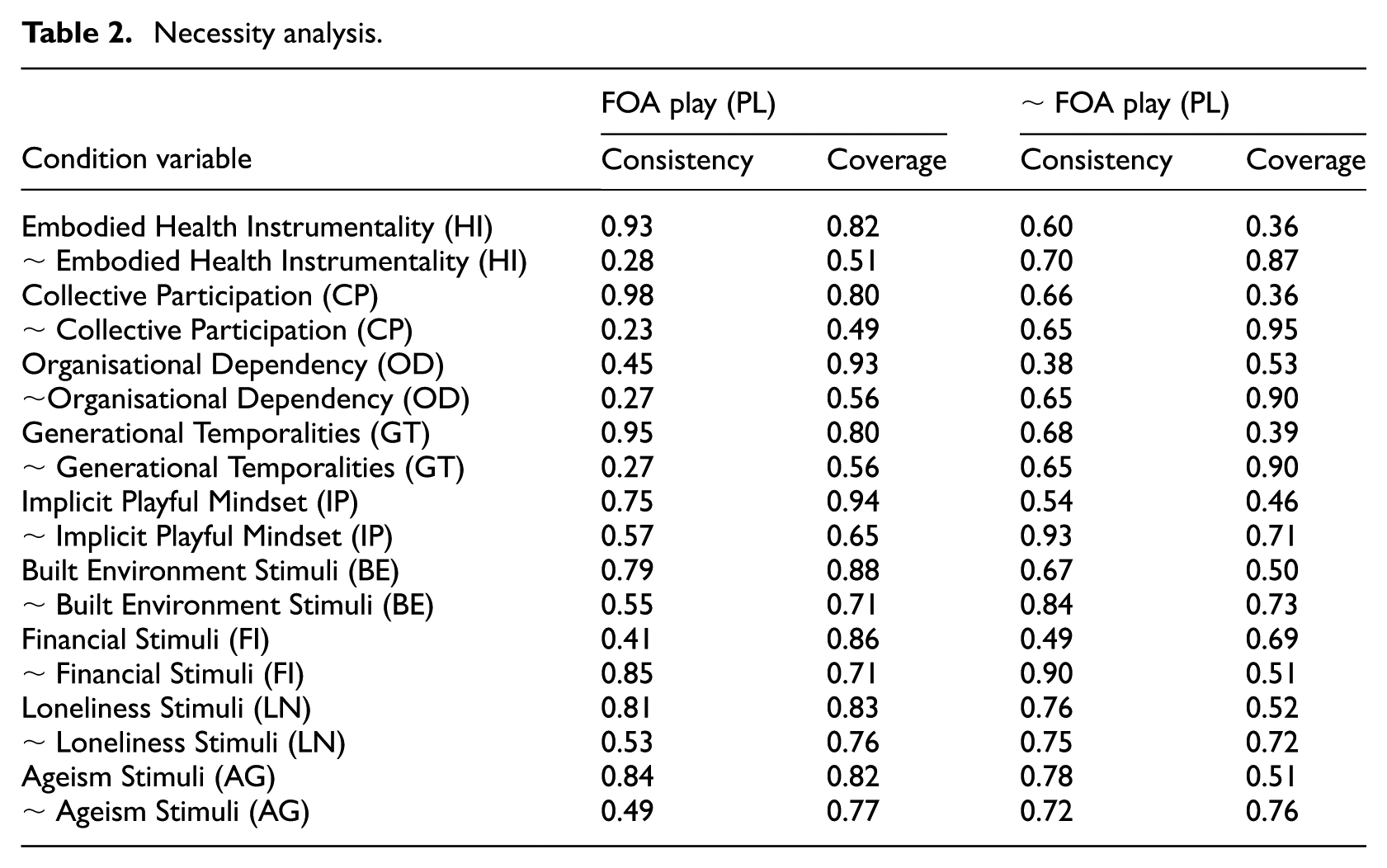
Analysis of absent conditions (∼) reveals that the absence of an Implicit Playful Mindset (∼IP) shows the highest consistency (0.93) for limiting play (∼PL). This suggests psychological readiness acts as a primary gatekeeper: without this intrinsic orientation, engagement is fundamentally constrained regardless of other factors. Interestingly, the absence of Financial Stimuli (∼FI) also meets the strict necessity threshold (0.90) for limiting play (∼PL). However, given that ∼FI also demonstrates high consistency (0.85) for the presence of play (PL), this indicates that a lack of financial concern is a pervasive baseline characteristic among the participants, rather than a differentiating driver. Consequently, for this demographic, financial freedom (∼FI) alone does not guarantee play; rather, internal psychological barriers (∼IP) or inadequate environmental support (∼BE, consistency 0.84, coverage 0.73) serve as the actual differentiating constraints that veto participation. This asymmetry highlights the complex nature of FOA play, where avoiding barriers, particularly regarding mindset, finances, and the physical environment, is as crucial as accumulating facilitators.
Sufficient configurations
The conditions and configuration analysis (Ragin, 2008) produced good overall coverage (0.7590) and high consistency (0.9318), accounting for approximately 76% of high play engagement cases (Table 3(a)). The findings illustrate the principle of equifinality, with multiple pathways leading to the same outcome, as evidenced by the decreasing raw coverage from 0.6754 in the dominant configuration to 0.2096 in the least common one.
Conditions and configurations of factors and stimuli affecting FOA play.

Note. Large black circles (●) = Core causal condition present; Large crossed-out circles (⊗) = Core casual condition absent; Smaller black circles (•) = Peripheral causal condition present; Smaller crossed-out circle (⨂) = Peripheral causal condition absent; Blank spaces indicate insignificant condition.
Across all five configurations, HI functions as a universal core condition, confirming physical health as a prerequisite. GT appears as a supporting element (peripheral condition) in most pathways. CP acts as a key social facilitator, serving as a peripheral condition in four of the pathways (Solution 1, 2, 4, and 5), while its absence defines the solitary nature of Solution 3. Notably, OD appears as either irrelevant or explicitly absent across all solutions, suggesting that successful play configurations generally preclude heavy reliance on structured organisational support.
While fsQCA configurations express equifinal routes using AND (•) to combine conditions and OR (+) to link pathways, standard minimisation often results in overlapping pathways that can complicate interpretation (Ragin, 2008). In our study, initial Solutions 1 and 2 shared identical conditions (HI, GT, CP, BE, LN, AG) except for the variation between ∼FI and IP. This overlap obscures the distinct roles of financial freedom versus intrinsic motivations. To resolve this, we applied Ragin’s (2008) clarification method, which assigns overlapping coverage exclusively to specific recipes. Although this yields non-minimal expressions, it isolates the unique contribution of each pathway, providing a sharper contrast between mechanisms driven by FI and those driven by IP. The clarified recipes are:
Supported Ecosystem (Solution 1 and 2: HI•CP•GT•BE•LN•AG•(∼FI + IP)): This mainstream pathway combines the highest coverages, characterised by a comprehensive support package: strong health (HI), social connection (CP), and a supportive built environment (BE), alongside the presence of psychological stimuli (LN, AG). Within this ecosystem, Solution 1 represents individuals engaging in play lacking financial stimuli (∼FI), relying heavily on the supportive infrastructure itself. Solution 2 captures cases where an IP acts as the key enhancer within this well-supported context.
Solitary-Focused (Solution 3: HI•∼CP •∼OD•GT•∼IP•BE•LN•AG): This pathway is unique as it explicitly negates Collective Participation (∼CP) and an Intrinsic Playful Mindset (∼IP). It demonstrates that even without social interaction or a playful attitude, FOAs can achieve high engagement through robust environmental support (BE) and health (HI), coexisting with LN and AG. This points to a functional, solitary route to play facilitated primarily by infrastructure.
Resilient (Solution 4 and 5: HI•CP• ∼OD•GT•∼BE•∼FI (∼IP•∼LN•AG + IP•LN•∼AG)): This pathway characterises a resilient mode of engagement. Despite the absence of supportive infrastructure (∼BE) and organisational scaffolding (∼OD), FOAs sustain participation through distinct internal configurations. Solution 4 reveals a route independent of FI, where physical health (HI), social connectedness (CP), and specific psychological conditions (∼LN, AG) create a self-sustaining ecosystem for play. Solution 5 identifies the IP as a critical cognitive buffer mitigating environmental constraints, ensuring engagement is driven by internal motivation rather than external affordances.
Micro-level insights into play enablers and barriers
Table 3(b–d) presents the sufficient configurations resulting from the analysis of sub-factors. For the BE subfactors, Table 3(b) identifies four pathways (coverage: 0.7396), with Safety and Security as a universal prerequisite. The results reveal a dichotomy between Microclimate-driven (Solutions 1 and 2) and Infrastructure-driven (Solutions 3 and 4) environments. Solution 2 achieves the highest consistency (0.9358), indicating that a comfortable microclimate, when synergised with supportive Amenities, Aesthetics, and Safety, is highly effective in sparking play. This aligns with FOAs’ frequent mentions of preferring air-conditioned indoor spaces or breezy outdoor areas. Conversely, Solution 1 demonstrates that play remains probable even without Amenities and Aesthetics, provided the Microclimate and Safety conditions are favourable.
Table 3(c) elucidates paths driven by loneliness-related factors (coverage: 0.9368). A core condition across all six solutions is the presence of Interaction Accessibility. In most paths, this is paired with the absence of a Solitude Preference. However, Solution 4 presents a distinct ‘Autonomous solitary’ profile: interaction capacity co-occurs with a core Social Stability and, uniquely, the presence of a Solitude Preference. Rather than seeking new connections, these women lean into their Community Familiarity to enjoy their privacy. For them, play is not a compensation for isolation, but a chosen engagement to navigate social loss comfortably. Finally, Solutions 2 and 3 (highest raw coverage: 0.7453 and 0.8682), demonstrate that FOAs utilise their interaction capacity by employing Active Coping Strategies and benefitting from Freedom from Caretaking.
Similarly, Table 3(d) frames play as a strategy for psychological resilience against ageism. Both identified pathways are anchored by Counter-Internalised Ageism and Resistance to Self-Stigma. This suggests that play is fuelled by the capacity to resist negative societal views, rather than being suppressed by them. Notably, Solution 2 (coverage: 0.7779) illustrates a scenario where FOAs engage in play specifically to navigate Interpersonal Dynamics, leveraging strategies such as Counter-Interpersonal Ageism. Synthesising the findings across Table 3, while FI do not necessarily preclude play engagement if strong social support is present, passive social losses, such as those stemming from geographical mobility or the mortality of peers, consistently manifest as significant barriers that are difficult to overcome.
Discussions
Integrating qualitative insights with fsQCA, this study challenges leisure-centric definitions, showing play is not merely a recreational pastime but a critical survival strategy interwoven with health maintenance, social resilience, and environmental adaptation. This reconceptualisation challenges ageist notions that dismiss play as inappropriate for older women, who often face societal expectations of passivity and caregiving over personal leisure (Chrisler et al., 2016; Jaumot-Pascual et al., 2018).
We identify a fundamental duality in FOA play: it is simultaneously a Health Instrumentality (HI) and an Intrinsic Playfulness (IP). Aligning with feminist gerontology (Chrisler et al., 2016), FOAs often frame play engagement within a discourse of ‘productivity’ (i.e. maintaining health) to legitimise time spent on themselves. The necessity of HI confirms that a self-perception of health capability forms the bedrock of recreational engagement. For FOAs navigating chronic conditions and gendered health disparities (Yang et al., 2022), the ‘capacity to play’ is synonymous with the ‘capacity to maintain independence.’ However, the concurrent presence of IP suggests that this instrumentality does not preclude joy. Unlike child-centric fantasy, FOA play represents a sophisticated form of health-oriented self-management that retains intrinsic playfulness. This reflects a pragmatic wisdom: FOAs seek activities that provide simultaneous pleasure and physiological benefits, maintaining the essence of play for play’s sake while adapting it to the exigencies of ageing.
The fsQCA results reveal three distinct equifinal pathways, namely Supported Ecosystem, Solitary-Focused, and Resilient, illustrating how older women navigate the S-O-R process differently depending on their resource constraints. The first configuration, the Supported Ecosystem, represents an ideal alignment where external stimuli from the built environment and social participation work in synergy with internal health and mindset. The high coverage of this solution suggests that for the majority, play is a socially embedded practice. This aligns with recent findings that P-E Fit promotes playful engagement (Hartt, 2023), while social capital acts as a force multiplier for health benefits (Lin et al., 2024). Consequently, urban infrastructure alone is insufficient; it requires activation through social programming to fully engage these residents (Jian et al., 2025).
In contrast, the Solitary-Focused pathway reveals a critical finding that bypasses social interaction entirely. Relying heavily on the built environment and health status, this group demonstrates that play can be a private and restorative act. This challenges the assumption that successful ageing must always be social or that solitary play is inherently negative. For these women, high-quality, safe, and familiar infrastructure serves as a surrogate for social support (Bi et al., 2026), allowing them to maintain engagement despite a preference for solitude. Crucially, being alone during play does not equate to loneliness; rather, it serves as a respite facilitated by safety and freedom from interaction barriers. The critical distinction lies in agency: play is beneficial when solitude is a choice supported by a safe environment, rather than a condition imposed by the passive loss of social networks. Therefore, interventions should not solely enforce socialisation but must also design spaces that dignify solitary play.
Finally, the Resilient pathway highlights women who engage in play despite the absence of supportive environments or financial stimuli. Here, internal factors such as a playful mindset and strong social bonds override the lack of external resources. This demonstrates strong agency, as these women create their own play spaces through social improvisation when the city fails to provide them. However, the analysis reveals hard constraints. While this pathway suggests play is possible without significant funds, the necessity of freedom from financial concerns (represented by the absence of Financial Stimuli, ∼FI) in other configurations implies that economic precarity remains a non-negotiable barrier. Thus, the resilience observed here is likely contingent on the availability of low-cost public resources.
The significance of these pathways extends to reframing play as a restorative, regenerative, and rewarding mechanism for FOAs’ well-being. By focusing on FOAs, this study addresses critical gaps in understanding how ageism intersects with sexism to create compounded discrimination. The finding that ageism subtly undermines women’s self-efficacy, but is mitigated by communal, health-driven engagement, suggests that collective approaches are particularly effective in overcoming gendered barriers. Furthermore, this Asian perspective contributes valuable cultural insights to the predominantly Western gerontological literature. It highlights that in regions experiencing rapid population ageing, community-based approaches may be more culturally appropriate than formal service provision, positioning play as a resilient anti-ageing tool where women’s longer lifespans amplify the need for sustained engagement.
The analysis of micro-level factors further clarifies the mechanisms underlying these pathways. The finding that safety is a prerequisite for the built environment configuration, whereas aesthetics remains peripheral, establishes a clear hierarchy of needs in public space usage: a space must be perceived as physically safe before it can be appreciated as ‘playful’ or ‘beautiful.’ Moreover, the observation that play persists even in the absence of amenities, provided that safety and microclimate are adequate, implies that FOAs are pragmatic users of space. Their behaviour demonstrates that elaborate facilities are secondary to accessible, climatically comfortable, and secure environments for enacting daily routines. Furthermore, the dimension of organisational dependency reveals a critical nuance in how social play is sustained: while user resilience allows activity to continue, it is institutional legitimacy that sustains it over time. The most robust engagement occurs when institutional support mitigates the cognitive and logistical burdens of organising play. Consequently, while BE subfactors (e.g. safety, microclimate) and the absence of social barriers (e.g. loneliness, ageism) act as catalysts, physiological inevitabilities, specifically passive losses from mobility or mortality, remain consistent, non-negotiable hindrances.
Conclusion
This research reaffirms play as a cornerstone of healthy ageing and calls for a fundamental reimagining of urban spaces and social policies to nurture playful ageing. The findings indicate that successful interventions must transcend generic age-friendly provisions to acknowledge diverse ageing experiences. We identify a critical hierarchy in environmental design: safety and comfortable microclimates are non-negotiable foundations, whereas aesthetics serve merely as peripheral optimisers. This creates an asymmetrical reality where physical barriers can nullify social benefits, yet physical enhancements alone cannot guarantee activity without social activation.
Translating these insights into urban design requires prioritising foundational needs before aesthetic enhancements. Interventions must first ensure safety and comfortable microclimates, such as shading and wind protection, particularly for older women facing mobility barriers. Beyond these basics, designers should create a mosaic of spatial types: sociopetal hubs for mainstream social groups, quiet nature-integrated zones for solitary users, and loosened spaces that allow resilient groups to improvise and appropriate their environment. Additionally, public spaces could incorporate subtle, non-prescriptive cues, such as interactive murals or gamified paving, that invite informal engagement. Concurrently, policy must destigmatise play for pleasure. By making play visible and legitimate in public spaces, policy can shift the narrative from ageing-as-decline to ageing-as-engagement, thereby mitigating loneliness and bolstering the restorative benefits of public housing.
Several limitations should be noted. The focus on 52 FOAs within two specific PHEs limits statistical generalisability; findings may vary across different cultural or built environments. Furthermore, the cross-sectional design limits the ability to establish temporal precedence. While fsQCA identifies sufficient configurations, these findings represent logical associations rather than definitive temporal causality, and should be interpreted as descriptive patterns. Methodologically, while solution coverage was substantial, unobserved factors likely remain. Although calibration subjectivity was mitigated by rigorous external benchmarks and thematic saturation was achieved, the sample size reflects the intensive nature of fsQCA, necessitating caution in extrapolation. Future research should adopt longitudinal designs to track trajectory stability and expand the scope to include diverse socio-economic groups, male counterparts, and varied typologies. Additionally, integrating fsQCA with machine learning could further refine predictions for personalised, site-specific strategies.
Ultimately, this study marks an important step in changing how we conceptualise age, ageing, and play. By advocating for policies and environments that promote playful, socially embedded ageing, we can ensure that all older adults have opportunities to experience the health, social, and emotional benefits that play provides, enhancing the quality of life for the ageing population.
Supplemental Material
sj-docx-1-usj-10.1177_00420980261444166 – Supplemental material for Recreational well-being and the neglected older adult play: How ageism and built environment affect female seniors in Hong Kong?
Supplemental material, sj-docx-1-usj-10.1177_00420980261444166 for Recreational well-being and the neglected older adult play: How ageism and built environment affect female seniors in Hong Kong? by Izzy Yi Jian, Tian Cheng, Weixuan Chen and Kar Him Mo in Urban Studies
Supplemental Material
sj-png-10-usj-10.1177_00420980261444166 – Supplemental material for Recreational well-being and the neglected older adult play: How ageism and built environment affect female seniors in Hong Kong?
Supplemental material, sj-png-10-usj-10.1177_00420980261444166 for Recreational well-being and the neglected older adult play: How ageism and built environment affect female seniors in Hong Kong? by Izzy Yi Jian, Tian Cheng, Weixuan Chen and Kar Him Mo in Urban Studies
Supplemental Material
sj-png-3-usj-10.1177_00420980261444166 – Supplemental material for Recreational well-being and the neglected older adult play: How ageism and built environment affect female seniors in Hong Kong?
Supplemental material, sj-png-3-usj-10.1177_00420980261444166 for Recreational well-being and the neglected older adult play: How ageism and built environment affect female seniors in Hong Kong? by Izzy Yi Jian, Tian Cheng, Weixuan Chen and Kar Him Mo in Urban Studies
Supplemental Material
sj-png-4-usj-10.1177_00420980261444166 – Supplemental material for Recreational well-being and the neglected older adult play: How ageism and built environment affect female seniors in Hong Kong?
Supplemental material, sj-png-4-usj-10.1177_00420980261444166 for Recreational well-being and the neglected older adult play: How ageism and built environment affect female seniors in Hong Kong? by Izzy Yi Jian, Tian Cheng, Weixuan Chen and Kar Him Mo in Urban Studies
Supplemental Material
sj-png-5-usj-10.1177_00420980261444166 – Supplemental material for Recreational well-being and the neglected older adult play: How ageism and built environment affect female seniors in Hong Kong?
Supplemental material, sj-png-5-usj-10.1177_00420980261444166 for Recreational well-being and the neglected older adult play: How ageism and built environment affect female seniors in Hong Kong? by Izzy Yi Jian, Tian Cheng, Weixuan Chen and Kar Him Mo in Urban Studies
Supplemental Material
sj-png-6-usj-10.1177_00420980261444166 – Supplemental material for Recreational well-being and the neglected older adult play: How ageism and built environment affect female seniors in Hong Kong?
Supplemental material, sj-png-6-usj-10.1177_00420980261444166 for Recreational well-being and the neglected older adult play: How ageism and built environment affect female seniors in Hong Kong? by Izzy Yi Jian, Tian Cheng, Weixuan Chen and Kar Him Mo in Urban Studies
Supplemental Material
sj-png-7-usj-10.1177_00420980261444166 – Supplemental material for Recreational well-being and the neglected older adult play: How ageism and built environment affect female seniors in Hong Kong?
Supplemental material, sj-png-7-usj-10.1177_00420980261444166 for Recreational well-being and the neglected older adult play: How ageism and built environment affect female seniors in Hong Kong? by Izzy Yi Jian, Tian Cheng, Weixuan Chen and Kar Him Mo in Urban Studies
Supplemental Material
sj-png-8-usj-10.1177_00420980261444166 – Supplemental material for Recreational well-being and the neglected older adult play: How ageism and built environment affect female seniors in Hong Kong?
Supplemental material, sj-png-8-usj-10.1177_00420980261444166 for Recreational well-being and the neglected older adult play: How ageism and built environment affect female seniors in Hong Kong? by Izzy Yi Jian, Tian Cheng, Weixuan Chen and Kar Him Mo in Urban Studies
Supplemental Material
sj-png-9-usj-10.1177_00420980261444166 – Supplemental material for Recreational well-being and the neglected older adult play: How ageism and built environment affect female seniors in Hong Kong?
Supplemental material, sj-png-9-usj-10.1177_00420980261444166 for Recreational well-being and the neglected older adult play: How ageism and built environment affect female seniors in Hong Kong? by Izzy Yi Jian, Tian Cheng, Weixuan Chen and Kar Him Mo in Urban Studies
Supplemental Material
sj-xlsx-2-usj-10.1177_00420980261444166 – Supplemental material for Recreational well-being and the neglected older adult play: How ageism and built environment affect female seniors in Hong Kong?
Supplemental material, sj-xlsx-2-usj-10.1177_00420980261444166 for Recreational well-being and the neglected older adult play: How ageism and built environment affect female seniors in Hong Kong? by Izzy Yi Jian, Tian Cheng, Weixuan Chen and Kar Him Mo in Urban Studies
Footnotes
Acknowledgements
Our deepest gratitude goes first to the older adults who generously shared their time and lived experiences; your voices are the very heart of this research. We also sincerely thank the Hong Kong Housing Authority, the Housing Bureau, our community partners, and the Happy Ageing Lab members for their unwavering support. A special thanks is extended to Dr. Maxwell Hartt, whose inspiring work profoundly shaped our conceptual thinking. Finally, we are truly grateful to the editor and reviewers for their invaluable guidance in refining this manuscript.

Funding
The authors disclosed receipt of the following financial support for the research, authorship, and/or publication of this article: This study received Funding from The Education University of Hong Kong (0405O, 0407H, 0313L, R4407), The Hong Kong Research Grants Council (Early Career Scheme, 24600323), The Chinese University of Hong Kong (4052272, 4052295, 4052351, IDBF24SSC20), The Guangdong Province Philosophy and Social Science Planning Project (GD26YYS28), ZeShan Foundation and Ho Cheung Shuk Yuen Charitable Foundation.
Declaration of conflicting interests
The authors declared no potential conflicts of interest with respect to the research, authorship, and/or publication of this article.
Declaration of generative AI and AI-assisted technologies in the writing process
During the preparation of this work the author(s) used ChatGPT 4o to proofread the manuscript. After using this tool/service, the author(s) reviewed and edited the content as needed and take(s) full responsibility for the content of the publication.
Supplemental material
Supplemental material for this article is available online.
References
Supplementary Material
Please find the following supplemental material available below.
For Open Access articles published under a Creative Commons License, all supplemental material carries the same license as the article it is associated with.
For non-Open Access articles published, all supplemental material carries a non-exclusive license, and permission requests for re-use of supplemental material or any part of supplemental material shall be sent directly to the copyright owner as specified in the copyright notice associated with the article.


