




Abstract
Controlled environments create specialist forms of microclimatic enclosure that are explicitly designed to transcend the emerging limitations and increasing turbulence in existing modes of urban climatic conditions. Across different urban contexts, anthropogenic change is creating urban conditions that are too hot, cold, humid, wet, windy, etc. to support the continued and reliable environments that are suitable for the reproduction of food, ecologies and human life. In response, there are emerging forms of experimentation with new logics of microclimatic governance that seek to enclose environments within membranes and develop artificially created internal ecologies that are precisely customised to meet the needs of the plant, animal or human occupants of these new forms of enclosure. While recognising that enclosure has a long history in urbanism, design and architecture, we ask if a new logic of microclimatic governance is emerging in specific response to the ecological changes of the Anthropocene. The paper sets out a research agenda to investigate whether the ability of cities, states and corporates to design and construct internalised environments is now a strategic capacity that is critical to developing the knowledge, practices and technologies to reconfigure new forms of urban climatic governance that address the problems of climate change and ensure urban reproduction under conditions of turbulence.
Introduction
Taking over a former industrial building in Newark, New Jersey, the AeroFarms company has almost 70,000 square feet of space for growing salad greens and other plants on 12 stacked layers each 80 feet long. This creates ‘a completely controlled environment … [to] take indoor vertical farming to a new level of precision and productivity with minimal environmental impact and virtually zero risk’. 1 This ‘closed loop’ aeroponic farming – growing plants without the use of soil by spraying a water, oxygen and nutrient mist over their roots – allows faster production cycles, predictability in results and improved food safety. 2 AeroFarms balances the place specificity of being based in Newark (local workforce and available market) with a desire to replicate its model to fit other urban contexts using algorithms, sensing devices, CO2 enriching and bespoke LED lighting: ‘The technology it uses derives partly from systems designed to grow crops on the moon. The interior space is its own sealed-off world; nothing inside the vertical-farm buildings is uncontrolled … In short, each plant grows at the pinnacle of a trembling heap of tightly focused and hyper-sensitive data’ (Frazier, 2017). Given thehigh-tech process, the result is indeed a product unlike anything in ‘nature’ whereby ‘plants create themselves partly out of thin air’ (Frazier, 2017), and there is production of ‘more crops in less space while minimizing environmental damage, even if it means completely divorcing food production from the natural ecosystem’ (Vyawahare, 2016). As AeroFarms chief marketing officer argues: ‘Out there, in nature, we don’t have control over sunlight, rainfall, here, we are giving plants what they need to thrive’ (quoted in Vyawahare, 2016).
As this brief example illustrates, controlled environments (CE) are enclosed and engineered socio-technical spaces that create specialised ‘microclimates’ that are specifically designed to provide the precise conditions for food production, but also ecological protection and human occupation. 3 These spaces are proliferating throughout many cities and becoming a major feature of urban landscapes across the globe. Faced with a concurrent series of challenges and turbulences across global society, economy and ecology – from climate change to financial crisis – a set of responses is emerging, under different contexts and across distinct domains of activity to experiment with creating the microclimatic conditions that can inform a new logic of urban climate governance that can, it is claimed, secure urban futures in the anthropocene. Technological development, climate change and intensified urbanisation, inter alia, create the conditions for experiments in new and extended forms of urban environmental manipulation and control (see Evans et al., 2016).
The concept of a CE, as distinct from comparatively unenclosed urban spaces and underpinned by large-scale networked technological systems of environmental manipulation, is not new. Cities have always had enclosed spaces of habitat, industry and business – and could even be argued to resemble overall a form of CE based on clustering, agglomeration and medieval fortressing/security. But we ask whether a new logic is emerging as encapsulation now is being done for bigger, more fundamental reasons – securing the futures of humanity under turbulent conditions (see Amin, 2013) – and on a scale or to a degree unseen previously. These new microclimates may still be, in some cases, piecemeal experiments yet they have tremendous potential and actual resources for re-organising futures of settlement and occupation in new forms of extended urban climatic governance (Bulkeley and Castan Broto, 2013). As such they mobilise specialist knowledge and science from multiple domains, and they reach out (literally) into the cosmos as human–environment relations are reconfigured on planetary and extraterrestrial levels.
But, in spite of these crucial stakes in terms of the future of cities, there has been little systematic attempt at analysing the drivers, forms, and implications of CE from an urban perspective. In this paper, we aim to rectify this deficit and offer an analysis of the current state of, and ongoing prospects for, urban research around CE. This does not take the form of proposing an overarching ‘single’ urban approach to CE. The inherent complexity of the processes involved means that this is surely not possible. Rather, we identify the critical issues that need to be addressed within a broad framework of research into CE. In the second section, we unpack briefly the drivers of new and renewed types of urban enclosure, and identify the critical research gaps in the existing literatures on analysis of forms of enclaves, urban infrastructure studies and urban environmental change. In the following section we develop a typology of three domains – production, protection and consumption – through which CE are being strategically and systemically configured in urban settings. Identifying specific antecedent technologies and practices from which they emerge, we highlight the similarities and differences between these forms at different scales and through particular exemplars. Thereafter, we build on this analysis to work through a potential urban agenda around CE, suggesting three particular heuristic urban dimensions of CE which may be productive for further thinking and reflection. The conclusion identifies some of the tensions sparked and proffers directions for future research around urban CE.
Controlled environments: Enclosure, infrastructure, transcendence
Cities worldwide have evidently long been composed of enclosed spaces and habitats with one recent piece of research calculating the total indoor space in Manhattan to be three times that of the island’s actual ground surface area (Martin et al., 2015). 4 While these spaces are sometimes micro-managed to some extent (for air conditioning for instance), what is different about an emerging logic of controlled environments is, as we shall see, both the far greater degree of technologically mediated management of environmental conditions to allow certain functions to take place, and the strategic rationales being mobilised as state, city and corporate actors attempt to constitute enclaved responses to prevailing threats as a means of ensuring urban reproduction in the anthropocene. Indeed, on a global level, the capacity to create and manage particular forms of controlled environments is becoming a strategic priority that is testing and piloting through microclimatic experiments new logics of urban climatic control that may be key to sustaining urban futures.
The origin of the development of controlled environments was broadly in the domains of the agricultural sciences and other lab disciplines/sectors to capture the ways in which biological processes could be enclosed under specific conditions to produce ‘optimised’ environmental configurations. Our contention is that the forms of techno-scientific logic – knowledge, methodologies, techniques and rationales – it describes have moved out of their sectoral silos to become part of a wider systemic concern for configuring socio-technical-ecological conditions through which selected aspects of urban life can be maintained, reproduced and improved. Examples include the predicted doubling in area worldwide in the next decade given over to greenhouse food production for perennial fruit and vegetables for urban consumers, 5 the transmutation of techniques and rationales from CE agriculture, horticulture and biotechnology into the creation of new urban indoor spaces, and the use of climate control expertise for artificial ecospheres.
These emerging systemic processes and practices involve the creation of new enclosed spaces for human occupation and refuge, ecological conservation and food production that demonstrate a need to make, control and manipulate microclimates to (scientifically) manage and transcend intensified eco-resource security and constraints: ‘an insular habitat for a small group of living beings facing a hostile outside world’ (Höhler, 2008: 69). As such these are designed to address emergent problems with the existing regime of urban climatic control that has been based on stabilised and relatively well known conditions and ecological parameters. Increasing turbulence in urban climates is raising the visibility of urban climate control as an issue as conditions become destabilised and more unpredictable (Jonas et al., 2011; Whitehead, 2013). This context is stimulating the production of microclimatic experimental responses that can contribute to the emergence of a more systemic logic of urban climate control. There is a substantial literature on urban microclimates in technical disciplines based on a notion of optimal design and often using modelling methods (see, for example, Erell et al., 2012; Roth, 2007; Taha, 1997), but we lack critical analysis of the core issue of whether CE signal the emergence of a new logic of microclimatic control. There are three sets of deficits in the existing literature in urban studies that need to be addressed in order to start critically analysing emerging forms and implications of CE. Below we set out in turn the critical gaps and the key questions these raise before moving on in subsequent sections to develop a new research agenda on CE.
Urban enclaves/enclosed microclimates
There is, of course, a long history around urban enclosure and the varying ways in which shared public space and commons have been privatised or walled for more restricted access and use (e.g. Hodkinson, 2012; Jeffrey et al., 2012; Lee and Webster, 2006). There has also been a lot of very pertinent research into specific forms of urban enclosure, including exploration of urban fortressing and security (Adey, 2014; Davis, 1995; Graham, 2011; Klauser, 2010), bunkers (Bennett, 2011), malls (Mennel, 2004), capsules (De Cauter, 2005), social encapsulation or cloaking strategies of the wealthy (Atkinson, 2016; Mitchell, 2005), indoor domestic experiences and practices (Biehler and Simon, 2011; Chappells and Shove, 2005), and refugee camps or temporary settlements. But the ecological dimensions or eco-resource implications of urban enclosure have been much less investigated.
Work on models and practices of urbanism in extreme environmental conditions highlights the antecedent thinking behind contemporary efforts at making enclosed spaces. Seeking to understand the history of efforts ‘to urbanize this last frontier’ (Jull and Cho, 2013: 1), Jull (2016) examines experimental urban prototypes developed in Arctic areas where ‘survivability is a priority’ (p. 215) which aimed to produce new relationships between residents, buildings and the environment. While some designers and architects proposed sealed indoor domed cities (see, for example, Bolonkin and Cathcart, 2007), Jull focuses instead on Soviet and Canadian projects which recognised a need for planning to integrate with, rather than isolate from, the outside environment (see also Pressman, 1996). These 20th-century modernist planning efforts to tame adverse Northern environments (and ‘Native peoples’) are linked to a wider context of Cold War militarism which sought to engineer hostile landscapes for research and military requirements (Farish, 2006; Farish and Lackenbauer, 2009). Further afield, a critical source of inspiration and transfer of ideas, knowledge and practice towards generating enclosed spaces has been the technoscience and engineering of space exploration (Anker, 2005; Höhler, 2008; Marvin, 2016). Peder Anker (2005) shows, for example, how many of the ideas and technologies underpinning the imagined environments of space travel and exploration were imported into the field of green architecture from the 1970s onwards. A number of NASA, Russian and European programmes have sought to investigate the conditions under which life could be supported and become bioregenerative in closed loop cabin conditions (Averner, 1990; HI-SEAS, 2016; Lasseur et al., 2010; Nelson et al., 2009). As ‘Spaceship Earth’ ideas were born out of the US space programme in the 1960s, and in particular, the ‘whole Earth’ view depicted in photographs taken aboard Apollo missions (Cosgrove, 1994), so was the science and technology underpinning the environmental control system configurations used in spacecraft – ‘the epitome of human technologies designed to achieve world control’ (Höhler, 2008: 79) – rescaled or grounded back on Earth in various eco-habitat and conservation projects. A focus on emerging controlled environments extends this work to explore how knowledge, technologies and practices from these fields are supporting new forms of urban enclosure as responses to changing climatic conditions.
Urban infrastructure studies/microclimatic systems as urban infrastructure
CE are becoming subject to a process of infrastructuralisation which both extends what infrastructure is to new resources, spaces and components, and produces a new socio-technical configuration underpinning food production, ecological conservation and human-leisure occupation through various overlapping logics including simulation-synthetic-artificial; secured-enclosed; precision-monitored capacities, etc. Thus, bringing the outside into specific strategic urban ‘insides’ explains why perhaps the ‘outside’ matters less. If infrastructural stretching can bring or replicate or simulate (engineer) important resources, components and processes into a manageable enclosed space then this inside may be seen as sufficient, and everything else as extraneous. Urban infrastructure studies have primarily focused on the development and transformations of socio-technical networks for energy, mobility, communications technologies, water and wastes, and their relationships with urbanisation. These infrastructures effectively enable the city to function as an extended controlled environment. More recently, infrastructure studies have extended a focus from networked resource flows to the ways in which nature itself can be constituted and conceptualised as an infrastructural resource (Carse, 2012). Critical interest in the development of atmospheric or nature-based services both within and outside the city focus on the ways in which ecological processes create the conditions for urban life (see Thornes et al., 2010; Tzoulas et al., 2007).
A critical gap in urban infrastructure studies is an absence of a focus on controlled environments per se as an urban infrastructure. With some notable exceptions including air conditioning and DNA banks (Cooper, 1998; Hitchings and Lee, 2008; Shove et al., 2014; Williams, 2018), controlled environments are themselves not an explicit focus for urban infrastructure studies. But there is much that could be gained through examining CE though this conceptual frame. Following Susan Leigh Star and others (Star, 1999), there are three dimensions which it would be useful to analyse further. First, the extent to which CE might be constituted through standardised norms and practices. Are CE being subject to standardisation and regularisation through proprietary or even international standard-setting agencies such as the ISO? Second, the extent to which CE becomes increasingly transparent to use and does not need to be reinvented as a practice in every context where it is applied. Third, the extent to which solutions are constituted as global infrastructure products that can transcend different contexts and scales of application (Easterling, 2014). Moreover, urban infrastructure studies might also be able to address the issues involved in the resource (carbon and energy) intensity of CE as well as the wastes produced, and questions about the vulnerability and reliability of the systems that become visible on breakdown. Critical questions then emerge around whether CE constitute an infrastructural capacity that becomes increasingly applied to microclimates and, more widely, in urban climate controlled regimes.
Microclimatic experimentation/designing urban climate governance
Developing a critical understanding of CE is crucial for navigating and forging possible urban futures in the Anthropocene. As knowledge, techniques and practices of enclosure, experiment, manipulation and improvement circulate and transmute between and into the urban arena from other domains, it is essential to unpack contexts, constituents and consequences of this emerging response to global anthropogenic change. In critically exploring both the hybridisation of insides and outsides and technology and ecology, and the crossovers between distinct domains of expertise, knowledge production and life support, in the production of controlled environments, this area of research pushes at and looks beyond the traditional boundaries and settings of the city in order to develop new ways of understanding anthropogenic, potentially celestial, urbanism. There are three dimensions to the development of a new regime of urban climatic control illustrated in Table 1.
Urban climate governance: 3 modes.
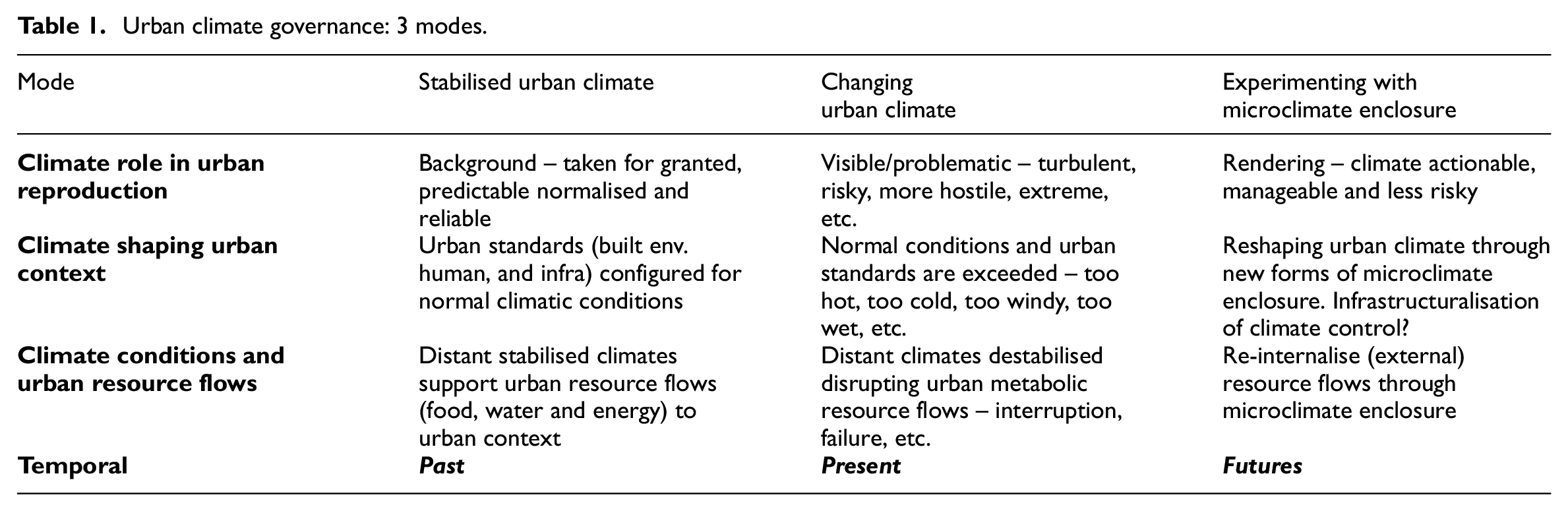
The first is how in the context of human-shaped global ecological change an increasingly turbulent ecological context reshapes the intensity of and disruptive implications of severe weather-related events (see Arnfield, 2003). Some recent analysis in urban studies has begun to grapple with the production, circulation and use of specialist urban climate knowledge (e.g. Caprotti and Romanowicz, 2013; Hebbert and Mackillop, 2013). Urban governments and their stakeholders’ ability to manage and minimise the implications of economic and ecological turbulence in the more uncertain ‘urbanatura’ (Luke, 2009) become increasingly important in the capacity to guarantee urban reproduction (Hodson and Marvin, 2009). Concern for ecological flows extends from the metabolic resources (food, energy, water) that service cities and remove wastes, but also extends to the development of a new understanding of the atmospheric conditions that shape urban life (Janković, 2013; Whitehead, 2011). Whether the context is too hot, too cold, too dry, too wet, etc. starts to be strategically important as this quite literally shapes the contextual conditions for reproducing urban life. Increasingly, extreme weather-related events raise the visibility of new climate conditions and how these might reshape the ecological boundaries that support life.
Second, with this context, then, the ‘inside’ of CE attempts to develop microclimates that improve on the humanly altered and denuded ‘outside’. In response, (more) efficient, precise enclosed urbanisms are produced to bypass perceived socio-ecological constraints of the existing urban climate regime. CE involve the production, maintenance/manipulation and extension/circulation of ‘denatured space’, that is, this is not a mobilisation of nature, bringing nature into the city in the usual way (some kind of conflation of nature and culture as has been analysed by urban political ecologists over the last 20 years), but more its effacement or ‘immunisation’ (Adams, 2014). This is, as Luke (1995) argues in the case of Biosphere 2, synthetic nature with an engineering infrastructure. CE do not reproduce or replicate Nature or offer a return to pure nature, but they create artificial ecospheres (which do not actually exist elsewhere) to improve on unproductive Nature (based therefore on potential ecological performance rather than actual existing qualities). They are experimental artifices, visions/enactments of possible future enclosed urban worlds totally oriented towards particular human goals of securitisation/insulation, efficiency/productivity and technological hubris. This offers a glimpse of a new category in ecosystem classification (and indeed a prospective evolution in human–environment relations) beyond human-based settlements which mobilise traditional ecological flows, and towards a totally artificial, ‘designer’ ecosystem (see Frederickson, 2015) synthesising natures for a better humanity.
Third, the critical question is then how the microclimatic responses and experiments themselves reshape and/or constitute a new regime of urban climate control. The critical gaps here are the extent to which particular urban contexts host bundles of experiments that cut across the food, conservation and human domains; the degree to which there is systemic learning and efforts to up-scale and replicate experiments through domestic/private spheres and in larger scale development of districts and cities; and finally, the extent to which these are constituted through new standards and mobilised as global infrastructures.
We need to critically explore how CE are coming to represent a systemic urban response to the need to organise/manage and test/check (as per the dual sense of control) particular ecologies across different domains of life, and whether CE constitute, to this end, a new socio-technical infrastructure. If CE create new enclosed inside spaces for particular crucial activities, what is left beyond this and what happens to these external unvalued spaces? Can we see this as an intensified form of socio-spatial inequity? What resource imbalances are produced? How secure or vulnerable are they as they become more selective and precise but less reliant?
Controlled environments as strategic urban priority: Production, protection and consumption
CE are developing in and through key areas and functions of urban life. They are beginning to constitute key sites for experimenting with and ensuring the ecological and economic reproduction of cities in the current juncture. In this section we focus therefore on emerging forms of enclosure to develop a heuristic typology of modes of urban controlled environments in three domains of production, protection and consumption. Mapping the emergence of these types of infrastructuralised enclosure allows us to explore their historical lineage in terms of antecedent technologies and practices, how and why encapsulation is now being undertaken, and its emerging systemic nature as responses to ‘outside’ turbulence. Taken as a whole, this demonstrates that the ability to create new synthetic environments is becoming an increasingly strategic means of intervention in urban climate governance.
Table 2 sketches out an initial typology of CE organised by domains of production, protection and consumption, and by scale or site of development. The table is not meant to be exhaustive but it does demonstrate that socio-technical enclosure is being done for food production, conservation of threatened ecologies, and human occupation and leisure, and in each case across multiple sites and spaces from a systemic urban scale, through specific sites within cities, to domestic and home spaces.
A typology of controlled environments.
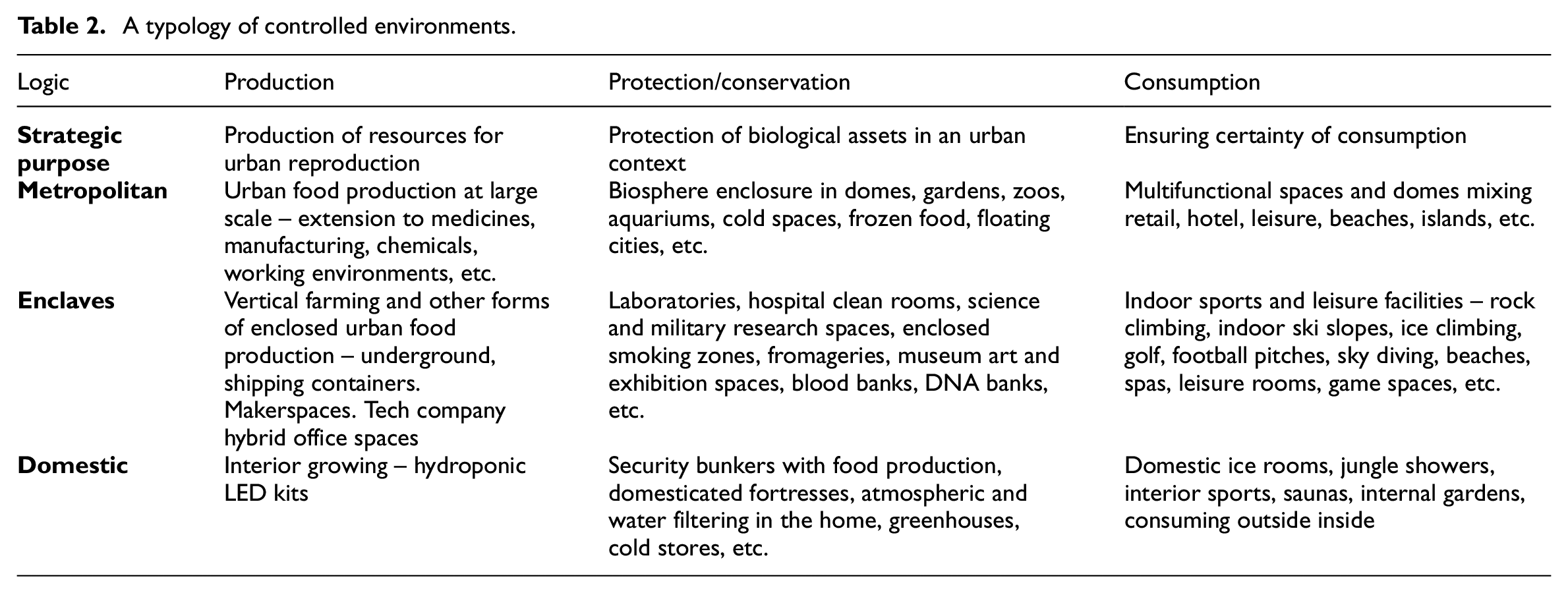
Controlled environments are being configured as spaces of production of food, crops and plants as climate change – notably – creates uncertainty over future land availability and agricultural productivity. There is a long tradition of controlled environment agriculture (CEA) based on agricultural science, whereby smart technology and so-called precision agriculture has assisted control of the growing environment through instrumentation and augmentation in food production (Jensen, 2002). The aim is to ensure optimal growing conditions by manipulating temperature, light, water and nutrient variables within enclosures such as glasshouses or plastic covered tunnels. CEA practices and technologies are now being put to work in urban areas, opening possibilities of producing food closer to consumers in renovated dense environments through vertical farming (Despommier, 2011). 6 Vertical farming has taken off in the USA, Singapore 7 and Japan 8 in particular, with many buildings being used for stacking layers of salad greens, herbs and mushrooms. Hydroponic or aeroponic techniques mean that the amount of water, soil and sunlight required is vastly reduced. AeroFarms in Newark, New Jersey, for instance, uses a patented artificial fabric cloth instead of soil, bespoke LED lighting and a set of digital devices and algorithms which provide a more efficient, precise and faster growing environment than unpredictable ‘nature’. 9 The traditional ecological materiality of the sun, water and soil becomes less critical for food production here than the capacity to capture, circulate, analyse and act on a set of digital data. Similar logics are at work in the domestic realm too, as Ikea now sells a range of hydroponic indoor gardening technology kits complete with seeds, nutrients and LED lights aimed at apartment-dwelling citizens the world over who do not have access to outside. 10 Through these initiatives, large-scale farming previously done beyond the city is being brought or rescaled into urban areas and into the home, creating new ‘insides’ that aim to alleviate the problems of, and therefore improve on, increasingly turbulent unsustainable ‘outsides’.
Controlled environments are being developed as spaces of protection as risks and threats to particular ecologies and ecosystems through a more turbulent climate lead to a search for new artificial spaces in which important species are protected through the constitution of a specific bespoke microclimate. There is a fascinating history of greenhouses, botanical and winter gardens, and horticultural practices which have, over time, developed ways and technologies of circulating and gathering together particular plant species and configuring spaces of enclosure for their conservation as well as for aesthetics, pleasure, wellbeing and therapeutic value, where gardens enacted utopian aims or a search for (an ‘artificial’) paradise (Johnson, 2012). Indeed, the history of glasshouse technology since the Victorian era has helped to create protected spaces for the conservation of species and plants. 11 This combined with new imaginaries of human–nature relations where ‘the greenhouse’s appearance in the world was a part of a very particular form of the picturesque, of nature artificially rearranged in order to appear more “natural”, [testifying to] the ability of humanity to reconfigure their environment to their liking [and asserting] humanity’s seemingly effortless dominance over the material world’ (Murphy, 2016: 200–201). These precedents are now being more widely mobilised, primarily for non-humans, but they can also be designed for human life support, or are configured for both in hybrid enclosures. Biospheric enclosure of selected valued plant and animal species in, for example, botanical gardens, ecodomes, zoos and aquariums is one dimension of this. Singapore’s Gardens by the Bay has two glasshouses replicating microclimates from other parts of the world and thereby containing plants that would not normally be found in the city.
Controlled environments are being shaped as spaces of consumption whereby artificial ‘natures’ are created ‘inside’ to reproduce – and improve on – conditions under which particular leisure activities, sports and functions can take place. The history of geodesic dome architecture, the shopping centre and particular key technologies such as air conditioning has inspired contemporary enclosed consumption spaces. The geodesic domes proposed by Buckminster Fuller and others and biospherical initiatives in the cold war period contributed to taking a range of outside species and ecologies into configured and engineered insides. They had a ‘staged’ or scenographic quality where they could often then ‘perform’ other functions as well as being gardens. Gruen’s 1950s Southdale mall in Minnesota was the first climate-controlled indoor shopping centre with a complex ‘technological substrate’ to configure optimal conditions for leisure and retail (Mennel, 2004). To transcend Minnesota’s poor weather conditions, Southdale used a large heat pump to become ‘a large-scale controlled environment in which it was literally always the same temperature’ (Mennel, 2004: 129). Climate control here became crucial to the broader economic project. Indeed, the engineering of the permanent interior spaces to bring ‘outsides’ inside has been particularly important. Air conditioning has played a crucial role – having been used early on as a way of cooling cinemas and thereby attracting customers in hot summer months 12 – as have other techniques for adjusting temperature and air quality and pressure.
There is now a more general tendency towards the creation of new forms of enclosed, highly engineered interiors which allow year-round leisure activities usually done outside and/or in ‘nature’. This takes at least three forms: artificial leisure centres with indoor ski slopes (Tivers, 1997), climbing walls (Eden and Barratt, 2010), indoor golf simulators, sky diving simulators, sports pitches, aquariums, etc.; the inclusion of synthetic ‘natures’ in premium accommodation (housing and hotels); and the production of multifunctional consumption spaces which combine shopping, leisure activities and environmental experience in new enclosures designed to keep a hostile environment outside. For example, Tropical Islands near Berlin is an enclosed tropical rainforest theme park in a former airship hangar with Thai and Bali inspired beaches and atoll pools surrounded by a collection of tropical plants all supported by a complex infrastructure which produces permanent microclimatic conditions for holidaymakers and plants (Engels-Schwarzpaul, 2007). Again, this is not a replication of an existing nature but a creation of an artificial microclimatised environment that does not actually exist anywhere else.
We argue then that a long lineage of environmental configuration for specific requirements has been mobilised in contemporary forms of enclosure which are increasingly being deployed to address key strategic concerns for (food) production, threatened ecologies and human occupation. This is being done through a configuration of multiple spaces at suitable scales for research, experiment, living, pleasure, etc. Our argument is that these emerging modes of microclimate control are now becoming calculated attempts to ensure the ecological and economic reproduction of urban life.
It is important to stress that these distinct spaces are not mutually exclusive and often involve significant overlap and hybrid configuration. A number of examples of ecodomes which are ostensibly concerned with the conservation and collection of plant species are also tourist attractions which play an important role in local economic development, such as Gardens by the Bay in Singapore. This demonstrates that climate control and governance and the shaping of synthetic natures can be put to work for multiple, allegedly not incompatible, purposes such as economic development and ecological sustainability. It is, therefore, crucial to analyse and understand the visions and interests underpinning and driving their development, which is a core part of an urban research agenda on CE, to which we now turn.
An urban research agenda on microclimatic enclosure
The three domains/processes considered in the previous section often have urban settings, illustrating the way in which logics, practices and technologies from various functions and activities are becoming transferred into the contested making of enclosed microclimatic urbanisms. Thus, the most obvious urban characteristic of controlled environments is the increasingly vast array of such enclosed managed sites and spaces in cities both in absolute number and in diversity of function that we see in Table 2 – all kinds of leisure spaces, residential conservatories and greenhouses, enclosed public spaces, hotel atria, etc. This is partly about accessibility as ‘nature’ is configured and brought closer to urban citizen consumers in the form of distinctive artificial spaces (see, for example, Forrester and Singh, 2005, on simulated metropolitan tourism environments). It also means that ‘the controlled environment’ is becoming a major type of land use in urban areas, requiring infrastructural underpinning and maintenance.
Beyond this straightforward locational quality, however, we wish to sketch out three more processual elements of a potential urban agenda around CE which may help to characterise the emerging and contested city-ness of socio-technical microclimatic enclosure. As the typology and examples in the previous section began to make clear, an urban CE agenda needs to map and analyse the forms, modalities and implications of this increasing production of microclimatic enclosure in cities. This focuses on three core issues: first, the varying contexts and contextual specificities and differences which account for their emergence and uneven distribution within and across cities; second, the purposes and practices through which they are constituted; and third, their distinctive socio-spatial consequences. These themes are neither exclusive nor exhaustive, but we argue that they represent crucial areas of inquiry in developing more understanding of both how the ability to configure microclimatic controlled environments is becoming an important capacity in ensuring continued urban reproduction, and whether this constitutes an intensification of existing logics or a qualitative shift to novel configurations.
A first crucial urban characteristic of CE that we need to explore is the process of contextualisation through which particular forms of socio-technical microclimatic enclosure are enacted. In configuring specialised synthetic ‘insides’ to ensure and improve logics and means of production, protection and consumption, urban, state and corporate actors are using and producing contexts or contextualised responses in three ways. First, they are creating protective spaces which assemble particular valued entities and components and shield or shelter them from a perceived wider turbulent ‘outside’ context. Second, they are transmuting into urban areas microclimatic techniques, logics, knowledge and practices from sectors or activities commonly undertaken in other (non-urban, less apparently urban, or ‘extreme’ urban: arctic, desert) contexts. Third, and through protection and transmutation, they are enacting a transcendence of local unproductive or threatening conditions and creating a new synthetic environment which aims to guarantee a continued and improved microclimatic context for particular urban activities and functions. This process of contextualisation through protection, transmutation and transcendence is likely to be variable, such that we may be able to distinguish between very bounded responses which could effectively be ‘boxes’ that could be transferred anywhere – the middle column of the typology in Table 2 – and at a larger scale, multifunctional urban region responses which are more contingent and porous and both depend on and reshape local contexts. The AeroFarms vertical farm in New Jersey is located on a former industrial site in Newark and employs a local labour force, while the company equally aims to test a configuration of algorithms and sensing technology that it could then export elsewhere. In the same way, the Tropical Islands resort near Berlin was able to take advantage of local subsidies for development in a peripheral area and yet the broader objective is to create a leisure dome which bears no relation to the Berlin region. All this suggests that an urban CE agenda needs to explore genealogies of CE where particular aspects, components, processes and practices of CE in cities have epistemic origins in other domains or sectors, and how and why these (and perhaps not others) have been translated into urban contexts: who operates the transmutation/translation, for what purposes, using which techniques or ways of doing; and how this reworks the urban.
A second urban characteristic of CE is that, as a systemic strategic response, they are increasingly subject to diverse forms of infrastructuralisation with a stretching of the notion of infrastructure to incorporate new things and resources (Braun, 2014; Carse, 2012), and, thus, an extending of the urban to new spaces. Socio-technical processes underpin enclosed microclimatic spaces by introducing and reinforcing logics of efficiency, calculability, predictability and control through technology (see Ritzer, 1996, in Eden and Barratt, 2010). While infrastructure has usually been employed in relation to water, energy, communications and transport flows, there is an expansion in CE to consider atmospheric components such as air pressure, light, soil and nutrients as part of the infrastructuralisation permitting microclimatic enclosure in spaces of production, conservation and leisure. These become a support system that creates and maintains ‘the conditions of possibility for a particular higher-order objective’ (Carse, 2012: 540). The ecological infrastructure of Gardens by the Bay is a form of ‘symbolic national power’ designed partly to position Singapore in a global context and the appeal to biodiversity and eco-preservation in resource intensive air-conditioned biomes demonstrates the ability of the state to control climate in calibrated atmospheres (McNeill, 2016). This infrastructuralisation is urban in the sense both that it is enabled (or constrained) through the particular mix of actors and components constituting the city, and that it in turn reconfigures the nature and make-up of the urban fabric. So an urban CE agenda needs to study how this infrastructuralisation is materially – concretely and politically – done to allow the work of microclimatic enclosure to take place for particular productive purposes and to exclude that which is not required or undesirable.
Third, CE are bound up with uneven and unequal possibilities and consequences as different places and groups have varying capacities to develop these kinds of responses. This means that an urban CE agenda needs to examine the spatial politics of socio-technical enclosure, practices of socio-spatial selectivity and filtering, and who and where has the potential and resources to decide, manage and control and with what wider implications. Within cities, it is likely that only a select group will have the incomes required to access some high-end leisure facilities, and even Singapore’s Gardens by the Bay and Berlin’s Tropical Islands are not accessible to all. In producing this kind of new techno-nature, artificial environments escape the realm of the commons and are not configured by collective needs or desires but are totally at the disposal of their owners (Forrester and Singh, 2005). On a global scale, it is not anodyne that vertical farming is being done in US cities, London, Japan and Singapore, and that ecological conservation both in large-scale greenhouses and ecodomes and in enclosed leisure spaces is also more often to be found in the North. A key issue then is how attempts at microclimatic enclosure are being engaged with in the Global South in relation to a very different set of processes of contextualisation, infrastructuralisation and unevenness, and the bigger tensions and contradictions that the uneven global geography of CE reveals, perhaps especially in further reproducing existing socio-economic inequalities and disparities in resource use. Microclimatic enclosure in CE appears to be less about global sustainability and more concerned with refocusing on ‘precise’ ecologies essential for urban life support for particular groups and spaces, thus transcending any need for collective solidarity in favour of creating and enacting new enclosures of atmospheric commons.
Through a critical focus on these three processes, we would argue that further research may grasp both what is qualitatively distinctive about urban CE compared with, for example, CE agriculture, small-scale ecological conservation spaces, small greenhouse projects, etc., and how urban microclimatic enclosure is (made) distinctive. We suggest that there is something quite new and specific to the current moment about these forms of eco-enclosure, in their strategic, rather than piecemeal, potential and use for developing urban responses to wider increasingly turbulent conditions. In this respect, we need to hold together a concern for the work that goes into the production and maintenance of enclosed urbanisms with a strategic understanding of controlled environments in a global urban context. The examples we mentioned around the production, protection and consumption typology each demonstrate how the need to master the broader or underlying environment pushes the various state, market and urban actors involved into more active forms of microclimate governance. This requires the assemblage of new expertise – construction, biological and ecological, finance, material and infrastructure – to strategically manage micro-environments, as a form of technopolitical intervention (McNeill, 2016).
Furthermore, a focus on controlled environments interrogates the very notion of the urban, in ontological as well as epistemological terms. CE seem to be bound up in a double ‘normalisation’ process: first, ideas and lessons from studies of extreme urbanisms and life support conditions in space exploration have, as we have seen, been brought back down to Earth and put to use in (existing) urban areas around the world (normalisation of studies); but second, increasing recognition of a context of global turbulence begins to push for requiring knowledge and ideas of these extreme cases not just for transfer to urban settings but for exploring how settlement may be extended into these ‘frontiers’ as normalisation of extreme conditions makes even more relevant what was previously (seen as) frontier science. This requires an urban agenda focus which is necessarily wider than what ‘the city’ has been considered to be previously, opening up possibilities of new areas of settlement, refuge and human occupation as ‘but the latest in the series of expansionary advances of life’ (Nelson et al., 2009: 559), albeit an expansion of ‘the world interior’ that is liable to operate unevenly and by bypassing vast swathes of less valued space (Sloterdijk, 2016). In this way, as well as an emerging empirical formation, CE can be viewed as a theoretical tool to think through the actual and potential forms, modalities and consequences of urban futures in the anthropocene, where we may have to look, sometimes, beyond the urban or what we have usually considered as urban.
Conclusion
In the conclusion we reflect on the distinctiveness of our contribution before proposing key issues that could be fruitfully examined in further comparative research. The paper makes three key contributions. First, we have argued for an in-depth focus on the process of making and maintaining CE as emerging forms of microclimatic enclosure. We suggest that tracking the socio-technical engineering of these spaces – through their contextualisation, infrastructuralisation and unevenness – brings out a simple, but profound, perspective on urban anthropogenic futures. Artificial, synthetic, hybrid ecologies which bear no resemblance to anywhere on the planet are rebundling and packaging an efficient ‘designer’ urban techno-ecology for human occupation, food production and/or plant and animal conservation. Second, we have shown that the distinction between the inside and outside in these spaces is crucial, with the framing and exclusion of outside as a negative space at present which is then used to construct and make function an inside which can protect from turbulence and hostility. At the same time, however, components of the outside are incorporated in these engineered insides, producing a form of total environment. In turn, this highlights the importance of processes of dissimulation to the making and maintaining of spaces and boundaries. Urban controlled environments cannot visibly demonstrate that they are artificial, engineered environments, nor that they involve explicit practices of partitioning, selectivity and exclusion. They have to appear as naturalised, synthetic and inhabited by self-regulating bodies and processes to avoid resistance and challenge. But research can reveal the disjuncture between discursive claims to enclose the whole world and actual highly selective practices which would save only those parts of the world deemed worthy (see Luke, 1995). It is therefore important to be attentive to the geographical unevenness and inequalities of CE development at different scales. Third, critical analysis in this area is therefore crucial as it concerns nothing less than ‘the alleged power of humanity to choose a technologically enhanced nature over a once-pure but now polluted environment by constructing a more sustainable Earth than the one that is now literally at man’s disposal’ (Höhler, 2008: 81). CE do not invoke or evoke (a return to) pure nature, but the prospect of a techno-ecological politics sustained by hybridity, overflowing and divergence, recognising that we inhabit and experience multiple environments, our knowledge of which is increasingly technologically mediated and contested (White and Wilbert, 2009). We need to ask ‘for what spatial and climatic history are today’s experiments setting an example?’ (Sloterdijk, 2009). This contributes to placing focus back onto crucial matters of global urban environmental change which are otherwise displaced or moved off-stage by current dominant discourses and theories of sustainability management (Swyngedouw and Ernstson, 2016).
The forms and examples we have discussed and focused on are emerging, experimental and mobile in terms of practices, expertise and technologies. Further comparative empirical and conceptual exploration of CE cases is required along at least three lines. First, we need a more detailed genealogy of architectural and engineering approaches to the production of microclimatic spaces, identifying key cities, prototypes, models, and movements, and their geographical spread and influence, as they shift from prototypical status to standardised solutions. Second, we need to identify the specialist procedures and products that are used to operationalise atmospheric control in these spaces, including the use of mobility devices, capacity studies, elevator algorithms, building services, food production techniques, and specialist ecological systems for temperature, light and air quality control. Third, we need to further explore the contestation of processes of microclimatic enclosure and the emergence of new contradictions and tensions associated with the construction of premium ecologies across the urban landscape. Previous projects of enclosed urbanism failed as ‘the endosphere turned out to be an exosphere, where the only environment in which it was possible to survive was outside’ (Höhler, 2008: 78). Clearly then, a continuing question concerns whether emerging CE initiatives are any different from previous initiatives, and how they reconstruct relations between inside and outside to sustain valued enclosure, insulation and protection.
Footnotes
Appendix 1: Glossary
Acknowledgements
We would like to thank three referees for their critical yet constructive comments on the paper. Also to the participants in the Volumetric Urbanism workshop at Sheffield University in May 2017 who provided encouraging and helpful feedback on an earlier version of the argument. The paper has also benefited from discussions with Aidan While and other colleagues in the Urban Institute in Sheffield. We are, of course, responsible for the final version.
Funding
This research received no specific grant from any funding agency in the public, commercial, or not-for-profit sectors.