




Abstract
This paper explores how agonistic conflict can be made productive for urban governance by means of applied theatre. Discussing the development and implementation of Urban Drama Labs in the cities of Drammen (Norway), Gdynia (Poland), Tilburg (the Netherlands) and Genk (Belgium), the paper introduces three analytic principles for understanding the potential of applied theatre to put agonistic planning into practice: estrangement enables new perspectives on the conflict at hand by defamiliarising what is taken for granted; embodiment foregrounds the role of multiple senses, emotions and affect to stir engagement in conflictual situations; and entanglement moves beyond static oppositions by foregrounding how interests, roles and identities are woven together. While acknowledging the challenges of integrating Urban Drama Labs in planning in terms of navigating tensions between contingency and predictability, trust and control in procedural settings, the paper proposes new pathways for advancing agonistic approaches in participatory urban governance.
Introduction
Conflict in cities has reached a new level of intensity, perpetuated by the inequality manifested in the production of urban environments (Kühn, 2021; Marchart, 2019; Swyngedouw, 2018). In response, participatory urban governance practices, such as co-production and co-creation in policy making and planning, are seen as effective tools to avoid polarisation and reach consensus. The assumption is that opposing interests and perspectives can be aligned in a communicative policy process (Albrechts, 2004; Ansell and Gash, 2008; Innes and Booher, 2003). An example is the use and popularity of Urban Living Labs (ULLs) as an experimental and empowering arena for solving real-life urban challenges through co-creation (Bulkeley et al., 2019). However, critics have taken issue with how the consensus-seeking approach of ULLs narrows the possibilities for contestation, reflexivity and deliberation (e.g. Torrens and von Wirth, 2021; Verlinghieri et al., 2024). Similarly, concerns within urban studies and planning around the so-called ‘post-political city’ (see i.e. Beveridge and Koch, 2017; Derickson, 2017; Legacy et al., 2019) observe how neoliberal urban governmentality nullifies consensus-seeking approaches if powerful actors ‘get their way’ (Metzger, 2017; Pløger, 2018). The result is alienation, exclusion, and disillusionment with public participation (Pollock and Sharp, 2012), with many micro-dynamics narrowing which voices are heard (De Roeck and Van Dooren, 2024). Hence, the question is, how can we better deal with urban conflict?
Responding to this question, we introduce a practice-led approach to agonistic urban planning. Agonistic planning promises to better accommodate tensions, differences and disagreements between stakeholders, and thereby ensure a more inclusive participatory politics (see Fainstein, 2011; Hillier, 2003; Landau, 2021; Verloo, 2018). Following Mouffe’s (2005, 2013) plea to accept adversarial conflict as a characteristic of a healthy and vibrant democracy, we put agonistic planning into practice using applied theatre in the Urban Drama Labs (UDLs). The UDLs foreground Mouffe’s (2007, 2022) arguments that artistic practices can create arenas for productively negotiating conflicts and differences by (1) making visible what the dominant consensus tends to obscure and (2) making space for passions and affective forms of identification that can accommodate pluralism. Through this practice-led approach, the article provides insights that move debates on public participation in urban governance beyond the static opposition between depoliticising governance and ‘real’ political agency. As called for by Halvorsen and Annunziata (2024) we instead propose a participatory model that foregrounds an open and non-essentialist approach to participation.
The article draws on a recent Debates Paper in this journal (Sachs Olsen and van Hulst, 2024). This paper provides a theoretical discussion of how applied theatre can foreground that participatory arenas are never neutral and free from conflict and power relations. It argues that UDLs, by setting up a frame in which these relations can be made visible, and thus scrutinised and possibly remodelled, may expand current practices and approaches to public participation. Yet, work remains to be done to empirically investigate how UDLs might not only broaden understandings of urban conflicts, but also critically intervene in how they are addressed. In this paper, we therefore ask: How can UDLs put agonistic planning into practice? And what role(s) does the use of applied theatre play in this regard?
To answer these questions, we offer a set of three analytical principles through which the relationship between applied theatre and agonistic planning takes distinct forms: estrangement demonstrates how applied theatre creates an artistic setting that defamiliarises what is familiar and taken for granted, in order to look at conflicts from new perspectives and positions; embodiment demonstrates how applied theatre accommodates individual experiences that include multiple senses, emotions and affects that stir engagement and thus enrich participation in contentious situations; and entanglement demonstrates how applied theatre makes visible how interests, roles and identities are woven together, in order to move beyond static oppositions and better understand complex relations. In the following, we discuss how these principles have been at work in four UDLs developed in the cities of Drammen (Norway), Gdynia (Poland), Genk (Belgium) and Tilburg (Netherlands).
We proceed as follows: first, we outline the relation between agonistic planning and theatre, and introduce the principles of estrangement, embodiment and entanglement. Second, we describe our four case studies and the local conflicts the UDLs responded to. Third, we use the principles of estrangement, embodiment and entanglement as analytic lenses to understand how the UDLs responded to these conflicts by putting agonistic planning into practice. Finally, we discuss the challenges and potentials of implementing this approach within urban governance.
Agonistic planning and theatre
Urban studies have, in recent years, become increasingly attuned to radical critiques of public participation, following concerns around the post-political city. Much of this literature draws on post-foundational thinkers such as Mouffe (2013), who argues that it is not possible to achieve consensus without obfuscating and repressing deep differences in worldviews and ideologies. Differences must be openly recognised to avoid them resurfacing in destructive and antagonistic forms. Antagonism here suggests an unsolvable opposition between enemies, in contrast to agonism, which remains a struggle between adversaries, based on commonly accepted rules and values. Agonistic planning accordingly promotes the acceptance of open adversarial conflict as a productive force in democracy (Carpenter et al., 2021; Mouffe, 2013), and is, by some, declared as the new paradigm for planning theory (Gualini, 2015; Pløger, 2004).
While holding the potential to break institutional participation free of consensus-driven logics, agonistic planning is criticised for being a largely theoretical concept that is underdeveloped on practical applications (Bäcklund and Mäntysalo, 2010; Lowndes and Paxton, 2018; McAuliffe and Rogers, 2018). In response, the Urban Drama Labs sought to translate the theoretical ideas of agonistic planning into practice by means of applied theatre. Applied theatre is here used as an umbrella term that embraces collaborative and participatory artistic performance taking place both inside and outside the theatre, including in educational, community or political contexts (Sachs Olsen, 2022). In line with Carpenter et al. (2021), artistic practice is understood here as a key contributor to reimagine public participation within an agonistic framework.
Combining applied theatre and agonistic planning, the UDLs reimagined participation through the principles of estrangement, embodiment and entanglement. These principles were not formulated at the start of our research process but emerged through the development and execution of the UDLs.
Estrangement points to the creation of an artistic setting that defamiliarises what is taken for granted and thus provides new perspectives on the conflict at hand. It promotes agonism by addressing underlying issues and challenging the prevailing order. Applied theatre here provides a frame that interrupts the status quo and catalyses new imaginative possibilities, creating a liminal space (Turner, 1979). The tension between ‘real’ life and its theatrical representation enables reflection around how identities and interests are performed and framed in participatory processes. In this way, theatrical representations can surprise and challenge assumptions and expectations that actors carry into the planning setting. Through various performances, scenographies and interactions, new articulations of conflicts, present realities and potential futures may be offered (Kampelmann et al., 2018; Mouffe, 2013).
Embodiment points to the potential of theatre to accommodate ways of knowing beyond cognitive experience, including affect and multiple sensuous experiences. This can foster empathy and engagement, and combat apathy and withdrawal, by productively working with emotion and passion (addressing, for instance, anxiety or anger). It promotes agonism by fostering the ability to appreciate and respond to different and complex emotional influences, and by accommodating different forms of expressions, skills and senses than conventional participatory settings. As a tool for agonistic planning, embodiment has the potential to combine the discursive and the affective and enable forms of identification that are better equipped to accept and negotiate differences between agonistic positions (Baum, 2015; Westman and Castán Broto, 2022).
Entanglement builds on estrangement and embodiment to examine how interests, roles and identities are woven together in complex webs of differing perspectives and relations. It promotes agonism by accommodating the organisational, institutional, social and embodied complexities experienced in conflicts. This includes different scales and spheres of lived experience, such as the interaction of personal, social, economic, political, cultural and environmental dimensions (Verloo, 2018). By offering tools to navigate, rather than reducing, this complexity, applied theatre provides the opportunity to move beyond fixed, rigid and static oppositions and better understand the complex relations that come into play in conflicts.
One project, four conflicts, four Urban Drama Labs
The UDLs were initiated by Tilburg University and a consortium of researchers from Norway, Poland and Belgium. They were developed as part of the research project CONTRA (CONflicts in TRAnsformation; 2022–2025), which examined how conflicts can be made productive in transformation processes towards more sustainable cities. The project was funded by the Joint Programming Initiative Urban Europe which promotes partnerships between academia and non-academic sectors such as city governments and civil society. Hence, the consortium consisted not only of researchers, but also of municipalities and theatre makers. The development and implementation of the UDLs were key to the research, combining empirical inquiry with practice-led research (Candy, 2006) and thus offering tools for both understanding and intervening in local conflicts. These conflicts were linked to urban transformation projects in four small urban areas (OECD indicator), consisting of Drammen (104,487 inhabitants), Gdynia (253,730), Genk (67 245) and Tilburg (222,601). These were conflicts that are quite common in transformation projects: questions around the preservation of buildings (Drammen); the power of the public (Gdynia); collective responsibility versus individual interests (Genk); and the many unfulfilled plans and promises in urban planning (Tilburg).
In each city, the national team of researchers and theatre makers met regularly with the municipalities, interviewed a broad range of stakeholders, observed municipal and citizen meetings, and accessed policy documents, social media posts and other relevant materials. In total, 107 interviews were conducted and 14 meetings were observed. Ten UDLs were conducted, with a total of about 200 participants. The participants were recruited through the networks of the municipalities, research teams and theatre makers, as well as through posters and flyers distributed in post boxes and through local schools and organisations. The aim was to recruit a diverse participant group (youth, elderly, politicians, residents, developers, architects, planners, social workers) who were linked to the transformation site in different capacities. The UDLs were documented through photos and observation notes. To develop this paper, we analysed the four cases side-by-side and abductively, iterating through the data and the relevant literature (van Hulst and Visser, 2025).
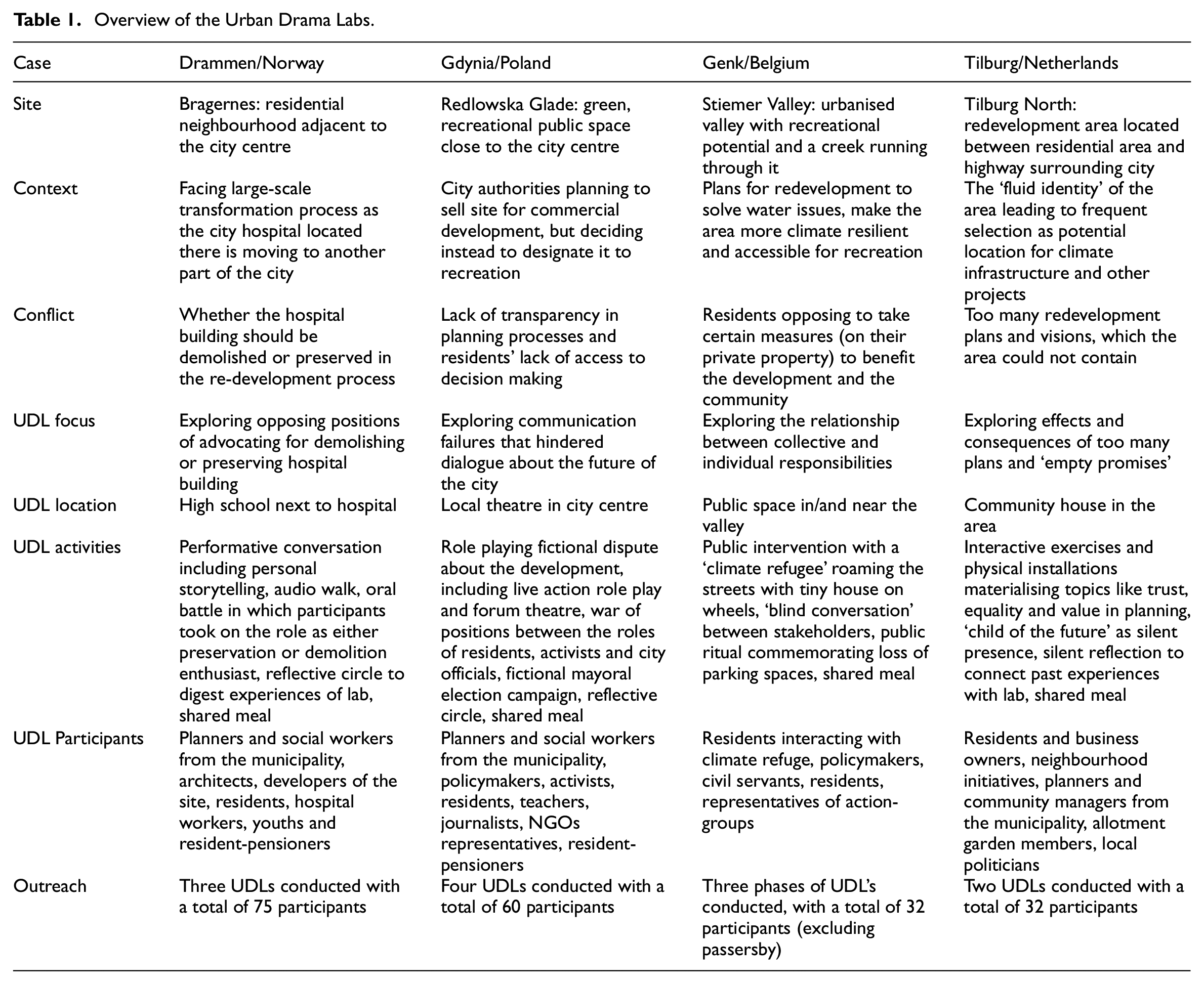
There is a long tradition for planning to draw on artistic practices, such as theatre, to develop new forms of collaboration and participation in urban development (see e.g. Cuff et al., 2020; Dang, 2005; Metzger, 2011; Rannila and Loivaranta, 2015). These practices include efforts to use theatre to move beyond polarised and antagonistic posturing between stakeholders, as well as to empower people by expressing the plurality of stories in neighbourhood spaces. However, artistic practices risk being too convivial, focusing on pursuing a presumed neutral and ‘level playing field’ (Sachs Olsen and van Hulst, 2024). Artistic practices are also often seen to constitute so-called ‘cool forums’ (Metzger, 2011: 217) which might diffuse conflicts and diminish any ‘real’ problems that the stakeholders are facing. Furthermore, when issues of contestation are taken on, artistic practice often struggles in relation to the strategic power in the city as its deliberation is often marginalised in the overall policy negotiation (Larsen and Frandsen, 2022). To address these challenges, the theatre makers and research team worked in close dialogue with the municipalities to identify local conflicts and to develop interventions that would directly address them and then co-facilitated the UDLs. In Table 1, we introduce the site, context and local conflicts to which the UDLs responded, and give a brief overview of their activities. We then go into detail about how the UDLs ‘played out’ through the principles of estrangement, embodiment and entanglement.
Overview of the Urban Drama Labs.
Estrangement
Theatre offers estrangement by cutting out a piece of reality for inspection, allowing the audience to experience what is ordinary as unfamiliar, conventional as fictional and thus present reality from a new and surprising perspective (Thaler, 2018). The UDLs built on this function of theatre for making strange what is taken for granted (Metzger, 2011), providing a new framework in which participants could approach the conflict and their position in it. The liminality of theatre was key here. In line with the theories of Turner (1970), liminality is understood as a threshold in space and time when disruption of the stable is possible and in which ‘novel configurations of ideas and relations may arise’ (p. 97). Accordingly, the UDLs sought to make local conflicts strange in order to question given claims about the stakeholders, visions, tensions, relations and interests that constituted these conflicts.
The Polish UDL responded to an especially antagonistic and ‘hot conflict’ concerning the lack of transparency and dialogue in the development of the Redlowska Glade. Estrangement was therefore specifically important for moving the conflict from an antagonistic to an agonistic setting. Hence, the UDL engaged participants in a fictional plot which was staged at the local Gdynia Główna theatre. The plot was set in the 1990s and revolved around plans to develop Redlowska Glade for entertainment, involving the clashes of various interest groups. While the fictional plot mirrored the essence of the real-life conflict, it provided a distance that avoided directly referencing or reproducing the antagonism that characterised it. This distance was enforced by engaging participants in a game of role-play in which they were assigned roles different to those they normally occupied. These were roles of artists, residents or city officials, all with a specific stake in the development. The task was to negotiate the different interests of these groups and to reach an agreement concerning the development. Many participants appreciated ‘this stepping out of one’s daily role’, which gave them new perspectives on the roles they played. For example, a resident noted how difficult and stressful it was playing the role of a civil servant, as civil servants are often perceived as those who generate chaos in planning processes, while they are also the ones having to manage that chaos. This realisation enabled a reflection around how identities and interests are performed and framed in such processes.
Reflecting on the framing of identities and interests in conflicts was also explored in the Norwegian UDL. Here, the function of estrangement was to introduce different languages and logics of reasoning for debating the future of the hospital building (Metzger, 2011). Firstly, participants were invited to share their personal stories about the hospital and surrounding area. They did this by placing porcelain cups, representing places that were special to them, on a large textile map of the area. The participants could present themselves as who or what they wanted (including opinions, interests, preconceptions, and agendas), rather than as predetermined roles or as representatives of specific groups (i.e. ‘planners’, ‘residents’). The developer pointed to the importance of appearing to other participants ‘as a human in flesh and blood sitting there beside them’. This way, she said, she could exit her role as ‘the developer’ and establish a personal relation to the people she talked to. This experience was shared by participants from the municipality. Sharing their personal relations to the site, they said, led to different conversations than if they were bound by their professional roles. The world of planning, then, was made strange as they reflected on how their professional roles can be alienating, for example by excluding personal emotions as distractions or counterproductive compared to the more accepted use of rational arguments, facts and evidence. Following this experience, the participants went on an audio walk where they listened to the stories and visions of the site itself: The Old Power Station advocating for preserving the cultural history of Drammen; the Tourist Sign dreaming of branding Drammen through new ‘starchitecture’; the Hospital Building just wanting to serve the citizens in Drammen in the best way possible, and so on. Participants confirmed that the fictional characters further promoted a personal approach by representing emotional and personal agendas that were easier to ‘take in’ than had the characters communicated official narratives and plans for the area.
The Dutch UDL made strange the conflict around the many unaccomplished plans and promises in the planning of Tilburg by materialising contradictory visions and plans in models, scenarios, costumes and characters. The physicality of abstract notions such as ‘time’ and ‘inequality’ made the plans tangible, while at the same time unsettling the participants’ taken-for granted relations to them. For example, ‘inequality’ was materialised in an installation of two houses facing floods. One participant got a big shovel to protect their house with sand, whilst another received a much smaller shovel, after which both houses were flooded. In another installation, the participants knotted a thread along a timeline made of a row of nails on a wooden plank, each representing one year, to show the length of their lives up until the present. The last participant to knot a thread was the ‘child of the future’, a role played by a member of the research team. She knotted a thread way beyond the present, where others had ended. The ‘child’ was wearing a LED mask and was a strange and silent presence throughout the UDL. Participants confirmed that the ‘eerie’ and ‘uncomfortable’ presence of the ‘child of the future’ created conversations that transcended the, often short-term, timeframe of urban planning. Within this longer timeframe, some of the conflicts between the different plans felt less pressing and could thereby be approached from a more agonistic, rather than antagonistic perspective.
In a similar vein, the Belgian UDL brought the future to the present as a way of making the conflict strange between collective and individual interests in the Stiemer Valley. This took place as a public intervention in which a ‘climate refugee’, played by the local theatre maker, roamed the streets with a tiny house on wheels, a mystifying object in public space. The climate refugee represented a foreboding future where, due to flooding, she had to abandon her home and live in a mobile house. She also provoked reflections on the concrete implications of climate change regarding how collective actions have detrimental effects on individual lives. By being present in public space for many weeks, the climate refuge became an object of talk, with people stopping, asking questions and discussing with her and each other what this future would mean for them. In this way, the UDL used disruption and exaggeration to link people’s individual lives to a possible future.
The Belgian UDL further estranged the conflict between individual and collective interests through the performance of a ceremonial funeral procession for parking spaces that were to be removed to make space for water storage. Participants reflected on this as an odd but memorable event, connecting elements from their daily life with rituals that connected to the grander scheme of things, such as climate change. One participant shared that they specifically appreciated that the procession allowed for ‘saying goodbye’ to something that would normally be taken for granted. The procession also established new connections. A civil servant, for example, mentioned that it caused him to interact in new ways with residents. For once, he could focus not only on short-term and individual solutions that were often expected from him, but more on the long-term, addressing climate change more generally and what is needed to collaboratively tackle its challenges.
Embodiment
Theatre promotes embodiment by foregrounding ways of knowing beyond cognitive experience: knowledge that includes multiple senses and involves bodies in affective experiences and learning. Accordingly, the UDLs challenged the distance produced in the ‘constructive’ and rational set-up of formal participatory processes, by moving away from simply analysing conflicts at a distance to being immersed in them. Rogoff (2006) observes that this approach holds transformative power because it fosters a deeper awareness and more emotionally resonant ways of understanding. In turn, this allows participants to engage beyond static and antagonistic disagreements and oppositions. Rather than focusing on reductive diagnostics and straightforward solutions, embodiment moves into sensations and relationships that promote agonism by transcending fixed divisions. It produces a shared sensibility that recognises differences and emotions, fosters empathy and makes visible power inequities (Leeuw et al., 2017). Including the body can here work as a tool to address exclusionary mechanisms that relate to, for example, race, gender and disability (hooks, 2014). Nevertheless, in planning and beyond, sensuality and bodies have often been considered ‘distractions to be overcome in order to attain true knowledge’ (Rivera, 2012: 208). This conception is upheld by the Habermasian idea of rational deliberation that leaves little space for passion or affective identification. Embodiment thus enables other forms of participation than those enabled through traditional citizen meetings.
In the Norwegian UDL, for example, the conflict concerning the hospital building was embodied in an ‘oral battle’ between preservation and demolition enthusiasts. While polarising the conflict to the extreme, the aim was to explore the complexity of what preservation and demolition meant in this context. Leading up to the battle, participants were invited to ‘pick sides’. They could choose the side they agreed with or explore a role they disagreed or were unfamiliar with. A woman from the municipality chose the role of preservation enthusiast even though she was pro-demolition. She explained that she was constantly faced with hard-core preservation enthusiasts in citizen meetings and needed to understand this stance better. After picking sides, the two groups were led into separate echo chambers where they embodied their group identity. The demolition enthusiasts had to smash the porcelain cups that were invested with personal meanings in the opening session. They admitted that the physical act of demolition was much harder than simply discussing why the hospital building should be demolished. What helped them justify their actions in the end was the argument that they had to allow the area to get a fresh start, rather than being tied to the past. The preservation enthusiasts had an easier task: they repaired the broken porcelain cups through the Japanese art of ‘kintsugi’. The care invested in repairing the cups made them connect their position with the importance of valuing what we have rather than constantly replacing it with something new. Beyond merely offering a stage for exploring different perspectives, embodiment here harbours potential for empathy and engagement (Heras et al., 2021) through affect and opportunities to experience, rather than merely observing.
Another example was a ‘hammer and nail installation’ in the Dutch UDL. Here, one person had to hold a nail, whilst the other had to hammer it into a tree chunk. This exercise transformed experiences of being power-full or power-less into a very concrete experience, which according to participants ‘hit the nail on its head’. Several participants voiced that they chose to hold the nail despite the risk of being hurt by the hammer holder, one of them saying ‘I hold the hammer enough of the time so I can hold the nail in this instance’. What makes this form of engagement suited for agonistic planning is that it leads the conversation away from mere cognitive disagreements and involves participants as dynamic persons rather than static positions. This enables empathy on levels that may at first seem irrelevant to the conflict at hand, but that provides a bond between people that supports constructive conversations about conflicting topics. At the same time, embodiment provides a shared experience and frame of reference to participants that may come from highly different communities, organisations or backgrounds, including differences of race, gender and/or (dis)abilities.
In the UDLs, efforts were also made to include bodies through sensuous experiences. For example, in the Belgian UDL, the Stiemer valley was made ‘edible’ in the form of a pesto created from wild herbs that were foraged in situ. Participants were thus invited to ‘taste the valley’. One participant explained that the performative character of the tasting made them experience the valley differently by fostering a more emotional connection with it and with nature in general.
It is worth noting that embodiment can also create new types of in- and exclusion in participatory processes. In the Dutch UDL, for example, a participant who was not fluent in Dutch participated successfully, whilst more language-heavy sessions would have been inaccessible to her. But on the contrary, in the Norwegian UDL, a participant who had mobility issues could not attend the audio walk. This points to the importance of critically scrutinising what tools and approaches accommodate or exclude certain perspectives and abilities. As Haraway (1988) reminds us, embodiment foregrounds the politics and epistemologies of location, positioning, and situating, where partiality, and not universality, is the condition of being heard and to make knowledge claims. The view from a body is always complex, contradictory and structuring and thus empowers differently than the view from above, which is a view from everywhere and nowhere, and therefore less open to critical reflection and scrutiny.
Entanglement
Theatre foregrounds entanglement by opening for scrutiny how interests, roles and identities are woven together in complex, mutable and messy relations (Engelhard et al., 2021). Building on the principles of estrangement and embodiment, the UDLs examined various entanglements by bringing together the cognitive, discursive and affective. In so doing, the UDLs challenged the ‘disciplinary space’ of urban planning to create a space for learning (Verloo, 2018). Marquez (2012) argues that disciplinary spaces are spaces in which subjects are seen only as their specific roles – as planners, developers, residents and so on. These pre-given roles give stakeholders little possibility to challenge the rules to which they are subject and much less to create new ones. In contrast, the UDLs complicate given rules and roles by entangling, dis-entangling and re-entangling the webs of relations that exist between stakeholders in urban transformation processes. This was, for example, done through role-play in which participants assumed or created new rules and roles for themselves and thereby challenged the creation and imposition of certain identities and interests pertaining to the conflict at hand.
In the Norwegian UDL this role-play was manifested in the oral battle between demolition and preservation enthusiasts. After embodying their identity in the echo chambers, the groups met for the battle. They stood opposite each other and addressed their differences: ‘you [preservation enthusiasts] are stuck in the past, we [demolition enthusiasts] are future oriented!’; ‘you [demolition enthusiasts] do not care about the environment, we [preservation enthusiasts] take care of what we have’. While this us versus them set-up might appear both antagonistic and simplistic, it made visible the complex entanglement between the two opposing positions. Many participants observed that the arguments on both sides were, in fact, very similar (for instance, focusing on caring for the environment, quality of life, accommodating residents’ needs) and that both groups wanted the same thing in the end: what they saw as best for the neighbourhood. One participant said this made her realise that she could accommodate a development with or without the hospital building because there were so many other factors that were more important for the totality of the development.
The battle demonstrated that the division of the conflict into antagonistic positions and single issues of preservation or demolition was not a simple affair. Not only did the arguments on both sides overlap, but they were deeply entangled with a wider set of values concerning what constitutes a ‘good’ city. As McAuliffe and Rogers (2018) argue, the move from single issues to a more nuanced appreciation of the complexity of urban development is essential to transitioning from rigid antagonism towards a more agonistic position. This was also confirmed by a participant in the Polish UDL. She said the lab made her understand that ‘there is no such thing as a monolith of officials and a monolith of residents, that even residents mean five billion different conflicting opinions’, and that such a reflection can lead to a dialogue ‘which in some way demonstrates that people are different, but we can all respect each other’. Accordingly, the UDLs put forward the agonistic sentiment that various truths and roles need to be recognised through a process that transforms relations of antagonism and resentment into those of agonistic respect and mutual recognition (Lowndes and Paxton, 2018).
The question is what happens when respect and recognition are not possible because the differences are too deep-seated, inadmissible and/or irreconcilable? While not providing a definite answer to this question, the UDLs did attempt to move beyond simply recognising differences, to also provide a space in which discussions around the various entanglements that constitute these differences could be brought to the fore. In the Belgian UDL, this was done through anonymous ‘blind date’ conversations: Two participants were sitting in a small wooden house with a wall between them, each with a window looking out on the Stiemer Valley. Not knowing who their conversation partner was, they were equipped with prompts to guide them through an hour-long conversation about their dreams and concerns for the valley’s future. Through the anonymity, these conversations harnessed agonism’s potential for articulating differences more freely (Lowndes and Paxton, 2018). Opposing parties could meet without having to hold back based on their own role and identity or the assumed role and identity of their conversation partner. Hence, participants could challenge presumptions about who or what they represented, and this way create new (re)presentations of themselves. This corresponds with Asenbaum’s (2018) understanding of anonymity not as identity negation but as a form of identity creation. One of the participants said that the anonymity made her talk more openly because she was ‘not afraid to say something stupid’, or something that would not fit her professional role. Another participant stated that the conversation became more balanced because he did not have to adjust his answers according to who he was talking to or what he thought the other person would find interesting.
Being temporarily released from predetermined roles and expectations was perceived by participants as particularly fruitful in a conflictual setting. One participant mentioned the ‘deadlock’ that was often experienced between agricultural and nature organisations due to presumptions of who ‘the other’ group is and what they represent. Having anonymous conversations in this setting, she argued, would enable these actors to be brought together in a way in which their differences could be more freely articulated and examined.
Collaborative relationships and challenges
The UDLs promote agonistic planning as a process that is not about reaching a final decision or plan but about negotiating different understandings of the present and the directions to move on from. As Pløger (2023) points out, the contingency and openness of this process might be problematic for planning institutions because participation in planning is predominantly oriented around erasing contingency by securing legitimacy and consent to plans and thus ensuring the predictability of its implementation. To scrutinise this tension between contingency and predictability, as well as other challenges for putting agonistic planning into practice, we now turn to the collaborative relationships between actors and institutions that were forged through the UDLs.
Our collaborative relationships with the planning institutions occasionally featured resistance and cautiousness around the process and outcomes of the UDLs. Many municipal actors evaluated the UDL based on the concrete outcomes it could produce, such as gaining new information from stakeholders. The value of the more open-ended and intangible processes it established, such as the new relationships it could engender and the engagement it could trigger, was less recognised. Hence, it was often challenging for the municipalities to grasp what the outcomes of the UDLs were and how they could be effectively used. Therefore, they questioned the ‘functionality’ of the UDLs. Next to that, cautiousness about participating in the UDL was common. In the Dutch case, a politician decided at the last minute not to participate out of cautiousness for the potential consequences. In the Norwegian case, even though there was great enthusiasm among municipal social workers to set up a UDL, the municipal planners were more sceptical. They feared that the UDL would generate mistrust from both leadership and residents because the planners could be seen to take a stand about the hospital building too early in the planning process and be expected to follow-up on this later. Within the cities, varying levels of control and oversight were experienced throughout the development and execution of the UDLs. In the Netherlands, Poland and Belgium, the UDLs took place during election years. This heightened the political sensitivity of the municipalities in relation to the UDLs. In Poland, city authorities tried to control the communication around the UDL from the start, possibly because the UDLs addressed a lack of dialogue and trust between city representatives and residents. The authorities ensured that researchers remained ‘unbiased’ and ‘objective’ about the conflict, and indicated which respondents were worth talking to and which were not. Even after the UDLs were executed, a degree of control remained, with the city wanting to have a say in what and how the results were communicated, as well as to whom the intellectual property rights of the UDLs belonged. The research and theatre team had to navigate these conditions of trust, control and procedure by translating academic and artistic needs into administrative language, and at times adjusting their work dynamics.
In Belgium, the artists initially wanted to put up signs that announced fake construction plans for the valley, to stir up dialogue and engagement. The civil servants did not want to proceed with this idea out of concerns about the level of confrontation it could cause. The UDLs therefore took a less confrontational approach. The theatre methods of the UDLs also posed some challenges concerning involvement, with some finding this approach rather intimidating (‘we don’t want to play theatre’) or frivolous (‘what does theatre have to do with the actual planning in our area?’). In the Norwegian UDL, one participant left the lab in protest because he was provoked by the ‘irrelevant’ and ‘unserious’ approach of the lab. He thought he was participating in a traditional citizen meeting in which he would get ‘serious’ information about the development.
Our collaboration with local stakeholders and institutions highlighted the political, institutional and personal limits of putting agonistic planning into practice. As researchers and theatre makers, we constantly had to negotiate institutional rules of engagement. Two strategies came in handy. The first concerned how we had to ‘smuggle’ (Rogoff, 2006) the agonistic practice into the ways of thinking and doing within the planning institutions. As Rogoff argues, smuggling is not about crossing barriers or borders, but ‘sidling along with them seeking the opportune moment, the opportune breach in which to move to the other side’ (Rogoff, 2006: 5). These opportune moments materialised in the willingness of the municipal actors to let artists and researchers scrutinise their routinised approaches and re-imagine (to some extent) how participation is organised and agonism can be accommodated. Personal relationships sometimes facilitated this, with for example the Norwegian research team having already established a good working relationship with the ‘local democracy coordinator’ of Drammen municipality. Her role was to strengthen dialogues between citizens and the municipality, and she played a key role in communicating to the rest of the municipality the value of the UDLs in that regard. The second strategy concerned transparency: collaborating with planning institutions alerted us to the importance of communicating (more) clearly about how stakeholders could benefit from participating and how the UDL was linked to formal policy making. This entailed emphasising that the UDLs were about exploring issues of shared concern and building engagement and relations rather than extracting information. This was demonstrated in the Norwegian context in which, after participating in the UDL, residents organised their own meeting with the developers of the site whom they had met in the UDLs. In the meeting the two groups entered into direct dialogue about the development. The municipality had not before experienced this kind of engagement and initiative without having to get involved themselves and credited it to the UDLs.
Conclusion
This article has demonstrated the potential of Urban Drama Labs for putting agonism in practice through applied theatre and the principles of estrangement, embodiment and entanglement. This was done in three steps. First, the UDLs provided a frame in which local conflicts were made strange so that given claims about stakeholders and interests could be questioned and held up for scrutiny. The strangeness of the audio walk, funeral procession, child of the future and climate refugee enabled agonistic relations to be negotiated rather than suppressed, and the various forms of role play enabled participants to explore other or new perspectives. Second, the UDLs promoted affective and embodied engagements including personal reactions and emotions as well as shared experiences and sensibilities. Abstract plans were embodied in actions, installations and experiences that moved conflictual discussions away from mere cognitive disagreements towards forms of embodied empathy that better accommodated and valued differences. Third, the UDL complicated given rules and roles by insisting on their relational entanglement, thereby shifting the focus from single issues towards a more nuanced appreciation of the complexity of urban transformation processes.
We acknowledge that there are also limitations to the use of UDLs in urban planning, for example in terms of navigating the tensions between contingency and predictability, as well as conditions of trust and control in procedural settings. There is also a risk that UDLs are seen simply as a useful way for governing bodies to be perceived to listen to local communities and that their deliberation is marginalised in policy negotiations. Marginalisation can be caused by uncertainties around the open-ended and processual nature of the UDLs, and the lack of tangible outcomes. A similar concern is that artistic practice becomes instrumentalised through collaboration with dominant forces and thereby loses its potential for critical intervention (McLean, 2018; Sachs Olsen, 2018). A key contribution to participatory urban governance debates in urban studies is our attempt to navigate these concerns, rather than reducing them to post-political readings of participation based on a clear binary between depoliticising governance and ‘real’ political agency.
To navigate these concerns, we focused on transparency in terms of recognising the task of planning institutions to form consensus around future plans and communicating how the UDLs can strengthen the relations and broaden the perspectives upon which these plans are made. This way, the UDLs may foster an ‘ethical consensus’ (Pløger, 2023) that lets stakeholders recognise themselves in the plan rather than being left with a distance to their differences, experiences and needs. Furthermore, we ‘smuggled’ agonistic principles into ways of doing and thinking in planning. This approach takes its cue from the emerging field of ‘critical institutionalism’ (Cleaver and De Koning, 2015). It recognises that while tied to laws and decision-making practices, planning institutions are also constituted and reconstituted relationally through the creative practices of the actors involved in them. Hence, agonistic practices can be smuggled into planning through the gaps between institutional prescriptions and what actors do (Lowndes and Paxton, 2018). This means that productive collaborations between artistic practice and municipalities are indeed possible, given that involved actors recognise and appreciate the potential of these collaborations to re-think existing participatory practices and approaches.
Finally, in the spirit of agonistic planning, we must recognise that no public participation will be universally good nor inclusive of all. This does not mean that participation is futile, as suggested in some debates over the post-political city, but that any participatory project must acknowledge that exclusions will inevitably be made and thus should be critically reflected upon rather than ignored. Engaging different audiences and building and maintaining relations calls for diversifying approaches and working methods that take participation along as many different lines as possible, to ultimately include as many differences as possible. Scholars of urban studies can further pave the way for using such a wider variety of participatory approaches in planning rather than succumbing to a one-size fits all participatory model.
Footnotes
Acknowledgements
This paper is the result of the research project CONTRA (CONflict in TRAnsformations) for Urban Europe,  . A special thanks goes to our theatre partners Marthe Sofie L. Eide, Sara Vertongen, Taco van Dijk, Małgorzata Polakowska and Marzena Chojnowska for their work with conceptualising, developing and executing the Drama Labs in Drammen, Tilburg, Genk and Gdynia. We further thank John Pløger, Vivien Lowndes and Tom Hawxwell for their thorough and critical reading of earlier versions of this paper. A final thanks goes to the research team Eva Wolf, Kasia Szmigiel-Rawska, Tobias Arnoldussen, Esther van Zimmeren, Gro Sandkjær Hanssen, Wouter Van Dooren and Joanna Krukowska for helpful comments on the development of the paper.
ORCID iD
Ethical considerations
The Ethics Review Committees at Oslo Metropolitan University, Tilburg University, University of Antwerp and University of Warsaw approved our Drama Labs and interviews prior to these being conducted.
Consent to participate
Participants gave written consent for review and signature before participating in the Drama Labs and before starting interviews.
Funding
The authors disclosed receipt of the following financial support for the research, authorship, and/or publication of this article: This project has received funding from the Joint Programming Initiative Urban Europe and the European Union’s Horizon 2020 research and innovation programme under grant agreement no. 101003758. The national Funding authorities that support the project are the Dutch Research Council (NWO), Research Foundation Flanders (FWO), the Norwegian Research Council (NFR) and National Science Centre, Poland (NCN) (project no. 2021/03/Y/HS5/00207).
Declaration of conflicting interests
The authors declared no potential conflicts of interest with respect to the research, authorship, and/or publication of this article.
Data availability statement
The datasets generated during and/or analysed during the current study are available from the corresponding author on reasonable request. Metadata for the project CONTRA are available from the corresponding author on reasonable request. Due to privacy concerns the primary data for the fieldwork is not openly available.