




Abstract
Chinese cities, especially large cities, are in urgent need of urban redevelopment but social conflicts in redevelopment processes have threatened social stability. Public participation has been stipulated in national policies to alleviate these conflicts and the responsibility to implement these policies has been delegated to local governments. Therefore, the features of public participation may differ between Chinese cities. Yet, a systematic investigation of this possible heterogeneity is lacking. This article adapts 11 features of governance to build a framework to compare public participation in urban redevelopment in Beijing and Guangzhou. Findings show that the two cities are similar in five features (policy instruments, policy integration, initiators, position of stakeholders, policy level at which citizens operate) but differ in six (policy goals, policy–science interface, power base of citizens, model of representation, rules of interaction and mechanisms of social interaction), making citizens in urban redevelopment in Guangzhou more powerful than their counterparts in Beijing. The observed shift towards urban micro-redevelopment might further strengthen the power of citizens in urban redevelopment in Beijing, but might weaken their power base in Guangzhou. The findings highlight the importance of local context and policy dynamics in the study of public participation in urban redevelopment in China.
Introduction
Urban redevelopment has become necessary to make precious land available for urban growth (He, 2012), because urbanisation continues while central government 1 has issued a policy of strict control over urban expansion to protect the stock of arable land. Issues in the redevelopment of urban China have captured public and academic attention since the 1990s (Zhang and Li, 2016). These issues can be divided into two kinds. First, redevelopment projects are opposed by local residents because of forced relocation and unfair compensation. For instance, the relocation of more than 745,000 households in Shanghai from 1995 to 2004 led to social conflicts, because the market-oriented urban redevelopment process favoured land developers by constraining the compensation standard for relocated residents (He and Wu, 2007). In Nanjing city, the local government attempted to use monetary compensation rather than the in-kind compensation for relocated residents in the urban redevelopment process to minimise the financial expenditure on compensation (Hu et al., 2015). Second, redevelopment projects are opposed by (historic) preservationists. The large-scale redevelopment projects in urban China have destroyed cultural heritages and the old urban fabric, and thus have caused strong criticism from preservationists (e.g. Graezer Bideau and Yan, 2018). Engaging the public is an important means of resolving the above-mentioned issues proposed by central government.
In theory, public participation in urban redevelopment is strongly related to urban governance. Governance is the processes through which collective affairs are managed, referring to the complex interactions between the state, the market and civil society (Healey, 1997). Although the state still plays a crucial role in shaping and implementing policies for urban redevelopment, collaborative governance between governments, private developers and residents has been promoted in Western European countries in the context of decentralisation (Li et al., 2018). In the governance process, citizen participation has become important in contributing to planning discussions in Western countries (Bäcklund and Mäntysalo, 2010). In China, some recent studies have shown that urban redevelopment has increasingly become a governance process that involves local governments, private enterprises and civil society (e.g. Lin et al., 2015). There has been considerable debate over public participation in urban (re)development (e.g. Morrison and Xian, 2016; Zhang et al., 2019). Some scholars have studied the relation between place attachment and public participation. Lewicka (2005) indicated that people with strong place attachment tended to participate in public affairs to maintain or improve their living conditions. Wu et al. (2019) found that residents’ participation was substantially affected by their place attachment, their actual participation experience and their residential registration status in China. However, this logic could be challenged by the free rider issue, that is, people might not participate since they expect to benefit from others’ participation even if they possess strong place attachment (Kleinhans and Bolt, 2014). Similarly, people may also not participate in civic affairs because of the issue of ‘not-in-my-back-yard’. These studies have contributed to people’s motivations to participate in civic affairs, which reveal the heterogeneity of public participation at the individual level. Besides, several scholars have raised the assumption that public participation in the redevelopment of urban China 2 varies across cities (e.g. Liu, 2015). However, theoretical and empirical research on this possible heterogeneity is still lacking. Furthermore, public participation in China’s planning, particularly at the city level, remains relatively under-researched (Morrison and Xian, 2016).
Therefore, this research aims to investigate the possible heterogeneity of public participation in urban redevelopment in Chinese cities. It also contributes to international debate on the relations between public participation and urban governance by adapting a governance framework to understand public participation in urban redevelopment. This article is structured into five sections. The following section presents a framework to analyse the heterogeneity of urban redevelopment in China. The next section introduces data collection and research methods. The penultimate section analyses the policies and practices of public participation in urban redevelopment in Beijing and Guangzhou. The final section compares the findings in Beijing and Guangzhou, and discusses the underlying reasons for the heterogeneity.
Conceptual framework
The complexity of urban redevelopment processes and the diversity of local institutional contexts are potential impacts on the heterogeneity of public participation in Chinese cities. They may lead to different levels of power of citizens and to various relations between citizens, governments and other actors in the governance processes. Therefore, this research adapts a governance framework developed by Driessen et al. (2012) to understand key factors of governance that cause the differences in and similarities of public participation in urban redevelopment in various Chinese cities. Based on an extensive literature review, Driessen et al. (2012) have developed a framework to differentiate the modes of interaction between the state, the market and civil society. The framework has the potential to be adapted to investigate the heterogeneity of public participation in urban redevelopment in China. For one thing, urban redevelopment in China is a governance process, based on the interaction between state, market and society (Lin et al., 2015). For another, the application of the framework can lead to ‘comparable claims’ about governance (Driessen et al., 2012). This research is a comparative analysis of various policies and cases in two different cities.
Nevertheless, this framework is developed in a democratic context and originally for environmental governance. It lacks attention to different relations and policies of central and local governments, the roles of specific actors and the diversity of local institutional contexts. In China, market transition has significantly influenced the roles of the state, the market and local residents in urban redevelopment (Li, 2018). Although local governments implement top-down initiatives, they have steered policy implementation for their own interests (Li et al., 2018). Therefore, to tailor the framework developed by Driessen et al. (2012) to fit to the Chinese context, we have adapted the contents of three dimensions. First, the feature ‘policy content’ dimension focuses on various policies put in place by central government and local governments. Second, the ‘actor features’ dimension focuses on citizens and their relations with multi-level governments and other actors. Third, the ‘institutional features’ dimension concerns the variety of local institutions. Although China is considered as an authoritarian state, local institutions vary in different geographical, cultural and economic settings (Xu, 2011). These differences can affect the power of citizens in urban redevelopment. The detailed information of the adapted framework (Figure 1) is presented in the following paragraphs.
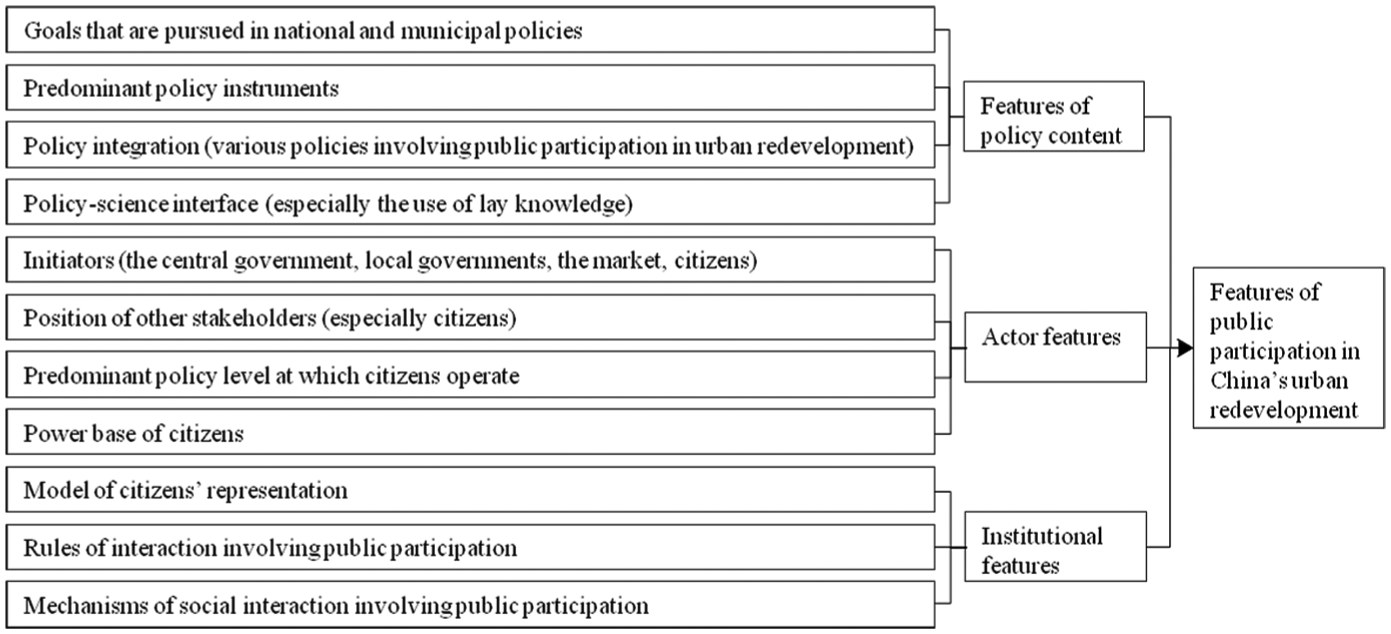
Conceptual framework.
Features of policy content
In their study of the legal requirements and implementation of public participation in infrastructure planning at the national and local levels in China, Shan and Yai (2011) claim that legal and administrative support is imperative for the effective implementation of public participation in urban planning. The features of policy content include goals that are pursued in policies, predominant policy instruments, policy integration and policy–science interface (Driessen et al., 2012). Goals of related policies can be uniform or tailor-made. The goals are decided by local governments since land-use decision rights have been devolved to municipal governments after decentralisation (He and Wu, 2009). Urban redevelopment in China is usually a means to foster economic growth, but the way in which this contributes to economic performance might differ. Local governments could adopt different policy instruments to ensure policy implementation, including legislation, permits, and incentives such as compensation and fines, etc. Policy integration can be sectorial (policy sectors and levels separated) or integrated. Urban planning necessarily requires some form of integration, the including transportation and environmental standards. Policy–science interfaces refer to the type of expert and lay knowledge used for policy preparation, decision-making, implementation and evaluation.
Actor features
In research on reframing public participation, Innes and Booher (2004) suggest that participation should be understood as a multi-way set of interactions among citizens and other actors who together produce outcomes. The actor features dimension includes initiators, the position of other stakeholders, predominant policy level at which key actors operate, and formal and/or informal power base of the key actors (Driessen et al., 2012). In the arena of urban redevelopment in China, initiators can be the central government, local governments, the market and citizens, according to the national Guiding Opinions on Further Promoting the Redevelopment of Urban Land with Low Use Efficiency (Trial) (Ministry of Land Resources, 2016). The position of other stakeholders is determined by the state, which grants some level of autonomy within predetermined boundaries. In China, local governments often dominate urban (re)development (Wu, 2016). The predominant policy level at which citizens operate starts at the local level, but might also include the provincial and even national level. The power base of citizens could be authority, legitimacy, autonomy, group size, leadership, etc.
Institutional features
Institutional capacity is a key element for collaborative participation to solve complex and contentious problems (Innes and Booher, 2004). The dimension of institutional features includes a model of representation, formal and/or informal rules of interaction and mechanisms of social interaction (Driessen et al., 2012). The model of citizens’ representation reflects whether representatives articulate the voice of citizens. Rules of interaction include formal rules (rule of law and self-crafted rules) and informal rules (norms, political and social culture). Institutional features vary between Chinese cities because they are influenced by local histories (Xu, 2011). Traditional media reflect local political culture or informal rules. Nearly all traditional media in China are state-owned and are managed by the Communist Party’s propaganda system (Lu et al., 2016), so the content of traditional media reports largely reflects the openness and willingness of local governments toward planning participation. New media have provided new platforms for public participation in urban redevelopment (Deng et al., 2015). Mechanisms of social interaction refer to the way decision-making is working in practice and can include local governments’ decisions about collaborations within top-down determined boundaries but also private actors’ decisions to engage in collaborations, and even bottom-up deliberations and negotiations. The mechanisms can be more hierarchical or more open to negotiation and deliberation.
Methodology
Selection of cities
Beijing and Guangzhou were selected because they have the potential heterogeneity based on the three dimensions in the framework. First, Guangzhou is of research value concerning features of policy content, since it is the first pilot for the experimental ‘three olds’ redevelopment policy. ‘Three olds’ refers to old urban areas, old factories and old villages. However, Beijing has not adopted this redevelopment policy. Second, the two cities are different in terms of actor features. Unlike Guangzhou, Beijing is directly controlled by the central government. The central government stipulates national policies to guide public participation in urban redevelopment in both cities, but is only directly involved in solving conflicts caused by urban redevelopment in Beijing. Third, the two cities are distinct in terms of institutional features. For example, the content of traditional mass media regarding urban redevelopment projects in Beijing verges on propaganda, but that in Guangzhou is much more independent from the government (Liu, 2015).
Data collection
The data collected in this article are from 2003 to 2018. Conflicts over demolition and relocation were extremely acute in 2003, and the central government started to make policies to protect the interests of affected residents in urban redevelopment (He and Wu, 2009). Two kinds of data were collected. The first are policy documents. These data were collected in three steps. First, keywords were searched (e.g. urban redevelopment, relocation, cultural heritage preservation, Guangzhou/Beijing) in the Baidu search engine 3 to gather the first related set of policies. Second, all potentially related policies were identified through the snowball sampling method. Local policies usually list higher-level policies and we also identified and collected these. Third, we checked their contents to select related policies at the national and/or municipal levels.
The second kind of data is urban redevelopment practices. First, practices were identified through searching keywords (e.g. participation, demolition, Guangzhou/Beijing) in the Baidu search engine, China Academic Journals full-text database (CNKI) and local government portals; and then checking the results to gather the required data. Digital news archives, academic literature and social media blogs were collected online. Second, references in the academic literature were checked, and urban planners and preservationists in Beijing and Guangzhou were interviewed to identify more practices. Third, information on the identified practices was collected through field work and searching published materials online. Field work included site visits, observations, photographs and semi-structured interviews with citizens in 2016 and 2017.
Research methods
Content analysis and critical discourse analysis were adopted to analyse the collected data. Content analysis is applied to identify the 11 features, and critical discourse analysis aims to discover the heterogeneity of these features and its significance to urban governance. One simple form of content analysis is identifying units of analysis within semantic contexts (Petrina, 1998). The process of identifying and gathering units of analysis is coding. The units of analysis of the content analysis are empirical evidence of the latent meaning found in discourse analysis (Petrina, 1998). The content analysis was done using the data analysis software NVivo 11.4. NVivo is considered the best in simplifying the difficult ‘coding’ task (Hilal and Alabri, 2013), and can code both textual and visual data.
In our research, the textual and visual data were chronologically ordered before coding. Most data were in Chinese and to keep their original meanings in the coding process we did not translate them into English. The coding procedure in NVivo included three steps. First, we imported various data by using the ‘Data’ tab. Then, we created 11 nodes with the ‘Node’ button and named them as the 11 features. Finally, we identified units of analysis related to each node, and coded the identified units by dragging them from ‘the document detail window’ to the corresponding nodes in ‘the node window’. The identified data were then translated into English for the discourse analysis.
Critical discourse analysis aims to understand ‘how discourse is implicated in relations of power’ (Janks, 1997); it can demonstrate ‘the political and powerful nature of seemingly mundane statements and symbols’ (Petrina, 1998). We first selected representative cases in each city through analysing the identified units. The case selection criteria were: (1) each case has to exemplify at least one feature; (2) there should be as few cases as possible while achieving a priori thematic saturation, which means that all of the 11 features have to be exemplified; and (3) important national and local policies should be exemplified. Related policies and practices were then analysed according to the framework, and major conclusions were synthesised from the perspective of urban governance.
Public participation in urban redevelopment
The national context
In China, urban redevelopment programmes were launched in the 1990s, market mechanisms were introduced from the beginning but began to play a key role from 1998 onwards (Wu, 2016). Citizen participation has been introduced in recent years particularly in three fields: urban and land-use planning, cultural heritage preservation, and expropriation and compensation of housing. There are four relevant national policies: first, the 2007 Property Rights Law. It defines the legal status of private property rights for the first time to prevent forced demolition of private housing. Second, the 2008 Urban & Rural Planning Law. It formalises public participation in the preparation, revision and supervision of urban planning, and stipulates accountability to promote its practice. Third, the 2008 Regulation on the Preservation of Famous Historic-Cultural Cities, Towns, and Villages. It is the first national policy that encourages the participation of the market and civil society in the preservation of historic-cultural cities. Fourth, the 2011 Regulation on Expropriation & Compensation of Housing on State-owned Land. It stipulates that municipal and county-level governments have sole responsibility for housing expropriation and compensation in their jurisdictions. This policy also stipulates that ‘social stability assessment’ has to be conducted before making a housing expropriation decision, and devolved the power in making detailed regulations to guide the selection of real estate price assessment agencies to local governments. Although these national policies have stipulated public participation in urban redevelopment, detailed and standard regulations to guide its implementation are lacking, which provides room for municipal governments to exercise their discretionary power. The following section is about related municipal policies and representative practices in Beijing and Guangzhou.
Public participation in urban redevelopment in Beijing
Municipal policies in Beijing
The policy documents collected show that related Beijing municipal policies focus on the same fields as their national counterparts, and provide relatively minor supplements. For example, Beijing’s City Master Plan (2016–2035) was prepared based on the speeches of the Chairman of China when he inspected the old Beijing in 2014 and in 2017. It primarily aims to create space for so-called Capital functions, namely political, cultural, international and technological centres. It stipulates the integration of several urban plans, the engagement of the public to improve the ‘scientificity’ of the plan, and the adoption of a planning participation approach. It also stipulates the improvement of the micro-space of hutongs (a type of narrow alley in Beijing), the preservation of courtyards in the old city, and the encouragement of residents to self-redevelop their housing according to preservation plans. The information platform for ‘plan integration’ was built in 2018. There are several municipal policies concerning public participation in housing expropriation and compensation. First, the expropriation and compensation plan has to be published in the project area and on the website of the municipal urban and rural construction committee. Second, in an old city redevelopment project, if the majority of homeowners questions the compliance of the housing expropriation plan a public hearing should be organised and the plan should be modified based on the hearing. Third, a certified real estate price assessment agency will be selected by the homeowners. These policies stipulate that incentive fees and compulsory expropriation through judicial procedures can be adopted to ensure housing expropriation.
Representative practices in Beijing
In Beijing, large-scale urban redevelopment projects initiated by the government and/or the market have been implemented since the 1990s (He, 2012). Four representative projects are selected based on coded data and presented chronologically, together they help us understand related practices in Beijing.
First, the Dongsi Eighth Alley redevelopment project (2007). This project was initiated by a property developer, and the local residents were informed that they must move away in April 2007. Located in Beijing’s historic-cultural preservation zone, this large-scale demolition project was opposed by some local residents and preservationists. Traditional media, within and beyond Beijing, reported the controversy. The project was stopped a few months later because of opposition from civil society. There are two interesting events in this controversy. One is that there were about 90 affected households, and their opposition to the project was reported by the newspapers, but only one local resident took legal steps to stop the project based on a related national regulation in 2007 (Zhang and Wang, 2007). Reports showed that she was encouraged by the newly issued national Property Rights Law, which emphasised the legal status of private property (Zhang and Wang, 2007). The other is that the performance of an Expert Advisory Committee in this project made citizens distrust experts. The Beijing municipal government founded this Committee at the request of the central government in 2004, and then appointed Committee members and controlled its work (Zhao, 2007).
Second, Liang-Lin’s former house preservation activism (2009–2012). This project was initiated by a property developer. A demolition and relocation notice was posted on the wall of the former residence of Liang-Lin in May 2009, and then a preservationist appealed to preserve this building on a blog post. The traditional media owned by the central government tended to oppose the demolition, but those owned by the Beijing municipal government tended to support it (He, 2010). Through the efforts of seven Beijing citizens, the State Administration of Cultural Heritage asked the Beijing Municipal Bureau of Cultural Heritage to recognise the building as an immovable artefact according to a newly issued national policy in 2010. Our interview with one applicant showed that this activity was organised by a NGO, the Beijing Cultural Heritage Protection Center (CHP). The local district government instructed the property developer to preserve the building in 2011, but a local newspaper reported that the building was nevertheless demolished several months later. The reactions of local governments to the demolition event sparked criticism from the media, experts and the general public (Feng and Wang, 2014). In the end, the land developer was fined according to national law and was forced to rebuild the building.
Third, the Bell-Drum Towers Square restoration project (2010–2013). This project was initiated by the district government and had two stages: 2010 and 2011–2013. According to reports in official media, the first stage aimed to redevelop an area of 12.5 ha. It was widely criticised because the project would destroy historical heritage. Several newspapers reported the controversy. Our interview with CHP shows that they announced a public debate about the project, but cancelled it at the request of the police. A preservationist petitioned to the State Administration of Cultural Heritage, which then put pressure on the municipal government. The project was suspended in 2010 and restarted in 2011. Approved by the State Administration of Cultural Heritage, the new plan aimed to only demolish buildings ‘without historical value’, and the area was reduced to 4700 m2. This information was not released until the acquisition and demolition notices were posted in the project area. Many local residents strongly opposed the project because they were dissatisfied with the compensation. A group of preservationists protested against the project online and on site, but interviews with these preservationists show that the local government dominated the controversy: We carefully accepted the invitations of several (local) journalists, but they told us that this project was prohibited from being reported in the end … local residents started avoiding opening doors for us because the government forbid them to talk with us. (Interview with Ms J, October 2016) We petitioned to the municipal departments and the central departments for the procedure was illegal, but we did not get any reply … The government negotiated with each household separately … I asked residents why they didn’t unite to negotiate with the government, and they were surprised at my question. It looked like that they considered it as a revolution. (Interview with Ms C, November 2016)
Fourth, the Nanluogu alley micro-redevelopment project (since 2005). Unlike a traditional urban redevelopment strategy, which is characterised by completely demolishing old buildings, an urban micro-redevelopment strategy refers to renovating an old building whilst maintaining its basic structure (Zhang et al., 2018). This project was initiated by the local subdistrict office in 2005 and is a cooperation between the local governments, the market and local residents. The municipal government is partly funding the project in response to the lobbying of the subdistrict office. The firms and local residents self-finance their redevelopment activities. In order to improve local business culture, the subdistrict government persuades the firms to develop targeted businesses; asks the Nanluogu chamber of commerce for help; provides subsidies to targeted businesses; and persuades local residents to limit the business entries. The redevelopment has been upgraded with the inspection by the Chairman of China in 2014. In 2015, four hutongs in the Nanluogu alley were selected by the local district government as pilots for redevelopment. The redevelopment goals include landscape preservation, improving livelihoods, improving the environment, etc. Residents have four choices: directional resettlement, monetary compensation, replacement and self-redevelopment. The micro-redevelopment process is still running.
Public participation in urban redevelopment in Guangzhou
Municipal policies in Guangzhou
The collected policy documents show that the focus of the Guangzhou municipal policies is in the same fields as their national counterparts, but adds considerably to them when it comes to public participation. For instance, the 2015 Guangzhou Municipal Urban and Rural Planning Regulation stipulates that: the municipal government should take opinions of the planning committee as an important basis in making planning decisions; planning committee members should include both experts and lay citizens; and feedback to participants should be given within seven days after their questions are solved. Municipal policies on housing expropriation and compensation require more transparency than in Beijing. First, if the number of households involved is 100 or more, the decision on the plan should be taken at an executive meeting of the city/district government. Second, the expropriation and compensation plan needs to be published in the project area, in publicly issued newspapers and on the government portal. Third, a public hearing should be held and if 50% or more of the households contest the housing expropriation plan, the plan has to be modified according to the results of this hearing.
A new round of urban redevelopment in Guangzhou was proposed by the municipal government to bypass centrally allocated land development quotas to make room for land-based economic development in 2006 (Wu, 2016). This strategy coincided with the provincial ‘three olds’ redevelopment policy in 2009, which stipulated two consulting stages. The first stage is about consulting local residents to determine their willingness for the redevelopment. The project can be launched when at least 90% of homeowners agree to redevelop the area. The second stage is about consulting on residents’ opinions on compensation. The demolition can be implemented when at least two-thirds of homeowners have signed the housing demolition and compensation and resettlement contracts. To facilitate the implementation of urban construction projects, the urban construction public consultation committee was formed by the Guangzhou municipal government in May 2013. The urban redevelopment bureau was established and issued the Urban Redevelopment Measures in 2015. The measures stipulate that urban redevelopment methods include comprehensive redevelopment and micro-redevelopment. Local residents are encouraged to self-redevelop their housing according to redevelopment policies.
Representative practices in Guangzhou
In Guangzhou, large-scale urban redevelopment has been initiated by the municipal government since the 1990s (He, 2012). Municipal documents show that property developers were permitted to be involved in urban redevelopment in 1993, were excluded in 1999, and were re-permitted in 2007. Based on chronological order in which the projects started, four representative projects are selected for understanding related practices in Guangzhou.
First, the Enning road neighbourhood redevelopment project (2006–2013). The new round of urban redevelopment in Guangzhou starts with this project, which also is the first pilot re-permitting property developers to be involved in urban redevelopment. The pressures faced by the local governments mainly came from local residents, preservationists and the mass media. In 2007, the municipal planning bureau prepared the Enning road redevelopment plan (Shin, 2014), which was strongly opposed by preservationists. Facing social pressure, the municipal planning bureau made a new plan which would preserve some arcades. In May 2008, 80 residents submitted a petition letter to the National People’s Congress, because the project violated the newly issued Property Rights Law (Tan and Altrock, 2016). The petition was widely reported by local journalists but the national congress did not reply. The demolition started in 2008. In 2009, the district government published the historic-cultural neighbourhood preservation and development plan, and hired a company to collect citizens’ opinions on it. A total of 183 local households sent their objections to the district government one month later, but did not receive any substantive reply (Huang, 2013). Therefore, 220 local households handed petition letters to congress delegates during the annual Municipal People’s Congress and Political Consultative Congress in April 2010 (Zhang and Li, 2016). Preservationists organised a NGO to participate in the project. In 2010, a local journalist reported the controversy to a delegate of the Municipal People’s Congress, who then successfully persuaded the mayor to inspect the project area. The mayor promised to give priority to cultural preservation in the new plan. The district ‘three olds’ redevelopment office set up an advisory group (including residents) soon after the mayor’s inspection. The project was gradually suspended.
Second, the Jinglingtai and Miaogaotai (two adjacent buildings) demolition event (2012). On 15 May 2012, a preservationist appealed to preserve the two buildings on a microblog post because they were under urgent threat of demolition. On 17 May 2012, expert(s) suggested to preserve the two buildings in a field assessment organised by the local district government, and the demolition was stopped. On 18 May 2012, Guangzhou Municipal Planning Bureau claimed that the demolition of the two buildings had to be approved by the sector of urban planning and the sector of cultural heritage. On 25 May 2012, Guangzhou Municipal Bureau of Land and Resources instructed the land developer to suspend the demolition. Guangzhou Municipal Planning Bureau and Municipal Bureau of Land and Resources negotiated with the land developer to change the plan to preserve the two buildings, but they did not reach an agreement (Feng and Wang, 2014). The two buildings were demolished in 2013, a few days after the political order suspending the demolition expired. The land developer said the demolition was legal according to the contract and local policies, but the owners of Miaogaotai sued the land developer and won the lawsuit. The municipal government fined the land developer and forced him to rebuild the buildings.
Third, the Guangzhou bridge widening project (2013), which is the first project of the public consultation committee of urban construction. This bridge is a key traffic route of Guangzhou and suffered from congestion frequently. In order to ease its congestion, a proposal to widen the bridge was put forward in 2002, but the report was not submitted to the municipal government until 2011 because many local residents did not agree with the proposal. In July 2013, the Public Consultation Committee for the Guangzhou bridge project was established with five local residents and the 25 standing members of the committee, which is composed of various social groups. Members of the committee had different attitudes towards the plan, and they made the final decision by taking the votes of the 25 standing committee members. The final decision was about making a systematic redevelopment plan (Ye et al., 2016). In September 2013, the committee submitted its report to the municipal government. One version was sent to the mayor directly, which substantively improved the influence of the committee (Ye et al., 2016). The redevelopment plan was accepted by both local residents and the government.
Fourth, the Yongqingfang micro-redevelopment project (2016). Yongqingfang is a small area of the Enning road neighbourhood. Most buildings were expropriated but not demolished, and some still accommodate residents who chose to self-redevelop their housing. This project was initiated a few months after the establishment of the Guangzhou municipal urban redevelopment bureau, and represents the restart of the Enning road redevelopment project. The Enning road redevelopment project was suspended in 2013 for failing to attract market investments. The self-redevelopment and historic building preservation made the available land too fragmented to have enough market value for property developers (Tan and Altrock, 2016). In 2015, the district government used the Yongqingfang micro-redevelopment project as a pilot for introducing new business models to redevelop the Enning road. A property developer won this project through an open bid in 2015 and finished it a few months later. Interviews with local residents show that their voices were weak in this micro-redevelopment project: … the pavement (in front of my door) was raised by the developer, so the rain water flows into my house when it rains heavily … that window [she pointed at a neighbour’s window] was blocked by a newly built wall, he/she [that neighbour] visited the developer’s office but could not find the manager, the journalists reported it [the controversy a few days ago] … we visited the government but no one solves the problem … (Interview with a local resident, October 2016)
Comparative analysis
The policies and practices mentioned are analysed according to the framework to investigate the heterogeneity of public participation in urban redevelopment in Beijing and Guangzhou. Regarding the dimension of features of policy content, the goals of urban redevelopment policies in Beijing are mainly driven by the municipal government’s political agendas, which are influenced by the central government. For instance, Beijing’s City Master Plan is prepared directly based on the speeches of the Chairman of China. Public participation contents closely follow related national policies. By contrast, the goals of urban redevelopment policies in Guangzhou are mainly driven by the municipal government’s economic agendas. The Yongqingfang micro-redevelopment case reflects that public participation is included in urban redevelopment policies mainly to promote the implementation of redevelopment projects. The predominant policy instruments in both cities are legitimacy and incentives (rewards and accountability), as national instruments. Integrating land-use-related policies is a national directive, so policy documents of both cities encourage integrating different kinds of land-use plans into one. In practice, both cities have begun to investigate policy integration. As for the policy–science interface, the knowledge of experts is used in policy decision-making in Beijing, while the knowledge of both experts and lay citizens is used in policy preparation and decision-making in Guangzhou.
Regarding the actor features dimension, initiators in both cities are either property developers or local governments, the municipal governments in both cities dominate the position of other stakeholders regardless of the type of initiator. The municipal governments decide whether to allow property developers to participate in urban redevelopment or not, and dominate the interaction with residents, mass media, preservationists, etc. The central government sometimes directly participates in the conflicts in Beijing as a response to citizens’ legal petitions, but it rarely responds to citizens’ legal petitions in Guangzhou. However, an increase in the power of citizens is observed in both cities. The predominant policy level at which citizens operate in both cities is multiple and has shifted from national to local: citizens have referred to national polices to defend their rights in the past, but they increasingly seize the opportunities provided by local policies. The power base of citizens in Beijing is legitimacy, legal recourse and knowledge, while citizens in Guangzhou have extra power bases: group size, and leadership. For example, comparing the third cases in both cities shows that collective petitions to the municipal government can make a difference in Guangzhou but not in Beijing; the public consultation committee in Guangzhou has the power base in leadership by submitting reports to the mayor directly. Moreover, it is implied that the Guangzhou government is more sensitive than the Beijing government to the group size of dissenting residents in urban redevelopment.
Regarding the institutional features dimension, the voices and interests of citizens in Guangzhou are better represented than those in Beijing. For instance, members of the expert advisory committee for urban redevelopment in Beijing are appointed by the municipal government, while the member selection and work of the public consultation committee of urban construction in Guangzhou are independent of the government, and its members are composed of various social groups. The formal rules of interaction in Beijing require only minimal public participation as the national ones and local governments do not always meet even these minimal requirements, but the formal rules of interaction stipulated in Guangzhou are more democratic than those of Beijing and the national ones, and are actually implemented. The informal rules of interaction in Guangzhou are also more democratic than those in Beijing. Traditional media in Beijing were strictly controlled by the municipal government since the ‘social stability assessment’ was stipulated in 2011, but those in Guangzhou have certain freedoms on reporting redevelopment controversies. In recent years, citizens have increasingly used new media such as the internet and social media to participate in urban redevelopment in both cities. Comparing the performance of citizens in redevelopment conflicts in the two cities indicates that the social culture in Beijing is more conservative than that in Guangzhou. The mechanism of social interaction in Beijing leaves little room for negotiation and aims to avoid the rise of collective protest, the government deals with citizens on an individual basis and citizens are unaware of the potential of collective action, but the mechanism in Guangzhou allows more room to arrive at a consensus and to mediate between citizens’ interests and governments’ priorities.
Discussion and conclusions
This article adapts three dimensions (policy content, actor features, and institutional features) of governance as a framework to compare public participation in urban redevelopment in Beijing and Guangzhou. Findings show that the two cities are similar in five features but differ in six, making Guangzhou citizens more powerful than Beijing citizens in local urban redevelopment. In the dimension of policy content, the two cities are similar in predominant policy instruments and in policy integration, but differ in goals that are pursued in policies and in the policy–science interface. The predominant policy instruments are legislation and incentives. Related policies (e.g. land-use, urban planning, and environmental policies) are gradually integrated in both cities. The policy goals are tailor-made. In Beijing, the municipal policies of urban redevelopment are driven by the municipal government’s political agendas. Public participation is restricted to a level that complies with national policies. By contrast, the corresponding policies in Guangzhou are driven by the municipal government’s economic agendas. Public participation is included mainly as a means to facilitate the implementation of urban redevelopment plans. The policy–science interface is also different. Unlike Guangzhou, Beijing does not use the knowledge of lay citizens in policy decision-making.
In the actor features dimension, the two cities are similar in initiators, in the position of other stakeholders, and in the predominant policy level at which citizens operate, but differ in the power base of citizens. Initiators in both cities can be the government or the market, yet the Guangzhou government is more pro-active. As regards to the position of other stakeholders, the municipal governments dominate urban redevelopment in both cities no matter who the initiators are. They can decide on allowing property developers to participate in urban redevelopment, and dominate the interaction with citizens. This finding supports Wu’s (2016) argument that the term ‘neoliberal urbanism’ might be misleading in China considering that it refers to a more market-centred approach in urban redevelopment, while redevelopment in China is dominated by the government. The predominant policy level at which citizens operate is multiple in both cities: citizens referred to national regulations to defend their rights in the past, but also increasingly seize the opportunities provided by lower-level policies and regulations. The power base of citizens differs: citizens in Guangzhou are allocated more rights; collective actions are more common and a clear leadership has developed with direct access to the centres of decision-making.
In the dimension of institutional features, the two cities differ in the model of citizens’ representation, in rules of interaction, and in mechanisms of social interaction. The difference in the model of citizens’ representation is reflected by the consultation committees and related policies in the two cities: citizens in Guangzhou are better represented. The formal rules of interaction in Guangzhou are more democratic than those in Beijing. For example, the Guangzhou ‘three olds’ redevelopment policy stipulates two consulting stages: consulting the redevelopment willingness of local residents, and then consulting residents’ opinions on compensation. The former is a response to the 2007 Property Rights Law, but it has been ignored by the Beijing municipal government. Purcell (2008) proposes two components of the right to the city: a right to appropriation and a right to participation. Therefore, in contrast to Guangzhou, Beijing residents’ property rights and their right to the city are more deprived. Similarly, the informal rules of interaction in Guangzhou facilitate citizens’ participation: both political and social cultures in Beijing are more conservative than these in Guangzhou. One possible reason is that Beijing is the capital of China; the suppression in traditional media to maintain social stability might be more easily accepted by the central government for China’s international image. For example, traditional media in Beijing were prevented from reporting the Bell-Drum Towers controversy in 2011. But in Guangzhou, the municipal government prevented local media from reporting a controversy over a waste-to-energy plant project in 2009, then local protestors successfully invited traditional media owned by the central government to report the controversy, which in turn put more pressure on local governments (Lang and Xu, 2013). The mechanisms of social interactions in Beijing emphasise the suppressing of conflict, in Guangzhou emphasis is on arriving at consensus.
In China, urban redevelopment is an arena of power struggle between levels of government, market parties and civil society. Local governments dominate urban redevelopment, with the market as their main instrument and citizens at the receiving end. Yet citizens are becoming more influential, but not at the same pace in every city. All in all, the collaborative redevelopment model is still a long way off in China. Focusing on mechanisms of political conflict management and decision-making in authoritarian regimes, He and Warren (2011) propose two possible models of China’s political development: ‘the increasing use of deliberative practices stabilizes and strengthens authoritarian rule, or deliberative practices serve as a leading edge of democratization’. In the field of urban redevelopment, the first model tends to happen in Beijing, while the second model tends to happen in Guangzhou. Looking to the future, an important question is whether the trend towards micro-redevelopment, which we observed in both cities, will become the mainstream method. In Beijing this would certainly contribute to wider and more profound participation. Ironically, it might weaken the power base of citizens in Guangzhou as it may erode the current organisation of collective action and the attention of local and national media.
This study has tested the hypothesis that the features of public participation in urban redevelopment differ between Chinese cities. The analytical methods could be applied to related research in other countries, which might stimulate further discussion on public participation in urban redevelopment. This research contributes to international debate on public participation in urban governance, particularly in the domain of urban redevelopment. The findings challenge the validity of Friedmann’s (2005) claim that China has no civil society in the sense of social organisations that actively participate in the debates over public issues. The framework has proven to be a powerful tool in systematically analysing the heterogeneity of public participation in urban redevelopment in Beijing and Guangzhou. Findings highlight the importance of several dimensions of the local context and policy dynamics in the study of public participation in urban governance in China. Future research should pay more attention to the institutional variation in particular, because both the model of citizens’ representation and the rules and practices of interaction vary with the local social and political culture.
