




Abstract
In this paper we introduce the Urban Drama Lab as a new manifestation of Urban Living Labs. We expand current debates concerning Urban Living Labs by contrasting and comparing them with knowledge and practices developed in the field of theatre and performance. This enables us to scrutinise the ways in which stakeholders, issues and interests are represented and, in extension, performed in Urban Living Labs. We argue that this is important for two reasons: (1) because the current focus of Urban Living Labs on offering a real-world testing ground for urban experimentation constitutes a specific way of representing and performing stakeholders, issues, and interests, but that (2) questions of representation are seldom explicitly addressed because Urban Living Labs are seen to offer direct access to the real-world in a presumably ‘neutral’ setting. The Urban Drama Lab foregrounds that Urban Living Labs can never be neutral and free from structures of power but that they can set up a frame in which these structures can be scrutinised, assessed and possibly remodelled and rearranged. We conclude that the Urban Drama Lab might enable a fuller understanding of how the Urban Living Lab may address not only complex urban challenges, but also how it might also engage better with the power relations, contestations, conflicts and politics that are often at the core of these challenges.
Introduction
In the 1930s, the German theatre maker Bertolt Brecht lamented the efforts of bringing theatre ‘up to date’ in terms of filling it with new content (Brecht, 2015: 61). Brecht insisted that such efforts simply served to renovate institutions that have become obsolete. He sought instead attempts that would ‘carry out a fundamental change in the function of the institutions’ (Brecht, 2015: 69). What Brecht had in mind was to turn the theatre into a tool for social transformation. Inspired by this epic effort to reframe a creative practice, our aim in this paper is to propose a theatre-driven manifestation of Urban Living Labs (ULLs): enter the Urban Drama Lab (UDL). The Urban Drama Lab, we suggest, might increase the critical thinking needed in efforts to address urban challenges and support urban transformation.
Thanks to funding networks such as the Joint Programming Initiative (JPI) Urban Europe – encouraged by the European Commission in collaboration with national funding agencies – ULLs have, in the last decade, mushroomed across Europe and beyond. Their popularity can been seen in the context of, and is further boosted by, the recent upsurge of interest in the experimental city as an arena within and through which urban challenges are addressed and by which change can be engendered (see e.g. Bulkeley et al., 2019; Davidson et al., 2019; Evans, 2016; Evans et al., 2016; McLean et al., 2016). The challenges addressed can be environmental, social, economic and technological, ranging from traffic congestion and flooding to the quality of public spaces, and from strengthening citizens’ involvement in governance through technological advances to the co-creation of sustainable age-friendly cities. The promise that ULLs hold in this regard is, according to Veeckman and Temmerman (2021: 5), that they ‘have a particular focus on the generation of public value with a place-based focus, often a specific urban site or city, and aim to deliver innovative and transformative improvements across the urban milieu’. That the lab operates in a ‘real-life’ urban setting is key here: ‘One of the appeals of urban living labs is that they produce knowledge “in the real world” and “for the real world”’(McCormick and Hartman, 2017: 5). Summed up by JPI Urban Europe, ‘the urban living labs approach offers a way to foster new collaborative, trans-disciplinary ways of thinking in urban planning and development and provides a real-world testing ground for urban innovation and transformation’ (McCormick and Hartman, 2017: 2).
This debates paper introduces an alternative way to envision ULLs. Rather than focusing on ULLs as a real-world testing ground, we are concerned with the liminality of ULLs as a threshold between a real-world environment and an artificial laboratory-like set-up (Oldenhof et al., 2020). The focus on liminality enables us to scrutinise the ways in which stakeholders, issues and interests are represented and, in extension, performed in ULLs. We argue that this is important for two key reasons. Firstly, because the current focus of ULLs on being a real-world experimental testing ground constitutes a specific way of representing and performing stakeholders, issues, and interests. But that, secondly, questions of representation are seldom addressed in ULLs, as they are seen to offer direct access to the real-world in a presumably ‘neutral’– rather than artificial and constructed – setting. Hence, while ULLs are praised for enabling a diverse set of interests to be expressed and negotiated, there is less focus on how ULLs constitute a specific framing (van Hulst and Yanow, 2016) that may either enable or constrain the representation and performance of stakeholders and their interests.
In engaging a diverse group of stakeholders to better face urban challenges, the framing in or through ULLs becomes tied to forms of governance and politics (Bulkeley et al., 2019; Chronéer et al., 2019). That is, ULLs become political tools, varying, selecting, and retaining particular practices in particular ways (Savini and Bertolini, 2019). Accordingly, some critics question the politics of experimentation, asking on whose behalf urban experiments seek to make change and to what degree the changes they generate are truly transformational (see e.g. Baxter, 2022; Evans, 2016; Oldenhof et al., 2020; Savini and Bertolini, 2019; Taylor, 2021; Torrens and Wirth, 2021). However, as of yet, they have not combined their critique with proposing an alternative manifestation of ULLs, that scrutinises how various representations of stakeholders and their interests might be differently produced and negotiated. It is to this endeavour that this paper is devoted.
To address issues of representation in ULLs, we bring into the debate artistic practices, and more specifically studies of theatre and performance. There is a long tradition for urban research and planning to draw on artistic practices to develop new collaborative formats for urban development (see e.g. Cuff et al., 2020; Dang, 2005; Gkartzios and Crawshaw, 2019; McLean, 2018; Rannila and Loivaranta, 2015; Sachs Olsen, 2019; Sarkissian, 2005). More recently, political and organisation studies have started discussing artistic practice and performance as forms of entrepreneurship and organising (see e.g. Cinque and Nyberg, 2021; Holm and Beyes, 2022; Just et al., 2021). Following these trends, in this paper, we focus on ‘applied theatre’ and propose to develop Urban Drama Labs. Applied theatre is here understood as an umbrella term that embraces collaborative and participatory artistic performance taking place outside the theatre, in educational, community or political contexts (see Sachs Olsen, 2022).
The new contribution that we bring to debates in urban studies is that this is, to our knowledge, the first analysis and elaborate conceptualisation of how applied theatre might offer new, critical tools and understandings of the ways in which ULLs might engage differently with questions of representation. The key questions we ask in this paper are: How could the field of performance enable us to critically scrutinise the ways in which Urban Living Labs represent people and issues? What alternative ways of representing people and issues might be developed in Urban Drama Labs? And what ways of engaging differently with the polysemic nature of complex, and often conflictual, urban challenges could the Urban Drama Lab’s focus on liminality, representation and applied theatre bring to ULLs?
To answer these questions, we proceed as follows: First, we use theories from performance studies to link performance, representation, and politics, before sketching out the potentials and challenges of ULLs in this regard. We then demonstrate how artistic performance may provide new avenues for critically questioning the representation of people and their interests in urban settings. Second, we point to similar challenges faced by artistic performance and ULLs when entering the real-life setting of urban planning and development. On this basis, we discuss how the Urban Drama Lab might enable a new manifestation of the ULL by producing a liminal space that enables a destabilisation of the real-life setting in which it is part. Finally, we provide an example of how the Urban Drama Lab might work in practice.
Bringing performance studies into debates on Urban Living Labs
In the words of Schechner (2002: 2), a performance is ‘any action i.e. framed, presented, highlighted or displayed’. It is a repeated or rehearsed behaviour, the ‘showing’ of a ‘doing’. To perform, then, can be understood as reflexive, relational, and self-conscious action: ‘to be aware of the act of doing something, and to show doing it’ (Gluhovic et al., 2021: 5). While this means that just about anything can be studied as performance, we are concerned not with everyday performances (i.e. ceremonies, rituals, protests) but with the kinds of performance that emanate from the field of arts, and applied theatre specifically. We argue that perspectives and practices from this field can enable a fuller understanding of how ULLs may address not only complex urban challenges, but also how they might also engage better with the power relations, contestations, conflicts and politics that are often at the core of these challenges. A key concern in this regard is the representation of stakeholders and interests in urban settings.
The question of representation
The term ‘representation’ can be defined as ‘the process in which something that is not present in any real physical sense is made so through the action of an intermediary (an image, a spokesperson, or an actor, respectively)’ (Daloz, 2021: 117). In this paper we are concerned with the role of the lab – in both ULLs and in UDLs – as an intermediary, liminal space that represents and performs stakeholders and interests in specific ways. Hence, we position ourselves in line with the idea of the constitutive dimension of representation (see i.e., Alexander, 2011; Rai, 2014; Saward, 2017). Key here is that the makers of claims constitute or create the object of their claim in the process of representing these claims. This understanding of representation is closely linked to notions of politics and performance, as is also the case in representational analysis in urban studies (Angelo and Wachsmuth, 2020). Here, performance is defined in relation to Austin’s (1975) notion of ‘performativity’ and the recognition that social reality is ‘talked into existence’ through speech acts. The lab then, becomes a stage on which claims are made: this is who I am, you are, we are, and this is what is important to us or you. This is also what makes representation intrinsically connected to politics, understood in this context as a contestation over the creation and imposition of certain identities and interests, over who and what is made present or not, who and what is excluded or included, who speaks for whom, and how. In the next part we discuss how these contestations are an inherent part of Urban Living Labs but are not necessarily recognised as such.
Urban Living Labs: Potentials and critiques
Speaking about Living Labs, an umbrella term that encompasses Urban Living Labs, Hossain et al. (2019: 985) find that they have been described as ‘an approach, method, context, environment, experimentation, network, business model, and intermediary’. Urban Living Labs (ULL) also take many shapes, but it is possible to point at some shared elements and potentials (based on Bulkeley et al., 2019; Hossain et al., 2019; Karvonen and Van Heur, 2014; Rizzo et al., 2021; Veeckman and Temmerman, 2021).
Elements and potentials of Urban Living Labs
ULLs, to give a condensed characterisation, entail participatory, collaborative innovation in real-life urban environments. With their roots in open innovation and participatory design (Rizzo et al., 2021), ULLs have come to imply an ‘urban hack’ (Maalsen, 2022), an ecosystem or network, set up within real-life urban environments and offering (infra)structure and resources to engage a broad group of urban actors in their activities. Stakeholders often include communities, businesses, research institutions, local authorities, civil society groups and others. In contrast to many other forms of innovation, including other kinds of Living Labs, many ULLs have multi-stakeholder, inclusive participation with value for all those involved as a key element or, at least, ambition.
Given their participatory approach, ULLs are celebrated by some for engendering new forms of urban ‘public–private–people partnerships’ (Hossain et al., 2019; Veeckman and Temmerman, 2021) and even as a means for the democratisation of innovation (Fuglsang and Hansen, 2022). To realise these potentials, ULLs should enable community organisations to establish different possibilities for the development of local areas. They should also involve those living or working in these local areas as citizens, actors who have a right to participate in the governing themselves, and not necessarily as users, actors who ‘merely’ provide important knowledge for a well-functioning product – as has been the generic approach in Living Labs (Chronéer et al., 2019). Veeckman and van der Graaf (2015), writing in the context of sustainability, sum up the potentials of ULLs as follows: (1) ULLs facilitate citizen participation and collaboration; (2) ULLs facilitate co-creation processes; and (3) ULLs empower citizens. They suggest that by using different tools and techniques, citizens who do not have very high technical skills are also able to participate in the development of different solutions that are beneficial for the self and the city. Veeckman and Temmerman (2021: 5) accordingly call ULLs ‘a platform for change, rather than a methodology in themselves’. The real shift in perspective here, however, one that Karvonen and Van Heur (2014: 387) also point at and that echoes the ideas of the Chicago School (Gieryn, 2006), is that of seeing the whole city as a laboratory through which a more desirable urban future can be created (cf. Chronéer et al., 2019).
In sum, ULLs entail participatory, collaborative innovation in real-life urban environments, allowing involvement of a large range of stakeholders, while holding the potential for democratising innovation, empowering citizens, and helping to transform cities themselves into future-creating labs. Yet, despite these core elements and potentials, the ways in which ULLs frame and practice participation, democratisation and innovative experimentation is not without its critics (see e.g. Bulkeley et al., 2019; Evans, 2016; Oldenhof et al., 2020; Savini and Bertolini, 2019; Taylor, 2021; Torrens and Wirth, 2021; Westman and Castán Broto, 2022).
Critiques of Urban Living Labs
Recently some critics have taken issue with what they call a ‘projectification’ of urban experiments through ULLs (Torrens and Wirth, 2021). Projectification means that experiments are shaped by a project logic that emphasises delivery and implementation, strict monitoring of quantifiable outputs, and the expectation of efficient operations in a controllable and cost-efficient manner (Bruling and Svensson, 2011; Munck Af Rosenschöld and Wolf, 2017). These pressures, critics argue, may narrow the possibilities of contestation, reflexivity, and deliberation and thus risk rendering the political as technical, and ultimately depoliticising issues. This critique should make us scrutinise the ways in which ULLs are designed and practised (Bulkeley et al., 2019: 321), and how they constitute stakeholders and issues rather than merely reflecting pre-existing ones (Metzger, 2013). Torrens and Wirth (2021), for example, observe that the project logic may impede ULLs from engaging with contention and strife and that by foreclosing possibilities towards dissent the most powerful actors tend to end up ‘getting their way’. This, they argue, is because the projectification of urban experiments may promote a view in which ULLs are seen as transformative only to the extent that they align with efficient, ordered and solution-oriented approaches. Within these approaches, contestation and conflict are conspicuously absent because the underlying rationale is that the best solutions and goals are unambiguous.
In similar vein, Taylor (2021) warns against accounts of ULLs that uncritically situate citizens as the beneficiary of the experiment and thus display certain assumptions about the experimental subject, that is, the person whose city becomes more liveable or who gains economically or politically as a user of the experiment’s result. The problem with such assumptions, Taylor argues, is that little attention is given to the power being exerted through ULLs, and what avenues of resistance may be available to experimental subjects. In turn, this may increase the likelihood that the ULL entails what Seamster and Charron-Chénier (2017) call ‘predatory inclusion’, meaning that it attracts experimental subjects who are already on the receiving end of power asymmetries and that ULLs ultimately reproduce these power asymmetries. Baxter (2022) furthermore points to how ULLs are structured by ‘epistemologies of the North’ (Santos, 2018), fuelled by logics of capitalism, colonialism, and patriarchy. He foregrounds the need for ULLs to embrace different epistemologies that draw on decolonial and feminist theory to ‘unearth’ the epistemic foundations of ULLs.
Despite these critiques, ULLs are, in practice, often depicted as so-called ‘neutral spaces’ facilitating equal conversations between stakeholders. This is well illustrated in the study by Oldenhof et al. (2020) of ULLs in the Randstad in the Netherlands. The study illustrates that in executing ULLs, little attention is given to the different power positions and interests of stakeholders and how these are represented within the ULL. Instead, the experimental nature of ULLs is used as a justification for temporarily ‘putting aside’ positions and interests to be able to alternatively envision the future of the city, or a part of it. Oldenhof et al. (2020) use the concept of liminality to explain the experimental nature of ULLs in this regard. Defining liminality as ‘a condition where the usual practice and order are suspended and replaced by new rites and rituals’ (Czarniawska and Mazza, 2003: 267), Oldenhof and colleagues understand ULLs as liminal in three respects: firstly, by being positioned in-between different organisation boundaries, stakeholders and domains (market, society, science and policy); secondly, by being situated in a specific local context while at the same time being ‘placeless’ by generating knowledge that is meant to be transferred to and applied in other urban settings; thirdly, by being a free space for innovation that is exempt from normal rules and regulations. While these liminal positions, in theory, are seen as having the potential to level power-imbalances, Oldenhof et al. (2020) observe several shortcomings in practice. Despite the inclusive rhetoric of ULLs’ design-led approaches, inclusive participation by lay residents and their perceptions of what a liveable city should constitute was less of a priority than the visions of the architects and designers. This was because inhabitants often resisted being guinea pigs or subjects of experiments, and because the dominance of stakeholders such as architects and urban designers led to a situation in which the development of physical infrastructures were prioritised over social issues that were pressing to inhabitants, but less tangible.
Following this, one might agree with Savini and Bertolini (2019: 845) who argue that the notion of experimentation that is applied in ULLs ‘needs to be emancipated from a managerial understanding of social innovation which sees experiments as “good” and “desirable”, as something that can be crafted to achieve predefined goals’. As Torrens and Wirth (2021) observe, this understanding is not simply an organisational issue but also a political one, because the goals that are set up, the funds that are chosen, the activities implemented and the results attained cannot be disentangled from the interests of the involved project participants, while also overlooking or excluding other interests. In their study of a low-carbon urban laboratory in Manchester, Karvonen and Van Heur (2014), for example, demonstrate how powerful urban actors can define a shared space of innovation based on their property ownership and influence in shaping the city. Here, framing becomes an essential precursor to experimental activities in the laboratory, and the boundaries set up by powerful urban actors define a legitimated space for innovation. Savini and Bertolini (2019) accordingly remind us of that everyday life in cities is full of social experimentation (cf. Jacobs, 1961), but only a certain sub-set formally gets the label. This also means that the support for and nurturing of experimentation as such is unevenly divided. Hence, Savini and Bertolini (2019: 846) urge us to ask what experimentation is or might be, how it relates to the dominant urban order, and the politics that underpin it.
These critiques foreground that ULLs are not neutral spaces, but political ones. Project logics, dominant stakeholders and managerial understandings of social innovation exert power over ULLs by representing people and issues in certain ways. Yet, in practice, little or no attention is given to the framing of stakeholders and issues in ULLs and the kinds of collaboration, subject positions and possibilities for self-representation that are enabled within these framings. In the next part we discuss how artistic performance may enable critical perspectives in this regard.
Artistic performance: Potentials and critiques
Theatre scholar Joe Kelleher (2019) argues that the theatre to some extent always represents our lives, that it always stands in for something and engages us personally to make critical judgements on the fidelity of such representations. The political dimension of performance therefore lies in the tension between life and its representation (Petrović-Lotina, 2021). By foregrounding this tension, the theatre enables critical scrutiny and reflection on the political dimension of representation.
The potentials of artistic performance
There is a growing tendency for theatre makers to produce increasingly self-aware and identity-conscious works, continually questioning themselves as producers of specific representations of identities, ideologies, politics, and circumstances (Steirischer and Malzacher, 2014). This tendency reflects how theatre makers not only explore pressing political issues, but also turn the theatre itself into a political space, that is as a site of debate (Marchart, 2019; Steirischer and Malzacher, 2014: 20). Key to this political function of the theatre is its insistence that society is always plural and temporal, never absolute. Society is contingent, that is, it can be reversed, and it must be established against contesting and conflicting foundational attempts. Moreover, that which is contingent opens possibilities that things could have been otherwise (Laclau and Mouffe, 2001 [1985]). The value of artistic performance in this regard is that it breaks with everyday habits and routines and thereby also allows for new perspectives and identities to emerge.
Theatre makers have long developed performances that explore this potential. We can think of Brecht’s Lehrstücke (learning plays, 1920–1930) in which the audience was trained in understanding a story from many different perspectives and Augusto Boal’s Theatre of the Oppressed (1970) in which spectators could take on roles of both those who oppress and those who are oppressed to enact empowerment and liberation. More recently, the Australian theatre company Back to Back Theatre has, for the last 30 years, engaged with the representation of disability on stage with an ensemble consisting of neurodivergent and disabled people. Theatre makers such as Anna Deavere Smith have furthermore promoted forms of ‘verbatim theatre’ focusing on recounting real events, such as the 1992 LA riots, using the actual words spoken by real people who had experienced the riots to foreground perspectives that were not represented in mainstream historical accounts (Garson, 2014).
The multifaceted terrain of representation is also explored in contemporary performances such as those by the German theatre collective Rimini Protokoll and the Israeli performance group Public Movement. In the performance 100% City (2008 – ongoing) Rimini Protokoll work with 100 inhabitants of a particular city. They are put on stage to envision the city as consisting of various democratic associations of people. The premise is that each inhabitant on stage represents a single percentage of the city’s population, based on statistics gathered from national censuses. During the performance, the 100 inhabitants line up next to one another, create columns, or split into smaller groups so that key identity markers, accomplishments and beliefs can be choreographed into visually striking tableaus in response to questions and statements. Engaging the audience in a similar exercise in the performance Positions (2009), Public Movement stretches a rope across a public square and demands that the audience physically take up a position. A member of Public Movement announces a series of binaries: left/right, Israel/Palestine, etc. and the participants are supposed to ‘take a side’ by moving according to their choice, to one or the other side of the rope.
The setting of these last two performances might appear simplistic, but they make a complex political form visible. As Marchart (2019) points out, while politics is always premised on an underlying logic of simplification (which side are you on, us or them?), it will rarely remain a simple affair, because one’s own position in many issues is far from consistent. In both 100% City and Positions, the participants are constantly moving back and forth between different, and sometimes even conflicting, positions, showing that each citizen may belong to different human associations constructed around mutually contesting and conflicting values (Petrović-Lotina, 2021). The participants are therefore confronted with an intertwined and contradictory urban terrain where there is rarely a point reached that it is entirely clear which side one is on.
As demonstrated, artistic performance can make explicit how identity is context dependent and implies a continuous process of disidentification from one group and identification with another. It is perhaps not by chance, then, that the political philosopher Chantal Mouffe’s (1999) concept of ‘agonistic pluralism’ draws its name from theatre, from ‘agon’, the game, the competition of arguments in Greek tragedy. Agonistic pluralism refers to a situation, field or arena in which we can act out our differences as adversaries – not enemies – without having to reconcile them. As Mouffe (2013) points out, artistic performance may facilitate such an arena, demonstrating one possible way in which groups might engage with each other as adversaries.
As an arena for agonistic pluralism, theatre and performance may foreground that a city or a neighbourhood is not simply a consequence of an aggregation of inhabitants and their interests harmoniously co-existing together. On the contrary, inhabitants may share a view on some issues and disagree on others, suggesting that any urban setting is an expression of an eternal tension between a multitude of human associations. The city, then, is not a smooth space but rather a striated space of constitutive division, and a space which implies acts of exclusion of certain identities and interests, potentially giving rise to conflicts and contestations.
Yet, despite inevitable divisions, Laclau and Mouffe (2001 [1985]) foreground the need for arenas in which people might engage in a creative act of collaboration and collective construction to connect with each other and chart a direction in which to move. This direction, however, cannot be based on a pre-existing idea derived from a privileged element of the formation, but is ideally the creative product of a collaboration among many groups to construct a shared common sense, a collective way to see the world and to move forward together. The notion of ‘solidarity’ is key here. As Marchart (2011) points out, solidarity has predominantly referred to a mutual bond within a given social group or community – solidarity among those similar to each other. But solidarity only becomes meaningful when one declares oneself in solidarity with others who are not already part of one’s community, for example solidarity of heterosexuals with gay marriage. In consequence, one must establish a relation of solidarity with someone who does not share one’s own position. This requires an act of ‘self-alienation’ in terms of having to, at least partially, dis-identify with one’s own position. Theatre may foster this form of self-alienation. As Cameron and Gibson (2005: 320) explain, new forms of subjectivity may emerge through affective experiences that free embodied practices from their usual sedimented patterns, creating opportunities to act on other possibilities for being.
The potential of applied theatre and artistic practice for stimulating this form of solidarity through shifts in perspective and open-ended dialogue is increasingly recognised within urban research and planning (Dang, 2005; Gkartzios and Crawshaw, 2019; Metzger, 2011; Rannila and Loivaranta, 2015; Ryan and Flinders, 2018; Sachs Olsen, 2019; Sachs Olsen and Juhlin, 2021; Sarkissian, 2005; Vasudevan, 2020). An important inspiration here is the work of planning theorist Sandercock (2002). She points to how performance has the potential to help planners and citizens alike to ‘imagine oneself in another skin, another story, another opening of space’ (p. 8). This could, for example, be developers reimagining themselves as council estate tenants, or environmental activists seeing issues or hearing events through the eyes and ears of politicians. In parallel, ‘the urban’ has become an important subject matter for artists (Beyes, 2015). Artistic practices are increasingly exiting the designated art spaces (i.e., the theatre stage, the museum or the cultural institution) and entering into various urban contexts in which they invite audiences to actively participate (Harvie, 2013). Here, artistic practice becomes part of a critical urban discourse, in which it is seen as a function not of art but of urbanism. This move, however, is not without its critics.
Critiques of artistic performance
Art critics have long taken issue with the instrumental role of artistic practice in urban development. Art historian Kwon (1997: 110) points to an ‘undifferentiated serialization’ in which site-specific artistic work becomes generic by simply ‘taking’ one site after another without carefully examining the relationship between the objects, people and places of a particular site. Art critic Deutsche (1996) furthermore points to how the new site-specific art that emerged as part of urban redevelopment strategies in the 1980s in New York was instrumentalised through collaboration with urban planners and design teams, and thus lost its potential for political intervention. Instead of making the social organisation and ideological operations of a space visible, artistic practice was expected to construct images of coherent, inclusive, harmonious, well-managed and beautiful cities.
Following these trends, artistic practice today is often used to gloss over growing structural problems relating to issues such as inequality and accessibility while, at the same time, it is assumed that ‘bottom-up’‘participation by the people’ automatically ensures greater representation and extends civic engagement and community involvement (Beyes, 2015; Bishop, 2012; Sachs Olsen, 2019). Bishop (2012) observes that there is hardly any space for contestation and conflict in these kinds of convivial artistic practices. In similar vein, Larsen and Frandsen (2022) observe that when artistic practice is put to work in urban development the focus is often on pursuing a presumed open and ‘level playing field’. The result is that the stakes of the situation are lowered, and heated issues are either postponed to other phases of a participatory process or diverted into questions of dialogical deliberation. They further observe that when artistic practices do take on issues of contention, they are still struggling in relation to strategic power in the city as their deliberation is too often marginalised in the overall policy negotiation.
These observations and critiques have much in common with the critiques of Urban Living Labs. We therefore conclude that there is a tendency to conceive of both ULLs and applied theatre, as a form of artistic practice, as a neutral, open, interest-free space removed from the constraints and power structures that saturate urban planning and development. The problem with this tendency, as we see it, is that it results in a situation in which both ULLs and applied theatre are seen as being free from the constraints of social and material circumstances rather than as a product of these very circumstances. In the next part, we demonstrate how the Urban Drama Lab, by engaging with such constraints rather than trying to evade or disrupt them, might enable a different approach. While still being integrated in urban development strategies, the Urban Drama Lab destabilises the real-life setting of urban development by facilitating a liminal space and time separate from the routine world and thus provides a frame in which society can look at, reflect on, and reimagine itself by cutting out a piece for inspection.
The Urban Drama Lab as a liminal space
To understand how the Urban Drama Lab might enable a new manifestation of the Urban Living Lab, in this part we scrutinise how the laboratory – as a constitutive component of both Urban Living Labs and Urban Drama Labs – can be understood as a liminal space (Larsen and Frandsen, 2022; Oldenhof et al., 2020; Rahmawan-Huizenga and Ivanova, 2022; Thomassen, 2014). We argue that the Urban Drama Lab, by enabling a performative model of the lab, engages with liminality as tension and thus works as an active and generative force in questioning given claims about stakeholders and interests. This tension destabilises the relations between the artificial lab and the ‘real world’ environment, inside and outside and truth and opinion. Consequently, while the Urban Drama Lab cannot be free from structures of power, its liminality might enable a new function of Urban Living Labs in terms of scrutinising the multiple representations – of the issues at stake and the interests and identities promoted through them – that determine these structures. This way, the Urban Drama Lab might create contexts for a collaborative practice in which contestation, conflict, reflexivity and mutual learning are made available.
Understanding liminality in Urban Drama Labs
Our understanding of liminality is borrowed from the anthropologist Turner (1979) who observes that it is key to social transformation. Transformation, Turner (1979: 468) argues, requires that ‘[society] must set up a frame within which images and symbols of what has been sectioned off can be scrutinized, assessed, and, if need be, remodelled and rearranged’. Liminality here provides a threshold in space and time when disruption of the stable is possible, constituting what Turner (1970: 97) calls ‘a realm of pure possibility whence novel configurations of ideas and relations may arise’. Oldenhof et al. (2020) also draw on Turner to understand ULLs as a liminal space. However, in their study, the liminal is seen to provide a ‘free’ and ‘neutral’ space, temporarily exempt from the normal rules and regulations of the outside world. Drawing on influential studies in laboratory practices and the parallel development of the theatre and laboratory, in the following we argue that the potential of liminality is not about escaping the outside world but about destabilising it.
Decades ago, Latour (1983) traced how scientific insights travel back and forth between the laboratory and society. He observed that it is through the strategic negotiation between inside and outside that the laboratory exerts its societal power. Callon et al. (2009), more recently, have shown that the social power of the laboratory has as much to do with its relationship with the outside world as with its artificial set-up and isolation from it. Hence, while the process of purification, key to the functioning of the laboratory, is an illusion, it is artfully created to give lab workers the power to control material from ‘the outside’ on terms favourable to those ‘inside’ (Kohler, 2002). Conversely, what happens inside the laboratory might always be challenged by its constitutive outside which foregrounds the discursive, relational, and contingent character of what happens inside the laboratory.
Tracing the parallel development of modern laboratory space and the conventions of theatre in the 17th century, Borowski et al. (2021) argue that the laboratory and the theatre are both rich liminal spaces which constantly negotiate the hitherto accepted modes of perceiving reality. Hence, none of them can be seen to (re)present an unconditional and unified truth, rather they destabilise our experience of what is presented to us as being true. According to Schaffer and Shapin (1985: 56), 17th-century scientists used performative techniques to allow others to experience the results of their laboratory experiments to render their claims believable. Like in the theatre, the laboratory, then, facilitated a stage for the re-presentation of experiments in front of spectators who, through the active act of witnessing, vouched for the probity of the experience.
The focus on witnessing implies a break with former ideas of science and knowledge as universal truths. The 17th-century experimentalists increasingly took the view that all that could be expected of scientific knowledge was probability, which in turn was dependent on the communication through which assent concerning this probability was mobilised among the audience (Shapin, 1984). Laboratory experiments and theatre, then, can both be seen as communicative acts which interrogate questions of truth and falsehood. It is up to the spectators to form an opinion on what they have witnessed. As Chemi (2018: 33) puts it, ‘[i]n theatre, truth is not truth, but plausible. Verisimilitude is the philosophical and aesthetic criteria that theatre answers to’. Indeed, the word ‘theatre’ originates from the ancient Greek ‘theaomai’, a verb that indicates an act of looking at, looking again, pondering (Chemi, 2018).
In the 17th century, however, the problem with the communicative aspect of the laboratory was precisely that it could often lead to producing conflicting perceptions of reality rather than establishing definite forms of knowledge. For example, when the Dutch physicist Reiner de Graaf argued for the acidic nature of pancreatic juice in 1665, he invited spectators to taste the juice extracted from a living dog’s pancreas to verify that it was indeed sour. However, most of them did not find the juice sour which resulted in an epistemological dissonance rather than grounding a firm scientific system (Borowski et al., 2021). The tension between the desire to stabilise knowledge about the world and the subversive potential of the perception of this knowledge led to the closure of the 17th-century laboratory for spectators, severing for three centuries all the links with the theatre. By introducing the Urban Drama Lab, we want to link the laboratory once more with the theatre as a model of performative practice that aims to destabilise and negotiate accepted modes of perceiving reality.
Rather than undermining the conditional operations of representation, such as persuasion and opinion, the Urban Drama Lab highlights how these are generated by embodied experiences and various forms of identification and subjectification. Hence, in the Urban Drama Lab there is no ‘one right way’ of doing things or one specific solution to be implemented. Instead, the Urban Drama Lab aims to provide a space to consider various opinions and differences as gestures of political thinking. A key function is that it explores the multifaceted terrain of identity and interest formation and encourages critical scrutiny, reflection, and mutual learning by enabling participants to observe themselves and others in action. We will return to an example of how this might work in practice at the end of the paper, but first we compare the set-up of ULLs and the set-up of UDLs in order to discuss in more detail how the Urban Drama Lab might constitute a new manifestation of Urban Living Labs.
The Urban Drama Lab as a new manifestation of the Urban Living Lab
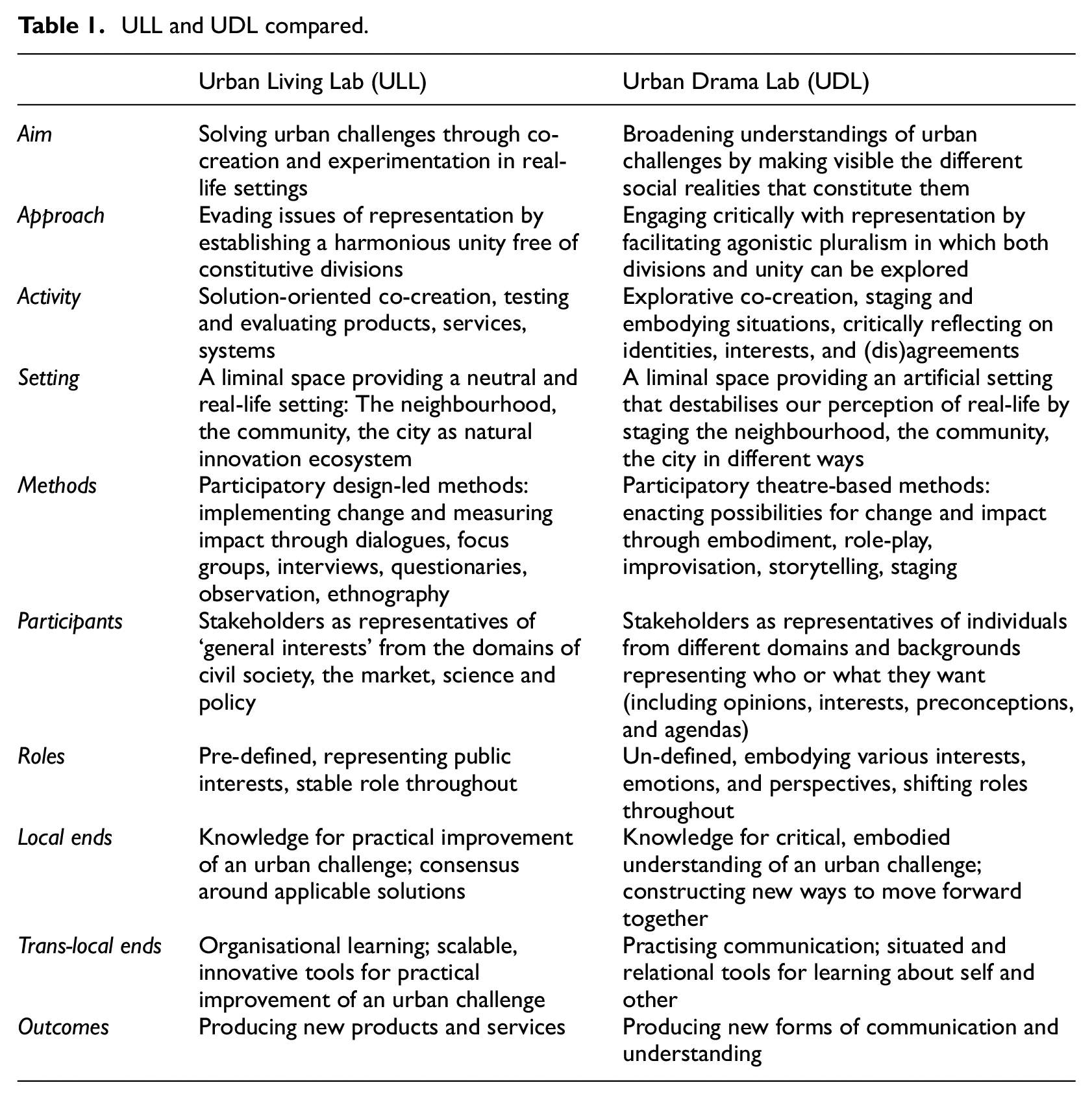
To some degree, the set-ups of Urban Living Labs and Urban Drama Labs are quite similar. Both try to enhance local capacities to ‘hack’ (Maalsen, 2022) urban challenges through a process which celebrates experimentation and creativity. Both develop knowledge about an urban challenge, using iterations to improve understanding. Both abstract knowledge about this challenge and turn the abstraction into a model of the socio-political and material urban complexities faced. The main differences between the ULL and the UDL, however, concern the general approach and goals. The ULL starts from an experimental set-up that aims to control and ‘level out’ real-life contingencies to deliver a new product, service, or system. It is often solution-oriented, focusing on developing knowledge for practical improvement of an urban challenge and/or knowledge about the factors that hamper their solutions, whether locally or trans-locally applicable. In practice, it often falls short of representing multifaceted and contesting identities and interests, because it follows a project logic, a managerial understanding of social innovation, or suffers the dominance of certain stakeholders. In contrast, the Urban Drama Lab aims to develop knowledge for critical, embodied understanding of the conditions that shape urban challenges or hamper their solutions. Importantly, while the ULL is focused on finding (practical) solutions, the UDL is geared towards increased critical understanding and an agonistic pluralism which may or may not lead to a productive locally shared agenda. The Urban Drama Lab is hence founded on the belief that it is impossible to reach full consensus – a belief that, although seldom made explicit, seems to accompany solution-oriented approaches prevalent in ULLs.
We know that proponents of consensus-building governance do not look naively at what it takes to develop a consensus. They highlight, for instance, the importance of taking power asymmetries and past conflict into account, to build trust, commitment, and shared understanding, and to celebrate ‘small wins’ (Ansell and Gash, 2008). We can indeed learn from consensus-seeking work in planning that moves towards a ‘critical pragmatism’, as Forester (2013) calls it, and is as open and processual as the Urban Drama Lab intends to be. The UDL, however, further investigates possible contestation and conflict and does not strive for consensus as such. It is particularly mindful that any effort to include everything and everyone in processes of urban transformation will simultaneously exclude some (see Mouffe, 2013). Furthermore, it recognises that attempts to level out differences means a risk that potential conflicts over what is common are transformed to a simple management of (assumed) common interests (Ranciere, 2006). To tackle this risk, the Urban Drama Lab aims to facilitate space in which initial discussions around what is common are brought to the fore. Key here is that participants may recognise and maintain their difference, and, at the same time, reach out to one another in solidarity, acknowledging common beliefs and shared responsibilities.
The comparison of ULLs and UDLs – summarised in Table 1– highlights the very different functions of ULLs and UDLs. While ULLs are instrumental and oriented around the question ‘what can this action do for the city?’, UDLs are processual, asking the question: ‘how can we use everyone and everything around us to encourage conditions of possibility?’ As with all abstractions, the table does not do justice to the variety of actual ULLs, nor do we want to restrict the possible variety of future UDLs. The purpose is mainly to find contrast between their key elements.
ULL and UDL compared.
To give an idea of what the Urban Drama Lab might look like in practice, we end this paper with a practical example. Even if the example itself was not developed as an Urban Drama Lab, it helps us to unpack some of its core elements.
The Factory of the Future: An Urban Drama Lab example
The Factory of the Future (2019) was an applied theatre project curated by Cecilie Sachs Olsen, the first author of this article, and developed by the British performance maker Zoe Svendsen (for a detailed account of the project, see Sachs Olsen, 2022). The performance was part of the Oslo Architecture Triennale – a 10-week festival that occurs in Oslo every three years, providing a public arena for discussing and addressing urban challenges. Sachs Olsen was one of the main curators of the 2019 edition of the Triennale which examined ‘degrowth’ as a radical idea for urbanism and architecture where human and ecological justice and flourishing are favoured over economic growth. Svendsen was invited by Sachs Olsen to create a project for the Triennale using applied theatre to collaboratively produce future scenarios for a degrowth Oslo.
In line with the typical set-up of Urban Living Labs, The Factory of the Future was situated in and responded to a ‘real-life’ urban setting, more particularly the adjacent neighbourhoods of Bjørvika – a new high-end waterfront development – and Grønland – a multicultural district housing a large proportion of Oslo’s disadvantaged population (Brattbakk et al., 2015). Collaborating with local organisations and community workers in the first stage of the project, Svendsen did a series of ‘consultations’ with people living and/or working in the two neighbourhoods. The consultations were centred around lived experiences of climate change, from the dire state of the Oslo Fjord to friends and family suffering floods and drought in other parts of the world. They further explored what one might do about it, and how that might transform the city and the lives of its inhabitants (for the better) as a result. In the second stage, planners, architects, municipal workers, and developers created scenarios that re-imagined the existing social and economic infrastructure and built structures of the neighbourhoods so that these structures would address the concerns expressed in the consultations. This entailed a collaborative invention and staging of multiple open-ended future scenarios that operated in the middle of contradicting emotional, normative, personal and collective concerns, and that searched for something ‘better’ without necessarily knowing, agreeing or predetermining what this ‘better’ would be.
An Urban Living Lab might typically focus on solving contradictions by uncovering a shared understanding and consensus around what a good city should be. The risk here is that the focus is on effectively promoting shared demands for societal change, while this sharedness at the same time obscures the plurality of contestation and conflict around what exactly has to change (Blythe et al., 2018; Westman and Castán Broto, 2022). The Factory of the Future started from a different position. Instead of aiming to solve tensions, the project brought into view the multiple experiences and connections that underly them. In contrast to the solution-oriented approach of ULLs, Svendsen did not want to generate a single future that she would determine beforehand. Instead, she wanted to underline that we do not all live in one reality, and thus make room for a multiplicity of perspectives and experiences (Svendsen, 2019, personal communication). Professional actors played a key role in this process. They insisted on fleshing out the embodiment of everyday life in the scenarios by asking other participants questions such as: ‘What makes this neighbourhood feel like home to me?’; ‘What does this place smell like?’; ‘What is it like living in this building?’ The task of the actors was to root abstract ideas in everyday experiences so that they, in the final stage of the project, could tell credible stories about what the everyday would be like living in these future scenarios. As one of the actors put it, ‘because we come from different ways of approaching the issue, we need to be able to communicate in the details. So, the smells, the tastes, how this world is felt’ (Grenne, 2019, personal communication).
The focus on embodying and ‘living out’ the future scenarios had an important critical function. As opposed to the distance produced through the rational and ‘constructive’ set-up of Urban Living Labs, the Urban Drama Lab sought to ‘actualize people’s inherent and often intuitive notions of how to produce criticality through inhabiting a problem rather than by analysing it’ (Rogoff, 2006: 1). Applied theatre can here be understood as an activity that brings together that being studied and those doing the studying so that it is not possible to objectify it as in a disinterested mode of learning. This activity, according to Rogoff (2006), has a transformative power as it, rather than simply looking for an answer or solution, enables a heightened awareness and access to a different way of knowing. Key here is to recognise that we might be capable of the most sophisticated modes of analysis, but we are nevertheless also living out the very conditions we are trying to analyse and come to terms with. By accommodating this embodied way of knowing, from which one cannot gain critical distance, the project invited responses that were multi-perspectival, defying notions of a consensual ‘we’.
In order to navigate these multiple perspectives, Svendsen facilitated a process named ‘enable–challenge–respond’: one participant would ‘enable’ one specific future by telling a story about everyday life in it, then another participant would challenge the story by saying ‘I don’t think it would work that way, because…’, and then respond with an idea as to how the initial story might work from a different perspective. This process helped develop an understanding of the role of consensus as an always precarious and temporary achievement and it highlighted the importance of creating a space where conflictual and diverse narratives could shape and enrich each other. The performative practice of framing becomes important here. By telling a story about a specific future the participant framed it through opinion formation. This entails making decisions around what this future would ideally be like, who this future is for, who plays what roles in this future, and ultimately making agreements about shared forms of life based on certain values. Such an appointment of parts and positions, as Rancière (2006 [2000]: 12) argues, ‘is based on a distribution of spaces, times, and forms of activity that determines the very manner in which something in common lends itself to participation and in what way various individuals have part in this distribution’. This performative practice of framing is a political process (van Hulst and Yanow, 2016) that gives rise to certain views while excluding others, and in so doing exercises vigilance over the decisions of inclusion and exclusions, over what and whose life is being imagined, and what is left outside or excluded. The Urban Drama Lab does not intend to ‘fix’ this process of inclusion and exclusion, but rather to make it apparent as a dynamic involved in all forms of collaboration.
In the third stage of the project, the final stories devised by the actors were played out as monologues by fictional characters and presented in a video installation on several screens that formed a circle. The stories were not aligned with each other, but expressed diverse, and sometimes contesting and conflictual everyday and future scenarios. These stood in stark contrast to the message-based scenarios (i.e., Computer Generated Images, CGIs) that are often used by developers and urban planners to convince the recipient about one particular vision of the future city as the best option. Both Bjørvika and Grønland are sites for future urban renewal projects that are depicted in sleek promotional images, displaying racial homogeneity, economic prosperity, and harmonious, privately managed public realms. Lejano and González (2017) accordingly observe a tendency in urban (re)development processes in which planners and architects project an imagined community, free of divisions and disturbances, on to a place and direct growth and change towards the same. Invariably, they argue, this turns the focus away from the existing community and effaces it. In contrast, The Factory of the Future installation tuned in to the multitude of identities, interests and experiences of Bjørvika and Grønland.
Standing in the middle of the installation, the audience could only hear a cacophony of voices and they were not able to decipher what was being said. To understand the content, they had to choose one character to listen to by moving closer to their screen. The audience was however constantly reminded of the presence of the other stories that they had chosen to ‘block out’ as these then formed a buzzing backdrop to the story they were listening to. In this way each scenario was presented as a precarious and contingent construction that could always be contested from its constitutive outside, that is by the other stories and scenarios.
While The Factory of the Future did not directly feed into the urban development of Grønland and Bjørvika, several participants confirmed that the project gave them new ideas and perspectives that informed their work practices: a social worker stated that she wanted to use the format of the project to work with young adults about their visions for Oslo; a planning consultant announced that he would try to ‘sell’ the scenarios developed in the project to his clients working in and with the two neighbourhoods; an urban planner proclaimed that she would implement similar participatory methods in the planning processes she was involved in; and a Greenpeace official saw the project as a great inspiration for working out new strategies for the organisation. Hence, if The Factory of the Future did not invent new futures, it did lay new grounds for reinventing and changing practices of everyday life. As an example of how the Urban Drama Lab might function, The Factory of the Future illustrates that applied theatre need not entail turning away from pragmatic and policy agendas. Rather, it may help to develop a wider vision that can provide a context for such debates and raise fundamental and often neglected questions about collaboration, society, processes of societal transformation and what they might become.
Limitations of Urban Drama Labs
While demonstrating the potentials of Urban Drama Labs, The Factory of the Future also laid bare two key limitations concerning its use in urban development and planning. Firstly, UDLs are much more ambiguous arenas for addressing urban challenges than ULLs, and city governments might therefore see them as less relevant than ULLs. As the outcomes of UDLs are predominantly intangible and therefore do not provide a direct answer for what is the ‘right’ or ‘best’ solution, their outcomes might easily remain marginalised or overlooked in the overall planning process. Hence, UDLs risk being seen simply as a useful tool for municipalities and developers to be seen to listen to local communities, while, in practice, they become isolated islands of empowerment.
Secondly, the conceptualisation and execution of UDLs depend on the artistic competence of theatre makers and actors. This might make the barrier for organising UDLs higher than for organising ULLs, which rely on skillsets that are more readily available within planning and city offices. In a similar vein, the framing of ‘theatre’ and ‘drama’ is not necessarily an easy ‘sell’ to potential participants and the UDL risks being perceived as a rather elitist and privileged endeavour that is disconnected from the everyday lives of ‘ordinary’ people.
More work is needed to understand how UDLs might respond to these limitations. Key here is to examine how UDLs not only broaden understandings of urban challenges, but also how they might critically intervene in the ways in which these challenges are addressed.
Conclusion
As we have argued in this paper, ULLs are often seen to have a liberatory potential, providing a free or neutral space that levels out and gives equal weight to different stakeholder and their interests. However, this is not always the case in practice. Dominant stakeholders in ULLs exert their power by defining the space for innovation and using citizens as mere experimental subjects. This is further accentuated through a project logic and managerial understanding in which quantifiable outcomes, efficiency and implementation often become more important than critical scrutiny, reflection, and deliberation. As a result, ULLs fail to engage sufficiently with difficult questions around how they work to constitute stakeholders and interests rather than simply re-presenting pre-existing ones or taking them for granted. The field of performance helps us rethink this function of ULLs, foregrounding that the lab can never be free from structures of power but that it can rather set up a frame in which these structures can be scrutinised, assessed, and possibly remodelled and rearranged.
Providing a new manifestation of ULLs, the Urban Drama Lab accordingly provides a liminal space in which actors collectively experiment with how ‘the urban’ is apprehended, organised and inhabited. Here, the notion of ‘liminality’ is not about temporarily ‘putting aside’ the constraints and conditions of the outside world, but rather addressing and destabilising these constraints and conditions in order to reimagine them. This way, the Urban Drama Lab creates a context in which critical reflection, questioning and change are made available. In sum, the Urban Drama Lab approaches the representation of stakeholders and interests not as a final state that can be reached but as a constant work in progress. In recognising that representation and politics are closely linked and that difference and tension are an important part of representation, the Urban Drama Lab aims to grasp the alternative practices, beliefs, feelings, and knowledges that constitute different ways of being. The aim here is to acknowledge that we could always change our perspectives and relate differently, and this way can foment the emergence of new types of knowledge and new understandings of what constitutes abstract issues such as ‘the good city’. Although there is no guarantee of the outcome, this approach may permit the questioning and disruption of unsustainable conventions and urban orders, and the emergence and consolidation of new forms of collective engagement with alternative visions of urban futures. More work is needed, however, to understand how this approach might critically and practically intervene in the politics and practice of urban transformation, development and planning.
Footnotes
Acknowledgements
This paper is the first result of our project CONTRA (CONflict in TRAnsformations) for Urban Europe,  . We thank Barbara Koole, Eva Wolf, Lieke Oldenhof, Kasia Szmigiel-Rawska, Krzysztof Janas, Lisa De Roeck, Amanda Machin, Camilla Eeg-Tverbakk, Siemke Böhnisch and Tobias Arnoldussen for their critical reading of earlier versions of this paper. We also thank the three anonymous reviewers for their constructive and helpful feedback. At present, we are implementing the ideas we propose in this paper in our project. If you are interested, please contact Cecilie Sachs Olsen.
Declaration of conflicting interests
The author(s) declared no potential conflicts of interest with respect to the research, authorship, and/or publication of this article.
Funding
The author(s) disclosed receipt of the following financial support for the research, authorship, and/or publication of this article: This project has received funding from JPI Urban Europe and the European Union’s Horizon 2020 research and innovation programme under grant agreement no. 101003758. The national funding authorities that support the project are the Dutch Research Council (NWO), Research Foundation Flanders (FWO), the Norwegian Research Council (NFR) and National Science Centre, Poland (NCN).