




Abstract
Cities are increasingly encouraged to adopt cross-sector coordination mechanisms and visions as a response to complex urban sustainability challenges. However, infrastructure governance remains highly fragmented, with limited understanding of how and why coordination emerges, what issues it prioritises and whether these selective forms effectively address or obscure deeper structural challenges. This article investigates the dynamics of cross-sector coordination by examining water and energy governance in Cape Town, Los Angeles and Maputo – three cities with distinct governance structures and capacities yet facing similar socio-ecological pressures. It argues that rather than an absence of coordination, cities experience a proliferation of diverse, often selective and sometimes conflicting coordination efforts, each shaped by specific institutional, political and strategic imperatives.
Introduction
Greater coordination of urban infrastructures is seen as critical for transitioning to more sustainable cities. Coordination has been key to debates on governance for several decades: as a form of organisation, as a principle of good or more collaborative governance, to overcome the fragmentation of neoliberal governance regimes or to shape environmental policy (Weitz et al., 2017). In cities, longstanding debates surround coordination in transport and spatial planning (Rode, 2018), with more recent debates on ‘resilient’, ‘circular’ and ‘smart’ cities forwarding more holistic infrastructural management strategies. Attention has turned to transformative approaches such as water-sensitive urban design and maximising ecosystem services, which reimagine the technical interdependencies between urban systems and encourage greater coordination. Thus, as some argue, contemporary cities face an integration agenda (Macrorie and Marvin, 2019; Williams et al., 2019).
Despite such shifts, the governance of urban infrastructures, such as water and energy, continues to be fragmented through distinct technical and planning domains, siloed through departmentalisation and entrenched institutional cultures. In some cases, there is a disjuncture between the strategic policy level (typically more coordinated) and the renewal, management and operation of technical systems (typically fragmented). In others, substantial coordination challenges are often overlooked or unanticipated in strategic plans or left for operational actors to deal with. Moreover, obduracy remains a strong feature concerning the huge sunk investments in technical systems and the power relations and knowledge politics surrounding entrenched infrastructure regimes (Hommels, 2020).
Perspectives on integrated governance have thus (re)emerged, perhaps most prominently ‘nexus thinking’ (Kenway et al., 2011) and integrated urban governance more broadly (Monstadt and Coutard, 2019; Rode, 2018). Nexus thinking, mainly applied to the water–energy–food nexus, is the ‘study of the connections between these three resource sectors, together with the synergies, conflicts and trade-offs that arise from how they are managed’ (Simpson and Jewitt, 2019: 2). However, recent research highlights an increasing implementation gap and broader governance gap where nexus thinking is said to be ‘disconnected from the decision-making and policymaking processes’ (Weitz et al., 2017: 165), such as at an urban level.
This article critically explores the role of cross-sector water and energy infrastructure coordination in addressing urban sustainability challenges in Cape Town, Los Angeles (LA) and Maputo. Key questions are what forms of coordination emerge concerning existing challenges (e.g. water/energy scarcity, reliability, efficiency); how do different notions of ‘sustainability’ shape, or how are they shaped by, such forms of coordination; and how does coordination help to address such challenges. The article does not adopt a prescriptive notion of sustainability. Instead, it explores how conceptions of sustainability are constructed through and by coordinated action, and thus how and why coordination is prioritised. It therefore explores the highly selective and contextual ways in which urban nexuses are governed (or neglected), arguing that overlapping forms of coordination often reflect conflicting goals. The article examines horizontal coordination between (predominantly) city-level government agencies/departments, first concerning major policies, and second through common strategic visions. It also examines how underlying governance arrangements deter or hinder such coordination.
The article mobilises a ‘boundary work’ perspective, which concerns how ‘actors’ work to affect boundaries and practices leads to institutional change or stability’ (Zietsma and Lawrence, 2010: 190). Through this lens, the article examines how strategic discourses among city-level government actors serve to either span or reinforce existing boundaries between the water and energy sectors, given the divergent contextual governance arrangements, discursive drivers and capacities of each. It argues against an implementation gap, but instead argues that nexus thinking presents an oversimplistic view of coordination that does not consider the translation of local knowledge, organisational contexts and politics of cities. Once considered, the limits to how coordination can address cities’ sustainability challenges become apparent. The findings draw on key-informant interviews conducted from 2019 to 2024, complemented by a policy and literature review of sectoral and city-level strategies.
Literature review
Disentangling coordination
The coordination of urban infrastructure systems pervades many debates on urban sustainability transitions. Urban systems are increasingly interconnected, making integrated solutions to sustainability more appealing, particularly concerning ‘wicked’ environmental challenges. This has sparked interest in how infrastructures ‘interface’ in contemporary cities and how such interfaces can be better managed (Covarrubias, 2019; Monstadt and Coutard, 2019; Romero-Lankao et al., 2018). However, underlining this urban and infrastructural turn is a much longer set of debates on coordination and integration from disciplines such as environmental governance, public administration and organisational studies, briefly reviewed below.
Rode (2018) distinguishes three common, interdependent senses of integration used in the literature (often used interchangeably with coordination): coordination of organisational structures, of technical systems and of policies and goals (‘policy coherence’). In some cases, this distinction has clear corollaries in reality, such as in environmental policy integration (EPI), which promotes commonality and alignment of policies surrounding environmental protection and sustainability (Jordan and Lenschow, 2010). However, it is typically difficult to distinguish the integration of urban systems from the policymaking or organisational context.
Others have distinguished between two modes of reasoning and processes underpinning coordination: operational synchronisation and cognitive synchronisation (Darses, 2009). In the former, actors work simultaneously (but not jointly) on ‘allocated’ tasks, often through distinct sub-goals on an organisational/sectoral basis. In the latter, actors engage in ‘the joint development of the solution’ (Darses, 2009: 49), thus establishing joint reasoning and design procedures where both problems and solutions are jointly framed. Darses’ work emphasises that coordination nearly always exists within and across organisations. Moreover, he outlines the importance of considering both the processes and outcomes of coordination, that is, what is synchronised, in what forms and what the real-world impacts are on infrastructures or policies and strategies surrounding them.
More broadly, disentangling ‘governance’ from ‘coordination’ is problematic as popularisation of the term governance in the 1990s was tied to debates on coordination and integration, particularly surrounding ‘whole-of-government’ and collaborative governance approaches debated as remedies to the fragmentation of responsibilities under neoliberalism and governance trends (e.g. new public management) in many Western contexts (Christensen and Lægreid, 2007). Partly fuelled by these trends, coordination can also refer to the need to steer and balance different governance modalities, such as ‘market’ or ‘public’.
Such complexity also results from the overlap and unclarity over the use of similar but ultimately different terms, including ‘cooperation’, ‘collaboration’, ‘integration’ and ‘coordination’. For Stead and Meijers (2009: 322), coordination aims to create ‘mutually enforcing and consistent’ policies, while integration more comprehensively should lead to joint working, and active attempts to create synergies and formulate the same policies (Meijers and Stead, 2004), a view closely aligned to the ‘strong version’ of coordination associated with cognitive synchronisation described by Darses (2009). For Perri 6 (2004), coordination should be both strategic- and process-orientated (e.g. holistic working, dialogues between agencies, etc.). In contrast, integration is the outcome or long-term state of ‘common organisational structures and merged professional practices and interventions’ (Perri 6, 2004: 106).
The work above highlights that different notions and forms of coordination exist, however analysing the processes and outcomes of coordination should closely consider the relationship between problem-solving and the organisational context. Analytically, therefore, focus on coordination necessitates a different set of questions to integration: coordination of ‘what’ (governance arrangements, policies, material infrastructure systems), in which form (process or goal orientated) and for what end (integration, policy coherence, particular societal goals). By posing such questions, we can analyse contradictions across different forms and critically situate their effectiveness for addressing contemporary sustainability challenges.
The bounding of coordination: Process or goal-orientated?
One common axis to understanding coordination is a procedural/structural view versus a goal-orientated one. Some see coordination as novel structural relations where ‘the policies and programmes of government are characterised by minimal redundancy, incoherence and lacunae’ (Peters, 1998: 298). Coordination is abstracted from specific goals, or at the very least such goals are assumed. However, others contend that coordination should be goal-orientated and thus ‘the deliberate and orderly alignment or adjustment of partners’ actions to achieve jointly determined goals’ (Gulati et al., 2012: 533).
This distinction is crucial for nexus thinking and its application to socio-technical infrastructures in cities. A primarily structural view of coordination was promoted at the Bonn conference in 2011 organised by the German Federal Development Ministry (BMZ) and the Federal Environment Ministry (BMU), with invited international actors and funders, where the nexus discourse was popularised. The conference promoted ‘nexus opportunities’ by ‘incentivising cooperation and coordination for mutually beneficial approaches, multiple benefits and fewer unintended or adverse consequences’ (German Federal Government, 2011: 2). While documents allude to a range of goals that nexus thinking could serve (e.g. increased productivity of resources, stimulating use of waste (German Federal Government, 2011; Hoff, 2011)), no goal is prioritised. The consensus was that nexus thinking could implicitly address all such goals, ignoring potential conflicts between them.
As a result, the attraction of the nexus concept is simplicity in how it characterises interactions between sectors, as ‘synergistic’ (i.e. win–win situations), conflictual (lose–lose) or as ‘trade-offs’ (i.e. win–lose). This implies perplexing implications for (a) the new knowledge(s) needed to identify, measure and represent such relations between sectors and (b) the institutional arrangements and organisational procedures needed to coordinate. Many nexus-thinking assumptions are thus rooted in rationalist governance, where conflicts can be resolved and resources allocated optimally (Weitz et al., 2017). Others have critiqued this, highlighting the political nature of resource supply and use (Williams et al., 2019), suggesting a crucial need to examine the relationship between the goals of coordination and translating such goals into action (i.e. forms of coordination).
A useful concept to unpack cross-sector coordination in complex contexts is boundary work. This set of approaches examines how groups or individuals purposefully demarcate their own identity, authority or area of responsibility to achieve particular goals (Lamont and Molnár, 2002; Langley et al., 2019). Langley et al. (2019) identify three types of boundary work: competitive boundary work (‘working for boundaries’), collaborative boundary work (‘working at boundaries’) and configurational boundary work (‘working through boundaries’). Each involves different modes of work (i.e. defending, embodying and downplaying), which are practices, discourses and representations of actors.
While much of this literature seeks to analyse the strategic importance and power dynamics of boundaries, the concern of this article is largely around collaborative boundary work, that is, how (potential) actions are negotiated, embodied and/or downplayed between actors through particular forms of coordination. Specifically, the article examines how boundary discourses among key city-level government actors serve to either transcend (i.e. span) or reinforce existing institutional boundaries between urban water and energy sectors. Boundary discourse concerns knowledge content and how real-world actors translate, align or embody knowledge to support particular actions (Quick and Feldman, 2014). Boundaries are ‘spanned’ concerning how ‘the content of knowledge […] shapes the dialogue among the experts from distinct domains’ (Hawkins and Rezazade, 2012: 1807). This is useful to nuance the simplistic way coordination is presented in nexus debates as largely a procedural reality, neglecting how the local knowledge politics of cities and actors are translated and shape coordination.
Advancing the nexus debate
Such analysis speaks to several threads within the nexus debate. The first regards the ‘implementation gap’ in nexus thinking. This has previously been explained through a lack of conceptual clarity and practical direction, allowing such discourses to be ignored or appropriated by existing powerful interests (Cairns and Krzywoszynska, 2016; Monstadt and Coutard, 2019). Here, the article aims to reframe the debate by suggesting that rather than a failure to ‘implement’ a predefined notion of ‘the nexus’, how urban sectoral actors coordinate shapes the nexus as a highly relational and fluid reality. Still, coordination occurs in multiple, overlapping ways, which raises important questions over which challenges are coordinated, why and whether such forms of coordination address underlying challenges.
The second concerns how capacity and divergent government arrangements across cities are translated into different forms of coordination. Despite emerging research on the urban nexus, existing research largely focuses on single case studies, ignoring the potentially considerably different infrastructure governance arrangements and capacities across cities. While it is well established that local autonomy, discourses, tax bases and policy agendas vary across cities (Kaufmann, 2020), if and how this translates into divergent forms of coordination is less well studied. Here, there is a severe risk that ignoring such differences sustains nexus thinking as a privileged discourse for wealthier cities.
The third relates to the knowledge politics of cities. The dominant focus in existing nexus literature on physical resource interactions, either through the dominance of quantitative methods in nexus research (Dai et al., 2018) or through focus on large-scale systems such as biofuel production and hydropower, neglects the political and institutional dimensions (Covarrubias, 2019), the divergent capacities of local governments (Monstadt and Coutard, 2019). In sum, coordination is a relational question, heavily dependent on urban governments’ epistemic, political and material contexts and their capacity (embedded in a multi-level governance context) to govern change. Therefore, this article contends that it is crucial to trace the genealogy of how such diverse drivers and antecedents are translated into different forms of infrastructure coordination and reflect upon the broader theoretical and practical implications of this improved understanding.
Research approach and methodology
The article takes a comparative approach in three cities, inspired by calls for renewed comparative research in urban studies (Hart, 2024; Mcfarlane, 2010; Peck, 2015; Robinson, 2016). According to McFarlane (2010: 733), ‘comparative research across theory cultures prompts reflection not just on contrasting spaces or processes, but on the ontological and epistemological framings that inform how the world is debated, how knowledge is produced and questioned’. This quote inspires the approach by focusing on why and how framings, representations and practices of coordination, and water–energy nexuses, come to be. Here, differences across cities are not solely the result of local contexts, which change pre-understood coordination, but rather expressions of how cities’ local material, institutional and knowledge politics give rise to different senses of coordination itself.
Therefore, I implicitly challenge the notion that cities are tied to pre-determined ‘nexuses’ (of resource interdependencies, with their hinterlands, etc.), which can a priori be easily defined or politically neutral. Discourses of nexus thinking, and the wider impetus for greater cross-sector coordination, circulate in all three cities, inspiring their choice. Such discourses arise from similar socio-environmental crises, particularly drought and water scarcity and ensuing strategic developments to secure alternative water sources. Thus, the comparative approach is also informed by relational comparison (Hart, 2018) and conjunctural analysis (Peck, 2024). Both approaches are attuned to ‘teasing out the mutually constitutive, dialectical relationships between the general and the particular’ (Sheppard et al., 2024: 7). Coordination emerges as a relational consequence of how policy ideas circulate and how cities are situated in global, national and regional material and political processes.
While the three cities’ deeply different contexts/histories cannot be fully explored, such differences are generative of deeper understanding. Each city has different governance structures but faces challenges in coordinating policies across sectors. In LA, there is a division between water and energy agencies. As Pincetl et al. (2019) argue, the challenge in LA is overcoming entrenched technocratic institutional cultures and a tendency towards capital-intensive and means-tested solutions. Cape Town’s drought response highlights the need for better cross-sectoral coordination, as managing the water crisis also impacted the energy sector. While exhibiting weaker institutional capacity and fewer resources, Maputo also faces challenges in coordinating water and energy governance such as extending supply of both sectors to meet urban access goals.
Following Rode’s (2018) tripartite classification, the three cities are compared firstly in two direct senses: (i) concerning how the different governance arrangements for water and energy in each city influence coordination; and (ii) concerning urban water, energy and broader urban development policies. Each city is then examined to determine how coordination translates into real-world projects and programmes. The primary method was 48 semi-structured key-informant interviews (17 in LA, 11 in Maputo, 20 in Cape Town) conducted from 2019 to 2024 with infrastructure providers/utilities, regulators, public officials in city governments (departments including water, energy, environmental management and resilience), civil society actors and local researchers. Some interviews were also conducted with provincial/national-level policymakers.
How differences in urban water and energy governance arrangements and policies shape coordination
Governance arrangements and the influence on coordination
Each city exhibits a very different governance arrangement for water and energy. LA exemplifies one of the few cities (globally) with a (vertically and horizontally) integrated water and energy department and utility (DWP) with a strong role in decision- and policymaking in the provision of both water and energy. Cape Town exemplifies a more common situation where water and energy are mandates of the City but through two separate departments (which also act as utilities) embedded in a multi-level governance system. In Maputo, while there is a sectoral plan for water (but not energy) at the municipal level, energy and water are chiefly the responsibility and mandate of national actors, but investment and policy focus strongly on key urban centres.
In LA, DWP has been historically influential in the City’s development, and decision-making for water and energy is centralised in the Mayor’s five-member Board of Water and Power Commissioners. Despite organisational integration and strong city-level centralisation, interviewees highlighted that water and energy maintain functional and institutional separation. One DWP official described the organisation as ‘essentially two departments under one umbrella’ (DWP water manager 2), adding that ‘you do need collaborative synergy and cross-functional collaboration but that hasn’t occurred that often between the power and water industry’. While DWP officials interviewed stated a high willingness to coordinate, coordination primarily occurs following sectoral policy and strategy making, with different long-term strategic resource plans for water (LADWP, 2020) and energy (LADWP, 2022).
In Cape Town, the departmentalisation of water and energy has reinforced barriers to certain forms of coordination. A frequent response concerning coordination between energy and water governance was how performance indicators, auditing and budgets within departments created a risk-averse sectoral culture deterring officials from coordinating with other departments. One official described how their colleagues had been ‘burnt in the past’ by taking initiatives across departments, and that working on a sectoral basis was easier. Likewise, one civil society actor highlighted the ‘siloed mandatism in these big departments, who’ve traditionally trundled along in their own way’ (City of Cape Town, civil society actor). While many interviewees emphasised that, in principle, urban governance is integrated through the Integrated Development Plan (City of Cape Town, 2022), this had also reinforced mandatism by tying sectoral strategies to rigid budgets and key performance indicators, the latter acting as a deterrent for officials within departments to allocate funding to collaborative projects and initiate potentially risky collaborations with other departments.
Several attempts have been made in Cape Town to traverse such departmental logics. For example, a ‘transversal management’ regime, within and beyond the water sector, was established as a response to drought in 2017 (i.e. the Water Resilience Task Team). However, this was viewed by most actors as unsuccessful as it disregarded sectoral expertise within individual departments and highlighted significant divergences of knowledge cultures. A further example is the progressive formation of the Future Planning and Resilience Directorate. Originally a response to the compound crises that Cape Town faces, the directorate has taken on an expanded cross-cutting role through time. One official detailed how the directorate’s role was to ‘join the dots’ and ‘bring the right departments together’. However, officials within the directorate clearly perceived themselves limited to providing technical assistance, ordering and classifying risks across departments and creating coordination mechanisms rather than intervening in department decision-making at strategic levels.
A second prominent coordination challenge in all three cities is the multi-level governance dynamics in energy and water. For energy in Cape Town, most decisions and policies remain national, with Eskom, the national electricity utility, responsible for generating, transmitting and distributing electricity. Water is also a complex entanglement of responsibilities, ownership and mandates, making coordination within the water sector complex and often politically unattractive. One DWS official highlighted how this challenge stems from low levels of trust between levels of government, and secondly the constitution, which enshrines the independence of the different levels as distinct spheres of governance. ‘National government cannot dictate to the province or the municipalities what they must do, because they are three separate arms of government’ (DWS official, Cape Town).
In Maputo, water governance is also a complex layering of regional water basin authorities, a national water assets company that owns and operates water infrastructures (FIPAG), a national regulator and a private local water supply company in Maputo. The Integrated Water Resources Management paradigm partly inspired this ‘Delegated Management Framework’ created in the late 1990s to integrate different water system functions more closely. However, interviewees suggested that this development had complicated coordination within the water sector by increasing specialisation, making sub-sectoral collaboration more challenging: ‘without doubt the complexity of the sector creates challenges in sustainable management’ (former Autoridade Reguladora de Aguas official). While specialisation of sub-sectoral functions has occurred, there is a disjuncture with decision-making, which remains highly centralised.
Coordination of water and energy policies
A second axis to compare the three cities concerns the coordination of water and energy policies. While LA and Cape Town have separate urban policies/plans for water and energy, Maputo does not. I consider relevant national policies with urban implications and how water and energy are integrated into the City’s spatial masterplan. It is clear to see in Table 1 the limited role of energy in urban water policies, and vice versa, in all three cities. In Cape Town’s key water strategy (Our Shared Water Future), energy is mentioned only once as an essential resource for water. All three energy policies mention water in two senses: water use in energy generation and its potential in hydropower generation (for urban areas).
The key actors, budgets and role of water and energy in respective policies in the three cities.
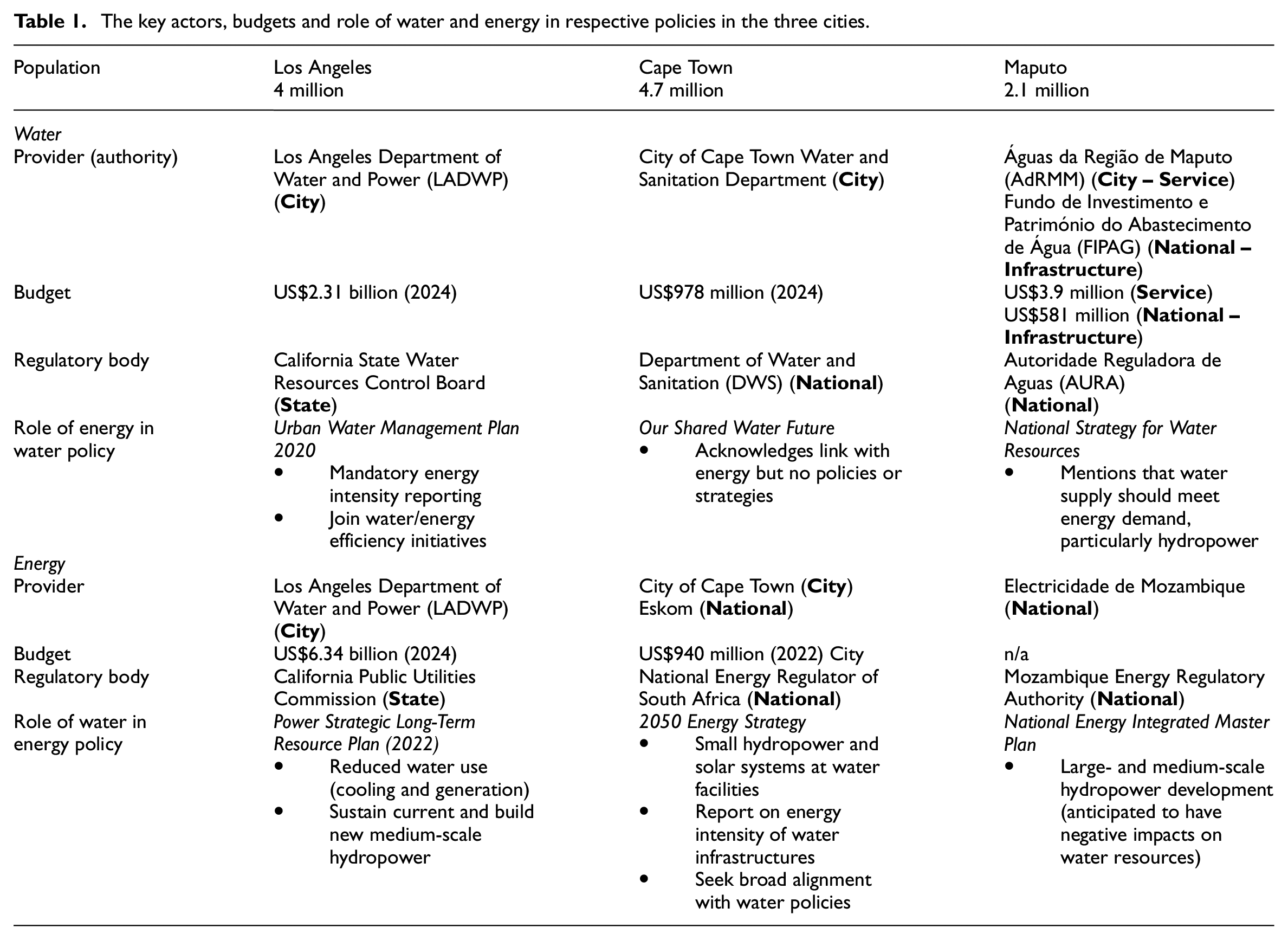
Two common findings emerge. The first is the increase (in LA and Cape Town) of early initiatives to map and measure water–energy interactions. The second is how sectoral priorities, mainly to develop alternative water sources and local energy generation, have shaped water–energy coordination. In Cape Town, water–energy measurements have occurred voluntarily, partly through awareness of cross-sectoral impacts (e.g. load-shedding on sewage plant failures) and increased research surrounding nexus thinking. One official stated that worsening drought had increased the importance of water conservation in other sectors. In LA, the DWP dedicates a chapter to the ‘Climate Change and Water and Energy Nexus’, driven by changes to the California Water Code, which mandates providers to ‘estimate’ energy use in water systems. The DWP provides breakdowns of energy intensity in its water systems, but its figures show that local wastewater recycling is as energy intensive as current water supply sources, highlighting strategic neglect of energy in water policies.
‘LA’s green new deal: Sustainable city plan 2019’ (City of Los Angeles, 2019) presents a more holistic vision of infrastructure sustainability. It references the ‘water–energy nexus’ and greater ‘coordination’ for sustainability goals, but coordination is narrowly focused on cross-sector carbon emissions reporting, with no outlined strategy. Much less accounting of cross-sector interdependencies is evident in Maputo, where efforts are focused on assessments for individual projects. The Municipal Development Plan for 2019–2023 envisions service expansion (water supply, renewable energy) but acknowledges the lack of capacity, especially in peripheral areas. Strategies for energy and water are absent. Donors have funded major urban development plans, such as ‘ProMaputo’ and the ‘Maputo Urban Transformation Project’. These initiatives have promoted cross-sector coordination but primarily for individual project funding.
Cape Town is unique in Africa for introducing its own energy policies since 2006, culminating in the strategy Our Shared Energy Future (City of Cape Town, 2023). Interviews revealed that national political failures were a key driver of local energy policy development, especially to manage load-shedding’s impacts on municipal services, like water. Energy policies aim to increase local renewable supply, exemplified by the 2020 ‘Independent Power Producers Program’, which encourages ’low-carbon’ energy to lessen dependence on water-intensive national coal generation.
The wider point is the ambiguity of water–energy policy coordination as a strategy when alternative water sourcing and energy generation remain key policy goals. As one LA official said regarding its wastewater recycling policy, ‘it’s energy intensive, but if you’re 100% renewable, you could do that with renewable energy’ (DWP water manager 2). Interviewees referenced joint policy programmes, but in narrower areas like joint efficiency, conservation programmes and renewable energy on water sites. In sum, despite increased awareness and measurement of interactions, most coordination is underpinned by operational synchronisation (Darses, 2009), where sectoral goals shape coordination.
Bounding cross-sector coordination
The previous sections show coordination challenges related to governance arrangements and a general disregard for energy and water in respective sector policies. The following sections examine the interplay between these two dimensions concerning how coordination is translated into specific projects and programmes through specific boundary spanning discourses in each city.
Cape Town: (Post-)crisis solutionism
A key rationality guiding energy and water governance in Cape Town is post-crisis solutionism. Cape Town faced a well-publicised water crisis in 2017–2018 when municipal water supplies nearly ran dry (Ziervogel et al., 2019) and a persistent load-shedding crisis severely limiting electricity availability. These crises are crucial underlying factors that have shaped coordination between water–energy sectors. The immediate response to the drought was mass water conservation campaigns, which many argue avoided a complete crisis. This opened the longer-term prospect for sustained conservation, affecting coordination by reducing energy requirements while posing risks to municipal revenue models. In the long term, while conservation remains one (joint) goal, City water officials noted how the new water strategy was essentially a response to drought and sets the priority to secure ‘adequate water for developmental needs’. Officials, particularly in the water utility function, embodied this discourse and discussed coordination with energy actors to achieve the goals.
One goal is to diversify water sources through wastewater recycling, groundwater systems and desalination, which are energy intensive (or dependent), when the energy crisis has already significantly affected existing water infrastructures, such as exacerbating wastewater treatment plant failures and pumping. During the water crisis, the municipality experimented with desalination, but this was abandoned because it was too expensive, partly due to energy costs. The City’s water strategy states that desalination is not a preferred option (due to the high costs associated with energy) but is necessary to increase the diversity of water sources (i.e. resilience to shocks) and function as a ‘backup’ in potential times of crisis. Thus, further entrenching the reliance of water infrastructures on energy is viewed as a legitimate response to the crisis and is framed as part of a ‘resilient’ future.
Concerning the energy crisis, there have been a series of early, coordinated cross-sector responses from the Cape Town Municipality and Western Cape Province governments. In 2023, the provincial parliament initiated an ‘Ad Hoc Committee on the Energy Crisis’ with an initial investment of US$57 million comprised of different municipalities and sectors (including water). This is significant, as energy has not historically been a strong mandate of the province. Still, the urgency of the crisis, and perceived failure of national actors to address it, is a key driver. The committee has explored the impacts of the crisis on other sectors, most notably the economy (more broadly), the agricultural sector and water. Focus has been on coordinating mitigation efforts (e.g. demand-side management, back-up power systems typically powered by diesel) and protecting services (water supply and treatment) through targeted investment strategies. Here, the boundary-spanning discourse is crisis response, which legitimises coordination around specific actions while disregarding others.
This City’s long-term strategy is to provide further power, autonomy and funding to the energy department, which has initiated an intense search for new sites for local power generation, including on city-owned water infrastructures. However, despite heightened dialogue between water and energy officials (largely initiated by energy actors), water officials interviewed expressed reservations about taking responsibility for energy management (after a certain period, management of such energy infrastructures falls under the responsibility of individual departments) when their primary focus was on ensuring reliable water supply. Here, the concern was ensuring future water flows, and water officials expressed that increased involvement in energy laws would stretch already limited capacity.
Los Angeles: Localising water through technological fixes
A key driver of water policy change in LA has been increasing and diversifying ‘local’ supply by reducing the reliance on ‘imported’ water. This shift requires reorientating local discourses and technical knowledge towards wastewater recycling and repurposing the city’s centralised treatment plants (Meilinger and Monstadt, 2022). This discourse appears in city-level strategic water planning (LADWP, 2020) and LA County’s climate action framework (LADWP, 2020). One respondent detailed that ‘we’re looking at all potential local water supplies’ (DWP water manager 1). This reflects an openness to considering energy on the utility side but has also acted as a boundary discourse around which new actor-coalitions (politicians, officials, academics, environmentalists) have emerged, challenging existing organisational boundaries (i.e. drinking water supply and wastewater management actors).
Several emblematic drivers exist. The first is increasing supply resilience through diversification and local management. Others are reducing dependence on costly, unreliable imported water (exacerbated by climate change) and environmental damage (linked to stringent state regulations). This shift has improved coordination between technical aspects of water (i.e. wastewater treatment, groundwater, drinking water) and different city agencies (i.e. LA Sanitation, DWP). The ‘One Water LA 2040’ plan exemplifies this shift, identifying roadmaps for integrated water infrastructures as platforms for multi-stakeholder engagement. However, while energy officials were consulted, ‘energy’ was not a significant decision-making factor.
‘Imported’ water is considered sourced from the State Water Project, LA Aqueduct and Colorado River Aqueduct (in 2019, accounting for 86% of supply (Meilinger and Monstadt, 2022)). Water supply fluctuates between these sources annually, as does the energy needed to supply water to LA. While the LA Aqueduct is completely gravity fed, the others use considerable water pumping. Therefore, how LA sources water has a ‘large impact on the energy footprint to supply water to the city’ (Mika et al., 2018: 146). However, public officials and researchers disagree on how the shift to ‘local’ water alters this energy profile. Some evidence suggests that replacing imported water with 100% recycled water in Californian cities increases the impacts of energy use on climate change (Szinai et al., 2019) and DWP’s own water strategy highlights the high energy intensity of local wastewater recycling. However, others argue that energy use may be cut (Mika et al., 2018; Porse et al., 2020). This uncertainty was noted by water officials who stated that: even though it does take a lot of energy to recycle that water, you are offsetting the energy it takes to import that water […] some of the recycled water projects require a lot of pumping, starting to approach that of seawater desalination. (DWP water manager 2)
The broader point is that overlapping conceptions and discourses of sustainability exist: one heavily focused on addressing the challenges of imported water and one normatively orientated to reducing energy use. Coordination has materialised in the former. Generally, water officials downplayed the benefits of coordinating over water-sourcing decisions, emphasising how current coordination efforts occurred in efficiency and conservation. As one official stated, ‘water supply reliability to customers is the first priority. The energy piece is never going to be the priority’ (DWP water manager 2). Officials expressed that the optimal solution would be for energy to transition to renewables independently. Therefore, water–energy coordination is decentred away from sourcing decisions and realigned as a post-policy concern in the design and implementation phases of infrastructure projects (predominantly evident in modelling technical pathways, cost-benefit analyses, etc.) and defended as a narrative to emphasise the importance of ongoing joint projects.
Maputo: Developmentalist drive to increase supply
In Maputo, a key driver of both water and energy policy and coordination is significant gaps in access. In 2017, the coverage of domestic water connections through the formal network was only 56% (Zuin and Nicholson, 2021). This is framed by actors such as the World Bank as a ‘crisis’ (World Bank, 2023). While energy access rates (electricity connections) are higher (estimated at over 90% (Smith, 2023)), this conceals selective electricity use and the continuation of heterogeneous infrastructures. Emboldened by the Sustainable Development Goals, international donors and national policy priorities, a key goal in the water and energy sector has been to universalise access, predominantly by increasing supply and extending network coverage.
This agenda has shaped the translation of coordination, noticeably surrounding harmonising cross-sector supply to encourage direct (socio-economic) development needs. This is driven by highly centralised decision-making and how the scarcity of energy and water resources encourages close consideration of mutual needs in individual projects (i.e. water cooling for cooling power plants, energy for water pumping versus increasing access). It is also tied to funding, where donors such as the World Bank consider deficiencies in water access to be a constraint on economic growth. Similarly, in 2013, FIPAG produced an environmental assessment report of the Maputo water supply system, stating that: the installation of the water supply system can decrease the time and energy spent by consumers in search of water. They [the population] can invest the time and energy previously spent on fetching water for economic and social activities, such as income-generating activities and education. (FIPAG, 2013: 238)
Officials perceived the uninterrupted water supply to energy and energy for water as crucial to broader development goals. Extending energy supply has largely relied on new gas-powered generation. For water, this involved coordination on hydropower developments, such as the Corumana Dam, which supplied 500,000 residents while producing 16.6 MW of electricity. As one regional official stated, ‘we provide information for planning investments in the energy sector and energy production. Energy needs are integrated into water allocation plans. These are integral to the consultation committees’ (water manager, Maputo). Water and energy officials saw information sharing, cross-sector accounting and joint committees as key to coordination. Coordination aligns with the operational synchronisation model (Darses, 2009), aiming to increase supply and access. Energy officials highlighted this: We are collaborating. One of our electrification criteria is to facilitate water infrastructures, […] to reach places where we can develop a water facility […] we assist water facilities so they can develop infrastructures to serve the community and country. (EDM energy manager 1) The initial concern was ensuring power availability to water systems. There is always a concern of cost and benefit in sizing electronic equipment. As energy costs rise, greater efficiency and renewable energy are needed to reduce costs for [water] consumers. (EDM energy manager 2)
‘Ensuring availability’ and ‘facilitating infrastructures’ are boundary discourses framing coordination. Water suppliers and managers stated that energy actors were ‘vital’ customers in development. There should be few impediments to increasing supply, which deepens energy–water interactions. Expanding hydropower increases water/energy needs and sectoral risks through drought and climate change. While officials acknowledged efficiency and conservation, little coordination has occurred. Institutional willingness to collaborate is high but is mainly project-based and within a bounded context to drive economic and social development.
Capacity: Misalignments in revenue, finance and knowledge
The following section focuses on governance capacity for coordinating water and energy infrastructures. Governance capacity is ‘the ability of societal actors to work together to solve collective problems’ (Dang et al., 2016: 1155) influenced by agency and the institutional context. Building on the previous sections, how coordination is translated through capacity constraints is discussed. Municipalities face financial (and other) constraints tied to revenue generation and cost recovery. As Swilling and de Wit (2010) contend concerning Cape Town, municipal infrastructure provision balances providing reliable and just services, responding to economic and population growth and cost recovery. Here, coordination is shaped by economic misalignments between water and energy. Respondents in all three cities indicated that the lower economic value of water leads to energy generally assuming higher strategic importance linked to the inability of water revenues to cross-subsidise many (potentially coordinated) projects. This is corroborated by reports on cities in California, where water and energy utility workers (and other officials/experts) have reported that the most common barrier to coordination is limited or inconsistent funding in the water sector (Cooley and Donnelly, 2013). Moreover, respondents reported struggles to sustain joint financing and, therefore, coordination beyond specific projects or funding programmes.
In LA, officials reported that electricity revenues were three times higher than those of water. 1 Capital budgets for infrastructure projects are also similarly misaligned. One academic in LA described energy as a ‘cash cow’ for the City, adding that there was less resulting ‘interest’ in water among energy actors. Infrastructure managers in LA also noted the difficulty of changing the culture of energy provision due to stronger contestation to rate increases from bulk energy customers due to short-term ‘sustainability fixes’ (e.g. the phasing out of coal; Furnaro and Kay, 2022) and contestation over integrated sustainability plans from unions (Furnaro and Kay, 2022).
In Cape Town, energy is the most significant revenue source for the City and cross-subsidises other municipal services, including water (Swilling and de Wit, 2010). In the budget year 2024/2025, energy represented 33.4% of the city’s revenue, over four times higher than water. The Mayor and officials have frequently stated that absorption of rate increases (which have been high and frequent in recent years) would ‘bankrupt the city’ (Charles, 2023). Cross-subsidisation is double-edged for coordination in that it increases the siloism of revenue-bearing energy departments while enabling (typically capital) funding for other sectors. Water officials in each city detailed how this funded many sustainability initiatives and broader infrastructure investments.
Generally, interviews in all cities revealed that limited knowledge capacity was a significant barrier to coordination. This was most pronounced in Maputo, where knowledge of nexus concepts among public officials and infrastructure managers was almost completely absent, but coordination was recognised as important. In LA, knowledge of nexus thinking was generally higher, following notable state-level reports published in the 2000s (e.g. the California Energy Commission’s (2005) report California’s water–energy relationship). Moreover, respondents stated that insufficient knowledge surrounding water–energy interactions was one barrier to a comprehensive, integrated city-level resource management plan.
Discussion and conclusion
Comparing coordination across the three cases, we see that in Cape Town post-crisis solutionism acts as a key boundary discourse, legitimising coordination efforts primarily as shorter-term responses to water and energy shortages, culminating in the city’s priority to diversify water sources (through energy-intensive means) and pursue decentralised energy supply. Increasingly, resilience discourses frame such responses as necessary adaptations to future crises, introducing layers of resilience assessment and creating new coordination mechanisms (e.g. ad-hoc committees on each crisis), but not aiming to dislodge or transcend sectoral decision-making procedures. In LA, the shift towards localising water supply is a key boundary discourse, bringing sub-sectoral actors together within water governance, including drinking water, wastewater and groundwater management actors. This narrative has supported the emergence of new actor coalitions, challenging traditional institutional boundaries between water agencies. However, energy concerns are somewhat marginalised through such discourses, creating a fragmented boundary where water–energy coordination occurs primarily in infrastructure design rather than strategic decision-making. In Maputo, developmentalism discourses of universal access serve as a central boundary-spanning mechanism, aligning water and energy sectors under a shared goal of expanding infrastructure supply. Coordination is institutionalised through cross-sector consultation committees, joint planning and project-based collaboration. However, this discourse reinforces a supply-side focus, privileging expansion over other sustainability concerns, meaning that while efficiency and conservation are acknowledged, they remain marginal to dominant coordination efforts.
These findings support notions from those such as Darses (2009) that coordination (in this case, cross-sectoral) is prevalent beyond organisational and policy barriers detailed in the literature. Empirically, there is not a lack of coordination or ‘implementation gap’ across city infrastructure systems but rather a profusion of overlapping, tightly bounded coordination attempts. Crucially, there is ‘selectivity’ (Hodson et al., 2017; Monstadt and Coutard, 2019) in how coordination actually materialises in concrete contexts. Whereas previous research highlights the political underpinnings of such selectivity, this article argues that selectivity results from how underlying notions of sustainability (e.g. environmental protection, universal access), rationalities of infrastructure governance (e.g. universalising supply) and governance arrangements are translated first into boundary-spanning discourses and ultimately into real world coordination mechanisms (e.g. ad hoc committees on crises response, technical consultations in infrastructure design and pathway modelling, cross-sector consultation committees).
This raises the question of how multiple coordination efforts aim or help to address the sustainability challenges that cities face. While coordination efforts in the three cities mitigate short-term risks and improve inter-sectoral dialogue, they often prioritise immediate service provision and crisis response over systemic transformations, such as tackling resource overuse, conservation/efficiency issues, climate change adaptation and addressing institutional capacity constraints. The significance for the urban nexus is that ‘synergistic’ sectoral interactions vary considerably across the three cities and do not always rationalise or reduce resource use or sustain meaningful collaboration between actors. Instead, higher resource use (Maputo) or dependence (Los Angeles) is often conceived through certain sustainability discourses as necessary, with coordination bounded around such discourses and translated into more technical forms of coordination (i.e. localising supply, joint technical work on new supply sources, safeguarding against drought, etc.). On the other hand, actors simultaneously coordinate on efficiency and conservation, but this typically occurs with fewer resources and in smaller arenas, highlighting contradictions across different coordination forms.
Such selective, overlapping coordination is not always inevitable or desirable. Capacity restrictions, including inconsistent funding and economic misalignments between sectors, prevent deeper, longer-term water–energy coordination. Recent attempts in LA and Cape Town for a more foundational rethinking of water–energy independence have been made; however, it is unclear if such efforts have influenced the largely sectoral ways in which policies are made and decisions are formed. Moreover, short-term politically motivated reorganisations (e.g. transversal regimes, newly created cross-cutting departments) have attempted to institutionalise stronger forms of coordination. However, while collaboration and knowledge-sharing among actors are increasing, organisational and political barriers have been faced.
Therefore, caution must be drawn surrounding greater coordination in urban sustainability debates. While the findings agree with the critiques of a techno-rationalist framing of nexus thinking (Cairns and Krzywoszynska, 2016; Williams et al., 2019), they suggest that we should also consider closely how discourses and political drivers are translated through the boundary work of different actors. The comparison across three cities also shows that the meaning and form of coordination varies considerably across urban contexts, highlighting how a critical lack of engagement with the context of cities means that nexus thinking may privilege governments, actors and cities with strong technical coordination capacity, becoming a framework for wealthier urban municipalities. Generally, the governance complexities of the ‘urban’ nexus have been poorly understood and assessed (Romero-Lankao et al., 2018; Simpson and Jewitt, 2019). While some argue that nexus thinking is an ‘inconvenient narrative’ (Giampietro, 2018) that challenges unsustainable resource use and technical responses, it is not always a convenient solution.
For urban infrastructural theory, this suggests that sectoral infrastructure silos are broken down more than conventional notions suggest, but again selectively and only to a limited extent. Some silos (i.e. sectoral strategies, institutional boundaries) are also actively protected through strategic alignment as pockets of agency that are presumed necessary to encourage sustainability transitions in particular directions. Here, the broader assumption in governance socio-technical infrastructure debates that ‘silos’ generally serve as a barrier to sustainability transitions must be nuanced.
Footnotes
Declaration of conflicting interests
The author(s) declared no potential conflicts of interest with respect to the research, authorship, and/or publication of this article.
Funding
The author(s) disclosed receipt of the following financial support for the research, authorship, and/or publication of this article: This publication is partly supported by the Pathways to Sustainability research theme at Utrecht University. This publication is also part of the project Nexusing Water, Energy and Food to Increase Resilience in the Cape Town Metropolitan Region (project number 482.19.112) of the research programme the Merian Fund, which is (partly) financed by the Dutch Research Council (NWO).
