




Abstract
This article critically interrogates the over-emphasis upon urban solutions when considering complex and multi-scalar energy infrastructures that must transition to low-carbon intensity for a sustainable future. While urban actors can play an important role in energy transition, their interventions are riven with difficulties, and at times failure, as they encounter challenges of politics, capacity and agency in a broader and multi-scalar governance landscape. Drawing upon the comparative and variegated political economies of energy infrastructure governance in Germany and the UK, this article makes three critical arguments. Firstly, it contends that patterns of ownership of key infrastructures, particularly in the highly privatised context of the UK but also in Germany’s more diversified energy market, trouble urban-level interventions. Secondly, against a backdrop of post-financial crash austerity, we raise the issue of capacity at an urban level, principally concerning the financing and technical administration of urban infrastructural ‘solutions’. Thirdly, the entrenched politics of neoliberalisation, its multi-scalar articulations and in particular discourses of marketisation and competition, while distinct across the two contexts, shape the possibilities, imaginaries and support available for local-level change in complex infrastructures. The article points to differential urban capacities and governance conditions that require a greater degree of nuance in sustainability narratives, and a critical conversation around the need for multi-scalar coordination in energy transitions, in order to avert catastrophic climate breakdown.
Introduction
Discourses of the urban within sustainability transitions have shifted in recent years to reflect a language of urban solutionism (Angelo and Wachsmuth, 2020), situating the urban as a critical frontier for sustainability science (Castan Broto, 2017) and a terrain on which lifestyles, economies and infrastructures will be transformed and new visions of life will emerge (see e.g. C40 Cities, 2016; Worldwatch Institute, 2016). Reflecting urban infrastructure’s projected responsibility for perhaps 20% of global greenhouse gas emissions (Creutzig et al., 2016), infrastructure is viewed not only as a source but also as a site of transition solutions, especially in the development of niche technologies and experiments in infrastructural assemblages towards new, emergent pathways to sustainable urban life (Bulkeley et al., 2019). Such a shift from problematising infrastructure as a source of carbon to situating it as a possible solution reflects this broader shift around how modernist cities and infrastructures are seen; but it also reflects a certain necessity around moving towards decarbonised energy sources and shifting energy infrastructures to reflect this, and the role of the urban and urban actors as critical to how this unfolds (Rutherford and Jaglin, 2015). In this, cities broadly, and in our case here urban infrastructures specifically, are situated discursively as terrains of necessary intervention. In what follows, we focus on what capacity local authorities have to enact putative solutions and the problems and opportunities they face in doing so, rather than the technologies themselves, as this illuminates how governance and ownership are critical to transition.
Two interlinked questions emerge in relation to pursuing this infrastructural solutionism. The first is: what capacity exists at the urban level in relation to technically complex and often unbundled infrastructures? The second is: how transformative might such solutions be, among the relative positioning of cities within broader multi-scalar landscapes of economic and political power? In the global north, four decades of neoliberalism as a globally dominant policy discourse have cascaded down to the urban scale to varying degrees, combining with spatially specific political economic conditions and trajectories to diverse regimes of urban competition that have transformed urban landscapes and infrastructures (Harvey, 1989). Processes of privatisation, marketisation and financialisation, in particular, have decisively reshaped vital infrastructures in real estate, housing, transport, energy and water, exacerbating social divisions and inequalities (see Graham and Marvin, 2001 for an early account; more recently, see e.g. Ashton et al., 2016; Birch and Siemiatycki, 2016; Wijburg and Waldron, 2020).
Urban actors and local governments retain some key capacities and competences to shape urban infrastructural landscapes, including planning, local tax and subsidies and land use controls and strategies (While and Eadson, 2019). We deliberately cast our net wide by utilising the term ‘urban actors’ and not focusing solely on local authorities, as in most contexts an array of governance actors, both state and non-state, are at play in energy transition (Rutherford and Jaglin, 2015), often agonistically (Becker et al., 2016; Paul, 2018), including for example energy cooperatives, third-sector organisations and arm’s length subsidiaries. Yet their abilities to lead on climate change adaptation and mitigation efforts vary dramatically, depending on their positioning within broader landscapes of governance and capitalist uneven development reflected in patterns of infrastructural ownership and management (Traill and Cumbers, 2023a). We thus argue that ownership in relation to energy infrastructures and services is critical for urban actors to undertake the kinds of transformative strategies required to achieve zero carbon goals, particularly moving towards renewable energy, reducing energy consumption and removing reliance on fossil fuels. Thus, critical attention to the diverse and variegated trajectories of cities within the broader landscape of 21st-century global capitalism, its unevenness, contradictions and crises, is required to unpack how urban infrastructure can or cannot function as a kind of sustainability ‘solution’.
Our approach here builds on work which positions urban action towards sustainability transitions in a multi-scalar context (Bulkeley, 2005; Miörner and Binz, 2021), in order to address the situatedness of transitions and socio-technical change, and the broader need for multi-level coordination in order to avert climate catastrophe. We also recognise that the capacity and willingness to divest from carbon-intensive fuels is unevenly distributed. This reflects variegated prevailing conditions: inherited infrastructures of energy and their diverse spatialities between places (Bridge et al., 2013) that can constrain or enable emergent transition strategies at the urban scale; wider existing spatialities of governance within which urban actors operate; lack of coordination for resilience between interdependent infrastructural silos (Monstadt and Schmidt, 2019); and the uneven spatial trajectories of global capital accumulation processes. Paramount among the latter in the 21st century are a faltering neoliberal project, the context of over a decade of austerity which has hit local governments (in Europe and North America) particularly hard, a more financialised capitalism and a partial renewal of state interventionist narratives (in part to deal with climate change and other attendant crises, including the 2022 Russian invasion of Ukraine, produced by the effects of these global processes).
To unpack these constraints and explore the limits of urban action towards transitioning energy infrastructures and systems, we pursue three themes in this article, illustrated through the comparative cases of the UK and Germany. Firstly, forms of ownership, governance and regulation of energy systems shape urban capacities to transition, a trend most obvious through recent remunicipalisation initiatives, which open the horizon for localised action by bringing elements of energy infrastructure back into public control. Secondly, the levels and extent of local government-integrated capacities are often limited after years of austerity and cuts following the global financial crisis (Jonas and Wurzel, 2021), which impacts their abilities to engage in complex infrastructural change. And thirdly, a broader ideological context of neoliberalisation shapes the possibilities, imaginaries, policy narratives and subsequently support available in pursuing urban infrastructural solutions. Through these three themes, we engage with infrastructure as a field over which urban authorities have limited control, capacity and ownership, demonstrating the impacts of marketisation and neoliberalism, and the importance of the opportunity space afforded by devolution of power.
The comparison between two countries in the G7 is suited to such a discussion. The UK and Germany are comparable in wealth and development, and have made similar, stumbling trajectories towards transition, and this comparison offers a good terrain to consider how pathways to infrastructural change are shaped by dynamics of ownership, devolution and different experiences of neoliberalisation. No two countries are exactly the same, and the UK has a more service-based economy, whereas Germany has more industry (the highest rate in the G7) and a greater reliance on coal, which challenges emission reduction plans. Yet in comparing two wealthy, Northern European countries, the main distinction we want to raise is around the difference in devolution, ownership and capacity, and the implications this has for energy transition. As such, our themes emerge differently between the UK and German contexts, yet they remain crucial for understanding the multi-scalar spatial politics of energy transition and the political economy of urban infrastructure solutions to address the impending climate catastrophe.
An open political economy approach to urban infrastructural transitions
Seeing the urban as a site of sustainability solutions (Angelo and Wachsmuth, 2020; C40 Cities, 2016) is troubled by transitioning technically complex and often unbundled infrastructural systems. Energy system transition requires a shift from centralised and carbon-based forms of power to more decentralised and distributed forms of energy, including more locally integrated infrastructures like combined heat and power plants, non-carbon district heating systems and the electrification of local transport networks (e.g. Bridge et al., 2013; Sovacool, 2017). Managing such complex, distributed systems requires nexus thinking and control over integration (Luque-Ayala and Marvin, 2016; Monstadt and Coutard, 2019; Smith, 2025), as they are seen often principally as a technical question. Yet infrastructural scholarship has not only highlighted that these are socio-technical systems, made up of assemblages of material and human elements, but has also importantly situated infrastructures as always political – often reinforcing and reinscribing dominant interests (Graham and Marvin, 2001; Karaliotas, 2017). Where transition visions in cities around the world reimagine infrastructural futures, particularly when considered in relation to justice, such visions can be problematised as reproducing those interests (Lamphere, 2025). As such, building on McFarlane and Rutherford (2008: 364), who argued that infrastructural scholarship should ‘explore the ways in which infrastructures, cities and nation states are produced and transformed together’, we argue that transition, as a moment of re-inscription within urban infrastructures, offers a potential terrain of revitalisation for urban politics, a moment where the traditionally invisible terrain of infrastructure is made visible not through breakdown (see Star, 1999) but through problematisation and contestation.
The possibilities for reimagining politics are embedded within relations that are ultimately political economic in nature. Thus, we ask: what windows of opportunity for democratic revitalisation exist within sustainability transition? Urban infrastructures provide a political terrain: as Karaliotas (2017: 1157) puts it, ‘a discursive and material terrain in and through which political projects, rationalities and imaginaries are articulated, (new) governance and accumulation regimes are forged and uneven power relations are (re)produced and contested’. But the openness of this terrain to contestation and democratic alternatives is, we contend, a product of the political economy of the setting, and the possibilities that exist to reimagine the politics of infrastructure within transition depend on the conjunctural conditions of transition itself.
Situating such a possibility at the level of the urban is contestable, despite a recent revival of the municipal imaginary (Thompson, 2021). The boundary-crossing geographies, interdependency and multi-scalar governance structures of energy infrastructures problematise the potential of urban-level interventions (Monstadt and Schmidt, 2019; Wurzel et al., 2019). Considerable debate is concerned with envisioning the spatialities of transition implied in the shift towards a post-carbon era, with knock-on effects for the political outcomes of such transitions. An important advance in this respect has been a shift from the rather simplistic national-centric spatial approach of multi-level perspectives, derived from the literature on socio-technical transitions (Geels, 2019; Gibbs and O’Neill, 2017), to a more nuanced multi-scalar approach foregrounding a relational and less fixed understanding of space, politics, actors and networks (Bulkeley, 2005; Miörner and Binz, 2021).
Our approach here is grounded within an open political economy framing of transition processes. In contrast to more deterministic and overly structuralist perspectives, this approach is alert to the shifting, or more immanent, sets of relations between actors, mobilisations and networks of power, the materialities of energy bound up in infrastructures and non-human resources and the way these get reconfigured. Informed by a relational, multi-scalar approach, this is attentive to longer-term processes of capital accumulation, political-economic governance and resource depletion. This conceives of energy transition in terms of the social and spatial situatedness of urban infrastructures and relations, including the legacies, constraints and opportunities from inherited infrastructures and pre-existing energy trajectories, political contexts and multi-scalar governance processes (cf. Castan Broto, 2017).
Three types of multi-scalar dynamics are particularly pertinent here to urban energy transition across the European continent. First, to varying degrees, existing energy infrastructures with their more centralised geographies of big carbon or nuclear power generation need reconfiguring as decentralised and dispersed systems required for renewable energy generation, supply and distribution. This provides the open terrain for a localised, democratic energy infrastructure politics. In practice, though, this is unfolding in very different ways, contingent on existing power relations and the ability of particular interests to mobilise discursive and material resources and enrol other actors at and across multiple scales to meet their objectives. Such processes therefore involve contentious politics, not just between existing vested carbon interests and green coalitions, but also potentially exposing new fault lines and socio-spatial injustices, as new transition pathways unfold (Moss et al., 2015; Paul, 2018).
The second type is the growing importance of an energy policy agenda at the EU level. The positive aspects of this include a push to encourage EU member states and subnational actors to develop faster energy transition strategies, but more negatively the policy discourse continues to be captured by a neoliberal competitiveness agenda which has strong disciplining effects on local actors (Cumbers and Traill, 2021). This has reinforced existing tendencies in sustainability policy to pursue growth-based marketisation policies with a heavy bias towards larger corporate actors, vested interests and even inherited carbon-based infrastructures over alternative public values or more socially equitable outcomes (Ruedinger, 2017). Thus, while there is a desire for greater interconnection of grids and energy infrastructures to create Europe-wide networks of renewable energy distribution and supply, and at the same time to empower local energy communities, policy effectively prioritises the incentivisation of larger established actors and individual consumers over the common good. The question of how infrastructures are funded, controlled and imagined is thus deeply integrated and replete with tensions around power and governance (Graham and Marvin, 2001).
Finally, our approach recognises that the agency to shape urban transition is itself multi-scalar, and that while local municipal actors are often the focus of attention in the reconfiguring of urban energy systems, other actors at higher scales (e.g. national states, supranational organisations such as the European Commission, multinational capital) importantly frame and often constrain the agency of local actors in their efforts to reconfigure urban energy systems. These relate both to particular national energy policies but also to deeper currents of political economy and spatial variants of capitalism, and to what these reveal about power dynamics, multiple-interest groups and actors working through the state at and across scales (Brenner, 2004). The outcome of these processes and the social and ecological implications vary widely between countries and in their trajectories, despite shared ‘global’ tendencies in contemporary political economy, related to neoliberal mutation, financialisation and crisis.
At global and European levels, neoliberal governance hegemony enshrined privatisation from the late 1980s onwards, creating a somewhat hostile context for contemporary urban agency in the field of energy, although it varies between countries, depending on the intersection between neoliberalism and existing and diverse forms of governance, ownership and energy infrastructures. In both the UK (despite Brexit) and Germany, the European Commission’s ‘obsession’ with completing the Single Market Project has had an important effect in shaping the energy landscape, meaning that competition and market-based governance imperatives have driven policy to the detriment of social and ecological values (see Hoedeman, 2022). The capacity of urban actors to fashion energy transitions is thus shaped by broader multi-scalar governance contexts, pre-existing policy narratives, existing geographies of infrastructure and divergent institutional and regulatory landscapes. The germane question in this context is not only what capacity exists but also how genuinely transformative transitions may be.
Methods
We develop our argument through a comparative analysis of urban energy transition in the UK and Germany, around the three themes of: (1) ownership of infrastructures in the context of neoliberal governance; (2) the differential contexts of multi-scalar governance processes; and (3) the differential capacities and agency of local actors in the two countries. Ontologically, our comparative approach is informed by a Gramscian-inspired conjunctural analysis (cf. Cumbers and Paul, 2022), in which urban agency has to be understood as a product of multiple determinations at and across scales where energy transition narratives and policies intersect with other local and non-local longer-term processes (e.g. climate change, capitalist accumulation, urban development) and broader logics and discourses (e.g. neoliberalism, sustainability policies, climate urbanism) in particular historical and spatial settings. As such, we situate our contemporary understandings of transition and infrastructure drawn from interviews, site visits and secondary data within historical trends, governance structures and the broader political economy of each national context.
We develop our argument here by drawing upon ongoing empirical work from two related projects: a European Research Council project on global remunicipalisations and an EU Horizon project called MPOWER: Municipal Action, Public Engagement and Routes Towards Energy Transition. Both projects have used multi-method approaches involving both quantitative surveys and qualitative interviews to develop global overviews, case studies and comparative analyses. 1 Here we draw upon qualitative secondary data and interview material, including study visits across both countries. Study visits and interviews together encompassed 11 municipalities or cities (see Table 1 for the full list), including 22 interviews, and many site visits to infrastructural projects and local actors. Interviews were transcribed and, alongside fieldnotes, reports and secondary data, have been thematically analysed and form the basis of our arguments below. While Germany and the UK have been deliberately selected to illustrate differences in ownership and local capacity, our findings echo in place- and context-specific ways around the European continent (see e.g. Cumbers and Traill, 2021).
Interviews and study visits.
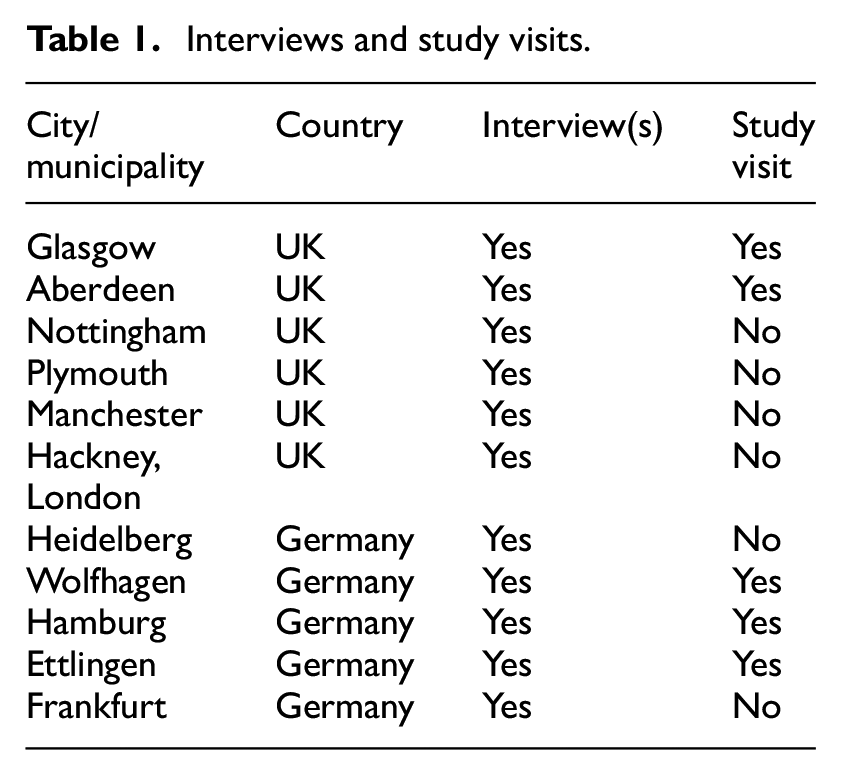
The focus of study visits and interviews was on capacity, opportunities, barriers and progress around local projects, and particularly the Horizon 2020 project around capacity to engage in energy transition. Thus, our focus here speaks both to a critical terrain of intervention for sustainable futures and to a major area of thematic overlap between the two projects. This article draws on data across these two projects to illustrate key themes that emerged around urban transition capacity and infrastructural ownership.
The multi-scalar legacies and constraints for local actors in the UK’s centralised and marketised energy system
The UK has a highly centralised energy system reflecting the dominance of national government since 1945. Nationalisation of the country’s energy sector in the immediate post-war years created a highly centralised infrastructure around a single nationwide grid with energy supplied by massive, centralised power stations, including coal-fired, gas and nuclear. Distribution of heating and electricity tended to be via regional organisations without democratic control, answerable to national government ministries and with the autonomy of a managerial class from local scrutiny or accountability. Following privatisation in the 1980s, this system was sold in its entirety to the private sector through stock market flotations of various parts, including a separate private firm, National Grid, charged with maintenance and investment of the national electricity grid. Although the sector is frequently described in market terms, it is best considered as an oligopoly that is a ‘rentier’s paradise’ (Christophers, 2020), with an over 70% share of electricity and gas markets in October 2022 taken up by the ‘big six’ multinational companies, some of which are partially state owned by foreign governments (EDF, RWE, E.on, Iberdrola, SSE and Centrica). 2
Attempts by local governance actors within the UK to enact the energy transition expected of them by central government are heavily constrained by a lack of control of key infrastructures and assets, leading to assessments of cities in the UK as relatively weak transition actors (While and Eadson, 2019). Outside energy, the mass privatisation of housing and transport since the 1980s deprives many local authorities of control of other critical infrastructures to develop integrated transition planning. As Tingey et al. (2017: 17) put it: ‘local authorities have very limited capacity for strategic energy management, in line with their limited statutory powers or duties, and limited budgets for energy provision or services’ (cf. While and Eadson, 2019). These legacies and constraints on local action have been further undermined by austerity policies pursued by UK governments from 2010 onwards, leading to a decrease in local government spending by 17% over the decade from 2009 (Harris et al., 2019).
A critical casualty of austerity was the scrapping of the Renewables Obligation under the Conservative Government in 2017, a feed-in tariff (FIT) subsidy for renewable energy set up by a previous Labour Government, judged as too costly and interventionist. This created market difficulties for newer smaller, local and community renewable providers, strengthened the hand of larger established actors and all but stalled the development of smaller-scale renewable energy infrastructure. A final ironic twist was the introduction of new planning legislation in 2015 by the Conservatives which effectively blocked onshore wind development in England, by far the cheapest and most effective way for the UK to accelerate its renewable energy capacity. In an apparent local devolution of power, all new wind developments were required to have community backing. The policy was a response to NIMBY-style objections by wealthier constituents in Conservative heartlands which have further hamstrung local government’s transition capacities. The terrain of local energy infrastructural politics has thus been mobilised by the right as a defence of vested private property interests, rather than as an opportunity for the country to meet its climate obligations in a manner that might include forms of community ownership. Such negative mobilisations by the right against renewables inadvertently draw attention to one largely unremarked element of the UK’s multi-scalar political economy of energy: the relative absence of grassroots mobilisations around alternative energy discourses compared to countries such as Denmark and Germany. The wider political atmosphere then narrows the field in which infrastructural interventions are possible – removing support for and effectively putting barriers in place to localised energy generation, leaving energy transition projects to large-scale interventions by market players.
Despite this unfavourable broader environment, there have been some attempts by local authorities to establish their own energy transition initiatives, though they are generally restricted to energy distribution rather than interfering much in transforming infrastructures. In 2015 and 2016, a wave of energy supply companies was set up across the UK, aiming to use the lever of public ownership to address issues of transition and fuel poverty together. The creation of Our Power in Scotland, Bristol Energy in Bristol and Robin Hood Energy (RHE) in Nottingham heralded a movement towards market intervention in the UK, although all ended in financial trouble and ultimately closure or takeover by larger market players. Their emphasis on energy poverty, which speaks to the UK’s deep inequalities, skews UK municipal market entrants towards attempting to keep costs down, without necessarily having the liquidity to do so. All three market entrants were victims of the volatility of wholesale gas and electricity markets, with increased prices driving up debt to levels that were unsustainable for a local authority to manage. As Sugar (2021) argues, the failure of RHE was a market failure rather than the result of failures at RHE itself, as council energy companies are held to the same standards (the ‘level playing field’) as incumbent market players, and effectively must behave as commercial entities, despite vastly different priorities and capacities.
Plymouth City Council offers a counterexample of an urban authority whose approach has arguably been more successful without entering the market or taking ownership over energy infrastructure, through working creatively alongside other urban actors. It has worked alongside businesses and community groups to develop green initiatives as a collective endeavour that tackles derelict land, engages citizens and, through directing the profits back to community benefit, addresses fuel poverty. A key development was the creation of the Plymouth Energy Community (PEC): a social not-for-profit enterprise, created with some financial assistance and staff support from the city council but independent of the council itself. Like other UK council interventions, it has the twin goals of decarbonisation and addressing fuel poverty (Hopman et al., 2021). As of October 2021, the PEC had supported over 21,000 households to reduce their fuel costs and had created its own community-owned energy subsidiary, PEC Renewables. With funds from the city council and a cooperative resident share-owning scheme, it has created its own solar energy generation (33 community-owned solar arrays generating over 21,000 MW), which created local jobs and returned profits back into public projects. In effect, the PEC is generating its own local energy infrastructure, and generating surplus revenues locally to feed back into social projects.
Plymouth, although an outlier here, demonstrates the art of the possible within a multi-scalar landscape that is unsupportive of localised energy transition, against the backdrop of a rather ‘piecemeal’ landscape of local government climate action (Tingey and Webb, 2020: 8; While and Eadson, 2019). Effective urban action occurred through cooperation and partnering with community and businesses, reflecting a lack of integrated capacity over key urban infrastructures to carry out transition.
A good comparator in this respect has been a more top-down effort at post-carbon transition in the UK’s North Sea oil capital, Aberdeen. The city faces critical challenges in moving towards a decarbonised energy system given its heavy dependence on fossil fuels, once supporting industries are included (Elliott, 2021). Policies to support a post-carbon transition have secured large sums of public money from both Scottish (£26 million) and UK (£27 million) governments. This includes a large projected infrastructure project based in the ‘Energy Transition Zone’ (ETZ) next to the much-delayed new deep-sea harbour, funnelling £60 million from various sources into transforming brownfield and greenfield sites into the supportive infrastructure for the new green economy. The ETZ transition zone aspires to a local alliance with BP to produce a so-called hydrogen hub and to upskill supply chain companies to cushion job losses from oil closures. Yet Aberdeen’s transition plan has resulted in a backlash from local organisations due to its site, its narrow focus and its top-down vision.
Controversies around the ETZ speak to the power dynamics involved, favouring small groups of already empowered people and seeming to ignore local resistance. As the director of a local climate group put it, transition planning decisions are ‘very secretive’ (interview, 2022). She continued: ‘I elbow us into the conversations that are being had but … the major decisions are taken, just in small rooms by a very small amount of people’. This points to problematics of power and money within transition, especially in cities where economies are so closely tied to oil and gas. Despite some efforts in community engagement from the Energy Transition Zone Ltd, concerns were raised by various actors in the city about the vested powers involved in the development of the transition plans for the city, evident in the alliance with BP and the emphasis on upskilling existing oil supply companies. Urban agency and capacity within infrastructural transitions must be considered in relation to such vested interests, often able to mobilise broader multi-scalar networks of power and resources.
Our council respondent pointed out the ineffectiveness of the council in directing an infrastructural shift in energy that requires direction and coordination at the national scale. This was mirrored in the community activism, which often targeted Scottish Government officials and considered the relationships between localised and national Scottish governments, when it wasn’t concerned with the shifting terrain of FITs at Westminster. As such, despite concrete effects in local places, the sense from most respondents was that local activity could only engage with energy transition’s dynamics in limited ways. Because of the control of infrastructure projects through centralised planning, funding and subsidies, this effectively leaves citizens with only dissent as a tool to engage. The idea that this has been technocratically managed by Aberdeen’s ‘great and good’ maintains a sense that these infrastructural solutions – though contested – are kept out of their reach.
Such remarks suggest that the urban level may not always be able to function as a route to energy transition without a broader supportive multi-scalar governance environment, given its paucity of agency under austerity and the disciplining effect and prevalence of strong market norms to which local projects in energy are held (cf. While and Eadson, 2019). This raises serious questions about urban infrastructural solutions as a route to a sustainable future, highlighting that local-level intervention does not always mean local control, challenging any implicit democratic association with urban solutions (per Purcell’s (2006)‘local trap’).
The sense of exclusion of local and community actors from the UK’s energy transition and infrastructural politics is also confirmed by the recent central government decision to invest in a new generation of nuclear power plants, dominated by foreign French and Chinese state capital. Similarly, the main substantial area of progress in developing renewable energy has been in the construction of massive offshore wind plants, which have increased their share of UK electricity generation from virtually zero in 2010 to over 10% by 2020 (Cumbers and Traill, 2021). These have all been administered through central government licences with minimal democratic scrutiny, and dominated by foreign (especially Nordic) state-owned energy utilities, notably Equinor, Ørsted and Vattenfall. In a rather perverse set of power geometries (Massey, 1993), the city of Munich’s utility company, which owns shares in the Gwynt y Mor windfarm off the North Wales coast, has greater involvement in the UK’s offshore renewables expansion than any British public or private actor.
Enabling transition and empowering local agency in Germany’s decentralised energy system
Germany has a much more fragmented and decentralised set of energy infrastructures than the UK, with less centralised grid systems and with local governments (at municipal and rural county level) traditionally owning and controlling most of the estimated 1600 utilities in the electricity and gas sectors (see Bohne, 2011). As a federal state, there is also a more decentred governance system, with regional states (Länder) having considerable powers and competences, and direct political representation at the federal level through the second chamber, the Bundesrat. These include substantial powers over energy policy which mean that: ‘the national government is in a considerably weaker position in terms of its influence with regard to the implementation of sustainable energy policy at the Laender level, compared to that of non-federally organized nation states’ (Ohlhorst, 2015: 306). The federal government can set sustainability targets, for example on CO2 emission reductions and renewable energy, but it is heavily reliant upon Länder to coordinate and implement, with the latter having legislative powers to set their own targets and regulations (Monstadt and Scheiner, 2014). In practice, many Länder have set more ambitious targets than the federal government, and although there are often co-ordination problems between governance levels, overall this decentralised system has provided a relatively benign environment for municipally led energy transition strategies.
Although, in common with the UK, large private utility corporations have increased in importance in the sector in recent years, local municipal governments have continued to be critical actors within energy infrastructure in the ownership of local grids, the generation of energy and the supply of electricity, though in many successful cases they are pushed to do so by social movements within cities (Becker et al., 2016). Although Germany experienced its own privatisation of the energy sector in the 1990s, and with the growing EU drive to liberalise energy markets, imperatives to marketise structures – including the unbundling of infrastructure from service operations, which perversely works against the kind of integrated municipal capacity essential to effective transition – have been far more partial and contested than in the UK (Traill and Cumbers, 2023b), and done on a more limited franchise basis. This is because of the local and regional state’s continuing constitutional responsibilities to provide basic services as part of general well-being – a concept known as Daseinsvorsorge (see Cumbers and Paul, 2022). There has also been an active tradition of grassroots and civil society mobilisation in Germany, manifested in strong green and anti-nuclear movements from the 1970s onwards, and re-energised in recent years through a local climate change politics (Moss et al., 2015). Localised interventions in energy infrastructure are not automatically aligned with a progressive political direction, but there is an opportunity space afforded by a combination of political mobilisation, governance mandates and devolved power (Becker et al. (2016) use the idea of strategic action fields to describe contests in this space) – a space markedly absent in our comparator country discussed above.
One consequence of this context is that as local privatised energy franchises for electricity and heating systems have come up for renewal, there has been a massive remunicipalisation trend since 2000, with 173 cases as of November 2021 (see Public Futures database: https://publicfutures.org/), to take privatised energy assets and infrastructures back into local public ownership (Traill and Cumbers, 2023b). There has also been a trend for local governments to establish new public energy companies, with 108 being created in the period between 2000 and 2021 (Public Futures, n.d.), and a proliferation of local renewable energy co-operatives (Klagge and Meister, 2018), often with the support of local governments. Thus, Germany’s legacy of inherited infrastructures, decentralised governance structures, continued social imperatives and thus incomplete neoliberalism has been critical to empowering local actors to engage in energy transition initiatives.
A further critical factor has been the stimulus to transition from the country’s Energiewende, although this is not without conflict with private and corporate vested interests. Indeed, Germany’s progress in meeting its carbon reduction targets stalled in the 2010s due to a less supportive national political environment and opposition from the powerful corporate carbon lobby of auto producers and private energy utilities (Hockenos, 2018). In the two most celebrated cases, Berlin and Hamburg, grassroots campaigns have fought to take back control of the local energy grids to pursue more rapid energy transitions towards renewables in the face of dominant local political actors, trade unions and private utility companies wedded to fossil fuels. Another obstacle at the local level in Germany has been the shareholdings held by many local governments, particularly in the most populous state, Nord-Rhein-Westfalen, in some of the private utilities that still have dominant coal, gas and nuclear interests. The interconnection then between local governments and energy interests, particularly in coal, reiterates a well-worn point about not assuming the local to be progressive (Purcell, 2006), especially as Länder have the power to, and often do, restrict wind energy plant permits. Thus, decentralisation in the German case, whilst it has produced celebrated urban cases such as Hamburg, cannot be assumed to be automatically productive of a progressive energy transition. Our argument here is principally that it offers more space for manoeuvre; and the possibilities (however unrealised they might be) of a more democratic transition.
Critically, though, the decentralised nature of energy governance in Germany has facilitated many local mobilisations beyond celebrated urban cases. A by now famous example is the small Hessen town of Wolfhagen, where a local citizen campaign took back control of the town’s electricity grid from the multinational energy utility Eon in 2006, establishing its own public energy company and citizen’s cooperative with the aim of producing 100% of its electricity from local renewable energy sources (Hopman et al., 2021). But such examples are to be found throughout Germany. Small towns and rural municipalities in traditional conservative heartlands have also experienced both remunicipalisations and the setting up of new public utilities. In their analysis of the 72 new public energy companies created since 2005, Wagner and Berlo founded some of the largest clusters in traditionally conservative rural strongholds of southern Germany in Bavaria and Baden Württemburg (Wagner and Berlo, 2017).
Beyond the remunicipalisation trend, German local government actors benefit from far greater financial resources and capacities than their more restricted UK counterparts, through the availability of local finance from the country’s network of local state-owned and cooperative banks, again in contrast to the UK’s more financialised and marketised institutions (Hall et al., 2016). Local actors also benefit from the activities of the German federal state investment bank, the KfW, which provides patient capital for local governments to embark upon innovative and expansive transition projects. The KfW has been tasked with the provision of around 40% of its €80 billion budget for cheap loans and grants to environmental schemes (Marois, 2017).
While Germany has not escaped the broader multi-scalar governance trends towards austerity after the financial crisis (e.g. Mullis, 2021) – with the adoption in 2009 of ‘balanced budget’ constraints at federal and Länder level, and a longer-term trend over four decades of fiscal retrenchment and financial disciplining of many municipalities, especially in poorer regions – the effects have been more muted and less severe than in the UK. This has meant that, although there remains considerable spatial unevenness in urban capacity, local actors have not faced the same degree of cuts to budgets, staff and resources experienced there. Larger cities such as Munich and Hamburg, for example, have been able to embark on impressive initiatives to shift towards renewable energy. Munich embarked upon a €9 billion strategy to meet 100% of the city’s electricity needs by 2026 (interview, 2017). This was made possible by the existence of its own publicly owned multi-utility company with the capacity to develop an integrated strategy through control of strategic assets and infrastructures in energy, transport and water. Just as important was the ability to recycle revenues from these activities to its carbon reduction strategies.
The Hamburg case is illustrative of the possibilities of a city state within the German federal system (Bundesland), though in this regard it must be seen as an outlier. Following the celebrated grassroots mobilisation in 2013 to remunicipalise the electricity grid (Becker et al., 2016), the earlier establishment of its own public energy company to sell electricity and produce renewables and the 2018 decision to also take its heating grid back into public ownership, the city has embarked on an ambitious strategy to convert 400,000 of the city’s homes away from coal- and gas-fired heating towards renewables and combined heat and power (interviews, 2020). More than any other policy, this will be a significant game changer in reducing Hamburg’s CO2 emissions if successful. Hamburg’s position as a city state has also produced an interesting set of power geometries, where it has been able to forge alliances with other Länder to amend federal district heating laws that help it implement its local transition plans (interview, 2020).
But supportive state structures at higher geographical scales are also able to underpin transition initiatives in smaller and less wealthy municipalities. One example of this comes from the small city of Ettlingen in Baden Württemberg (population 40,000), which has set itself the ambitious target of halving CO2 emissions by 2030, which is not easy in a rural area with considerable car dependency (interviews, 2019). Ettlingen took back control of its energy grid from private utility EnBW in 2011 and subsequently has invested in new initiatives, including a wood-burning heating system from a local forest, and an electric car-sharing network (with 40% of funds coming from the federal transport ministry). The latter indicates that a final critical component of the success of Stadtwerke Ettlingen (SWE) has been the availability of ‘patient’ investment capital from the state which allows borrowing for renewable projects at very low borrowing rates. A scheme that illustrates this well is an initiative set up to replace heat boilers in the town’s households which has involved a loan (at less than 1% interest) from the German Development Bank, the KfW, allowing the SWE to cover the cost of replacing boilers in return for users entering a 20-year contract for heat supply.
The comparative point here is not necessarily that Germany’s transition is faster or better than the UK’s – the two countries are remarkably similar in their aggregated CO2 reduction success so far, though through very different pathways. Yet, given an increase in the narrative that cities are to some extent an answer to the sustainability problem, and indeed urban infrastructures as a big re-imagined element within that, how much local autonomy exists, how much room for manoeuvre, indicates who is in fact driving transition, indeed where power lies within putatively local infrastructure planning. It is also the horizon on which transition is or is not more democratic. A comparison of UK and Germany suggests that it is indeed possible to move towards a decarbonised energy infrastructure from a local, arguably more democratic, level, though a slow-down in recent years might highlight a reducing opportunity space for pursuing this (and neoliberal pressures from an EU level would seem also to restrict this). The danger of romanticising the local level is clear, but does this mean that we give up on the possibility of local self-determination, and secede control over important considerations of land use and local development to multi-national corporations or central governments with minimal democratic involvement or scrutiny?
Conclusion
In this article, we have emphasised the way that political economic trajectories within a wider terrain of neoliberalisation interact with variegated forms of multi-scalar governance processes to shape local and urban agency in energy transitions. Thinking across infrastructure as it intersects with patterns of ownership, capacity and neoliberalisation, we argue that the current considerations of climate urbanism (Castan Broto et al., 2020; Long and Rice, 2019) must engage with the complex and constrained realities confronting urban actors. In so doing, it pushes the city exceptionalism of urban sustainability narratives to embrace a more multi-scalar vision of agency within the energy transition that engages both the national but also the many varieties of subnational agency, without privileging the urban scale. This is particularly acute in relation to infrastructure, which often crosses boundaries and requires coordination across places and jurisdictions.
In both the UK and Germany, local projects highlight the possibilities that emerge where ownership of key assets remains in public hands. The ownership of key assets (and their data (cf. C40 Cities, 2016)) allows urban actors to pursue non-market goals (such as decarbonisation or the reduction of fuel poverty) as alternatives to the profit-centred logics of large private and corporate actors. Yet clearly ownership is a difficult terrain, given neoliberal-inspired privatisation drives, especially in the UK, where local governments are not able to access the finance necessary to invest in fully owned assets, or to regain control of critical energy infrastructures that remain in private hands. Materially focused accounts of infrastructure do justice to the complexities of infrastructure and their role in governance and control, but often occlude the potential for infrastructure to be an emancipatory terrain (Karaliotas, 2023). The Plymouth example demonstrates, in the absence of more integrated local capacity and assets, a soft approach where partnerships with community and business actors are a necessary adaptation to the UK’s multi-scalar marketised energy landscape. In Berlin and Hamburg, as elsewhere in Germany, the continued local regulatory control over assets (and their long-term contracting out to other suppliers) allowed for them to be brought back to public ownership. Yet while mobilisations within Berlin and Hamburg allowed for pressure towards energy transition (Becker et al., 2016), the capacity to act in this context is not restricted to larger cities. Ettlingen and Wolfhagen point to the potential that exists outside exemplar or even outlier cases to take action outside of urban centres within a more supportive multi-scalar governance context than in the UK.
Local capacity is a critical factor in the success of urban energy transitions. It is notable that we can situate greater capacity to transition in the field of energy in smaller cities in Germany than in many larger UK cities. This may not always lead to progressive outcomes, but it speaks to the existence of opportunity spaces that are at present highly constrained in the UK. Such opportunity spaces may open and close over time, as the failures of municipal energy companies in the UK attest to, leaving little room for such ventures now. In infrastructure, which is so often seen as ossified and fixed, it pays to attend to a greater fluidity within ownership as well as materialities (cf. Guma, 2023), particularly as it constrains and enables climate action.
Neoliberalisation plays into this – both as a logic of small government and through an insistence on marketisation and the ‘level playing field’ where, especially in energy, this pits small municipal companies against large conglomerates, many part-owned by other national governments, to the former’s great disadvantage. Yet where neoliberalism plays out differently, such as in the German context where the Daseinsvorsorge principle underpins a public orientation towards well-being, this need not automatically lead to situations where local public agency is disadvantaged. The context of competing values matters to the actualisation of urban energy transition.
Contemporary enthusiasm for the urban as the horizon for climate change mitigation, for cities as ‘solutions’ (Angelo and Wachsmuth, 2020), must not overstate the ability of the city to act, especially in the often unbundled and technically complex arena of energy infrastructure. Progress has been made in small, localised ways, often illustrating the art of the possible and reflecting the greater possibilities of success in the context of de-centralised agency. Yet successes must be taken in the broader context of what is and is not possible to certain actors in certain contexts at certain times (cf. Becker et al., 2016). Particularly in the global north, where a great deal of impetus to reduce carbon emissions rightly sits, there is a need to recognise the blockages to urban capacity – in terms of both the infrastructure legacies of the carbon energy system and the powerful vested, corporate and private interests that are able to capture policy agendas – as a facet of the system that centres sovereignty at the national level. Opportunities to circumvent this through inter-city networks and experiments are precisely that – tinkering at the edges of a dangerous problem that requires joined-up thinking and coordinated action. Thus, one possible pathway to action sits not just in working at the urban level but also in coordinating action across scales and between places, actors and governance regimes (Gasbarro et al., 2017). As such, we should not allow urban enthusiasm for ‘taking the lead’ in climate action to obscure the need for action across scales, and with particular responsibility at the national level, especially for the kinds of patient capital required to reimagine our energy infrastructure for a post-carbon future.
Footnotes
Declaration of conflicting interests
The author(s) declared no potential conflicts of interest with respect to the research, authorship, and/or publication of this article.
Funding
The author(s) disclosed receipt of the following financial support for the research, authorship, and/or publication of this article: This article has benefited from funding under the European Union’s Horizon 2020 programme, project ‘MPOWER: Municipal Action, Public Engagement and Routes Towards Energy Transition’; and the European Research Council Advanced Grant ‘GLOBALMUN: Global Remunicipalisation and the Post-Neoliberal Turn’.
