



Abstract
Internationally, a number of façade fires have highlighted significant safety problems in multi-storey residential buildings. England is an exemplar of this problem, with thousands of buildings requiring extensive remediation work to cladding systems and other areas. In many cases, this work will take place whilst homes are occupied. Although construction is an integral part of urban life, there has been little attention to the lived experience of building works. The article draws on interviews with 20 leaseholders in England affected by fire safety remediation works. The research highlights the unsettling of home as a safe, controllable, private sanctuary. First, home was disrupted by the sights and sounds of remediation work, the intrusion of noise and dirt and the shrouding of buildings in plastic sheeting. Then, workers with an orientation to the home as ‘building site’ eroded the boundaries of private space. Finally, a prolonged and unpredictable remediation process revealed the limited control of residents. The research draws attention to the neglected psychological costs of building works, revealing how a bundle of rights associated with ‘home’ are disrupted. The research has wider implications for the experience of ‘vertical’ building sites and the repair and retrofit of multi-storey buildings. Rather than a technical problem associated with building materials and construction, such work must draw on an understanding of home, foregrounding the experiences of residents.
Introduction
This article explores the inhabitation of an unsettled home during building works to remedy safety-related defects following the 2017 Grenfell Tower fire. Internationally, a number of façade fires and other safety defects in newly constructed or renovated homes (Ó Broin, 2022; Oswald and Moore, 2022; Rehm et al., 2020) have led to widespread concerns about construction quality and regulatory failings (Apps, 2022; Hodkinson, 2019; Moore-Bick, 2019). England is an epicentre of this crisis, with thousands of multi-storey buildings in cities requiring remediation works, fundamentally changing the urban landscape as buildings are de/reconstructed behind scaffolding and wrapping. Remediation commonly includes the replacement of cladding and insulation, work to balconies, fire barriers, and sometimes internal work within communal areas and private homes. Whilst research has explored the political, socio-emotional and financial impacts of fire safety problems internationally (Cook and Taylor, 2023; Melser, 2023; Oswald et al., 2022, 2023; Preece et al., 2023; Preece and Flint, 2024), the next phase of the crisis – fixing the buildings – has received little attention.
Leaseholders who have purchased flats in affected buildings have already faced many years in limbo, living in potentially unsafe homes yet being unable to sell them because of mortgage lending restrictions (Preece, 2021) and slow progress in determining funding for remediation (Ward and Brill, 2023). This has generated significant negative impacts on mental wellbeing (Preece, 2021). Whilst fixing buildings represents the possibility of being able to move on with their lives, remediation also brings considerable problems. Most leaseholders are not in a position to move from their homes, so remediation generally proceeds with residents in-situ. This research draws on in-depth interviews with 20 leaseholders living through building remediation works in multi-storey residential buildings in England (Preece, 2022). Whilst construction activities are integral to urban life, research on their impact has been limited (Sage, 2013).
This research extends scholarship on communities under (re)construction (Gillon, 2018; Kraftl et al., 2013; Watt, 2021), exploring a case which differs in the scale, proximity and type of construction. Building safety remediation opens up a new frontier in understanding how people inhabit an unsettled home, demonstrating the mechanisms through which fundamental attributes of normative ‘home life’– safety, comfort, privacy, control and autonomy – are disrupted. By bringing empirical attention to the neglected psychological costs and effects of building works (Watt, 2021), the research works across micro-level multi-sensory and bodily experiences (Sou and Webber, 2023), as well as the wider structures and relationships that shape the remediation process. In focusing on the mundane elements of repair and everyday life (Graham and Thrift, 2007), we can observe how the unsettling of the home also disrupts a bundle of rights that individuals have come to expect from the home, particularly achieved through home purchase. The research suggests that urgent attention is needed to ways of enhancing the ability of residents to make a liveable life whilst inhabiting unsettlement, addressing calls to focus on the experiences and active participation of residents in building renewal, not simply the technical challenges (Gram-Hanssen, 2014). This has relevance for understanding the liveability of high-rise (Ebbensgaard et al., 2024; Yuen et al., 2006) through ongoing processes of repair and retrofit.
Remediation context and the limits of leasehold
Despite the urgency of completing remediation for residents, progress has been very slow (Ward and Brill, 2023). This is because of ownership, governance and legal structures – affecting control and accountability for remediation – and financing work. Flats in England are usually purchased on a leasehold basis, giving the purchaser the right to occupy the property for a fixed period, after which – for a fee – the lease can be renewed. A freeholder generally retains ownership of the building and land, with leaseholders paying a regular ‘ground rent’, and service charges for maintenance of communal areas (Cole and Robinson, 2000). Managing agents often manage buildings day-to-day, communicating with residents, whilst in some buildings a Resident Management Company (RMC) of nominated leaseholders undertake management on behalf of the freeholder. Because of its normalisation, individuals buying flats in England often view themselves as homeowners, but in property law, they are tenants (Cole and Robinson, 2000). This legal structure gives many leaseholders limited control over remediation.
The funding of millions of pounds of remediation per building has been a significant and evolving policy problem (see Ward and Brill, 2023). Who should pay (based on culpability for building defects), and who can actually be held financially accountable have often been at odds. As Ward and Brill (2023) argue, the lack of accountability mechanisms and the legal framework of housing as property in England meant that – prior to the Building Safety Act 2022 – freeholders could recharge leaseholders for the cost of remediation. Legal action against developers was slow, costly and risky, since complex company structures and contracting may leave no assets to leverage; this created an ‘accountability vacuum’ (Hodkinson, 2019). Leaseholders highlighted the injustice of this position as well as the practical reality that bills were unaffordable (Preece and Flint, 2024). Today, much remediation is financed by Government- and developer-funded schemes targeting different types of cladding and heights of building, with ‘waterfall’ protections in the Building Safety Act making leaseholders the funder of last resort, with a cap on financial contributions. However, some leaseholder landlords, defects and types of building remain excluded from these legal protections, creating a patchwork of eligibility. There are no remediation funding schemes for buildings below 11 m in height.
The legal framework for private sector buildings only proscribes narrow consultation with leaseholders in relation to some contracts and recharging works. Unlike in social housing – notwithstanding its own limitations – there is little culture of wider resident involvement. Consequently, leaseholders often have little say in management decisions, little power to direct buildings to be fixed, and little voice in the process when this happens. Although some buildings are managed by RMCs, inequalities between leaseholders, developers and freeholders persist. The leasehold model contrasts with resident self-governance of multi-occupancy buildings internationally, although building management can still be characterised by power-dynamics and conflict (Blandy et al., 2006; Treffers and Lippert, 2020). At the time of the research there was no understanding of the impacts of remediation or how disruption to homes could be minimised. The research seeks to shed light on this.
Inhabiting unsettlement through building reconstruction
Home is ‘a site in which we live. But … also an idea and an imaginary that is imbued with feelings’ (Blunt and Dowling, 2006: 4). For Saunders (1990: 330), home is ‘the private realm in an increasingly public and intrusive world’, a place of physical and psychological shelter and comfort, providing independence, warmth and security. Home is the ‘psychic armour’, or ‘shell’ that protects our psychic development and wider sense of assuredness in the world’ (Atkinson and Blandy, 2017: 20). Whilst this does not accord with all lived experiences of home (Mallett, 2004) the idealised vision of what home should be remains a powerful point of reference for measuring one’s own experience within a given cultural context, and feelings about home are shaped by wider ideologies such as the idealisation of homeownership (Atkinson and Jacobs, 2016). Disruption to the advantages that ownership is held to confer, and to expected futures which are contingent on the maintenance of the home’s financial value, can therefore be profoundly unsettling (Preece et al., 2023).
Many leaseholders have been living through processes of unhoming for years (Preece and Flint, 2024). Remediation marks a new phase in the unsettlement of home, a harbinger of the ‘unhomely home’ or the uncanny experience of the familiar rendered out-of-place (Blunt and Dowling, 2006; Kaika, 2004). Existing scholarship highlights the varied ways that individuals live through unsettling and unhomely encounters resulting from urban marginalisation, displacement and natural disaster (Lancione, 2016; Sou and Webber, 2023). By attending to unsettlement –‘material, experienced or sensed ruptures in habitual ways of living, belonging and identification’ (Viderman et al., 2023: 2) – we can understand home as a process of making, unmaking and remaking. This includes exploring the ‘dark-side’ of home, rather than the dominant focus on its psycho-social benefits (Gurney, 2023). Remediation showcases the mechanisms involved in home disruption – at once sensory, relational and temporal.
Sensory perception and bodily behaviour are central to the development of feelings in buildings (Rose et al., 2010). Indeed, to feel ‘at home’ is to express a particular kind of sensed atmosphere, a dynamic quality of feeling that envelops people, things and sites (Anderson, 2016: 139). In part, the home is constructed through ‘porous sensory entanglements’ between the domestic and urban (Bille and Hauge, 2022: 2077) as individuals encounter sights and sounds (Jaffe et al., 2020). Boundary-making is an important part of homemaking, regulating the inclusion and exclusion of these sensory stimuli. Whilst the experience of the home as a controllable sphere of private enjoyment and retreat exists in this dynamic relationship with the world in which it is embedded, it is through loss that such habitually taken for granted elements of home are revealed (King, 2008). This highlights the need to think of atmospheres, such as homeliness, as arising from practices and the things that people do – or cannot do – in place (Bille and Simonsen, 2021).
Home is also contingent on relationships with others, which unfold within domestic space and the admission of others into this space. In multi-occupancy buildings, residents make daily decisions around how and to what extent they interact with others (Arviv and Eizenberg, 2021), and whom they admit into the home (Cheshire et al., 2018). Everyday life may also be governed by norms such as suppressing noise and keeping communal areas tidy (Arviv and Eizenberg, 2021). The dramatic change in the material, sensory, and relational dynamics of life under construction work has significant potential to disrupt shared norms of conduct, as ‘others’ act in ways contrary to the maintenance of home atmospheres and the placement of strangers ‘out there’ (Cheshire et al., 2018). As the building site is constituted vertically, it achieves a new proximity as scaffolding encases buildings and everyday cultures of construction permeate the boundaries of the home.
Through unsettlement, home becomes a liminal space in which memories and markers of homeliness persist despite disruption (McKinnon and Eriksen, 2023), with daily life continuing amidst a home that is in a process of ruination. Whilst in some disasters, the destruction of homes is rapid (McKinnon and Eriksen, 2023), the crisis of building safety is slow and chronic (Pain, 2019), characterised by waiting (Preece and Flint, 2024). Although resolving building defects is urgent for occupants, they have limited control over the process. During remediation, lack of urgency results in living in close proximity to strangers and their unhomely practices for months and years (as in large-scale regeneration, see Hodkinson, 2019; Watt, 2021), in contrast to more acute experiences of disaster (Cheshire et al., 2018; McKinnon and Eriksen, 2023). This highlights the importance of home as a sphere in which individuals have power and control over decisions. As Jackson (1995: 123) argues, feeling at home arises from a sense that ‘what we do has some effect and what we say carries some weight’. In England, this control and self-efficacy has long been associated with homeownership (Saunders, 1990), an ideology which persists despite experiences to the contrary. The research exposes the strictures, inequalities and contradictory orientations of the leasehold property system, exemplified by the experience of leaseholders in a safety crisis.
Methods
Data collection was conducted in May and June 2022, comprising in-depth, semi-structured interviews with 20 leaseholders who were living through building safety remediation works in England. The aim was to use the experiences of leaseholders in early waves of remediation to inform remediation policy. The research focuses on leaseholders rather than tenants because: financial impacts are unique to this group; private renters may be more readily able to move; and social housing has stronger regulatory requirements related to resident involvement in decision-making. Nevertheless, it is likely in some areas – particularly the disruption of noise, dirt and intrusion – that the experiences of renters and leaseholders would align.
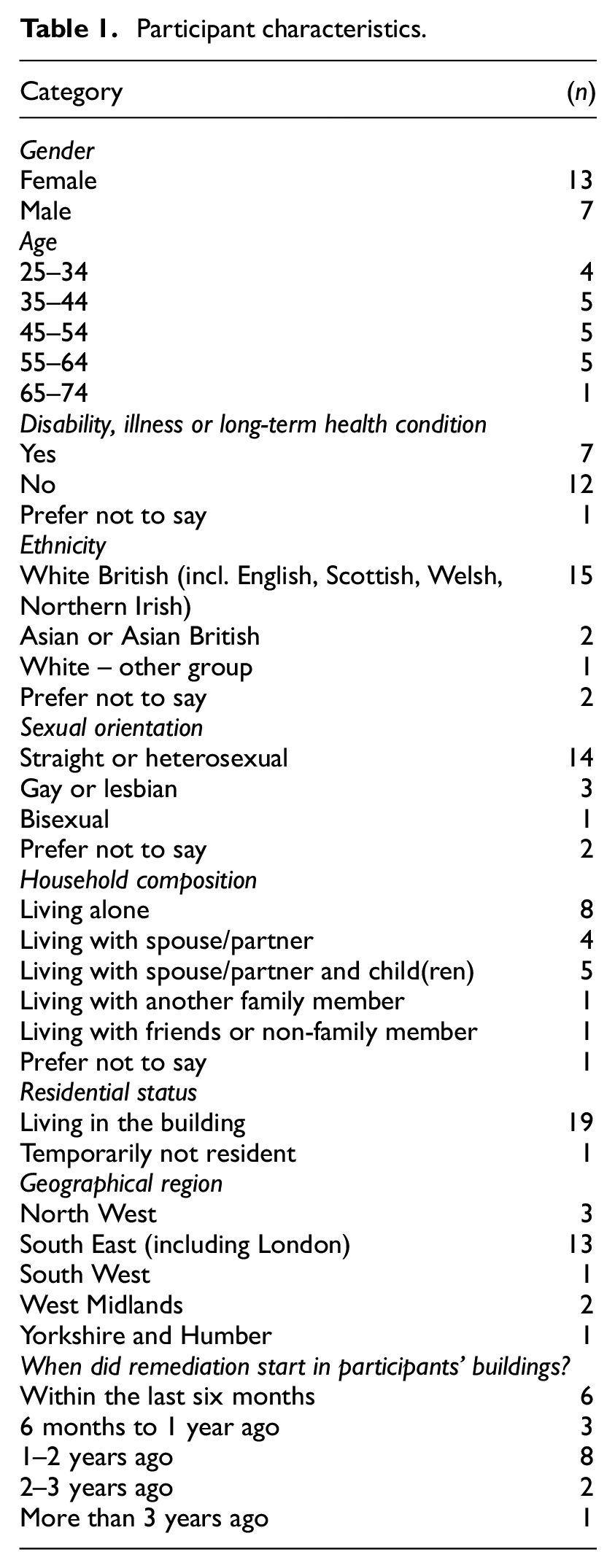
The interview sample was drawn from a survey of leaseholders living in buildings undergoing remediation works (110 respondents), which sought information about their experiences. The survey was distributed online through the researcher’s networks and action groups active in leasehold campaigning, for example the newsletter of the UK Cladding Action Group, and the End Our Cladding Scandal campaign group. Survey respondents answered a range of demographic and closed survey questions, with an option to be contacted about taking part in an interview. Fifty-three people gave consent to be contacted about interviews. The interview sample was taken purposively from this population, seeking to achieve a diverse sample across characteristics such as age, household type, building type, duration of remediation and regions. Participant characteristics are presented in Table 1.
Participant characteristics.
One limitation to this approach is that less-satisfied individuals may have been more likely to see and respond to the survey, and to volunteer for interview. However, at the time of research there was no comprehensive or publicly available data about buildings affected by safety problems or undergoing remediation. This limited the range of possible approaches. Even with the ability to sample buildings in a different way, individual participants would remain self-selecting. The research does not make claims to generalisability but sought to inform understandings of an urgent and unfolding challenge through in-depth insights into everyday life. However, engagement with different stakeholders since the conclusion of the research suggests convergence of concerns across multiple independent research projects, rather than the results presented here being particularly unusual.
Among participants, almost all were or had been living with scaffolding, netting or plastic sheeting wrapping the building, and drilling associated with removal of cladding and insulation. Some had works to balconies, internal communal areas and/or internal areas of private homes to instal fire-blocking barriers within walls and ceilings. Just over half the sample were over a year into remediation works, with about one-quarter beginning works within the previous six months.
Interviews were carried out via video call software or phone, depending on participant preference. Interviews typically lasted for 60–90 minutes, and all participants were offered a shopping voucher of £25. With consent, interviews were audio recorded and transcribed. Some participants shared photos about their experience to discuss during the interviews. Some interviews were disrupted by noise from remediation works, with others leaving buildings to avoid disruption. Interview transcripts were open coded line-by-line following an inductive process which labelled data with codes such as ‘mental health’, ‘privacy’ and ‘delays’. This initial analysis was worked into a structured coding framework in which sub-categories were nested under broader themes such as ‘sensory disruption’ and ‘choice and control’; these themes were informed by an understanding of relevant literatures on home-making and its disruption. Data were then coded using this framework. Pseudonyms have been used to protect participants’ identities – at the first use of participant data, their gender, age range and regional location are included.
Findings
Home atmospheres unsettled
For most participants, home was conceptualised as a place of comfort, independence, privacy and security (Saunders, 1990), with remediation fundamentally unsettling these attributes. However, the impact of remediation occurred in conjunction with other home-stressors that stemmed from living with building safety problems for years (Preece and Flint, 2024). Whilst remediation represented the start of a process that could potentially release individuals from this crisis, it also compounded existing stressors and added new vectors of disruption. For example, living with uncertainty, unsafety, loss of control and struggles for information were already chronic problems, which were exacerbated by remediation, but sensory disruption to the home contributed to problems anew (Preece, 2021, 2022).
Anna (female, 55–64, West Midlands) explained that remediation ‘has changed how I feel about my home … it just makes you kind of feel unsettled’. Others explained that the works had undermined the notion of ‘home as haven’; Harry (male, 35–44, North-West) explained that ‘sometimes … you just want a bit of peace and quiet and … you just can’t get it at … the sanctuary of your own home’. Hannah (female, 45–54, West Midlands) similarly was trying to remember ‘why my home’s a sanctuary. It’s been the opposite of that for so long. We’ve just felt like a prison for all this time’. Remediation therefore prolongs feelings of being trapped within the wider crisis, comparable with the ‘psychosocial limbo-land’ of long-term estate regeneration (Watt, 2021: 263). Feelings of home were lost in multiple ways: I don’t feel safe being there, I don’t feel comfortable being there. I’m not enjoying my home. I’m not there. That’s the impact it has. I do not have the freedom or the right to enjoy my own home, and I don’t feel as though I have had that right for a long time. (Alana, female, 35–44, South-East)
Alana had left her home during remediation, which left her feeling ‘out of place’ (Jaffe et al., 2020), with psychological discomfort arising from the sights and sounds of building work. This unsettlement sits in tension with the memories of other times, feelings and possibilities that the home afforded (Rose et al., 2010), which only enhances the sense of loss and discomfort in present feeling states (McKinnon and Eriksen, 2023). However, Alana’s narrative also suggests that remediation exacerbates ongoing restrictions on the freedoms associated with homemaking, including the ‘right’ to enjoy all that home was thought to represent – particularly through private ownership (Atkinson and Blandy, 2017).
For Hannah, the combination of pandemic-related ‘stay home’ orders and disruptive building works resulted in a sensation which ‘felt like being attacked physically in your own home’ and ‘a form of trauma that I don’t know that I’ll ever properly recover from’. Rather than a sanctuary and a place of ‘quiet enjoyment’, home came to be associated with negative emotions. Nina (female, 55–64, South-East), for example, had ground down her teeth ‘from the stress when I was going to sleep at night … constantly thinking about “how can we get out of this situation?”’
Remediation was a necessary step towards resolving safety problems. Starting work could mean beginning ‘to see the end of the tunnel’ (Rob, male, 35–44, South-East). However, the process also disrupted the home in ways which were unnecessary and avoidable. There were very few attempts to understand or minimise negative impacts on people’s experience of home. On the contrary, Alana explained that ‘there’s an expectation that you just accept what’s going on and be grateful for the fact that the work is being done’. Similarly, Priya (female, 45–54, South-East) felt that the developer saw leaseholders as ‘a nuisance … almost to the point now where we should be grateful for what is being done here’. Those responsible for remediation therefore viewed disruption as counterbalanced by the ‘lucky’ position that these buildings were among few at this time having defects addressed, rather than recognising the way in which work dismantled many of the psycho-social benefits of home.
Multi-sensory impacts
The historic construction of the home as an autonomous, protective, private sphere relies upon processes of control and exclusion (Kaika, 2004). Participants’ narratives reveal the ways in which remediation unsettles this balance; central to this was the assailing of the senses by noises, sights and bodily disruption as homely atmospheres were transformed into work sites, disrupting normal life (Watt, 2021).
Noise was the most significant sensation experienced by participants, perhaps not surprising given its key position as a public health concern (Hong et al., 2020). Priya described noise as ‘another level’ with ‘day in, day out drilling, banging’. Drilling was ‘one of the most debilitating aspects … like having a drill in your head’ (Tim, male, 45–54, South-East), which resulted in some participants leaving their homes due to feeling ‘as though you’re in some weird sort of torture’ (Alana). Hannah described living with ‘above 90 decibels noise … on an almost daily basis now for 20 months’, equivalent to a lawnmower, which she found was ‘unbearable’ and ‘completely abnormal’. The building site was also sensed through ‘big vibrations’ (Nicola, female, 25–34, South-East). Charlotte (female, 25–34, South-East) described ‘eight hours of drilling, every day. The walls would shake … It was like having someone stand next to you [with] one of those concrete drills that you have … in the middle of the road’. Many participants were more exposed to daytime noise because of the reshaping of home-working practices, suggesting a need to re-evaluate the positioning of ‘out-of-hours’ noise as the key problem for domestic settings (Hong et al., 2020). Narratives also highlight the value of measuring perceived annoyance and disruption, rather than the more dominant focus on formalised measurements (Hong et al., 2020), as well as understanding the wider context, distance, longevity and controllability of noise (Adams et al., 2006).
Many buildings had been scaffolded and wrapped, either with coloured netting or opaque plastic. This reduced light, with opaque plastic sheeting obscuring the function of windows as a sensory connection to the wider neighbourhood (Sheringham et al., 2023). For Anna, this meant that ‘we never knew what the weather was like, so we’d end up going outside either overdressed or underdressed’. Priya described the same wrapping as making her flat feel ‘claustrophobic’. Living in low light caused considerable mental distress for some, as Hannah explained: ‘we had netting … it was completely dark … When the scaffolding came off … I just cried with relief, because there was light in the building … I had just got used to being in the dark for so long’. Whilst loss of light is often a concern within urban development and densification, resulting in violence for affected households (Laing Ebbensgaard, 2024), remediation also highlights the importance of loss of light during renovation and reconstruction.
Plastic wrapping also affected temperatures and air flow, with individuals describing living in ‘a heat trap’ (Priya). Balconies were generally not accessible during building works, and the doors in Alexander’s (male, 35–44, South-East) living room and bedroom were sealed off with tape. Unable to ventilate his home, Alexander ‘climbed on the balcony and removed the tape to break open my door’ in an everyday act of resistance to restore comfort to the home. Others described parallel bodily adaptations to the new discomfort of home. For example, Anna’s home was exposed to cold when their building ‘went through last winter with no insulation … I wore four layers … all day, every day, indoors’.
The ‘home as vertical building site’, extending up the building and along corridors, required bodily attention to hazards that were previously absent. This added a new layer to the existing unsafety of home, creating an atmosphere of risk that required heightened vigilance. For Charlotte, significant work to internal communal areas meant having to be constantly aware of what awaited her outside her door: I took my daughter to the park … And we walked outside our front door, and the builders had just left drills plugged in all down the corridor … And gone home for the night … We’ve got baby gates up all over the flat … we’ve got stuff on the corners of all of the tables. But, like, if I open the door … (Charlotte)
Charlotte juxtaposed her attempts to create a safe environment within the home with the exposure to a building site immediately outside. This contrasts with traditional building sites which are usually one step removed from the home and may be reconfigured by residents as creative and playful spaces, albeit also involving negotiations of risk (Kraftl et al., 2013). Charlotte’s experience has more in common with the negotiation of the debris of ruins (Edensor, 2007; McKinnon and Eriksen, 2023).
As well as hazards, the day-to-day sights of rubbish, dirt and grime were a constant reminder of the unhomely nature of living through remediation works. Judith (female, 45–54, South-East) described ‘crisp packets and … bits of people’s lunch just lying outside the windows’, ‘out of place’ objects which contributed to visual disturbance (Kraftl et al., 2013). Anna highlighted the way in which an inescapable part of building works significantly undermined her experience of home: It’s just having been such a long time and living it … and the attitude of the workers is, ‘Oh well, what do you expect? It’s a building site, of course it’s going to be dirty’… just the grind from day-to-day … There’s brick dust everywhere … And they don’t come in and clean the stairs. I do it … and I’m kind of thinking, ‘This is not my job. This is my home’… it wasn’t ever intended that people would live in a building site. (Anna)
This narrative demonstrates the importance of micro-events, which combine over time to create a sensation of ‘the grind’ of daily life. As well as altering the tactility of the environment (Edensor, 2007) through the presence of dirt and obstacles, the grind was also a material expression of different orientations to the building, revealing the lack of power for residents to assert the primacy of ‘home’ over ‘property’ or ‘building site’.
Relational disruption
One of the most significant manifestations of the relational nature of home unsettlement was the impact on home as a private sphere. This was driven to a significant extent by the relationships between residents and workers – human interaction is therefore an important disruptor to the home (Bille and Hauge, 2022). The private boundaries of the home became newly permeable (Atkinson and Blandy, 2017), particularly for those who were not routinely exposed to street level and the intrusion of the outside world. Scaffolding and wrapping signalled the home’s transformation into a building site. Large windows that had previously provided a valued – but controllable – connection with outside reconfigured the home into a site of surveillance, challenging individuals’ ability to live free from unwanted intrusion (Arviv and Eizenberg, 2021). As Nicola explained, ‘I’ve definitely caught … the contractors peering in … This is my home at the end of the day; you wouldn’t go up to someone’s house in the street and just peer in the window’. Priya described her child coming into her room at night ‘crying saying, “somebody’s at the window. I can hear noises”’. This undermines the sense that home is a sanctuary which keeps the out-of-control world outside at bay (Atkinson and Blandy, 2017).
Several individuals reflected the sentiment that ‘I don’t think the workmen have been briefed very well that actually, this is people’s homes’ (Judith) – cultures of construction sites (Sage, 2013; Watt, 2021) produce atmospheres, with distinct noises and patterning of social interactions, that are fundamentally incompatible with the home atmospheres that residents sought to retain, as Hannah describes: At no point did … the building agents or the construction companies involved consider that … they were in a residential building with people living and working and sleeping at home. There was absolutely… zero attempt to accommodate the fact that this wasn’t a building site … The head contractor said to me recently, ‘my men forget that this is not a building site every day’… We had radios blaring, music blaring, people shouting at each other … not just the noise of the building itself, but all of this noise. (Hannah)
Whilst Watt (2021: 285) noted contractor noise, swearing and lack of consideration as being a symbol of tenants’ second class status, ‘devalued by class and tenure’, this research suggests that such tensions are also relevant for other groups who cannot assert control over their wider home environment. Importantly, this often sits in tension with the expectations associated with private ownership (Crawford and McKee, 2018). Hannah’s account also indicates frustration borne from the lack of concern exhibited by other key actors – contractors, building managers – for avoidable disruption. The dominant orientation towards ‘building site’ was fundamentally at odds with attempts to maintain home as a place of comfort and privacy, and its persistence revealed the limits of control for affected residents.
Some participants reported having their curtains closed most of the time because of workers outside, as Alana explained, ‘I’m not comfortable at home … When there are builders working … they like to have a good look in, so there’s … no privacy at all … In the bedrooms the blinds are down constantly, and I worry about my safety’. The works also changed how people used their homes, moving away from windows or reminding children to shut the bathroom door because ‘someone could be standing right there … it’s like a different mindset for us’ (Judith). This demonstrates the ways in which residents sought to reassert the home as a private sphere, remaking boundaries.
Loss of privacy contributed to a wider sense of unsafety at home, revealing the way in which the atmosphere cultivated on the building site plays out in the homes of communities close by (Sage, 2013). Under remediation, strangers were ever-present, with multiple reports of non-residents ‘roaming the buildings’ (Chris, male, 55–64, South-East), ‘attempts of burglaries … up the scaffolding’ (Clara, female, 25–34, North-West), and theft. Sarah (female, 25–34, Yorkshire and Humber) explained that the ‘the big impact on our lives has been not feeling safe and secure whilst this work goes on. That is something that really has had a negative impact on our mental health and wellbeing’. These kinds of experiences all affected the feeling of home as a safe place and undermined the achievement of ontological security – stability in a chaotic world – through the home (Giddens, 1991).
Unruly rhythms and temporalities of disruption
Sensory and relational disruptions to home were intensified by the unpredictable temporal patterns through which they proceeded and the limited power that leaseholders had to control the patterning and progress of work. Day-to-day intrusion created ‘the grind’, in which layers of negative impact built up, eroding people’s capacity to endure. For many, negative impacts had already been years in the making, even before remediation commenced (Preece, 2021), but the works did not have urgency for key actors responsible for remediation. Frequent and prolonged delays were very common.
The unpredictability of noise was a major stressor, demonstrating the importance of control in creating borders between outside disruptions and the inner atmosphere of the home (Bille and Hauge, 2022) and the influence of controllability on perceptions of sound (Adams et al., 2006). This disruption coincided with a significant shift in working practices during and post-Covid, which was particularly difficult to manage alongside unpredictable intrusions. As Harry argued: ‘if you knew, “Okay, it’s going to be happening this day … these hours”… you’d be able to sort of manage it a bit more. Whereas it’s just suddenly … that … shock’. As with encounters with ruins, in which disruptive sights, sounds and textures ‘lurk in marginal spaces, waiting to burst out and infect regulated space and sensory experience’ (Edensor, 2007: 222), so in the case of building remediation residents are assailed by unwanted, uncontrollable intrusions.
Individuals had very little control over disruptions or the ways in which they might be mitigated, as Tim explained: [The contractor] have always point blank refused to inform us when they will be working where … They could say ‘this week, we’re going to be here and making a lot of noise’, so that you could think to yourself, ‘okay, I’ll postpone a call or do something else’… But it’s just like, ‘no, we can’t tell you when we’re going to be where’… It’s just debilitating. (Tim)
This inability to predict disruption was particularly problematic, because it left individuals unable to plan to minimise negative impacts. In this sense, it was another factor that diminished the control and autonomy people had over their lives. Hannah argued that ‘agency was always removed from us … it’s not ok for the contractors to just do whatever they like, when they like … you wouldn’t be able to do this if we were living in a house and you were builders employed by us’. This reveals the tension at the heart of many remediation projects, in which different actors with competing interests resulted in leaseholders receiving little information and having little say about work to their homes. Hannah went on to explain her feeling that this inability to exert control signified that a flat was not her ‘own home’ in the same way a house would be. This suggests that remediation unsettles the home in part because it unmasks the tensions inherent within the leasehold system, in which leaseholders feel like private owners but are often in a subordinate position relative to freeholders. This undermines the autonomy and control associated with homeownership (Atkinson and Blandy, 2017).
The rhythms of remediation can therefore be characterised as unruly, with those most affected the least able to exert control. This is part of a wider problem during remediation in which ‘whether it’s information, communication, consultation, there’s none’ (Harry). Despite many different stakeholders involved in building remediation, leaseholders were often left with ‘no sense that anybody is acting in our best interest’, with managing agents ‘stuck between us and the freeholder, and the freeholder are saying “don’t give anything away, don’t make any concessions, we’re not going to talk to them”’ (Tim). This highlights fundamental inequalities in access to information and the leasehold system more widely (Ward and Brill, 2023). Judith explained that ‘there’s no resident voice in any of this at all, it’s only just what [the developer] want to do … If we ask questions, we never get an answer, and we have not been consulted on any of this … This is our home’. Tensions in the governance of leasehold buildings are magnified during remediation, illustrating Ward and Brill’s (2023) argument that the systematic production of incentives within the leasehold system results in the violence of forcing people to live in dangerous conditions for long periods.
The prolongation of remediation works evident in participants’ accounts suggests a fundamental lack of urgency. Alana was unable to say ‘how many times the completion date has been pushed back … There’s no end date in site, so it’s stretching out … It’s like the never-ending nightmare. The lack of control, the lack of accountability’. Whilst participants were at different points in remediation, over half had been living through work for over a year. Charlotte estimated that ‘by the time we get out, it will have been about five to six years of living on a building site’. All projects had experienced delays, but many participants felt that the lack of urgency ignored the level of disruption to people’s homes and lives. As Anna argued, ‘it’s like, ‘oh well, another month, another month. It doesn’t matter’… that other month is what might push that person over the edge … There’s no sense of urgency’. This chronic experience of disruption –‘the grind’– mirrors that of long-term estate regeneration, with residents trapped within degenerating neighbourhoods at significant cost to their psychosocial wellbeing (Watt, 2021).
Concluding discussion
Although building re/construction is a common part of living in urban areas in which high-rise development has proceeded at pace, there has been little attention to daily life alongside building work (Kraftl et al., 2013). This is despite the significant potential for homes to be transformed into a locus of harm (Gurney, 2023). The research extends the sociological complexities of what it means to live through estate reconstruction (Watt, 2023). It does this by focusing on the degeneration of home among individuals whose housing consumption was often oriented towards the achievement of a bundle of ‘rights’ and benefits associated with home purchase, including privacy, security and control. The research reveals that home has been deeply unsettled, creating a growing gap between the expectations associated with property purchase and the actual realisation of a set of housing aspirations normatively achieved via ownership (Crawford and McKee, 2018). The possibilities for the realisation of some of the fundamental attributes of home are limited both by day-to-day realities of building remediation, but also by the property relations that underpin the system of building ownership and governance (Ward and Brill, 2023). It is this which has often resulted in leaseholders having little choice in the work, little voice in the process and little access to respite.
Everyday life living through remediation reveals disruption to home atmospheres, which are maintained through particular practices (Bille and Hauge, 2022). Participants experienced sensory, relational and temporal disruption to habitual ways of living, producing a constellation of compounding negative effects. As in natural disasters (Sou and Webber, 2023), sensory impacts were particularly pronounced, creating tension in the performance of domestic life. The noise, dirt, darkness and debris associated with living in scaffolded and wrapped multi-storey buildings, sometimes for years, profoundly impacted people’s ability to feel at home. This can be conceptualised as a moment of crisis in which the ‘domestic uncanny’ surfaces (Kaika, 2004) – as the material fabric of the building is deconstructed, the auditory, visual and felt ways in which the home is sensed are unsettled, creating an atmosphere in which inhabitants experience alienation within a space which remains familiar. This can leave a profound sensation of not belonging and discomfort, highlighting the importance of considering the wellbeing impacts of repair processes (Grealy et al., 2024).
A significant source of tension comes from the incompatible orientations that key actors have towards buildings. Cultures of construction encroach on the boundaries of the home as workers move around the building, drill into walls and engage in banter. The function of the home is re-learned, with curtains drawn, doors closed and work-spaces reconfigured. Just as natural disaster recovery opens homes to the public (Cheshire et al., 2018), in remediation the privacy, control and freedoms previously afforded residents are eroded. The offence that occurs through the incursion of strangers is not solely territorial and bodily (Cheshire et al., 2018), but also multi-sensory, as residents confront unfamiliar sights and sounds.
However, remediation is also ‘uncanny’ in other ways, highlighting ‘not only feelings of being unsettled, but also a sense that the observer is uncovering something that should remain hidden’ (Atkinson and Blandy, 2017: 50). As well as direct impacts on the comfort and privacy of the home, remediation unsettles by uncovering an underlying reality which is often obscured – that many purported ‘owners’ have little control over their home. The veneer of quasi-ownership offered through long-leasehold obscures fundamental power imbalances, which undermine many of the perceived benefits associated with ownership.
The crisis therefore exposes inequalities at the heart of urban development in England, including the ways in which the negative impacts of corporate violence, indifference and de-regulation accumulate in the home (Gurney, 2023: 238). The crisis uncovers a web of property relations involved in the production, ownership, purchase and management of homes, and the ways in which this also configures and reinforces particular social relations of power (Blomley, 1998). The sight of high-rise buildings wrapped in opaque plastic sheeting for months and years, whilst residents continue daily life inside, is a powerful visual manifestation of claims to property and the symbolic struggles associated with different orientations to buildings as property or as home (Blomley, 1998). It is not simply that adjustments were not made to mitigate the negative impacts of remediation, but that the question of what it would be like to live through remediation had seldom been viewed as relevant for many key actors with an orientation to buildings as property and assets. Calls for the adoption of a commonhold model of building governance may address some of these power imbalances, but it is important to also learn lessons from the experiences of resident co-management elsewhere (Blandy et al., 2006; Treffers and Lippert, 2020).
Resident voice is now receiving more attention in the governance of multi-storey buildings. However, at the time of the research there were very few attempts to engage leaseholders and enhance liveability during remediation. Homes were conceptualised as buildings in need of material repair, much the same as any other building site, with little regard for the ability of residents to make a liveable life. The research raised various issues for policy, and informed by the findings the Ministry of Housing, Communities and Local Government (2023) subsequently published a Code of Practice for the remediation of occupied buildings. This sets expectations on those responsible for remediation, acknowledging that residents have a right to information and should be involved in making decisions, and that minimisation of disruption should be a guiding principle. However, as guidance the Code is not legally enforceable – whilst compliance may be more readily enforced through established management and monitoring arrangements for schemes receiving public funds, routes to monitoring and enforcement of remediation being undertaken directly by developers are less clear. In more comprehensively monitoring the implementation the code, a range of inter-disciplinary methods could be deployed, from measurement of noise, light and temperatures, to longitudinal diary-keeping, and periodic surveying across the life course of projects across tenures. Ultimately, addressing more widespread power imbalances within the leasehold sector requires legal and regulatory reform, the beginnings of which can be seen in some of the provisions of the Leasehold and Freehold Reform Act 2024.
Whilst remediation for building safety defects is one example of the transformation of home into building site, the findings have wider application. Pressing efforts to decarbonise existing buildings and reduce the impact of demolition has resulted in growing interest in building retrofit. However, most research into multi-storey buildings focuses on technical performance (Calderón and Beltrán, 2018) and the use and perceived benefit of energy measures, with resident-focused research overall remaining limited (Palm et al., 2020). There has been little attention to experiences of the process of retrofit. The research presented here supports calls for attention to the human dimension of the retrofitting process (Gram-Hanssen, 2014: 393), paying attention to power-dynamics and the different orientations of key actors towards buildings as ‘property’, ‘building site’ and ‘home’. This is perhaps more pressing given changes to home-working practices, which expose more individuals to the negative impacts of renewal. This may mean rethinking the regulation of noise and ‘out-of-hours’ work as the central driver of negative impacts. From this research, it is clear that remediation of buildings is too often approached as a technical problem associated with improvements to the material fabric of the building at the expense of a more holistic understanding, which requires a defined focus on the everyday experiences and voices of residents in occupation.
Footnotes
Acknowledgements
I am grateful for the time taken by all participants to tell their stories as part of the research. I also appreciate the comments from the anonymous reviewers which have greatly improved the paper, and Ryan Powell’s role in providing comments on the manuscript.
Declaration of conflicting interests
The author declared no potential conflicts of interest with respect to the research, authorship, and/or publication of this article.
Funding
The author disclosed receipt of the following financial support for the research, authorship, and/or publication of this article: I acknowledge funding from the Crook Fellowship at the University of Sheffield, which enabled data collection, and the ESRC/UK Collaborative Centre for Housing Evidence (ESRC grant numbers ES/P008852/1 and ES/W012278/1).
