




Abstract
Critical scholarly attention to vertical urbanism has expanded greatly in recent years but has seldom engaged with the variety of high-rise urban forms developed in mainland Chinese cities following the demise of socialist urban political economy. This paper introduces the case study of Chongqing as a critical example of the cultural significance of vertical urbanism in the post-socialist Chinese city, examining how supposedly ‘weird’ spaces of vertical density are materially and discursively constructed. Chongqing has undergone rapid urban expansion since the 1990s within a narrow and mountainous terrain, resulting in a number of extraordinary instances of extreme vertical density in the city. These sites have subsequently become ‘spectacles’ in themselves, widely photographed and discussed on social media. This paper surveys online discourse and imaging of these sites to categorise them as examples of connection, compression and luxification. Verticality is used to construct imaginaries of urban futures, and designations of ‘weird’ verticality differ between outsiders and locals. Such imaginaries may also obscure the history of urban restructuring which gave rise to these spaces in the first instance, and the conflicts between public and private space which emerge from this restructuring. The example of Chongqing provides an important demonstration of verticality as an everyday, historically grounded and contested environment within the city, rather than a recent imposition on a residual horizontal way of life. This paper concludes with a call for greater ethnographic attention to the weird qualities of such vertical spaces in the production of new urban theory.
Introduction
In recent years, scholarship of vertical urbanism has documented the vertical extension of urban forms around the globe and engaged in lively critique of the planning and politics of the high-rise. Verticality has been understood in the context of military and political control (Elden, 2013), accumulation (Nethercote, 2018), infrastructure and privatisation (Graham, 2016), morphology (Murawski, 2018) and fragility (Gastrow, 2020). This paper responds to Harris’s (2015: 611) call for attention to the ‘multiple geographical imaginations’ of the vertical city by examining the politics of imagining high-rise urbanism in the context of mainland China, and the contested ways in which such spaces are imagined as ‘weird’.
Since 2010 the megacity of Chongqing in south-west China has been the focus of an emerging discursive and visual culture which centres around images of extraordinary vertical density in the daily life of the city. Photographs of bridges sweeping over the roofs of houses, monorail lines tunnelling through buildings, and raised walkways connecting densely packed high-rises have gone viral on the Sinophone and Anglophone internet. International attention to the apparently ‘weird’ (qiguai) qualities of Chongqing’s vertical built environment have made it a popular tourist destination and much-photographed ‘internet celebrity city’ (wanghong chengshi) on Chinese social media. The discursive and visual representation of Chongqing as a city of ‘weird architecture’ mobilises this weird verticality to construct differing imaginaries of the future of the city.
The Chinese term ‘weird’ rose to prominence in relation to urbanism in 2014, when President Xi Jinping laid out a vision for a socialist arts policy which included a prohibition on ‘weird architecture’. In this context, weird architecture functions as a catch-all term for spectacular attempts to construct futuristic buildings, imitations of foreign urbanism, and other garish or extravagant urban forms which the central state judged to be inappropriate (Cao, 2014). The conceptualisation of the weird in Chinese culture originated in Han Dynasty chuanqi (transmissions of marvels) and zhiguai (accounts of anomalies) – brief supernatural tales of the qi (anomalous, rare, odd) and guai (weird, uncanny) which blurred the boundaries of history and fiction (Zeitlin, 1993). These stories were a highly popular literary form that was repeatedly banned and viewed as subversive in late imperial China, because they recorded and transmitted the presence of anomalous weirdness which challenged orthodox frameworks of knowledge (Chiang, 2005). The concept of ‘weirdness’ as a quality which challenges prior expectations is echoed in Fisher’s (2016) suggestion that ‘a weird entity or object is so strange that it makes us feel that it should not exist [… thus] the categories which we have until now used to make sense of the world cannot be valid’ (p. 10).
Urban weirdness in the context of the recent official prohibition on weird architecture is understood to refer to architectural forms symptomatic of excessive attempts to please commercial clients and embody a self-consciously futuristic or extravagant aesthetic (Chen, 2014), and can appear as an attempt to attract attention through social media imaging (Yin and Qian, 2020). However, many of the urban sites in Chongqing which are imaged on Chinese social media and described as weird do not conform to this definition. Instead the majority of them represent practical adaptations of infrastructure and the built environment to an uneven and dense urban landscape, created out of necessity by local construction and adaptation rather than aesthetic concern for eye-catching architecture. This being the case, we might ask what exactly is so ‘weird’ about the vertical density of Chongqing? I suggest that the ‘weird’ qualities of these spaces are precisely that they challenge prior expectations of what is normal in the city – weirdness in this sense is not pejorative, but describes qualities which exceed prior conceptions and theoretical categories which presume horizontality as the norm.
The representation of Chonqging as a city characterised by weird verticality belies a history of post-socialist urban restructuring which produced this distinct built environment. Whereas the transition to state entrepreneurial capitalism in many other Asian metropolises has contributed to an increasingly homogenised built environment of world city urbanism (Kong, 2007; Roy and Ong, 2011) and high-rise spectacle (de Kloet and Scheen, 2013; Nam, 2017), the peculiar vertical density of Chongqing is imagined as localised, futuristic, and demonstrative of the speed and scale of urbanisation (Roast, 2021). Chongqing serves as an extreme example of a vertical density apparent in many Asian megacities (see Harris, 2015; McFarlane, 2016), but thus offers a provocation as a critical site from which to make urban theory.
Based on analysis of the history and discourse surrounding several key sites of spectacular vertical density in Chongqing, I argue that such spaces are discursively used to construct imaginaries of the future of urban life, but that the focus on the apparent strangeness of such spaces obscures a concrete history of post-socialist urban restructuring and daily life which produced such spaces and continues to define their use. Inhabitants of Chongqing tend to regard many of these spaces as mundane and convenient spaces of connection and compression which form part of a longstanding vertical urban lifestyle, but, conversely, regard the recent Raffles City commercial high-rise project as a ‘weird’ and foreign form of verticality. These insights challenge the tendency for scholarship to theorise all forms high-rise verticality as an exogenous phenomenon which is imposed upon urban lives assumed to be horizontal by default. By tracing the contested basis on which such spaces are regarded as ‘weird’, I suggest that the value of such spaces to urban theorisations is precisely that such empirical spaces may appear ‘weird’ in the eyes of global urban theory, and thus provoke new theorisations and new ways of knowing the city.
This paper commences by surveying the scholarship of vertical urbanism, followed by a contextualisation of this work within the Chinese context and the role of images in China’s urban political economy, and outlines the research methodology. This is followed by a section presenting the historical restructuring of Chongqing and its relation to vertical density, focusing on three categorisations of sites which have been the focus of online attention: spaces of connection, compression and luxification. The history of these sites, and their reception and representation on social media is explored. In the final section conclusions are presented and possible directions for further research on weird verticality are considered.
Vertical perspectives
Vertical urbanism in the Global North during the early 20th century was imagined as offering radical social and political possibilities by futurist, modernist and socialist movements (see Graham, 2016). Over the course of the 20th century, the avant-garde architecture of early verticality became stabilised in the form of the ‘bureaucratic’ high-rise tower (Jacobs et al., 2007: 627) and was exported globally as a solution to mass housing needs, a technology of social control and surveillance and a representation of globalising urban culture and world city status (Gastrow, 2020; Ghosh, 2014; Graham, 2016). In the process, verticality has remained central to imaginaries of urban futures worldwide (Gastrow, 2020; Graham, 2016; Harris, 2015) but is increasingly associated with the globalising urbanisms of Asian metropolises rather than those of the Global North (Nam, 2017; Roy and Ong, 2011).
The recent critical scholarship of three-dimensional space has a longstanding association with the study of warfare and violence (e.g., Graham, 2013; Sloterdijk, 2009; Virilio, 1994). This influence is apparent in the tendency for researchers of vertical urbanism to conceptualise their objects of study through violent or militaristic metaphors. These are frequently appropriate – because vertical urbanism often entails forceful appropriations of space and impositions of control – but risk a narrow perspective on the vertical dimension of urban life which obscures more varied and heterodox uses of space. Scholarship interrogating the political economy of vertical urbanism have identified high-rise housing as vehicles of capitalist accumulation (Nethercote, 2018), the colonisation of space (Liong et al., 2020) and exclusive domains of a privatised and detached elite (Graham, 2016). Where high-rises are recognised as spaces of communality, belonging and popular solidarity, it is generally as a result of adaptations by inhabitants reacting against the cramped (Nethercote and Horne, 2016) sterile and functional (Ghosh, 2014) or physically decaying (Arrigoitia, 2014; Gastrow, 2020) architectures of the buildings themselves.
Verticality scholarship thus retains a tendency to narrate vertical urbanism in a manner which presumes that verticality entails power imbalances and violent domination. High-rise urbanism can be portrayed as a recent unwelcome assault on a residual communal urban life which is implicitly horizontal. There is a danger of presuming vertical urbanism to necessarily occupy ‘a strongly dominant and exclusive position over the more everyday and marginalised world of the horizontal below’ (Harris, 2015: 607), or that high-rise structures are inherently oppressive and undesirable, as they have sometimes been seen to be in Europe and North America (Smith and Woodcraft, 2020). Recent scholarship on verticality in the context of East Asia has pushed beyond this anti-vertical bias through explorations of the changes in technology, authority and aesthetics (Tamburo, 2020) and affective placemaking (Guan, 2020) which constitute high-rise urbanism.
Chinese urbanism and the economy of the spectacle
Within the Chinese context the vertical expansion of urban form has been closely linked to the political economy of producing and consuming urban spectacles. Hsing (2010) describes China’s post-socialist urbanisation as being driven by ‘the urbanisation of the local state’ (p. 6), in reference to the framework of professional incentives and entrepreneurial competition for investment which has led municipal government to pursue the image of urban modernity as a primary goal of urban development. This move towards vertical aggrandisement and city branding has been noted in urban contexts throughout the Global South, where the vertical spectacles of cities such as Dubai (Acuto, 2010) have been interpreted as practices of ‘worlding’ local urban economies through ‘hyperbuilding’ (Ong, 2011: 209). While the resulting ‘economy of the spectacle’ (yanqiu jingji) (Hsing, 2010: 112) is not wholly unique to China’s post-socialist political context, Hsing argues that the incentivisation of constructing symbols of modernity in promotion within the Communist Party of China has driven entrepreneurial state actors to pursue an aggressive campaign of urbanisation centred upon urban spectacles which construct an imagined future through architectural signifiers of globalisation and urban modernity. This drive has been central to entrepreneurial pursuit of neoliberal policies of place-making and inter-city competition (He and Wu, 2009).
The desire to give representation to the future through Chinese urban space and the entrepreneurial imperative to local placemaking have resulted in the production of unusual and eye-catching urban forms, many of which incorporate vertical elements. The rise of weird architecture in China can be seen in urban developments which seek to imitate non-Chinese architectural forms (as in the faux-English ‘Thames Town’ in Songjiang) or embody a self-consciously futuristic and avant-garde aesthetic (as in the CCTV Tower in Beijing), provoking debates about the role of creativity, originality and the politics of architecture in the post-socialist city (Pan, 2015).
This paper utilises the concept of weird in relation to the creation and redistribution of photographic, video and textual representations of urban space. To analyse the imaging of the built form of Chongqing, this paper utilises visual and discourse analysis of articles and comments focusing on several spectacular instances of weird verticality: strange and extreme vertical urban forms which have received widespread media attention and viral online presence.
Identification of these sites began during my doctoral fieldwork in Chongqing between October 2015 and June 2017. I noticed friends who had never been to the city occasionally sharing viral images of ‘weird buildings’ which I recognised as being locations in Chongqing. I began to save copies of these images and tried to find the location of the buildings. I expanded this record of viral and weird sites to include Chinese social media and noticed increased tourist crowds at these sites. After fieldwork, I continued to check for commentary and further news stories about weird vertical architecture in Chongqing. This resulted in a collection of 11 specific locations where spectacular vertical density and extension in the built environment had been the subject of viral images on social media, and an archive of 46 news articles (local and national press), blogs, and other pieces of written media which described the spaces and their online popularity. In addition, comments were collected from popular Chinese social media and discussion sites (Weibo, Toutiao, Zhihu, Ixigua, Bilibili) in August 2020, capturing comments on posts (news stories, viral images and videos) related to the specific sites in addition to more general discussion of Chongqing’s verticality. This resulted in a dataset of 17,197 comments (minus 1164 duplicates removed), which were reviewed and reduced to a core of 2090 highly relevant comments.
The text of the articles and comments (in addition to photos gathered from social media and during fieldwork) were firstly analysed to allow a critical architectural history of specific sites and to trace possible common ‘genetic’ origins (Robinson, 2016) of these repeated instances of vertical density, as well as to examine how such vertical spaces were constructed and used in daily life. This reading was used to establish a ‘building biography’ of these high-rise structures (Jacobs et al., 2012), their ostensibly weird qualities, and how they had been created and modified. Secondly the same texts were coded and subject to a discourse analysis of commentary to examine how and why verticality in the built environment is imagined to exhibit weird qualities.
The remainder of this article presents a critical reading of the origin, construction and everyday use of vertical architecture in Chongqing, and analyses its portrayal as weird. I categorise the sites identified according to the apparent use that this weird verticality allows – connection, compression, and luxification – and discuss four paradigmatic sites in detail. 1
Constructing an 8D City
The traditional core of Chongqing lies on the narrow and steep peninsula of Yuzhong at the confluence of the Jialing and Yangtze rivers, on the mountainous eastern edge of the Sichuan Basin. The steep and uneven topography requires a unique urban layout spread over multiple vertical levels, different from the traditional grid system which characterises most Chinese cities. Since being granted municipal autonomy from Sichuan province in 1997 and designated as an experimental zone for policies intended to boost urbanisation and growth in western China, Chongqing has undergone a very rapid expansion of population, infrastructure, and built environment, and emerged as a high tech manufacturing base of global significance (Roast, 2020).
The historical layout of the city embodied a vertical hierarchy, by distinguishing between the Upper City (shangbancheng) of the hilltop and Lower City (xiabancheng) of the riverside, with movement between the two facilitated by steep staircases cut into the rockface. The Upper City was the historical location of government power, and by the 1940s had sewage and energy infrastructure, and modern multi-story buildings (Lee, 2000). The traditional housing of the Lower City was characterised by wooden and bamboo stilts allowing structures to occupy the cliffs and steep slopes (Lu, 2004). The writer Zhang Henshui (1946) identified this uniquely vertical city as having ‘the weirdest architecture in the world […] weird in ways which outsiders won’t believe’ (p. 13), noting that such verticality nonetheless appeared entirely mundane to locals. The distinction between Upper and Lower City is still invoked by residents in the 21st century, and much of the built environment of Yuzhong still utilises narrow terrace-like structures built on extremely steep terrain interspersed with staircases.
The rapid development of the city since the 1990s further extended and intensified its vertical density (Wang et al., 2005). The municipal government pursued an aggressive strategy of liberalising the socialist land system. Chongqing’s economy had previously been based around heavy industry and close state planning, described by one reform-era mayor as comparable only with North Korea in extent of state planning (Hong, 2004). These large state-owned industries were liquidated or moved to the outskirts and the land they had occupied given over to private developers. Many central residential neighbourhoods (including large areas of private housing on steep slopes which were never formally integrated into the socialist land system) were expropriated, demolished and leased to developers. Simultaneously, the construction of the nearby Three Gorges Dam resulted in the displacement and relocation of several hundred thousand people to the city.
The tenure of mayor Huang Qifan in Chongqing’s municipal government (2001–2016) further transformed the urban economy through the liquidation of under-performing state-owned enterprises and the reconsolidation of others into state-owned urban financing vehicles. During the brief leadership of Bo Xilai (2007–2012) the state built extensive high-rise public housing on the urban periphery and sought to attract private capital investment to the urban core. The city’s first residential high-rise of over 30 storeys was completed in 1997, but over the next decade over 130 structures exceeding this height were completed. By 2021, central Chongqing’s skyline comprised 43 completed skyscrapers with heights of over 200 m (with a further 11 under construction), and five super-tall skyscrapers of over 300 m (including the two tallest buildings in western China) (Emporis, 2021).
This period of heavy construction coincided with the experimental era of the so-called Chongqing Model of urban development pursued by the municipal party secretary Bo Xilai. Under this model a supposedly neo-socialist path to urban growth was pursued through the extensive construction of high-rise public housing, facilitated by the liquidation of state-owned enterprises and their transformation into urban investment and development companies (Jiang and Waley, 2020; Roast, 2020). In 2015, shortly after the central government’s statement condemning weird architecture, Chongqing municipal government issued legislation which tightened planning approval processes and prohibited ‘the use of weird spatial forms and garish colours’ (Chongqing Land Group, 2015).
The rapid restructuring of vertical urban space also gave rise to a more unique form of weird architecture. The vertical density of Chongqing has provided a dynamic backdrop or subject matter for directors and photographers, providing a gritty and futuristic urban background for Jia Zhangke’s A Touch of Sin (2013) amongst others. Media attention helped bring the spectacle of vertical density to wider public attention, and online discourse in the 2010s identified this unique built environment as profoundly weird and variously worthy of praise or ridicule. References to Chongqing as a city which is ‘3D’, ‘weird’ or ‘magical’ (mohuan), accompanied by commentary on its unique vertical architecture and infrastructure, are apparent in Weibo comments from the early 2010s onwards: Chongqing’s specialism is making weird things. [#9424] The weirdest buildings in the world are probably all in Chongqing. [#13595] The mountainous highs and lows have created Chongqing’s psychedelic spatial layout and surreal 3D architecture. Besides architecture the road layout has a deviant 8D style making it the world’s most difficult city to drive through. [#7050] These buildings have added to the ‘cyberpunk’ atmosphere in Chongqing. A high-tech, low-life, sci-fi feel, it deserves to be China’s most famous city. [#8924]
These comments, largely from domestic tourists describing their visits to Chongqing, rapidly increased around the year 2016. The description of Chongqing as an ‘8D City’ (implying an urban space superlatively more-than-3D in its complexity and dynamism) became increasingly common in captions and comments on photo galleries of Chongqing’s ‘crazy architecture’ in popular media portals. Chongqing’s vertical density is thus envisioned by outsiders as weird in the sense that it is heterogeneous, distinct, and challenges prior conceptions of the urban.
Conversely, the voices of local residents in Chonqging commenting on such spaces tended to question the apparent weirdness of the city, and stressed that such spaces were both longstanding and mundane in the eyes of locals: These things which have existed for decades are suddenly seen as ‘rare’ and ‘weird’ in the eyes of commentators. [#6839] I wonder if I’m a ‘fake’ Chongqing native then? Because I don’t see anything ‘weird’ in these places. [#15019]
This distinction between an outsider perception of verticality as weird and a local perception of the same spaces as mundane can be further illustrated through the examination of how vertical sites facilitate the connection and compression of urban life. However, this relationship was reversed in the case of the luxury commercial development Raffles City, which was perceived by local commentators as a foreign and inappropriate form of verticality which appeared weird to them.
Connection
A common theme in images of Chongqing found online is vertically elevated connections between spaces in the city. Raised pedestrian footbridges (Figure 1)– often referred to as ‘weird footbridges’ (qiguai tianqiao) – are heavily imaged in social media postings. The construction of weird footbridges was a feature of a stage of Chongqing’s development in the 1990s, when commodity housing emerged in the aftermath of the abolition of the socialist housing system and planning oversight was relatively lax. Legislation in the early 1990s allowed the buying and selling of use-rights for urban land (which remained formally state-owned), and largely demolished the work unit system of housing provision for employees of state-owned enterprises, removing the legal requirement to provide in-kind housing replacement for expropriated housing. In response, privatised enterprises sitting on potentially valuable central urban land rushed to build high-rise commodity housing in cooperation with private developers, which could be sold to those exiting the work unit system (He and Wu, 2009). Planning regulations were inconsistent and poorly enforced, resulting in a wide range of weird and experimental forms of construction which sought to take advantage of the emerging market in private property.
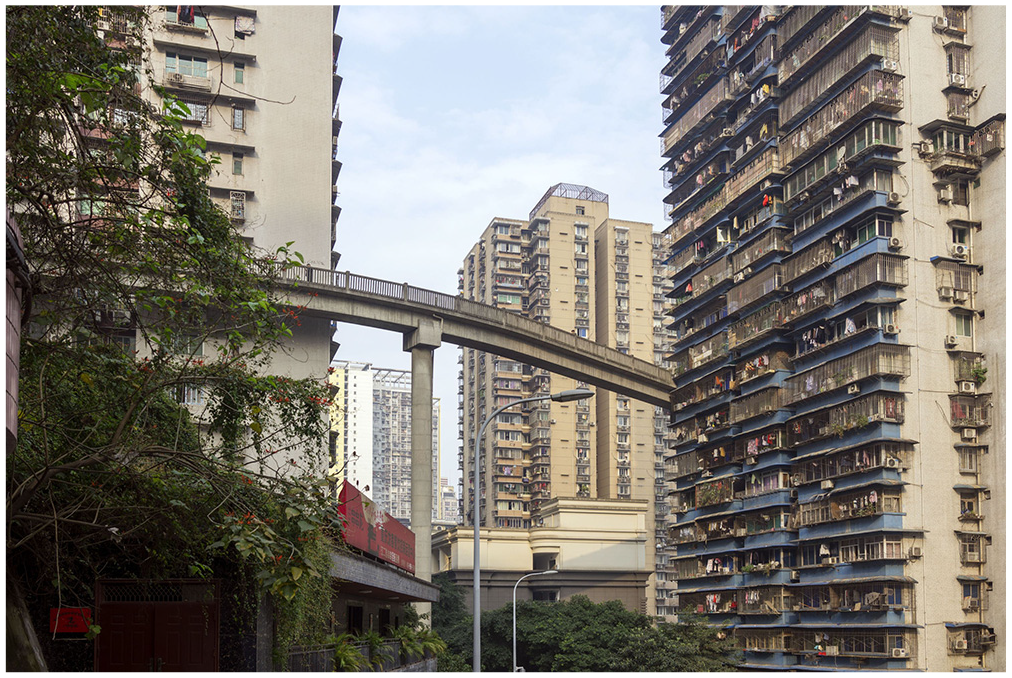
The ‘headstrong’ footbridge at Xinlong Garden.
The high-rise housing of Baixiang Street Community is an example of such a development. This dense collection of six towers stands on a steep hillside in the former economic centre of the Lower City, with bridges connecting the individual structures and a total of 24 storeys of housing and restaurants. None of the towers have a lift, which was common in 1991 when construction was completed. Instead, due to the extremely steep terrain, the towers have three separate exits on the first, 10th and 15th floors. The building thus connects to three separate parallel streets, effectively splitting the towers into three vertically stacked communities. The neighbourhood became an essential photoshoot location for tourists after it featured prominently in the 2016 film Chongqing Hotpot. The extended vertical connections of the building form a communal living space for residents, as raised bridges and open-air corridors are used for social reproduction (childcare, laundry) leisure activities (games of mahjong) and small shops and stalls. The ambiguously public and private nature of these high-rise corridors (primarily serving the residents, but directly accessible from the street) and its vertical street life is shown in the film and in the texts and images created by tourists intruding into these spaces: This 24-storey building with no elevator is where the most indigenous (zui tuzhu) people of Chongqing live. A little brother will ask you to help them open sweets, the grandmas and grandpas will play mahjong from morning to night, while uncle sits in the corridor watching videos and children gather in the corners to eat ice cream. [#5518] It may seem tired and full of holes, but as a native of Chongqing I love this place. It is the epitome of the city which has grown with me from youth to adulthood. [#5117]
Xinlong Garden is a similar high-rise tower constructed near to Baixiang Street in the 1990s. Rather than hugging the steep land, Xinlong Garden stands distinct from the incline of the hill and connects to the Upper City with a precarious free-standing footbridge extending from its 13th floor. The bridge is 40 m in length, curves to avoid another tower, and towers 30 m above a carpark and street below. A local journalist reported that residents recounted happy memories of playing on the bridge, which enabled them to pass above the lower city directly to the Upper City (Ren, 2014). Other comments described the great convenience the bridge brought to residents by connecting them to the Upper City (#4839). The bridge featured in the film Crazy Stone (2006) but became popular with young tourists in 2014 after photos went viral on Weibo.
These spaces were generated by restructuring of the urban economy in the 1990s, as private housing developers and the demolition of the socialist land system encountered the mountainous terrain and traditional vertical building practices of Chongqing. The lack of planning oversight allowed such weird vertical forms to flourish. In online discourse, these vertical connections were described as ‘headstrong’ (renxing) for their refusal to be limited by the steep terrain of the city and the city’s planning regulations. In an interview, a worker in the Chongqing Urban Planning Bureau noted that the lack of planning oversight in the 1990s had caused many such weird structures, which the city now regarded as somewhat embarrassing and sought to avoid in future planning. 2
The bridges themselves resemble the ‘streets in the sky’ created by post-war modernist architects in European and North American high-rises in order to replicate urban street life in a vertical context (Borges and Marat-Mendes, 2019). The ‘headstrong’ construction of these paths of connection, against planning regulations and amidst the mass privatisation of urban space in the early 1990s, represents an improvisation of urban form provided for the benefit of residents. Vertical connections in post-socialist restructuring provide a form of public ‘service’ (Harker, 2014: 328), enabling easier navigation of the city and allowing the reclamation of walkways and roof-spaces as sites of potential communal verticality (Baxter, 2017).
Compression
After 1997, Chongqing became the focus of central state developmental policies seeking to advance urbanisation and urban–rural integration in western China. A key element of this policy was state-backed investment in transport infrastructure, focusing on drastically extending road and rail provision (Martinez, 2015) under the slogan of ‘Chongqing Speed’ (Roast, 2019). The construction of road and rail infrastructure within the city, typically utilising raised bridges and tunnels to navigate the dense urban landscape, created sites in which transport infrastructure is vertically compressed into narrow spaces above and below other land uses.
The most widely photographed example of compression through vertical density is the Liziba Light Rail Station, which occupies the sixth–eighth storeys of a residential tower block (Figure 2). The surreal image of the passenger train passing through the side of a high-rise tower has become a widely recognised symbol of the city, and one of its most popular and most-photographed tourist destinations. The building emerged directly out of the push for high-density planning which maximised space and compressed infrastructural and residential functions in the same vertical stack. The construction was planned in the late 1990s, as the city was entering its most intensive period of restructuring. The unit of land, sitting on a narrow gap between cliff-face and riverbank, was zoned for high-rise commodity housing, but also lay on the route planned for the city’s number 2 light rail line. The solution reached was to incorporate the light rail platform within the residential building, with housing directly above and below the three storeys occupied by the platform and accompanying mechanics. The station was completed in 2004. The passage of the train apparently does not severely impact the lives of residents, as the flow of passengers is segregated from the residential areas, and the main road at the foot of the building is noisier than the station itself.
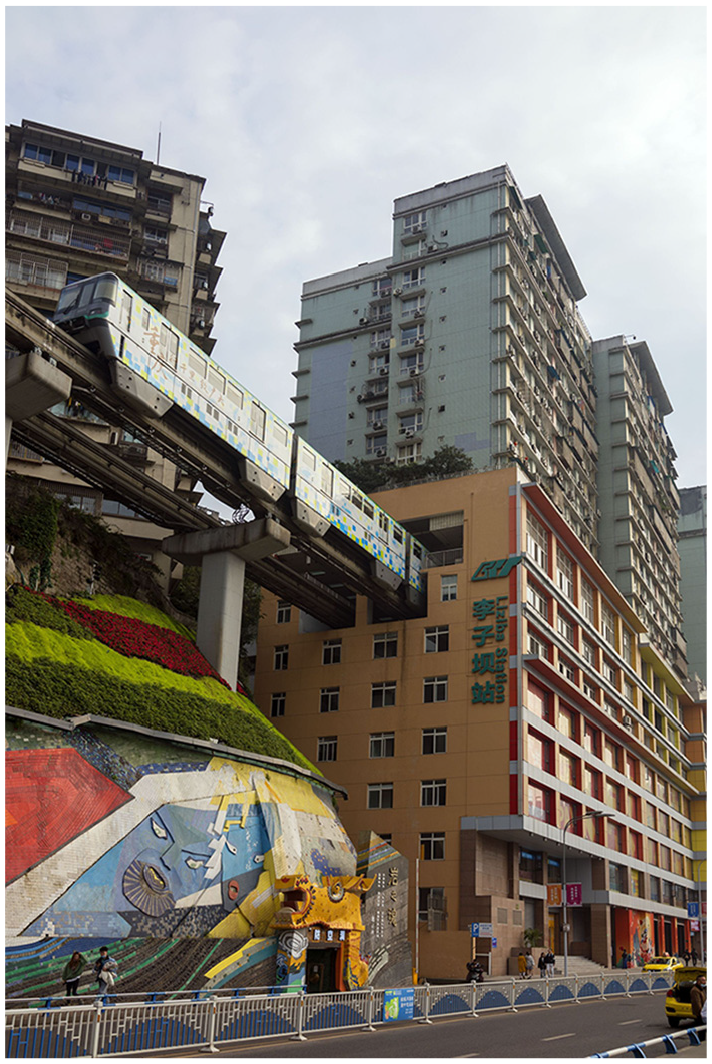
Liziba Light Rail Station in the sixth–eighth storeys of a residential high-rise.
During fieldwork between 2015 and 2017 I observed a gradual increase in the number of tourists who rode the line and filmed the journey on their phones or waited on the road at the foot of the building to photograph the arrival of the train. The popularity of Liziba Station as a tourist destination exploded after 2017, and residents reported that the number of young tourists visiting the site was becoming a nuisance, because they would request access to people’s homes to take pictures and crowd nearby public spaces (Chongqing Youpin, 2019). In response, the local government created a dedicated viewing platform nearby where tourists would be able to take photos, and in 2020 announced that the building would be refurbished to further enhance its status as a tourist destination. The touristification of Liziba prompted angry reactions from many local residents, with some accusing the local government of turning this symbol of the unique quotidian culture of Chongqing into a gaudy ‘pile of shit’ (Chongqing Shiwu, 2020).
Luxification
The sites of connection and compression described above emerged out of urban restructuring in response to the topography of the city and the political economy of post-socialist transition. Conversely, the recent Raffles City development (Figure 3) represents an example more typical of existing theorisations of the vertical, in which extreme vertical architecture serves to create ‘luxified skies’ (Graham, 2016) and privatised high-rises.
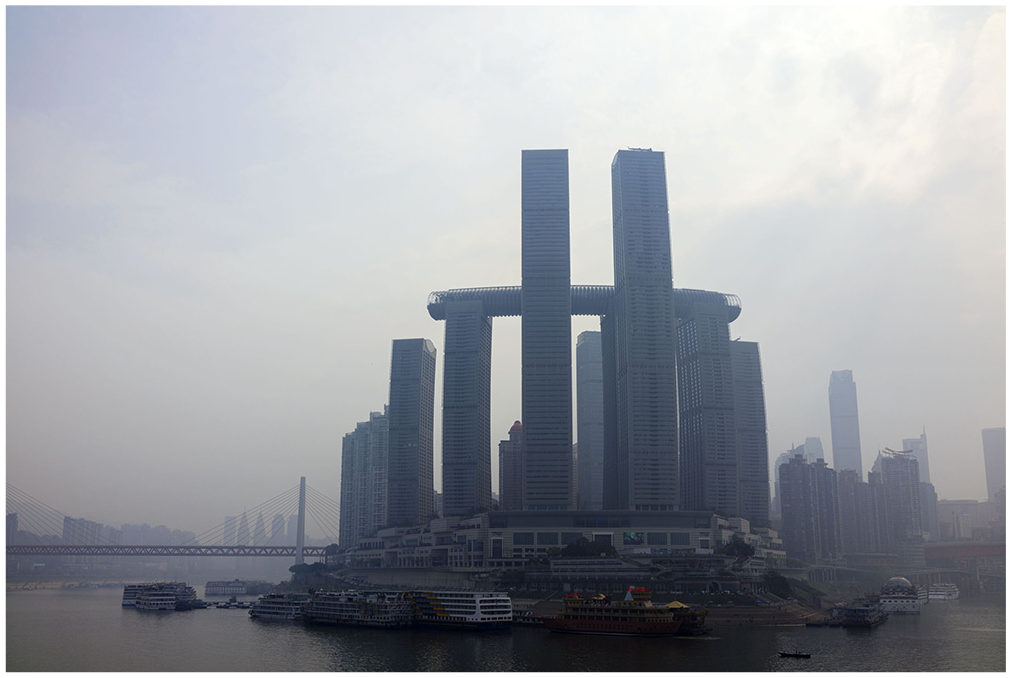
Raffles City development at Chaotianmen Docks.
The Raffles City project was initiated in 2011 when the Singapore-based CapitaLand group purchased the use-rights for the redevelopment of Chongqing’s Chaotianmen Docks for 6.5 billion yuan. The approved project would be part of CapitaLand’s Raffles brand (named after the 19th century British founder of Singapore) following the successful construction of a mall and office high-rise developments in several other mainland Chinese cities. The neighbourhood of Chaotianmen, which would be largely demolished in the process, was highly significant in the city’s history. The traditional docklands of the city, lying at the tip of Yuzhong peninsula, Chaotianmen formed a symbolic focal point and the home of Lower City culture and commerce. The old Chaotianmen neighbourhoods themselves were extremely vertically dense, with staircases cut into rock rather than roads and examples of traditional housing. In the process of redeveloping the area, much of the old neighbourhood was demolished, along with a section of the city walls dating from the Ming Dynasty.
The design of the Raffles City project was controversial from the outset. The public space adjacent to the wharfs would be replaced with a five-storey mall, with eight skyscrapers protruding from it in a fan-like sweep. The two central towers would be the tallest buildings in western China, and the towers were linked by a 300-m-long distinctive glass ‘sky deck’ named The Crystal containing restaurants, a public observatory and an exclusive clubhouse. The design is closely reminiscent of the Marina Bay Sands development in Singapore – itself an exemplification of the luxification of the vertical city (Graham, 2016: 242–243) – and was designed by the same architect, Moshe Safdie.
Raffles City attracted considerable international attention, despite its obvious emulation of Marina Bay Sands. A recurring theme of the coverage was fascination with the sky deck which would be suspended 250 m above the city. The Guardian referred to it as a ‘horizontal skyscraper’ which sought to solve the problem of increasingly overcrowded cities in China (Roxburgh, 2018), evoking a futurist imaginary of extreme vertical density as a technological fix necessitated by excessive urban growth.
The project also received domestic commentary and criticism in the context of the central state’s campaign against weird architecture from 2014 onwards. A spokesman for CapitaLand rejected the accusation that the project was an example of weird architecture or a copy of Marina Bay Sands, as local commentators suggested. Instead, he argued that the fin-like structures of Raffles City were inspired by the image of sailboats crossing the Yangtze and accordingly insisted that ‘if such buildings seem to have a slightly weird appearance this is derived from taking the characteristics of that city as a starting point in our design process’ (Cao, 2014).
Online commentary reveals that despite this assurance, many local residents have objected to the project. Commenters on Weibo and Zhihu worried that the area would be ‘privatised’, that the old name of Chaotianmen would be forgotten and replaced by Raffles, and that the project demonstrated the erasure of Chongqing’s cultural heritage. They lamented that Chongqing was making itself a ‘knock-off Singapore’. A group calling itself the Chongqing Cultural Heritage Volunteers was formed, and wrote an open letter to the municipal government in January 2018. In it they voiced their concerns that Raffles City would erase the traditional dockside culture of Chaotianmen and cut off the waterfront from the rest of the city. They proposed the construction of new roads and pathways to better integrate the plaza with the surrounding district, echoing the traditional vertical connections which had characterised the lower city (CCHV, 2018). Other condemnations of the project grounded their critique in the traditional architectural metaphysics of feng shui, as the high-rise towers resembled a sieve through which the city’s prosperity would leak away (Liu, 2018), or six swords stabbing the city (Zhuge, 2019). This was mirrored in widespread local social media commentary which decried the imposition of such a weird foreign shape upon the city: It gives me a weird feeling, and doesn’t match Chongqing’s style or terrain at all. [#8938] Despicable behaviour! It has seriously damaged Chongqing’s feng shui and cultural heritage. The people of Chongqing ought to unite and blow it up. [#8834]
The local opposition to Raffles City illustrates a distinction drawn by the inhabitants of Chongqing, who viewed it as the imposition of an unsuitable and inhospitable form of verticality which was incompatible with existing local forms of vertical life: appearing ‘weird’ to locals, even if not to outsiders. It is significant that several online commenters also noted that space would be exclusive and subject to private control, ‘a commercial building where only the rich will live’ (#8707), risking the creation of exclusive and unwelcoming vertical spaces of consumption. The luxification of verticality in Chongqing necessitated the destruction of the traditional forms of vertically dense housing which typified the Lower City and the old dockside housing of Chaotianmen. In a further iteration of the post-socialist restructuring of vertical space, the residents of Chaotianmen were displaced (likely rehoused in the high-rise public housing built simultaneously on the edge of the city).
Verticalities weird and everyday
Spaces of extreme vertical density in Chongqing arose out of a historical need to adapt to mountainous topography, but the creation of such spaces accelerated and transformed as part of the restructuring of the city from the early 1990s. The demolition of the socialist housing system and poor enforcement of planning regulation allowed experimental vertical forms of connection to be created in high-rise blocks, and state-led investment in transport infrastructure created spaces where domestic and residential spaces of the city were vertically compressed by road and rail lines. More recently, a discursive construction of the city as a space of ‘weird’ urban forms occurred, focusing on images of the extreme vertical density created by urban restructuring. This involved the imaging of these spaces in Chinese domestic cinema and social media as accidental urban spectacles, their re-imaging for an international audience as evidence of the futuristic verticality of Asian urbanism, and the subsequent attempt to create further vertical urban spectacles as in the touristic redevelopment of Liziba, or the commercial development of Raffles City.
The distinction in why and by whom verticality is viewed as weird is illustrative. While the connective footbridges and compressed living spaces of the older vertical spaces were viewed by outsiders as weird insofar as they exceeded typical expectations of urban space as ordered around the horizontal axis, commentary by Chongqing locals asserted their mundanity, and their value as spaces of convenience and community for inhabitants. By contrast, Raffles City was seen by locals as truly ‘weird’ in that it imposed a foreign, commercial form of verticality which clashed with existing everyday vertical urbanism. Vertical spaces in Chongqing moved from an incidental product of restructuring political economy to the conscious production of vertical urban spectacle.
The vertical spaces of Chongqing are liable to be designated as ‘weird’ in two distinct ways: as an ethnographic object of social media and as a form of urban governance used to prohibit certain architectural forms. I would suggest that we might add to this a consideration of the theoretical ‘weirdness’ of these spaces. Just as the everyday verticality of Chongqing exceeded the expectations of outsiders as to how urban space should be organised, it likewise offers a ‘weird’ provocation to urban theory because many of its examples challenge the notion of high-rise living as unnatural, and the perceived undesirability or failure of vertical urbanism.
Chongqing’s discursive portrayal as a site of spectacular vertical density demonstrates that representations of verticality perform a critical role in imagining urban futures. Verticality is mobilised through the production and sharing of images of walkways, flyovers, train lines and ‘horizontal skyscrapers’. In representations outside of China, the imaginary of the ‘Sino-futurist city’ uses images of vertical density to imagine Chinese urbanism as impossibly futuristic in comparison to cities of the Global North (see de Seta, 2020; Roast, 2021). Conversely, domestic imaginaries of density contrast the everyday spaces of accidental weird verticality in Chongqing with those projects which seek to deliberately embrace the political-economy of the urban spectacle.
This underlies a broader re-spatialisation of socio-economic class in the post-socialist Chinese city, and the lived political economy of an increasingly vertical city. The verticality of connection and compression created publicly accessible spaces within the city which were utilised by ordinary residents. The nostalgic communality associated with spaces of vertical connection such as Baixiang Street and the ‘headstrong’ bridges of Xinlong Garden offers a vision of verticality as a stubborn persistence of everyday life, wherein such spaces allow a blending of public and private, domestic and commercial. By labelling such spaces as ‘headstrong’ and ‘indigenous’, local commentators posited them as a nominal space of local utility and agency in response to the wider economic restructuring of the city. While such spaces do not necessarily constitute resistance to urban restructuring, their contrast with other forms of luxified verticality is instructive. The uncoupling of verticality from local needs, as in the case of Raffles City, met with angry reactions from inhabitants incensed by the privatisation of space. These cases illustrate the countervailing ways in which the politics of public and private space are mobilised along the vertical axis in post-socialist urban restructuring.
The ‘weirdness’ of Chongqing’s urban form provides an instructive example of how the scholarship of urban verticality might respond to Harris’s (2015) call to address the multiple geographic imaginations of urban verticality. Chongqing illustrates the multivalent nature of the vertical city, with spaces of vertical density appearing as sites of communality, restructuring, everyday life, as well as spectacle, luxification and accumulation. This mitigates the temptation to understand verticality purely through metaphors of control and capture as an exogenous and violent imposition on a city which is horizontal by default, suggesting new directions for research which would fully excavate the politics of daily life in the weird high-rise. Chongqing’s vertical spaces carry theoretical weight because their ‘weirdness’ in the eyes of outsiders (tourists, official prohibition, and urban theory) belies their normality for local residents.
Conclusion
My argument has been primarily concerned with how verticality is imagined, and what those imaginations obscure. If the scholarship of urban verticality tends to imagine the vertical as a recent, forceful imposition on a residual horizontal city of communality and the everyday, it risks obscuring the fact that vertical density has been a longstanding feature of everyday urban life. Conversely, the gaze of outsiders imagines the vertical density of Chinese cities as indicating a form of futuristic urbanism which appears weird, and so overlooks the specific history of urban restructuring and transition to a post-socialist urban economy which created such spaces. In both cases, verticality is imagined as indicating unsettling and implicitly unnatural forms of urban life.
By adopting the terminology ‘weird’ to describe these sites, my intention is not to concede to this othering of verticality, but rather to highlight how investigation of such spaces and the qualities which make them remarkable can reveal the inadequacy of these imaginations and the need for new theorisations by urban studies researchers. Contra the prohibition on ‘weird’ architecture initiated by the Chinese state, we might ask what research of nominally weird spaces can contribute to urban theory. In that sense, weirdness provides a heuristic lens for investigating how and why urban forms are marked as being something beyond the normal, as in Lancione’s (2019) investigations of the weird exoskeletons of underground life in Bucharest. The sites presented in this paper serve to disavow the tendency for verticality scholarship to over-assume horizontality as default, and instead highlight the everyday nature of vertical spaces which may appear weird to outsiders.
Closer investigation of the nominally weird qualities of these sites would prompt consideration of the weird spatial politics of the urban. This paper is limited by the relative silence of the voices of those who actually inhabit and make daily use of these spaces, for which long-term ethnographic research is needed. Such an approach might lead researchers to examine the cultural politics of heritage and aesthetics in vertical restructuring, as revealed by the case of Raffles City. It might prompt study of the way everyday spaces are restructured for touristic consumption and imaging, as in the example of Liziba Light Rail Station. It might lead to an ethnographic study of how support and community constitute the ‘ordinary topologies’ (Harker, 2014: 323) of life in everyday vertical spaces, and how these are enclosed by ongoing urban restructuring. This article serves as a call for further sustained ethnographic engagement with discursive, material, and affective construction of these ostensibly weird urban spaces.
Footnotes
Acknowledgements
The author wishes to thank the editors of this special issue for their support and advice in preparing this manuscript. The comments provided by Katherine Zubovich and Saffron Woodcraft were particularly useful in clarifying the main topic of the paper. He wishes to thank Gabriele de Seta and Amy Yueming Zhang for their encouragement and thoughtful conversations which helped extend and deepen many aspects of the paper’s argument. Thanks should also be extended to friends in Chongqing for their assistance, in particular Yi Xiaoting and Zeng Rui for the photos included in this article. Finally, he wishes to thank the three anonymous reviewers for their valuable comments and critiques. All errors and omissions remain the responsibility of the author alone.
Declaration of conflicting interests
The author declared no potential conflicts of interest with respect to the research, authorship, and/or publication of this article.
Funding
The author received no financial support for the research, authorship, and/or publication of this article.
