




Abstract
While the question of how the Smart City (SC) concept is mobilised at global and local levels is well researched, few studies have focused on the national level. In this article, we seek to better understand the role of the national level regarding the embedding and creation of SCs. More specifically, we explore the German Smart Cities Dialogue Platform, established by the German government in 2016 as a place where ways of thinking about and acting on the SC are produced and stabilised. Drawing on key concepts of governmentality, we analyse dominant narratives of the SC in Germany, focusing on how the national SC discourse shapes the governance of urban sustainability. We show that the national level in Germany plays a decisive role in embedding and creating the SC, as it mediates between globally prevailing ideas of the SC and local realities. By linking the SC to nationally prevailing values, norms and political cultures such as sustainability, the common good, civil rights and digital sovereignty, a corrective to globally dominant techno-euphoric narratives of the SC is created. At the same time, the (re)definition at the national level promotes an ecological modernisation approach to sustainable urban development to the exclusion of alternative visions of urban sustainability pathways.
Introduction
Compared to other countries such as India, Italy or the UK, German municipalities started implementing the Smart City (SC) concept comparatively late and with a rather cautious approach. This is mainly because in many German municipalities, concerns about the risks of an increasing integration of digital technologies into urban administrative services and infrastructures of general interest outweighed the promises of a SC future. Risks were seen, for example, in the fact that socio-spatial inequalities or dependencies on technology companies could increase. However, in 2016, the German government launched the German Smart Cities Dialogue Platform (SCDP) to formulate a common understanding of the SC that is shared by a broad range of stakeholders and to further guide the implementation process for SCs in Germany. A few years later, the concept has arrived on the political and planning agenda of many German municipalities. This observation raises the question of the influence of the national level regarding the embedding and creation of SCs on the local level.
In this article, we therefore attempt to add to the literature that deals with the question of how and for what purpose the SC is mobilised and embedded on different levels, focusing on the national level. Some of the literature has shown how the SC is mobilised by multinational tech giants such as IBM or Cisco (e.g. McNeill, 2015; Sadowski and Bendor, 2019; Söderström et al. 2014) and at the European level (e.g. Haarstad, 2017) or how it is locally embedded (e.g. Cowley et al., 2018; Crivello, 2015; Leitheiser and Follmann, 2020). However, few studies have focused on the national level, although numerous studies have found similarities between ‘actually existing’ SCs within a country (e.g. Caprotti and Cowley, 2019; Dowling et al., 2021) and thus point to the role of the national level in shaping SCs. Therefore, we follow Varró and Bunders’ (2020) call to reintroduce the national into the study of globally circulating policy ideas like the SC by looking at a central site of SC negotiation in Germany, the national SCDP.
This article is guided by the question of how the concept of the SC is understood, (re)defined and mobilised at the national level in Germany. As the SC in Germany is closely linked to the sustainability discourse, we further ask how the SC shapes the governance of urban sustainability and thus also the corridor of action for urban sustainability policy. To this end, we analyse dominant narratives that emerge in the national SC discourse and ask how sustainability is framed within them. To analyse the narratives, we use a post-structuralist discourse analysis based on concepts from governmentality studies to interpret a corpus of 162 documents (website material, policy strategies, reports, grey literature and press releases) that have emerged aligned with the SCDP, as well as six interviews with key figures from science, politics and business.
Although our empirical analysis is focused on a specific policy arena, the SCDP, it provides a detailed picture of how the SC is constructed at the national level. Our findings suggest three dominant SC narratives in Germany, which we refer to as the ‘modernisation narrative’, the ‘citizen-centred narrative’ and the ‘sovereign city narrative’. Together they criticise parts of globally dominant techno-euphoric narratives of the SC. Furthermore, our findings suggest that the seemingly successful process of (re)defining the SC from a ‘German’ perspective also produces problematic results.
(Re-)defining and shaping the (sustainable) smart city at the national level
The SC is associated with various promises such as social progress, competitiveness, prosperity and security. In the political and scientific SC discourse of the global North, particularly in Europe, the SC is also associated with the goal of sustainability, whereby ‘smartness’ and ‘sustainability’ are increasingly used interchangeably (De Jong et al., 2015; Martin et al., 2018, 2019).
In response, social science research has sought to understand how sustainability and smartness are conceptually linked and to what extent SCs contribute to urban sustainability (e.g. De Jong et al., 2015; Greenfield, 2013; Haarstad, 2017; Hollands, 2008; Joss et al., 2019; Leitheiser and Follmann, 2020; March, 2018; Martin et al., 2018; Vanolo, 2014; Viitanen and Kingston, 2014). This literature is critical of the notion that SC agendas promote urban sustainability. In this context, scholars have criticised SC agendas for promoting an entrepreneurial approach to urban development (e.g. Greenfield, 2013; Hollands, 2008; March and Ribera-Fumaz, 2016; Söderström et al., 2014; Strüver and Bauriedl, 2020; Viitanen and Kingston, 2014; Wiig, 2015) and reinforcing an ecomodernist approach (e.g. Joss et al., 2019; Martin et al., 2019; Miller, 2019; Sadowski and Bendor, 2019). Furthermore, scholars state that there is a lack of evidence that SC agendas offer solutions to social and environmental sustainability problems (Martin et al., 2018) and that the potential of digital innovations and technologies is overestimated (Viitanen and Kingston, 2014). Moreover, some scholars argue that the pursuit of SC agendas could potentially exacerbate social and environmental sustainability problems in urban areas by reducing sustainability to a set of standardised technical and economic solutions (March, 2018; Martin et al., 2018; Strüver and Bauriedl, 2020), thus marginalising aspects of a holistic approach to sustainability (Joss et al., 2019; Moss et al., 2021).
However, given the definitional and conceptual vagueness of the SC concept, ‘it is […] difficult to measure with any accuracy what smart city projects actually contribute to urban sustainability’ (Haarstad, 2017: 424). After all, notions of the SC are constantly being renegotiated by urban researchers, policy makers, urban planners, technology developers and city dwellers, making the SC a multi-layered, ambiguous, flexible and dynamic concept that is constantly evolving (e.g. Haarstad, 2017; Joss et al., 2019; Sadowski and Bendor, 2019; Sadowksi and Maalsen, 2020; Shelton et al., 2015; Varró and Bunders, 2020). Therefore, a more recent strand of social science research has emerged that explores questions of negotiating and embedding SCs at different levels and in different contexts. Some scholars have critically engaged with the socio-technical imaginaries generated by multinational tech giants such as IBM or Cisco (e.g. McNeill, 2015; Sadowski and Bendor, 2019; Söderström et al. 2014; White, 2016; Wiig, 2015), while others have explored how the SC has been mobilised at the European level (e.g. Haarstad, 2017). Yet, the majority of scholars, including those in this journal, followed Shelton and his colleagues’ (2015) call to engage with ‘actually existing’ SCs (e.g. Caprotti, 2019; Chang et al., 2021; Cowley et al., 2018; Crivello, 2015; Leitheiser and Follmann, 2020; Miller, 2019; Sadowski and Maalsen, 2020; Valdez et al., 2018).
Remarkably little attention is paid, however, to the national level when addressing questions of by whom, for what purpose and how the idea of the SC is mobilised. Only a few studies look at countries that have declared the implementation of SCs in a top-down approach to be a government project, including studies on national SC policies in India (Gupta and Hall, 2017; Höffken and Limmer, 2019), China (Dameri et al., 2019; Yang et al., 2021), Singapore (Ho, 2017; Kong and Woods, 2018), Korea (Yang et al., 2020) and Hungary (Varró and Bunders, 2020). However, when examining countries where municipalities have a high degree of administrative autonomy and where the SC is largely organised as a bottom-up process, including numerous European countries, the focus on the national level appears to be a rather exceptional case. In this context, studies usually only refer to the national level to explain similarities between SCs within a country (e.g. Caprotti and Cowley, 2019; Dowling et al., 2021; Sadowski and Maalsen, 2020). Some studies focus on national SC policies in European countries, for example in the Netherlands (Varró and Bunders, 2020), the UK (Buck and While, 2015) or Italy (Dameri et al., 2019; Pollio, 2015; Vanolo, 2014). However, these studies do not explicitly attempt to understand the role of the national level in mobilising, embedding and creating SCs.
The ‘family resemblances among smart cities in one country’ (Varró and Bunders, 2020: 220) have been noted by several scholars, and the importance of the ‘national’ in the creation of SCs has been pointed out (e.g. Buck and While, 2015; Caprotti and Cowley, 2019; Crivello, 2015; Dowling et al., 2021; Höffken and Limmer, 2019; Varró and Bunders, 2020). Therefore, in this article we aim to contribute to a better understanding of the role of the national level in the mobilisation of SCs. To this end, we turn to the national level by looking at a central site of SC negotiation in Germany, the national SCDP, and focus on unravelling national SC narratives and how they shape the governance of urban sustainability in German municipalities.
The rise of the smart city in a country full of sceptics
While the concept of the SC entered the political discourse at the European level in the 2000s, it took another decade for the SC to become a dominant discourse in Germany. Today, the concept has become a guiding principle for urban development and there is strong political support for the implementation of SCs in Germany.
In general, SC development in Germany can be divided into three phases: a pioneering phase, a phase of (re)definition and an implementation phase. In the first phase, which lasted until 2016, most German municipalities were sceptical about the SC concept. Concerns about socio-spatial inequality, the growing influence of IT companies and democratic deficits outweighed the promises of technology companies (Libbe, 2018). Only some, mainly larger, so-called ‘pioneering cities’ such as Cologne, Hamburg and Munich developed the first SC initiatives. In the absence of national strategies and funding programmes at this stage, the main driver for this development was the interest of technology companies in deploying their digital products and services in cities. In addition, the European Union has also played a significant role, particularly through the European innovation and funding mechanisms that have been in place since 2012, including the Horizon 2020 programme ‘Smart Cities and Communities’.
In response to the hesitant attitude of most German municipalities towards the SC and the growing momentum in the field of digitalisation, the Federal Ministry for the Environment, Nature Conservation, Building and Nuclear Safety (BMUB) launched the SCDP in 2016 on behalf of the German Federal Government. This marked the beginning of the second phase, a phase of exchange and (re)definition on a ‘German’ understanding of the SC between various stakeholders. One interviewee describes the aim of the SCDP as redefining the corporate and technology-driven concept of SCs from the perspective of urban development and to ‘regain sovereignty of interpretation over what actually happens in the cities’ (I_2). To this end, 70 experts from municipalities, municipal umbrella organisations, several federal ministries, various research organisations, business, social and professional associations and civil society developed a common understanding of SCs in a one-and-a-half-year consultation process, which resulted in the ‘Smart City Charter: Making digital transformation at the local level sustainable’ in June 2017. Since then, this Charter has served as a guiding framework for the implementation of smart agendas and projects in German municipalities.
In the third phase, which has been running since 2017, numerous German municipalities are implementing SC agendas (or digitalisation strategies, as they are often called in Germany) and developing so-called ‘smart model projects’, while sharing their experiences between municipalities. This development is supported by several private and public funding programmes that provide millions of euros for implementing SCs. The federal programme ‘Smart Cities Model Projects’ alone has already supported 73 cities and 659 measures with a funding volume of €820 million (BMWSB, 2024). Nevertheless, the SC discourse in German urban development policy is relatively new, and German municipalities are still in a phase in which model projects are being implemented on an experimental basis, while comprehensive SC approaches at the city-wide level are lacking.
Analytical framework and methodology
In this article, we analyse dominant narratives that emerge in the German SC discourse, focusing on the SCDP. The analysis of narratives is crucial because they ascribe ‘meaning to social or physical phenomena’ and thus shape our understanding of ‘who or what is significant’ (Leipold, 2021: 1047). We understand ‘narrative’ as a story that emerges from a concatenation of discursively constructed problems and the assumption of a shared conception of how these problems can best be addressed through specific policy rationales and modes of governance, and by whom they should be addressed. As such, narratives are not simply descriptions of reality, but rather tools that serve to shape reality, legitimise or justify (in)action and provide normative guidance to set subsequent processes in motion; they can ‘fundamentally enable or constrain our thought spaces and practical options for the future’ (Leipold et al., 2021: 2).
To analyse the dominant SC narratives, we combine a discourse-analytical approach with insights and concepts from governmentality research. This field of research goes back to Michel Foucault, who developed the concept of governmentality in a later phase of his work, especially in his lecture series ‘Security, Territory and Population’ and ‘The Birth of Biopolitics’ in 1978–1979. Initially rooted in political science, governmentality research has gradually expanded to encompass various disciplines within social science to analyse implicit rationalities and modes of governance. More recently, scholars have pointed out that SC agendas lead to a reconfiguration of urban governmentality and have adopted a governmental perspective to analyse SCs (e.g. Gabrys, 2014; Ho, 2017; Klauser et al., 2014; Kuecker and Hartley, 2019; Luque-Ayala and Marvin, 2015; Pollio, 2015; Vanolo, 2014). Some of this literature has analysed the logics and dynamics of digital technologies and how they reshape urban governmentality (e.g. Badouard et al., 2016; Coletta and Kitchin, 2017; Dammann et al., 2022; Kitchin et al., 2020; Klauser et al., 2014).
Yet, we take up a line of research that can be observed particularly in energy geography. This research strand understands SCs as governmental programmes and seeks to unravel the purposes for which they are mobilised and the modes of governance that they legitimise (e.g. Bulkeley et al., 2016; Büttner and Barning, 2023; Envall, 2021; Levenda, 2016). Following this scholarship, we seek to expose and critically interrogate the governance problems and rationalities articulated in the national SC discourse as well as the solutions to these problems.
We used extensive discourse material in order to identify and analyse the dominant SC narratives in the German discourse. The document corpus comprises 162 documents from the years 2015–2023, including policy strategies such as the Smart City Charter, but also ‘Point of View Papers’, blog entries, funding calls, protocols, presentations and grey literature. On the one hand, we analysed all publicly accessible documents produced in connection with the SCDP. On the other hand, we analysed relevant documents that were published in the same period by actors involved in the SCDP. In addition, we conducted six in-depth face-to-face and semi-standardised interviews to compare our findings from the documents analysed with the impressions and assessments of different stakeholders. We selected interviewees who were either involved in the SCDP or critical observers of it, including representatives from administration, science, business and civil society. The interviewees were asked about their understanding of the SC and of the role of the SCDP in embedding and creating SCs in Germany. In addition, we addressed the connection between digital and sustainable urban development as well as controversies in the German SC discourse.
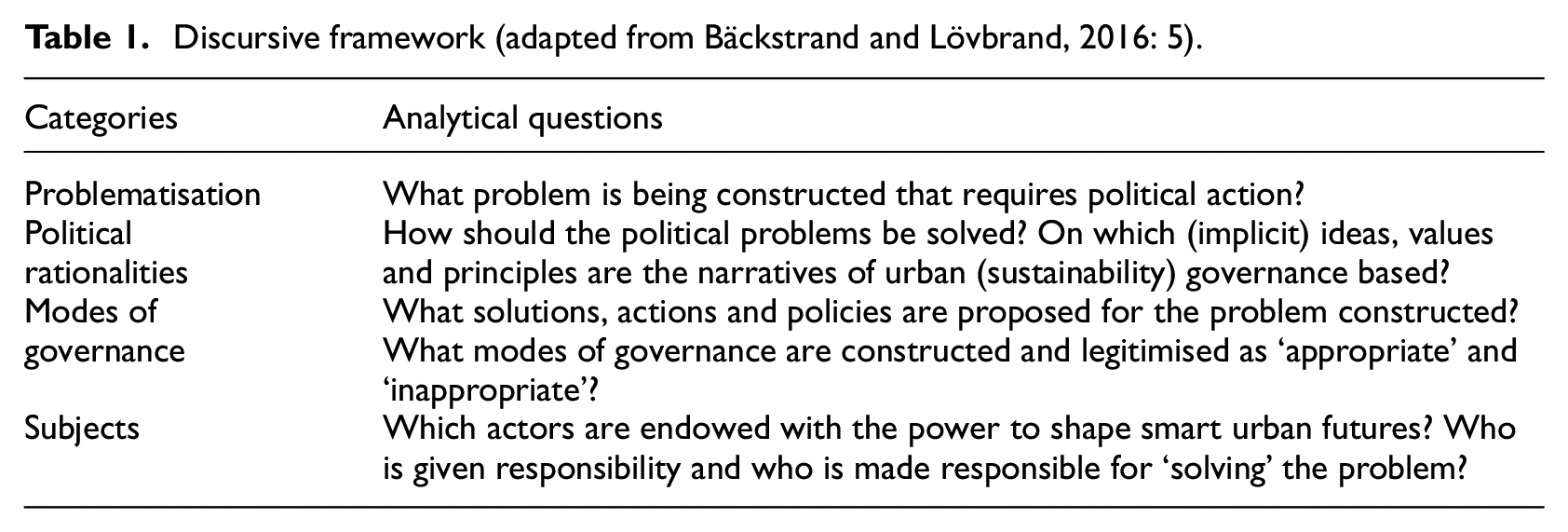
In this study, Foucauldian governmentality research is used as an ‘analytical toolbox’ (Bäckstrand and Lövbrand, 2016: 5) and four analytical categories guided our analysis of the dominant SC narratives in Germany: (1) problematisation, (2) political rationalities, (3) modes of governance and (4) subjects. The collected documents were finally coded in MaxQDA and thematically analysed guided by questions related to these four categories (see Table 1). Qualitative, inductive coding with interpretative codes (such as ‘climate crisis’, ‘efficiency’, ‘governing in partnerships’, ‘smart citizens’) was used, and these codes were then assigned to the respective categories. After the entire document material had been coded, we searched the data material for recurring problematisations, rationalities, governance modes and subjects and in this way identified the dominant SC narratives in the discourse. Finally, the document analysis was combined with the analysis of the interviews in order to obtain a comprehensive and more reliable picture of the SC narratives produced by the SCDP. The interview material was thematically coded in the same way as the documents.
Discursive framework (adapted from Bäckstrand and Lövbrand, 2016: 5).
German smart city narratives
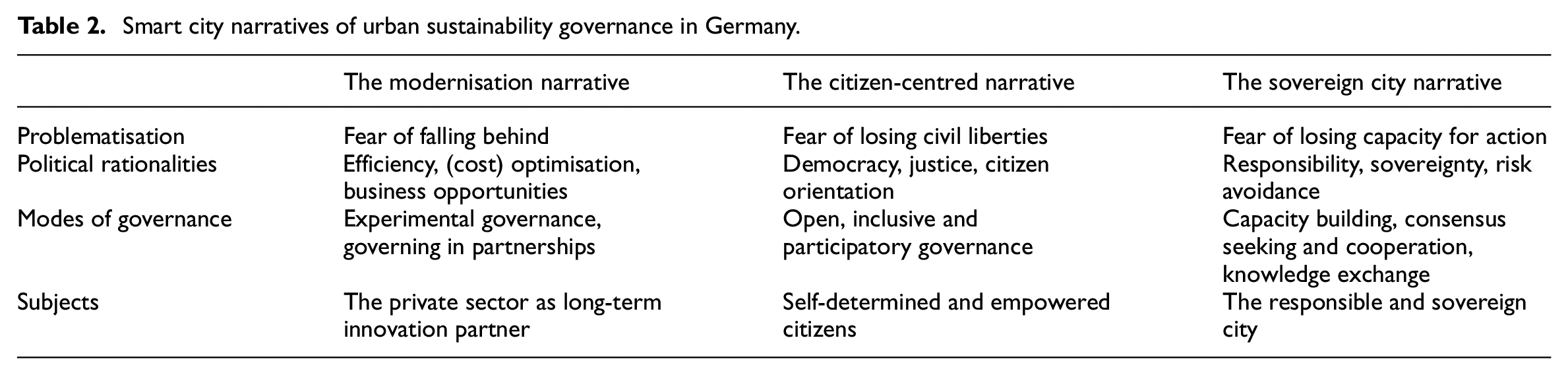
Our analysis points to three coexisting, hegemonic narratives that have emerged in the national SC discourse and that represent different visions of a smart sustainable urban agenda: the ‘modernisation narrative’, the ‘citizen-centred narrative’ and the ‘sovereign city narrative’ (see Table 2).
Smart city narratives of urban sustainability governance in Germany.
These narratives have in common that they construct a digital future as if there were no alternative. The digital transformation, they claim, will take place at an ‘unprecedented speed’ (BMWSB, 2022: 4; see also BBSR, 2017a, 2017b; BMI, 2019) ‘without us having the opportunity to decide against it’ (BMI, 2018: 6). The digital transformation ‘will continue to change many areas of the economy, administration and urban society’ (BBSR, 2017a: 25) and therefore poses major challenges to municipalities, meaning that ‘municipalities must address the issue, whether they like it or not’ (BMI, 2019: 20).
However, the three narratives differ in terms of the problems outlined if no action is taken and the policy responses derived from them.
The modernisation narrative
Problematisation
The first, rather optimistic modernisation narrative problematises the untapped growth potential of the digital transformation in Germany. Germany is portrayed as a country that is too slow and cautious regarding the digital transformation, and a constructed fear of being ‘left behind’ (BBSR, 2017a: 53; see also I_1) legitimises an urgent need for action. A lack of digital infrastructure investment, but also ethical debates on data protection (prevalent in Germany), poses risks to local competitiveness, prosperity and ultimately the sustainable growth of cities. Only if regional companies remain competitive and Germany can maintain its role as a global market leader will it be possible to ensure compliance with sustainability targets vis-à-vis foreign companies and to implement ‘value-orientated digitalisation’ (I_2): ‘If we just wait and see 10 years from now that there are products that are only from foreign manufacturers, but they don’t meet our security standards […] or […] our privacy requirements, then we have a problem. (I_1)
1
Political rationality
In this narrative, the digital transformation is presented as a chance for cities and society, as digitalisation makes it possible to ‘keep the production in Germany or even bring it back from other countries’ (BBSR, 2017a: 19). However, the SC is constructed not only as a business opportunity (e.g. BBSR, 2017a; BBSR, 2023a; I_1) but also as a driver for sustainable urban development with a clear focus on climate neutrality and resource efficiency. Efficiency through digital technologies dominates this narrative as a central rationale, for example in relation to energy and resource use (BBSR, 2017a: 63), internal administrative organisation (BBSR, 2021a: 10) or the management of urban systems and the provision of services (BBSR, 2017c: 14).
Modes of governance
This narrative promises to achieve urban sustainability through digital technologies without jeopardising economic growth, thus telling the story of a win–win situation. A growth coalition is promoted, for example it is stated that ‘[t]here is no doubt that the digital transformation necessitates new forms of cooperation between local governments and private industry’ (BMI, 2020: 10). Governing in partnerships is legitimised with the aim of pooling resources and (digital) competencies. In addition, the Smart City Charter presents ‘real-world laboratories with liberalised regulations’ (BBSR, 2017a: 15) as the key governance mode. This requires agility, fault tolerance and a new, open ‘innovation culture’ (BBSR, 2017a: 16).
Subjects
Private and public companies are seen as key players in implementing the digital transformation due to their knowledge and technologies. According to the modernisation narrative, they act not only as ‘ad hoc suppliers of services and products’ (I_1) but also as long-term ‘innovations partners’ (I_1) of the municipality. Municipalities, in turn, are imagined as supporters of new business models that arise from these partnerships. Furthermore, they are portrayed as being responsible for setting up the technical infrastructure as well as for creating the legal, political and financial framework required for the digital transformation (BBSR, 2017a). In contrast, citizens are ascribed a more passive role. Their contribution is primarily seen in providing data for the digital transformation, as the following quote demonstrates: Of course, citizens are the central part, that’s why we’re doing the whole thing. And the main thing here is to convince citizens of the digitalisation of the urban community, because […] citizens also provide data’. (I_1)
The citizen-centred narrative
Problematisation
In the citizen-centred narrative, the loss of democracy is imagined as the central policy problem of uncontrolled digitalisation. In addition, ‘a threat to the fundamental rights, security and privacy of each individual’ (BBSR, 2017a: 14) is outlined and the ‘digital division of our society’ (BBSR, 2017a: 74) is problematised. Ultimately, the citizen-centred narrative creates an urgency to act by constructing images that fuel fears, such as the image of a ‘democracy vacuum’ (BBSR, 2017a: 69) or of an ‘analogue hermit’ (BBSR, 2017a: 76) who is losing touch with society.
Political rationality
While this comparatively sceptical narrative emphasises the risks of digitalisation for democracy and participation, it also sees ‘an opportunity for even greater participation and ultimately even greater democratisation’ (I_4) if it is implemented ‘correctly’– that is, if the new ‘technologies are put at the service of people and the overarching goals of the common good’ (BBSR, 2021b: 6; see also BMI, 2019; I_3). In this context, it is said that ‘[t]he raison d’être and the central element of smart cities are the citizens and not the technology’ (BMI, 2019: 31). This narrative thus rejects the view that the SC is a technological endeavour, and instead positions the SC as a social project that responds to ‘the people’s need’ (BBSR, 2017a: 10). Accordingly, the SC is defined as a city in which ‘digitalisation is not an end in itself’ (BMI, 2019: 5) but a ‘tool’ for achieving urban sustainability, with ‘people at the centre’ (I_2). Furthermore, concepts such as the ‘right to digital participation’ (BBSR, 2017a: 79) or the ‘open city’ (I_3) are linked with this rationale.
Modes of governance
The narrative emphasises thinking SCs ‘from the bottom up’ (I_2), and an ‘activating, integrative and inclusive approach to participation’ (BBSR, 2017a: 12) is presented as the key mode of governance. However, instead of reacting with comprehensive structural reform proposals, this narrative responds by shifting responsibility to the individual, who is expected to have a certain level of digital competence. The sovereignty of the individual is to be secured through the development of ‘digital skills in urban society’ (BBSR, 2023b: 16), thereby reducing the risk of marginalisation. However, it is acknowledged that ‘analogue structures’ (BBSR, 2017a: 12) are needed to reduce the emerging social and spatial divide between digitally ‘educated’ and ‘uneducated’ citizens.
Subjects
The narrative positions the ‘mature’ (BBSR, 2017a: 55) and ‘self-determined citizen’ (I_2) as a key actor. Citizens should be able to use digital technologies and services in a competent and responsible manner and to actively shape the digital transformation. The state or municipality is portrayed as a supporter of this ‘smart citizen’.
The sovereign city narrative
Problematisation
The sovereign city narrative anticipates worrying consequences for the municipal (digital) sovereignty, the ability of municipalities to shape the future and ultimately the common good because of a digital transformation steered by a ‘foreign hand’. The mobilisation of emotive language and dystopian images, such as that of a ‘digitalisation tsunami’ (BBSR, 2017a: 69), is used as a discursive strategy to legitimise political action. The rapid and huge change is said to be hitting ‘municipalities largely unprepared’ (BBSR, 2017b: 15), which are unable to act due to a lack of human and financial resources, expertise and digital infrastructure, as well as unclear responsibilities and inflexible administrative structures (BBSR, 2017a; BMI, 2019). As the digital future is seen as inevitable, this could lead to a loss of relevance for local authorities.
The narrative constructs an ‘us’–‘them’ schema, where ‘good’ German values are pitted against ‘bad’ American and Asian values. The narrative draws the image that the ‘dependence on [foreign] IT and technology companies will increase significantly’ (BBSR, 2017b: 22), with the risk that these companies could impose ‘their’ values on ‘our’ cities (BBSR, 2017a: 53). However, it remains unclear which value systems these are in contrast to ‘our current values’ (BBSR, 2017b: 8). This rhetoric shows that the ‘German’ vision of the SC is constructed in relation to ‘the other’. It reinforces the role of German cities as ‘protectors’ or ‘guardians’ of European values and emphasises a ‘European counterpart’ (BBSR, 2017c: 14) to globally prevailing SC narratives.
Political rationality
In this narrative, SCs are presented as those cities that do not simply allow digitalisation to happen but actively shape it in the sense of sustainable and integrated urban development and thus ‘in the spirit of the Leipzig Charter’ (BBSR, 2017c: 14). Germany’s self-image as a sustainable country and role model for Europe and the world, which, in contrast to other countries, implements digitalisation in a value- and goal-orientated manner, becomes evident here. A ‘normative compass’ and ‘suitable guidelines’ (BMI, 2018: 6) will help to shape the digital transformation and to use the new technologies ‘with caution and foresight’ (BBSR, 2017a: 10). The risk awareness that comes with digital transformation is at the heart of the ethos of this narrative: These changes open up a lot of new possibilities and opportunities, the potential of which we are only just beginning to realise in many areas. But they also harbour risks. We need to be aware of both risks and opportunities. (BBSR, 2017a: 38)
According to the narrative, it is the responsibility of the state and local authorities to promote an ethical discourse on the risks of digitalisation (BBSR, 2017a, 2017b, 2017c) and to continuously assess these from the perspective of ‘our fundamental values’ (BMI, 2018: 7). This relates, for example, to issues of privacy, the ‘digital divide’, data protection and data sovereignty as well as the vulnerability of sensitive infrastructures.
Modes of governance
In this rather reformist narrative, several proposals are formulated to secure ‘digital sovereignty and local autonomy’ (BBSR, 2021a: 4) and thus ultimately to strengthen municipal capacity to act. These relate to a reform of municipal administrative structures, the expansion of financial and human resources and the development of municipal digital competencies, as well as increased efforts in relation to knowledge transfer, exchange of experience and cooperation between municipalities (see e.g. BBSR, 2017a, 2017b, 2021a; BMI, 2018, 2020; BMWSB, 2022).
Subjects
In this narrative, municipalities are positioned as ‘primarily responsible for the SC’ (I_2; see also I_3), although it is acknowledged that the digital transformation is a ‘cooperative practice’ (BMWSB, 2023) between various actors. Private and public companies, citizens, civil society and academia should be involved in the process, led by the municipality.
Discussion
In this article, we have disentangled the dominant SC narratives produced in the national discourse in Germany, particularly by the SCDP. We describe these narratives as the ‘modernisation narrative’, the ‘citizen-centred narrative’ and the ‘sovereign city narrative’. Together, they formulate a corrective to globally dominant techno-euphoric narratives of SCs. Thus, we observe that the logics and ideas of the SC promoted in the German national discourse differ from, or even oppose, those promoted by multinational technology companies (McNeill, 2015; Sadowski and Bendor, 2019; Söderström et al. 2014; White, 2016; Wiig, 2015) or the European Union (Haarstad, 2017). The national understanding of SCs also explicitly distinguishes itself from ‘Anglo-Saxon’ or ‘Asian’ approaches, which in Germany are associated with privatisation, monopolisation, full automation or surveillance. However, our analysis shows that this process of a ‘German’ redefinition of the SC, which appears to be successful at first glance, also produces ambivalent results that can be viewed critically.
Renegotiating the smart city discourse in Germany: Between corrective and affirmation
Firstly, our analysis shows that the idea of the SC is ‘translated’ at the national level in a seemingly suitable way for urban development actors by linking the SC to key concepts of national urban development policy. We find that the SC is tied to the goal of sustainability, which remains the central driver of German urban development. In addition, the SC is approached in an integrated, multidimensional and therefore holistic way, which rejects the monodimensional intervention logic of SC approaches observed at the European level, with a focus on the energy sector (Haarstad, 2017; Mora and Deakin, 2019). Moreover, the SC is linked to democratisation, civil rights and the common good, as well as to debates on data protection – all key concepts of the ‘digital sovereignty’ highlighted in the German discourse. This finding fits in with Dammann’s (2021) observation that since the early 2010s, demands for state intervention in digital infrastructures and for territorial closures of data streams have been increasing in the public–political debate in Germany. Together, the discursive linking to these nationally prevailing values, norms and political cultures forms a corrective towards globally prevailing SC narratives. We suggest that this has helped to overcome the initial scepticiscm of German municipalities towards the concept.
However, the national dialogue process has not only formulated a corrective but also consolidated an understanding of urban sustainability governance that is increasingly linked to ‘smartness’. We observe a hegemonic view in the narratives that digitalisation and sustainability ‘must be thought together’ (BBSR, 2017b: 16). One interviewee even claims that ‘the potential [of digitalisation] is so great that you basically […] can’t develop a city sustainably at all without dovetailing that closely with digitalisation’ (I_2). Nevertheless, the connection between digitalisation and sustainability remains vague, as previous studies suggest (e.g. Haarstad, 2017; Martin et al., 2018; Viitanen and Kingston, 2014). Particularly the ecological potential of SCs appears, ‘rather than being based on evidence, [… to be] driven more by a vision or faith’, as Haarstad (2017: 13) has noted for SCs at the European level. Although the idea of the SC is being redefined and embedded at the national level, the national narratives thus also reaffirm parts of prevailing European and global approaches to the SC.
An inevitable digital future
Secondly, our analysis shows that a digital future is presented as inevitable in the national SC narratives. In this way, digital urban development is naturalised and legitimised, while non-digital counter-narratives and contesting discourses are marginalised. This observation of a perceived lack of alternatives is consistent with findings from previous research on SC narratives produced by multinational technology companies (Sadowski and Bendor, 2019) or regional governments (Esposito et al., 2021).
Cherry-pick the suitable narrative
Thirdly, we are critical of the simultaneity of the three different and partly contradictory narratives associated with the SC in Germany. The idea of the SC is intertwined with different rationales and governmental goals in the dominant SC narratives, including commitments to innovation, economic growth and prosperity through technological progress, as well as modernisation, environmental sustainability, democratisation and digital sovereignty. This multi-pronged approach, which studies have already observed in relation to the SC (e.g. Haarstad, 2017; Joss et al., 2019; March 2018; White 2016), ultimately allows urban development actors to ‘cherry-pick’ the (part of the) narrative that suits their interest.
It is therefore doubtful whether the ‘German’ understanding of SCs represents an alternative to the techno- and corporate-driven SC approach that is prevalent worldwide. While cities can implement interventions for digital participation and climate protection under the umbrella of the SC, they can also spread ideas of progress and modernisation under the guise of sustainability and promote unsustainable economic growth at social and environmental cost (see Haarstad, 2017).
Stabilising an ecomodernist approach to urban sustainability?
Fourth, we find that the German SC discourse on how to achieve ecological sustainability is supported by the meta-narrative of ecological modernisation. Our analysis shows that a vision of sustainability is being constructed that does not jeopardise economic growth. Instead, environmental and climate concerns are articulated as market opportunities. In addition, an approach to urban sustainability based on efficiency and modernisation is promoted. This is in line with findings of other scholars who have observed the embedding of the SC in an ecomodernist narrative and reinforcement of this narrative through the SC concept (e.g. Haarstad, 2017; Joss et al., 2019; Martin et al., 2019; Miller, 2019; Sadowski and Bendor, 2019; Trencher and Karvonen, 2017). However, it is questionable whether an ecomodernist approach can contribute to achieving the necessary environmental and climate goals. The reasons can only be briefly outlined. Technology-centred approaches generally fall short when it comes to making cities sustainable. Insights from technology assessment show that technology-centred approaches carry the inherent risk of an endless chain of technology deployment (Grundwald and Ufer, 2023). For efficiency-based strategies in particular, there is also the risk that the increased use of the more efficient systems may outweigh the energy and resource savings, known as the ‘Jevons paradox’. Scholars have also noted that the growing reliance on digital technologies is associated with a significant increase in overall energy consumption and resource use (Lange and Sanatarius, 2018; Strüver and Bauriedl, 2020). Furthermore, ecomodernist approaches run the risk of stabilising existing, unsustainable urban systems, practices and technologies instead of fundamentally questioning them. Thus, exnovations – that is, the removal of unsustainable innovations – are not considered in a SC discourse focused on efficiency, modernisation and growth. Finally, as March (2018: 4) points out, it can also simply be seen as cynical to ‘reduce urban problems to efficiency problems solvable through Smart City technologies’. Instead, current and future urban problems require ‘more fundamental and wide-reaching responses’ (White, 2016: 585). A narrow focus on technologically solvable problems and economic solutions prevents the adequate management of systemic crises such as the climate or biodiversity crisis (see White, 2016). In addition, other urban sustainability problems such as social justice, which can hardly be solved by digital technologies and services, are neglected. The pursuit of social justice, for example, gives way to the goal of improved ‘digital participation’ (Viitanen und Kingston, 2014).
Concluding remarks
Contrary to the trend in current SC research, which documents the complexity ‘on the ground’, this article looks at the SC from a discursive and national perspective. In this way, the article offers an explanatory approach for the similarities between ‘actually-existing’ SCs in a country that have been observed in current SC research. After all, the article shows that practices through which SCs are created take place at different political levels, including at the national level. The argument developed in this article is that the national level in Germany plays a decisive role in the negotiation and embedding of SCs by mediating between globally prevailing ideas about SCs and local realities. In the national discourse, the SC was discursively intertwined with nationally prevailing values, norms and political cultures such as sustainability, the common good, civil rights and digital sovereignty. In this way, the SCDP has formulated a critique of parts of the globally prevailing, techno-euphoric and neoliberal image of the SC. We consider this attempt to (re)negotiate the SC within the SCDP to be expedient, as the results of the consultation process provide German municipalities with the first approaches to a more socio-ecological SC. Nevertheless, our analysis reveals that the national SCDP also produces ambivalent results. For example, our findings indicate that the negotiation and embedding of the SC concept in Germany narrows the corridor of action for urban actors regarding urban sustainability governance by excluding alternative non-digital transformation paths. However, the question of how the national SC narratives, identified in this article, are being interpreted and implemented at the local level, and thus how the national SC discourse actually affects urban sustainability governance, is the subject of further research.
Furthermore, while this article focuses on how different SC narratives are mobilised at the national level, it is also worth scrutinising the processes that produce them. We note that in the SCDP, experts formulate a consensus in which some critical positions are not represented. Our discursive material implies that the negotiation of the SC within a closed panel of experts represents the SC as a depoliticised endeavour that can be solved, planned and shaped through ‘rational’ negotiations between ‘rational’ experts. In this way, political decisions regarding the SC appear to be natural, objective or non-ideological, rendering alternative ways of thinking and acting for ‘smart’ urban sustainability invisible. However, further research is needed to examine the processes that lead to the dominance of certain narratives and the exclusion of alternative counter-narratives. Ultimately, we see a need to open up the political arenas in practice, to negotiate and shape urban futures that include alternative visions of ‘smartness’ and leave room for non-technological solutions to enable efficacious narratives of urban transformations towards sustainability.
Supplemental Material
sj-docx-1-usj-10.1177_00420980241295935 – Supplemental material for (Re)defining the smart city at national level? Coexisting narratives of urban sustainability governance in Germany
Supplemental material, sj-docx-1-usj-10.1177_00420980241295935 for (Re)defining the smart city at national level? Coexisting narratives of urban sustainability governance in Germany by Leonie Büttner and Nele Kress in Urban Studies
Footnotes
Acknowledgements
We would like to thank Sybille Bauriedl, Sina Leipold, Carmen Perez del Pulgar Frowein, Christine Polzin, Elizabeth Caldéron Lüning, Frank Hüesker, Silke Beck and Yannick Ecker for all their constructive comments and feedback on our research. We would also like to thank the anonymous reviewers for their helpful remarks and recommendations on this article.
Data availability
The research presented here is based on interviews and the analysis of documents. Depending on the consent of the interviewee, interview transcripts and a collection of all analysed documents are available upon request.
Declaration of conflicting interests
The author(s) declared no potential conflicts of interest with respect to the research, authorship and/or publication of this article.
Funding
The author(s) disclosed receipt of the following financial support for the research, authorship and/or publication of this article: This article has emerged from NORFACE and Belmont Forum ‘Transformations to Sustainability’– Joint Research Programme Research/Project file number 1163 entitled Governance of Sociotechnical Transformations (GoST). It is financially supported by the Belmont Forum and NORFACE Joint Research Programme on Transformations to Sustainability, which is co-funded by DLR/BMBF, ESRC, NSF and the European Commission through Horizon 2020.

Supplemental material
Supplemental material for this article is available online.
Notes
References
Supplementary Material
Please find the following supplemental material available below.
For Open Access articles published under a Creative Commons License, all supplemental material carries the same license as the article it is associated with.
For non-Open Access articles published, all supplemental material carries a non-exclusive license, and permission requests for re-use of supplemental material or any part of supplemental material shall be sent directly to the copyright owner as specified in the copyright notice associated with the article.
