



Abstract
Despite criticism, the smart city solutionist rhetoric has gained popularity and investment across the world. In response, this paper interrogates the notion of neutrality in smart city projects and investigates the resulting rationales of the smart brand as a technology of control. The paper develops Nikolas Rose’s argument that a central tenet of liberal governance is to create, and then obligate, a desirable form of freedom, through a framework of economic maximisation, self-responsibility and autonomy. This framework is applied to the Singaporean Smart Nation as a neoliberal-developmental state to consider how the Smart City can be understood as a governance technique. The research is undertaken through a mixed method analysis to unpick the discursive frameworks shaping how individuals navigate the smart city. This approach identifies one of the many ways realities have become governable, to provide a relational perspective through the juxtaposition of government and citizen experiences. Data is drawn from three key government documents, an online survey of Singaporean residents (n = 255), and key informant interviews (n = 9). The results demonstrate the potential of the digital environment of Singapore to oblige freedom to engender a compliant population. In addition, the Singaporean case highlights the need for contextualised analysis of smart city projects to explore the governance potential, especially beyond the western perspective.
Introduction
Smart cities have defied definition but have largely been positioned as benevolent in nature (Kitchin, 2014; Vanolo, 2014). An instrumental, solutionist approach, popular with city practitioners and providers, would consider smart buildings and cities as examples of a data focussed method of urban planning and architecture. This corporate driven, utopian, view of smart places promises efficiency, participatory governance and increased quality of life (Cardullo and Kitchin, 2018). However, as the implementation of smart solutions increases, the underlying rationales and consequences need to be understood to ensure responsible development. Due to the COVID-19 global pandemic, and resultant reliance on technology and information communication infrastructure, new opportunities for digitally enabled governance to infiltrate everyday lives have been created, making this investigation especially poignant.
While smart is an approach to the design of the built environment and infrastructure, due to the corporate drivers in smart development, its impact and reach go beyond the physical to the liminal in its influence on behaviour. Firstly, through the incorporation of ‘real-time’ data analytics into spatial practice, as data is not neutral: from collection to use, there are possibilities for bias (Noor, 2020). These biases then reinforce current socio-political systems, especially the dominance of corporate interests in the smart city. Secondly, through the narratives, norms and societal expectations built within and upon smart discourse, there is a produced spatial imaginary (Lefebvre, 1991) which alters inhabitants' experience of the city and, resultantly, how individuals navigate it. It is the second, constructed understanding of smart that this paper will develop, drawing on Sadowski and Bendor’s (2019) call for smart cities to be understood as socio-technical urban imaginaries. The Singaporean Smart Nation (forthwith SN), through its application to the whole city, defies its purely technological bounds to project onto inhabitants an urban socio-technical imaginary (Jasanoff and Kim, 2009).
Critical investigations into smart urbanism have largely focussed on European smart initiatives, including Dublin (Cardullo and Kitchin, 2018, 2019), Italy (Vanolo, 2014), Switzerland (Klauser et al., 2014) and the Netherlands (Schuilenburg and Peeters, 2018). Primarily, this paper adds to the critical smart literature, by combining and extending the approaches to smart which draw on governmentality, with those who approach smart through a discourse analysis (Cowley et al., 2018; Joss et al., 2017; Sadowski and Bendor, 2019), in addition to responding to calls for contextualised smart city research (Verrest and Pfeffer, 2019). Through focussing on the Singaporean SN, not only does this paper test assumptions based on European studies, it aims to identify the ways that the smart city interacts with governance techniques.
As a neoliberal-developmental state with high levels of state intervention in the economy, yet restricted political freedoms (Liow, 2012), Singapore holds a unique position; barriers to implementation of smart policies are low, and compliance of the population with government is high. Resultantly, it offers a unique insight into a deeply integrated smart place. However, it also poses challenges for analysis as the authoritarian government undoubtedly influences governance and freedom in Singapore. To manage this, the paper approaches freedom through a capabilities approach (Sen, 2005) which allows the interaction of the SN with existing social and political institutions to be identified, and inhabitant experience to be centred through exploring the forces that shape the realisation of capabilities, instead of defined freedom. This approach situates the SN as a conversion factor (Sen, 2005), and technology of control (Rose, 1996). Rose (2017), in a development of governmentality, argued that by controlling the acceptable form freedom takes, and obliging people to make choices to achieve this freedom, the potential control of a population is increased.
To explore this phenomenon, the paper applies the frame of obliged freedom to the SN at the government (macro) and people (micro) levels to provide a relational understanding of smart obliged freedom. Firstly, it undertakes a discourse analysis of a suite of Singaporean government documents, which outline the foundations of their SN project to explore the governmental top-down approach to the smart urban imaginary. Secondly, it analyses the macro perspective through 255 survey respondents from Singapore, in addition to key informant interviews, where respondents were asked about their perceptions of the motivation and meaning of the SN. The juxtaposition of these levels demonstrates how the Singaporean socio-technical smart urban imaginary can be understood as a technology of advanced neoliberal-developmental governance, and furthers Rose’s work on the sociology of freedom.
The article is structured as follows: the next section outlines the analytical framework for this paper, highlighting the three dimensions of obliged freedom which will be used to interrogate the produced smart urban imaginary. The case is situated within Singaporean context, then the data collection and textual analysis methods applied to the SN are presented. Next, the findings are reported in the tripartite structure of obliged freedom: economic maximisation, self-responsibility and autonomy. The experiences of these at the micro and macro levels are juxtaposed to demonstrate the logics of obligatory freedom within the monetised smart environment. The article concludes by identifying areas for future research and wider implications of the findings.
The smart urban imaginary: Main theories
Through following the rhetoric shift towards ‘citizen-focussed’smart cities (Joss et al., 2017), different ways to analyse the relationship between smart city and citizen 1 have been undertaken. Vanolo (2016), for instance, demonstrates the subaltern positioning of citizens in popular conceptions of the smart city such as films and media. Alternatively, Joss et al. (2017), consider the British Smart City Standard through discourse analysis, using the conceptual framework of a citizen regime to understand this relationship. The mix of methods employed by these studies demonstrates the ubiquitous acceptance of smart technologies into everyday life and the importance of centring the inhabitant in the highly technocratic discourses around the smart environment. However, these analyses tend to reduce the relationship between smart place and inhabitant to a top-down, one dimensional approach which underestimates the reciprocal, socio-technical development of smart places.
Smart socio-technical development
The process of socio-technical development is an understanding of the interplay and overlap of technical systems with society as they interact to inform each other’s development and vice versa (McLean et al., 2016). Sadowski and Bendor (2019) propose the use of the socio-technical urban imaginary to understand smart cities, which is significant as a technocratic or purely market-led approach to understanding smart technologies lacks an appreciation of the impact they have on society, and additionally how the subsequent use of technology will alter the intended outcomes.
Smart neoliberal governmentality
To explore the position of the citizen within smart urbanism, many researchers have employed governmentality (Gabrys, 2014; Schuilenburg and Peeters, 2018; Vanolo, 2014). Klauser et al. (2014) stress the productive aspect of power, rather than purely disciplinary, as being particularly relevant to explorations of space and design. This paper, therefore, is interested in the construction of discrete powers; the process of truth becoming truth, and the control engendered by this. Specifically, the neoliberal character of governmentality recognised in smart projects (Cardullo and Kitchin, 2018; Ho, 2017). This investigation aims to trace how the identified corporate, neoliberal influences create processes which encourage and demand the input of inhabitants in the maintenance of this order. Therefore, tracing the mechanisms of control through the juxtaposition of key narratives with inhabitant experience offers an understanding of the operationalisation of freedom.
In one such study, Vanolo (2014) uses the term smartmentality to describe the EU framing of a ‘good city’, the competition between cities that is created by this dynamic, and the resultant roles of citizens and private actors within this regime of urban management. His insight on the possibility of the production of docile subjects and political legitimisation through the smartmentality is useful in demonstrating the smart city discourse as a stage in the ‘history of urban imaginaries’, where urban environments become engines of development (Mah, 2012).
Alternatively, research focussed on the inhabitant has drawn on the popular conception of the smart citizen as a consumer (Sadowski and Bendor, 2019; Vanolo, 2016). This view of the market–citizen interaction results in smart technologies empowering and emancipating citizens, and is an argument for the implementation of digital technologies frequently given by advocates of smart places. However, many authors argue that this agency, attributed to purchasing power and portrayed as autonomy for inhabitants, is tokenistic at best (Cardullo and Kitchin, 2019; Wiig, 2016), and is a simplistic, utopian understanding of technology’s development and use. Consumer choice within available market derived options may represent a form of socio-technical development as the system adapts based on purchasing behaviour. However, it is limited by the assumption that options available cover all desirable choices.
Obliged smart freedom
Instead, purchasing power could be considered a form of self-regulation and complicity of individuals in the neoliberal system that this paper highlights and deconstructs. To understand this dynamic, the paper draws on Rose’s (1992) argument, that the newest form of liberal governance was to create and administer freedom (Rose et al., 2006). The use of technologies to inculcate desirable attributes onto society cultivates a very particular form of freedom, one in which people are obliged to undertake certain behaviours. The onus was placed upon individuals to organise their lives as an enterprise and meet societal standards of success.
Building on this, Miller and Rose (1990) suggested ‘governing at a distance’, which highlights the assemblage of institutions and entities to align goals and administer the desires of actors from geographically distant locations. Developing their case, Rose (1992, 2017) argues that regimes of governance which obligate freedom, are no longer governing for freedom, understood as the power and right to act. Instead, governance is being undertaken through liberty, shaping the freedom people have within society from oppressive restrictions imposed by authority. Where Foucault (2009) has been interpreted to be a philosopher of freedom and advocate of resistance, Rose’s argument differs significantly concerning resistance; by creating and shaping the boundaries of freedom, the possibility of resistance through freedom is rendered moot. He argues that: A new set of strategies is set in place, which are re-spatialising and circumscribing the national territory and to know and to control as much as possible within that space, perhaps now not simply in terms of rigid norms and simple distinctions of what is permitted and what is forbidden, but in terms of a certain bandwidth of liberty. (Foucault, 2009: 20)
A distinctive feature of smart places is that, through surveillance, sensors and tracking, possibilities for knowledge about a territory, both physical and digital, are close to boundless. Moreover, the digital world is re-spatialising the landscape of political and private spheres, making digital, ubiquitous governance commonplace and significantly more effective than it has been before. The argument follows therefore, that the neoliberal freedom in smart places, which prioritises the maximisation of individual choice, ultimately obliges people to live their lives in a certain way.
Rose (1992, 2017) highlighted three core aspects to obliged freedom: maximising economic output, self-responsibility and autonomy. Firstly, subjects of these regimes produce the desired outcomes of government, not by being simply obedient, but by fulfilling themselves and aspiring towards entrepreneurial outcomes, maximising their economic output. Secondly, as the active party, individuals are positioned as responsible for maximising themselves and improving their conditions, for example, a refugee to an asylum seeker, or an unemployed person to jobseeker. Finally, individuals are in control of their desires and expected to put in as much or as little effort as they see fit to achieve what they want from life through a series of autonomous choices.
These three elements therefore make up the core lines of investigation for this paper, which asks: how does the SN oblige the maximisation of economic output? How does SN rhetoric place responsibility on individual inhabitants? And finally, how is this positioned as autonomous choice? By applying this tripartite framework to the SN, the paper distinguishes itself from other work considering smart places by understanding the smart city as both an advancement of governance and constraining factor in actualising capabilities (Sen, 2005). Moreover, taking freedom as a subjective ethic to live by offers a novel way to conceptualise regimes of governance in the smart city.
The Singaporean case
From independence in 1965, Singapore profited from rapid economic growth and urban development through the state-led macro-economy (Liow, 2012), which created a systematic reliance and trust in government to act in the interest of the people (Ho, 2017). The rapid economic growth, and resultant development model under study here, has largely been attributed to Lee Kuan Yew (LKY) the first Prime Minister of Singapore, who is credited with moving the nation ‘from 3rd world to 1st’ (Pye and Lee, 2000). He also favoured communitarian values, including filial piety and paternalism, though it does incorporate multiculturalism and greater gender equality. In a study of internet censorship in Singapore and China, Yu (2022) found that the influence of Confucian cultural-historical narratives meant that citizens were not bothered by internet censorship. This finding further supports the need to understand socio-cultural narratives when studying policy and technology implementation in Singapore.
Ho (2017) has demonstrated the value in considering the SN through a governmentality approach, as it unpicks this form of power relations, not discounting disciplinary power, but illuminating the nuanced addition of embedded power in smart places to consolidate authoritarian control. Rose (2017) developed obliged freedom through considering far-right populism, which focusses on individual liberty. However, the neoliberal-developmental model of Singapore centres national liberty through economic prosperity and therefore necessitates additional attention for the interaction of individuals within a social system to best make use of the obliged freedom framework. The authoritarian nature of governance in Singapore undoubtedly alters the comparability to other studies of smart places. However, Singapore highlights the way power can act through the digital medium as it has key identifiable societal and historical factors which allow the interaction of context and control to be illuminated.
To appreciate LKY’s influence and the context of Singapore for this paper however, it is crucial to highlight his use of narratives, which continue to be seen today in the form of myths and will be shown to be part of the SN foundation (Loh et al., 2017). The first myth is that Singapore is inherently vulnerable, due to size, lack of resources and geopolitical threats, in addition to internal factors, such as deficient, immature people and ethnic divides, that are fault lines for conflict. 2 The second myth is that of progress through a homogenised narrative of ‘The Singapore Story’ (Pye and Lee, 2000). The Singapore story is one of success and drive through strong leadership and constant technological development (Tan, 2008), positioning progress and international competition as crucial. The final myth is the aim for meritocracy within Singapore, and belief of its unbiased application across Singaporean society, so that those who are capable will rise to the top if they try hard enough (Loh et al., 2017; Young, 1958). The myths are apparent in many aspects of Singaporean life, and are used in support of the SN, intertwining contextual tropes with marketing rhetoric to influence behaviour.
Research into the Singaporean SN has considered the citizen. Kong and Woods (2018) have looked at the Singaporean SN through the notion of ‘thirdspace’, and position digital living as a ‘fourthspace’ which is developing and still open to influence. However, their analysis focusses on the potential for participation rather than the bounds which have been placed upon participation and that shape the form it takes. Yeo (2022) addresses the call for contextualised understanding of everyday smart living through an ethnographic study of the SN. They highlight the multiplexity of experiences of the SN and the dichotomy between the smart discourse and experience of the discourse, which will be supported through the findings of this paper. Yeo’s (2022) paper also discusses the space for resistance against the SN through apathy, interpretation and even repulsion for the SN implementation from some interviewees. However, resistance through apathy or dislike ultimately still results in choices being made within the form that obliged freedom has taken, centred around economic maximisation.
This paper contends therefore, the SN, understood as an assemblage of discourses, context and experiences, is of interest as it combines these narratives and produces an observable obliged freedom. While this form of obliged freedom is unique to Singapore, it offers insight into how digital spaces interact with their context, and are value laden. The next section outlines the methodology undertaken to explore how the frame of obliged freedom has been applied to the SN beyond overt narratives to explore how it privileges and marginalises (Nadesan, 2008), through obliging economic maximisation, self-responsibility and autonomy.
Methodology
This study is situated within the chosen epistemological stance of structuralism, which assumes that the production of reality through perception of the smart city is valid.
To trace this production of smart obliged freedom in Singapore, the paper juxtaposes the macro-level government discourse and implementation experience, with the micro-level experience. Through this comparison, the paper teases apart the Singaporean narratives, showing the interaction of myths and history to form smart obliged freedom and influence the way people navigate the smart environment. As Miller and Rose (1990) argue, language is a key element in the assemblage of actors to homogenise their desires, thus shaping individuals into ‘allies in governing’ (Rose et al., 2006: 89). This focus on declarative attitudes offers one limited way to explore smart places, but it is the ideal starting point to identify the bandwidth of freedom offered, from which to develop a more holistic post-representational understanding of the bandwidth of freedom and its inscription onto the bodies of inhabitants.
Macro level approach: SN documents and interviews
The macro level was assessed via the tripartite obliged freedom framework. The paper draws on the Joss et al. (2017) approach to understand smart city governance through discourse analysis. Discourse analysis is chosen to highlight language within the government documents, as one element among many, which renders reality governable. An evolutionary coding approach is taken through NVivo, with an operational category list formed from empirical findings, pilot surveys, the theoretical perspective outlined above and a close reading of secondary literature. Once coded, the structural elements of the texts, as well as the linguistic and rhetorical mechanisms, are considered. In addition, AntConc is used to ascertain the co-occurrence of terms and undertake T-score tests to consider word placement and choice around pronouns (such as ‘our’, ‘us’ and ‘together’).
A suite of three documents, published by the Singaporean government, is used as a central data source. They cover 131 pages across three pillars: social, economic and governance, published in 2018 (SE, 2018; SG, 2018; SS, 2018). The research assumes the officially published documents are representative of government goals for the SN and, as such, are ideal for close textual analysis. The limitation of published documents is that government is not monolithic, and implementation could differ to their stated aims. To address this, six interviews were undertaken with members of the Singaporean civil service, including those who have worked with the Prime Minister in the SN Office and junior workers in varying departments. Their input allows for the implementation and interpretation of governance goals to be highlighted.
Micro level approach: Inhabitant survey and interviews
At the micro level, survey data were obtained as part of an ongoing research project relating to quality of life in the SN. The survey was undertaken in December 2020, and concluded with 255 respondents who have resided in Singapore since at least February 2019. Respondents were recruited through a convenience sample during the coronavirus pandemic (Saunders et al., 2012), and accessed through university networks. While this resulted in a sample bias towards individuals with high tertiary education attainment and socio-economic background, it is nonetheless a useful sample which represents the ideal smart citizen: they own multiple digital devices, are English speakers, and have a median age of 24–35. They have been exposed to digitally enhanced living and therefore, interact with the SN in similar ways, and are widely accepting of government intervention.
Respondents were asked about obliged freedom via proxy measures as there was expected bias against the idea of obliged freedom as control. The survey was coded via NVivo, mirroring the process for the government documents, to look for factors of obliged freedom in conjunction with the Singaporean myths and popular political ideologies. These findings were cross validated through an additional six interviews with Singaporean citizens to clarify and expand on key findings from the survey.
A consideration relating to the reliance on interview and survey materials to understand the lived experience is the attitudinal fallacy, which posits that attitudes cannot be relied upon to predict behaviour (Jerolmack and Khan, 2014). The purpose of this paper is to identify how the construction of smart in Singapore can be understood to be obliging a certain bandwidth of freedom. Therefore, the employment of inhabitant attitudes has two objectives. The first is to offer their experience of the SN, which Vaisey (2014) argues is reliably undertaken through self-reporting. Secondly, inhabitant experiences are used to infer boundaries set by the smart environment, and we take self-reporting to be the most important understanding to explore Lefebvre’s (1991) perceived space.
Moreover, taking a cogitative approach to behaviour, which supports a structuralist stance, the interpretation or cognition of experience is highly important as thinking leads to feeling, which inspires action (Beck, 1963). More directly, the neoliberal bounds of the SN, experienced as an imperative for economic maximisation through technology, and feeling like that is the desired outcome, might not result in the individual becoming a computer specialist, it could conversely result in the individual feeling like they are not meeting the expected standards, which has additional connotations for quality of life in smart places. While there is not space to unpack this association here, it demonstrates how the current research into the lived inhabitant experience is not only important for plotting the bandwidth of freedom available, but also for future research into impacts of smart places.
Results and discussion
The next section is split into the three factors of obliged freedom: economic maximisation, self-responsibility and autonomy, juxtaposing the government and people levels to offer an insight into the mechanism of action across Singapore.
Economic maximisation
Centring economic maximisation is not unique to smart places, but the advancement and rhetorical deepening of these messages through the digital sphere is of note. Within government rhetoric, technology is positioned as reshaping ‘….businesses, industries, and economies’ (SE, 2018: 3) with a ‘digital future for a better quality of life’ (SE, 2018: 5), leaving little space to question the benevolence of smart policies. Mirroring this, in the inhabitant survey, 81% of respondents considered international competition, GDP growth, or efficiency, as the main reason smart policies were being pursued, demonstrating the significance of economic maximisation messaging that is being received by inhabitants.
Public–Private Partnerships
Public–private partnerships (PPPs) are a key area of economic maximisation in the data, as ‘co-creating with citizens and businesses, facilitating adoption of technology’ (SG, 2018: 3) are core to the vision of Digital Government in Singapore. Citizens and businesses are placed as equally important as the SN aims to serve ‘…citizen & businesses needs’ (SG, 2018: 3). The private sector is encouraged to provide digital services and innovation to support Singaporeans to benefit from the SN (SG, 2018). Yet, while inhabitants are set to gain from digital technologies, they are also positioned as customers, with business at the core, aiming to accumulate capital. Businesses, therefore, are in a privileged position to steer development of the SN as ‘…the private sector will continually chart the way forward for Singapore’ (SE, 2018: 26), demonstrating the core goal of economic maximisation, supported through Singaporean myths, especially survival and progress.
In practice, policies for small and medium-sized enterprises (SMEs) and individuals with technological capabilities reflect their prioritisation, with plans to ‘…groom Digital Leaders across SMEs’ (SE, 2018: 30). Additional resources are provided by government for digital business development, and businesses are then expected to uptake these to be successful. This dynamic therefore creates a systemic preference towards a digital-business orientated life, privileging behaviours and choices which support these goals. These are ways in which the SN, has the potential to shape inhabitants to ‘…serve the interests of capitalist accumulation and market forces by eliciting and optimising the life forces of a state’s population, maximizing their capacity as human resources and their utility for market capitalization’ (Nadesan, 2008: 3).
A*STAR, a government agency which focusses on the integration of public and private sectors (Gov.SG, 2016), is a key example of the prioritisation of PPPs in action. One of their core functions is to provide scholarships for higher education. Dyer-Witheford (2005) identified universities as key sites of contestation in the advancement of academic capitalism through the ‘research-for-profit economy’. Positioning education and research as a regulated good which privileges profit maximisation raises both ethical and practical questions about the purpose of research. The Singaporean case is unique, as the A*STAR programme is a government led initiative, countering the trend of reducing public spending on education as a neoliberal advancement. Instead, it speaks to an advancement of a neoliberal-developmental governance model as it is formulated to maximise individual behaviours as human capital through governance. In this way, it is useful to understand the SN as a productive way to administer life, but the produced life is curated in a very particular form, geared towards economic maximisation through inhabitant choices.
Ong (2006) highlighted that the strategies of many South East Asian States tend to focus on economic progress, and resultantly ‘the control of the population [as] a key strategy for linking up with global circuits of capital’ (Ong, 2006: 177). One example, explored by Liow (2012), is the Work Pass system in Singapore, which they demonstrate treats workers differently based on how valuable they are rated to be. In this way, it is a technology of subjection. For Ong (2006), this refers to the ‘…political strategies that differently regulate populations for optimal productivity, increasingly through spatial practises that engage market forces’ (Ong, 2006: 6). In this way, the SN, can be understood as a technology of subjugation, obliging certain behaviours from inhabitants.
Life purpose
However, there is a tension between the economically maximising citizen, described by SN discourse, and the variety of inhabitant experiences of the drive for economic maximisation, largely spoken about through meritocratic terms. Though the question of the meaning or purpose of life has produced much philosophical and theological debate, it is an important question which influences subjective wellbeing, shapes the values which are embedded in governance decisions, and contours how people live their lives. When survey respondents were asked 3 if ‘I understand my purpose in life’, on a scale of 0–10 (with 10 being the most positive response), the average response was 6.04. Of the 10 wellbeing measures, this was the lowest average, and it also had the highest standard deviation at 2.67 and mode of 8. This variety in understood purpose, indicates that the messaging around economic-maximisation-as-purpose is potentially failing some of the respondents, or clashing with other values. Additionally, when asked if they felt overly connected to work, the majority responded that they agreed or somewhat agreed. Feeling overly connected to work could be understood as a symptom of neoliberal biopower in the digital age. While proving a causal relationship between these findings is difficult, the contrast between rhetoric and experience does suggest a tension between the SN as a construct, and the experience of it.
Self-responsibility
Centring economic goals as the marker for success in the SN, combined with understanding inhabitants as capital, results in individuals being positioned as a self-responsible part of the production of the SN. This dynamic is further supported by the strength of the meritocratic myth in Singapore.
Digital skills and continued education
Digital skills and education are the key examples of self-responsibility within smart rhetoric. When searching for co-located pairs with ‘Singaporean(s)’, those with the highest T-Score (removing function words such as ‘the’) were ‘digital’ and ‘skills’, with 4.3 and 2.9 respectively. The combination of shifting responsibility onto the individual and the priority to digitise is highlighted here: ‘To seize new opportunities afforded in the digital economy, each of us must take action’ (SE, 2018: 5). This exemplifies the expectation placed upon the title of ‘Singaporean’. The national drive for progress and the ambition to occupy the forefront of the ‘digital revolution’ creates the only acceptable form of progress: behaviours that are within the digital and data-driven sphere.
Moreover, the use of ‘we’, ‘us’ and ‘all’ as subjects of the government documents highlight the responsibilisation within the SN narrative, inducing collective obligation towards the project. It is a vision which not only shapes what is ‘normal’, but also charges the individual with the responsibility of achieving the normal and to behave accordingly. This language is in keeping with the politically communitarian rhetoric within the SN documents and history, where it implies the necessity and common good of the SN. However, while the language used was informal, and implied a community or familial connection, the implications leave the people responsible for keeping up. For example, the focus of Singaporean government scholarships on STEM and prestigious higher education institutions through bodies such as A*STAR reinforce the expectation of educational achievement as the only acceptable form of achievement and success in the SN. This form of success not only rewards one form, but marginalises other behaviours which might not have an economic output but do produce social goods.
The survey asked if the participants felt living in a smart environment created expected behaviours from them. Results showed that most respondents somewhat to strongly agreed, and only 2% of people disagreed, with 10% remaining neutral. Moreover, when asked to elaborate, an overwhelming number of respondents commented that they felt they were expected to keep up with technological advances. In some cases, this was seen as problematic for populations with lower English and tech literacy skills, and the less affluent who bear a disproportionate cost burden to keep up to date with technology (Informant HSCW). 4 However, there was an implicit assumption that technology was benevolent, even if there were concerns over the implementation.
One participant in this research spoke of their experience as a social worker for the geriatric population in Singapore (Informant HSCW). They described how their job has changed and is now focussed on supporting technology use by their clients: SN is a great idea, but naively conceived by policy makers. The SingPass password portal is programmed entirely in English. This leaves many of the Baby Boomer and War Generation perpetually frustrated. There is a huge literacy gap…Even those who are fluent in English are frustrated at the rapid rate in which Technology is imposed upon on them. (Informant HSCW)
While there is no space to explore the complexity of language use as a space for resistance (Lee, 2022) here, this experience demonstrates the way that the decisions and biases implemented through code can be significant (Lessig, 2012).
Autonomy
Autonomy is the final factor of obliged freedom through which the SN is interrogated. A key aspect of autonomy is the question of experts, who cultivate options for the less expert. While the expert phenomena is not new, the digital medium of exchange is significant as it enhances the depth and means by which experts can assert authority, so is an important area for this research. 5
Technological experts
Experts, within the highly complex digital systems, through the black-box effect, require trust: ‘The full benefits of the digital economy can only be realised if individuals and businesses have trust in the system’ (SE, 2018: 32). This approach privileges those in control of the digital systems, to make decisions and act in the interest of inhabitants. Drawing on trust, this implies the population needs to accept the truthfulness and benevolence of the system without evidence or investigation. With minimal ways to opt out of the system, inhabitants must defer to the government or corporate expert, making choices within confined systems which prioritise capital accumulation and production.
Urban data-driven planning
Informants for this paper who have worked at The Urban Redevelopment Authority (URA), which is the office in charge of spatial development of the SN, spoke about the mechanisms of data driven planning they use, with the aim of anticipating and narrowing all possible outcomes. For example: ‘When we run our simulations…it’s getting more and more fine grained, it’s getting more and more perfect…but at the same time, there is this trend towards multiple outcomes…of predictability on multiple trajectories’ (Informant POES). This form of digital planning is capable of reducing chaos, or spontaneity as, ‘I would say that technology tends to accelerate towards increasing particularity’ (Informant POES). The shape and form that this particularity takes is important, from the experience of this URA worker; while themes of mental health and wellbeing have surfaced, somewhat forcibly due to the coronavirus pandemic, the day-to-day functioning of their work aims to maximise economic growth and output through the city, making decisions based on data for a cost-benefit analysis.
Survey respondents were asked if they felt that living in a highly technologically advanced environment changed their behaviour; over 80% said it did in some way, ranging from the influence of living online and social media, how they pick where to go and what to do, to which employment sector they chose. One respondent wrote that it is just ‘part of my lifestyle’ (Respondent R_3G9wYjyP). In other words, technology is embedded in day-to-day lives, and this has become normal, expected and accepted. The shape choices take, therefore, is steered by the digital reality in Singapore, and this demonstrates the curated autonomy possible through advanced neoliberal-developmental governance.
Experts are placed in a privileged position, to make minimally questioned decisions on behalf of the population. Due to Singapore’s hybrid neoliberal-developmental economic policies (Liow, 2012), the expertise is strongly positioned within government. The centralised locus of expertise makes the influence of the language they use especially important to assess as an ‘intellectual technology’ (Miller and Rose, 1990). Supported by the communitarian language, the government expertise in decision making is positioned as benevolent and for the common good. The language used by the SN is important as an intellectual technology, which is one method of exploring objects made governable that can then be inscribed and made calculable (Miller and Rose, 1990). Community itself, in this way, is included in the realm of management by experts within the government.
Ability to opt out
Not only are experts making digitally masked decisions, but the ability to choose not to participate or to opt out can be understood to be restricted through the SN. In an interview with Informant FTC, they opened their SingPass app, the platform through which residents are expected to communicate with the government. They could not find a way to ask for their data to be removed or opt out of the digitised system: ‘… the assumption is still that they need all this information off you, and they’re going to have this information no matter what’ (Informant FTC). This experience was also highlighted by survey respondents. One identified their inability to do anything in Singapore without using the SingPass app including paying taxes or renting a house. Another noted the technological solutionism, with the adage that to any problem, the response by Singaporean government was to create an app.
While apps can be seen as innocuous, the app-based approach allows the control of available choices. For example, through the SingPass app, Informant FTC was only able to select from a limited list of options to report a problem. The curation of this ‘menu’ curtails the autonomy of individuals, and expresses Lessig’s (2012) assertion of control through code. While the restriction of communication methods with government is not a new phenomenon, the digital medium is different, as it enables the government to hold vastly more knowledge of individuals, compared to available information about government processes. Moreover, the data-driven digital medium of exchange, through the black box of technology, obfuscates decision making while also de-politicising these decisions through positioning experts as the decision makers. The Singaporean government aims to provide open data banks but keeps processes of decision making closely guarded. While solutions to this have been suggested, including publishing processes of decision making, Dewandre (2020) argues that simply increasing transparency of the algorithms used is not enough to readdress the balance of autonomy, as it places the burden of understanding and responsibility onto the users of the technology.
Assemblage of obliged freedom
The assemblage of narratives, context, history and political ideologies of Singapore all contribute to the creation and reproduction of the SN as a neoliberal technology of control, supporting Liow’s (2012) findings. Figure 1 provides a visual representation of the forces identified through this paper within the SN, and the mechanism of obliged freedom working in the SN. The diagram represents the way political values feed into the myths, into the formation of the SN goals, and further into obliging freedom and the outcomes of this dynamic, in addition to highlighting the cyclical feedback of these ideas.
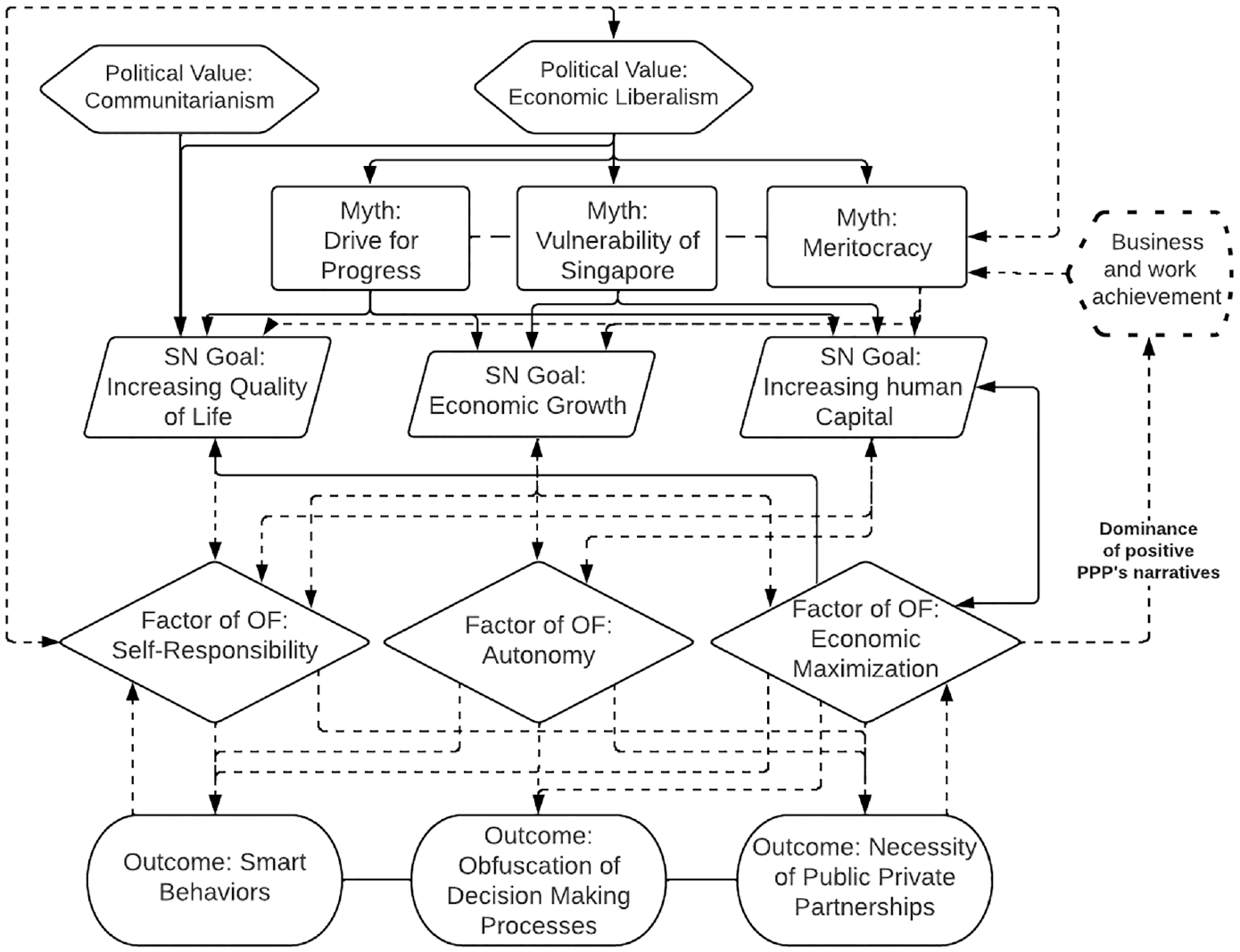
Diagram demonstrating the narrative assemblages which contribute to the smart nation as a technology of advanced neoliberal governance.
Moreover, this advancement of neoliberal-developmental governance through curating and obliging a very specific form of freedom, centres economic liberalism through digital technologies. Acceptable and rewarded behaviours, such as educational attainment, participation through consumerism and navigation of the smart city, all position life as an enterprise.
Public–private partnerships as autonomous self-responsibility
Of note is the cyclical, self-supporting relationship between the PPPs rhetoric, autonomy and self-responsibility. Not only are the benefits of working with businesses taken as a truth, through plans to ‘co-create the solutions and services with them’ (SG, 2018), but there is also a cyclical responsibility placed upon individuals to be the digital Homo-economicus and build businesses themselves. SMEs are then counter-positioned as ‘…well placed to help Singaporeans acquire skills and adopt digital technology’ (SE, 2018: 49). This dynamic therefore creates a systemic preference towards a digital-business orientated life. Figure 1, following the dashed line, highlights the occurrence of a cyclically reinforcing system in the SN, with the input of ‘Business and work achievement’ as a desire of PPPs. The dashed line only shows one iteration of the spread of the messaging and self-supporting cycle, but it highlights the interconnected and powerful nature of the interaction. Cook’s (2020) freedom trap is applicable here, as inhabitants are positioned as free to maximise themselves through digital technologies if they choose, though alternate options are minimised. This form of freedom privileges individual capital accumulation, while positioning it as a community or public good, and is a form of ‘community-washing’, previously seen in greenwashing.
Socio-technical processes of adaption and resistance to technologies are possible, for example, inhabitants choosing to live outside of the economically maximising expectation and prioritising alternative goals in life. However, the significance of obliged freedom through the SN is that other choices have been obfuscated by the technological medium of decision making combined with the imbuement of culturally significant success and failure metrics within the self-responsibility dynamic. In other words, making different choices is harder now than before the SN. Even for the privileged Singaporeans who have the financial means to ignore the need for capital accumulation to support themselves, there is an awareness and social pressure to accumulate more that is intensified through the smart environment.
Conclusions
This research aimed to understand the way in which smart cities have the potential to be co-opted into technologies to govern liberty through exploring rhetoric and experience in the Singaporean case. The study highlighted the underlying influence the market-based vision of smart technologies has had on the development of the SN, and the behaviour this obligates within the population. Singapore is unique in having such dominant and specific identifiable ideals such as their myths and political history, and this paper’s data focussed on high socio-economic inhabitants. While the lessons learnt are bounded by this context, the study indicates that for individuals able to participate economically and who embrace smart, the surrounding narratives influence the experience of the SN. It is also a useful case to support the importance of context in the analysis of smart places. Whether mundane (e.g. choosing options shown first within an online search) or life changing (e.g. feeling the need to develop digital skills), the design of digital space bounds how individuals navigate city life.
Beyond Singapore and across the world, smart initiatives contribute to a changing landscape of power and influence which threatens to reduce the space for resistance through the digital world. Building and design methods play a part in this story, creating the physical and digital systems the population acts within. However, the influence of digital city spaces are understudied, yet insidious due to their ubiquitous and invisible nature, enhancing the impact of biases. Therefore, the worldwide push for smart solutions, incrementally creating a new norm of data governance, makes this investigation into underlying motivations and resultant impact time sensitive, especially considering the digital leap that the COVID-19 global pandemic created.
This study presents one method of examining the smart city, and the first step to understanding the impact upon inhabitants of this form of life. The use of obliged freedom in this paper shows the way certain values are prioritised within the Singaporean smart city, and encoding of the digital Homo-economicus onto the psyche. In this way, the paper contributes to Rose’s (1992) critical sociology of freedom, asking how the digital world contributes and enhances mechanisms of control, to form a foundation for research in this area. Moreover, interrogating the digital Homo-economicus, speaks to questions of values, and the distinctly economic-maximising form of freedom prioritised by the SN. The next step of this research, then, is to understand the impact of privileging this form of existence, and challenge the ‘community-washing’ approach within smart places.
Footnotes
Acknowledgements
To Professor Emily So, who listened, developed and backed this project from inception, and pushed it to be better.
Funding
The authors disclosed receipt of the following financial support for the research, authorship, and/or publication of this article: Funding was provided by the Fitzwilliam College LKY PhD Studentship for this research.
