




Abstract
African urban populations are growing predominantly through types of settlement commonly referred to as ‘informal’– settlements constructed outside the control of city or state governments. For the UN New Urban Agenda, informal settlement presents a challenge to developing sustainable cities. Settlement qualification in urban development discourse often relies on prescriptive formal models and considers anything not complying to these as ‘informal’ and unsustainable. This paper advances informal settlement as an adaptive response to Western planning models that builds on regional histories of organising urban space. Examining archaeological and historical urban records from northern Ethiopia, we define spatial patterns and social processes of urban transition over millennia. In the analysis, settlements that in current urban debates fall under the ‘informal’ rubric contribute to building urban resilience. A century-scale resolution reveals contingent conditions for cities enduring climatic and socio-political shifts during the Pre-Aksumite and Aksumite periods (c. 800 BCE–CE 900) and afterwards. Past urban transitions were marked by inverse settlement dynamics: as urban cores shrank, peri-urban settlement grew and new centres were established. Although spatial reconfigurations followed political shifts, urban settlement remained largely consistent: urban landscapes of food production, material processing, resource trading and ritual making. In the Aksumite record, informal processes convey flexibility and diversity of settlement forms to undergo sustainability transitions. The durability of urban morphologies in the archaeological record warrants against stereotyping informal settlement as a challenge to sustainability transitions. A long-term perspective supports emerging approaches to informal settlement today as a locally adaptive property of urban systems.
Introduction
People have been living in cities for over 6000 years (Smith, 2019). Despite millennia of experimentation, modern cities are the main drivers of environmental, ecological and social global challenges (UN-Habitat, 2022). In sub-Saharan Africa, urban populations are growing rapidly beyond government-sanctioned urban development in informal settlements. On the continent, annual urban growth is estimated to be 3.82% against 2.01% in Southeast Asia and 1.15% in Latin America and the Caribbean (2020–5; UN WUP, 2018: F6; see also UN-Habitat, 2022: 14).
For the New Urban Agenda (UN-Habitat, 2017, 2022), informal settlement presents a major challenge to developing sustainable cities, and much emphasis in the Global South development discourse is placed on defining the drivers of informal settlement (conflict, poverty, climate change; UN WUP, 2018). Current approaches to urban planning in African cities, such as in Addis Ababa, Ethiopia and Accra, Ghana, are shaped by planning ideals and urban models developed in post-World War II Europe (Förster and Ammann, 2018). These are ultimately legacies of the colonial era and disconnected from indigenous urban traditions (Pieterse and Simone, 2013).
Urbanism is not a recent phenomenon in Africa where diverse urban cultures emerged in different environments with some thriving for centuries. Archaeologists have been unravelling these urban pasts for over a century, debating the drivers and environmental impacts of urban development. This record offers a unique resource to examine the properties of informal settlement and their role in urban transitions at multiple spatial and temporal scales. Such an analysis is particularly important in Africa where many social institutions of resource use and settlement are at odds with land and urban planning agendas, which are focused on formalising settlement and housing for urban sustainability transitions.
This is the case, for example, of urban traditions in the Horn of Africa, including the Aksumite Kingdom, one of the earliest, premodern urban states in sub-Saharan Africa (Figure 1) (Fattovich, 2019; Phillipson, 2012). Drawing on the millennial record of urban change in this region, this paper aims to contribute nuance to the stereotyping of informal settlement as a challenge to urban sustainability transitions. Furthermore, we problematise the binary opposition of formal/informal settlement and offer a deep time vantage to recent critiques in the Global South urban development discourse (Dovey, 2012, 2015; Dovey et al., 2020, 2021; Dovey and King, 2011; Elorduy et al., 2024).
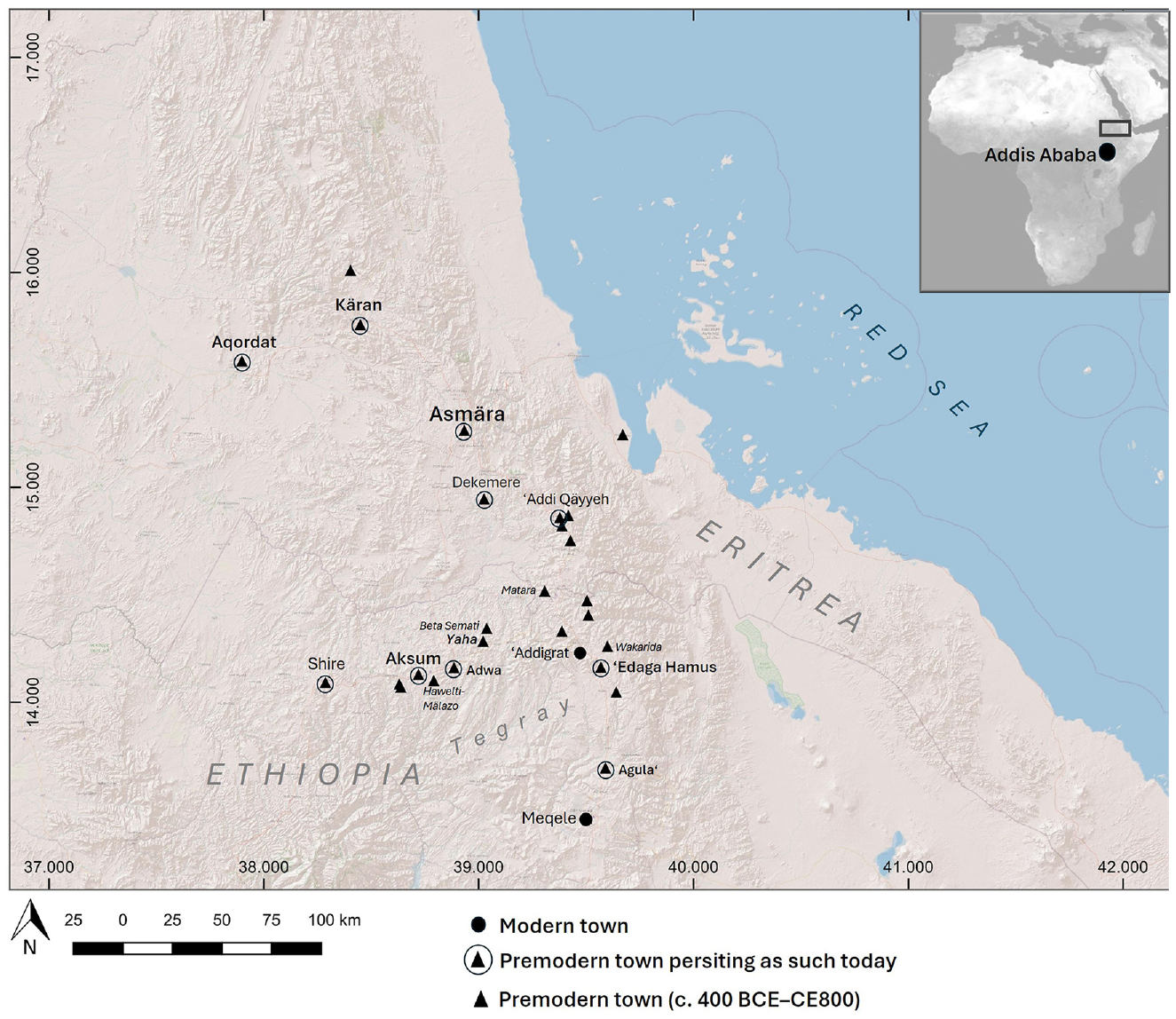
Pre-Aksumite and Aksumite settlements in northern Ethiopia and central Eritrea. Distribution of settlement types by size averages, excluding the capital Aksum: towns (20–40 ha), villages (1–20 ha) and household compounds (>1size) based on data from Benoist et al. (2016), Curtis (2009), Fattovich (2019), Harrower et al. (2023), Phillipson (2012) and Sernicola (2017). Base image sources: Esri, USGS, NOAA.
We suggest that informal settlements provided elements of flexibility and contributed to urban resilience and durability. However, the contribution of informality to the adaptive capacity of urban traditions over longer time intervals (several centuries to millennia) is scale-dependent (Crumley et al., 2022; Isendahl et al., 2025). Our analysis builds on and extends the centurial timescale commonly used in urban and population growth assessments and projections (UN WUP, 2018; UN-Habitat, 2022).
Defining contexts, frameworks and methods
Drawing on archaeology and historical ecology, we review the nature, development and persistence of informal settlement, and examine development trends over century- to millennium-scales with a view to identifying processes and agents of sustainability transitions: do contingent processes shape settlement form over the long term? How does urban informality work over the long term?
A relatively recent expression, informal settlement refers to self-organised living spaces and infrastructures produced outside normalised urban formality. Despite growing scholarship on urban informality (e.g. Dovey, 2012; Dovey et al., 2020, 2021; Fahmy, 2004; Fegue, 2007; Soliman, 2021; Sosa Lopez et al., 2019), the expression often carries negative connotations and is used interchangeably with terms such as slums (e.g. UN-Habitat, 2022; see review by Dovey et al., 2021). However, informal settlement is a form of urban development ‘with a morphology that is highly adapted to local conditions and livelihoods of the urban poor’ (Dovey et al., 2021: 145).
Informed by sustainability transitions research (e.g. Hansen and Coenen, 2015; Markard et al., 2012), from our archaeological vantage we define an urban transition as ‘a set of processes that lead to a fundamental shift’ (Markard et al., 2012: 956) in an urban system that persists over several human generations – that is, at a timescale identifiable in the archaeological and historical record – while maintaining vital urban forms and/or functions. We use changes in urban settlement and land use patterns as archaeological indicators of urban transitions. Similarly, we define urban sustainability transitions as ‘long-term, multi-dimensional and fundamental transformation processes through which established [socio-ecological] systems shift to more sustainable modes of production and consumption’ (Markard et al., 2012: 956). As discussed by Isendahl et al. (2025), among others, determining sustainability in premodern urban systems is both ontologically (what is the nature of urban sustainability in the premodern past?) and epistemologically (what are the practical indicators of urban sustainability in the archaeological record?) challenging because of the ways in which we study and understand cities and urban processes. Drawing on archaeological evidence of long-term settlement persistence (e.g. Isendahl et al., 2025; Lawrence et al., 2025; Smith, 2023; Smith et al., 2021), we assume that any process of transition that contributes to urban landscape persistence or longevity is indicative of a sustainability transition. This assumption comes with considerable caveats that are important to acknowledge (Isendahl, 2022). The adaptive capacity of an urban settlement to generate longevity may not necessarily be indicative of properties of sustainability that are valued today, such as social equity or non-depleting natural resource management. Ours is an initial approach to stimulate further analyses of what factors build resilience-capacity to overcome vulnerability and minimise risk, and to detail the long-term nature of urban sustainability.
In archaeology, cities are commonly defined from a sociological or a functional perspective: the first using formal assessments of density and population as main parameters, whereas the second looks at cities through their roles over a larger territory (political, economic, etc.) (Fletcher, 2019; see Roberts et al., 2024; Smith, 2020). If a sociological approach can easily fall into the binary trap (formal/informal, large/small, etc.), the functional one often leads to centre/periphery models of urban development. An alternative is to focus on the socio-ecological processes and emergent properties of human behaviours that contribute to the diversity of urban landscape development (Isendahl, 2012; Isendahl et al., 2020; Sinclair et al., 2019; Smith, 2023; Sulas and Pikirayi, 2020). In this approach, examining the role of informal settlement and associated land uses in long-term urban landscape dynamics is fundamental to understand multi-dimensional transformations of sustainability transitions.
In the highlands of northern Ethiopia, Aksum lies at the crossroad of the Sudanese lowlands, the Eritrean coastal plains, the Nile Valley and the great Rift Valley, ranging from over 4000 m above sea level of the Semen Mountains to the Danakil Depression at 120 m below sea level. These different environments are distributed over a relatively small area (c. 23,000 km2). Cultivated crops and domestic animals were in use from the early first millennium BCE and, through time, cattle, sheep, goat and cereals (emmer wheat, barley, teff) shaped local subsistence practices (Fattovich, 2019; Hagos, 2010; Phillipson, 2012). These resources were pivotal in the development of rain-fed, plough agriculture that persists to this day. Aksum emerged as the capital of a kingdom in the late first millennium BCE, soon growing to control a territory stretching over northern Ethiopia, central Eritrea and southern Sudan, at times reaching across the Red Sea (Figure 1). By the time imperial Romans were moving to the new capital at Constantinople in the 330s CE, the Aksumites were thriving in domestic economy, trade and exchange and cultural vibrancy. They played an important role in the early introduction of Christianity and, later, Islam into sub-Saharan Africa. Following peak expansion and growth in the first few centuries CE, the Aksumite Kingdom began to decline in the late 6th century CE and Aksum was no longer its capital by the 9th century CE (Fattovich, 2019).
Northern Ethiopian and central Eritrean cultures and landscapes are living legacies and enduring actors in a long history of human–environment dynamics. Over the course of three millennia, the communities of this region engaged with management of key resources such as grains and livestock to support food production and subsistence strategies for urban traditions outliving early state centralisation. They were engaged in regional and interregional trade, developed multi-script writing, tri-metallic coinage and crafts, and adopted and adapted belief systems and religions (Fattovich, 2019; Phillipson, 2012). Following the decline of the Aksumite Kingdom, a new polity emerged and consolidated further south, in the Shawa highlands of central Ethiopia, under the Zagwe Dynasty (12th–13th centuries CE). The Zagwe were soon overtaken by the Solomonic Dynasty (14th–15th centuries CE) with the establishment of the Ethiopian Empire, which ended in 1974 with the revolutionary (Darg) junta (Crummey, 2000; Zewde, 2001). Throughout these political shifts, urban settlement has been a defining feature of social, cultural and economic development largely anchored to landscapes shaped by premodern urban design and architecture, low-density settlement and plough agriculture. In this urban history, low-density housing and settlement sustained social cohesion, cultural resilience and resource management for centuries – if not millennia.
In this paper, we interrogate archaeological and historical data from northern Ethiopia to examine the form and longevity of urban settlement and houses through time and across space. The data includes physical remains of past settlements, houses and materials (artefacts, plant–animal remains) recorded by archaeological excavations and surveys and written sources and oral traditions (Anfray, 1990; Crummey, 2000; Fattovich, 2019; Hagos, 2010; Harrower et al., 2023; Phillipson, 2012; Sernicola, 2017; Sulas, 2018; Zewde, 2001). We examine this data using models and criteria of present-day urban agendas. Our methodological approach, thus, combines study of data from archaeology, history and urban development, spatial analysis of settlement and housing records and comparative analysis of past and present-day urban spaces.
(In-)formal settlement to whom?
‘The proliferation and resilience of such [informal] settlements have been phenomenal and half a century of state intervention has failed to halt their growth… most developing cities are unsustainable without them’ (Dovey and King, 2011: 11).
The 2022 UN-Habitat World Cities Report suggests that about one fourth of the world’s urban population lives in informal settlements (UN-Habitat, 2022). Addressing the challenges of informal settlement are specific targets of Agenda 2030’s Sustainable Development Goal (SDG) 11.1 (UN-Habitat, 2018) and priority areas of Agenda 2063’ Aspiration 1.1. Agenda 2063 is the development blueprint to achieve inclusive and sustainable socio-economic development in Africa (AUC and AUDA-NEPAD, 2022). In both agendas, progress towards developing sustainable human settlement scores low performance compared to achievements in other goals and aspirations (AUC and AUDA-NEPAD, 2022; UN-Habitat, 2022). Informal settlement is monitored using definitions and criteria set by UN-Habitat and outlined in the SDG 11.1 Training Module (UN-Habitat, 2018): inhabitants have no security of tenure vis-à-vis the land or dwellings they inhabit; neighbourhoods lack or are cut off from formal basic services (water, sanitation, energy, waste disposal) and city infrastructure; and housing lacks durability and adequate living space and does not comply with current planning and building regulations. Underpinning these criteria are prescriptive settlement models that adhere to norms and regulations of Western urban planning. Security of tenure, for example, refers to a constitutional or legal right that guarantees lease to the tenant, which might or might not align with customary laws and communal uses. Access to basic services and infrastructure is determined by variables such as resource type, distance and transport that have diverse forms and properties. For example, access to water and energy in modern urban planning refers to public or private company-run utilities (piped water, electrical networks) and usually does not consider other supply forms (fountains, wells, solar panels, etc.). One criterion for housing assumes that formal planning and regulations are fundamental features of sustainable cities. Yet, settlement informality and adaptive governance are predominant in both regional urban histories and current growth patterns. UN-Habitat criteria also restrict assessments of durability to physical buildings and defines it in terms of structural permanency and location: ‘A house is considered as “durable” if it is built on a non-hazardous location and has a permanent and adequate structure able to protect its inhabitants from the extremes of climatic conditions such as rain, heat, cold, and humidity’ (UN-Habitat, 2018: 11). In this framework, housing durability and permanency have no specific spatiotemporal dimension and there is no reference to relations between individual houses or intra-settlement interactions – rather the focus is on the physical properties of the single residential unit. However, these aspects as well as social and cultural considerations feature prominently in the rich literature on urban informality. In informal settlements, form, location and physical conditions are as important as social views and cultural norms. The settlement process is distinctive: occupation of a place precedes land development, whereas in formal developments occupation is the final step in a process that follows a legal and regulated sequence (Sosa Lopez et al., 2019).
Dispersed and/or low-density forms of settlement are very common in sub-Saharan Africa, past and present (De Satgé and Watson, 2018; Pieterse, 2011). Indeed, premodern cities in the Global South predominantly had low-density distributions of population (Fletcher, 2019; Smith, 2010). Furthermore, dispersed urban housing and settlement patterns integrated farming and subsistence practices with residential dwellings, public spaces and places serving centralising urban functions (e.g. Isendahl et al., 2020, 2025; Sinclair et al., 2019; Sulas and Pikirayi, 2020). Often, a central civic-ceremonial area shaped by formal planning was surrounded by informal residential housing integrating with a mosaic of agricultural production. Following SDG 11.1 indicators, these cities would be considered informal settlements doomed to failure. The contrast with the archaeological record of the longevity and, arguably, sustainability of this generic urban spatial morphology in the tropics could not be greater (e.g. Carter et al., 2021; Hawken, 2017; Isendahl et al., 2025; Rostain et al., 2024). The question, then, is if informal settlement hinders urban sustainability transition or is a factor that might contribute to it. To address this question, we need to engage with empirical data at multiple spatiotemporal scales. Archaeological and historical records provide this data.
Ethiopia offers a salient case study to illustrate how formal–informal binary thinking influences understandings of urban transitions. Africa’s second most populous country, Ethiopia has a 3000–year long urban history and is predicted to be the continent’s fastest growing economy. Yet, it is the fifth least urbanised African country (UN WUP, 2018: F2). Today, 80% of Ethiopians are small-scale farmers living in rural areas, but the urban population has tripled since the early 1990s and is projected to rise to over 39% of the total population by 2050 (UN WUP, 2018: F2). The country is struggling to meet the needs of its fast-growing urban population: affordable housing, food and water security, and transport and communication infrastructure. Despite substantial, state-sponsored housing development in Ethiopian cities, the UN-Habitat (2021) estimates that over 60% of urban dwellers live in informal settlements.
Ethiopia, like many other African countries, has responded to urban growth by investing in multi-billion-dollar housing projects over the last two decades. But, in Ethiopia, private land ownership no longer exists since the seizure of (rural and urban) land by the Darg regime (1974–1991) (Zewde, 2001). The Darg junta scrapped the traditional (gult [granted right or fief] and rist [hereditary, inalienable and collective right] tenure system regulating land use and property rights since the 13th century CE (Crummey, 2000), seized property ownership, fragmented land into parcels and allocated these to families, and established large-scale state farms. In the Constitution of Ethiopia (Art. 40.3), the land (surface) belongs to the state and the people. In practice, city authorities lease hold of plots to individuals and cooperatives, but land use and urban design are largely controlled by the government (Ambaye, 2015: 30–35). The plot size and the length and cost of leasing are variable. For example, in Addis Ababa, plots up to 73 m2 are leased out free of charge to housing cooperatives, and larger plots (up to 175 m2) are leased out at a fixed rate at m2/year. The lease is granted for up to 60 years to estate developments – for others, it can vary between 50 and 99 years (UN-Habitat, 2007: 15).
Under the Darg rule, when not busy tending the fields, farmers were required to work on tree planting (using imported, water-demanding eucalyptus), terrace building and watercourse damming that reshaped vast areas of Ethiopia – country-scale and blanket-style interventions that continued after the fall of the junta, and in a somewhat refashioned shape persist today (Sulas, 2018). One could mention the hydropower development to supply cities, including the newly built Grand Ethiopian Renaissance Dam – the largest and much contested hydroelectric power plant in Africa (Pemunta et al., 2021).
Today, housing remains a key challenge for Ethiopian cities. However, defining such challenges depends on the ways in which housing problems are identified and assessed. UN-Habitat (2007) estimates that the total housing stock in Addis Ababa is dominated by units made of mud and wood with makeshift roofs that follow traditional architecture models (known as cheqa [mud] houses) (Datta and Gruber, 2021; Desta, 2019; Lyons, 2007), which are considered poor buildings. Irrespective of building materials, only about 17% of the total housing stock in Addis Ababa is considered poor and lacking access to basic infrastructures (UN-Habitat, 2007: 29; see also Mamaru, 2019). Yet, a 1996 survey showed that access to water per housing unit, solid waste collection and road access were significantly higher in unplanned parts of the city than elsewhere (UN-Habitat, 2007: 33–34).
In the early 2000s, the government adopted a low-cost construction technology to build affordable housing across the country. Developed by the German Technical Corporation (GTZ) under the mandate of the Addis Ababa City Council, this low-cost technology was first implemented in the Integrated Housing Development Program (IHDP) that began in 2005 (UN-Habitat, 2010) (Table 1). Fully financed by public money, the programme has built over 200,000 condominium units for low-income urban populations across 56 towns (UN-Habitat, 2010: 37–43). It has now been suspended outside the capital, partly because the condominiums were unpopular in smaller, low-rise towns. The modular architectural system uses hollow concrete blocks, a prefabricated element and a foundation system claimed to work on all soil types. Although initially reducing construction costs by almost 50% and waste costs by 30%, the overall costs have risen and the IHDP today imports 75% of the building material. Despite governmental subsidies, condo-units remain beyond the financial reach of the poor. Integrated housing development faces additional challenges: inadequate energy and resource supply, detrimental impact on local environments and community fragmentation (Baye et al., 2023; Charitonidou, 2022; Mamaru, 2019). First, units are allocated via a lottery, which prevents extended families from living in the same building or even nearby. Secondly, condo-units are very dense (5–10 stories) and are largely without communal spaces. These properties are in contrast with the single-story houses with shared compounds dominating urban and rural settlements – which remain the cultural template for urban informal settlement (Table 1). In Ethiopia, extended families have been living in low-density housing and settlement, sharing spaces and resources, for centuries. Some premodern urban settlements have evolved and transitioned to continue to exist as medium-sized towns (Figure 1).
Housing through time. Comparison of Aksumite housing and modern condominium housing.
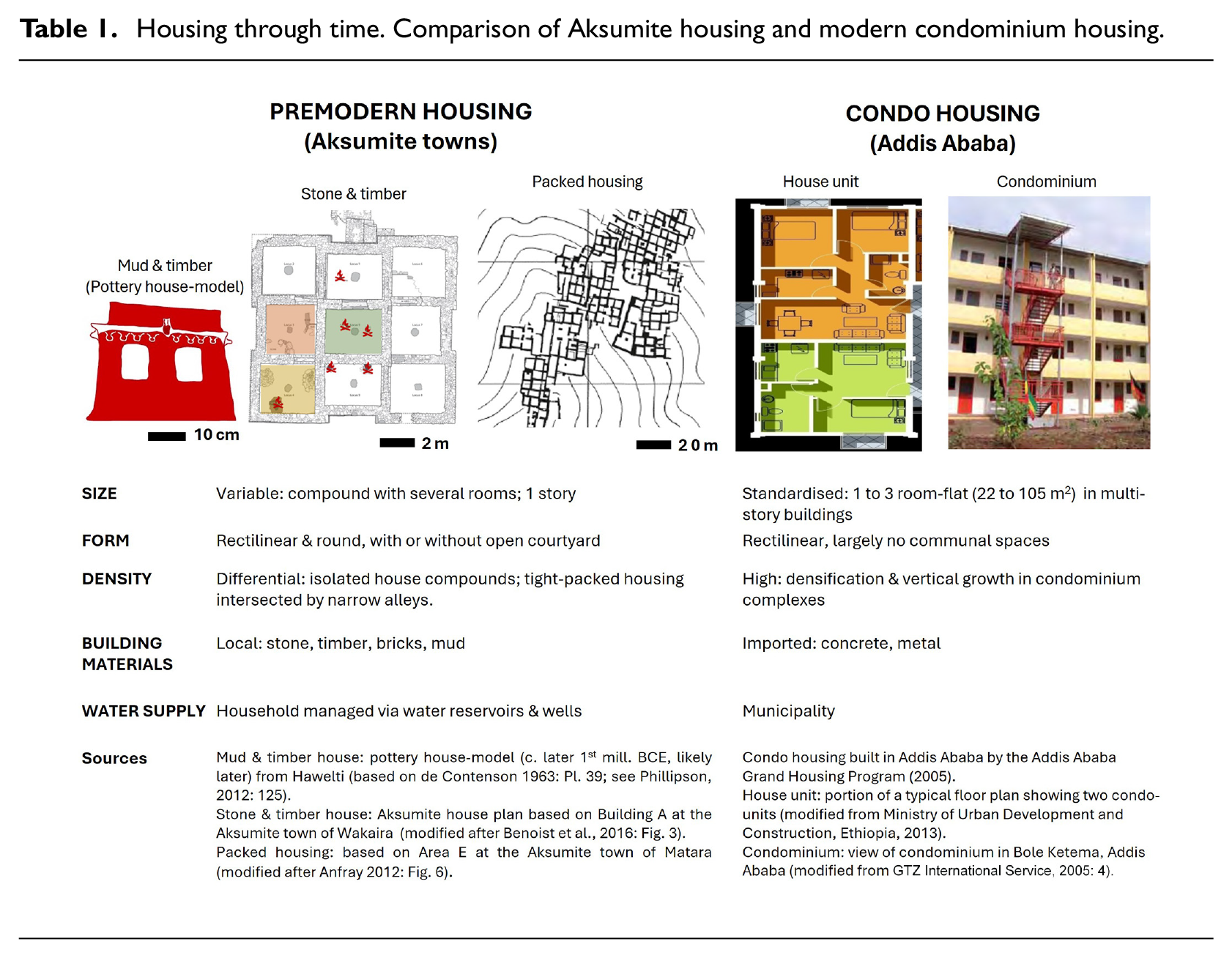
How can we recognise urban formality/informality in premodern urban settlements? How do present-day informal settlement and housing relate to historical urban lifeways?
Urbanising the highlands
In the early first millennium BCE, the highlands of northern Ethiopia and central Eritrea experienced fundamental cultural developments that shaped the subsequent history of the wider region. New forms of lifeways, resource uses and community interactions produced diverse and regionally distinctive material culture, architecture, goods exchanges and belief systems – all pointing to a vibrant syncretism and consolidation of practices that, through innovation, define the region. From ploughing to timber-and-stone architecture, highland communities developed the earliest forms of urbanism while maintaining pastoral and semi-nomadic lifestyles alongside village-type settlement. These communities relied on rain-fed farming of grains (emmer wheat, barley, teff, finger millet) and domestic cattle, sheep and goats – which remain widely practised today. Permanent settlements emerged in the early first millennium BCE, with town development in full swing throughout the early to mid-first millennium CE. A rich body of archaeological investigations, analyses of ancient architecture and material culture, dating and environmental records have enabled a classification of settlement and house types though time. Hundreds of different settlements have been systematically recorded and investigated in Tegray (Anfray, 1990; Fattovich, 2019; Harrower et al., 2023; Michels, 2005; Phillipson, 2012; Sernicola, 2017) and on the Asmära Plateau (Curtis, 2009) across different ecological niches and associated with different but linked cultures: the Pre-Aksumite and Aksumite cultures in Tegray and the Ona culture on the Asmära Plateau (c. 900 BCE–CE 900; Figure 1). Spatial and temporal variability notwithstanding, the household compound was the building block of settlement diversity and a constant feature through time.
Premodern towns are known from written records, the remains of architecture (e.g. buildings, walls, rubble, standing stones) and traces of domestic activities (e.g. hearths, potsherds) spread across several hectares – from 1 to about 90 ha in area, with Aksum reaching c. 100 ha (Fattovich, 2019; Harrower et al., 2023) (Figure 1). Smaller settlements and sites included large and small villages, homesteads, isolated households and production areas, clustering around and in-between towns (Figure 2). The archaeological record shows that urban settlements developed gradually with the establishment of a monumental complex and elite cemeteries, followed by a growth of domestic, civic and funerary architecture and infrastructure. Local stone and timber were the main building materials, but brick, mud and probably other materials (e.g. animal skins) were also used. Residential occupation associated with town emergence is hard to estimate as the record is limited, possibly because the first houses were built in ephemeral materials and/or their remains were absorbed by subsequent urban expansion.
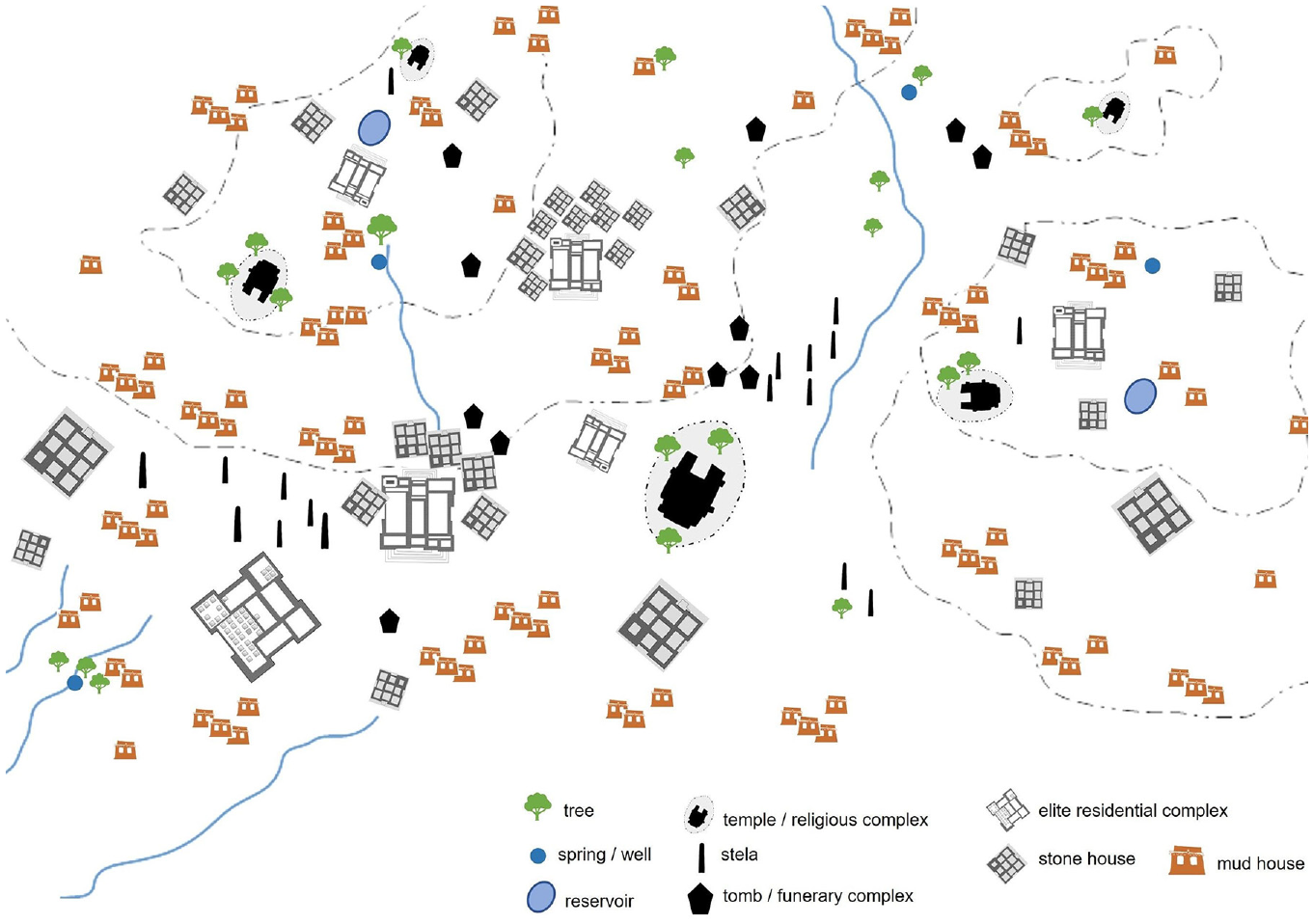
Hypothetical model of an Aksumite urban landscape. Spatial distribution of buildings and infrastructures based on data from Benoist et al. (2016), Fattovich (2019), Harrower et al. (2023), Phillipson (2012) and Sulas (2018).
As towns grew, different house types and other buildings appeared in variable patterning with packed housing clustering around monumental complexes, and an open and sparse distribution (Figure 3). Elite residential complexes comprised a central, often multi-storeyed, building with recessed walls and entrances with broad steps set in an open court and surrounded by several rooms. The size of such complexes varied greatly, from 2–3 m2 to over a hectare (Phillipson, 2012: 124). Lower-status houses were rectilinear and had one story and a variable number of rooms, sometimes surrounding a courtyard. It is likely that most people lived in houses built from in mud and wood, much like those represented in clay models recovered in archaeological contexts (Phillipson, 2012: 125) and traditional houses (Lyons, 2007; Table 1).
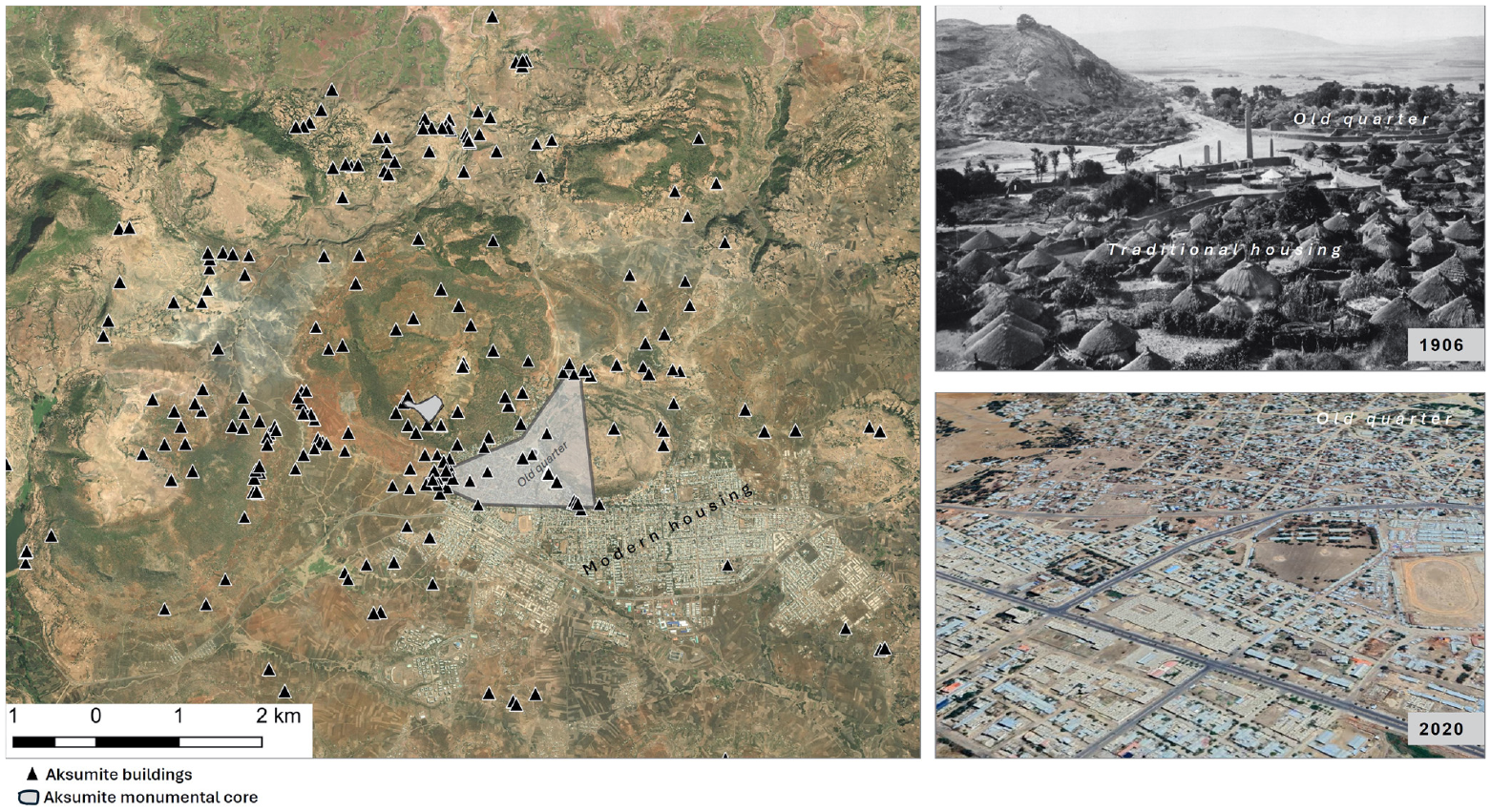
Aksum urban landscape and housing through time. Left: Aksumite buildings and monuments (c. 150 BCE–CE 500) over a satellite view of the Aksum plain (Esri Data & Maps). Right: top, traditional (tukul) housing with the (Aksumite) Stela Field in the foreground, Deutsche Aksum-Expedition 1996 (courtesy of the British Institute in Eastern Africa); bottom, view of modern housing from GoogleEarth 10.52.0.0 (17 February 2024).
The earliest record of town development is associated with the Pre-Aksumite culture (c. 900–400 BCE) and its political centre at Yaha (Figure 1). In this period, villages and towns proliferated as contacts within the wider region and with contemporary South Arabian kingdoms increased. Rain-fed farming and animal herding were the backbone of Pre-Aksumite subsistence economy, and villages and homesteads clustered around main centres such as Yaha (Harrower et al., 2023). At about 2150 m altitude, Yaha sits in a valley surrounded by hills and bisected by perennial water sources. Landforms, enriched by Holocene alluvial and slope deposits and with a mean annual precipitation of 600 mm today, support a montane grassland vegetation cover. Remains of monumental complexes, houses and cemeteries litter an area of about 15 ha in and around the present-day settlement (Fattovich, 2019; Harrower et al., 2023). The town of Yaha was the first and remained the largest settlement in the region until the end of the Pre-Aksumite period (c. 400 BCE), persisting in a much smaller form until today. Reaching a size of over 40 ha (c. 700 BCE), early Yaha doubled the size of contemporaneous towns in the region (Harrower et al., 2023). People lived in stone-built houses, some multi-storeyed, gathered in monumental complexes and buried their dead in shaft tombs. The early town had temple and funerary complexes and a large, multi-storeyed building (the Palace of ‘Grat Baal Gebri’, c. 46 m × 46 m) erected upon a 4.5 m-high podium and with walls made of wooden beams, rubble stones and mud (Anfray, 1990: 17–32). Dating to the early 8th–6th centuries BCE (Japp et al., 2011: 151), this building is the oldest known example of a tradition of timber–stone construction that persists to this day. Its function remains debated, but traces of a storeroom with wares, doors with a sealed closure and ruler seals point to an administrative seat. By around 400 BCE, the core occupation area of Yaha appears much reduced but small villages and homesteads increased in the wider area (Fattovich, 2019; Harrower et al., 2023). Settlement persisted in the Yaha area while the political focus shifted about 50 km to the west with the emergence of a kingdom at Aksum.
The rise of the Aksumite Kingdom was accompanied by expansion of settlement diversity across the wider region. Settlements of over 100 ha in area grew at Aksum (Figure 3) but also further away from it, such as Matara, and the whole region was dotted by smaller towns, villages and small household compounds (Figure 1). Houses were built using local stone and mortar, the quality of stone dressing probably reflecting the households’ status. Rectangular and square ground plans were characterised by wall recessions and projections, and timber frames and posts across different rooms. In both the main centres and small towns, elite residential complexes followed the same spatial organisation: a central, symmetrical building surrounded by smaller outbuildings (Table 1). Smaller domestic residential units and houses were also built in stone with undressed and mortared walls, shaping rectilinear plans and narrow alleys. As mentioned, most Aksumites plausibly lived in mud houses (Table 1).
Residential complexes and small housing compounds, irrespectively of size or status, shared several basic properties: masonry style using local stones and timber, square or rectangular ground plans with a large central room and several smaller rooms and annexes facing a courtyard, and the presence of different types of indoor fireplaces. The nature and distribution of material culture (e.g. pottery, lithics) and plant and animal remains suggest an operational, domestic space with rooms dedicated to food processing and cooking, separated from storerooms and convivial, reception and sleeping rooms. Different doorways and some indications of staircases reaching onto the roofs are suggestive of open horizontal and vertical traffic.
Aksumite towns were established preferably on lower hillsides, low-lying land and valleys rich in water and arable land. Around these, smaller household compounds formed low-density, open-spaced resource landscapes (Figure 2). There is no evidence of distinctive spatial patterning but the low-density, open-spaced distribution of settlement types are suggestive of an urban region model shaped by environmental, landscape and socio-political factors in Pre-Aksumite and Aksumite times (Harrower et al., 2023; Sulas and Pikirayi, 2020).
Archaeology provides little information on past land ownership and tenure. Some monoliths found in the Aksum area might represent Aksumite landmarks of communal land ownership (Fattovich, 2019) and family names in inscriptions (c. 4th century CE) found in Aksumite towns might be delimiting the land of different lineages. This form of land tenure is well attested from medieval times until recently in Ethiopia and Eritrea and was based on the principle that all the descendants had the inalienable right to use the land occupied by their ancestors (Crummey, 2000).
Scaling sustainability transitions in Aksumite urban history
Examining the Pre-Aksumite and Aksumite archaeological record, a century-scale temporal resolution reveals contingent conditions of towns but conceals ‘why’ and ‘how’ the basic physical, cultural and ecological essence of urban living persists through climatic and socio-political shifts since the late first millennium BCE. The Pre-Aksumite–Aksumite transition is marked by a reduction in size and density of central urban areas and expansion of settlements around these (Harrower et al., 2023). In the Yaha area, for example, Harrower et al. (2023) recorded a sharp increase in site density per km2 (from 0.8 to 4.6 sites) matching a drop in the average settlement size (from 5.34 to 1.78 ha) in Aksumite times. These changes suggest a shift from an aggregate settlement concentration around major towns to a more dispersed occupation with villages and house compounds increasing in-between towns. As the Pre-Aksumite towns shrink, settlement expands in their peri-urban areas and beyond, and some cases see the growth of urban centres elsewhere – epitomised by Aksum. At Aksum, the gradation of settlement follows the same pattern as earlier: sparce occupation on lower slopes and along pediments, leaving alluvial plains and hilltops for farming, animal herding and vegetation cover (Figure 3). In contrast, settlement expansion since the 1930s has followed a rectilinear plan with concrete buildings for housing, administrative offices, banks, hospitals, shops, hotels and a university campus concentrating in the Aksum plain to the south and west of the early (old) urban quarter (Figure 3).
Scaling these processes across space and time, the definition of transformations changes quite significantly. Using the spatiotemporal resolution of a century and a town, the emergence of occupation at Yaha was followed by an exponential growth of settlement and built space, which contracted within about 200 years. Stretching the spatiotemporal resolution to the wider Yaha area during the last 3000 years (from c. 700 BCE to today), the density of settlement around the urban core increased as this shrank – a trend that was taken as evidence for the abandonment of Yaha, following the decline of the Pre-Aksumite polity. Similarly, looking at Aksum at century and place scales disguises building traditions (house plans, building materials, masonry styles) into power architecture defining a new capital city, whereas we can trace their development in Pre-Aksumite Yaha and follow them in Aksumite and later towns of different grade and longevity.
In considering urban transitions, the shift and decline of temporal power did not result in a collapse of settlement. The settlement pattern remains largely constant throughout transitions from Pre-Aksumite to Aksumite times, spanning two millennia. The Aksumite decentralised organisation is associated with greater physical extension – Aksum’s rule stretching from western Tegray to the Eritrean littoral – and higher regional and interregional connectivity (indicated by exchange and trading commodities and cultural contacts). This spatial reconfiguration is accompanied by changes in belief systems and power structures. But the organisation and workings of towns remain consistent: urban landscapes of food production, material and mineral processing, resource trading and ritual making. In these urban landscapes, fluidity and changeability appear as properties of sustainability transitions and these properties are enabled by human agency and shaped by socio-ecological knowledge.
Discussion
Understanding of, and approaches to, urban transitions are often biased by binary thinking that defines planning and policies on contingent conditions and one-fit-for-all panacea and ignores a key variable of any resilience equation: time.
It is alarming that punitive measurements, demolitions and forced resettlement continue to be practised and, even more alarmingly, advocated for as the ultimate panacea to the problem of informal settlement. For example, in an article recently published in the International Journal of Urban Sustainable Development: ‘the researchers recommend the punitive approach of marginality theory … be adopted in Butajira town [central Ethiopia] to curtail the future tendency of informality through forceful relocations of informal settlers but with the provision of basic services’ (Mengist et al., 2023: 244). Such approaches have failed miserably and have proved very costly across Africa (e.g. Bandauko et al., 2022; Fahmy, 2004; Fegue, 2007; Limbumba, 2010) and elsewhere (UN Economic Commission for Europe, 2009). There persists that bipolar attitude towards ‘informal’ or ‘marginal’ settlement in developing countries as either a problem or a resource shaping urban growth (see review by Peattie and Aldrete-Haas, 1981). However, the literature measuring and monitoring the positive contribution of informal settlement to African cities is rapidly increasing (e.g. Agyabeng et al., 2022; Desta, 2019; Förster and Ammann, 2018; Pieterse, 2011).
The urban archaeological record from northern Ethiopia bears no evidence of formalised models in either settlement or housing forms. Pre-Aksumite and Aksumite towns and houses exhibit a variety of forms, spatial organisation, building materials and uses. The settlement process observed in historical development finds a parallel in the ways in which informal settlements are established today: a place is first occupied and then adapted to human lifeways. This sequence enables dwellers to experience the place and space of occupation, interact and adjust to pre-existing resources and settings, and adapt and modify physical environments and human practices in the process of homemaking. In this process, forms and properties of houses and settlements are shaped by human experiences and interactions with the surroundings. The use of open spaces and accessible building materials not only delivers living and social services but also ensures some degree of spatial and physical flexibility for housing maintenance and upgrading, accommodating changes in household composition (Table 1).
As seen in the case of premodern Yaha and Aksum, settlements began with the establishment of culturally significant built spaces (civic-ceremonial structures) within specific landscape conditions, and residential spaces developed organically around these. As the focus and nature of civic-ceremonial services change following socio-political reorganisations, the fundamental patterns and properties of settlement and housing remain constant. Looking at sustainability transitions across Pre-Aksumite, Aksumite and present-day urban settlements, a multi-century temporal lens brings into focus several human factors:
• Experience before development: early town development starts with the establishment of culturally significant buildings at a particular place, which must have been visited, experienced and ultimately intentionally selected for permanence.
• Socio-ecological memory and practices: experiencing a place through permanence enables continuous learning through practicing.
• Adaptive behaviour: permanence and living together further the making of communities, whose members not only learn from their surroundings but also from each other and, in so doing, expand and diversify the repertoire of experiencing, adapting and responding to change.
• All the above enable diversity in building, spatial organisation, strategies and practices.
Historical perspectives on sustainability transitions contribute important insights for addressing urban problems and informing understanding of informal settlement for five main reasons: (1) they broaden the frame of reference of human behaviour and place-making and expose urbanisation patterns that operate beyond the control or limits of (state) resources; (2) they enable an holistic approach to settlement by recognising the fundamental interconnections among social, economic and environmental issues; (3) in so doing, they engage with the wider spatial dimensions of such interactions, overcoming the formal–informal binary frameworks to embrace urban diversity; (4) they can reveal feedback effects and adaptive cycling of urban development; and (5) they show that urban transitions can be supported by socio-ecological (and traditional) knowledge and ways of building.
In resilience thinking, adaptive governance combines experimental learning with organisational theory to build settlement resilience. In this framework, problems commonly associated with informal settlement (poverty, insecurity, etc.) are interconnected and addressing one feature (e.g. houses, roads, etc.) through ad hoc initiatives (e.g. affordable housing, road development) cannot solve problems (see e.g. Seeliger and Turok, 2014). Archaeological and historical data provides a temporal and spatial resolution to observe how human experience moulds settlement practices and adaptive responses to urban transitions.
In sum, the long-term and multiscalar perspective afforded by archaeological records demonstrates that informal settlement is part of the urban fabric and not a recent phenomenon. In so doing, archaeology adds valuable and temporal depth to the contribution of urban informality to sustainability transitions (Dovey et al., 2020, 2021).
Conclusions
The Aksumite urban tradition is only one example of African millenary urban cultures that are at odds with understandings of urban sustainability transitions constrained by narrow spatiotemporal resolution: the urban plan is shaped by decade- and generation-scale contingencies and life outside is considered ‘informal’, if not rural. Understanding the nature and rooting of settlements that are labelled as ‘informal’ is crucial and pressing – an urgency imposed by fast economic and urban growth alongside exacerbating environmental degradation and vulnerability to climate change. Grasping and enabling sustainable urban transitions requires a wide range of empirical data produced by rigorous, ethical and transdisciplinary work (e.g. Agyabeng et al., 2022; Hawken, 2017).
The Aksumite archaeological record suggests that diversity and flexibility sustained settlement and resource practices amidst change, and that these properties are rooted in local social institutions and socio-ecological knowledge. What we call ‘informal settlement’ today has resonance to premodern housing. In the Ethiopian examples reviewed here, as well as others across sub-Saharan Africa, housing traditions endured for centuries, some for millennia. In contrast, ‘formal’ settlement is a very recent phenomen on with inbuilt costs and trade-offs for shorter-term sustainability (Hegmon, 2017), which has yet to prove durable over the longer term of centuries and millennia.
As candidly put by S. Hawken (personal comment, 2023), ‘this modern fear of the urban informal is in fact an inability to see and work with patterns of otherness’. Approaches to sustainability transitions need to recognise and integrate bottom-up, informal urbanisation. The question for current and future urban agendas, thus, is: what needs fixing in African cities? The so-called informal settlement? Or current planning and housing frameworks?
Footnotes
Acknowledgements
We are grateful to Scott Hawken for providing insightful comments and important references on urban informality throughout the development of this manuscript. Our deep gratitude extends to three anonymous reviewers and Markus Moos for insightful comments, constructive criticism and detailed feedback on earlier versions of this paper, which have greatly contributed to the final product. Last but not least, FS wishes to acknowledge the warm welcoming and generous hospitality of many urban dwellers, whether in Aksum’s countryside or central Addis Ababa, always open to share and transfer their knowledge.
Declaration of conflicting interests
The author(s) declared no potential conflicts of interest with respect to the research, authorship, and/or publication of this article.
Funding
The author(s) received no financial support for the research, authorship, and/or publication of this article.
