




Abstract
Budgets are often thought of as boring, invoking the tedium of bookkeeping. The summer of 2020 suggested otherwise. As America’s plague of police brutality combined with the death-dealing blows of the COVID-19 pandemic and a wave of urban uprising gripped US cities, activists turned their organising attention to municipal budgeting. From Seattle to Atlanta, demands rang out for cities to #defund the police, rethink public safety and adopt budgets for the people. Since then, the people’s budget movement has grown in strength at the municipal level, including in Los Angeles, Chicago, Louisville, Jacksonville, Minneapolis and Nashville, among other cities. What should urban studies scholars make of these struggles and from the aspirations and visions that impel them? This paper uses a case study of the Nashville People’s Budget Coalition (NPBC) to examine how municipal budgeting processes and public financing have become new sites of theorisation, debate and political intervention. We demonstrate how the people’s budget movement offers a new calculus for municipal budgeting that radically reconceptualises the logics of value and care that underpin economic thought and public accounting practices. We conclude by considering avenues through which a scholarly agenda for economic democracy in solidarity with movement organisers could be expanded.
Introduction
With roughly 200 people waiting to speak, there was still no end in sight for the budget meeting of the Nashville Metro Council as the evening of 2 June 2020, turned into the morning of 3 June. Ostensibly, the meeting was to discuss Mayor John Cooper’s proposed property tax increase, but public comments focused on reallocating the Police Department’s bloated proportion of the city budget. ‘As servants of this city, I urge you and I beg you, please give that money to housing, please give that money to health and human services, please give that money to schools and the arts’, said one caller (Baird, 2020). The meeting represented a moment of reckoning, not only in Nashville but across the country, over how racial inequities are structured within urban governance, especially, the role that municipal budgets play in their architecture.
Crisis moments are often moments of structural change, for good and for ill. At the start of the COVID-19 pandemic, a disorienting hope seemed to hang in the air. Demands that social movements had been making for years passed seemingly overnight, including the release of prisoners for low-level offenses and eviction moratoriums. However, as the wealthy retreated to their vacation homes, the middle class pulled their children from schools, and the lower classes worked frontline jobs, the virus manifested in death-dealing blows along race and class lines. Meanwhile, the American plague of police brutality continued unabated with the high-profile murders of Ahmaud Arbery, Breonna Taylor and George Floyd igniting a wave of urban uprisings not seen since the 1960s. By the 2 June meeting in Nashville, cries rang out from Seattle to Atlanta amplifying longstanding demands to #defund the police and rethink public safety, but through a more direct confrontation with city budgets.
Since then, debates over municipal budgeting have continued to rage nationwide. The People’s Budget Los Angeles (2023) is in its fourth year of organising residents. Despite strong opposition at the state level, they are working to redistribute nearly a quarter of the city’s $13 billion budget from policing towards community safety. In November 2023, residents in Cleveland, OH, voted down a ‘people’s budget’ charter amendment with both city council members and the city’s labour unions citing fears over the budgetary consequences of such an initiative (Astolfi and Smith, 2023). The same month, in New York City, organisers challenged such simplistic calculations by rallying against a narrative that proposed budget cuts were a necessary outcome of the city’s migrant crisis. They suggested that there are other ways to make up budget shortfalls without bigotry (Narizhnaya and Crane, 2023). As such examples make clear, organisers have not only put people’s budgets squarely on the urban agenda but have also positioned municipal budgeting processes and public financing as critical sites of intervention. What should urban studies scholars make of these struggles? What can we learn from the aspirations and visions for urban futures that impel them? How might scholars co-generate knowledge and research that helps build such movements for economic democracy and justice?
This paper takes up these questions. It proceeds in three main parts. First, we briefly situate contemporary budgetary debates within broader scholarship on financialisation and public finance, specifically exploring the relationship between participatory budgeting and the people’s budget movement. Second, we analyse recent budgetary debates in Nashville. Here we examine how the Nashville People’s Budget Coalition works to highlight and teach the larger public about the central role of policing and property regimes in the budgeting process. We argue that their new calculus for municipal budgeting is rooted in an emancipatory politics that understands the need for a radical reconceptualisation of the logics of value and care that underpin neoliberal economic thought, public accounting practices and urban governance. We conclude by suggesting several avenues by which urban studies researchers and educators might advance a scholarly agenda for economic democracy in solidarity with movement organisers.
Budgets, boring or worldbuilding?
Why focus on budgets? While budgets are often thought of as boring, invoking the tedious practice of record keeping, budgets have long generated academic study (Rubin, 1998; Sbragia, 1996). There is a voluminous literature on austerity urbanism and financialisation that shows how the autonomy of municipal governance is circumscribed by the dictates of municipal bond rating agencies and creditors (Hackworth, 2002; Jenkins, 2022; Phinney, 2022). Meanwhile, scholars have shown how real estate development has become a predominant urban development strategy, often secured through public financing and policing (Akers, 2015; Graziani et al., 2022; Stein, 2019).
While this literature highlights the underlying political economies of budgeting processes, and their associated geographies of inequality and race, popular understandings of municipal budgeting continue to position budgets as a political process guided by race neutral economics. This is especially true given the entrenchment of neoliberal ideologies within urban governance that suggest markets are the highest and best arbitrators of social needs (Theodore, 2020). However, as Nashvillians demonstrated the night of the marathon city council meeting, budgets reflect and reinscribe dominant ideas about how social life ought to be lived. Their underlying economics entail deeply political and ethical decisions about who and what is valued in society and thus cared for and in what ways. For these reasons, and as the people’s budget movement underscores, budgets are important sites of anti-racist worldbuilding and political intervention.
If the people’s budget movement took centre stage in the summer of 2020, its tendencies were not altogether new. In many ways, the people’s budget movement can be understood as an outgrowth of the participatory budgeting movement, first experimented with as a democratic decision-making process in Porto Alegre in the late 1980s. Grounded in the decolonial aspirations of the Workers’ Party, participatory budgeting provided a means to reckon with the abuses of a military dictatorship. Since then, the model, which involves citizens participating in the allocation and implementation of budgets, has spread from Mozambique to Peru to the United States, largely thanks to its promotion by the World Bank and other global philanthropic entities (Goldfrank, 2012; Peck and Theodore, 2015; Wampler et al., 2021).
While participatory budgeting is lauded as a popular mechanism for promoting active citizenship, social inclusion, transparency and oversight, it has also been critiqued on several grounds. Citizen involvement, for instance, tends to be limited to a small portion of the budget, approximately 1–5%. This means that it rarely addresses questions of regressive taxation and tax loopholes and largely takes fiscal constraints, like state mandated budget requirements, as immutable. Public administration literature similarly suggests that the largest portion of the budget – what is called the budgetary base – is often protected from ‘serious scrutiny’ (Wildavsky, 1992: 55). Moreover, feedback tends to be solicited mostly for geographically specific capital investments and social programmes.
For these reasons, some scholars and advocates argue that while participatory budgeting started as a radically democratic model for citizen engagement, it now functions as a technical tool that props up a façade of participation (Cabannes and Lipietz, 2018; Stewart et al., 2014). This is especially true in the United States where the effects of anti-Black racism on the participatory process and the fiscal context of municipal budgeting are largely underexplored (Peck and Theodore, 2015; Pin, 2020; Su, 2018). In other words, as the people’s budget organisers have made clear, there is also a need for budgeting approaches that more adequately address redistribution, reparations and police divestment. In this sense, like earlier movements for participatory budgeting, recent movements for people’s budgets are concerned with the redistribution and community control of public resources, but they are also surfacing and problematising the structural inequities that have limited participatory budgeting’s radical potential in the United States.
In its progressive orientation, the term ‘people’s budget’ harks back to UK prime minister Lloyd George’s 1909 call for a progressive budget. In the context of rising unemployment and a large budget deficit, he argued that parasitic landlords and the incomes of the rich should be taxed, not the food of the people. Likewise, since 2012, the Progressive US Congressional Caucus, one of the leading voices for economic justice at the federal level, has put forth a people’s budget that provides major reinvestments in infrastructure, education, immigration reform, wage growth and more. They also advocate for a fairer taxation system.
While defunding the police, or reimaging public safety, has not been a major component of congressional efforts, they have been core tenets of the people’s budget movement at the municipal level, including those in Los Angeles, Chicago, Louisville, Jacksonville and Minneapolis (Simonson, 2023). Using a divest–invest organising model combined with anti-racist community organising, these examples are destabilising not only many of the terms through which public funds are allocated and distributed, but also the root causes for these disparities. In doing so, they are rejecting many of the rules of the game, like austerity politics, that weaken existing participatory budgeting efforts in the United States. They are also publicly disseminating an understanding that capitalist urban development and governance not only fails to meet the needs of Black, Brown and poor people but is in fact predicated on the exploitation, expendability and policing of racialised, gendered and classed groups. In the next section, we turn to a case study of the Nashville People’s Budget Coalition to consider how they contribute to new public understandings of urban finances by forwarding a new calculus for municipal budgeting.
A new calculus for municipal budgeting: Thinking with the Nashville People’s Budget Coalition
In the summer of 2020, as urban uprisings swept the country following the police murder of George Floyd in Minneapolis, calls for police oversight in Nashville turned into calls for the city council to defund the police and implement a people’s budget – a budget by and for the people. Leading many of these efforts was the Nashville People’s Budget Coalition (NPBC), a group of organisations with longstanding ties to Nashville’s low-income communities and communities of colour. Individually, the coalition organisations advanced issue-based initiatives including fair wages and dignified workplaces, affordable housing, transportation access, divestment from policing and investment in restorative justice. The NPBC member organisations included the local chapter of Black Lives Matter, Gideon’s Army, Free Hearts, Middle Tennessee Democratic Socialists of America, Music City Riders United (MCRU), No Exceptions Prison Collective, Open Table Nashville, People’s Alliance for Transit, Housing, & Equity (PATHE), Safer Schools Nashville, Southerners on New Ground Nashville (SONG Nashville) and Workers’ Dignity/Dignidad Obrera.
The NPBC sought to advance their liberatory vision of a Nashville budget by and for the people by engaging in several strategies including collective study, political education and community visioning. For example, during the heated 2020 budget cycle, the NPBC successfully: (1) produced a report that analysed the mayor’s proposed budget, especially highlighting key funding allocations; (2) released an online survey soliciting input from Nashvillians on their alternative visions for the city’s budget; and (3) created a People’s Budget from the results of the survey that reallocated large portions of the city’s spending away from policing and towards community-controlled public goods. The report resulted in significant community engagement at the June 2020 budget meeting described at the beginning of the paper, and in just four short days, the survey garnered nearly 5000 respondents. The NPBC’s pace of organising was impressive, representing the sense of urgency and threat that defined the moment.
To be clear, the NPBC did not emerge from thin air. The need for community-centred alternatives to policing and mass incarceration had long been central to abolitionist organising in Nashville, as too had a recognition that policing, racism and urban inequality are intertwined (Websdale, 2001). Budget debates had also long been a site of action for abolitionist organisers across the country (Simonson, 2023). That said, efforts by the NPBC represented a new iteration of such efforts shaped by heated contestations over the crisis of police brutality and the particularities of Nashville’s socio-political climate as a liberal bubble in a conservative state. By 2020, it was routine for the state legislature to pre-empt progressive policies, such as inclusionary zoning, local hire laws and citizen oversight boards, hard fought for by Nashvillian voters in 2018. Many of these policies aimed to protect Nashville’s marginalised communities from police abuse and mitigate some of the negative impacts of urban development.
The fraught relationship between the city and the state shaped contemporary budgetary debates in foundational ways. For example, regressive state laws, like the constitutional prohibition on an income tax and the requirement for a balanced budget, meant that local budgets depended heavily on the collection of sales and property taxes. In Nashville, regressive taxation led to economic and urban development policies that privilege tourism and real estate development. Given such constraints, the possibilities for progressive change in Nashville rested in large part on the reallocation of local funding, especially in the context of declining federal aid (though federal dollars became more available in the COVID era). For these reasons, as Nashville organisers recognised, the city’s budget was a critical site of intervention for more just urban futures. To spur public debate over the city’s budget allocations, NPBC launched a campaign to explore the ‘fundamentally faulty calculus[es]’ at the heart of Nashville’s municipal budgeting process (2020: 6). In what follows, we analyse NPBC’s efforts to reimagine the budgeting process through alternative accounting practices including efforts to offer counter-narratives of growth, reconceptualise dominant notions of crisis and scarcity and prioritise care in public finance.
Counter-narratives of growth: From an ‘“it” city’ to a ‘compassionate city’
‘I don’t want to live in an “it” city. I want to live in a compassionate city’. Expressed during a public budget hearing in June 2022, this comment reflects a common tension for Nashville residents over the city’s development, growth and the perceived benefits associated with both. Indeed, this comment references a much-debated 2013 New York Times article, where Nashville was named the latest ‘it’ city. Like other ‘it’ cities, such as Austin and Raleigh-Durham, Nashville’s newfound status incited an influx of new, young, affluent migrants, further bolstered by a series of negotiated deals that attracted several industries, including Nissan, General Motors, Amazon and Oracle. According to the census, Nashville’s population grew by 14% from 626,681 in 2010 to 715,884 in 2020, while the average US metro area grew by 9% during this time. However, as surrounding counties and the broader metro region have grown, in 2021 local experts estimated that approximately 40 people moved out of the city proper daily, due to rising housing costs and a lack of living wage jobs (Pratt, 2021). For some Nashvillians then, the city’s ascendance and continued prioritisation of tourism and private development has exacerbated and overshadowed pressing social issues, like housing, education and economic equity.
The heroic rise of Nashville as the ‘it’ city is a common trope for many US cities. More than a celebration of economic growth, people’s budget organisers have worked to expose how Nashville’s growing popularity rests on racial capitalist logics that disregard the city’s Indigenous and Black history. As Nashvillian writer Phillips (2014) wrote in response to the Times article, the ‘it’ city represents a curated fiction created by white people for white people, especially affluent ones. Counter-narratives of the ‘it’ city thus often turn to the city’s deeper histories to better frame contemporary development and budget debates.
Occupying the ancestral and traditional lands of the Cherokee, Shawnee, Choctaw, Chickasaw, Creek, Yuchi and Seneca peoples, Nashville’s history is rooted in colonisation, land speculation and broken treatises (Kreyling, 2016). Although Tennessee contains two Trail of Tears trailheads, the state recognised no tribal nations for almost 200 years. Finally, in 2011, the Mississippi Band of the Choctaw transferred land they purchased into a trust, becoming the first ‘returned’ tribe to Tennessee (Macaraeg, 2020). Nevertheless, much of this violent history remains unrecognised, with statues, office buildings, affordable housing projects and tourist sites still bearing the name of President Andrew Jackson, a leading proponent for the genocide of Indigenous peoples. In 2022, the erasure of Indigenous history was brought to the forefront of public debate when the city and tech giant Oracle began redeveloping over 65 acres of land on the East Bank of the Cumberland River, the site of a Native American metropolis in the 14th century (Bender, 2022). While activists with the American Indian Coalition called for development to slow down to allow for archaeological preservation, construction largely continues unabated, and with the support of public dollars.
The heralding of Jackson also overshadows attempts to grapple with Tennessee’s history of slavery. In the 19th century, auctions of enslaved people were common outside Nashville’s courthouse, and enslaved people also built the state capital building. Historical markers acknowledging this history, and the centrality of slavery to Tennessee’s economy, were not erected until 2018 (Hale, 2018). Similar efforts to detail the often-untold role of African Americans in histories of Nashville’s Union occupation during the Civil War are also underway. 1 Like cities across the country, efforts for these kinds of memorials reflect longstanding concerns over the politics of memory in the built environment and its relationship to white supremacy (Alderman and Inwood, 2013; Mitchell, 2003; Schein, 2012). Recognising and atoning for the police’s role in the history of slavery is also central to modern budget debates. In the 1860s, the city’s common council authorised the police to act as a slave patrol, allowing them to jail and use the labour of fugitive slaves to maintain and clean the city’s streets (Lovett, 1999). The NPBC are bringing these histories into the present as they critique conceptualisations of public safety, arguing that ‘police and jails were not created to fight crime; they were created to preserve an anti-Black and exploitative social order in which a few benefit at the expense of many’ (2021a: 10). It is this order than remains intact and undergirds the ‘it’ city.
Such efforts also highlight how historical redress is central to longstanding freedom struggles, which the NPBC grows out off. Take for example, demands for monetary reparations to restore the wealth and opportunities that were extracted from Black Nashvillians due to the construction of a two-and-a-half-mile portion of I-40 (Perry and Barr, 2021). In the 1960s, North Nashville, the city’s historically Black neighbourhood, was home to several preeminent Black religious and educational institutions, as well as renowned Civil Rights organisers, including a group of college students, ministers and other activists responsible for some of the first peaceful and successful sit-ins against segregated lunch counters (Lovett, 2015). The construction of the highway along the Jefferson St. Corridor, despite being contested by neighbours who took their fight all the way to the US Supreme Court, ultimately decimated large sections of North Nashville. Approximately, 650 homes were demolished, 1400 residents displaced, and property values decreased by 30%; today, the zip code encompassing the area has the nation’s highest incarceration rate (Perry and Barr, 2021). Steeped in this legacy, many of NPBC’s founding organisers not only hailed from North Nashville, but they also had ties to the institutions that fostered generations of Civil Rights organisers.
In addition to demands for reparations, NPBC organisers point to historic events like the destruction that accompanied the construction of I-40 as a root cause of inequality and police violence. In their 2020 report, the NPBC outlined an explanatory framework for divesting from police and investing in public goods and services. They stated, communities that have been cut off from the basic goods they need to thrive often have their safety compromised …To begin to repair centuries of deliberately designed social, economic, and racial inequities that make our communities unsafe, and to build the deep-rooted public safety we all deserve, we must find the courage to invest more of our public dollars in the social goods that foster our well-being than we do in the criminal legal institutions that do not keep us all safe, and that often put many of us in greater danger. (NPBC, 2020: 6, emphasis added)
Through such statements, NPBC organisers are challenging disavowals of the violence and dispossession that undergird the city’s prosperity and its inequities. By demonstrating how the city’s intersecting crises – from rampant homelessness to a massively underfunded education system to police brutality – almost always disparately impact communities of colour, Nashville organisers are demonstrating how history – its harms and the need for repair – is not isolated to the past. Organisers are leveraging budgeting debates to reckon with these histories, as well as the material disparities and systemic forms of violence that have persisted in their wake. They are suggesting that historical accounting might be a productive grounding for an alternative calculus within municipal budgeting.
The stark realities of ‘crisis’ budgets: Policing and speculative real estate deals
The second way that the NPBC engaged in an alternative form of accounting was through a reconceptualisation of fiscal crisis. Amidst the pandemic, Nashville’s then mayor, John Cooper, presented to the city a ‘crisis budget’, in which he laid out his vision for how to best tackle the deleterious economic effects of the pandemic, as well as the ongoing fiscal challenges from a tornado that decimated large sections of the city in March 2020. While noting that the public health crisis of the pandemic had taken thousands of Nashvillian lives, the focus of the mayor’s executive summary was on the steps the city’s Finance Department would be taking to protect the economic outlook and future prosperity of the city. With an estimated revenue shortfall of $470 million, the actions included shoring up fund balances, generating a $332 million increase in property taxes and finding $234 million worth of saving opportunities, ‘wherever possible’ (Metropolitan Government of Nashville & Davidson County, 2020: A-1).
Shortly after the mayor released his proposal, the NPBC published a report that called into question the nature of the city’s ‘crisis’. Through dollar-for-dollar cost comparisons, the NPBC underscored how the measures taken to resolve the city’s financial woes overlooked the crisis of police brutality and the true costs of the pandemic in Black and poor communities. They showed, for example, that while the city was supposedly cutting back on spending, allocations for courts, cops and cages were on the rise. 2 Meanwhile, the city planned to cut spending on affordable housing, social services, non-profits, summer youth employment programmes, the arts and public schools; the kinds of public goods ‘we depend upon for our individual and collective wellbeing’ (NPBC, 2020: 5). The result was that the city proposed spending $200,000 more a day on surveilling, arresting, convicting and caging Nashvillians than it did meeting their health, housing, transit, economic and community needs. The city also proposed cutting public education by $7 million while increasing police spending by $6 million. Using visual graphics to breakdown the complexities of the city’s fiscal documents and excavate its hidden facts, the NPBC brought widespread public attention to the stark realities of budget priorities like cutting spending ‘wherever possible’. Like similar academic studies on the unnamed costs of municipal finance (Phinney, 2022; Wilson et al., 2022), their analysis spotlighted how the city’s decision to protect its financial stability sacrificed the well-being of Black, Brown and poor people.
The NPBC also recognised that the faulty accounting of crisis was not unique to the current moment, but rather was part of a deeper history in which police spending and private development incentives have come to dominate, perhaps even determine, municipal budgeting. As they stated in their 2021 report, ‘these trends are not new’ (NPBC, 2021a: 27). Indeed, their demands to divest from policing highlighted two troubling but intimately interrelated trends: the continued ballooning of police budgets since the late 1990s and the rise of negotiated land deals as a new, highly speculative means of social provisioning.
Nationally, police budgets have ballooned as the rise of the welfare-warfare state and mass incarnation have become the main response to crises of land, labour and finance. As carceral scholars like Gilmore (2007), Loyd and Mountz (2018) and Hernández (2017) demonstrate, carceral logics are not confined to prisons. Rather, they expand outwards to encompass a host of everyday practices, including those that shape the fabric and financing of our cities (Graziani et al., 2022). Put another way, as Mayor Cooper’s ‘crisis budget’ made clear, the carceral–police continuum of state-sponsored violence (Massaro and Boyce, 2021) is part and parcel of capitalist urban development prerogatives that produce and reinforce the racialised conditions of urban poverty that in turn demand policing. As Gilmore (2007, 2022) argues, the state’s failure to care for poor people is not simply a failure of capacity. Rather such abandonment is organised. It is an intentional, even integral, component of the state’s orientation to racialised capital accumulation (Bonds, 2019; Inwood et al., 2021).
Nashville neatly follows this trend, including an increase in police spending from $200 per capita in 1977 to over $400 per capita in 2017. Moreover, while spending on housing and community development once outmatched spending on police, since the early 2000s it has drastically decreased. Cumulatively, this means that in the last two decades, Nashville spent $2.1 billion more on police and corrections than it spent on housing and community development (Civilytics Consulting, 2020, also see Figure 1). For the NPBC, allocating funding to policing at the expense of community development reflects a misguided understanding of the root causes of inequality. In their 2020 report, NPBC stated, trying to establish public safety by funnelling more and more money into policing and jails while cutting spending on the public goods that actually promote safety is a fundamentally faulty calculus. Nashville has tried this approach for decades and we know from our own experiences, the experiences of our loved ones and community members, that this fails to create safe communities (NPBC, 2020: 6).
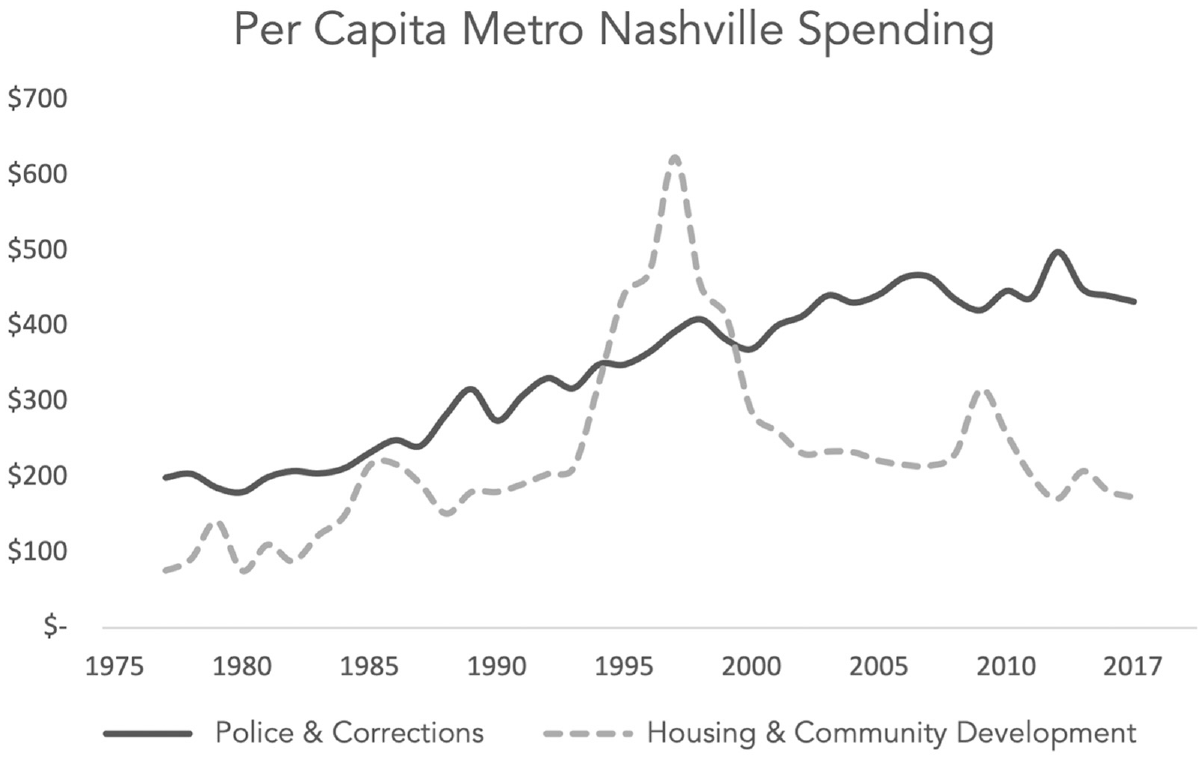
A reproduction of Per Capita Metro Nashville Spending, 19772017. Amounts are adjusted for inflation.
In addition, the NPBC worked to frame the city’s neoliberal agenda and its burgeoning reliance on public finance tools, like tax increment financing (TIF), to promote real estate and land development projects as a looting of the people’s money. Speculative mechanisms like TIF, which fund public benefits via increasing the revenue raised from property taxes, are contingent on successfully managing the fluctuations of real estate markets (Akers, 2015). They are a particularly attractive proposition in Nashville because the state constitutionally prohibits an income tax. TIF has been used in Nashville since the late 1980s, but under Mayor Cooper’s administration the amount of loans is significantly larger than the previous 35 years combined, accounting for 38% of all TIF loans ever given (Mendes, 2022). These loans have primarily gone towards attracting high-end development, igniting fierce debates over the types of social benefits promised versus those they ultimately secure. The NPBC (2021b) have thus charged the city with actively creating the social conditions of the so-called crisis budget by ‘giving our city away to developers and big businesses’.
Indeed, one of the impacts of using these speculative mechanisms is that debt servicing now constitutes the city’s third largest expenditure, after public safety and education. In comparison to cities of its size, Nashville had the greatest increase in per capita debt from 2006 to 2016, making it a city of ‘supernormal indebtedness’ (Davidson et al., 2021: 247). This trend has only been exacerbated with the city council’s approval of $2.1 billion to redevelop the city’s existing football stadium; with public funds making up 60% of the deal, it is the largest ever NFL subsidy (Stephenson and Wegner, 2023). Debates over using public dollars to fund these kinds of developments are not new. When the original stadium was built in Nashville in the late 1990s opponents questioned whether the funds might be better spent elsewhere, like on welfare, which was actively being cut by the state as an act of ‘tough love’ (Websdale, 2001: 73). However, the use of debt and the scale of development deals have taken on new significance in the conjunctural dynamics of municipal financialisation, where path-dependencies wed cities to deepening financial relations, their risks and constraints (Ponder and Omstedt, 2022).
In their analysis of these trends, the NPBC raised questions about the kinds of public goods secured via debt as well as the long-term costs of debt servicing. In their 2020 report, for example, the NPBC analysed the city’s capital spending plan, which allocates capital investments largely using general obligation and revenue bonds, both forms of municipal debt. They noted that the city financed $12 million for two new police helicopters. While the city cast the helicopters as the ultimate violence de-escalation tool, the NPBC argued that for $10 million the city could provide affordable housing for more than 750 Nashvillians; in 2020, roughly 2000 Nashvillians were unhoused, with at least 585 individuals living on the streets or in places not meant for human habitation (Horn Koch et al., 2022). To demonstrate the magnitude of these figures, the NPBC produced a one-page graphic: in a column on the left was an image of two helicopters, on the right, stretching almost the entirety of the page, and contrasting the blank space surrounding the helicopters, were 750 homes. The accompanying text also made it clear that taxpayers, and their dollars, are responsible for the long-term obligation of repaying these debts, even if revenue bonds are often positioned as reducing local taxpayer obligations. In other words, the NPBC highlighted that it was not simply the mayor’s proposed general budget that devoted a significant share of dollars to policing and private development, but also the city’s current and future spending plan.
In this manner, the NPBC opened the black box of the ‘crisis budget’. Their argument was powerfully simple: the ability to meet the needs and desires of Nashvillians during the pandemic was the real crisis, borne from the way policing and property regimes circumscribed the city’s budget and resulted in the routine underfunding of the resources and services that all communities need to thrive. Summarising their analysis, the NPBC stated, ‘Investing in social goods will not only reduce our life endangering dependence on criminal legal institutions, it will further free our money to fund what matters most’ (2020: 6).
More than simply calling attention to the hypocrisy of best urban governance practices, the analysis and demands of the NPBC showed how the twinned processes of policing and property development reinforce a vicious cycle of racial violence and harm that often works tacitly through the budgeting process. In some ways, the NPBC’s demands and tactics echo efforts like the Million-Dollar Blocks projects, which map single city blocks where states are spending more than a million dollars a year to incarcerate often minority and poor residents (see e.g. Kurgan, 2013; Story, 2016; or the project by Million Dollar Hoods, 2021). These projects not only demonstrate that incarceration is ineffective and inhumane, but they challenge us to imagine how millions of dollars of public funds could be put to better use. Likewise, the NPBC and the broader people’s budgets movement are also challenging the public to reimagine how public money is derived and spent. They are indicating that reconceptualising crisis, its root causes and deeper entanglements, creates possibilities for alternative accounting practices capable of meeting our collective needs.
Speculating on the possibilities of budgets after policing
People’s budgets do more than simply trace and bring into public debate the historic and ongoing entanglements between policing, property and racial capitalism. They also work to rupture the stronghold these systems of harm hold within municipal budgeting. They do so through a simple yet profound provocation: what other possibilities are made possible if we reject our dependency on policing?
This provocation is profound because it begins from the recognition that the money needed to make more liveable, just, and caring communities is not hard to come by but is in fact already at hand. In other words, it flips the script on the often overly determined discourses and practices of public finance that have long denied and cut funding to much needed social services and public benefits, like affordable housing. It suggests that a better future is both possible and plausible.
One way the NPBC is making this argument clear is by denaturalising and destabilising the terms through which money is scarce or abundant, distributed or withheld, caring or cruel. If as one Nashvillian stated, ‘there’s always enough money to lock us up, but never enough to house or educate us’ (NPBC, 2020: 20), then the NPBC is questioning scarce for what, who and when, and under what circumstances can money be found.
Austerity politics have long had a chokehold on municipal budgeting. With declining federal support and often limited fiscal powers, urban governments have tried to rein in their purse strings by pragmatically limiting city services, cutting payrolls, managing debt and offloading the responsibility associated with care work onto private individuals and households (Davidson and Ward, 2022; Peck, 2014; Phinney, 2020). While many austere cities have successfully managed to skirt bankruptcy, the dominance of austerity politics means that budgetary debates are often framed under the guise of imminent fiscal crisis and resource scarcity, even within relatively prosperous cities (Hinkley, 2017).
Nashville is a prosperous city. In FY22, the city’s total budget was $2.6 billion and in the following year the budget reached almost $3 billion. Despite fears over the economic impact of the pandemic, in 2023, Nashville’s bond rating was upgraded to AA+, its highest rating in over 40 years, and the city has developed a robust ‘rainy-day reserve’, one of the key factors driving cost cutting in 2020. However, year after year, the city cannot seem to expand its limited public transportation options, increase investments in its affordable housing trust fund, nor support robust social services. Indeed, for every $100 in the city’s general operating fund, $36 goes towards police, while only $1 is spent on affordable housing and $.66 on social services (NPBC, 2021a: 8). The opening and closing of the 2022 public budget hearing underscores this hypocrisy. It began by honouring several public employees for their heroism in preventing an unknown intruder from entering an elementary school. It closed with public employees begging the city for a cost-of-living adjustment so that they could afford to live and work in Nashville.
Starting from the assumption that Nashville’s budget can meet the needs of its residents, the NPBC invited residents to reimagine the city’s budget priorities. In 2020 and 2021, the process to create the Nashville’s people’s budget comprised an online survey in which respondents indicated how they would like to reallocate the city’s current budget expenditures. In 2020, across 5000 responses, the average resident wanted to divest $108 million from the city’s police department, $39 million from the county’s sheriff’s office and $3.5 million from the district attorney and re-invest that money in education, affordable housing, homelessness and social services. The 2021 people’s budget, which was informed by 3000 residents, further rearticulated and refined these demands, explicitly stating that the city should divest: $108–150 million from the police department; $6.8 million from school resource officers; $38–59 million from the county’s Sheriff’s office; and $5 million from the District Attorney’s office. In turn, the city should invest: $106–148 million in affordable housing; $53–95 million in infrastructure and transportation; $63–105 million in non-police violence prevention and interruption; $11–53 million in non-police first responders; $6–48 million in property tax relief; $18–60 million in social services; $56–98 million in health and hospitals; $10–31 million in parks, recreation and libraries; $7–49 million in arts and $80–180 million in the city’s public education system. These adjustments would take the approximate share of the general budget dedicated to policing from just under 50% to 15%. The differences between these visions of the budget are summarised by the following NPBC quote, ‘The difficult but necessary question that we must ask now and keep on asking every year is: will you use our money to fund a vision of public safety built on social goods or social control?’ (2020: 6). By inviting residents to spend public money, people’s budgets bring forth alternative accounting practices grounded in abundance and desire, rather than scarcity and harm. Yet, people’s budgets are not only an invitation to imagine a different future, but they are also an invitation to take seriously the work needed to dismantle systems of harm.
Non-reformist reform: Centering alternative forms of value and care in public finance
NPBC has adopted a dual strategy. On the one hand, they have worked to shed light on how municipal budgets spatialise and racialise relations of care and abandonment. On the other, they have opened critical spaces for broader debate over how these funds might be put towards other ends. This approach – both diagnostic and interventionist – successfully foregrounds the importance of reconsidering how forms of value and care – for land and for people – operate within urban governance. Echoing radical care theory – which reminds us that racialised, classed and gendered logics animate care practices, such that they determine who is worthy of being cared for, and who is burdened with performing the work of care giving – the NPBC has insisted on a rethinking of the logics by which policing and property delimit care within the municipal budgeting process (Hobart and Kneese, 2020; Reese and Johnson, 2022; Summers and Fields, 2022). Their intervention includes rejecting these rules of the game, and instead imagining and advancing an intersectional politics that centres caring first and foremost for the most vulnerable and most marginalised residents amongst us.
Such calls to centre care were amplified in Nashville and beyond during the pandemic with the turn towards models of mutual aid. A long-standing model for crafting reciprocal and community-driven relations of care, mutual aid emerged as a popular way to provide material support and build solidarity among neighbours, especially those who were neglected by the more individualistic measures of the pandemic. Though sometimes depoliticised, radical care scholars argued that for mutual aid to be a collective practice that refuses and resists the violence at the heart of capitalist modes of care, it must interrogate how care is mobilised by, for and against the state, especially when care practices normalise racialised violence (Reese and Johnson, 2022; Spade, 2020).
Indeed, the NPBC made clear that central to their vision for care was an investment in equitable public goods and services, recalling what Gilmore (2020) refers to as a ‘pro-state-state’ versus an ‘anti-state-state’. Equitable state provision would, as the NPBC argued, include affordable housing, transportation infrastructure, non-police first responders, property tax relief, hospitals, parks, libraries, art and a robust public education system. In short, it would entail the creation of urban infrastructure and social structures long denied to Black, Brown and poor communities so that they too could live, love and thrive in Nashville.
Such non-reformist reform – that is, conceiving of what is possible not in terms of a framework of a given system and administration, but in view of what should be made possible in terms of human needs and demands (Gortz, 1987, quoted in Gilmore, 2022) – is hard and unfinished work. Although the visionary demands of the NPBC increased widespread community engagement with the city budgeting process, in 2022, NPBC organisers took a break from their unpaid activism to rest and regroup. Their desire to do so reflected the exhaustion of engaging in a process that is largely committed to the status-quo and lacks meaningful engagement with public comments. It also reflects the complexities of an abolitionist praxis. Although the people’s budget demonstrated a clear desire to divest from policing and prioritise public goods and services, how to redistribute public funds without simply reforming the carceral state remains unclear. This is because the people’s budget divest-invest framework largely reallocates funds to already existing line segments of the budget, like social services, which tend to be seen as an extension of the carceral state. While some efforts for people’s budgets, like those in Los Angeles, are actively working to more expansively rename and recategorise budgetary items (Simonson, 2023), like public safety, questions nevertheless remain over how the redistribution of public funds will dismantle systems of harm.
Recognising these tensions, in 2023 the NPBC relaunched their efforts with a renewed focus on community organising to envision more just alternatives, as well as build the relationships needed to form new modes of being and belonging. They also sponsored ‘radical writing parties’. These parties brought Nashvillians together to write proposals for the city’s newly founded participatory budgeting programme. Founded in part to pacify the tensions that had emerged around budgetting since 2020, NPBC organisers challenged the city to do more. For example, they demanded that the mayor’s office relinquish control of the programme and transfer its oversight to a more independent department. Their intervention was intended to help build a participatory process that was true to its radical roots. This work is complex because it is not simply about providing new technical fixes for crises, like expanding forms of charity or fostering greater participation in processes that are hamstrung by the profit-making mandates of finance capital, but rather, as abolition geographies highlight, ‘reclaiming what it means to be human’ (Ranganathan and Bratman, 2021: 122). Such a reclamation entails centering collective desires and capacities to care and value life outside the dictates of neoliberal individualism and its accompanying violence.
As the work of NPBC – and the challenges they have encountered – underscores, radical place-making and prefigurative politics play a crucial role here. Radical place-making asserts that liberation requires a series of material changes that are both structural and spatial to undo the ways in which racial capitalism produces variegated landscapes of difference (Dawson, 2022; Inwood et al., 2021). Indeed, this is how Gilmore (2022) articulates abolition geography: as a means of remaking the world and ourselves. The NPBC’s effort as well as those in other cities to enact alternative visions of public finance and care suggest that a necessary component of this work is the cultivation of more expansive sociopolitical imaginaries that move beyond defining and determining value in relation to capital. In other words, because capitalism colonises our sociopolitical imaginaries, abolitionism crucially requires imagining modes of being and belonging that lie beyond systems of abstraction, extraction, dispossession and oppression. It requires a prefigurative politics that rejects the current world order, names a desire for a world otherwise, and by naming that desire, seeks to bring it forth into the present. Without remaking the world and ourselves, we risk redistributing resources without changing the underlying social relations and power configurations that sustain and reproduce inequality.
An agenda for the popular reimagination of budgets
There is an oft-quoted line: it is easier to imagine the end of the world than to imagine the end of capitalism. 3 It points not only to the entrenchment of capital but also to historical aphasia and an atrophy of imagination. All cultures are perhaps limited by their cosmogonies. There is an irony, however, to be living is an age when the ability to store data has never been so great but society’s ability to appreciate and think critically about history is not only seemingly dwindling but also under assault.
The writer and activist adrienne maree brown argues that ‘We are in an imagination battle’ (2017: 18) . She quotes Ursula Le Guin who once said, ‘It’s up to authors to spark the imagination of their reader and to help them envision alternatives to how we live’. We agree with brown and Le Guin, and we would add that it is also up to scholars and educators to spark the imagination of their students and the broader public, as well as be cognisant of how our imaginations can also be sparked by the writing and work of community organisers. We argue that understanding budget debates as battles over the imagination suggests some possibilities for how scholars can support and learn from efforts like NPBC. First, scholars can use research to contribute to critical conversations about budgets, for example, by documenting efforts to establish people’s budgets across municipalities and tracking their connections and impacts over time. Here, researchers might also analyse budget documents as an archive of the mechanisms of racial capitalism and its resulting tensions. To view budgets in this way is to recognise that budgetary debates are not simply conflicts over funding allocations and the optimal distribution of city services but are debates over the nature and future of capitalist society itself and the state’s role therein.
What might this stance require methodologically? Following Kass (2020), approaching budgets as archives of racial capitalism hints at the need for studies that recognise municipal finance data as a field site through which contested spaces, practices and power relations can be explored. Central to this approach is positioning budgetary documents not solely as technocratic products of government agencies nor objective and discrete data sets, but rather as discursive objects that demand interrogation and criticism. Researchers, for example, might ask, what is present, what is absent, what is legitimated and why? What are the conditions of production of such documents? This latter question focuses attention on how different power blocs, ideologies and laws shape the parameters of what is possible within public finance, how this has changed through time, and the implications for our current conjuncture. Another approach, following Hughes-McLure (2022), would be for scholars to use fiscal documents to quite literally follow the money: to track how the flows of public funds distribute material resources and thus produce and sustain social, economic and racial relationships.
Such empirical research could aid in sustaining productive counter-accountings (Heil, 2022) that uproot the dominant norms of municipal budgeting and provide organisers with a grounding for their political activism and public education. Indeed, while we see productive overlaps with critical accounting studies here (Catchpowle and Smyth, 2016), there is also a need for studies that explicitly focus on racial capitalism, recognising that racial identities and racialised spaces are not byproducts of capitalism, but are actively and continuously reproduced to structure when, how and from whom value is abstracted and extracted (Phinney, 2020; Ponder and Omstedt, 2022).
A second key area where scholars can support the people’s budget movement is through education. Finance capital’s hold on municipal governance has everything to do with how we teach economics – both within and beyond the discipline itself. In the span of human existence, capitalism as a mode of production and exchange and consumerism as a way of life are, young. Even younger, as Mitchell (1998) has so cogently shown, is the discipline of economics and dominant conceptions of the ‘economy’. Yet the paucity of alternative economics programmes in higher education allows the hegemony of neoclassical economics to remain unquestioned. As Mitchell argues, representations of the economy matter precisely because they are not mere representations. They remake the world in their image.
Movements for people’s budgets evidence that allowing this to happen has dire consequences. If we allow austerity politics and its discourses of scarcity to define what is possible solely through the lens of what is profitable, society’s mounting crises – crises of health, housing, climate – seem insurmountable. We fall prey to the logic that there is not enough money to fix our collective problems nor enough to meet our collective needs. In so doing, we submit our agency to the market. We forgo our humanity. We bring forth our own ecological and economic demise. To borrow a phrase from the philosopher Wynter (1995), we need a ‘root expansion of thought’ when it comes to economics. 4
Thus, while critiques of capitalism abound within the social sciences and humanities, it is equally important to move beyond critique to offer students – and ourselves – a sense of how things could be otherwise. Here, our argument resonates with other calls for more diverse theorising on just economies, including those calling for economic democracy (Bledsoe et al., 2022; Narayan and Rosenman, 2022; Nembhard, 2015).
Higher education would do well to develop more robust programming on economic democracy. For example, the interdisciplinary undergraduate programme in Social Thought and Political Economy at UMass, Amherst encourages students to critically examine society – capitalism, racism, the state, gender and sexuality – in relation to liberation struggles. Or the Canadian Centre for the Study of Co-operatives at the University of Saskatchewan promotes understanding and engagements with co-operatives. Directly attending to the role of universities in cities, the UCLA Luskin Institute on Inequality and Democracy, spearheaded by Ananya Roy, builds research-driven alliances with social movements to advance a more radical democracy. These are but a few examples of education models that uplift and build from the imaginations of social movements to disseminate alternative economic and development models.
A final area where scholars can support the people’s budget movement is through developing an infrastructure for organising. Finance capital is a well-networked machine, not only in terms of the flows of capital extraction and accumulation, but also in terms of its actors and techniques of coercion. The sophistication of these networks, and their casual infiltration into the everyday working of local governments, requires a commensurate organised and inter-scalar response. Teaching and research can help build this response and contribute directly to organising efforts. For instance, if the demands for people’s budgets were largely ignored or at least coopted by city governments in 2021, then it suggests that scholars have a role to play in grappling with the forms of knowledge that are recognised as legitimate – as well as those that are rendered illegitimate – in budgetary spaces.
Scholars may also use their positions within relatively privileged institutions to direct resources to facilitate organising labour. This might look like paying interns to research strategies and lessons from other cities, facilitating access to knowledge, services and tools that are behind pay-walls, or providing space to convene organising groups and activists. It might also mean tracking responses to the people’s budget movement nationally, especially in the context of how the movement is uplifting the structural inequities that undermine participatory budgeting, the differences between the two approaches, and the limitations therein. Given the ongoing promotion of participatory budgeting as the fix for police brutality, and even state repression to protect police budgets (Simonson, 2023), it would be naive to suggest that the radical ideas of people’s budgets are immune to co-optation, compromise or dismissal. Nevertheless, by working with social movements, scholars have a role to play in supporting a resistant and responsive people’s budget movement that attends to the history of participatory budgeting, and the critiques of its own radical visions, strategies and alternative imaginations. Moreover, scholars might form partnerships with community organisers and contribute their labour to organising activities like canvassing, public education efforts or speaking out at budget hearings. To make these partnerships mutually beneficial will require confronting the structure of value within higher education that promotes the sequestering of knowledge, individual entrepreneurship and hierarchies among ranks, departments and communities.
Research that enacts a reimagining of budgets agenda would thus unite these pursuits of research, education and organising and in so doing (1) help pull back the veil on the complex layers of public finance that shape municipal budgets; (2) uplift the aspirations and visions for alternative futures voiced by organisers in budgetary debates; and (3) work to co-generate knowledge and research outputs that will help build liberatory movements.
Footnotes
Acknowledgements
We are indebted to Gavin Crowell-Williamson and BR Balmer for their research assistance early in the process of writing this paper. We are also grateful for the constructive comments provided by several other people at various stages: Kathe Newman, Mi Shi, Bob Lake, and the participants of the Negotiating Social Futures conference, attendees of the panel on ‘public economic geography for the 21st century’ at the Association of American Geographers 2022 annual meeting, participants of Accounting for Space mini conference, and three anonymous reviewers. We also thank the staff at Urban Studies for their editorial guidance.
Declaration of conflicting interests
The author(s) declared no potential conflicts of interest with respect to the research, authorship, and/or publication of this article.
Funding
The author(s) received no financial support for the research, authorship, and/or publication of this article.
