




Abstract
Car dependency greatly contributes to the climate crisis and the corrosion of public space. In response, cities are introducing pedestrianisation, cycle lanes or tactical urban interventions aimed at repurposing streets for other road users. Framed as ‘experiments’, these reallocations of street space disrupt traditional transport planning procedures, often with promising results in promoting active travel. They are also associated with deep conflicts and criticism, especially by citizens defending the right to drive. Despite their ability to stop experiments, such conflicts have been little explored in the debates about experimentation and automobility. Similarly, street experiments have in most cases been uncritically embraced as a panacea for urban mobility problems, with little attention paid to experimentation as an expression of austerity urbanism. This paper aims to deepen our understanding of street experiments and their relationship to automobility by contextualising their conflictual unfolding as an expression of post-political planning in the age of austerity urbanism. Through a critical examination of the Torino Mobility Lab, a collaborative pedestrianisation experiment in Torino, we show how the governance-beyond-state setup of such projects masks a complex and contested coexistence of different meanings and processes for reimagining urban mobility and public space. We show how conflicts emerge embedded in the problematic and post-political governance of transport experiments. Nested within austerity urbanism, the experiment remains limited in its ability to create healthy spaces for participation. We conclude by highlighting the limitations and contradictions of attempts to overcome car dependency embedded in post-political frameworks and neoliberal-austerity planning practices.
Introduction
Automobility, the dominant paradigm of car-based urban mobility, not only greatly contributes to the climate crisis but also generates significant corrosion of public space. Cars occupy a substantial portion of public land (Gössling et al., 2016), confining pedestrians and cyclists to low-quality travel provisions, a few urban squares or parks, private gardens, schools, or courtyards.
The COVID-19 pandemic, which paralysed most journeys, provided an opportunity to reverse this trend. Environmental and health discourses prompted cities in Europe and elsewhere to introduce experimental road reallocations, including new temporary pedestrianisations and pop-up cycle lanes. Often introduced using emergency measures, experiments disrupted traditional transport planning procedures, with promising results in promoting walking and cycling (Aldred and Goodman, 2021). Nevertheless, these rapid changes generated widespread conflicts, primarily over driving rights, often with the effect of undermining the projects. 1
Tensions between providing safe spaces for playing, walking, or cycling and facilitating flows of motorised vehicles are at the heart of the politics of transport planning. Deep controversies over the values, meanings, and practices of ‘the street’ as a public space contour most measures that challenge car use (Wild et al., 2018; Wilson and Mitra, 2020). Rather than becoming a productive force able to generate ‘transformative change’ (Verloo and Davis, 2021: 5), such conflicts complicate the ways in which experiments can challenge automobility. As Zografos et al. (2020) highlight in a detailed analysis of the ‘everyday politics’ of Barcelona’s superblocks, the remaking of urban mobility away from car use is inevitably shaped by power, legitimacy, and authority and ringed by ideological conflicts over urban visions. However, controversies and conflicts have only been marginally considered in the analysis of experimental measures that challenge automobility.
Similarly, despite the growing interest in planning theory in deepening our understanding of ‘conflict and consensus as co-constitutive and shaped by politics’ (Legacy et al., 2019: 274), street experiments, for the most part, have been uncritically embraced as a panacea for urban mobility problems. The emphasis on the lexicon of experimentation and co-production has prevented a due examination of street experiments’ relationship to dissent, urban politics, and power, or their relationship to austerity urbanism (Peck, 2012) and processes of depoliticisation. This despite the fact that experimentation has become a popular modus operandi of transport planning under austerity in Europe and elsewhere (Bragaglia and Rossignolo, 2021; Ferreri, 2021). 2
The emerging literature on street experiments, or the more established socio-technical transitions literature, 3 rarely connect with existing scholarship on urban conflict or explore experiments’ implications for the production of publics, public spaces, and urban futures (Besplemmenova and Pollio, 2021). For example, although scholarship on socio-technical transitions is open to critical accounts of governance (Köhler et al., 2019), it remained, according to Sosa López (2021: 480), ‘short of linking experimentation with questions of urban citizenship’. Similarly, the emerging literature on street experiments focuses primarily on behavioural change (Bertolini, 2020), with little attention paid to the impacts of experiments on broader automobility politics and its implications for planning practice. Montero and Castaneda (2023) suggest that adequate mobility governance experiments are lacking. These should move beyond simplistic temporary changes designed to provide citizens with new experiences towards actions that ‘resignif[y] automobile infrastructures, and political, technical and institutional coalitions to make them durable in time’ (Montero and Castaneda, 2023: n.p.). As Sosa López (2021: 493) argues for cycling experiments in Mexico City, ‘interventions […] are limited both in their technocratic merits and in their redistributive effects’.
In response, this paper analyses the unfolding controversies around street experiments and their role in the urban politics of street space allocation and uses. By mobilising the idea of conflict and antagonism in the post-political city, we bring a deeper understanding of how, and whether, experiments might contribute to reconfiguring urban car dependency. Specifically, the article examines the conflictual governance of the Torino Mobility Lab (TML), an ambitious road reallocation project in Torino, Italy, a city whose history firmly entangles with automobility. As we trace the evolution of the TML, the contrasting perspectives of the actors involved, and the network of relationships at the heart of its conflictual development, we uncover a complex coexistence of variegated meanings and processes related to public space. We examine the political nature of these conflicts and show how they are embedded in the messy governance of an experimental intervention whose post-political set-up catalyses polarisation and undermines a fruitful rethinking of public space. We conclude by reflecting on the unlikely success of overcoming automobility via experimental measures within post-political austerity urbanism.
The paper contributes to debates on urban experimentation and automobility and speaks to the literature on dissent and conflict in urban planning (Allegra et al., 2013; Gualini, 2015; Legacy et al., 2019; Verloo and Davis, 2021). It complements the literature on the post-political nature of transport planning (Legacy, 2016). It contributes to framing car-dependence as a far-reaching challenge requiring in-depth analysis of the power configurations that allow its reproduction, but also profound socio-political transformations towards shifting the role of the automobile as a cardinal point of modernity (Mattioli et al., 2020; Merriman, 2009; Paterson, 2007).
Literature context
Experimenting in the neoliberal city
Bulkeley and Broto (2013) have already highlighted the growing popularity of ‘experiments’ as a response to the challenges of climate change governance under state restructuring. By staging a chosen future in the present, experiments helped to reframe climate change as an opportunity and to test visions that could be scaled up. By unlocking new potential for collaboration between public and private actors, they opened up novel governance spaces, supported capital investments in creating realistic alternatives and contributed to reshaping urban climate politics (Evans, 2016). Between trial-and-test approaches and more ‘experimentation’ as a novelty, urban experiments have been increasingly studied in planning (Caprotti and Cowley, 2017; Honey-Rosés, 2019).
Celebrated by many as protected spaces to practice alternative futures by ‘learning from real-world interventions’ (Evans et al., 2016: 12), experiments are also criticised for their alignment with two critical facets of the neoliberal city, austerity politics and forms of depoliticisation. Temporary uses and urban experiments are booming as pivotal instruments for remaking planning and policy under ‘austerity urbanism’ and its normalisation of precarity (Ferreri, 2021). Under the pressure of international and national austerity measures, local governments resort to the reduction or privatisation of local services, often turning to forms of ‘co-production’ under the influence of corporate and third-sector organisations (Chorianopoulos and Tselepi, 2019). In this context, urban experiments offer a quick and low-cost opportunity to engage with these actors to regenerate public space and increase urban attractiveness. However, by giving centrality to private actors’ initiatives, experiments risk becoming another tool for bolstering neoliberal urbanism (Bragaglia and Rossignolo, 2021), often with ‘deleterious effects on the social fabric of urban life via gentrifying processes’ (Mould, 2014: 530).
A key example is ‘tactical urbanism’, a form of experimentation that focuses on rapid, low-cost urban change, often using temporary street features such as benches, floor paint, and planters. The term encompasses a range of grassroots tactics – from DIY to guerrilla urbanism (Lydon and Garcia, 2015) – and is recurrent in urban regeneration and road reallocation initiatives. While some have celebrated tactical urbanism for its transformative capacity to enable a ‘radical site of material participation’ (Besplemmenova and Pollio, 2021: 84), others have criticised it for institutionalising and commodifying radical planning ideas in the service of top-down ‘spatial fixes’ (Brenner, 2020; Mould, 2014; Webb, 2018).
At the same time, while, for some, experiments help instigate temporary spaces for political debates embedded in praxis, materiality, and encounter (Webb, 2018), for others they risk ‘perpetuating a “post-political” urban condition (MacLeod, 2011) in which struggles over justice are diluted within regimes of experimentation’ (Evans, 2016: 440). Initially used to critique the neoliberal consensus underpinning sustainability discourses (Swyngedouw, 2014), the post-political thesis highlights the progressive erasure of public debate, dissent and ‘agonism’ in the name of overarching consensual narratives such as sustainability, health, and growth, and the replacement of urban politics with techno-managerial consensus. In the case of experiments, their post-political nature is evident in how, often associated with poorly structured forms of citizen engagement, they have departed from the original insurgent grassroots ethos (Kapsali, 2023). Limited in their ability to provide spaces for in-depth political analysis and contestation, experiments lose their ability to resist austerity urbanism. Rather, they provide another spatialised consensual form of governance-beyond-the-state, typical of processes of neoliberal restructuring (Swyngedouw, 2005).
Conflictual street experiments in the post-political city
Central to the post-political thesis proposed by post-foundational theorists is a robust analysis of antagonism as a necessary feature of public life and politics (Mouffe, 2005a, 2005b; Ranciere, 1992), which might better inform our understanding of conflict in street experiments. 4
For Mouffe, in the post-political city, opportunities for truly democratic debate and controversy are suppressed. As a result, the genuine agonism between adversaries disputing opposing views, typical of healthy political debate, is replaced by a fierce battle between moral enemies. The post-political city of consensual policies nurtures populisms and fundamentalisms, polarisation and the radical negation of the other as legitimate adversaries with the right to defend their opinions. Reversing depoliticisation and polarisation therefore requires restoring healthy spaces for the expression of antagonism, where a fundamental questioning of any hegemonic formation of how existing social norms are constituted and reproduced is allowed between legitimate opponents.
Such post-foundational analysis of the political are particularly instructive for a better understanding of the conflictual governance processes underpinning transformations in urban mobility, especially given the tendency of transport planning to ‘displace the political’ and to frame of urban mobility decisions as a purely technical matter. A clear example is provided by Legacy (2016, 2018), who exposes the limits of the techno-managerial denial of the political in the governance of urban mobility, particularly around the emergence of controversies surrounding road-building projects. Mobilising Mouffe’s understanding of antagonism, Legacy (2016) shows how path dependency and opaque decision-making processes create tensions between governments and communities who are denied a voice in the future of mobility.
In Legacy’s analysis, citizen-led opposition can challenge the denial of adequate spaces for political debate within official planning processes. Citizen opposition can bring the political by opening up informal deliberative spaces that profoundly reshape project outcomes. As such, agonism is ignited in the ‘interstitial spaces’ of planning, informal arenas that form at the edges of formal planning processes (Steele and Keys, 2015), where ‘state politics and citizen-led politicisation of transport converge’ (Legacy, 2018: 197).
Legacy’s contribution portrays citizen action as a re-politicising force capable of catalysing the transformative potential of antagonism and preventing it from becoming a clashing polarisation of views. Others, however, have warned of the lasting damage of a post-political set-up for genuine grassroots action and the limited transformative potential of political action from ‘interstitial planning spaces’ (Davies et al., 2021; Kapsali, 2023). This is a consideration that is particularly relevant in the context of experiments as an innovative form of governance-beyond-the-state, already set up to break down the boundaries between ‘formal planning’ and citizen action in the name of co-production. As mentioned, while some have highlighted the democratising potential of experiments (Besplemmenova and Pollio, 2021), others have emphasised their Janus face (Torrens and von Wirth, 2021). For example, an insightful analysis of a road reallocation project in Ghent shows that even when grassroots-led political deliberation underpins experimental action, different understandings of democratic politics can trigger deeper conflicts between residents (Van Wymeersch et al., 2019).
An analysis of the conflictual nature of decision-making processes is crucial when considering street experiments and their role in the broader landscape of automobility. A critical understanding of experiments as embedded in austerity urbanism invites careful consideration of their post-political configuration, which risks deepening conflicts. This means paying careful attention to the micro-politics of planning decision-making and how power and rationality reshape the post-political, within and beyond formal planning processes. At the same time, recognising experiments as a form of governance-beyond-the-state means avoiding the risk of over-romanticising grassroots actions and moving beyond the traditional consensus versus agonism debate (Bond, 2011; Legacy et al., 2019).
In the next sections, the case of the TML will be used to better understand how road reallocation’s conflictual nature intertwines with facets of austerity urbanism and the post-political city and with what effects on the future of automobility.
Case study
The Torino Mobility Lab is located in San Salvario, a neighbourhood in Torino, Italy’s fourth most populous city. Torino has long been considered a typical one-company town, hosting the headquarters and manufacturing plant of the automobile company FIAT since its foundation in 1899. The presence of FIAT has firmly determined the social identity and rhythm of the city throughout the 20th century. In response to the Fordist crisis, over the last two decades, the city has sought to diversify its economic base and re-brand itself as a ‘knowledge society’ fostering high-tech industries and cultural activities (González et al., 2018; Vanolo, 2008). However, the legacy of FIAT’s dominant role is still present in the local mobility system. Torino is largely car-dependent, with one of Europe’s highest car ownership rates and an under-used public transport system.
Situated at the edge of the historic centre, San Salvario is one of Torino’s semi-central neighbourhoods; it is very densely populated, with around 46,700 inhabitants in an area of nearly 2.5 km2. Situated close to the central railway station, Porta Nuova, San Salvario is also highly diverse, having been the first port of call for various waves of migrants from southern Italy in the 1960–70s and northern Africa since the late 1980s. In the mid-1990s, the neighbourhood become nationally known for inter-ethnic tensions, widespread drug trafficking, poor housing conditions and the decline of small-scale retail (Allasino et al., 2000; Marra et al., 2016).
In the last two decades, local socio-cultural associations, religious organisations, and NGOs, often supported by the District council, have promoted a less tense multi-ethnic coexistence. The socio-cultural mix has also facilitated a commercial expansion process that has gentrified the area. The arrival of new consumption spaces – trendy restaurants, cafes, pubs, music venues, art and design studios, craft shops etc. – has displaced most of the traditional and ethnic shops and started to attract university students and young creatives (Bolzoni, 2016). The transformation of San Salvario into the city’s new hip playscape has led older residents to complain about night-time noise, traffic and litter and to call for stricter regulation of club opening and closing hours (Crivello, 2011). The expansion of the outdoor space for bars and restaurants during the pandemic and the ongoing road works for the new central heating infrastructure exacerbated this situation in 2020–2021.
Torino Mobility Lab
The Torino Mobility Lab is an experimental road reallocation project. It originated in late 2016 in response to a grant issued by the Ministry of the Environment entitled ‘Experimental national programme for sustainable home-school and home-work mobility’ (see Figure 1). The call was aimed at encouraging the uptake of walking and cycling for journeys to school and work (Ministero dell’Ambiente, 2016). The Torino’s bid focused on the San Salvario neighbourhood. It included a package of ‘hard and soft measures’ to promote walking and cycling, from the introduction of new cycle lanes to sustainable school mobility plans (Città di Torino, 2016).
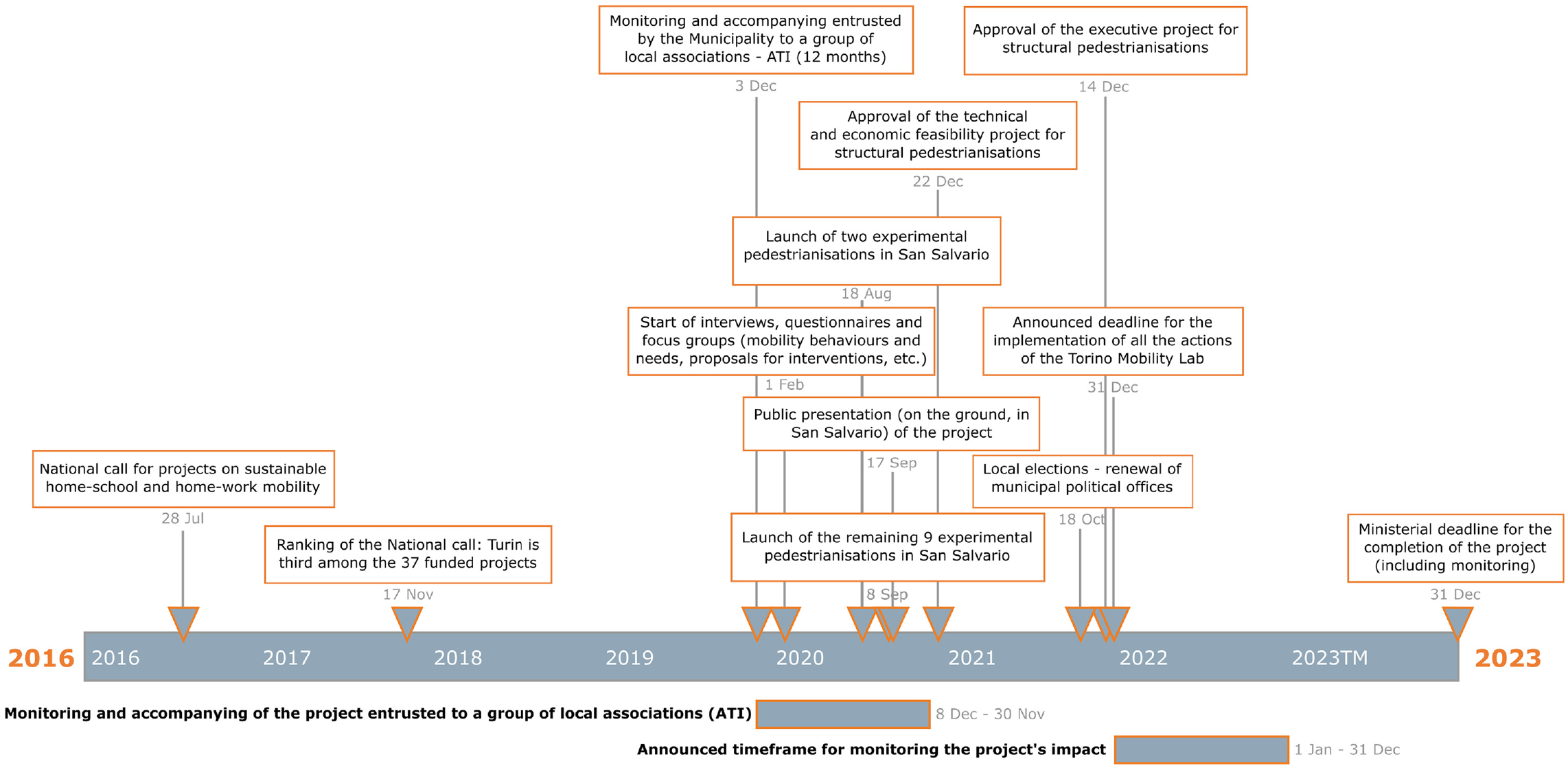
A timeline of the TML project.
With a budget of €3.0 million, 5 the TML is a multi-dimensional experiment. Firstly, it is a classic tactical urbanism intervention with pedestrianised streets, new street furniture, coloured pavements, speed reduction zones, bike racks, and a new cycle lane aimed at catalysing modal shift. Secondly, the TML is a governance experiment, combining traditional transport planning with a form of governance-beyond-the-state (Swyngedouw, 2005), where the Council works alongside the voluntary sector to deliver change through networked governance structures. Thirdly, the TML constitutes a form of ‘living lab’ for the city and its transport planning department to learn from this project with a view for similar projects in the future.
As the officials we interviewed told us, the initial decision to focus on the San Salvario neighbourhood was linked to the opportunity to propose a main cycle lane on its boundary road (Via Nizza, see Figure 2) as a co-financing deal, combining a EU-funded scheme with the ministerial one, and reducing the financial burden on the municipal budget. San Salvario was also particularly suitable thanks to its ‘superblock-like’ layout – a dense and mixed neighbourhood with a regular grid – and its ‘preparedness’ to sustainable mobility interventions. Territorial associations are particularly vibrant and active in the area. In the words of one interviewee, ‘in San Salvario, there are more associations than street numbers’ (Council rep). The associations are also very attentive to mobility issues. Many of the pedestrianisations included in the TML were previously proposed or designed by local associations.
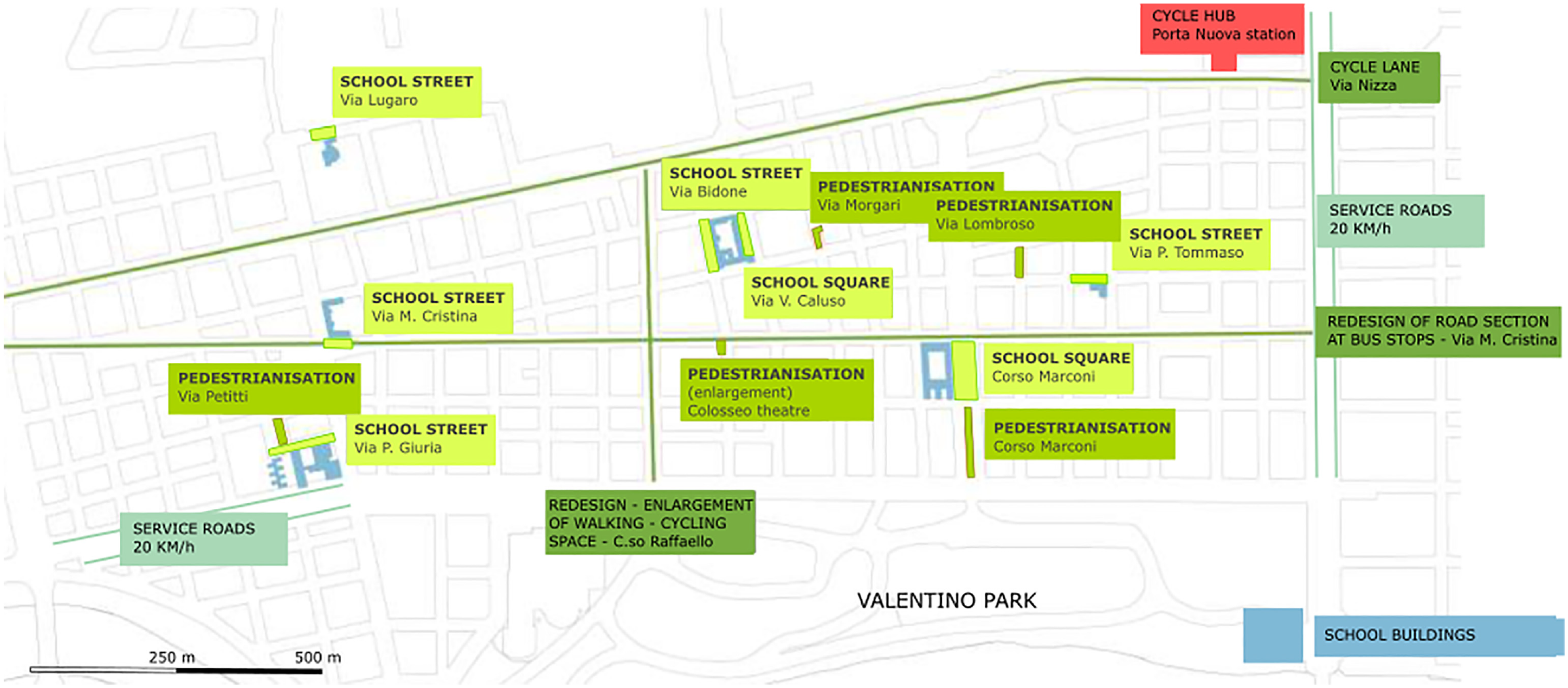
A map of the TML.
Despite San Salvario’s receptiveness, this highly car-dependent neighbourhood is simultaneously riven by sharp conflicts over the availability of car parking for residents, which in the past led to disagreements and the emergence of two different citizens’ committees. In this sense, San Salvario represents a challenge as ‘a very dense, very conflicted, very complicated neighbourhood where reducing the number of parking spaces risks causing “civil wars”’ (Council rep).
The TML project was accompanied by a relatively innovative approach to transport governance for Italian planning culture, opening up traditionally technocratic planning to other stakeholders. In particular, the project’s design and implementation were intertwined with a ‘Social accompaniment, participatory planning, and monitoring programme’ (hereafter ‘monitoring programme’), which aimed to generate opportunities for citizens to debate the design and continuation of the interventions. This process overcame the ministerial requirements for citizen engagement, which were limited to a simple evaluation exercise (Ministero dell’Ambiente, 2016). Nevertheless, it was planned to last only 12 out of the 36 months planned for the project’s implementation (November 2019 to November 2020, see Figure 1). The organisation and delivery of the monitoring programme were subcontracted by the municipality, through a call for tender (Comune di Torino, 2019) to a temporary enterprise (Associazione Temporanea d’Impresa – ATI) composed of four local NGOs: a network of 27 local associations linked to the local ‘Neighbourhood House’ (Caponio and Donatiello, 2017), the local Urban Lab, a local association for international cooperation, and an association working on local urban quality. The ATI delivered its work through interviews with local stakeholders, focus groups and two surveys aimed at ‘identifying needs, sharing, coordinating activities and accompanying the planning decisions of the municipal administration, supporting citizens dedicated to the activation of spaces’ (ATI, 2020, np).
At the same time, various local actors were engaged more or less formally in each phase of the project, especially in informal meetings led by the Council. These actors include the District council, local associations, the Superintendence for Architectural Heritage and Landscape, and citizens who, as we will explain, found other opportunities to express their opinions. It should also be noted that the implementation of the TML was promoted during the last year of the Five Star Movement’s mandate. 6 With the Mayor’s initial programme committing to take clear action to reduce car use (Comune di Torino, 2016), the TML assumed even more of a central role in local debates, and was seen as part of several actions taken by the Mayor to regain her declining popularity before the elections.
The occurrence of the COVID-19 pandemic and the flexible initial plan allowed the Council to divert the resources initially focused on cyclability to a series of pedestrianisations and school streets, which began in July 2020 (see Figures 1 and 2). The project’s central focus shifted to facilitating social distancing and walkability, while other actions for cyclability have been delayed until the time of writing. Inspired by international experiences, such as Barcelona’s superblocks, the municipality opted for a two-phase process: a first phase of low-cost experimental pedestrianisations (July–September 2020), followed by a ‘structural phase’ of more substantial infrastructure changes in late 2021. Between the two phases, the monitoring programme would have fed into an evaluation phase, whose criteria were not explicit. The monitoring programme was intended to confirm or withdraw the pedestrianisations. 7
Methodology
Our methodological approach responds to a call for ‘bottom-up theory’ in urban research and adopts ‘a sociohistorical approach that emphasises the production of “thick descriptions” of the reality observed’ (Allegra et al., 2013: 1682). Following Allegra et al.’s (2013) work on urban dissent, we combine Flyvbjerg’s (2003) invite for a phronetic approach to planning research with Latour’s indications for mapping controversies around socio-technical disputes (Venturini, 2010, 2012). Such epistemological eclecticism allows the emergence of an understanding of the role of power as a contingent, productive, and relational force which is constantly shaping and reshaping the networks of institutions, discourses, rules, built space, and documents which produce both spatial and social changes in the case study selected (Van Assche et al., 2014).
This is to say that power is the fundamental object of our analysis, as the moving force behind the networks, discourses, and actions that constitute the TML experiment. Tracing the project’s development cannot be ‘reduced to a set of categories produced within the planning system’ (Van Assche et al., 2014: 2393). Rather, our analysis accounts for the imbrication of the official planning moves with the myriad of territorial and grassroots movements; and, as we will show, the fundamentally political nature of the changes we witnessed.
In practical terms, inspired by the mapping of controversies methodology (Venturini, 2010: 260), we aimed to observe the evolution of the TML from ‘as many viewpoints as possible’, between March and July 2021, at a stage when the project was unfinished but in a phase of ‘stasis’. This observation was aware of productive alliances or conflicts that produced or blocked change while making and remaking the project’s governance. It entailed not only the development of plans and interventions, but also how the discourses around public space and sustainable mobility evolved and produced change.
To do so, we started mapping the controversy and outlining its chronology by digging into the available grey literature, including the reports developed by the actors delivering the project, social media, blog posts, websites and our local knowledge. This helped produce a first map of the actors involved, including events, spaces, and policy documents colour-coded differently. The map then evolved into a systematised visualisation of the relations and conflicts between actors and projects, whilst we dismissed the more material aspects, which are, however, crucial parts of the narration.
Based on an initial analysis of the vertex of the map and our deepened understanding of the literature, we developed a list of interviews. We started with those actors who were more involved and influential in the controversy (Venturini, 2012). We invited these actors to share with us their narration of the development of the TML and reflect on the different conflicts they identified. We used semi-structured interviews conducted in pairs or as a whole team, setting them up as a moment of open dialogue inspiring reflexivity (Vitale Brovarone et al., 2023). By openly listening to the different narrations, we better understood each actor’s interest in the development of TML and opened up the richness of the controversy in a way that was ‘adapted, redundant and flexible’ (Venturini, 2012: 800).
We refined our chronology and map alongside our interviews, met as a team after each interview to discuss key findings, and developed a shared file with notes. This process allowed us to refine the list of interviewees as our knowledge of the controversy progressed. In total, we interviewed 15 individuals, including four council officials, the Municipal Councillor for Mobility and her collaborator, the head of the District council (quoted as ‘Council rep’ or ‘Organiser’), and the members of six local associations, including the ones who had been in charge of the project evaluation (quoted as ‘Association rep’). The interview transcripts and our fieldwork notes were analysed thematically and utilised for our final analysis.
The TML as a post-political transport intervention
At the time of our research, in July 2021, when, as one of the planners told us, ‘the planning season ha[d] ended’, the TML looked very different from the original 2019 plan. The project’s main pedestrianisation, a portion of the historical axis of Corso Marconi, was a 5000 sqm area of car-free space with a few benches surrounded by parked cars and traffic lanes (see Figure 3). It was an area much smaller and less colourful than the original plans the Council showed us, but where many still came to play or relax under the historic trees; an area whose future is still uncertain and contested.
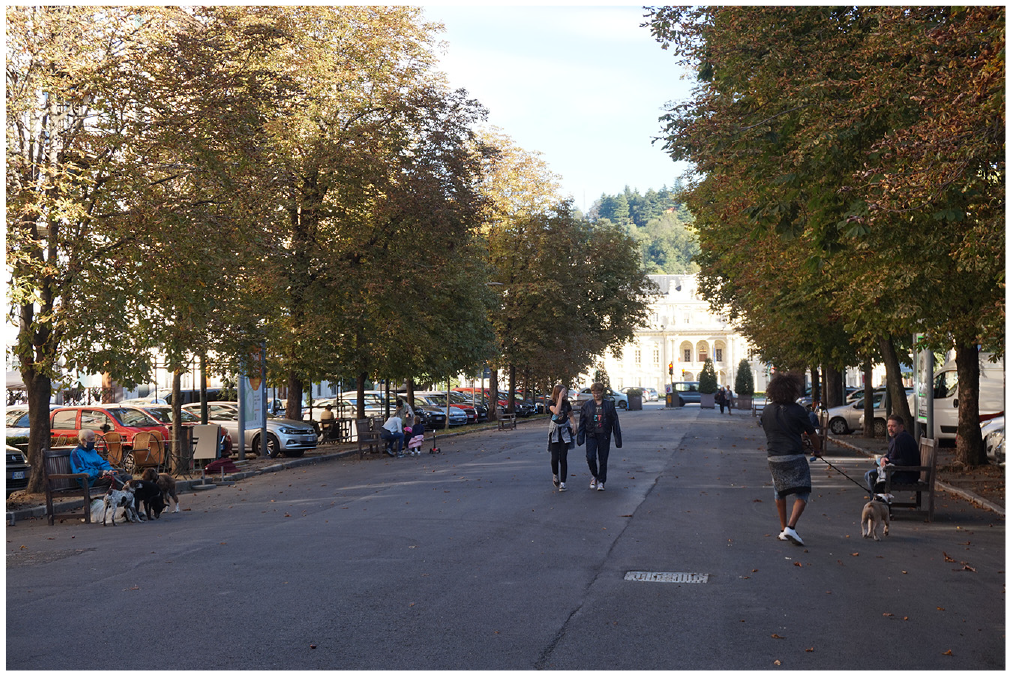
The pedestrianised portion of Corso Marconi (Authors’ photo, October 2021).
A general frustration was expressed across the spectrum of supporters and opponents of the project, which outweighed any disagreement on the project’s substance. As one resident remarked, ‘there was always a promise that there would be opportunities for listening and consultation and so on. But honestly, this did not happen; only pseudo consultations took place’ (Association rep).
According to residents and associations, the monitoring process did not provide concrete opportunities for feedback. One local association representative described the ATI survey as ‘designed to get the results they wanted’. Others were concerned about poor communication and project timing, with streets being closed unexpectedly, a mismatch between the monitoring process and the project timeline, and decisions to confirm interventions taken before consultations had ended. Similar to the Barcelona example reported by Zografos et al. (2020), many residents criticised the implementation of the pedestrianisations in August, which made the TML appear as a top-down process that ‘happened while everyone was on holiday’ (Association rep).
The typically post-political absence of opportunities to discuss the purpose and design of the TML exacerbated and polarised existing substantial conflicts. As predicted by Mouffe (2005a), the absence of agonistic debate within the monitoring process escalated tensions between residents into blatant antagonism between those ‘pro’ and ‘anti’ street closures. As covered in another paper (Vitale Brovarone et al., 2023), interviews with residents’ associations revealed multi-layered controversies over street use, with notions of safety and tranquillity, street life and the local economy mobilised to frame competing arguments for or against street reallocations. The same organisers we interviewed observed this tightening of positions; the atmosphere of conflict in the aftermath of the implementation contrasted sharply with the openness to reducing car journeys that many residents had previously expressed. 8
The poor design of the engagement process sharpened conflicts not only between the organisers and the ‘public’, but also among the organisers themselves (Vitale Brovarone et al., 2023). The District council expressed deep concern about the involvement of the ATI as a semi-private actor, and made a public allegation questioning its involvement. In retrospect, the Council regretted subcontracting the ATI, as its dual role as territorial actor and organiser made it unable to manage the public. However, the failure of the engagement activities as part of the ‘monitoring programme’ was not solely due to the ATI’s difficulty in engaging citizens, and even more so during a pandemic. Although the implementation of the engagement plan was severely hampered by the lockdowns, a much deeper procedural conflict emerged.
The temporal discrepancy between engagement and decisions reflected a systemic processual conflict around participatory decision-making that, in Wolf’s (2021) terms, exacerbated the substantive conflicts around road users in San Salvario. In contrast to residents’ expectations of substantial participation and agonistic debate, 9 the monitoring programme was deliberately designed as a ‘quality control’ exercise. Most organisers were reluctant to make the substance of the experiment subject to consultation. As one council member reported, ‘[participation] was not so much about “yes we are doing the interventions; no, we are not doing the interventions”, but about how we are doing the interventions in a definitive executive phase’.
Such a dichotomy exposed the fundamental disagreement about the purpose of experimentation. On the one hand, residents and associations, fully aware of the complexity of local issues such as parking, nightlife, safety, and quality of public space, could not disentangle the road-space reallocations from wider debates about neighbourhood identity and sense of place. These should have been discussed as part of the design and purpose of the TML as an urban experiment. On the other hand, the organisers focused on the experiment’s ‘modal shift’ objectives. Faced with the challenge of implementing a centrally funded project regardless of public opinion, the organisers saw the TML controversy as ‘practically a non-issue’ (Council rep). The same set-up of the TML funding was adamant about substantial participation and demanded a top-down approach where engagement was confused with monitoring and evaluation. According to the organisers, the grant application required the submission of set policy packages with very little room for reframing during implementation and minimal resources for engagement.
Under the strain of meeting funding requirements and facing the climate change crisis, the organisers felt they had no time to engage citizens about car-use reduction, especially since it was part of the outgoing Mayor’s political mandate (Comune di Torino, 2016). Reducing car dependency transcended local disputes, as it had, in the past, with road-building projects: ‘It won’t happen that they build a highway and then ask you, “do you want us to remove it?”’ (Organiser).
The processual conflict concerned not only the nature of experimentation, but also the political nature of challenging automobility. From its inception, the TML was based on a post-political framing of road reallocations as ‘neutral experiments’. The Council framed the new pedestrian areas and bike lanes as ‘small structural interventions’ (Council rep). It took a paternalistic approach to educate the population about active mobility without discussing the wider context of such change nor taking broader geographical actions to accommodate modal shifts.
In a scenario of overturned policy objectives, the techno-managerial logic typical of pro-car interventions (Legacy, 2016) underpinned measures aimed at weakening automobility. While the Council was determined to continue the experiment unless it was ‘swamped by controversies’, citizen engagement focused on the choice of street furniture. Broader issues about everyday life in San Salvario had no space in the discussions. The experimental framing of the TML generated interventions that focused on localised behavioural change and failed to address the pervasive nature of automobility as a profound political question.
Experimentation was used instead as a framework to normalise road reallocation as a technical procedure of international prestige. In the interviews, the urgency to experiment with climate mitigation solutions was peppered with repeated references to similar international initiatives in ‘paradigmatic cities’, such as Barcelona, Paris or Brussels, and to lessons learned from international exchanges attended by the organisers. Best practices around experiments attracted and intrigued planners, strengthened a discursive alliance around sustainable transport, and backed-up political consensus on the ‘right policies’ to make Torino sustainable. They supported the broader agenda the city had been pursuing since the 2006 Winter Olympics to reposition itself as an internationally competitive global metropolis (Bondonio et al., 2007; Caruso et al., 2015).
Certainly, such discursive alliances supported a shift away from a transport planning agenda traditionally focused on facilitating the flow of cars. However, they also diverted attention from the micropolitics of experimentation, including an obliviousness to the powerful potential of local relational conflicts, citizen opposition and needs. Like the projects analysed by Wild et al. (2018), the TML overlooked the complex social changes required to achieve transitions, including the clashing values around individual rights and the privatisation of public space that are mobilised when discussing automobility.
Experimentation was the birth and death of the project. Some interviewees referred to its obliviousness as the ‘original sin’ of the TML. Misled by the welcoming atmosphere of a neighbourhood historically open to change and sympathetic to sustainable mobility, deceived by the ease of a ‘neutral experiment’, the organisers miscalculated the substantial conflicts within San Salvario. 10 The project overlooked the economic and socio-spatial implications of redesigning mobility in a neighbourhood already facing sharp gentrification processes (Bolzoni, 2016), and contributed to a prevailing framing of local poverty and racial mix issues as urban décor problems.
On the one hand, the experimental nature of the TML meant that the spatial interventions were never fully completed, with more structural changes to the street infrastructure being delayed and repeatedly modified to the point of defying the purpose of the project. As a bottom-up, collaborative and place-based initiative, tactical urbanism was emptied to signify the painting of streets and installation of new benches. On the other hand, the experimental governance resulted in a post-political collaboration of actors whose mutable form was used to muddle the plot of responsibility and decision-making.
The following section explores the rationale behind such an arrangement and its implications for the future of automobility in San Salvario and Torino.
Experimental road reallocations under austerity
Despite the profound procedural disagreements surrounding the TML, all the actors interviewed, including the ATI, felt that it was a mistake to externalise the engagement process. Nevertheless, such a governance-beyond-the-state set-up – with a civil society party in charge of monitoring and evaluation – was not dictated solely by a national mandate to experiment. The ATI’s involvement was a forced decision in a post-austerity context, where neither the Council nor the District had the resources (or legitimacy) to take full control.
The TML emerged after decades of austerity urbanism (Peck, 2012), whose effect had been particularly acute in Torino (González et al., 2018) and led to a profound reshaping of local governance. For example, the District council, an institution dedicated to territorial politics that repeatedly accused the Council of not involving them adequately, was ‘not very representative since it is a constituency that could be a municipality. [It covers] 120,000 inhabitants with four commissions, without powers and with [less than half of the budget of a block of flats]’ (Association rep). 11
As reported in the literature, the effects of austerity have been particularly severe in transport planning, forcing an increasing reliance on soft governance and inter-institutional cooperation (Caruso et al., 2015; Pollio, 2016). In southern European cities, this has occurred in the context of increasingly prevalent ‘semi-democratic forms of territorial governance […] often based on particularism, favouritism, and unclear relations between political and economic actors’ (Knieling and Othengrafen, 2016: 2). A project-based activity delegated to consultants replaces strategic planning. Projects evolve in an inorganic way, continuously interrupted and reshaped as new actors enter the discussion (Torrens and von Wirth, 2021). Torino’s externalisation of monitoring and engagement to a territorial actor perfectly aligns with the decentralisation of public responsibilities to ‘semi-dependent public bodies’ typical of neoliberal planning (Taşan-Kok and Baeten, 2012: 3), part of a broader transformation of Torino’s planning tradition under the label of a smart and creative city (Crivello, 2015; Pollio, 2016).
In particular, the retirement and non-replacement of two main planners exacerbated such discontinuity for the TML. As one of the political advisors to the Council department told us: In the last ten years, there has been a freeze on recruitment so the internal technical staff are very advanced in age and their number has also reduced considerably. Even if they wanted [to lead the monitoring process], they would not have been able to carry it out internally. Let’s say the transport department would not have had the people physically able to carry out this participatory process.
Behind a façade of neutral and low-cost experimentation, the project was embedded in austerity urbanism and lacked human, leadership, and technical planning capacity. The ATI confessed that ‘it took months before we could figure something out’ (Organiser), while the officials themselves voiced their ‘embarrassment’ at having to meet citizens without any concrete result.
The Council never produced a technical study of mobility patterns in San Salvario, and planners seemed ‘not to know what traffic light you’re talking about, […] not to know that those streets [we were talking about] are one-way. And one wonders how they make technical decisions when they don’t even look at the map’ (Association rep). Planners’ naivety inevitably exacerbated citizens’ frustration, especially as locals had acquired a detailed knowledge of local traffic and mobility patterns. Many local associations highlighted the lack of an overarching vision for mobility in the city, which made the TML a disjointed intervention with minimal impact on broader-scale mobility, particularly when considered in relation to cyclability or public transport use.
The TML as a politics-led interstitial space
With its neutrality, vagueness, and lack of leadership, the experimental nature of the TML provided an opportunity to ‘try change’ without disappointing local drivers too much. As a purely technical procedure, the TML was a floating element ready to be removed whenever local politics changed; the imminent elections were mentioned several times as key to the project’s future.
However, framing the experiment in terms of ‘public interest’ did not prevent ‘politics’ rather than ‘the political’ from entering as a fundamental force shaping change, especially when reducing car dependency regardless of citizens’ opinion had to be pursued as part of a minority coalition and in coordination with political actors who disagreed on the fundamental visions. While public discussion was limited to the mundane aspects of the project, local politics was able to curtail the project in the interstitial spaces of antagonism that opened up because of poor planning and coordination. As in the Barcelona case, the need for elected members to maintain good relations with their constituents was the main factor behind most of the disagreements between different political groups (Zografos et al., 2020). The frictions that animated the public domain were often ‘relational’ conflicts masked by discourses on project’s substance (Vitale Brovarone et al., 2023). Most tensions in the project mirrored existing struggles between the supporters of the ruling Five Star Movement and representatives of the Democratic party, the majority in the District council, and the different social statuses of their constituents (González et al., 2018).
For example, the confused governance allowed the District council to adopt a highly controversial position of external contestation and internal support: while, in the technical meetings, the centre-left District representatives accommodated the project, in official channels, they would speak against the project to the point of legally challenging the existence of the ATI, some of whose members were more sympathetic to the Five Star Movement, voicing the dissent of many car-owners voting centre-left.
In effect, the discussion about the future of the experiment did not take place in designated decision-making spaces, but in the interstitial spaces of democracy that Legacy (2016) had individualised in the case of a road construction project. However, such interstitial spaces were far from mediating between consensus-driven planning and agonism (Legacy et al., 2019), but rather arenas where favouritism and interest-driven decisions emerged.
Both ‘pro’ and ‘anti’ cohorts voiced their concerns about the TML on ad hoc occasions, such as at the end of the regular Council meetings or being vocal on the media to secure a personal meeting with the councillors. 12 Personal connections with local politicians were also vital to the opening of other interstitial spaces. The interstitial spaces that Legacy interpreted as a ‘crack’ in automobility in the TML instead provided a politics-led interstitial space for decisions, a priority channel for automobility to reaffirm its dominance. As a result, the experiment was redesigned and reduced in scope, shaped by overlapping interests and visions and lacking a definitive direction: the nature and role of the TML in rethinking Torino’s mobility remains unclear to this day.
Conclusion
The partial failure of the TML – where ‘a transition to imagining a different mobility never took place’ (Organiser) – resulted from the Council’s refusal to properly engage with the fundamentally political nature of challenging automobility, rather leaving the project to evolve through a combination of poor planning and a politics-led interstitial space of decisions typical of austerity planning. The TML was an ‘opportunity-led planning’ initiative sparked by a national fund and the hype of the end of the electoral mandate rather than by a vision for rethinking automobility in Torino. Experimental governance in the context of dismantled public planning bodies, which reduces planning to ‘adjusting plans to meet the demands of various actors’ (Taşan-Kok and Baeten, 2012: 11), led to a disjointed collaboration between actors, translating urgency and dynamic learning into poor planning and engagement, resulting in the ‘creative accumulation’ (Bergek et al., 2013) of automobility.
The TML experience suggests that similar localised experiments are, at best, likely to achieve a localised change in the dominant automobility regime. They may be able to force a local reconfiguration of car dependency (e.g. reducing car use near CBDs or schools), but are less likely to challenge its vital role in the broader urban mobility landscape, especially when it comes to longer-distance journeys and non-central neighbourhoods. The TML example is a reminder that, without a substantial rethinking of transport planning away from ‘opportunity/project-led’ activities, post-political ideas about neutral experimentation may achieve very little or even overshadow the wider social and environmental challenges and conflicts that cities face when transitioning away from automobility. We saw how the focus on travel overlooked the economic and socio-spatial implications of redesigning mobility in a neighbourhood already facing sharp gentrification processes, but also the complex controversies surrounding differential uses of public space. As such, it adds to recent work calling for an ongoing critical assessment of the equity implications of road-reallocation measures (Aldred et al., 2021; Anguelovski et al., 2023).
Furthermore, as temporary, malleable forms of governance-beyond-the-state that produce a ‘multi-layered, diffuse, decentred and, ultimately, not very transparent [political power choreography]’ (Swyngedouw, 2005: 2002), experiments such as the TML run the risk of prioritising the visions of resourceful local actors, for example, better-resourced residents’ associations, able to use the interstitial spaces for decision-making, while further silencing those who are underrepresented in traditional democratic settings.
The experience of the TML can be read as a reminder that, as long as planning decisions remain within the same frameworks of fragmented participatory processes, private-interest-led decisions, dismantling of public planning bodies in favour of public–private collaborations that have also nurtured automobility (Walks, 2015), then top-down experiments are likely, at best, to promote isolated higher quality public spaces. As such, the TML and similar experiences should remind us of the importance of ‘broadening our perspectives and attending carefully to particular contexts’ (Soliz, 2021: 14), rather than uncritically adopting universally agreed-upon concepts of sustainable mobility and experimentation. 13
As others have repeatedly highlighted, dismantling automobility requires breaking down the paradigm of individual mobility towards recognising mobility as common and co-produced (Nikolaeva et al., 2019; Sheller, 2018). Defying automobility requires understanding how it relates to neoliberal worldviews on which current planning practices are based (Legacy, 2018; Walks, 2015). Hence, embedding attempts to challenge car ownership within post-politics and the constraints and contradictions of neoliberal-austerity planning, as the TML was, may lead planning away from the mobility commons needed to challenge automobility.
Footnotes
Acknowledgements
We would like to thank all the research participants for their time and insights, and our funders for making this project possible. We would also like to thank Professor Rachel Aldred, the editors and anonymous reviewers for their comments and suggestions, which helped to improve the manuscript.
Declaration of conflicting interests
The author(s) declared no potential conflicts of interest with respect to the research, authorship, and/or publication of this article.
Funding
The author(s) disclosed receipt of the following financial support for the research, authorship, and/or publication of this article: This work was supported by the Regional Studies Association [RSA Early Career Grant Scheme 2020 round]; and the Politecnico di Torino [Long Term Visiting Professor grant 2021].
