




Abstract
Digital mobility platforms have become increasingly pervasive over the last decade or so in a wide variety of urban contexts. Much digital mobility platform activity has focused on city centres and urban cores, where returns on investment are often seen to be greatest, where existing transport infrastructure can be thick and where there are concentrated circulations of people. The global spread of coronavirus from early 2020 resulted in widespread policies of social distancing and lockdowns. Though there was a geographical unevenness to such policies, COVID-19 saw dramatic reductions in urban public transport provision and use, and new forms of experimentation with urban infrastructures, including with digital mobility platforms. How digital mobility platforms have responded to COVID-19 is not clearly understood and requires systematic research engagement. To address this we ask: how have digital mobility platforms responded to COVID-19 and what are the implications of this for ‘the urban’? We develop a stylised understanding of six digital platform responses to COVID-19. The status of these six responses is that they are synthetic and propositional and need to be systematically tested in a variety of actually existing urban contexts.
Introduction
Digital mobility platforms are increasingly pervasive across different urban contexts. Diverse examples organised around ride-hailing, bike-sharing, journey-planning, payment and ticketing – among others – have emerged both in competition with and offering complementary services to existing urban transport networks. In response, research into ‘platform urbanism’ has become interested in both the relationship between digital platforms and urban context in general (Barns, 2020a; Hodson et al., 2020) and digital mobility platforms specifically (Stehlin et al., 2020).
The global pandemic beginning in 2020 produced a further shock for urban life and mobility in particular (Adey et al., 2021). Social distancing and lockdowns heavily constrained the circulation of people and goods. Travel by public transport collapsed, in some cases by 80–90%, while services ran on reduced timetables and entire networks even faced the prospect of permanent closure (Gkiotsalitis and Cats, 2021). In response, municipalities, transport operators and mobility platforms engaged in new forms of experimentation with urban infrastructures aimed at providing ‘bio-secure’ mobility for those who needed or wanted to move around cities. While much has been written about interventions in transport infrastructures, the role of mobility platforms in responding to COVID-19 remains understudied (but see Floetgen et al, 2021; Monahan and Lamb, 2022; Shapiro, 2022). Beyond urban transport systems specifically, the coronavirus crisis dramatically altered the spatial organisation of many economic activities. Driven by the large-scale (if uneven) shift to homeworking, changing patterns of work and consumption were also mediated by digital platforms, from booms in videoconferencing and home entertainment to online shopping and food delivery services.
Whether these responses constitute a transient or durable reconfiguration of urban transport systems and mobility patterns is a question which remains to be answered. While the immediate impacts of the pandemic continue to recede, the responses shed light on the shifting trajectories of urban mobility transformation in the present. Moreover, responses to COVID-19 help us better understand the potential role of digital platforms (born out of an evolution from their light-footed, asset light socio-technical constitution) in how cities respond to future unpredictable shocks, emergencies and the increasing turbulence of urban conditions, such as future infectious disease outbreaks or extreme climate events.
In this context, we focus on how urban mobility platforms have responded to COVID-19. Our analysis is based on a critical review of an international database of 65 digital (mobility) platforms and responses to COVID-19 in urban contexts, produced in the first half of 2021. From this, we develop a stylised understanding of six types of platform-based response. Making use of the concept of the ‘urban stack’ (Shapiro, 2018) to frame shifting ways of organising urban mobility platforms, we discuss the implications for how we understand urban mobility platforms and their significance for urban geographies and governance.
The paper is organised in six further sections. First, we review key issues in the literature on urban platforms and mobility prior to the pandemic. Second, we highlight how, under dramatically altered conditions of COVID-19, urban mobility platforms responded and how this can be understood through competing logics of urban agglomeration and biosecurity. Third, we articulate our research methodology. Fourth, from our database, we develop a stylised understanding of six digital mobility platform responses. Fifth, we critically examine what the implications of these responses are for how we understand the changing shape of platforms and what this means for urban geographies and governance, before a final set of conclusions.
Urban digital mobility platforms prior to COVID-19
Debates about the recursive role of ‘Big Tech’ and digital platforms in reshaping urban space, politics and governance have gathered pace in recent years (McNeill, 2021). Following the 2008 financial crisis, large-scale banking bailouts and fiscal austerity put major pressure on existing systems of urban infrastructure and service provision (Peck, 2017). Degradation of urban services, combined with efforts to make cities more amenable to private investment, created new opportunities for various forms of financial and technological capital – including the wall of money promoting the rapid expansion of digital platforms, primarily organised around the capture, processing and monetisation of user data, in urban contexts (Hodson et al., 2020; Sadowski, 2020). These conditions helped facilitate the growing urbanisation of ‘platform capitalism’ (Srnicek, 2016) which has seen moves by asset-light platform companies to ‘claim control of, and extract value from, urban spaces/services’ (Sadowski, 2020: 450).
As an emerging site of urban techno-politics, ‘platform urbanism’ has generated a growing body of literature (Barns, 2020a; Hodson et al., 2020; Rodgers and Moore, 2018). Urban mobility has been a domain of significant research, where the ubiquity of smartphones and other sources of locational data have enabled a proliferation of mobility services such as ride-hailing, bike-sharing, journey-planning and ticketing platforms (Brail, 2018; Chen and Qiu, 2019; Monahan, 2020; Stehlin and Payne, 2022b; Tavmen, 2020).
Relationships between platforms and urban context are understood in various ways. Shapiro (2018) for instance conceptualises platforms as socio-technical infrastructure configurations constituted as layers of an ‘urban stack’ (see also Mattern, 2014). In simple terms, an urban stack consists of an urban service, the urban socio-technical organisation that sustains the provision of the service, and the data that is produced and mobilised by the service. The possibility for multiple configurations helps explain the considerable variation and shape-shifting reconstitution of urban platforms across time and space (Stehlin et al., 2020).
Others have developed the notion of ‘platform ecosystems’ to understand how platforms relate to and build dependencies with each other (Barns, 2020a). In the domain of urban mobility, this might involve, for example, the bringing together of mapping, payment and bike-sharing platforms. A platform’s application programming interface (API) allows it to expand its functionality, with third party developers required to plug into the platform’s proprietary operating system. As Barns (2020a: 119) explains: ‘Unlike traditional, vertically-integrated firms, platforms have differentiated themselves by seeking to be extended and elaborated from outside, by other actors’. Focusing on platform ecosystems draws attention to the ‘extent single corporations control entire panoplies of interconnected platforms. Many of the newer, smaller platforms are dependent on pre-existing, larger ones, whose dominance is further solidified’ (Andersson Schwarz, 2017: 380–381).
The idea of the urban stack raises profound questions about whether constantly shifting urban mobility platforms are a shared form of public service provision, a private opportunity for new forms of accumulation or some combination of the two (Chen and Qiu, 2019; Monahan, 2021). Similarly, questions about who owns and how to manage and govern the huge volume of urban mobility data produced through mobility platforms have arisen (Monahan, 2020; Spinney and Lin, 2018; Tavmen, 2020). The competitive capture, processing and monetisation of data are central to the logic of platform capitalism, through which platform interests seek to build monopolies and extract value. Yet urban data is also of growing value to governments, service providers and other social interests looking to use data-driven methods to achieve a range of other goals (Barns, 2020b). Although there are numerous problems and limits to using these methods to make sense and use of urban big data (Luque-Ayala and Marvin, 2020; Mattern, 2021), it has, as Barns notes, become a key ‘medium of struggle and negotiation, used by platforms to undermine the regulatory competency of state-based institutions by both limiting external access and exceeding state-based data competencies’ (Barns, 2020b: 6).
The literature has also questioned the implications of digital platforms for urban governance (Graham, 2020; Tabascio and Brail, 2022). Under smart city initiatives governance was often characterised by the dynamic of major ICT firms seeking to sell ‘smart’ infrastructure systems to city governments, and technocratic efforts by municipal authorities to make their cities amenable to such technologies. Under conditions of platform urbanism however, some platform companies are moving to experiment directly with privatised forms of urban governance (Hodson and McMeekin, 2021). As Sadowski argues, this signifies ‘increasingly significant shifts in sovereignty over cities, from municipal governments to technology corporations’ (Sadowski, 2021: 1739). Yet this is not inevitable, with platforms also intertwined with forms of civic resurgence, alternative economies and movements for technological sovereignty (Lynch, 2020; Muldoon, 2022; Scholz and Schneider, 2017).
Digital platforms have also had implications for the constitution of urban geographies. Urban agglomeration has shaped the organisation and governance of cities and urban infrastructure in most parts of the world for many decades, built around the prioritisation of city centres as sites for global investors seeking returns on land and property development (Storper and Scott, 2016). This has often produced concentrations of offices, apartments and commerce in dense urban centres, with transport infrastructure organised to facilitate movement into and around city centres to service this logic of agglomeration. This process of concentration has also created crucial opportunities for the mediation of exchanges via digital platforms, which ‘benefit from the population density, spatial proximity and socio-economic specialisation of urban agglomerations’ where ‘[p]roximity can contribute to the spread of innovations and new patterns of consumption and production and changing lifestyles’ (Artoli, 2018: 2)
Drawing these issues together, the overall picture is of great variety in the social and technological organisation of digital mobility platforms, both individually and in ecosystems. While orientated around the production and operation of urban services and in capturing and mobilising value from these services and the data generated, it is important to understand digital platforms are not fixed entities but sites of struggle. It is this perspective on the shape-shifting dynamics of digital mobility platforms that informs the question of how COVID-19 may create conditions, opportunities and pressures for their re-organisation.
COVID-19 and shifting urban conditions for mobility platforms
The onset of the global pandemic caused unprecedented disruption to urban mobility and the organisation of cities. As Connolly et al. (2020: 214) have argued, this may reflect the advent of urban ecological conditions in which ‘the emergence of pathogenetic zoonoses in rapidly developing and urbanizing regions appears to have become a paradigmatic component of urbanization and globalization processes’. Global and urban transport networks can be a central element to the spread of infectious diseases such as the novel coronavirus, and have therefore become important sites of management, experimental intervention and governance.
Responses to COVID-19 have seen an increasing – if uneven – focus on biosecurity. Biosecurity ‘aims to reduce the impact and incidence of threats to life through regulatory means’ (Hinchliffe and Ward, 2014: 136). Historically concerned with building preparedness for nuclear conflict in the Cold War, approaches to biosecurity have been extended to encompass climate change and pandemics by following two key pathways: first, as an approach to security that uses technologies of categorising and sorting to allow some things and people to circulate but not others; and second, as a precautionary approach to infectious disease through ‘keeping disease out’ of particular spaces (Hinchliffe and Ward, 2014: 143). There are tensions both within and between constituting ‘safe’ circulations and ‘locking down’ spaces, producing an important spatial politics running through each approach which has played out through the COVID-19 crisis and will do so beyond it.
However, the logic of biosecurity cut against the pre-existing dominance of agglomeration thinking. In the early stages of the COVID-19 crisis, Connolly et al. (2020) argued that new pandemics are likely to require experimentation with forms of urban governance ‘to develop efficient and innovative methods of confronting emerging infectious disease without relying on drastic top-down state measures that can be globally disruptive and often counter-productive’ (p. 215). In the context of COVID-19, the tension between maintaining urban agglomeration and for more bio-secure urban environments produced a profound set of spatial dilemmas and political contestations. Lockdowns and social distancing seemed to challenge the logic of urban agglomeration and concentration in cities, with important implications for the future of urban mobility and transport infrastructure and governance.
As we argue, these shifting urban conditions have also affected urban mobility platform responses. Not only did biosecurity measures mean new restrictions which impacted mobility services and revenues, changing patterns of work, service provision and travel altered the spatial relations which urban mobility platforms had conventionally exploited. Yet the challenges of establishing bio-secure urban environments and maintaining certain flows of people and goods also generated new opportunities and experiments involving digital platforms. In the rest of this article, we consider and specify how digital platforms responded to these new conditions, what this means for how we understand urban digital mobility platforms, and the wider implications for urban geography and governance.
Researching urban mobility platforms in the context of COVID-19
In this section we turn our focus to our design for researching the ways that urban digital mobility platforms have responded to the COVID-19 pandemic. Drawing on literature outlined above, we mobilise a modified version of the ‘urban stack’ (Mattern, 2014; Shapiro, 2018), consisting of three levels. By framing urban digital mobility platforms this way, we are able to highlight: (i) changes in urban services provided by digital platforms in urban context as a response to the pandemic; (ii) shifts in the socio-technical (and spatial) organisation of urban platforms; and (iii) the ways that data is being generated and used. Analytically, we understand the changing shape of urban mobility platforms as mediated by tensions between agglomeration thinking and building more bio-secure urban environments. We develop thematic platform responses and use these to extend understanding of urban mobility platforms and the implications of these responses for urban geography and governance.
Methodologically, we began the research process with a review of ‘grey’ literatures, policy documents, promotional material, company documents and newspaper articles seeking at a general level to understand the different ways digital mobility platforms responded to COVID-19. From this initial search we sketched out six thematic categories of platform-based response, which were titled: ‘sanitisations’, ‘monitoring and control’, ‘substitutions’, ‘co-ordinations’, ‘inversions’ and ‘integrations’. These were intended as propositional categories (Lofland et al., 2005) that could orientate a systematic search and review of urban digital mobility platforms but where the content constituting the categories and, if necessary, the categories themselves could be refined and revised over the course of the research process through regular meetings between the authors.
We then built a global database of 65 urban digital mobility platforms, adding new examples to each of these categories. Our starting point for building the database sample was with what have been seen as the most emblematic of digital mobility platforms, ride-hailing platforms (e.g. Uber; Beat; Citymobi; Careem; Didi Chuxing; Lyft). We extended the database to encompass car clubs/sharing/pooling platforms (Bla Ba Car; Getaround; Turo). Moving beyond car-based modes of platform organisation, the database also included micromobility (bike sharing and e-scooters) platforms (Bird; Dance; Hellobike; Lime; Meituan Bike; Neuron; Voi; Yulu) and engaged with platforms that seek to mediate the movement of food, goods and services to the home (Door Dash; Getir; Glovo; Amazon; Netflix). The database sample contained platforms that provide urban mapping (Citymapper; Google Maps) and transport ticketing (HopOn Mobility) services, as well as so-called Mobility-as-a-Service platforms (SkedGo; Trafi) that aim to prioritise the integration of multiple transport modes to facilitate journeys. The logic of this sample is that it moves, at the beginning, from platforms that directly provide ‘new’ modes and mobility services in urban areas to, at the end, platforms that seek to provide a new mobility service by building greater integration between existing modes of public and private transport provision. The platforms in the database operate in various urban geographies and collectively provide a broad global coverage.
The database was populated via online searches using key terms and ‘snowballing’, between January and June 2021. Material was generated from online news articles, specialist magazines/websites (e.g. Intelligent Transport, CiTTi, TechCrunch), publicly available reports, white papers and webinars, company profiles on Crunchbase and LinkedIn, as well as websites, blogs and promotional materials. The database itself was organised in relation to the three layers of our urban stack, which adapted and extended a previous database that two of the authors were involved in constructing (Stehlin et al., 2020). The broader six categories and three subcategories were then used to orientate a continuous process of content analysis, writing and team reflection in meetings.
Although we drew on a range of sources, there were limits to the data, partly reflecting the methodological challenges of qualitative research at the height of COVID-19. The material used was almost exclusively written in English, impacting the variety of perspectives and examples. The methodology also privileged larger corporate platforms over smaller public and community-based ones, since material on the latter was less visible and easy to find. As a result, we characterise platform responses to COVID-19 in propositional terms about general trends, that require further ‘testing’ in actually existing urban contexts.
Six urban mobility platform responses to COVID-19
In constructing the database, there was an ongoing iterative process between refining the content of the propositional categories of the database, content analysis of documents in relation to our 65 platforms and the first part of our research question: how have digital mobility platforms responded to COVID-19? Via this process, we developed six critically synthesised ‘types’. In this section, we summarise each type, highlighting particular logics at play and processes of reorganisation in different levels of the urban stack.
Platform sanitisations
The most widespread response to the COVID-19 pandemic among urban mobility providers such as Chinese ride-hailing platform Didi Chuxing (Reuters, 2020) and bike-taxi platform Rapido (Kannan, 2020) was to develop new socio-material practices and protocols to minimise viral transmission via person-to-person contact within digitally mediated use of vehicles and urban transport networks. The key logic of what we call platform sanitisations was to mitigate effects of COVID-19 on existing platform mobility services of all kinds, from vehicle-sharing to delivery platforms. Platform sanitisation was, therefore, about the incorporation of sanitisation practices and protocols into existing platform operations. Didi Chuxing, for example, not only introduced disinfection and mask-wearing regimes as a response to COVID-19 but also required ride-hailing drivers to verify and report their compliance with these new regimes via taking a selfie with their mask on, reporting their body temperature to the phone app, and a daily uploading to the app of photos of vehicle disinfection (Reuters, 2020). Platform sanitisation processes responded to new public health regulations and guidance, while also aiming to regain public confidence and income.
Adaptation to the emerging context of biosecurity risk and governance involved the introduction of new cleaning and disinfection regimes, mandatory mask-wearing, in-vehicle segregation and ventilation of existing socio-technical arrangements. Digital platforms and user-facing apps were mobilised for communicating and verifying compliance by users, and enrolling drivers, workers and passengers into the sanitisation regime. It also relied on the accelerated adoption of ‘contactless’ booking, payment and ticketing platforms. This significantly increased the volume of urban mobility data produced via platforms further, sometimes including information about users’ health status and photographs used by facial recognition software.
In terms of the organisation of urban space, platform sanitisations were concerned with mitigating the impacts of COVID-19 on existing platform services, networks and spatial relations. Although relevant to a variety of urban spatial arrangements, facilitating continuing flows of people and services in and around dense urban cores – and broader circulations maintaining agglomeration activities – underpinned the rollout of sanitisation measures.
Platform monitoring and control
The use of platforms and real-time urban mobility data to monitor, analyse and control passenger flows through public transport networks is not new but was intensified and re-orientated to manage passenger flows in response to COVID-19 (UITP, 2022). Like platform sanitisations, the key logic of platform monitoring and control was to use digital platforms to mitigate biosecurity risks and optimise public transport services under emerging conditions and constraints. It used digital platforms to maintain mass public transport services, while minimising overcrowding and facilitating social distancing in buses, trains, stations and so on.
Drawing on various sources of historical and real-time travel data, public transport and journey-planning platforms such as Cityswift (2020) and Google Maps (Heathman, 2020) rolled out new predictive and real-time occupancy features that were designed to anticipate how crowded particular services and stations might be, with the intention of influencing travel behaviour and minimising bottlenecks and close contact. In the example of Google Maps, the platform would send alerts to users where COVID-19 restrictions were likely to have implications for service operation (Heathman, 2020).
Platform monitoring and control involved a range of digitally mediated interventions. This included intensified surveillance and datafication, use of real-time/predictive analytics to monitor network flows; demand management through pre-booking ticketing systems, user-facing apps, capacity limits and alternative routing options; and ‘demand-responsive’ fleet management platforms, dashboards and services. Platform monitoring and control boosted the role of a range of software-as-a-service platforms offering real-time information, fleet and passenger tracking and data analytics to public transport operators and authorities. It has also led to the routine, extended collection and processing of more fine-grained urban mobility data through location tracking, journey-planning and ticketing activity as well as networked cameras and sensing infrastructures.
These processes were already underway prior to the pandemic but were re-articulated as a strategy of monitoring and managing bio-secure circulations of people, aimed at maintaining existing mobilities and agglomeration geographies as far as is possible within the constraints of the pandemic and public health measures. Despite the lifting of social distancing requirements around the world, monitoring and control infrastructure remains largely in place, with digital platforms now offering data-driven services for managing public transport networks in the post-COVID context of constrained resources, depleted passenger numbers and uncertain patterns of future demand.
Platform substitutions
A third type of response saw urban micro-mobility and (to a lesser extent) car-sharing platforms repositioned as ‘safer’ alternatives to mass public transport. In this context, after the easing of initial lockdown restrictions in many areas of the world, platforms such as US micro-mobility company Bird (Korosec, 2021) and Chinese bike-sharing platform Hellobike (Roy, 2020) saw significant growth, while new schemes proliferated across Europe (Fluctuo, 2022) – aided by a renewed wave of investment in the sector totalling around $2.9 billion in 2021 (McKinsey, 2022). The key logic of platform substitutions was as an adaptive response involving experimentation and investment in urban vehicle-sharing infrastructure as bio-secure alternatives to public transport. For numerous micro-mobility platforms offering shared bike, e-scooter and moped schemes, public health measures and constraints on other services during the pandemic provided an unexpected opportunity in a moment of industry crisis to expand, attract new users and develop relationships with municipal governments and regulators.
Underpinning platform substitutions was the expansion of socio-technical architecture which included private micro-mobility platforms, manufacturers, investors and transport authorities, road and cycling infrastructure, docking and charging stations, ‘dockless’ parking zones, mobile apps for locating, paying for and unlocking location-tracked vehicles, operational control software and local fleet maintenance infrastructure and labour. Many national and municipal governments funded and facilitated micro-mobility trials while also rapidly rolling out temporary and more permanent cycling infrastructure to support active travel. Platform providers meanwhile were able to attract a wave of venture capital investment to support expansion and formed new coalitions to influence the emerging landscape of regulation and governance (Carey, 2021).
The substitution of micro-mobility and vehicle-sharing platforms for other modes of provision – especially public transport – sought to build biosecurity via individualising previously collective travel. Micro-mobility platform companies have been quick to recast these experiments and services as low-carbon alternatives to short car journeys, and in relation to spatial imaginaries of the ‘15-minute city’ which gained traction in the context of the pandemic (Voi Technology, 2021). Although such visions could transform the organisation of urban space if realised, the economic and spatial logic of these platforms still tends to favour concentrated urban centres and already well-serviced enclaves – a pattern which has not been reversed by the pandemic.
Platform co-ordinations
A fourth type of response involved experimental use of digital platforms to establish and mediate bespoke mobility infrastructures to (re)connect production, service provision and consumption, such as workers with workplaces and municipal services with users. This is exemplified by Busrapido, an Italian booking platform for private bus charters which, under conditions of COVID-19 in April 2020, partnered with the UK-based ‘smart bus platform’ Zeelo and repurposed its platform to offer ‘COVID-safe’ group transport for ‘key workers’. The Zeelo platform was mobilised in several countries, making use of unused buses and coaches (Stone, 2020). The key logic of platform co-ordinations was a rebundling and repurposing of existing platforms and physical infrastructures to meet new mobility needs created by public health restrictions, such as reliable and ‘bio-secure’ transport for workers or high-risk groups, or specialist delivery services (e.g. Korosec, 2020; Smith, 2020).
The socio-technical organisation of platform co-ordinations is marked by digital mobility platforms which provide software services to coordinate new configurations of a range of existing transport operators, vehicles, drivers and infrastructures as well as employers, businesses, service providers and local government and transport authorities. Primarily, this involved the mediation and co-ordination of bespoke and usually privately operated on-demand transport and delivery services, where these experimental configurations provided an opening to demonstrate platform capabilities and use cases, while building relationships with various public and private sector interests.
The spatial logic of platform co-ordinations was to build new bio-secure and flexible circulations to circumvent the blockages and constraints created by COVID-19. Often this meant creation of parallel and private services, which appear to advance more splintered and fragmented infrastructure in response to the shrinking of reliable public provision. However, platform co-ordinations were among the more diverse and experimental responses in terms of services and governance arrangements between private and public interests.
Platform inversions
Platform inversions refers to the use of digital platforms to invert urban flows of goods and services to support shifts to homeworking and lockdown restrictions. Its key logic is adaptive, reconstituting the home as a bio-secure site of work, service delivery and expanded consumption. Platform inversions was marked by the unprecedented growth of subscription-based online collaboration and home entertainment platforms as well as accelerated use of e-commerce and q-commerce delivery platforms (Bradshaw and Lee, 2021; Mattinson, 2021; Faulkner, 2021; Fleischmann, 2020). Probably the most emblematic example was the videoconferencing platform Zoom, which saw its daily users jump thirtyfold in Spring 2020 (du Preez, 2020) and its worldwide revenue grow from around $330 million in 2019 to around $4.1 billion in 2022 (Statista, n/d).
The socio-technical organisation of platform inversions was driven primarily by the rapid commercial growth in digital platforms offering services through devices in the home, backed by large-scale investment – while mostly bypassing municipal governments. In the case of videoconferencing and home entertainment platforms, this also involved extended reliance on broadband and mobile networks, data server and power-grid infrastructures, while e-commerce and q-commerce platform growth accelerated both the expansion and intensification of urban logistical infrastructures and labour. Platform inversions produced vast quantities of user and locational data, which may be used to both optimise logistical processes and drive the planning and location of new commercial services.
Although not directly about urban transport provision, platform inversions could have major implications for urban geography and mobility. The twin processes of this form of platform response support an uneven decentralisation of economic activity, contra urban agglomeration. The ‘reversal’ of work and leisure activities and resulting reduction in journeys to urban centres increased pressure on high street services and commercial property interests. The sustaining of the bio-secure home meanwhile depended on the rising circulation of less visible and precarious platform-based labour and the production of new urban logistical spaces such as urban ‘dark stores’ (Lomas, 2021). Yet although these transformations seemed potentially the most impactful, many of the drivers of platform inversions– such as patterns of remote working and home consumption, as well as readily available venture capital and cheap money – have receded quicker than predicted in the ‘post-pandemic’ context (Waters, 2022a, 2022b).
Platform integrations
The final category involved moves to reconfigure urban transport infrastructure through integration of platform responses within single ‘mobility-as-a-service’ (MaaS) systems. The key logic of platform integrations has been about using digital platforms to mediate infrastructural integration, creating systemwide resilience and flexible mobility choices which can adapt to new constraints (here, the pandemic) via integrated and ‘seamless’ intermodal travel. MaaS platforms offering multi-modal journey-planning payment and ticketing through a single app were initially hit hard by the sharp downturn in public transport use. As the pandemic progressed, however, companies such as Moovit (n.d.) and Siemens Mobility (n.d.) and its subsidiaries HaCon, eos.uptrade and Bytemark via the Mobility Marketplace platform, recast their platforms as integrative infrastructures which enabled the systematisation of different forms of biosecurity across urban transport networks (including platform sanitisations, monitoring and control and substitutions), and provided digital gateways for flexible ‘COVID-safe’ or bio-secure intermodal journeys.
The socio-technical organisation of platform integrations has a more ecosystemic structure than other responses. They typically consist of differing configurations built around MaaS platforms and public transport networks and operators, and some combination of micro-mobility, car-sharing platforms, digital demand-responsive transport (DDRT) and ride-hailing platforms, with the integration of key biosecurity features and processes. These different ecosystems rely on and produce a vast amount of urban mobility data from users, different operators and modes and biosecurity features, integrated to enable interoperability and ‘seamless’ travel. In terms of governance, many integrational responses have taken place through standalone MaaS platforms. Yet there are also examples where transport authorities play a central role in the emerging stack – exercising control through white label platforms procured from private providers.
The more systemic orientation of platform integrations raises questions about their appropriate geographical parameters, organisation and capacity to reshape urban space. This form of platform response may or may not correspond to the administrative boundaries of an urban area and has potentially important implications for the production of scale and governance of space. As the impacts of the pandemic fade, there are for instance questions about whether transport authorities might use platform integrations to either reprioritise agglomeration flows, or to encourage and shape more decentralised or polycentric ways of organising urban space.
Digital mobility platform responses to COVID-19 and implications of this for ‘the urban’
The key question posed in this paper is: how have digital mobility platforms responded to COVID-19 and why does this matter for ‘the urban’? In the previous section, we addressed the first part of this question. In this section we will draw out implications of these digital mobility platform responses, including implications for ‘the urban’.
Our database and analysis revealed considerable platform activity, but although we have presented them individually, how do we understand these responses in their multiplicity? In Table 1 the six responses are summarised, exemplars are listed and the ways in which each response navigated tensions between biosecurity and agglomeration is set out.
Six urban mobility platform responses to COVID-19.
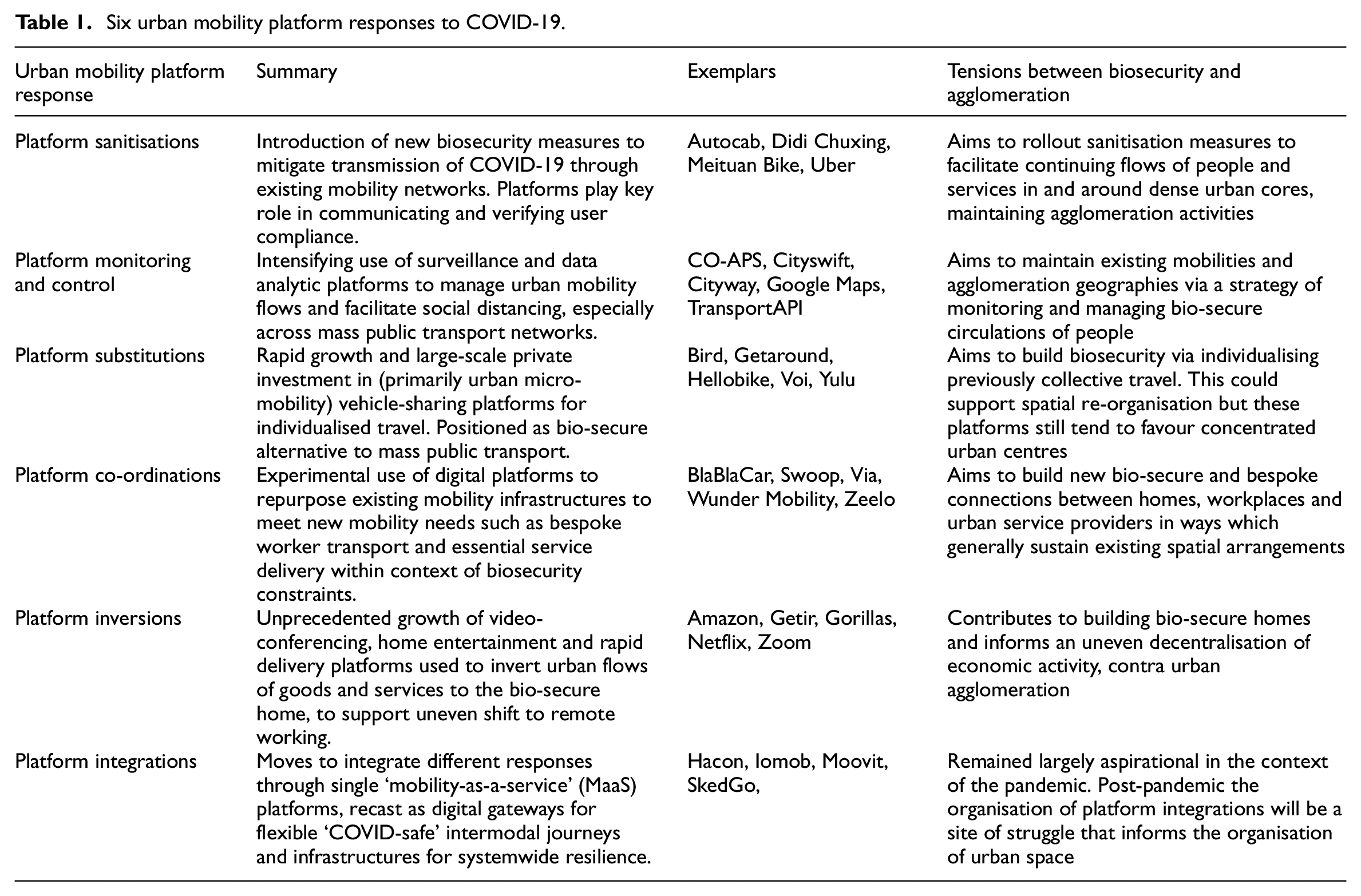
Our database took urban digital mobility platforms as its unit of analysis, while categorising types of response to COVID-19. In this section, we consider how these responses suggest a need for better ways of understanding the ongoing change in the shape of urban digital mobility platforms under volatile and changing urban conditions. Within debates in platform urbanism, ‘platformisation’ has become a key term for conceptualising mutually constitutive dynamics between digital platforms and social contexts as well as understanding variegation, and the far-reaching implications of this continuing process, especially in the urban context. Our argument is that we should understand platform responses to the changing urban conditions of COVID-19 not solely within the frame of the platforms themselves but through the dynamic co-evolution of platform and urban contexts.
As our analysis shows, the global pandemic and rollout of biosecurity measures clearly reshaped material conditions in which urban platforms operated. The mitigatory and adaptive logics of different platform responses reflected the tensions between modes of biosecurity intervention discussed by Hinchliffe and Ward (2014), yet it was also clear that both created opportunities for – and propelled – not just platform-responses but also, in some responses, platformisation. That is to say, in some responses to the pandemic (e.g. in the case of ride-hailing and bike-sharing platforms undertaking platform sanitisations) it was the platform organisation itself that was adapting its service, socio-technical architectures and data to the challenges of the pandemic. These can be largely understood as platform-responses, whereas, in other responses (e.g. re-purposing platforms under platform monitoring and control) the platform response is in the service of maintaining the operation of pre-existing public and private transport services that have been constrained by COVID-19. This re-shaping of the platform in use by new combinations of platform organisations and transport and public authorities can be understood as new forms of mutually constitutive processes of platformisation.
Efforts to mitigate COVID-19’s impacts in existing urban transport networks – especially stressed public transport services – accelerated and entrenched a pre-existing trend of platformisation through the interweaving of platform and public transport systems. Platform interests offering mobile and contactless payment and ticketing, surveillance and fleet management systems established important roles for themselves within a sociotechnical architecture modified to mitigate and manage biosecurity risks, involving intensifying capture, processing of (and action based on) user and urban mobility data. The pandemic also saw significant expansion of micro-mobility, carshare, DDRT and other platforms able to rapidly configure alternative, bespoke and ‘critical’ bio-secure infrastructures within urban contexts. These mostly private platform-based mobility providers saw the challenges facing conventional passenger transport as a renewed opportunity to capture market share and shape the future of urban transport. Often backed by large-scale venture capital funding, this has involved both intensification and fragmentation in the production of urban mobility data, used to optimise on-demand services and facilitate rapid commercial expansion. Whether this trend is sustained however appears less certain, particularly as deteriorating macro-economic conditions impact easy access to funding.
Similarly capitalising on constrained mobility services and anxieties about urban travel, was the unprecedented growth of digital platforms configured around bio-secure homeworking and service delivery. These too were supported by a new wave of venture capital investment seeking rapid scaling and market capture. These platforms were organised around a different set of urban logistical, power-grid and digital infrastructures, user, locational and mobility data, and crucially relied on a large pool of low paid and precarious platform labour. While this particular trend sits outside the urban transport system, its acceleration had potentially the most far-reaching implications for patterns of urban mobility and transport provision. Yet this trend appears to have been the most fragile, with continuing signs of reversal as biosecurity measures have been relaxed. Integrative MaaS platforms persisted in their pre-pandemic orientation to systematise urban mobility, but in doing so needed to account for the elevated status of biosecurity and diminished public transport capacity and patronage. This meant integrating various biosecurity measures while reorganising platform ecosystems around bio-secure circulation, with a growing emphasis connecting flexible on-demand services and associated social interests.
Why does this matter for ‘the urban’?
Our analysis of urban digital mobility platform responses to the conditions of the COVID-19 pandemic required us to build out from the platform as a unit of analysis; extending our analysis via the ways in which platform responses were often mutually constituted, in processes of platformisation, with pre-existing urban social interests and mobility system assets. We did this via the tension between whether platform responses re-inforced agglomeration trajectories or whether they sought to build new forms of urban biosecurity and spatial organisation. In this section we recognise that there are wider implications of these processes of urban mobility platformisation for urban geographies and urban governance. As an extension of our primary analysis, this section engages with broader debates on the implications of COVID-19 for urban governance and urban geography.
The changing urban conditions created by the pandemic and associated responses provoked major debates about the future organisation of urban geography (Florida et al., 2023; McFarlane, 2023; Nathan, 2023). As Brail (2021: 598) observed: ‘Seemingly overnight, physical concentration and all its benefits – including urbanization and agglomeration economies, innovation spawned by serendipitous exchanges, talent and knowledge spillovers – became dangerous’. In this context, platform responses to COVID-19 reflected tensions and ambiguities between agglomeration and decentralising tendencies in the pandemic city. Platform sanitisations and monitoring and control were orientated towards protecting and stabilising pre-existing urban geographies and circulations. Platform inversions meanwhile had a powerful decentralising logic, through which digital mobilities afforded via the so-called ‘Zoomshock’ (De Fraja et al., 2021) became closely tied to the materialisation of visions of the 15-minute city (OECD, 2020). Sitting beneath the explosion of home delivery platforms meanwhile was a ‘logistical-urban frontier’ (Shapiro, 2022), labour practices and circulations which revealed much about whose biosecurity and interests were privileged and devalued in a moment of crisis (Cresswell, 2021). Mobility platforms are often noted for their flexibility and data-driven capacity to re-arrange their spatial organisation in response to changing mobility demands or episodic shocks – as in the cases of platform substitutions and co-ordinations. Yet, the long-term shape of post-pandemic urban geographies remains uncertain, but may involve ‘multiple, overlapping urban worlds, with cities moving between more or less friction/constraint’ (Nathan, 2023: 1356). The role of digital platforms in shaping post-COVID urban geographies is likely to be framed for some time by these struggles between maintaining existing and experimenting with new urban geographies.
Prior to the global pandemic, platformisation was increasingly implicated in struggles for sovereignty over cities, between Big Tech platforms and various forms of civic resistance and municipal resurgence (Hodson and McMeekin, 2021; Sadowski, 2021). A key element of this has been the production and control of data, how it informed the organisation of urban services, and the capture of value generated through digital platforms. In extreme cases, platforms have been Trojan horses in attempts to create new forms of private urban governance (Hodson and McMeekin, 2021; Sadowski, 2021). More common have been modes in urban governance described as ‘extrospective’ and ‘beyond the state’, involving new and extended forms of public-private partnerships (McGuirk et al, 2021a: 1730).
New and dynamic forms of such partnerships were both visible and absent across the platform responses in our analysis. There are a number of seemingly competing and contradictory urban governance processes that platform responses have generated and, often, given new impetus to, under conditions of COVID-19. COVID-19 precipitated a major resurgence in state intervention in response to crisis. Yet it also involved an ‘increased permissiveness’ in relation to urban innovation, accelerating platformisation and creating numerous opportunities for digital platform interests to extend their influence within urban governance (McGuirk et al., 2021b). It is not clear how durable these emergent forms of urban governance will be, but there is a need to understand them dynamically and in combination. This means that ‘greater attention needs to be paid to the processes through which heterogeneous, widely scattered and dynamically emergent elements are drawn together and cohered to produce the capacity to govern’ (McGuirk and Dowling, 2021: 760) in the COVID and post-COVID era. Given the variable and multiple processes of platform shape-shifting and platformisation, this suggests that a critical implication of our analysis is a need for better understanding of the question: who governs platformised mobility in the post-COVID city?
Conclusion
In this paper we have critically examined the ways digital mobility platforms have been mobilised in urban contexts in response to the challenges of COVID-19, building on existing debates on the politics and processes of urban platformisation and digital mobility platforms. By producing a typology of six platform-based responses to the global pandemic, we considered how changing urban conditions are shaping evolving trajectories of mobility platformisation, and their possible implications for urban geographies and governance.
Using the notion of the ‘urban stack’, we highlighted the ways digital platforms – understood as shape-shifting configurations of services, social interests, technologies and data – responded to the changing urban conditions under COVID-19. A major contribution of this article has been applying analysis from the database we produced to think about platformisation in response to urban crises. During COVID-19, the malleability of platformisation proved capable of rapidly responding and recoding urban infrastructures around the imperatives of bio-secure circulation. Yet there are critical questions about how each response was configured and whose interests, mobility and safety were consequently prioritised or devalued. To what extent do these responses prefigure those of the future, and are they durable or desirable? Although platformisation shows some potential in building resilience and adaptability within urban transport systems, prevailing business models are equally sources of instability, risk and concentrated private power. We consider these to be key issues for future research in a historical moment of increasing turbulence, from economic and resource shocks to extreme climate events – as well as future disease outbreaks.
What is clear is that urban mobility platformisation is a site of multifaceted struggle over circulation and patterns of urban mobility, the socio-technical architecture and control of urban infrastructure, the organisation of urban economic activity and space, and how (and by whom) ‘the urban’ is governed. The rapid introduction of biosecurity measures in 2020 demonstrated the scope for greater regulation and intervention in urban transport systems for the public good. While urban transport networks were plunged into crisis, the conditions of possibility for reshaping and materialising alternative mobility visions also emerged. The political question that follows is what kinds of responses and visions are desirable and how can they be achieved? As we have shown, platformisation can be mobilised in support of different purposes and agendas. The pandemic has seen various purposive attempts to use platforms to build critical bio-secure infrastructures in urban contexts, across which there are likely to be ongoing contestations and experiments mediated by the diverse social interests, forms of governance and organisation of urban space involved in their promotion.
On the face of it, current trajectories of platformisation point towards multiple and contradictory forms of urban mobility and transport provision which will entrench structural and socio-spatial inequalities and exclusions. A key challenge is whether platforms can be more selectively organised in pursuit of strategic objectives such as biosecurity, decarbonisation or universal service provision, a challenge that is intimately bound up with the formation of new coalitions of interests and innovations in urban governance.
Footnotes
Declaration of conflicting interests
The author(s) declared no potential conflicts of interest with respect to the research, authorship, and/or publication of this article.
Funding
The author(s) disclosed receipt of the following financial support for the research, authorship, and/or publication of this article: The authors are grateful for the support of the UK Economic and Social Research Council (Award: ES/T015055/1).
