




Abstract
Building on recent work in postcolonial urban studies that has developed more genuinely plural approaches to urban theorising, this article poses the problem of ‘worlding’ in relation to urban LGBTQI+ activism in Sydney, Australia. Specifically, the article examines how Sydney is variously worlded as or against ‘Asia’ in public debate around LGBTQI+ politics and in the imaginaries of activists living in Sydney. These worldings are shown to be an important aspect of queer activisms and urbanisms in Sydney, and I argue that attention to this worlding can productively complement a renewed focus on place and specificity in queer urban literatures. While imagining Sydney or Australia as part of Asia is itself no guarantee of productive politics or of decentring epistemologies, the article argues that some of these worldings do provide an occasion and a provocation to think elsewhere and otherwise in ways that are responsive to the specific character of White Australia’s colonial pasts and presents, while also generatively (dis)locating Sydney beyond the ‘West’.
Introduction
Urban studies scholarship has been transformed in recent years by engagements with southern, majority and postcolonial urbanisms (Derickson, 2015; Lawhon and Truelove, 2020; Robinson, 2006; Roy, 2009; Simone and Pieterse, 2017). Calls to provincialise global urbanism, to decolonise critical scholarship and to develop more genuinely pluralistic approaches have widely circulated, and queer urban scholars have taken up these challenges in a range of ways. For example, Brown (2008) and Banerjea (2015) have each built on Robinson’s (2006)‘ordinary cities’ framework to show the importance of attending to a broader range of geographies beyond the ‘most frequently examined metropolitan gay centres’. Further, scholars have developed relational approaches to study transnational solidarities in LGBTQI+ activisms (Binnie, 2014a) and to make a broader case for shifts in the geographies of knowledge production about queer lives and urbanisms (Binnie, 2014b; Browne et al., 2017). More broadly, as Oswin (2019) has compellingly argued, the question of worlding – which connotes attention to both the uneven geographies of knowledge production and the varied ways that a world, or worlds, are imagined, constituted and enacted – stands as a key point of intersection and affinity between the projects of queer and postcolonial urban studies.
At the same time, recent work in queer geographies has highlighted anew the significance of place, and its specificities and contingencies, as a way to complicate overarching narratives of LGBTQI+ progress or ‘top-down’ styles of applying critical concepts like homonormativity (e.g. Brown, 2012, 2020; Browne and Bakshi, 2013; Gorman-Murray, 2017). This article seeks to make explicit the potential connections between analyses of place specificity and worlding, and I argue that more attention to worlding, a multi-faceted concept that is approached here through situated practices that imaginatively and materially relate some places, and times, to others, can shed important light on the places of urban LGBTQI+ activisms, wherever they occur, and contribute to intellectually productive practices of dislocation and provincialisation in queer urban studies. From this starting point, the article draws on public political discourse and interviews with activists conducted as part of a broader project on queer migrants’ experiences of belonging and citizenship in Sydney, Australia in order to analyse geographical imaginaries of ‘Asia’ and the ‘West’ as they inform and shape LGBTQI+ activisms at a moment when Australia’s relationship to an imagined ‘Asian future’ and its enmeshment in the ‘West’, as colonial fantasy and geopolitical project, are increasingly contested.
Building on foundational work in queer and critical Asian Australian studies, this article seeks to approach queer activism in Sydney in ways that do not take its location in the ‘West’ for granted (e.g. Caluya, 2019; Yue, 2016). While questioning the colonial worlding of the West is a more general imperative (Chen, 2010; Kulpa and Mizielinska, 2011; Yue, 2017), it has particular significance in Sydney, given that the city’s material and imaginative implications in ‘Asia’ have long been an important preoccupation of both geopolitical and economic elites and critical scholars, activists and artists (Ang, 2016; Johnson et al., 2010, 2015; Martin et al., 2008; Walker and Sobocinska, 2012). More specifically, in the case of this research, my analysis joins a number of others in suggesting the necessarily polyvalent nature of worlding Sydney in relation to an Asian future (Ang, 2016; Martin et al., 2015), and calling for worldings that can simultaneously locate Sydney in relation to its colonial pasts and presents and imagine Sydney otherwise, beyond colonial categories.
Worlding LGBTQI+ activisms and urbanisms otherwise
Critical scholarship on queer urbanisms and activisms is being reshaped in ways that better acknowledge the intersectional and coalitional character of queer politics that has long coexisted with and contested a ‘single issue and one-dimensional’ account of queerness (Cohen, 1997; Ferguson, 2019: 1). The emergence and consolidation of queer of colour critique and trans studies have been central to this reshaping, as have the analytics of homonormativity and homonationalism that have emphasised the centrality of sexual politics to neoliberalism, settler colonialism and state violence (Duggan, 2002; Ferguson, 2004; Puar, 2007; Spade, 2015). Catungal (2015), Goh (2018), Rosenberg (2017), Haritaworn (2015) and DasGupta and Dasgupta (2018) have each, in different ways, highlighted the violence and precarity faced by queer and trans people of colour, as well as political responses to that violence in Toronto, New York, Chicago, Berlin and London, respectively. There has been significant work on homonormative urbanisms and the space that these formations may open or close for different kinds of queer life and politics in the ‘global’ city (Benedicto, 2014; Manalansan, 2005; Oswin, 2015, 2019). Alongside the neoliberal homonormative city, conceptualisations of homonationalism have focused attention on inter-scalar geopolitical violence shaping urban LGBTQI+ activisms (Hartal and Sasson-Levy, 2018; Hubbard and Wilkinson, 2015). Much of this work speaks directly to ongoing problems and possibilities in queer activisms in Sydney, where, for example, Dreher (2017) has drawn on work on homonationalism to show how the push for marriage equality in Australia can play into a discourse in which Australia is imagined as being ‘on the right side of history’ and set against others in racialising ways. Importantly, however, such homonationalist and homonormative formations have co-existed in complex ways with queer activism centred around the violence faced by queer refugees (Baird, 2018), queer Asian activism emerging from the intersection of diasporic cultural production and ethno-specific HIV/AIDS public health work (Yue, 2008) and ‘multicultural queer’ projects, from which a range of minoritised queer groups have, separately or together, articulated political claims (Low and Pallotta-Chiarolli, 2015; Ruez, 2016).
While critiques of homonormativity and homonationalism continue to be a vital part of research on urban LGBTQI+ activisms, there have also been important efforts to disaggregate such normativities to better understand their unevenness and partiality and, in so doing, to illuminate the unevenness and partiality of the analytical frameworks informing queer research (Brown, 2009, 2020; Di Feliciantonio, 2016; Gorman-Murray, 2017; Kenttamaa Squires, 2019; Podmore, 2016). These moves have been made, in part, through critical attention to the dynamics and specificities of place. This has led to increasing attunement to ‘the heterogeneity of everyday social relations’ (Brown, 2012: 1071) and the possibilities of ‘commonplace’ ordinariness (Browne and Bakshi, 2013: 191), as well as conceptualisations of queer urban politics through ‘the unfolding of social relationships in place’ (Knopp et al., 2018: 404) and attention to the political urbanisms of ‘living the city otherwise’ (Podmore, 2016: 27). Rather than discounting the power relations often effectively captured by work on homonormativity or homonationalism, this attention to the specificities of place, at its best, can provide the basis for productive provincialisations and, at least potentially, for worlding otherwise (Chakraborty, 2000).
This article relies on an understanding of worlding practices from Roy and Ong (2011) that foregrounds the ‘constitutive, spatializing, and signifying gestures that variously conjure up worlds beyond current conditions of urban living’ (Ong, 2011: 13). This conception of worlding is shaped by Said’s (1989: 218) writing on the ‘philosophical and imaginative processes at work in the production as well as the acquisition, subordination, and settlement of space’, and I focus on the geographical imaginaries that situate, relate and contextualise places as they emerge in political discourse of LGBTQI+ activisms in Sydney. These imaginaries and practices ‘articulate disparate elements from near and far; and re-situate the city in the world’ (Ong, 2011: 13), and they also speak to broader attention to spatial imaginaries that has emerged in recent queer (sub)urban scholarship (e.g. Bain et al., 2020; Gieseking, 2016). Though much of Roy and Ong’s writing on worlding is about the allure and enactment of the ‘global’, their focus on Asian urbanisms and inter-Asian referentiality also highlights the importance of regions as enactments of particular kinds of worlding (Ong, 2011; Roy, 2011; see also Chiang and Wong, 2016; Gopinath, 2007; Wilson, 2006). I understand worlding practices to encompass a broad range of potential political orientations – from the inscription of colonial categories (Spivak, 1990) to messy practices of worlding ‘from below’ (Manalansan, 2015; Simone, 2001). In that sense, the article’s employment of worlding does not restrict its use to tendencies that might be understood as resistant or oppositional, but rather approaches worlding as practices which may work to a wide range of, often ambivalent, ends.
Bringing these theorisations into dialogue with the increasing attention to place and place specificity in scholarships on LGBTQI+ urban activisms suggests that importance of understanding the worlding of places, such that approaching the specific emplacement of LGBTQI+ activism in Sydney requires understanding how Australia has been situated as ‘both part of the Anglo-American centre, and peripherally “down-under”’ (Johnston, 2018: 5), as well as how ‘Asia already, thoroughly and inescapably, permeates Australia’ (Ang, 2016: 266). Thus, rather than understanding place specificity as a bracketing off of worldly relations, this article highlights the centrality of worlding to the place of LGBTQI+ urbanisms and activisms.
Work in critical and queer Asian Australian studies stands as a model of just this sort of attention to situated worlding (Caluya, 2019; Chakraborty, 2015; Kwok, 2017; Martin et al., 2015; Wong, 2015; Yue, 2016). In response to the release of the ‘Australia in the Asian Century’ white paper by the Julia Gillard government in 2012, which charts the economic and geopolitical rise of ‘Asia’ and outlines a reorientation of state policy to position Australia to share in the benefits of this imagined new Asian century, Martin et al. (2015) complicate the binary construction of an Australia–Asia opposition by showing how the ‘everyday translocal and inter-cultural experience of Asian-heritage migrants in Australia – which constitutes Australian social life as translocal and inter-cultural – underlines the fallacy of conceiving of “Asia” and “Australia” as radically separate or separable entities’ to begin with (Martin et al., 2015: 8; see also Australian Government, 2012). Queer Asian activism has, as well, long worlded Sydney spaces as Asian – including visible public health campaigning centred around HIV/AIDS, efforts to claim space in Mardi Gras and other prominent queer spaces, and a range of other grassroots projects (Fuh Teh, 2012; Yue, 2008). Beyond the important sense in which diasporic communities in Sydney create the possibilities for Asian worldings, Caluya (2019) offers a genealogy of the colonial worldings through which ‘Australasia (literally “south of Asia”) was hewn geographically, psychologically and culturally from the Asia-Pacific by British colonization, cutting off, replacing or appropriating the trading and cultural ties that Indigenous ancestors had with the surrounding region’ (Caluya, 2019). This understanding of how Australia and Asia have been worlded as part of the colonial project, in Caluya’s account, becomes an opportunity to consider how other worlds might be constructed that, for example, call into question scholarly and political divisions between East and West Asia – divisions that often extend to diasporic communities in Australia – and open up the potential for decolonial solidarities between Asian and Indigenous Australians (see also Perera, 2009).
Methods and analysis
Drawing on this critical and creative attention to the worlding of Australia and Asia, this research focuses on the complex and ambivalent ways that such worldings were imagined and enacted in LGBTQI+ activisms in Sydney, while also highlighting their importance for queer urban scholarship. To do so, I draw on a broader research project – conducted largely between 2012 and 2014 – which examined the political subjectivities, spatial imaginaries and everyday experiences of racialised queer migrants living in Sydney. Being an activist was not a criterion for participation, but the research did involve recruiting participants from activist and community organisations involved in queer migrant, multicultural queer and queer Asian organising. Through a process of ‘snowballing’, the research grew to include 43 participants, many of whom were activists. 1 Because of how the entry point shapes the data collected (Browne, 2005), analysing these materials highlighted the imaginaries and political subjectivities of activists in Sydney.
I sought to understand traditional forms of activism, but also, in line with the literatures discussed above, to gain a broader sense of everyday socio-spatial relations in and beyond the city. A persisting challenge here is the fact that the categories used in this research are necessarily the product of particular geopolitical formations that can, at the least, overcode actually existing forms of difference – and in relation not only to the problem of LGBTQI+ identity categories, but also to particular conceptual distinctions usually invoked in relation to ‘activism’ or the category of the ‘migrant’. I have attempted to use such categories relatively provisionally – where appropriate, in line with participants’ own identifications – and in ways that highlight their contingent articulation and construction. It is important to be cognisant of the histories through which Asia has taken on meaning in Australia – where Asian is more likely to be attached to people and projects from some parts of Asia, in a continental sense, than others (Caluya, 2019). My own use of ‘queer Asian’ encompasses projects and individuals that claim the term Asian in conjunction with some kind of political work around minoritised genders and sexualities.
Except where participants desired otherwise, interview conversations were recorded and transcribed, and transcriptions and notes were analysed through an iterative process of coding, where I approached interview materials as, simultaneously, discourse and account of everyday experience. Inspired by moves to think critically and capaciously about the politics of urban comparison, my analysis was attuned to both the inter- and intra-urban comparisons that participants themselves made as one avenue into an empirical examination of the worlding of LGBTQI+ activism in Sydney (McFarlane, 2010). During the fieldwork and analysis, I also made a particular effort to collect material from media sources and public debates that were discussed with me in interviews and informal conversations. I continued to follow those outlets and debates after 2014, and I also draw on those materials in what follows.
LGBTQI+ activism in Australia’s ‘Asian century’
In the prevailing worldings of white settler Australia, the relationship between ‘Australia’ and ‘Asia’ is a fraught one, embedded in the racist ‘paranoid nationalism’ discussed by Hage (2003) and the possessive whiteness analysed by Moreton-Robinson (2015). One repeatedly finds self-images of White Australia as a vulnerable outpost of the ‘West’ under threat from its neighbours (Walker and Sobocinska, 2012). At the same time, this anti-Asia sentiment coexists with ostensibly positive attitudes towards Asia that situate ‘Asia’ as an opportunity for Australia – such as that seen in the Australia in the Asian Century white paper.
These relations continually emerged as topics of conversation while I was conducting fieldwork in Sydney, which coincided with the publication of the Asian Century white paper. Some participants seemed to take Sydney’s location in Asia as something of a given, with one person, for example, responding to a question I asked about the white paper by saying, ‘look around, we’re in Asia,’ as we talked over lunch in an inner Sydney food court. Several other interview participants brought up the white paper directly themselves in our conversations. Some were sceptical, either of the depth of commitment of the Australian government to the project or, more critically, of its overarching assumptions and motivations. On the other hand, some expressed something like vindication that Asia’s importance was, perhaps, finally being recognised. For example, a queer man who had migrated to Australia from Malaysia and had been involved with activism around the problem of sexual racism, speculated that, in time, what he called ‘a rising Asia’ might improve the position of gay Asian men in the hierarchies of attractiveness he saw operating among gay men in Sydney.
This Asian century discourse has also been mobilised by conservative activists and politicians to pursue homophobic positions. For example, Senator Eric Abetz invoked geopolitical and economic discourse about the ‘Asian century’ to cast doubt on the project of pursuing marriage equality: ‘The Labor Party and other journalists tell us time and time again that we are living in the Asian century, tell me how many Asian countries have redefined marriage? … Are we in the Asian century or not?’ (Eric Abetz in Brissenden, 2015). Citing recent efforts to strengthen ties between Australia and Asia, Abetz suggests that marriage equality is, effectively, un-Asian and therefore a problematic stance for those interested in integrating Australia into Asia. Fellow right-wing politician, then Agriculture Minister, Barnaby Joyce agreed: I think that Eric is right in saying where we live economically is South-East Asia … what we have to understand is that when we go there, there are judgments, whether you like it or not, that are made about us … whether they see us as decadent. (Barnaby Joyce in Cassidy, 2015)
Here, Joyce suggests that due to the importance of Australian economic enmeshment in ‘South-East Asia’, Australians need to consider that people in the region might consider marriage equality ‘decadent’. Of course, there is little reason to assume that Joyce and Abetz offer these arguments from a good faith interest in Australia’s relationships with Asian countries, and there is even less reason to accept their premises about Asia. Mridula Nath Chakraborty (2015) responded to them by highlighting the complicated but diverse positions held by queer subjects across Asia, as well as the broader traditions of sexual and gender diversity across Asia that she suggested a then marriage equality-focused Australia could learn from: ‘If Australia wishes to trace a legacy of sameness with Asia, it might have to grab the multiple diverse ends of the rainbow it wishes to be a part of and then soar from there’ (Chakraborty, 2015).
While Chakraborty’s essay is suggesting making connections with ways of thinking and practising sexuality and gender beyond ‘Western’ categories, the most frequent example of participants drawing connections with Asia in discussing their politics was actually ‘Pink Dot-style’ LGBTQI+ activism in Singapore. This is, perhaps, not surprising, as Pink Dot (an annual event which started in 2009, supporting LGBTQ communities in Singapore) has been emulated in a number of ways in and beyond Asia. Tang (2016: 106), for example, has written suggestively about the ‘reverse implantation of Pink Dot’ in LGBTQI+ activisms elsewhere, from Hong Kong to Salt Lake City. In the case of this research, what was adopted as a model was not the visually striking pink dot formation, but rather the discourses around family and the ‘freedom to love’, as well as the rationalities for emphasising these, in terms of appealing to what was discussed as a distinct set of cultural values or sensibilities.
When asked about strategies to reach out to Asian communities in Sydney as part of his work for an LGBTQI+ community services organisation, Kai, a gay man of Malaysian heritage, offered this: It’s what Pink Dot is doing. So like, okay fine, you say Asian values. You say family. So, let’s talk about family. Is accepting your child, who’s gay and lesbian, breaking up your family? Or is it bringing families together? As simple as that. Clearly, not accepting is breaking up families, so what’s the alternative? Is celebrating the freedom to love something that’s going to break up your family?
Responding to the tendency to deploy a construction of ‘Asian values’ against queer people, he borrows Pink Dot’s ‘freedom to love’ slogan and the partial reconfiguration of ‘family values’ it has sought to mobilise in Singapore (Ramdas, 2013): The whole thing is using this adage of families, and bringing families together. And the freedom to love. You know, instead of the ‘we are gay, and we have a right to be here’ kind of thing. But a different way of speaking about the same thing. Really tapping into the psychologies and the ethics of a different community, and it’s effective because it speaks to people across the region.
Here, he articulates an understanding of ‘the region’ which enrols Sydney in a broader Asian regional field, and argues that the framework he sees in Pink Dot is more helpful than more assertive forms of rights-claiming for engaging Asian communities in Sydney. At the same time, the relations of difference and sameness between developments in Singaporean LGBTQI+ activism and those in Australia or elsewhere –‘a different way of speaking about the same thing’– raise a complicated question, given the multiple directions of influence at work, as well as the relative ubiquity of normalising pro-family discourse across LGBTQI+ activisms in many contexts.
Of course, the particular ‘disjunctive modernities’ of Singapore matter a great deal in the meaning and significance of Pink Dot (Yue and Leung 2017: 748; see also Chua, 2015; Oswin, 2019; Yue and Zubillaga-Pow, 2012), and Jazeel (2016: 655) is entirely correct to suggest that radical queer critiques of normalisation must be ‘located’, in that ‘the politics of normalcy in New York City look very different to the just as radical struggle to be considered normal that gay and lesbian communities in Southeast and South Asian postcolonies like Singapore, Sri Lanka and even India still face’. To be sure, this kind of ‘locating’ is part and parcel of the abandonment of the ‘West as method’ that this article supports. At the same time, as Kai’s account shows, this is, in some sense, only the beginning of a still unfolding story that necessarily must include how struggles in Singapore come to be taken up and influence activism – and understandings of normativity and queer critique – elsewhere.
Worlding families and futures in Western Sydney
This focus on and appeal to families in queer Asian activism in Sydney cannot simply be reduced to a normalising appeal to hetero- or homonormativity, although neither can it be fully disentangled from such. Families were a recurring theme in interviews, including specifically the idea that being ‘Asian’ entailed different – simultaneously closer and, for queer people, potentially more fraught – relationships to families of origin than those that prevailed among white (queer) people in Australia or, occasionally, the ‘West’. This worlding informed the activism that many participants of this research were involved with, and it did so in complex and ambivalent ways, as assumptions that activists struggled against, while also entering into their own stories of their lives and spaces. Further, this worlding is not purely a matter of ‘big picture’ geopolitical imaginaries like ‘Asia’ and the ‘West’, but also needs to be understood as inscribed in the spaces of the city in crucial ways.
The suburbs of Western Sydney were important in many participants’ narratives – sometimes as places to leave on their way to ‘queer friendly’ spaces elsewhere, sometimes as places to embrace as spaces of familial sociality or community solidarity, which may themselves be a site of queer possibility (cf. DasGupta and Dasgupta, 2018), and often enough as sites of somewhat more ambivalent identification. A large and varied part of the Sydney region, Western Sydney defies any singular characterisation, but it has a rapidly growing population and is home to a significant proportion of the region’s racialised migrant and ethnic minority communities, including many people with birthplaces or ancestries in countries that would commonly be considered Asian, as well others, such those from Western Asia, who are often situated differently (Centre for Western Sydney, n.d.). While often discussed as the future of Sydney, Western Sydney and the racialised communities living there have also, at times, been positioned as ‘behind the times’, specifically through tropes of conservative ‘cultures’ and families (Ruez, 2016). This can be illustrated in reactions to the marriage equality postal survey that would eventually lead to marriage equality becoming law in late 2017.
Although the overall margin of the Yes vote in favour of marriage equality was quite large, significant media attention was given to the results in a number of Western Sydney electorates, which returned some of the largest margins against marriage equality in the country. Maps showing a stark contrast to inner Sydney electorates, which returned some of the largest margins in favour of marriage equality, circulated in news and social media (see Figure 1). Indeed, racist voices seized on the results to argue that Western Sydney’s racialised migrant communities were not sufficiently integrated into an imagined Australian ‘mainstream’: ‘the reality is we have a sizeable group of people who have changed countries yet who continue to live more or less as they lived in the old country’ (Senator David Leyonhjelm, cited in Overington, 2017). At work here is a complicated ‘racial politics of scale’ of the sort that Caluya (2011) has theorised in order to understand how racialised migrants in Australia are rendered unhomely in the nation and in the suburbs. In this case, the suburbs, and the racialised communities living there, were themselves figured as a kind of backward constraint on urban-national progress towards LGBTQI+ equality.
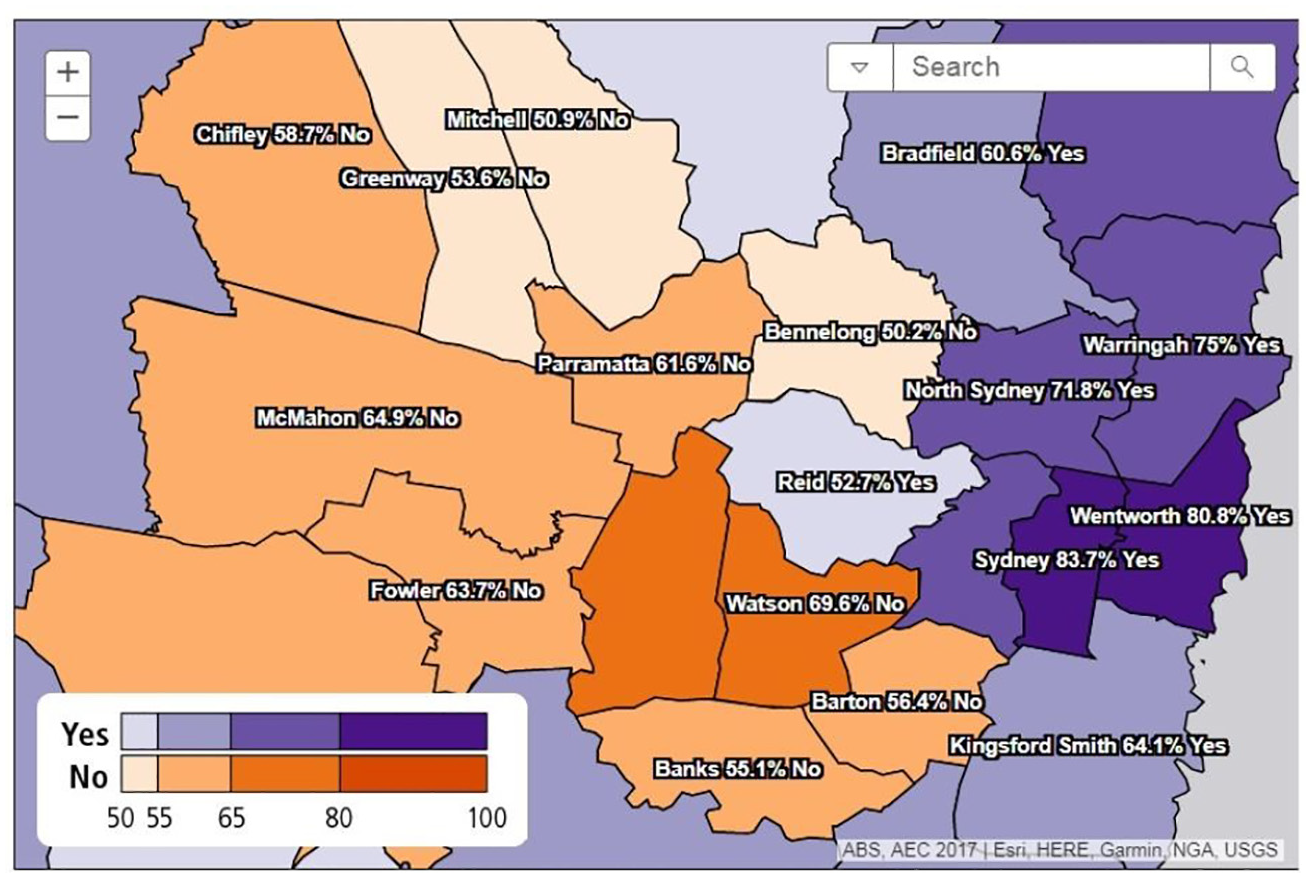
Australian Bureau of Statistics map of marriage equality postal survey results from Sydney region.
Such framings did not go uncontested, and minoritised queer activisms have been challenging these racist understandings before, during and after the marriage equality survey.
2
Happening before the survey, participants in this research articulated their own complicated understandings of the spaces and times of the Western Sydney suburbs and the racialised communities living there. When asked about his relationship to Vietnamese communities in the city, Tan, a gay man of Vietnamese heritage born in Australia and currently living in Western Sydney, discussed how: The Vietnamese community here is in a time bubble. Even if you talk to people who are from here and go back to Vietnam, Vietnam now is completely different – a completely different place to what it is here. Everyone here is definitely still living in the late 1970s and early 1980s from their social construct of how a community and a society should be structured compared to what things are like in Vietnam. It’s branched off and they’ve both evolved.
Across the quote, one can see two assertions in tension: that on the one hand Sydney’s Vietnamese community is stuck ‘in a time bubble’, and on the other hand it has been evolving – albeit, in this case, in different ways from in Vietnam. The assertion that a community exists in a time bubble, of course, fits in all too comfortably with the racialising figuration of some as stuck ‘in the old country’ in comparison with a ‘modern’, liberal white/Western subject. At the same time, it is important to note that that is not the comparison that Tan is making here. The fact that this comparison is made to Vietnam suggests an entirely different set of reference points. Picking up the conversation in relation to how his own family responded to his ‘coming out’ as gay, Tan said: When I think about it, my parents’ generation is very rigid-minded on it. When I look at people of my generation, I think that more often than not there’s a bigger acceptance of it … We are the evolutionary process of it. Amongst my peers, it’s okay. But the reason I don’t hang around my peers – all of our family friends – is because I’m worried that it will get back up to the older generation … For my parents, they have accepted the fact. I don’t think that it’s so much that it’s a Western or Eastern thing. It’s – why does this happen to my son?
Tan is careful to distance his explanation from ‘a Western or Eastern thing’. Indeed, when he goes on to discuss his understandings of his parents’ difficulty with him being gay, the marginalisation of Vietnamese communities in Sydney is central: For my parents’ point of view, the only way you can be successful is if you tick these boxes – have a job, get married, have kids … That’s the recipe for being successful. There is no other model … I think for them, that was the bigger fear. It’s not so much anything else, but the fear that Tan is going to be lonely and not have anyone to look after him. His work or his career is going to be affected. He is going to be marginalised – even more so now. We are already a marginal community, and now we are going to be marginalised within the marginal community.
While the heteronormative conventions that Tan notes could be considered cultural, they are not readily linked to any particular group or ‘culture’. What is more specific is an experience of marginalisation that heightens the stakes of securing a certain sort of heteronormative ‘success’ or, alternatively, of departing from that script. While not a discussion of activism per se, Tan’s account illustrates the complicated and ambivalent ways that worldings are inhabited – containing elements that potentially reinforce a prevailing worlding that would situate certain groups or spaces as behind the times, while also offering a critique of racist marginalisation inherent to that worlding, and gesturing beyond it to a different sets of references and imagined futures in Vietnam.
Asian elsewheres and ‘White Australia’s Bla(c)k history’
The extent to which ‘Asia’ is figured as promising futurity or as stuck in the past highlights the need to consider that these worldings are also timings (cf. Martin et al., 2015; Roy, 2017). The seemingly contradictory positions – of locating Asia in the past or in the future – nevertheless both tend to partake in what Oswin (2014: 415) has called the ‘developmental logic of straight time’. Indeed, some of the same participants who identified with Asia-as-future narratives, however, would also implicitly locate Asia in the past at other moments. For example, several participants noted public debates and legal moves in both Vietnam and Taiwan that had, at various points, made it seem possible that an Asian state might legalise marriage equality before Australia, and treated this as a sign that Australia was risking ‘falling behind’ to such an extent that even some Asian countries might be ahead of it.
At the same time, in conversations with participants, another sort of Asia would occasionally come through – one less tied to progressive narratives of an emerging Asia as the next stage of modernity. Instead, this other sort of Asia offered a kind coalitional, decolonial worlding of the sort called for by Caluya (2019). It was best exemplified in an interview with Anu, a queer woman of South Asian heritage, originally from Fiji. She offered an account of decades-long involvement in feminist, queer and Indigenous land rights struggles that differently world the coordinates of LGBTQI+ activism in Sydney, which has too often, implicitly or explicitly, aligned itself with settler colonial projects and rationalities (Clark, 2015). Anu’s narrative centres First Nations communities and highlights the importance of decolonising the spatial imaginaries of LGBTQI+ activism. To begin, she clearly, and at multiple times during the interview, recontextualised and thereby re-worlded the space in which we were sitting and in which her activism had taken place. For example, our conversation unfolded in a cafe on King Street in Sydney’s ‘queer-friendly’ inner west, and she made a point of noting that ‘we’re sitting in one of the oldest streets in Australia’ and discussed the history of King Street as a path originally walked by Aboriginal people prior to colonisation.
Her account of her own life centred a set of colonial geographies that often escape reference in Australian discourses of Asian futurity. In response to a question about what brought her to Sydney, she began by outlining the histories of the British indentured labour that brought her family from South Asia to Fiji. She then talked about her family’s move to Aotearoa at a young age, and the anti-colonial sensibilities she picked up while growing up in a working-class suburb surrounded by Māori and Pacific Islander communities there. She described her move to Australia as a young adult as a way to get away from the pressure to marry: To me, where I grew up, whether it was a love marriage or an arranged marriage, any marriage, alright, I saw violence, domestic violence both within the family and outside. So, I did not want to end up marrying some bloke who was going to end up belting the crap out of me.
Importantly, Anu refused an interpretation of this as a flight from a conservative culture toward other, queerer possibilities elsewhere, and instead shared this story to express her bewilderment at the emphasis that had come to be placed on marriage in LGBTQI+ activism in and beyond Sydney: ‘I spent my life running away from marriage only to find it everywhere’. She suggested that the focus on marriage equality, rather than a progressive next step in an unfolding trajectory of recognition, had narrowed the possibilities of queer activism and represented a problematic turn away from the insights of earlier feminist activism.
After arriving in Australia, she became involved in a range of activist work, including what she described as life-changing struggles to stop military exercises on Aboriginal land on the South Coast of New South Wales, as well as involvement with feminist movements and later LGBTQI+ activism. She asserts more than once during our conversation that ‘White Australia has a Bla(c)k history’ (for more on the alternative spelling of ‘Blak’, see Munro, 2020), gesturing simultaneously towards the violence of colonisation and the history of Indigenous people, as pre-existing and persisting despite colonisation: What we’ve got to remember is that before British colonisation and other European colonisers that came here, where was Australia physically? In Asia, the Pacific Ocean, a huge trading route … we forget that it’s always been multicultural, that people were coming in and out of this country constantly. So, it does seem bizarre to us that these most recent upstarts … think that they can tell the rest of us who can come and go …
Rather than locating Asia as Australia’s future, Anu articulates it as a part of Australia’s history that pre-existed European colonisation. In doing so, she highlights how the centring of Indigenous-Asian histories can unsettle White Australia’s colonial worlding, not only through critique but also through decentring their presence altogether, reducing white settlers to ‘these most recent upstarts’. This is, in one sense, an imagined decentring, but it is also enacted in Anu’s own history of activism and in many other historical and contemporary forms of Indigenous-Asian relations (Lo, 2014; Stephenson, 2007). Importantly, she worlds Australia and Asia together via a shared Pacific region that also brings in her own history of migration. Of course, there is nothing inherently more politically or epistemologically beneficial about a Pacific worlding as opposed to an Asian one – one might recall, for example, the Asia-Pacific regionalisations of transnational capital or the transpacific geopolitical and geoeconomic framings forwarded by powerful states on all sides of the Pacific (Dirlik, 1998; Hoskins and Nguyen, 2014). However, Anu outlines a kind of minor transpacific worlding that links Australia, and Indigenous Australians in particular, with Asia and with Black and Indigenous people in the Pacific in a way that challenges the assumed prerogatives of White Australia (cf. Kim and Leung, 2018). This would be a worlding that moves beyond ‘a simple and simplistic geographical inversion, a regional essentialism [or] a corrective inclusion’, and ultimately it calls, as Anu does, for a broader queer agenda around combatting poverty, racialisation and coloniality in and beyond Sydney (Roy, 2017: 37).
Conclusion
This article has engaged with the complex and ambivalent ways that LGBTQI+ activisms in Sydney are worlded in relation to Asia. On the one hand, this material and imaginative implication in Asia can productively dislocate Sydney as Western and call into question the ‘West as method’ assumptions that continues to inform political and intellectual life across contexts (Chen, 2010; Yue and Leung, 2017). Of course, not all Asian worldings are the same. The straight futurism of much official Asian century discourse is potentially counterproductive for a queer, decolonial project – and, indeed, it remains open to appropriation by actors intent on upholding a heteropatriarchal whiteness. Sydney’s settler colonial past and present cannot be forgotten in the rush to an Asian future, but instead must be understood in relation to an Asian future that is also a past and a present. Thus, for urban LGBTQI+ activism that would aspire towards a decolonial, coalitional politics, these worldings, in their material and imaginative forms, represent important contexts and stakes of political work.
For scholarship on queer urban politics, this research suggests that productive emphases on place, specificity and the locally contingent in urban LGBTQI+ activisms can be further developed through an account of worlding as a key aspect of that specificity. In this sense, worlding can productively attune scholars to sets of spatial relations, references and implications that complicate globally circulating critical concepts, such homonormativity or neoliberalism, without thereby discounting the power relations they continue to capture. It can thereby complement, as well, assemblage approaches to queer urbanisms (Nash and Gorman-Murray, 2017) and efforts to understand the tensions between appeals to normalisation and more radical critiques as they shape queer activism and its study (Johnston, 2017). More broadly, attending to worlding provides an occasion for queer urban scholars to critically examine the geographical imaginaries through which we situate, compare and connect (or not) movements across an uneven world and to imagine cities and worlds beyond the constraints of the West, even when studying those places that have been worlded as Western.
Footnotes
Acknowledgements
I would like to acknowledge the Eora, Darug and Dharawal peoples, who are the traditional custodians of the lands in which this research was conducted, and I pay my respects to their Elders, past and present. I deeply appreciate the participants in this research whose generosity made this work possible, and I also want to thank the editors of this special issue, Alison Bain and Julie Podmore, for their encouragement and patience as I worked on the article.
Declaration of conflicting interests
The author declared no potential conflicts of interest with respect to the research, authorship and/or publication of this article.
Funding
The author disclosed receipt of the following financial support for the research, authorship and/or publication of this article: Academy of Finland Centre of Excellence in Research on the Relational and Territorial Politics of Bordering, Identities, and Transnationalisation (RELATE).
