




Abstract
Until the 1990s and the spread of air-conditioning, cooling down during the hot, humid and windless summers in the city of Chongqing (Southwest China) was mainly practised outdoors: sleeping on the rooftops of multistorey buildings, playing mah-jongg in the streets, fanning oneself with a hand fan or installing bamboo beds in the compounds’ leafy courtyards. With the availability of affordable electricity and the popularisation of mechanical cooling, refreshing oneself has been relocated to the indoors. The transforming practices in and around the house have led not only to an increasing dependency on electricity for cooling but also to a socio-economic stratification. This paper traces the history of heat mitigation in Chongqing since the 1950s. Based on five months of anthropological fieldwork, semi-structured interviews, and oral history, I analyse how Chongqing residents cope with heat in and around the built environment. Practices of cooling are closely intertwined with the architectural history of the city, for example, building design, construction materials, green spaces, or the arrangement of houses. Staying cool in the socialist era buildings from the 1960s meant something different compared to the high-rise buildings in the early-21st century. Theoretically, the paper engages with urban energy landscapes as ‘connective tissue’ where everyday heat mitigating practices are intertwined with the locally built environment including architecture, energy infrastructure and technologies. By focusing on the material culture involved in cooling, I shift our perspective from the large infrastructure to the small objects that co-constitute the energy landscape of urban heat mitigation.
Introduction
On one of the hottest summer evenings in Chongqing in 2017, with temperatures not dropping below 30°C, I am riding home in a taxi. A heavy storm hit the city in the afternoon, and everywhere the driver and I encounter branches and entire trees that have fallen on streets and sidewalks. Roadworkers in orange vests are busy cutting the trees into transportable pieces with chainsaws, to clear the roads. Traffic jams have congested the main roads and drivers on their way home seem tired of waiting. My driver has to take a slight detour to get me to the residential compound where I live, and we have to wait here and there to pass through. Creeping around a corner, we get stuck in another traffic jam. As we wait, I see many people gathering at the roadsides, the men among them sitting on the sidewalk with naked torsos. Naively, I ask the driver whether they are about to go for a swim in the nearby Yangtze River. He bursts out laughing and explains that the heavy storm has probably caused a power blackout in their houses and that they are fleeing the heat in their apartments. Indeed, now I realise that none of the multistorey buildings in this street have any lights on. The power outage has also disabled the air-conditioning and electric fans, and the sticky summer heat is being trapped indoors.
Living in ‘thermal modernity’ (Chang and Winter, 2015) in today’s megacities depends on cooling the indoors with electric devices and creating ‘microclimatic enclosures’ (Marvin and Rutherford, 2018). Air-conditioning especially has led to a kind of addiction to cool air (Hitchings, 2011) and has significantly changed the way the outdoors is perceived (Horn, 2016). However, in many cities around the world, access to electricity cannot be taken for granted, but depends on political decisions and the socio-economic means of its inhabitants (Gupta, 2015; Sahakian, 2014; Silver, 2015; Winther and Wilhite, 2015).
This paper traces the history of heat mitigation since the mid-20th century in Chongqing, a city with roughly eight million inhabitants in the same-named municipality in southwest China (Roast, 2020: 38). Thermal modernisation in Chongqing from the socialist to the post-reform period since the 1980s was characterised by a transition from more passive, low-carbon means of climate control (such as using the wind, shade, and going to the riverside) to more electricity-oriented practices today (mainly air-conditioning and electric fans). Previously, many people cooled themselves with energy-independent practices such as sleeping on the rooftops of multistorey buildings, playing mah-jongg in the streets, waving hand fans, or installing bamboo beds in the compounds’ green courtyards. Urbanisation and the changing urban landscape from low-rise to high-rise living environments have led to more indoor-oriented ways of cooling. Analysing these changing heat mitigation practices in Chongqing shows their embedding in the social transformations from collective, socialist-governed urban living, to more neoliberalised and individual ways of cooling down. It also outlines the extent to which thermal practices are related to the available infrastructure, including the materials used for the construction of buildings and energy networks.
This article argues that these transformations have led not only to an increasing dependency on electricity for cooling but also to a socio-economic stratification: although electricity is relatively affordable compared to other cities in Asia like Manila (Sahakian, 2014), those residents with limited means more carefully use air-conditioning or rather choose an electric fan which consumes less energy. Even if the government subsidises air-conditioning devices for elderly people in order to prevent heat deaths, people still have to pay for the electricity themselves. Therefore, besides the retreat to cooled down indoor spaces, passive, low-cost means of mitigating heat such as searching for shaded places under trees or bridge infrastructure co-exist with electrified means.
The paper is based on a mix of qualitative data gathered between 2017 and 2020. Primary knowledge was gained during five months of anthropological fieldwork in Chongqing in 2017/2018, where I participated in different private and public indoor and outdoor activities. Due to the focus on urban heat, I especially draw on encounters and experiences in the summer months (July to September) in 2017. In that period, I lived in three different apartments (two in a high-rise and one in a socialist building), and conducted nine household visits with interviewees willing to invite me into their homes, that had been built in different time periods, most of them located in the Huangjueping neighbourhood. There, I assessed the use of cooling devices and practices with the inhabitants through semi-structured interviews. In addition, I conducted semi-structured interviews with residents and experts from different sectors of the building industry (e.g. heating engineers, architects, cooling-device sellers). Those were complemented by other qualitative methods such as photography, mapping, participant observation and walking. In 2020, when due to COVID-19 I could not continue my fieldwork, a research assistant compiled oral histories from residents of different socio-economic status who have grown up in the Huangjueping neighbourhood. 1 Published data on the historical development of architecture and building in Chongqing in the 20th century was analysed to understand the constructional characteristics of different housing typologies.
Urban energy landscape in practice
In order to bring together different layers of heat mitigation in Chongqing, I rely in this paper on the concept of ‘urban energy landscape’ by Castán Broto (2019) which helps in thinking together the landscape, energy infrastructure, the built fabric and the practices of citizens. To avoid drawing too static a picture of the landscape, Castán Broto (2019: 52, emphasis added) defines ‘urban energy landscapes’ as ‘connective tissue that enables the flows of energy resources and the performance of specific energy choreographies, all in relation to socio-technical artefacts that shape that landscape through multiple practices of energy production and consumption’. The focus on human–material, human–technology and human–environment relations in coping with urban heat brings together different scales of energy infrastructure. Here energy is broadly approached, including the human body as thermal agent, but also the built environment and energy infrastructures.
A historicisation of the built structures, and contextualisation of the politicised nature of infrastructure, are key aspects in depicting local energy landscapes. Cities and territories as palimpsests (Corboz, 1983) continuously transform, with some architectural typologies being replaced by others based on new technologies, political decisions and building cultures. In Chongqing, the proliferation of high-rise buildings since the 1990s, and the decreasing organisation of residential compounds by work units, are two such exemplary changes that have affected the energy landscape (see Figure 1). Beyond buildings, the street layout and the public spaces undergo a constant adaptation depending on the needs of population size, political trends and space restraints, among others.
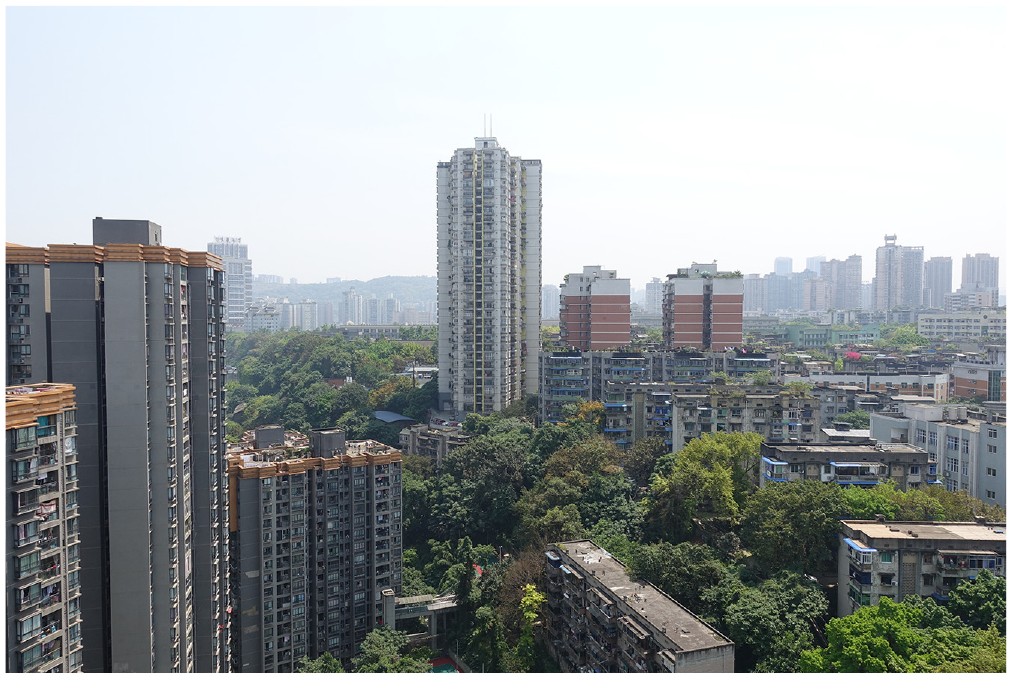
The urban fabric of Chongqing. The hilly urban territory defines the arrangement and heights of old and new buildings in Shapingba district.
Castán Broto shows, with fieldwork data from four cities around the world, that energy landscapes emerge out of particular local circumstances and are sustained by the daily tasks of citizens. This connective tissue is constantly in flux and components are partially and steadily replaced. Therefore, the energy landscape transforms over time, for example when a municipality decides to replace a gas network with an electric one or when energy production is spatially shifted from urban areas to the hinterlands (for further perspectives on how this has occurred in China see Ahlers and Hansen, 2017). It is through practices and use that the connective tissue is held together. Urban citizens daily reproduce the larger energy landscape of the city by designing, constructing, manipulating and inhabiting urban spaces. Using or not using a car, switching the air-conditioning unit on or off, cooking with coal or electricity, are small dots in the entire tissue, but are always reactions to the larger grid, that consists of the availability of energy and the material construction of the buildings. In the case of Chongqing, the electric fan, the bamboo mat, or the hand fan are essential components in the ‘system of thermal–material culture’ (Shove et al., 2014b: 118). Thermal practices, whether the relocation of one’s body from the indoors to a shaded outdoor space or switching on an electric fan, are dependent on the built fabric. Practices are fundamental components of the material arrangements provided by architecture and infrastructure (Castán Broto, 2019; Schatzki, 2010; Shove et al., 2014b).
An urban energy landscape is hence a collective task where multiple actors, such as policy makers, heating engineers, electricity companies and urban dwellers, all contribute. Mitigating urban heat is embedded in this energy landscape and the practices of different citizens depend on various factors such as profession, gender, age, socio-economic status, personal experiences and perspectives of comfort. As well as being contiguous, urban energy landscapes are thus always heterogeneous (Castán Broto, 2019). Thermal realities evolve through the ever-changing relations of bodies with apartments, objects, devices, cooling infrastructure and urban territories. While the interaction of cooling objects and people received considerable attention in heat-mitigation research (e.g. Pertierra, 2015; Sahakian, 2014; Shove et al., 2014b), I focus in particular on the architectural history of Chongqing’s residential housing stock and how the transformation of the urban fabric in the last decades has intervened in heat mitigation.
Transformations and transitions in mitigating heat in Chongqing’s Huangjueping neighbourhood (黄桷坪街道)
Chongqing has a subtropical climate and because it is located in the Sichuan Basin where humidity and hot air cannot escape, the city experiences very hot summers with temperatures of up to 40°C (The Central People’s Government of the People’s Republic of China, 2010) and high humidity of at least 80% all year around. On average, temperatures in July and August are around 33°C. Together with Wuhan and Nanjing, Chongqing has always been colloquially known as one of the ‘three furnaces’ (san huolu 三火炉) in China. Since the 1960s (and especially since the 1990s), temperatures in Chongqing have been rising more than the global trend, reinforcing urban heat-island effects (Yao et al., 2013: 16). One reason is the rapid urbanisation, which leads to more and more areas being sealed through construction activities. Another is that population growth and rising household incomes have increased the use of air-conditioning (see Figure 2). The temperature difference between dense urban and surrounding rural areas is almost 10°C (Luo and Li, 2014), leading to an even bigger desire to use air-conditioning. However, the more urban residents use air-conditioners, the more heat is emitted, thus further contributing to heat-island effects.
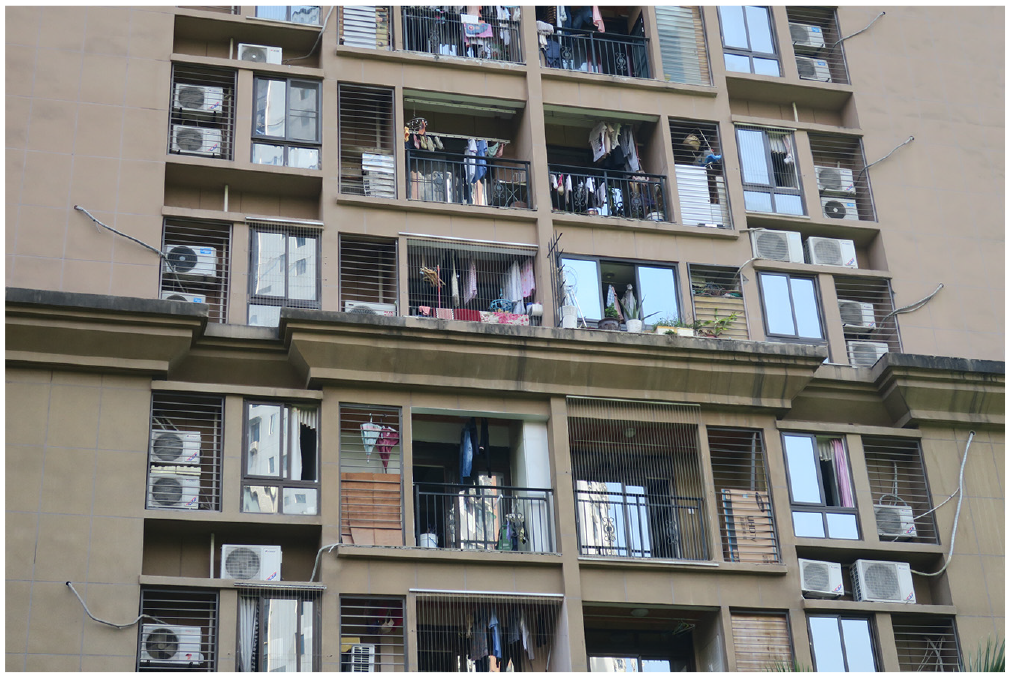
Split units are omnipresent on the facades of high-rise buildings as few new constructions provide central air-conditioning systems.
For this paper, I chose to foreground living realities in the Huangjueping neighbourhood in the Jiulongpo district (九龙坡区). The neighbourhood contains different types of buildings which are mainly inhabited by middle- and lower middle-class residents. Next to a few old, dilapidated one-storey buildings (pingfang 平房) remaining from the 1960s, we find six- to ten-storey buildings (loufang 楼房) from the socialist era and high-rise buildings (gaolou 高楼) from the 1990s or later. By outlining different housing realities in time and space, I make sense of how not only heat histories but also heat experiences differ between the residents of Huangjueping. Passive and active means have always co-existed to mitigate summer heat despite the recent proliferation of air-conditioning. The comparison between cooling in and around socialist-era and high-rise buildings outlines that built environment, technologies, material culture and practices have influenced one another. However, my ethnographic data highlights that compared to the socialist period, today socio-economic status largely defines the ways in which residents cool themselves during the summer.
Cooling as collective practice in socialist-era buildings
The era before the 1980s is particularly interesting when it comes to thermal practices. Buildings and compound layouts from that period date back to a time when passive means of cooling were much more important, due to the low electrification in residential buildings. The first electricity infrastructure installations from the 1950s and 1960s mainly provided electricity for public buildings and schools (Committee for Urban and Rural Construction Management in Chongqing, and Chongqing Building Authorities, 1997: 166). Households had only electricity for lighting with tungsten lamps, but the voltage was not strong enough to supply electric cooling devices like air-conditioning (interview with Mr He and Mr Pang, July 2020). Street lighting followed in the 1970s when the electricity network also reached private households.
Until the 1970s, traditional rammed earth construction (gandalei 干打垒) was popular, as it was cheap to produce (Zheng, 2006: 78). In the collective memory, the earth walls of those buildings had the advantage of cooling the interiors in summer and keeping them warm in winter. One of the residential compounds dating back to that period is the Xiao Meishu Xueyuan (小美术学院), a compound built for employees of the nearby Sichuan Art School. In 2017, the remaining building stock consisted of seven core buildings with four to six stories that were built between the 1970s and the 1990s, replacing a row of single-storey houses from the 1950s. The primarily used materials in this case were bricks and concrete.
the plans and design of Xiao Meishu Xueyuan. Insulation of walls was not a priority during the construction, as Mr Pang, who was involved in the financial overview of the project, stated (Interview with Mr Pang, 2020). But the multistorey row apartment houses provided optimal insolation and ventilation (Peng, 2018: 89). In the 1970s, the main concern in Chongqing was to create new residential space for the growing population (Peng, 2018: 73). The usual floor space that the government prescribed for apartments back then was 95 m2. In Xiao Meishu Xueyuan, the designers added glazed balconies, which increased the floor space to almost 125 m2, the size that most apartments in the compound still have today (Interview with Mr Pang, 2020).
With regards to indoor cooling, the floor and orientation within the building were decisive for how hot the apartments got. As Xiao Meishu Xueyuan was part of the local art school, apartments were assigned depending on residents’ status within the work unit as was usual in the socialist period. Those with a high rank, like the dean or the department leader, were the first to choose their apartments and they usually chose the fourth floor. The least preferred floor spaces were the uppermost and the lowest floors. Ms Zhu remarks that in her five-storey building the fifth floor was the hottest and was denominated as a ‘thermal barrier’ keeping away the heat from the middle floors through its thermal mass; at the other end, the lowest floor was colloquially named the ‘moisture barrier’ as it prevented humidity from the ground reaching the upper floors (interview with Ms Zhu, 2020).
The outdoors were more important for mitigating heat than the indoors: interviewees recalled that in the summer, most apartments heated up and the most pleasant place was in the shaded spaces of the generally very green semi-public compound space between buildings, another legacy from Soviet urban planning (Schwenkel, 2017). Xiao Meishu Xueyuan also hosts one of the biggest Huangjue trees (white fig tree, ficus virens) which lends its name to the area and provides a lot of shade. Mr Wong, a retired employee from the art school, remembers the use of different bamboo furniture in the 1970s: it was a bit cooler outdoors, so we went outdoors to cool down; we slept on ‘cold planks’ (liangban 凉板, kinds of bamboo beds) … [w]hen it was hot, all the people used to go outdoors, we put the liangban on the floor to cool down (chengliang 乘凉). (Interview with Mr Wong, 2020)
Moving furniture from the apartments to the semi-public compound space and the gathering of neighbours seem to have been common activities in the 1970s and 1980s. Mrs Zhu also recalls that her family used to take out the ‘cool chair’ (liangyi 凉椅), also made of bamboo. She remembers that when the sun went down, they used to sit in the courtyard, fanning themselves and talking to one another. Some residents from the neighbourhood also used to carry their bamboo beds to the riverside, made good use of their hand fans, and spent the nights there. Only in the morning would they return home to open all doors and windows and fill the apartments with the cool morning air. Those residents who slept indoors often used to spread water on the floor. Through its evaporation, the air would cool down. Many slept on the floor where it was a bit cooler than on the bed. According to Mr Pang, only those with rheumatism used to sleep in the beds, with the windows open.
Another communal cooling practice included meeting in front of or inside air-raid shelters, which are remnants from the Second Sino-Japanese War. Built into the hilly territory, they provided naturally cooled spaces. According to oral testimonies, some residents slept side by side in front of these air-raid shelters where the cold air streamed out.
As Chongqing has a high average annual humidity, and the humid air feels particularly sticky on hot summer days, a common practice to get rid of the mugginess in the apartment is ventilation. In socialist architecture and before, ventilation was inscribed in the built fabric: openings in the walls with ventilation bricks (tongfengzhuan 通风转), e.g., above doors or windows, are reminders of a time when air-conditioning was still absent. Bricks were often creatively arranged with ornamental applications, which permitted the steady ventilation of staircases or other communal indoor spaces. Compared to the post-1990s architecture – which focuses on air-tight facades that enhance the energy efficiency when using electric devices – the socialist-era building practice with partly open facades stands in the continuation of a subtropical architecture prevalent in the region (see Figure 3).
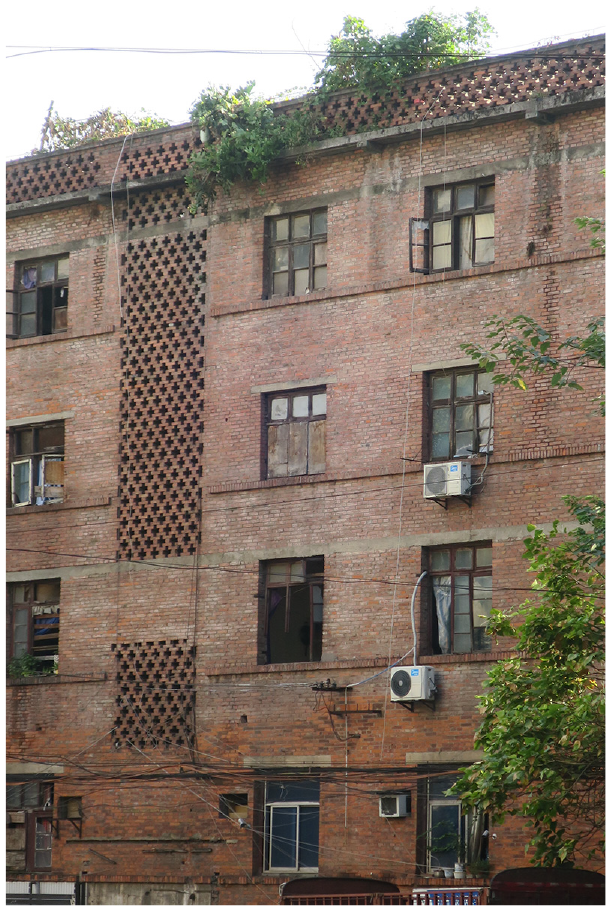
Socialist-era building where ventilation was inscribed in the built fabric: openings in the walls with ventilation bricks (tongfengzhuan 通风转?), here the case of a semi-open staircase, are reminders of a time when air-conditioning was still absent.
Apart from ventilation being inscribed in the design of buildings, ventilation also manifests in the residents’ practices of opening doors and windows. Residents from Xiao Meishu Xueyuan remember that in the 1970s, they used to open the back doors and the front windows on hot summer days to cross-ventilate. Mrs Zhu commented that this was possible because there were few thieves around. Since the 1990s, cross-ventilation has been mainly practised by elderly residents.
Cooling technologies and practices in the high-rise
Since the 1990s, electrification not only enabled cooling and other amenities of daily life, but also marked an important step in building vertically, with the inclusion of elevators. Concrete-sheltered apartments in high-rise buildings have replaced the older socialist architecture and artificial cooling has started to become a common means to mitigate the heat. Within the last three decades, cooling the indoors has become ‘both normal and necessary’ (Shove et al., 2014a: 1514). Today, inhabitants of socialist-era buildings, like Xiao Meishu Xueyuan, also cool and heat their apartments with electric devices.
On a Sunday evening in August 2017, with outside temperatures around 35°C, my expat friend Susan called to tell me that in her shared flat, the air-conditioner had stopped running. The reason was that she and her roommates had apparently used up their electricity credit and had forgotten to reload it at the community office. As the office was closed on Sundays and Mondays, they would have to live without air-conditioning for the next two nights. To escape the heat, I invited her and her two roommates to spend the night at my place.
When the three of them arrived at my apartment, they were all sweating and happy to cool down in front of my air-conditioner. The situation triggered a discussion about the modern indispensability of air-conditioning and about pricing. One of the roommates, Yuan, a native Chongqing woman in her thirties, could not understand why the 100 RMB (approximately €13) that they had still had on the card the day before had suddenly been used up, because she thought that they were in fact rather modest in their use of the air-conditioner. When Yuan’s family bought their first air-conditioner in the mid-1990s, it took them some time to save the money until they could finally purchase a window unit (chuangkou kongtiao 窗口空调). Since the 2000s, most people in Chongqing have bought split unit air-conditioners and between 2014 and 2020 the number of air-conditioning units per household in China has increased from 0,75 to 1,17 (China Statistical Yearbook 2021).
With the possibility to cool apartments with electric devices, indoor spaces have increased capacity to bear the summer heat, a tendency that is observed in many cities with hot summer temperatures around the world (Hitchings, 2011; Hitchings and Lee, 2008; Pertierra, 2015; Sahakian, 2018; Winter, 2016). Not only private, but also public places cool their indoor spaces. Large shopping malls offer air-conditioned indoor promenades where elderly people from surrounding neighbourhoods go for a stroll in their pyjamas and where the younger generation meet friends to have a cold drink in the fast-food chain restaurants. Small stores along the road also advertise on their doors that they offer air-conditioned spaces. Even small restaurants have to offer cooled spaces to stay competitive. I experienced people choosing their tables according to the distance to the air-conditioning unit: the table closest to the device was deemed more pleasant than one a bit further away. Another recent trend is the use of air-conditioning units or electric fans to cool even the outdoor terraces of restaurants.
My analysis of household practices shows, however, that air-conditioning is often accompanied by other passive and active means of climate control: opening windows and doors is common in the morning hours to fill the house with fresh air. Often, I observed people using thick curtains to protect the indoors from the strong summer sun. Curtains are also used within the apartments to separate cooled from non-cooled rooms when doors are missing or to create small cooled spaces within a room. Many point out that they would only cool down their sleeping rooms before going to sleep, while during daytime they simply close the doors to these rooms, leaving them uncooled.
Besides air conditioning, the electric fan is a very widespread object in Chongqing households too. It has the advantage of consuming less energy than the air-conditioner, but is often used in combination with it. When having dinner with an interviewee’s family, they turned on the ceiling fan above the table in addition to the already running air-conditioning unit. The mother of the family later told me that she would also turn on the table fan in addition to the air-conditioner when sitting on the sofa. The breeze would increase her feeling of comfort.
Only a few people living in high-rise buildings still rely on cross-ventilation for cooling. I met a couple in their thirties called Ming and Jack (who introduced himself with an English name despite being Chinese) who lived in a rented two-bedroom apartment on the 30th floor of a high-rise building in the Shangyuan Yinxiang (尚源印象, translated as ‘Impression of Shangyuan’) compound in Yubei district. Ming and Jack emphasise that they rarely use electric devices to cool their apartment even if they have an air-conditioning unit and could afford electricity costs with their middle-class income. Rather, they rely on natural ventilation by opening windows on all three sides, to create a comfortable breeze. To protect their sleeping room from mosquitos, they hang a net in the door frame.
The case of Ming and Jack is quite unusual as most people would switch on the air-conditioner more often. Those born after the 1980s especially, prefer to switch on the air-conditioner if they can afford it. Student Zhanghu, 24, tells me that he always uses the aircon when he is at home in his one-bedroom apartment in a socialist-era building in Huangjueping. In his case, his employer pays for the electricity costs. He would only open the windows when leaving the apartment in order to get rid of the sticky smell. The only occasion when he practices cross-ventilation is after washing the floor, so that it dries faster. But in general, he does not like to have his door open towards the staircase because then he hears and sees his neighbours and he prefers some privacy.
The price for cooling the indoors
With the transition from the socialist to the post-reform period, Chongqing residents’ heat mitigation strategies shifted from more collective, communal ways of cooling to individual retreat in cooled indoor spaces. While until the 1980s, people used to cool down in the outdoors making use of shaded places and the riverside breeze, from the 1990s on, they have relied on the electricity-dependent air-conditioning. Mrs Hu, an interviewee in her 50s with a lower middle-class income, recounts this adaptation to energy infrastructures with regards to her own apartment: first, [in the 1980s], we bought a ceiling fan […] from the brand Sanxia [Three Gorges], I used it for so many years and it never broke; these things before were all very well made not like today. Air-conditioning [came later], at first we had a window air conditioner, […]. Later, when it was hot, the window air-conditioner was not enough anymore, [so] we changed to a freestanding one. Around 2000, it broke after we had used it for a long time. [Today,] I usually put on the standing fan; only if this really cannot mitigate the heat, then I turn on the air-conditioning (Interview with Mrs Hu, 2020).
This personal heat history of Mrs Hu is very characteristic for the changes in heat mitigating practices in the post-reform period in Chongqing. Cooling down is strongly related to the design and construction of the building, to the affordability of energy services and to the availability of electric devices. Parallel to the evolving high-rise urban landscape, residents exchanged many of their former low-energy and passive strategies outdoors with more active means to control the indoors. Older construction knowledge such as the inclusion of ventilation, considerations of insolation or public greening has been abandoned for a concrete- and steel-dominated modernist architecture which has made reliance on energy-intensive cooling necessary. This has had serious consequences until today, namely (1) environmental degradation, (2) changes in the social life of the compound and (3) a socio-economic stratification with regards to cooling practices.
(1) In the case of Chongqing, human cooling practices over the decades have not only changed urban infrastructure and the built fabric, but have also affected the urban climate. Coal-driven electricity production led to serious air pollution rates until the late 2000s when campaigns such as the ‘Clean Energy Movement’ promoted cleaner technologies and alternative energy sources (Ahlers and Hansen, 2017: 89–90; Peng, 2012: 135). Further, the increasing electricity consumption and use of air conditioning have exacerbated urban heat concentration with steadily hotter summers (Yingda Media Group, 2013). Although decarbonisation efforts have in recent years relieved urban areas from air pollution, they were, in fact, passing on the environmental costs of electricity production to the hinterlands. The Three Gorges Dam that produces hydropower, for example, has caused the flooding of ecosystems, the extinction of species and the relocation of around 1.13 million inhabitants (McDonald-Wilmsen, 2009).
(2) The change of thermal summer practices in Chongqing since the 1980s has also affected social relations. According to my research assistant, the locally used term for enjoying the cool of the shade (xieliang 歇凉) implies not only cooling oneself down (naliang 纳凉) or enjoying a cool breeze (chengliang 乘凉), but is closely related to a kind of collective activity beyond the family in public spaces. Practices like sleeping on the rooftops or sitting together under the trees of the public compound spaces hence go beyond a search for thermal comfort, but are embedded in the social life of the compound, in gossiping, or communal cooking. While air conditioning is praised as having had positive effects on indoor temperatures, Mr Kong and Mrs Zhu highlighted that the high-rise’s anonymity and the limited green space in fact prevent a comfortable thermal environment. Today, people apparently are more distanced (lengmo 冷漠) from one another than in the socialist-era compounds. The social cohesion and the tranquillity of green spaces around the houses essentially contributed to a sense of comfort. In their narratives, the ‘cold’ in the high-rise today is not only a thermal description, but also characterises the social environment.
(3) The reliance on electricity-driven cooling devices has also led to a socio-economically stratified access to cooling. In the socialist period between the 1950s and the 1980s, Chongqing residents’ way of cooling was not shaped by their income as the shaded spaces outdoors could be enjoyed by everyone. In the 1980s, residents started to purchase electric fans, later window air-conditioning units, and then from the 1990s on, split unit air-conditioning became the most common. The purchase of these devices depended on the socio-economic means of a family as the costs for the running of these devices are not affordable for everyone. Yuan vividly remembered that in the 1990s her mother would be stunned when they had to pay more than 200 RMB (approximately €26) for their electricity bill for the entire summer. Today, she knows a gallery owner who spends about 2000 RMB (approximately €257) a month for his electricity bill because he has four air-conditioners running permanently for cooling in summer and heating in winter. Another family living in a two-bedroom apartment told me that in summer they would spend around 700 RMB (approximately €89) a month on electricity despite their thrifty use of the air-conditioning. This means that those with a modest income cannot afford to run an aircon in their apartment.
While the summer heat is tiring for everyone, those who cannot afford the electricity costs for cooling the indoors enjoy the shaded spaces provided by the numerous bridges criss-crossing the city territory, the underground markets or the riverside. The urban transportation infrastructure offers shaded public spaces, for example (see Figure 4). Even in 2017, one could still sporadically see people with low income sleeping on their mats outdoors, for example on the grass verges beside the roads.
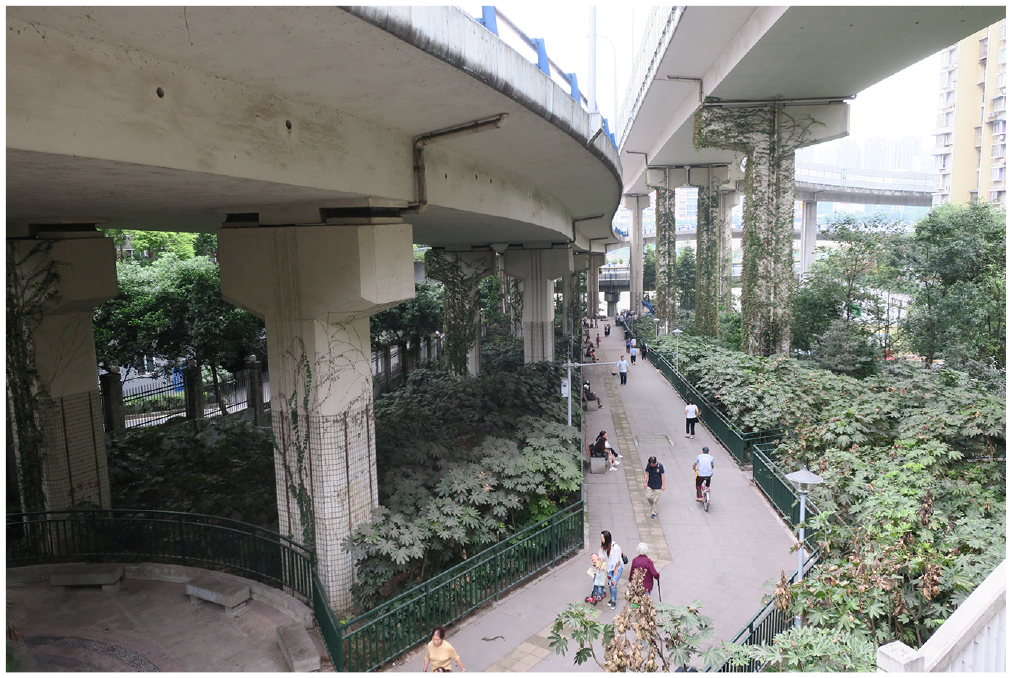
Going for a stroll in shaded concrete spaces under Huacun Overpass (huacun lijiao 花村立交).
Energy, material culture and urban heat mitigation
The history of heat mitigation in Chongqing is closely related to the development of the city’s architecture and electricity infrastructure. Using the concept of the ‘urban energy landscape’ (Castán Broto, 2019), this paper outlines the connectedness of the landscape’s components including the electricity grid, the construction materials, and everyday practices. By deviating our perspective from the large infrastructure to the small objects that co-constitute the landscape, we gain a more fragmented, but also more flexible view of energy landscapes which allows us to analyse ‘the spatial and temporal dimensions of urban energy landscapes’ (Castán Broto, 2019: 207).
The choreography of cooling practices in Chongqing emphasises that different forms of energy are necessary to keep bodies or indoor spaces cool. First, the urban electricity infrastructure governed from a macro-level enables individuals to switch on the air conditioning if prices are affordable. Second, the embodied energy in the built environment contributes to keeping cool the indoors or enabling shaded spaces through the arrangement of houses around courtyards. And third, the notion of energy also includes muscular energy, namely the movement of one’s body and the possibility to actively shape the built environment by moving a chair outdoors, for example.
The analogy of urban energy landscapes with a connective tissue (Castán Broto, 2019) helps to illustrate the connectedness of these different components from the infrastructure to the human body, from the building to the electric devices. In Chongqing, residents’ practices hold together different parts such as the electricity grid, the hilly landscape, the socialist-era building and the electric fan. It is through an analysis of individual thermal practices that we learn about this practice–arrangement–nexus (Schatzki, 2010) or the ‘system of thermal–material culture’ (Shove et al., 2014b: 118).
Rethinking the ways in which everyday practices are entangled with cooling infrastructure and the built environment foregrounds the role of citizens. Urban energy infrastructures and urban climates are largely the result of human practices as it is citizens who build infrastructures, construct houses, and plugin electric devices. These practices are, however, not arbitrary but related to standards of cooling and the political economy (Shove et al., 2014b: 122). Throughout the last decades, the objects used such as the bamboo chair or the electric fan have interacted with different forms of sociality. Urban transformation is hence not only an architectural or economic process, but it leaves traces in the social and cultural fabric (Cartier, 2002: 1517). In times when ventilated rooms only existed in collective spaces, as in the 1970s and 1980s, people simultaneously cooled down and spent time together. Also, the cooling in public spaces in shaded courtyards or along the river shore was then accompanied by a sense of collectively bearing the heat. On the other hand, the widespread affordability of the air-conditioning unit in households today has led to more individualised forms of enjoying the cold.
Conclusion
Research on urban heat mitigation in large cities tends to emphasise the benefits that electricity infrastructure has brought for the control of indoor climates. The availability of electricity is usually related to the notion of living in urban modernity (Winther and Wilhite, 2015). This paper outlines the ways in which the introduction of electricity to households in Chongqing has indeed reduced the reliance on natural conditions to cope with heat, e.g. through wind flows or shaded spaces. However, while those outdoor spaces have been broadly accessible as a common good, access to cooling devices today depends on the economic possibilities of residents. Some can afford to run several air conditioners in their apartments all day long while others carefully decide when to switch on their devices or they choose to cool down in public outdoor spaces such as parks or in an artificially cooled shopping mall. Access to the services of cooling devices is here not universal and democratic but rather fragmented along the lines of income. While energy infrastructure reaches almost all households, uneven possibilities to pay for electricity costs hint at the city’s splintered energy landscape (Graham and Marvin, 2001; Luque-Ayala and Silver, 2016: 4). The shift from cooling down outdoors to the indoors and the de facto commercialisation of thermal comfort accompany a general trend of socio-economic stratification in the post-reform Chinese city. Not only access to electricity, but also to housing and most consumer goods has become socio-economically stratified.
Both the ways in which residents cope with summer temperatures and the rising inner-city temperatures are closely related to the built fabric. People in lower floor apartments in old socialist-era compound buildings benefit from the lush greenery outside the window. Their buildings’ surroundings cool down more easily than an apartment on the 20th floor of a high-rise exposed to the sun. The path-dependency of concrete and steel modernism in these high-rise buildings led not only to a dependency on electricity to mitigate urban heat but has also had harmful effects on air, water and the environment. The already built environment challenges cities in implementing energy transition in particular because of these path dependencies (Hein, 2018; Rutherford and Coutard, 2014).
The current demands in energy transition scenarios to use less energy while at the same time relying more on renewables is difficult to achieve within the existing building stock. The case of Chongqing shows that the construction of poorly insulated high-rise buildings neglects previous thermal knowledge that integrated heat mitigation into its design through natural ventilation or the arrangement of buildings around shaded courtyards. Today’s high-rise buildings are widely responsible for the high electricity dependency in heat mitigation.
Constructions by local architects show concern for reducing energy consumption during the summer: Liu Jiakun has included ventilation features into the Department of Sculpture of the Sichuan Academy of Fine Arts (Klein and Kögel, 2005: 82–83); Vector Architects designed underground spaces, natural lighting and green rooftops into the Taoyuanju Community Center (Vector Architects, 2015); and Safdie Architects reinterpreted the local architectural feature of the terraced housing for Eling Residences (Safdie Architects, 2017). But developments in that direction are still rare and the challenge lies in finding solutions for the already existing building stock. In the words of Shove (2003: 76), ‘[t]he buildings we inhabit today consequently contain within them important scripts for the future for they are, like it or not, helping to build what will become the traditions and conventions of tomorrow’. With regards to environmental justice in climate change scenarios, the biggest challenges for Chongqing and other contemporary cities are thus to reduce electricity consumption for mitigating heat while at the same time providing more equal access to cool public spaces.
Footnotes
Acknowledgements
A first version of this paper was presented at the online workshop ‘Heat in Urban Asia‘ in April 2021 in Singapore funded by Ministry of Education (Singapore) Academic Research Fund, Tier 2 Grant, MOE2018-T2-2-120. Heat in Urban Asia: Past, Present and Future. The author would like to thank the very constructive comments from the organisers and all workshop participants which highly stimulated my thinking on heat in urban Chongqing. Further, I would like to thank the three referees from Urban Studies who helped me sharpen my arguments for the final version of this paper. I would also like to express my deepest gratitude to my research assistant and all the people who shared their knowledge and everyday practices on mitigating the heat during my fieldwork in Chongqing in 2017. Together we were sweating, searching for relief in front of the air-conditioning unit and drinking a beer here and there.
Declaration of conflicting interests
The author declared no potential conflicts of interest with respect to the research, authorship, and/or publication of this article.
Funding
The author disclosed receipt of the following financial support for the research, authorship, and/or publication of this article: Research conducted for this paper was financed by the Swiss National Science Foundation.
