




Abstract
Did the socialist experiment disrupt continuity in Russian urban housing? Based on a unique collection of urban data covering several hundred Russian cities and spanning three regimes across more than a century, this paper gives a nuanced account of continuities and discontinuities of housing in post-Soviet cities. Three main housing characteristics are analysed: urban density (persons per building and living space per capita), ownership structure and the modernisation of stock (building material and provision with amenities). Although all Russian cities underwent a number of major shocks and regime changes during the course of the 20th century, their rankings with regard to these three key housing characteristics are still significantly correlated over time, whereas living space per capita is largely uncorrelated over time. This holds true despite significant convergence processes in almost all dimensions and also when including contemporary control variables. We hypothesise that local or regional building traditions, regional differentiation in Soviet urban planning as well as Soviet land use specificities could explain differential growth across cities. Going beyond existing late-Soviet-legacy timeframes, the long-term perspective reveals that even major regime shocks did not completely erase regionally shaped patterns in housing conditions.
Introduction
Russian cities were subject to one of the most ambitious experiments in urban history of the 20th century: the centrally organised socialist state steered the belated but booming urbanisation process, nationalised a large share of the existing urban housing stock, and almost monopolised new urban construction. With the dissolution of the Soviet Union, another wave of shock-like changes swept across the cities. Although constantly exposed to change, both cities and housing are known for their path-dependent properties: once established, cities are rarely abandoned; urban systems and city rankings are relatively stable over time; regional traditions of urban culture and regional political traditions often span across centuries. One reason for this stability across, but also within, cities is related to urban housing: durable in itself, it is tied to existing networks and urban infrastructure.
Given such inertia of cities and housing, to what extent did the socialist experiment disrupt the existing city rankings? This paper tries to grapple with this puzzle empirically, by tracing major Russian cities and their housing over more than a century. In particular, we trace three important housing characteristics for which data are available: urban density, ownership structure and modernisation of the housing stock. We focus specifically on the Russian cities as they were arguably the most affected by the state socialist period: over the course of nearly 70 years of Soviet rule, about 80% of urban housing stock and an even higher share of new construction was brought under state control.
Combining some unique city data in a longer historical perspective (60–120 major cities since 1825 and 500–900 since 1970 in the Soviet period and 1991 in the post-Soviet period), we find that the period of state socialism did not completely reverse the initial differences that existed between Russian cities long before and after the Revolution of 1917. Although we find convergence processes in almost all housing dimensions, the degree of urban density, wooden share of building construction and the share of personal ownership in the early 20th century or the late Soviet period still correlate with the respective indicators in contemporary cities. For inter-city living-space-per-capita differences, however, we do not find a similar continuity. While the inter-city variance in personal ownership and provision with amenities has decreased over the last decades, the variance in urban density and living space per capita has increased. We hypothesise that local or regional building traditions, regional differentiation in Soviet urban planning, as well as Soviet land use specificities could be the driving forces behind the continuity of central characteristics of the Russian urban housing stock.
The paper contributes to long-term studies of urban phenomena in general, and looks at Soviet legacies and path dependencies in particular. While Russian housing studies to date have tended to focus on the immediate late Soviet legacies in the post-Soviet period (for example, Berezin et al., 1996; Kosareva et al., 1996; Zavisca, 2012), we go back to pre-Soviet times. Drawing on previously unused historical statistics on the city level, we supplement existing research that is often characterised by a paucity of data, resulting from the low political and administrative importance of cities in centralised regimes (Bater, 1980). Methodologically, by relying on city-level data, our analysis considers the variance at subnational level, an obvious strategy for studying a country of the size and heterogeneity of Russia and one rarely undertaken by Western scholars.
After reviewing literature on the socialist city and introducing our data and methods, we present our findings on (dis-)continuities for each of the three housing characteristics from the early 19th century until the year 2015. To trace the legacy of the post-war Soviet housing stock, we then present multivariate regressions using the large sample of around 500–900 cities for the more recent period. We end by hypothesising about possible explanations behind the continuities observed.
Literature
The paper draws on the studies of socialist, or Soviet, cities and housing. The ‘socialist city’ refers both to an ideological model and to the reality of most former state socialist countries, where city characteristics were systematically different from those in their capitalist counterparts. However, this distinction hides considerable heterogeneity across countries and regions of the (former) Eastern Bloc, with the Soviet city being its most outstanding variant. For instance, in relation to housing, Hegedüs and Tosics (1992) distinguish between the East European model and the Soviet model as an extreme case.
Despite the variance across Eastern Bloc countries, there was a common ideological model of the socialist city that was based on central planning principles underlying the political economy of communism. For one, the centrally planned economy has been described as resource-constrained and therefore plagued by constant shortages (Kornai, 1992). Thus the spatial allocation of limited resources was priority-based and resulted in particular urban development patterns both at the inter-urban (Sjöberg, 1999) and intra-urban (Gentile and Sjöberg, 2006) levels in most former state socialist countries. In general, priority was given to productive sectors of the economy (industry), while non-productive sectors such as housing suffered from underinvestment.
Socialist urbanisation was closely interrelated with industrialisation. Priorities directed industrial investment towards specific regions and/or cities, which resulted in geographically differentiated employment and, subsequently, urban growth (Sjöberg, 1999). At the outset of state socialism, the expansion of industrial employment was much faster than the growth of the urban population; this phenomenon has been termed ‘under-urbanisation’ (Murray and Szelenyi, 1984). The fast growth of industrial employment during the 1920s and 1930s was also conducive to overcrowding in the existing urban housing stock. Meanwhile, many communist countries attempted to restrict the differential growth of cities in order to achieve equity in their settlement systems. For instance, Soviet regulations and decrees established limits to the growth of the largest cities and instead shifted focus onto developing medium-sized and small cities inter alia by means of decentralisation of industry. Against the backdrop of these sweeping urban changes, one would expect as a null hypothesis that major housing discontinuities characterise the Russian urban housing system.
However, the overall preoccupation with economies of scale in the quest for the most efficient investment meant that centralisation and concentration tendencies prevailed over the decentralisation interventions intended to harmonise (and equalise) the urban system (Enyedi, 1996). Regarding the Soviet urban system in particular, Mirucki (1986) has observed a long-lasting dominance of large cities and the limited effect of state planning practices in diverting development to the cities lower down the urban hierarchy. Moreover, other in situ measures to control migration of labour force by means of internal passports and residence permits (propiska) were only partially successful (Buckley, 1995). Hence the largest and most industrialised cities tended to record the highest population growth rates, which was at odds with socialist principles of promoting regional equity (Bater, 1980).
The housing sector was given a relatively low priority under the centrally planned economy, and even despite the construction surge from the end of the 1950s under Khrushchev, Soviet cities were characterised by permanent housing shortages. While industrial enterprises had sufficient resources to build new housing and used their housing stock to attract and retain their workforce, the local soviets (municipalities) depended on the allocation of development funds from top governmental level (DiMaio, 1974). These two institutional entities, the local soviets and the industrial enterprises, were in a systemic conflict that ultimately embodied a struggle between spatial and physical planning on the one hand and economic planning on the other (Andrusz, 1984: 271). The local soviets failed to provide sufficient housing because of their relatively weak position vis-à-vis ministerial and industrial interests that often had an overriding influence over city planning and budgets.
Shortages notwithstanding, post-war Soviet housing was premised on egalitarian principles and aimed at raising the living standards of the whole population (Harris, 2013). Public provision of housing in mass-produced multi-storey apartment blocks grouped in large residential estates was an important and cost-efficient means of fulfilling these principles. As a result, most people lived in broadly similar, even if not particularly adequate, conditions (Bater, 1980: 167). However, despite the public provision of housing and the de jure abolition of private property, individual ownership persisted in Soviet cities as a form of decommodified personal property (Smith, 2010), and self-building was permitted in medium-sized and small cities to alleviate housing shortages, which were particularly acute in the aftermath of wars (Andrusz, 1984).
The realisation of a socialist city model was affected by conditions prior to the communist period. Despite the initial intention of eradicating the ‘chaotic’ capitalist urban planning legacies, the spatial structure of older cities experienced only an incremental transformation, whereas the newly founded cities represented the ‘purest version of the planned socialist city’ (Smith, 1996: 73). Likewise, egalitarian urbanism in the shape of large-scale building of apartment blocks was most pronounced in the new ‘socialist’ cities (Enyedi, 1996: 110). Socialist urbanisation therefore did not produce a sweeping homogenising effect on the whole urban system, but rather left a significant imprint, while still allowing for the regional variation in architectural and building heritage.
The literature on post-communist regimes is clearly marked by the ideas of legacy and path dependence (for example, French, 1995; Stark, 1991). Privatisation strategies, social stratification and socio-spatial differentiation, urban planning and development, and entire political economies have been explained with reference to the conditions during the socialist past. Housing literature has only recently addressed questions of path dependence (Bengtsson and Ruonavaara, 2010), possibly because the durability of housing structures makes them such an obvious case. For instance, in relation to post-communist housing systems, Soaita and Dewilde (2019) have employed a long-term perspective to highlight the persisting differences among the former Eastern Bloc countries in the quality of housing inherited from the state socialist period. In light of these path-dependency approaches, one could expect much more continuity in Russian urban housing than the discontinuity-null-hypothesis claims. After presenting our data and methods, we provide descriptive and multivariate evidence to see which of these competing views is right.
Data and methods
We successively trace three central characteristics of urban housing stock on the inter-city level: urban density (measured by the number of residents per building and the number of square metres per capita), share of personal versus public ownership and degree of modernisation of housing stock (expressed by the dominant building material and provision with amenities). As outlined above, the socialist city model led to housing shortages (higher urban density and restricted living space), higher shares of non-private (public rental) housing and more standardised (multi-storey and reinforced-concrete panel) buildings. However, this ‘socialist experiment’ on cities encountered regionally variegated initial conditions and was not applied to the same extent everywhere. In the following two sections, we trace how this experiment affected each of these characteristics in the smaller sample of about 60–120 major cities for benchmark years from 1825 to 2015 and in the larger sample of about 500–900 cities from 1970 to 2013. Table 1 (and data appendix, available online) presents the coverage of key indicators in more detail.
Variables and data coverage.
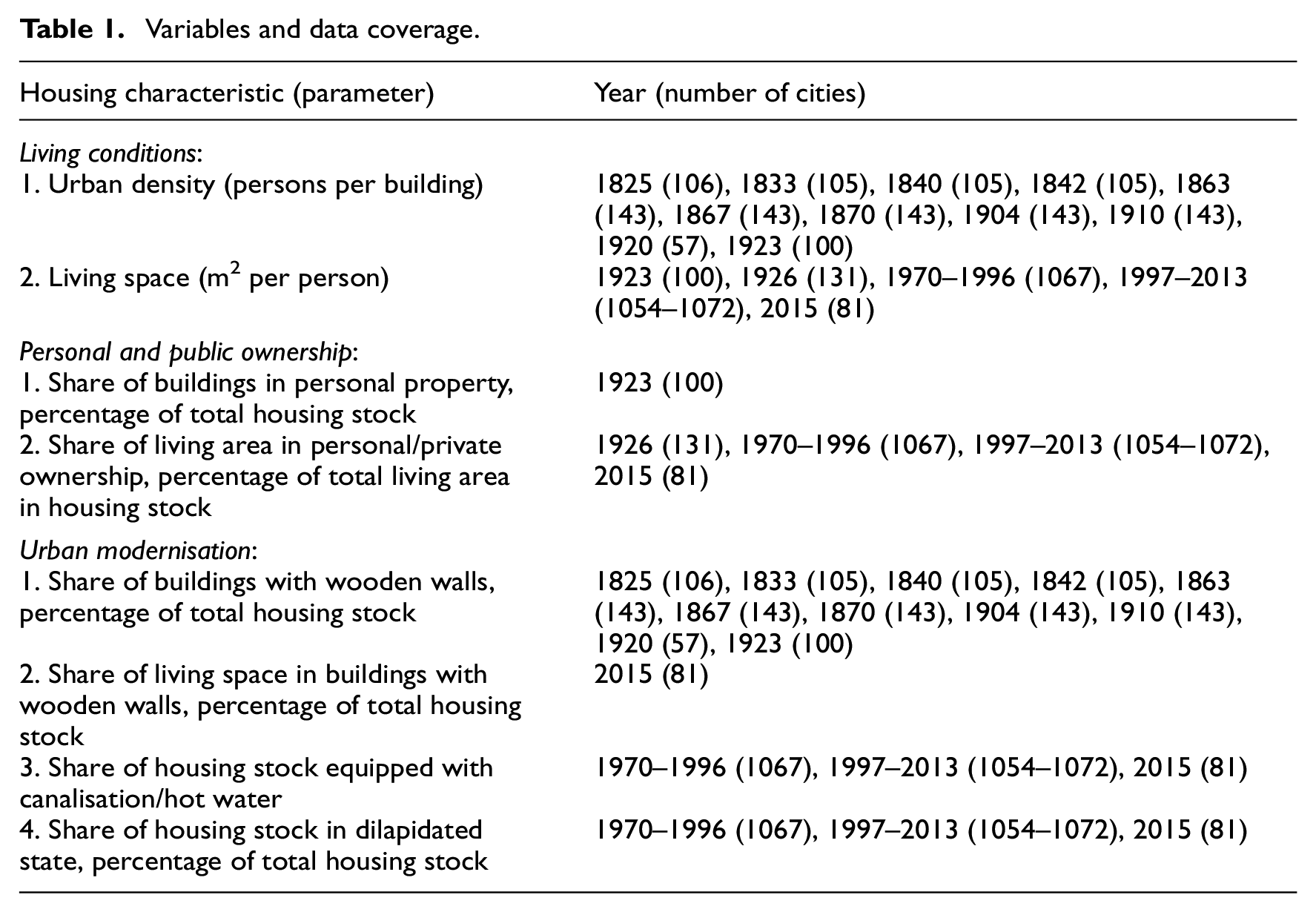
We conceptualise continuity over time in relative terms of city ranking based on three urban housing characteristics, which we operationalise in three different ways. First, we use (conditional) correlations over time, which measures whether the relative position of cities reversed, disappeared or remained intact. Second, we use convergence regressions of average annual growth rates on initial levels in each dimension (also called beta-convergence in growth economics). For each measure, we estimate the following equation:
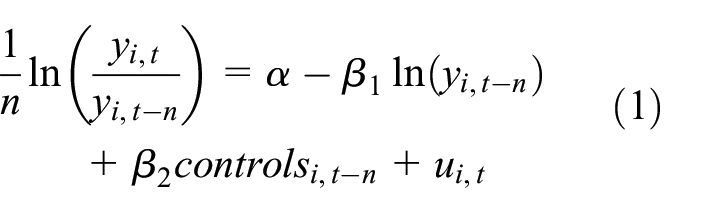
Here the left-hand side represents the growth rate, averaged over
Descriptive long-term evidence
Urban density: Persons per building and living space
The most common metric that can be drawn from our sources is the number of people per building, a characteristic of urban building forms and living conditions. It was commonly used by 19th-century reformers to measure the extent of ‘rental barracks’ (multi-storey rental buildings) with their dreaded overcrowding. St Petersburg, with its revenue houses (dokhodnye doma) as well as speculative substandard buildings for workers, was known to be the most densely built-up and overcrowded city in the Russian Empire, with 65 people per building in 1910 in our sources, well over 100 in others (Yukhnyova, 2008). Dormitories, of which St Petersburg had 3000, representing 10% of all buildings in 1910, housed the considerable migrant population common to Tsarist large cities (Brower, 1990). At the same time, most regional capitals and secondary cities maintained relatively low density levels (not more than 10–15 persons per building) until the very end of the 19th century (Koshman, 2008: 77–78). Throughout much of the 19th century and even until the first Soviet Census after the Revolution (1926), the ranking of major Russian cities according to their housing density (or persons per building) remained relatively constant, with correlations ranging between 0.6 and 0.98 for the available years 1825, 1833, 1840/1842, 1863/1867/1870, 1904/1910, 1920/1923 and 1926. While the ranking thus shows constancy, with the variance hardly changing, 1 cities still showed some convergence, as a significant negative regressor in a convergence regression reveals.
The First World War and the Russian Civil War led to massive de-urbanisation followed by rapid re-urbanisation. The 1926 Census recorded that 18% of the Russian population (current borders) lived in an urban setting, a tiny increase from the 15% in the 1897 Census. The Second World War had devastating consequences for both the population and the housing stock, with up to 30 million casualties and 25 million evacuated persons, the destruction of around one-sixth of the total Soviet housing stock and damage to at least another one-sixth (Andrusz, 1984: 19). However, post-war economic recovery and urbanisation was impressive, the urban population in Soviet Russia (RSFSR) reaching 52%, 62% and 73% in 1959, 1970 and 1989 respectively. 2 The Soviet Union was thus a relative latecomer in urbanisation, and its cities grew considerably in size and number, particularly in the second half of the 20th century. According to the 1989 Census, only 7.3% of the population of the urban RSFSR lived in housing stock constructed before 1941, while 89.2% were housed in buildings constructed during the 1950–1980s. This massive post-war renewal does little to lead us to expect a continuity of the urban patterns inherited from Tsarist times.
While there is a general increase in persons per building on average – only decreasing between 1910 and 1926 as a result of post-war de-urbanisation – the ranking of cities over time remains relatively stable throughout the 20th century. The correlation between 1910 (1926) and 2015 is 0.62 (0.46) for 60 (64) major cities and the convergence regression shows weak (or no) significance. But there is an increasing standard deviation: while Soviet housing allowed cities to grow upwards and in density and did so throughout, the initial differences across cities did not even-out but instead increased. As larger cities display higher levels of the urban density measure, a large part of this correlation is simply due to the stability of city-size rankings over time. Larger cities continued to be large and, despite the construction of standardised housing even in smaller cities, initial differences in size and urban stock were not completely reversed.
Urban density is not only about the distribution of people to buildings but also of people to living space. Late Imperial Russian cities were considerably overcrowded, with entire families occupying single rooms (or even just ‘corners’ in rooms) in cities such as St Petersburg and Moscow. While the forced redistribution of living space in larger cities in the wake of the Revolution improved these conditions slightly, the industrialisation and urbanisation of the 1920s and 1930s often exacerbated them once more. The system of internal passports and propiska was supposed to balance internal migration and residency within the USSR, but this did not prevent disproportionate migration to centres with an existing high labour supply owing to the ‘temporary resident worker’ quotas for unqualified labour. Urban living space fell gradually from approximately 7 m2 per capita in 1914 to 6.5 m2 in 1923, 4.9 m2 in 1932 and 4.1 m2 in 1940 (Sosnovy, 1954: 4 and 106). The Russian minimum ‘sanitary norm’ of 9 m2 per capita stipulated in 1922 would only be, on average, achieved by the 1970s. In our sample of the larger 60 cities, massive construction programmes also increased the average living space of the urban population from 5.6 m2 in 1926 to 23.4 m2 in 2015, with almost a zero over-time correlation, a weakly significant convergence regression and even an increasing standard deviation. Possibly, these city-related numbers document demographic or migration cycles of cities rather than structural preconditions. Overall, there are processes of convergence for both types of urban density, persons per building and living space per capita; in the latter it erodes the over-time correlations, but not in the former.
Personal and public ownership
Before the 1917 Revolution, private rental was dominant in Russian cities, while social housing, as provided by the municipality or philanthropic organisations, was almost non-existent. In 1918, urban private ownership was abolished by decree; housing of ‘non-working’ people immediately redistributed in favour of the proletariat, and urban land and above-minimum housing municipalised under local soviets (DiMaio, 1974: 8). After 1917, private renting was thus outlawed, and the nationalisation and municipalisation of private property restricted private housing to owner-occupation, yet even single-family houses could be seized by local soviets (Andrusz, 1984: 29).
Nonetheless, the inter-war and post-war periods still witnessed fairly large shares of personal housing in the RSFSR total urban stock: 48.7% in 1926, 30.5% in 1940 and 29% in 1950. This was associated with occasionally large volumes of self-building: in 1929 the share of individual construction in total housing construction of RSFSR was 40%, but dropped below 1% by the year 1932 (Sosnovy, 1954: 55). In the wake of the Second World War, individual housing construction was encouraged by the fourth five-year plan and by accessible state loans and allocation of plots of land, particularly in smaller cities, in order to contribute to post-war reconstruction and to alleviate housing shortages (Andrusz, 1984; Smith, 2010). However, with the advent of Khrushchev’s housing programme the focus shifted from the individual single-dwelling to collective multi-dwelling construction, which was also backed by the 1963 ban on all private construction in cities with more than 100,000 inhabitants. Since then, the average share of private housing stock (31% in 1963) slowly but steadily decreased until it reached its all-time low of 20% in the late 1980s. The reprivatisation of public urban housing stock in Russia started in 1988 with the sale of cooperative units, and was extended to public and state-owned units by the 1991 law of privatisation (Kosareva, 1993). From this point onwards, the 84 major Russian cities in our sample displayed rising rates of personal ownership, reaching an average of 89% in 2015.
Complete nationalisation, despite being a backbone of – especially early – Soviet housing policy, was never achieved in practice, and the general trend also obscures considerable variety between cities both then and now. Not all cities radically nationalised their building stocks in the 1920s, just larger cities, with more overcrowding and significant stock of housing in good condition. The geography of units in personal ownership in Russia shows a historically higher share of ownership in the smaller, more peripheral cities located mainly in the agrarian regions south of Moscow; there the percentage of urban housing stock held as personal property never went below 41% even throughout the 1940s to 1960s (Smith, 2010: 91).
In comparison with many Eastern European or other former Soviet cities, Russian cities did not radically privatise all housing units following the collapse of communism. Despite transfer to the sitting tenants being nominally free-of-charge (Kosareva et al., 1996), many residents were unwilling to acquire difficult-to-maintain units and hoped to receive municipally renovated or new alternative housing. Free privatisation of state and municipal housing stock was set to end by March 2005 but was extended six times after that (and indefinitely extended in February 2017).
When the first Soviet Census surveyed the extent of nationalisation achieved by 1926, the two largest cities, Moscow and St Petersburg, were already down to 6% and 1% private stock, respectively, but in other cities nationalisation was much slower. When correlated with the average of private stock in 116 Russian cities in the years 2010–2013, there is still a significant coefficient of 0.39, suggesting that the original history of nationalisation and privatisation remains associated with today’s housing markets, even if the convergence regression shows a significant beta-convergence, with a decreasing standard deviation over time. Yet, smaller cities and capitals of primarily agrarian regions display consistently higher shares of private housing throughout the 1926–2013 timespan, while Moscow, St Petersburg and regional capitals elsewhere saw noticeable reprivatisation in the 1990s. Again, the overall U-shaped trend of personal ownership in Russian cities across the last century led to an overall convergence towards high ownership rates, but did not completely erode the ranking over time.
Housing stock modernisation: Building material and provision with amenities
In 1913, more than 80% of urban housing stock in Imperial Russia was made up of one- or two-storey wooden houses with no running water or canalisation access (Zhukov and Fyodorov, 1974: 11). The Soviet housing stock was largely modernised over the 20th century, visible in the provision of basic amenities such as central heating, access to the sewage system and plumbing. For RSFSR in 1940, the proportion of urban housing with these amenities was just 20%, 43% and 50%, respectively. By 1990, the numbers had increased to 92%, 92% and 94%, respectively, with private housing and rural areas lagging considerably behind. As of 2015, these numbers remain approximately the same at 92%, 89% and 91%, respectively. Another important part of housing modernisation was the transition from wooden to (reinforced) concrete constructions. All modernisation parameters correlate strongly with each other; the housing stock share of all types of concrete buildings at 0.9 correlates with the three aforementioned modernisation parameters (Census 1989). Utilising the available data, we henceforth focus on building materials in this subsection, and on canalisation access in the following section.
Traditionally, Russian cities were mostly constructed in wood; this trend continued until Alexander II’s reforms of the 1860s–1870s, when major cities saw the increasing use of stone and brick, not least because of the emergence of revenue houses (Koshman, 2008). In Siberia, this type of housing was still constructed in wood until the turn of the 20th century (Kulikova, 2006). With the rise of urbanisation, bank-financed mortgages, fire insurance and the danger of city fires, the share of wooden construction declined, but more slowly than in Western European cities and at different rates. For the 94 largest cities between 1825 and 1870, the mean number of wooden buildings did not fall below 90% (the number is lower for housing units). In the 143 larger cities in 1910, 72% of buildings were still wooden, with St Petersburg (40%) and Moscow (50%) at the lower end of the spectrum and many cities in Siberia and elsewhere in the Northern European part of Russia with more than 90%. This still correlates significantly at 0.40 with the 1825 level, with increasing variance (sigma-convergence), while a convergence regression does not produce a significant result. As most wooden houses are of the lower-rise single-family-house type, its use as a building material is also indicative of cities that are low rise and somewhat sprawling, with private family ownership being the prevalent tenure form.
While stone buildings typified modern construction in the 19th century, reinforced concrete became the characteristic 20th-century building material. Invented in the late 19th century, it gradually replaced urban brick and stone construction during the inter-war period. This period also saw the start of the industrialisation of housing construction, including prefabrication, which took place in the experimental avant-garde architecture of the 1920s (Bliznakov, 1993). According to the 1926 Census, wooden houses still accounted for 72% of all housing stock in RSFSR; this share dropped to 47% by 1940 (Sosnovy, 1954: 93). Moreover, the large-scale construction of new industrial cities in the Urals and Siberia, coupled with economic hardships, forced planners to rely heavily on wooden barracks as provisional housing. According to the declassified 1953 report by the Central Statistical Administration, the construction of barracks continued during the Second World War and in the following decade (144% increase 1940–1952). The total share of living space in barracks for this period, however, never exceeded 8–9% of the Soviet average, and had been gradually decreasing to approximately 25% even in the industrial cities of the Urals and Siberia.
It was not until Khrushchev’s housing decree of 1957 and the nascent industrialisation of housing construction that fully fledged prefabrication of multi-storey houses (khrushchevki) became the Soviet building standard. The more industrialised and new-construction-based a city was, the more it realised this housing type. While the blueprint for city extensions (in the form of microraion– planned residential neighbourhood), as well as the blueprints for the construction of entirely new socialist cities, were relatively uniform, the differential adoption of this model within and between cities created considerable variety (Smith, 1996: 77). Initiated in the 1950s and revised in successive decades because of advancements in building technology and design regulations, standardised mass housing construction survived the Soviet regime.
This should not suggest, however, that all new construction was of that kind. For instance, by 1975, after prefabrication had become established, industrial large-panel construction accounted for only about half of the total volume of state and cooperative housing construction in the USSR (Zhukov and Fyodorov, 1974: 36). In fact, according to the 1989 Census, only 40% of all persons lived in buildings with concrete external walls in the urban RSFSR, while 41% lived in stone and brick buildings and 15% still lived in wooden buildings. For houses built in the 1940s, wood still predominated. This also remained the case for those built in the 1950s, which still made up an impressive 30% of the 1989 stock. Reinforced-concrete walls only became dominant in the generation of buildings constructed in the 1970s. ‘The application of standard norms, to say nothing of industrialized building techniques and consequent limited architectural variation, has homogenized parts of all Soviet cities. However, the stamp of uniformity has been applied to many cities with markedly different architectural and planning legacies, ethnic compositions and physical environments’ (Bater, 1980: 86). Regional building materials, particularly in brick, wood and stone, were thus a constant regional basso continuo in the national choir of standardised production.
The homogeneous concrete constructions of Soviet times did not even-out pre-Revolutionary differences across the major Russian cities, as the 1910 and 2015 percentages of wooden urban buildings still positively correlate at a 0.33 level. The continuity observed also retained its pronounced regional dimension. At the beginning of the 20th century, pre-Revolutionary cities in the Central and Northern European parts of Russia, as well as industrial centres in the Urals, were mainly wooden; stone and rock buildings accounted for more than half of the housing stock in the Southern regions (Semyonov-Tyan-Shansky, 1910: 195–202). In our sample of 81 major Russian cities, the share of wooden houses as a percentage of total living space in 2015 is still relatively higher – compared with the average of 9.5% – in Northern European Russia (on average 14%), in Siberia (19.8%) and in the Russian Far East (11.4%), whereas Southern Russia and particularly the Northern Caucasus shows relatively high proportions of stone constructions (11%). Regional differences, premised in principle on the local availability of building materials, continue to reverberate throughout the almost 200-year-long span.
It seems as if building material speaks not only of various regional traditions, but also denotes a particular construction apparatus underlying different building forms: individual self-built (often artisan-based ‘hand-made’) housing and the industrially produced. Individual residential construction in Russia has historically relied on wood, a tradition going back to pre-Revolutionary times. This building tradition was encouraged to a certain extent by the Soviet state in the inter-war and especially post-war periods in an attempt to solve the housing shortage by allowing individual construction of low-rise, mainly wooden dwellings, especially where timber reserves were accessible (Smith, 2010: 34). For instance, in 1940 wood accounted for more than 80% of housing construction in the individual sector (Sosnovy, 1954: 93). The advent of prefabrication and centralised mass housing construction in the 1950s changed this, but seemingly only in large and medium-sized cities; smaller towns with limited economic development retained high shares of wooden housing throughout the post-war decades (Bater, 1980: 105; French, 1995: 56). The continuities observed are hence rooted in the smaller-scale, local building traditions with individual housing construction still largely relying on timber. Wood still accounted for 50% of all living space in individual houses in 2015 and the aforementioned regional differences also survive. Finally, secondary summer houses, or dachas, which transcended the Soviet regime, mostly remained traditional wooden constructions (Lovell, 2003).
Multivariate evidence post-1970
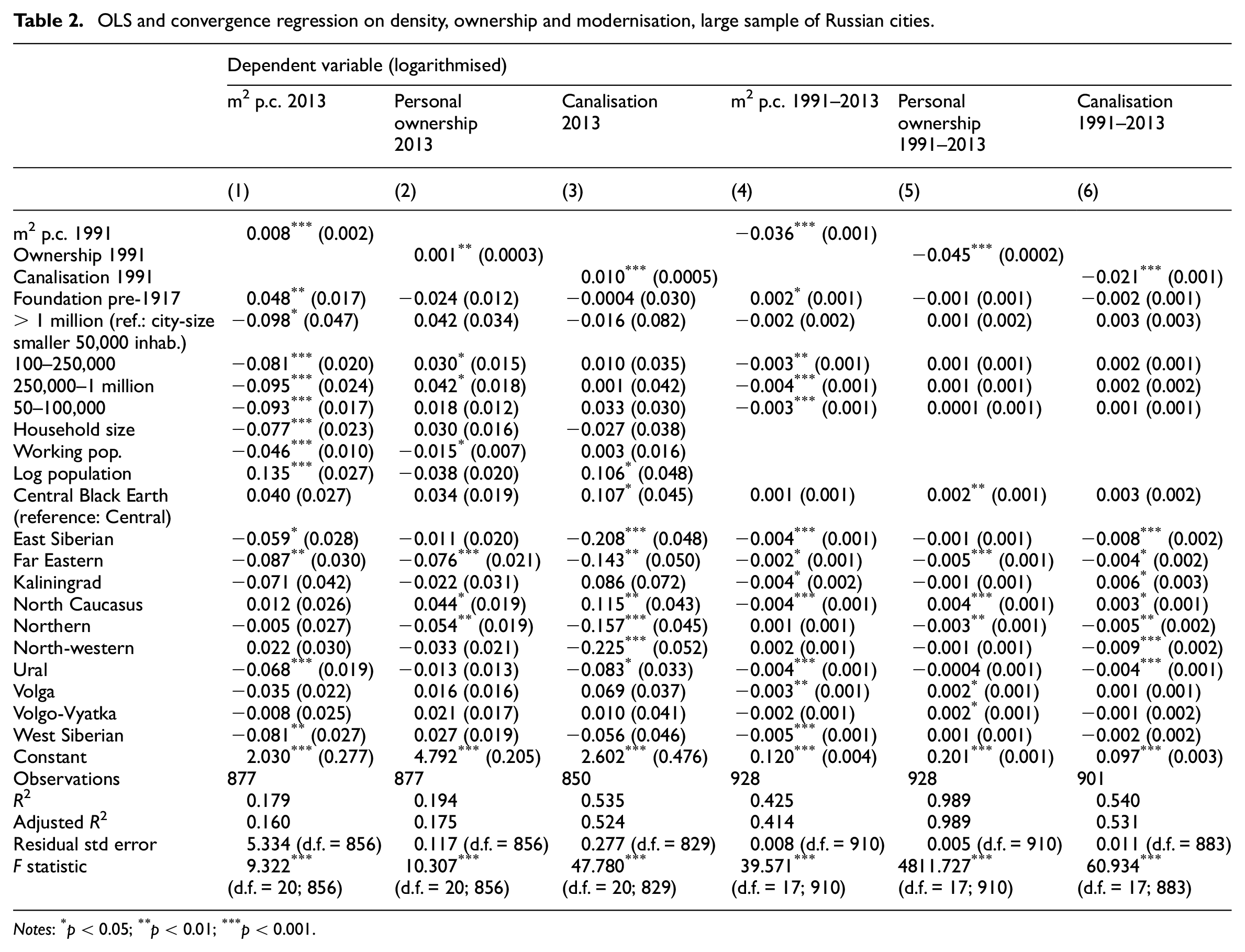
The post-Soviet Russian cities of 2013 differ widely with regard to living conditions, ownership and modernisation of their housing stock. Moreover, large-scale privatisation and the turmoil of the transition in the 1990s are likely sources of urban discontinuities. The above section suggested a pre-Revolutionary urban continuity that reached into the Soviet Union, and auto-correlations in the three dimensions indicated that contemporary cities are not independent of their urban past. Rankings are still associated over the long-run with the exception of living space, as regional averages of the key characteristics show (see Figure A2 in data appendix, available online). However, urban variation among current cities could also be explained by contemporary factors more than by the Soviet heritage, for example, contemporary demographic, economic or structural features. So what precisely is the Soviet heritage in contemporary cities? First we use OLS regressions for each of the three dimensions of urban housing in all available Russian cities in 2013 to enquire whether historical lags from 1991 (or 1970) can still account for current variation, given standard controls. In a second step, we again use convergence regressions of the average annual growth until 2013 on the initial Soviet level in 1991 (1970).
For density and ownership, we use living space per capita and the share of square metres in personal ownership. As building material is not available in the Rosstat data, we use the share of housing with canalisation access as proxy for housing modernisation. We take the logarithm of all dependent variables. We control for basic demographic and economic background variables: city-size by population, household size, working-age-to-elderly-population ratio, average salary, logarithmised population. We also control for pre- and post-Revolutionary year of foundation, given the potential disruption by the Soviet creation of completely new cities. Finally, we control for the 12 economic regions as even cities of similar size might show regional variation.
The first three columns of Table 2 show the results for the three different dimensions in urban housing: square metre per capita, personal ownership and access to canalisation. The first three lines show the 1991 lags for each of the three dimensions, revealing a strong positive autocorrelation in each case. The lag influence also holds when extending the lag back to 1926 for 115 cities with personal ownership coverage, whereas the 1970 (1926) lag of living space makes the positive coefficient significant, albeit for only 492 (115) cities. The alternative modernisation variables – access to running water or share of dilapidated housing – produce similar results. These associations are not simply reducible to regional, city-size or economic-demographic differences. Generally, larger cities exhibit less living space and slightly more private housing, while peripheral regional capitals tend to have less living space, personal ownership and canalisation access. But even within regions and city-size groups, the urban past of Soviet origins can still matter.
OLS and convergence regression on density, ownership and modernisation, large sample of Russian cities.
Notes: *p < 0.05; **p < 0.01; ***p < 0.001.
While the late Soviet and contemporary levels in urban housing structures are thus still conditionally associated with initial Soviet levels, this does not exclude processes of beta-convergence. Columns 4–6 in Table 2 show convergence regressions of the annual growth rate between 2013 and 1991 on the initial level of personal ownership, housing density and canalisation access in 1991, respectively. The negative coefficient and high explained variance imply a beta-convergence of cities in all three dimensions, that is, initially low levels of personal ownership, living space and amenities are associated with faster growth rates in provision. Convergence is similar when taking 1970 as the initial level.
Discussion: Hypothesising about continuities
The Soviet intermezzo in Russian housing history is often thought to have created more discontinuities, as the initial null hypothesis would expect. Although seen in the light of the considerable changes and shocks the regions and cities went through, continuities are the more surprising finding. Against this backdrop, our findings concerning three central urban housing characteristics of post-Soviet cities over a century and across several political regimes are surprising and worthy of further discussion. Despite many convergences, we still find over-time correlations of city rankings within central urban indicators.
To start with, we address the problem of cities’ diachronic identity. Of course all cities in our sample grew, often considerably so. Some were created from scratch, others developed from small initial settlements, but even the larger cities such as Moscow and St Petersburg significantly increased their urban territory and population. While there might be stability in a city’s self-identification, culture and name (often not even that), the strict diachronic identity of cities over the century is not a given. An alternative solution would be to focus on the regional level (Mäkinen, 2006), but this approach creates problems of its own as regional administrative boundaries tend to change. Moreover, given the size of Russian regions, the particularly urban aspect would be entirely lost. Our intention is to use the problematic diachronic identity to our advantage. First, continuities speak for the fact that, despite city growth, there is a core city identity over time; the urban ship of Theseus has lost most of its original material and has even grown, but it returns with its macro-properties intact. Second, continuities can be read as even more striking given the ever-changing nature of cities. Moreover, we observe continuities even when controlling for the year of foundation to account for the phenomenon of new cities (only significant for living space). New cities, despite being richer and better-off than older established ones (Skorobogatov, 2018), became typical for their size and region in terms of housing.
Our first hypothesis accounting for the continuities observed concerns not only cities themselves but the regional building and housing traditions they are situated in. Both the core city and its environs are often part of the same regional tradition; in the course of urbanisation, the expanding city territory not only shapes the suburban regions, but also absorbs the pre-existing traditions and forms one housing market. In this sense, the rural settlements ‘engulfed’ by the outward spread of cities accounted for a persistence in the share of private and wooden houses (French, 1995: 137). The continuity in the use of building materials over time despite the considerable post-war city extensions could indicate that it is partially rooted in a broader material culture of the respective region.
Likewise, the failure of the state to supply all the housing required to remedy the continual shortage and the consequent reliance on individual self-build initiatives in medium-sized and small cities (Andrusz, 1984) also contributed to the continuation of existing regional building traditions. More so, despite the egalitarian ideals, communist central governments, by way of top-down allocation of urban development funds, aided the development of a hierarchical urban network where priority was given to top-tier centres largely at the expense of middle or lower-ranking centres (Enyedi, 1996: 114). As a result, socialist urbanisation entrenched the divide between modern large cities and traditional regional centres. Some supporting evidence for this view lies in the analysis of new urban construction. For all years since 1997, we can split new construction into private and non-private. We find a positive correlation between the average of new units constructed from 1997 to 2013 and the existing share of privately owned stock in 1997, suggesting that the initial structure also shaped ongoing growth of the housing stock.
The second hypothesis argues that the Soviet influence, though powerful, was not as overriding as it seems. Despite regional redistribution and planning systems, incentive schemes to populate Siberia (Bater, 1980: 57), and the control of migration (Buckley, 1995) – all of which were meant to balance interregional differences – these measures were not effective enough to counteract the centralisation tendency of the Moscow region and the skewed interregional population balance. Even though optimal city-size limits were enforced on Moscow and regional centres (Clayton and Richardson, 1989), these cities continued to grow because of their administrative functions and productive industries, even if possibly less so in the presence of restrictions.
More so, on the intra-city level, two key tenets of the Soviet housing system, that is, equal access to housing and the abolishment of private property, were never fully embraced. Despite the officially espoused egalitarian allocation of housing (incarnated in the confiscation and redistribution of bourgeois dwellings for the benefit of the proletariat in the first Soviet years), housing was deemed by the government to be not only a right but also a reward and hence privileged ‘valued’ citizens and the elite (Hamilton, 1993). However, housing inequalities had been significantly levelled out thanks to the mass housing constructions since the mid-1950s (Gentile and Sjöberg, 2013). Furthermore, despite the formal abolition of private property, the Soviet state had to rely on the existing stock of individually owned units and on self-building/provision (mainly in medium-sized and small cities) to mitigate the constant housing shortages, especially in the aftermath of wars (Andrusz, 1984). In fact, the complete nationalisation of the housing stock was never accomplished, and the average share of privately owned urban housing never went below 20% during the whole Soviet period. It has also been argued that occupancy rights in public apartments became so secure with the advent of Khrushchev’s housing policy that they resembled elements of ownership rights (Smith, 2010).
Our third explanatory hypothesis points to the inertia of the built environment, which is related to particularities of land use in the socialist city. All land in Soviet Russia was nationalised, thus there was no incentive to redevelop built-up areas in inner-cities in the absence of land price formation as a market mechanism (Bertaud and Renaud, 1997). Therefore, the supply of land and urban growth were confined to the peripheral areas of cities, prompting extensive rather than intensive land use patterns. In Soviet housing stock construction, new residential areas were mainly erected on vacant plots forming consecutive circles of Stalin-, Khrushchev- and Brezhnev-era developments. The post-Soviet suburbanisation with the ongoing construction of high-rise residential estates, as well as dachas and gated communities, pushed the urban frontier further out, thereby reiterating Soviet land use patterns and at the same time leaving pre-Soviet and Soviet built-up areas largely intact.
Along similar lines, the lack of Soviet urban redevelopment and the subsequent inertias in the built environment could also be attributed to the unwillingness of the municipalities, because of constant housing shortages, to write off and demolish usable yet rundown housing stock inherited from the previous (building) regimes (Andrusz, 1984; French, 1995). It was scarcity and not desire to preserve heritage that led to the retention of existing houses. Thus, the growth pattern of many cities almost realised Burgess’s concentric-zonal model of urban land use, with the layers of socialist constructions surrounding the inner-city areas inherited from the pre-communist times (Hamilton, 1979). New building areas were concentrically added to old ones, as the maps of the present multi-storey housing stock by building period in two major Russian cities suggest (see Figure A3 in data appendix, available online). Cum grano salis, one can say that each generation of building added an urban layer to the existing ones – a pattern that only started to alter in the last two decades with more infill and redevelopment projects, such as the recently announced demolition of over 5000 khrushchevki apartment blocks in Moscow, home for more than 1 million people.
Conclusion
This paper contributes to the studies of Russian urban housing in the long term. The null hypothesis we confronted is that large-scale regime changes which occurred during the 20th century implied a unique urban history and completely disrupted pre-existing differences between cities as regards housing and urban morphology. While we indeed find significant shifts in absolute terms because of the socialist housing experiment – cities gradually improving living conditions, going through the U-shaped trend of private homeownership, and losing their wooden one-storey single-family-house nature – common trends, and even certain convergences, left many city rankings intact and failed to erode longitudinal correlations of key housing characteristics.
Our explanatory take on the continuities observed in urban housing in Russia over time is a simple ‘history matters’. Correlations for all indicators except for living space per capita suggest that looking at the past is informative for understanding present-day variation. On the more speculative side, we suggested three hypotheses. According to the first two, housing continuities reflect stability in regional material and building cultures as well as socio-economic development. The Soviet regional-differentiation tendency of new construction, controlled migration and public housing administration was not wholly successful in crowding out subnational circuits of housing distribution. The third hypothesis emphasised the layered growth of many cities that did not erode established land uses and urban forms. All hypotheses have an explanatory bias in favour of the supply-side factors of housing provision: existing urban structures, housing policy specificities, available construction material and construction industry conditions were considered in the above perspectives, rather than an arguably weak demand side that faced chronic housing shortages.
A statistically more elusive, yet complementary view of the demand side of housing and its role in sustaining the continuities observed is therefore an avenue for further research. Recent works on Soviet housing culture and everyday life are steps in that direction (Attwood, 2010; Harris, 2013; Varga-Harris, 2015). Another obvious strategy is to extend the focus on the effects of the Soviet housing system to the whole of Central and Eastern Europe. Although for a shorter period of time, these countries were also exposed to centralised urban planning to various degrees, with immanent prefabricated panel buildings, high population densities, less urbanisation, and housing shortages. This differential exposure might have emphasised initial differences that pre-dated the Soviet intervention, that is, those between the more urbanised rental cities of the Visegrad states and the more rural, lower-rise city traditions of the Balkans, not to mention the more intra-regional differences. Paying attention to urban housing in the historical long-term perspective can not only tell us about the underlying conditions that have moulded the path of post-Soviet transition, but also potentially provide insights into the future directions of urban development within the post-transition framework.
Supplemental Material
USJ852326_supplemental_material – Supplemental material for Continuities and discontinuities of Russian urban housing: The Soviet housing experiment in historical long-term perspective
Supplemental material, USJ852326_supplemental_material for Continuities and discontinuities of Russian urban housing: The Soviet housing experiment in historical long-term perspective by Alexander Kalyukin and Sebastian Kohl in Urban Studies
Footnotes

References
Supplementary Material
Please find the following supplemental material available below.
For Open Access articles published under a Creative Commons License, all supplemental material carries the same license as the article it is associated with.
For non-Open Access articles published, all supplemental material carries a non-exclusive license, and permission requests for re-use of supplemental material or any part of supplemental material shall be sent directly to the copyright owner as specified in the copyright notice associated with the article.
