




Abstract
For spatial practices such as architecture, urban design and planning, degrowth remains an abstract concept, as there is no clear alignment of its principles into spatial strategies. To bridge this gap, this paper examines how degrowth can be operationalised into sustainable spatial practices. Through a review of more than 200 sustainable spatial projects across the world operating at the building, neighbourhood and citywide scales, the paper shows that while the majority of sustainable interventions representative of dominant architecture and urban design culture do not align to degrowth principles, a significant number of examples using sustainability strategies such as convivial technologies, building retrofitting, urban renaturation and revitalisation, eco-urbanisation and spatial infrastructure upgrading are in fact aligned to degrowth principles. We suggest that these examples form a potential stepping-stone to enable an urban design and building culture rooted in a degrowth agenda, however further research and conceptualisation are needed to enable this to happen.
Introduction
This paper examines the extent to which degrowth principles can be applied to the cultures and practices of sustainable architecture, urban design and planning. In the context of sustainability science, degrowth presents itself as a form of radical environmentalism strongly opposed to both ecomodernism’s ‘pragmatic environmentalism’ and to more normative sustainable development practices that are dependent on continuous growth (Latouche, 2003). As the introduction to this special issue argues (Kaika et al, 2023), degrowth principles can form a pathway to building stronger principles for sustainable urban transformations (McCormick et al., 2013; Wolfram, 2016). However, these principles need to be addressed at different scales: the individual building, the neighbourhood and the city scale.
Considered explicitly, degrowth is directly associated with neither urban theory nor urban spatial practices. With the exception of a few fairly recent urban planning contributions to discussions of degrowth (Lehtinen, 2018; Varvarousis and Koutrolikou, 2019) there is no roadmap as to how spatial practices can serve the principles of degrowth (Kaika et al., 2023). Our paper aims to sketch such a roadmap by examining to what extent sustainability-oriented architectural and urban design interventions may work as a catalyst for pursuing or adopting degrowth principles. We employ two methods to assess this. First, we characterise how degrowth scholars consider spatial strategies at the building, neighbourhood and city levels. Second, we analyse the content of 252 documented examples of sustainable architecture, and urban design and planning interventions. Using theoretical coding (Bryman, 2016) we analyse the images and texts of intervention descriptions appearing in catalogue publications to identify whether the sustainability strategies employed by each intervention can be ranked as aligned, unaligned or ambivalent to the degrowth principles outlined in the first step. To assemble these examples, we select four international events illustrative of the mainstream architectural and urban design culture, whose goal was to present novel spatial visions and practices of sustainability. Due to their broad coverage, scope and target audience, these events form a comprehensive repository of current, renowned spatial sustainable projects. Since the interventions are mostly located in high-income countries, it is especially necessary to adopt a situated characterisation of degrowth complementary to environmental justice in low-income countries (Rodríguez-Labajos et al., 2019).
Operationalising degrowth principles into spatial strategies across scales
Currently, a small research field is investigating the repercussions of degrowth principles on architecture, urban design and planning. Nelson and Schneider (2019: 15) dissect the societal and environmental problem of increasing energy and material throughput into activities associated with the construction and inhabitation of buildings and urban areas. They identify two degrowth principles that can lead the process of reducing energy and material consumption of non-renewable resources like concrete, aluminium and steel: the first is to keep what is (or could potentially be) functional, and the second is to introduce social and low-tech innovations.
However, the application of these two key degrowth principles needs the development of different implementation methods at different spatial scales (see Table 1). First at the level of the individual building, Nelson and Schneider suggest the use of novel, low-tech construction materials. Vetter (2018) advocates the use of convivial technologies that reduce the material construction throughput. The latter exists implicitly in the sustainable practices of material upcycling and reuse (Gorgolewski, 2017; Stockhammer, 2020); however these often entail the degrading of materials, or require carbon intensive technologies, a problem shared with the use of smart technologies, high-tech construction systems and green building certificates (Nelson and Schneider, 2019: 10; see also De Castro et al., 2017). Other degrowth scholars advocate for the renovation and conversion of buildings through simple means, and for collective uses (Kallis and Vansintjan, 2017: 101). This strategy goes along with the growing interest in architecture and engineering in retrofitting as a design option (Grafe and Rieniets, 2020), and in the potential reduction of operational energy consumption in retrofitted buildings (Power, 2008).
Scale specific strategies aligned to degrowth/growth.
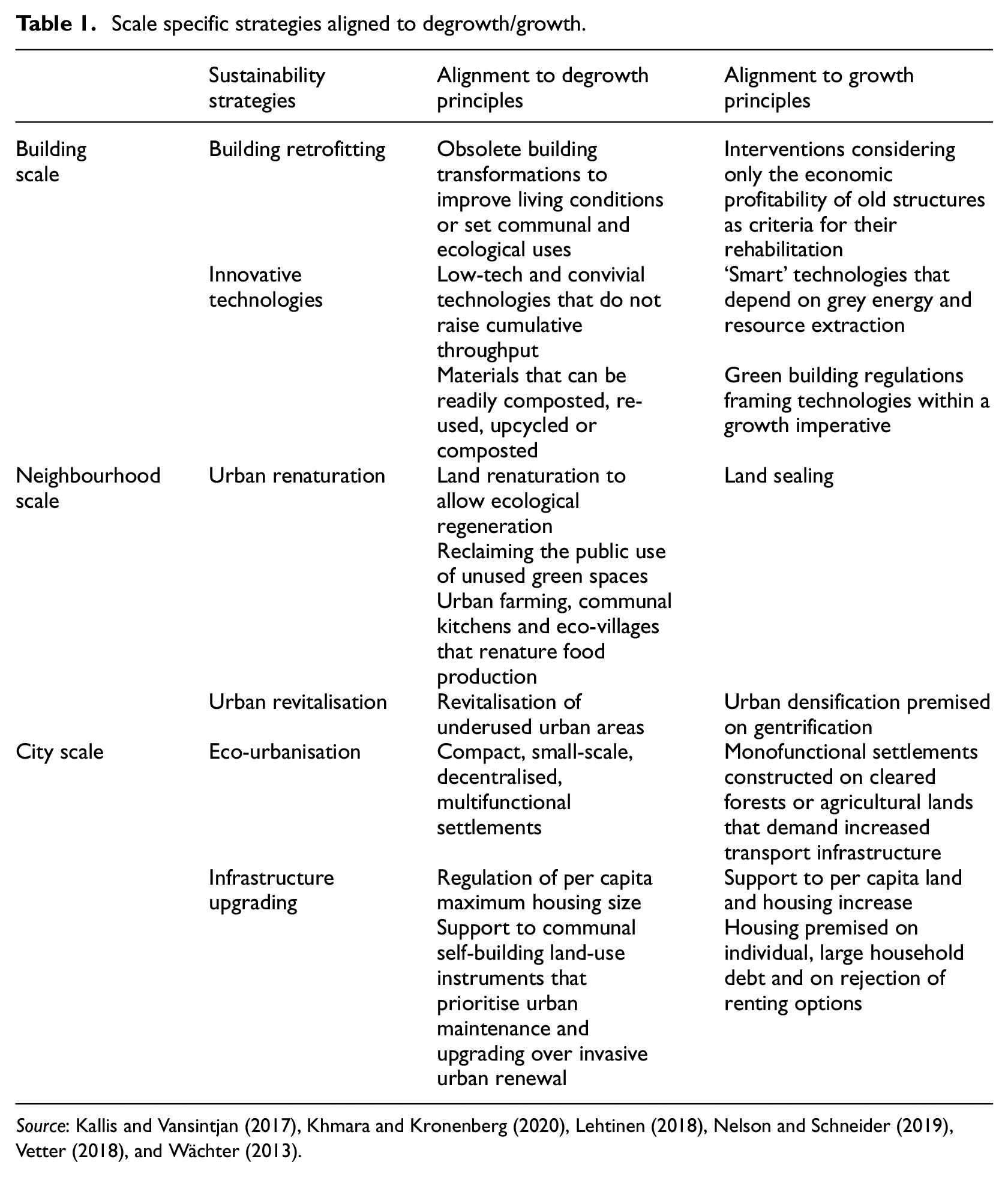
At the neighbourhood scale, degrowth scholars suggest that the reduction of the urban footprint could take place through the revitalisation of underused urban areas, their de-sealing and their renaturation (Nelson and Schneider, 2019: 14), as well as through urban farming practices (Khmara and Kronenberg, 2020). These strategies should not, however, be used as an accumulation strategy that promotes segregation (Anguelovski et al., 2018).
At the city scale, new urban settlements should avoid urban sprawl (Nelson and Schneider, 2019: 7) and only be considered if they are low impact, small-scale, decentralised, compact and multi-functional (Nelson and Schneider, 2019: 14; Wächter, 2013). Additionally, strategies promoting resource sufficiency include the promotion of the sharing of dwellings (Kallis and Vansintjan, 2017), the capping of housing sizes (Nelson and Schneider, 2019: 190), and the use of land-use planning instruments that prioritise the maintenance and upgrading of urban areas over invasive urban renewal schemes. Simultaneously, degrowth literature critiques growth-oriented policies that underpin dynamics of gentrification and land over-consumption (Lehtinen, 2018), as well as the commodification and financialization of housing (Nelson and Schneider, 2019: 59). In Table 1 we have codified a number of sustainability strategies across three different design scales (building, neighbourhood, city) with respect to whether they align to degrowth principles or not. This table is used as the foundation to assess the total of 252 spatial interventions for sustainability that were presented in the four international events described in the introduction.
252 sustainable spatial interventions and their alignment to degrowth principles
As noted in the introduction, we assessed the alignment of sustainable architecture, urban design and planning presented in four international events to degrowth principles. These events are the exhibition ‘Resource architecture’ presented at the 2012 Venice Architecture Biennale and in 2017 in Mendrisio (Italy); the multi-year research project ‘Ecological Urbanism’ carried out at the Harvard Graduate School of Design; the 2019 Oslo Architecture Triennale “Architecture of Degrowth; and the project ‘Ecology and Responsibility’ launched by the Association of German Architects in 2019. The first step was to assess the extent to which the entries presented sustainability strategies associated to spatial interventions. From the 422 entries, approximately one quarter (n = 106) did not have a clear association with sustainability principles, and a significant number (n = 64) provided theoretical insights on urban sustainability. The large majority (n = 252), however, presented practical examples of sustainable strategies that have been analysed below, as summarised in Figure 1. About two-thirds of all spatial strategies (n = 185) operated at the building scale; 42 dealt with neighbourhood strategies, and only 25 examples dealt with citywide scale strategies. The majority (125) of sustainable interventions referred to the refurbishment of existing buildings, and 59 to the use of innovative construction systems. At the scale of the neighbourhood, the sustainable strategies found in the sample were urban renaturation (n = 22) and revitalisation (n = 20). At the city scale, 17 examples were focused on infrastructure upgrading, while only nine addressed the development of eco-urbanisation patterns.
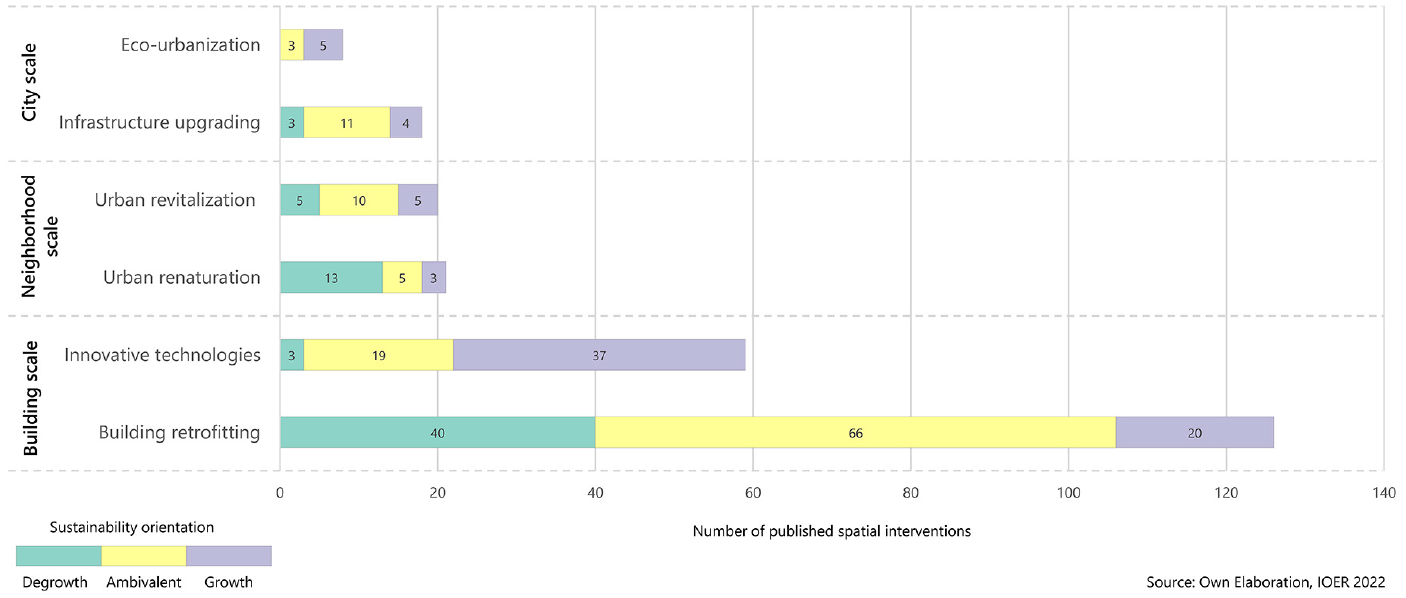
Orientation of sustainability strategies in 252 spatial interventions published in four catalogues of international exhibitions.
Figure 1 presents these results. In what follows, we shall assess each one of these categories with respect to degrowth principles.
Building retrofitting
Building refurbishment was shown through examples that either transform the interior partitions of different building typologies (n = 91), construct new building extensions (n = 22) or upgrade their façades (n = 12). In the case of single-family houses, building interior transformations (n = 28) were presented either through the repurposing of discarded building elements (Assemble, 2015), or through the re-styling of interior partitions within the original structural shell as a ‘house within a house’. For the latter, some projects attempted to retain all functioning building parts and changed only a small proportion of the interior partitions (De Vylder & Vinck Taillieu, 2011). Other projects merely kept the outer building envelope as a shell overlaying a new reinforced concrete structure for ceiling, wall and floor surfaces (Buchner + Bründler, 2008; Savioz Fabrizzi, 2005); this can only claim a marginal reduction in material throughput compared to the overall consumption of non-renewable materials required for the renovation. Examples of the sustainable transformation of large residential projects (n = 10) entailed either dismantling down to their structural elements (Stefan Forster, 2009), or their fitting with interior partitions and new elevators (Kämpfen für Architektur, 2011); since the project descriptions did not specify which proportion of the changes was carried out for strictly conservation or aesthetic reasons, these transformations cannot be easily assessed against degrowth principles and are thus consider ambivalent.
For commercial, educational and institutional building uses (n = 44), the examples of sustainable building interior transformations included examples aligned to degrowth that minimised material flows by subtracting superfluous furniture and partitions from pre-existing buildings (N’UNDO, 2008) or which shifted the internal layouts of buildings to optimise their lighting, energy conservation and function (Brenne Architekten, 2009). The supposed ‘simplicity’ of retrofitting measures and their rejection of ‘bigger is better’ principles can certainly not be confirmed in the case of refurbishments for high-end commercial buildings (OMA, 2009). Also, the conservational and aesthetic priorities of buildings’ redesign were in potential conflict in some cases where the preserved area of a building was marginal compared to the demolished or newly constructed area. Finally, the greatest misalignment with degrowth principles was found in projects demolishing and rebuilding entire buildings but keeping their façades (Herzog & de Meuron, 2008), as well as in landscape and underground transformations carried out in the name of preservation (Bjarke Ingels Group, 2013).
Regarding the second building refurbishing strategy identified in the sample, the construction of new building extensions, interventions showcased building rooftops featuring minimal layouts (Mayer and Heberle, 2012), and the expansion of indoor areas over outdoor covered porticos of institutional buildings (Schulz & Schulz, 2010). Since such extensions are premised on the preservation of buildings’ pre-existing footprint, they feature degrowth-aligned interventions.
Improving the energy performance of façades, the third sustainable strategy portrayed in building refurbishing interventions, included examples of doing ‘more with less’ with the affordable construction of a liveable buffer zone between former and new building envelopes (Lacaton & Vassal, 2011), as well as minimal window insulation and conservational façade repairs (KKLF, 2003). Interventions more ambivalently aligned to degrowth tried to harmonise the reuse of building materials and the use of new high-tech efficient materials and systems, as in the simultaneous retrofitting of façades to disrupt thermal bridges and thus prevent heat loss, and in the installation of rooftop solar modules and underground geothermal probes to generate power (Snøhetta, 2014).
In summary, one-third of all surveyed interventions clearly use minimal layouts that transform and upgrade buildings, which can be interpreted as s strategy aligned to degrowth. It should be noted that one-fifth of all building retrofitting examples displayed extreme typological adaptations of obsolete construction into new uses, as in the transformation of a gas station to an open-air cinema (Assemble, 2010), or of a pump station to a wilderness retreat (Cumulus Studio, 2014). While these transformations appeared to minimise the design (and thus the material input) required for the refurbishments, it should be considered that these extreme typological adaptations cannot be generalised as a degrowth-aligned strategy.
Innovative construction technologies
The surveyed literature identified three sustainable strategies carried at the level of construction systems. First, it showcased high-tech construction systems and materials (n = 29) using highly insulating materials and photovoltaic energy systems (HHS Planer + Architekten, 2015), green building certificate awards in the USA (Cook + Fox Architects, 2009), or industrially manufactured materials such as projected concrete (Elisa Valero, 2014). Particular to this group were hypothetical examples of bionic architecture, biomimicry and ecological urban techno-utopias (Behnisch Architekten, 2017), namely construction prototypes that integrate living organisms with technologically innovative materials. While these strategies aim at minimising resource consumption during the operational lifespan of buildings, their own construction relies on carbon intensive materials such as concrete or steel, and thus they are clearly not aligned with degrowth principles.
The second strategy portrayed 16 material upcycling examples using either industrial or low-tech approaches. Industrial processes of urban mining, presented in the remaking of building waste into flooring and structural elements for new housing (Cityförster, 2009), made an ambivalent case for degrowth since industrial upcycling processes themselves may consume considerable amounts of non-renewable resources or energy, and in so doing increase throughput. Low-tech upcycling, on the other hand, appeared in the dismounting, storing and re-installing of architectural elements such as doors, windows and beams in new buildings (Bauteilnetz, 2011; Rotor, 2021), or in projects that salvaged construction waste (Raumlabor, 2011). Such a low-tech approach to upcycling is clearly aligned with degrowth’s principles of frugal innovation and the reuse of functioning elements, yet it may have a merely incidental impact in throughput reduction when the aesthetic use of upcycling prevails, such as in the ornamental use of old bricks into a façade (Logon.design, 2011).
The use of compostable materials is a third identified sustainable strategy that takes place through either superficial vegetation elements (n = 12) or earthworks applied to the construction of walls (n = 2). The harmonisation of hybrid technological and natural materials was suggested through examples of hydroponic systems (Boeri Studio, 2014; Herzog & de Meuron, 2008) and solid wood integrated in building façades (Kengo Kuma & Associates, 2012). However, almost all entries ignored the high embodied energy of the technological systems needed to support and maintain large-scale vegetation in buildings, something that was particularly visible in conceptual renderings of green roofs in the urban skyline (Maison Edouard François, 2009). On the other hand, earthworks, that is reversible construction elements with low embodied energy, only did so as a façade and wall partition element (Boltshauser Architekten, 2008; Herzog & de Meuron, 2014) with no structural function. In conclusion, convivial technologies aligned to degrowth that focus on the salvaging of construction materials thus represent a minority (5%) of the sample of sustainability practices, while ambivalent strategies like industrial upcycling and the use of earthworks (15%), present ambivalent forms to degrowth.
Urban renaturation
In the study, examples of urban renaturation were shown through blue and green infrastructure projects. The latter includes the de-sealing of urban areas (Burkhardt, 2007), the qualitative upgrading of existing public parks (Hood Design Studio, 2010), as well as urban farming that reuses abandoned urban spaces using self-managed, participatory schemes (L’atelier d’architecture autogérée, 2001). The former includes the resurfacing of underground urban rivers as street or park elements (Ramboll Studio Dreiseitl, 2012). Despite the positive environmental impact of such projects in ecosystem service provision, some of them entailed either the demolition of pre-existing built areas, the construction of buildings, or the apparent drive to further urban development pressures (Heatherwick Studio, 2012). The potential use of such projects to foster green gentrification schemes limits their clear identification with the concept of degrowth and thus their orientation towards degrowth is ambivalent. In conclusion, while more than 60% of the examples present degrowth-aligned strategies of de-urbanisation, urban river resurfacing and nature-based solutions, the remaining examples require further analysis to understand whether they are premised on growth-based urban development.
Urban revitalisation
The sustainable urban upgrading of existing public spaces was portrayed through urban design interventions from the scale of the street to the district. At the smallest scale, interventions aligned with degrowth used minimal material inputs as in the withdrawal of parking permits and removal of garbage bins to improve public space (Lacaton & Vassal, 1996), or in the upgrading of informal areas by acupunctural public space and pedestrian interventions (Empresa de Desarrollo Urbano, 2004), which also had clear positive social and health implications. In contrast, examples of urban upgrading interventions misaligned with degrowth principles were constructed through individually prefabricated fittings (Stoss Landscape Urbanism, 2013) that required the copious use of non-renewable resources. In the context of impoverished areas, some cases displayed highly sophisticated public buildings with high maintenance costs or constructed in isolation from deprived urban contexts (SelgasCano, 2017), which can result in short living buildings and misrepresent the severe social and environmental challenges of populations living in informal areas.
At a larger scale, urban revitalisation aligned with degrowth’s bottom-up approach was realised through participatory practices to improve run-down central areas where existing buildings were retrofitted, public spaces underwent diversification (Chora Architecture & Urbanism, 2009), or green areas were preserved and repurposed (Bunschoten, 2016). Other practices of urban redensification were more ambivalently aligned to degrowth as they entailed large new housing developments (Peter Rose + Partners, 2010) that were not obviously aimed at relieving market pressures but rather at enhancing the financialisation of housing. In conclusion, acupunctural interventions aligned to degrowth that aspired to maximise their social input provided one-fourth of the sample; at the same time, 50% of them provided ambivalent cases where resource consumption and development pressures were unclear.
Infrastructure upgrading
While a number of theoretical contributions in the sample suggested citywide initiatives aligned to degrowth, like the adoption of voluntary simplicity (Krieger, 2016), and the critique of the financialisation of housing (Almaas, 2019), only a few examples (n = 17) applied interventions related to the implementation of smart-city technologies and of new mobility systems citywide. One exception to this took place in a citywide proposal to reconvert one-third of all municipal streets into renatured areas (BCN Ecologia, 2013), which has a transformative impact on land use planning and urban mobility and is clearly aligned with degrowth principles.
Examples of smart-city technologies include distributed digital systems that monitor and evaluate traffic, air quality/pollution, waste flows (SENSEable City Laboratory, 2009) and the energy consumption of buildings and urban infrastructure (Schroepfer, 2016). New mobility systems, on the other hand, appeared in the design for new tramways (West 8, 2015) and through e-mobility systems encompassing electric and autonomous cars as well as their physical network of tunnels and bridges (Rafael, 2010). While collective transportation is implicitly aligned with degrowth’s principle of stimulating collective urban uses, urban infrastructures reliant on digital infrastructure and their subsequent material hardware are liable to run counter to degrowth goals, given their unclear environmental impacts, and thus were considered ambivalent to the normative concept of degrowth. In summary, the large majority of examples (n = 11) were considered ambivalent regarding their alignment to growth, while only two were considered to support not only the principles of urban efficiency but also sufficiency.
Eco-urbanisation
The studied literature provided examples of new plans for small-scale urban areas called ‘eco-villages’ in European contexts, as well as for larger ‘eco-cities’ in the context of urbanising countries and regions such as Senegal, China, or the Saharan Desert – both emphasising their incorporation of urban green areas – and particularly urban farming. Even when the eco-villages in the sample addressed land co-ownership, timber frame passive housing, renewable energy production and local wildlife preservation (De Zwarte Hond & RMP, 2020), their visual appearance as residential suburban areas segregated from commercial cores (ZedFactory, 2007) did not clearly apply to the degrowth principle of compactness and multi-functionality. Other examples of mono-functional housing extensions surrounded by wind farms (MVRDV, 2011) were more clearly misaligned with degrowth’s principle of multi-functionality. Eco-cities, on the other hand, proposed complete urban systems that bring together urban agriculture with medium-density buildings (ARUP, 2010), and which included residential, working and open spaces as well as transport networks. Their emphasis on both technological innovations like photovoltaic energy, e-mobility and digitalisation, and on social innovations like collective property types makes eco-cities potentially aligned to degrowth. Yet in the absence of comprehensive information regarding the resource consumption of such vast and complex projects, the description of eco-cities is considered ambivalent to degrowth. In summary, there are no examples of eco-urbanisation that clearly align to degrowth, while half of them can at most can be considered ambivalent.
Conclusion
The analysis of 252 spatial interventions catalogued in four international events showcasing sustainable architecture planning and design demonstrate a limited association, from the part of sustainable architectural planning and design practices, to degrowth-aligned strategies at the neighbourhood, building and city levels. At the building level, such interventions mainly focus on reusing underutilised building spaces and repurposing salvaged building materials – which increase the reversibility of construction systems. At the neighbourhood scale, the renaturation of urban rivers and open spaces, and the de-urbanisation of non-functional urban areas are strategies aligned with degrowth principles if they are not used as a green gentrification strategy. At the citywide level, the implementation of public, collective mobility systems is also seen as oriented towards degrowth.
Our analysis however, indicates that the majority of interventions representative of dominant sustainable urban design and architecture cultures are either ambivalent to degrowth or support the ecomodernist hypothesis premised on technological growth. For example, 14 building-level interventions depict the use of natural elements such as vegetation, clay or wood as evidence of their sustainability, while ignoring the carbon-intensive technologies they use to enable the use and maintenance of these elements. Other examples combine degrowth-aligned spatial strategies with resource-intensive construction techniques, or with growth-based urban development dynamics.
Given the limited presence of degrowth-oriented examples in sustainable architectural and urban design culture, it is necessary to further articulate degrowth research with planning design and building practices and methods. It is a difficult task, and the efforts are only just beginning. But a better articulation of degrowth principles with building, design and planning practices would help make degrowth ‘tangible’ for spatial practitioners, and form a potential stepping-stone towards sustainable urban transformations.
Footnotes
Declaration of conflicting interests
The author(s) declared no potential conflicts of interest with respect to the research, authorship, and/or publication of this article.
Funding
The author(s) received no financial support for the research, authorship, and/or publication of this article.
