




Abstract
Cities play increasingly recognised roles in global climate change responses: as change laboratories, spaces of opportunity, and as administrative and economic hubs that concentrate human and financial resources and needs. They host high climate mitigation potential and acute climate adaptation vulnerabilities. Scholarship flags conventional urban planning approaches to limit global warming to 1.5°C as inadequate. Yet urban sustainability transitions literature features few examples of functioning alternative governance and planning paradigms. This paper assesses one such approach, new municipalism: social movements centred on a democratic transformation of the local economy and state. We combine attention to urban sustainability transitions and new municipalism research to interrogate whether and how the latter can facilitate the provision of leadership and institutional arrangements that enable urban transformation to sustainability. Our desk study considers two prominent examples of new municipalism in Spain, where Barcelona en Comú and Ahora Madrid arose as anti-austerity movements to combat neoliberal urban agendas during the 2010s. We find that the praxis of collective decision-making associated with new municipalism does offer inclusive, innovative policy pathways and the potential to implement experimental knowledge and learning in complex real-world settings at the urban scale. We argue, however, that powerful neoliberal mechanisms impose structural constraints on the very push for deep political change that new municipalist movements embody. By linking transformative climate governance needs with new municipalism movements and wider political economic structuring forces, we explicate the tensions and contested dynamics of institutionalising progressive social movements in the multi-scalar governance of urban sustainability transformation.
Introduction: New municipalism as an enabler of urban transformation?
Cities are increasingly recognised networked actors in global climate change response, hailed as key laboratories of change and spaces of opportunity. High urban population densities have implications for both climate vulnerabilities and mitigation potential, while as administrative and economic hubs cities attract diverse capacities – from engineers and bureaucrats to academics and policymakers. Many cities have pledged climate targets beyond regional or national government commitments. Yet as Hölscher et al. (2019) find in New York and Rotterdam, even cities that have long experimented with urban climate governance struggle to move beyond show-casing and experimentation. Pilots and regulatory sandboxes routinely remain disconnected from mainstream government processes and subordinate to business-as-usual planning and policy. While some scholars argue that experimentation is itself a form of governance (Voß and Simons, 2018), this alone seems insufficient to enact transformative urban shifts, if consigned to operating in parallel with the preponderous weight of mainstream public planning processes (Smeds and Acuto, 2018).
Piecemeal, ad hoc and divergent climate change initiatives ‘tinkering around the edges’ – that is how Moloney and Horne (2015: 2449) sum up their review of low-carbon urban transition efforts in Victoria, Australia. This is far from the transformative change necessary (IPCC, 2018; REN21, 2021). It does not address the development related root drivers of climate risk that Romero-Lankao et al. (2018) identify. Instead, transformation requires a ‘paradigm shift and the emergence of new management protocols and strategies’ (Solecki et al., 2018: 179), and a fundamental change of urban governance systems (Hölscher et al., 2019). Like Romero-Lankao et al. (2018) and Chaffin and Gunderson (2016), we interrogate how innovative leadership and institutional arrangements can create integrated, effective transformation to sustainability, by institutionalising new modes of urban governance. We also consider the tensions that such shifts give rise to, acknowledging that new modes of governance arising from progressive social movements like new municipalism do not necessarily go hand-in-glove with urban sustainability, but rather require work to align and synergise.
We focus on a governance approach that has rapidly gained prominence – new municipalism – in terms of its implications for urban transformation to sustainability, which have not been thoroughly scrutinised. ‘New municipalism’ refers to social movements premised on the democratic transformation of the local economy and state (Thompson, 2021), through radical changes in leadership and institutional arrangements. Such movements intersect with and build upon long-running scholarly and activistic engagement with urban institutions and networks, and with 19th- and 20th-century experiments with municipal socialism and anarchism. More recently, new municipalism overlaps with international municipalism, which pursues the common good by creating and nurturing municipal connections through strategic solidaric networks. New municipalism is gaining traction as a transformative, radical-democratic response to urban crises in the 21st century (Thompson, 2021). Social movements increasingly identify with prominent Spanish municipalism movements, Barcelona en Comú and Ahora Madrid; notably, the Fearless Cities Summit of 2017 in Barcelona brought together movements spanning six continents (Russell, 2019). These movements feature a post-neoliberal world order orientation, and reframe political elements such as citizenship, governance and the commons (Rubio-Pueyo, 2017), with an aim to structurally change incumbent modes of planning and implementation.
We examine to what extent this governance approach enables leadership and institutional arrangements for rapid urban transformation to sustainability. In doing so, we are cognisant that new municipalism is often regarded as a political project or an envisioned future being advanced by social movements and progressive local policy actors, but is not currently an established mode of governance in most contexts. Given the centrality of energy metabolisms and infrastructure to urban governance and economies (Hodson and Marvin, 2009), we mainframe ways in which new municipalists intervene in prevalent neoliberal trajectories through actual changes to urban infrastructure and practices, and analyse their potentialities and limits. Towards this, we pick two instances where strong overlaps between social movements and progressive local policy actors have led to a pronounced shift towards new municipalism. In Barcelona and to a lesser extent Madrid, one may reasonably expect to find some evidence of the synergies and tensions between the leadership and institutional arrangements spawned by new municipalism and the governance and infrastructural shifts ostensibly towards urban sustainability, given that both municipalities also aim to show climate leadership.
This interrogation is based on three main steps, after an overview of new municipalism. The following section reviews the urban transformation literature to identify three critical governance shifts for enabling urban sustainability, thus providing a heuristic that structures our analysis. Next, we introduce both cases with a focus on urban transformation in three key domains linked to requisite shifts: direct democratic governance, remunicipalisation of key infrastructure and services, and spatial planning and development. The subsequent section assesses the extent to which new municipalist governance enables urban transformation in these three domains, and analyses the tensions that arise. While our focus is at the urban scale, we recognise the interlinked nature of political interventions across levels of government (Rubio-Pueyo, 2017), and accord explicit attention to multi-scalar governance dynamics by approaching spatial scale as a nested category (Allen, 2012); that is, interventions and their implications cut across scales and have multi-scalar effects, thus requiring attention to more than urban governance to understand urban transitions. The conclusion reflects on whether and how new municipalism institutionalises the governance of urban transformation to sustainability. We identify potential but also structural limits to deep, rapid change.
New municipalism as a quantum shift in the nature of urban governance
We highlight key features of new municipalist governance: democratic decision-making, power-sharing arrangements and citizen involvement in urban development. Municipalism refers to ‘the democratic autonomy of municipalities over political and economic life’ (Gilbert, 2020: 69). The concept emerged with the formalisation of local authorities across Europe, as socialist and reformist groups experimented with local autonomy in the 19th century. The contemporary driving intent of localising control shows historical continuity, embodied as infrastructural legacies or residues of time, remnants of planning decisions (Hommels, 2005).
The economic recession of 2008–2015 and the continuing neoliberal response characterised by austerity measures have profoundly impacted fragile urban contexts. Public sector rollback has exacerbated existing patterns of wealth accumulation and disparity (Blanco et al., 2020). In response, grassroots activism has morphed into party politics in many cities, through political experiments of new municipalism (Janoschka and Mota, 2021). Scholars interpret the re-emergence of municipalist tendencies as a response to persistent austerity politics (Blanco et al., 2020; Janoschka and Mota, 2021; Thompson, 2021), and characterise these tendencies as participatory-communal governance (Bookchin, 1991; Gilbert, 2020). In addition to shifts in control over spending and procurement to local actors, new municipalism includes active local participation in decisions on the conditions of production (Thomas et al., 2018) and on urban infrastructure, to concretise citizen-centric commitment.
New municipalist movements aim to achieve strategic ends by harnessing the municipal scale, and to transform the state and capitalist social relations in expansive, contentious and proactive ways (Russell, 2019). They consider the how of politics on par with the what, as reflected in power structures and practices (Pisarello, in Barcelona en Comú, 2019). This marriage of form and content aims at participatory urban resource governance (Sharp, in Barcelona en Comú, 2019), prefiguring desirable social relations. Thus, rather than the harsher fervour of revolution that marks the rupture associated with anarchist approaches, new municipalism embodies a will to institutionalise democratic governance to enable transformation. This comes with its own tensions (Swyngedouw and Kaika, 2014), which merit even-handed attention.
New municipalism is a response to an urban-capitalist crisis (Thompson, 2021). Thompson (2021) offers a typology: autonomist municipalism realises democratic eco-socialist self-governance outside the state; managed municipalism retools the state from the inside through local economic regeneration; and platform municipalism works in, against and beyond the state to transform it. Platform municipalism troubles the categorisation of state and extra-state, changing the nature of statehood. It can alter the ontology of the state at an urban scale by transforming the relations that structure local conditions of production. Given its transformative potential, this form is our main concern. Given that unsustainable consumption and high urban metabolism with associated negative externalities are key aspects of the contemporary urban-capitalist crisis, we are especially interested in explicit efforts through new municipalism for urban sustainability.
How do such governance shifts match up to those prioritised by climate and energy social scientists in urban transformation scholarship? Our review of this literature helped identify three critical governance shifts to enable urban transformation to sustainability, presented below.
Governance shifts to enable urban transformation to sustainability
From urban transformation scholarship in the climate and energy domain, we identify three critical governance shifts. These are offered as a heuristic that encompasses three important complementary aspects of governance: inclusion, alignment and orientation. Inclusion refers to democratic, pluralistic approaches to decision-making; alignment refers to consistency in policy changes across levels of governance and scales of implementation; and orientation refers to low-carbon shifts both in decision-making mechanisms and infrastructural interventions away from incumbent fossil fuel practices and legacies. Given vast sustainability transformation and urban governance scholarship, this is not comprehensive or exhaustive, but aids analysis and enables useful insights on low-carbon urban governance shifts related to new municipalism. Inclusion is germane to both concerns as it is key to involvement in and ownership of any shift over time; alignment is vital for institutionalisation and impact as otherwise urban initiatives can be undermined through competing modalities and agendas at other levels of governance; and orientation is in line with our scope of analysis on shifts aimed at low-carbon cities, with a dual emphasis on processes (anti-incumbency) and impact (infrastructuring).
Inclusion: A shift to inclusive and innovative decision-making and policy development
Climate governance scholars call for more inclusive, innovative decision-making. They deem conventional urban planning approaches inadequate to deal with large-scale transformation for low-carbon transitions (Solecki et al., 2018). Technological change outpacing the ability of governance structures to respond is a key challenge. Docherty et al. (2018) argue that a failure to address such governance issues could lock society into paths that worsen social and environmental problems. This implies a need to address the persistent dominance of a technological lens in urban planning and transitions discourse at the expense of attention to socio-political relations (Lawhon and Murphy, 2012). This mode of planning tends to exclude dissent and marginalised stakeholders such as women, the poor, indigenous communities and minorities from decision-making. Here ‘there is a pressing need to engage with the diversity of everyday life’, and to include multiple forms of knowledge for fair, effective climate action (Romero-Lankao et al., 2018: 755).
The networks and relationships of decision-makers tend to reproduce existing policy trajectories (Haarstad et al., 2018). Given the recognition of unequal and unsustainable development as root drivers of climate risk (Romero-Lankao et al., 2018), reproducing existing policy trajectories is highly undesirable. Therefore, modalities of inclusion in decision-making require attention. However, a clear tension exists between top-down law-enforcement and the need for experimental, flexible and open-ended governance processes (Hölscher et al., 2019; Kivimaa and Rogge, 2022). Scholars find inclusive and experimental governance approaches subordinate to business-as-usual interests and policy and planning approaches, even in cities hailed as global leaders in climate action (Bulkeley et al., 2014; Hölscher et al., 2019). Thus, we approach the relationship between participatory decision-making and urban sustainability outcomes as ambiguous, and subject it to critical scrutiny on whether it engenders pluralism (and its attendant co-benefits, see Ross et al., 2021) in advancing urban change agendas in practice. Kythreotis et al. (2019) refer to such an ideal-type as ‘citizen social science’; our analysis is directed at its messier praxis.
Alignment: A shift to aligned policy and legislation and multi-scalar coherence
Another important trend in urban transitions scholarship concerns policy and legislative alignment and coherence across scales. Synthesising insights on urban climate governance, van der Heijden et al. (2019) note how decision-making takes place in diverse sectors, whereas governance across sectors is fragmented and lacks coordination. For instance, Patterson and Huitema (2019) examine water governance in Santiago, Chile, and identify a need to enhance institutional connectivity. Romero-Lankao et al. (2018) argue that narrowly cordoned sector-based responses constrain climate action. There is increasing recognition that engaging stakeholders through cross-sectoral coordination across scales is essential for the just allocation of burdens and benefits associated with climate response (Boyd and Juhola, 2015; Silva and Sareen, 2021).
Scholars identify worrying disconnects and constraints both within and between departmental levels (Howes et al., 2015) and lacking coordination in climate action across scales (Romero-Lankao et al., 2018), which implies challenges for decentralised and hybrid climate governance approaches to gain traction with systemic effects (Hölscher et al., 2019). A shift from localised, disjointed climate actions to coherent, joined-up responses across vertical (administrative-hierarchical) and horizontal (spatial) scales is seen as essential for systemic changes to address climate change (Moloney and Horne, 2015). This entails aligning priorities and legislation across governance levels. Prima facie, this seems at odds with increased local autonomy associated with new municipalism, yet urban initiatives struggle to bring about durable change without corresponding priority shifts at higher governance levels (Janoschka and Mota, 2021). Thus, to succeed over time, emerging urban shifts need to inform national priorities and establish backing at higher governance levels.
Orientation: A shift in underlying processes and mechanisms away from incumbency and infrastructural legacies
A third focus in thematic scholarship concerns the direction of infrastructural change away from the interests of powerful incumbent actors and towards broadly inclusive low-carbon urban futures. Cities are characterised by complex and dynamic realities; thus, the argument that cities can steer transformative climate action is confronted by the fact that they often lack real power (Díaz-Pont, 2021) and adequate local capacity (Anguelovski and Carmin, 2011). As Harvey (1989) presaged upon analysing changes in urban governance during rapid liberalisation three decades ago, private actors mobilise international financial capital and interpellate negotiations with local powers. Flyvbjerg (2002) famously illustrated how power dominates rationality in shaping and implementing urban agendas in Aalborg, Denmark. Van der Heijden (2019) characterises such private actor involvement as fragmentation of urban decision-making (also see Ysa, 2007). This is reflected in infrastructural legacies that undergird high-carbon systems, urban metabolisms and practices, whose material continuities sporadic action cannot overcome, and which require alternative pathways and new logics of provision to disassemble (Guy et al., 2001).
Transformative action is in part constrained by investment, planning and construction decisions (Romero-Lankao et al., 2018), spaces and processes dominated by short-term economic interests and investment (Hölscher et al., 2019). Planning and implementing urban infrastructure and form thus require transformation (Moloney and Horne, 2015), and challenges to mainstream urban development political rationalities (Bulkeley, 2006). To be transformative, climate governance requires the integration of long-term goals, pathways and knowledge into existing incentive structures and regulations (Hölscher et al., 2019). This integration must be translated into infrastructural change to move towards low-carbon systems, a step that requires governance shifts to engage closely with – and steer – technological reconfiguration (Bulkeley et al., 2014; Monstadt, 2009). Avoiding the co-option of new decisions that can perpetuate selective vulnerability and high-carbon lifestyles requires a firm understanding of (and efforts to mitigate) their political economic roots and path dependencies (Barry, 2012; Turnheim and Geels, 2012). Thus, we attend to shifts away from incumbency with close attention to the concrete infrastructural implications of evolving governance mechanisms.
Case studies and methods: Barcelona en Comú and Ahora Madrid
To examine whether and how new municipalism enables these shifts in leadership and institutional arrangements for rapid urban transformation to sustainability, we interrogate two prominent new municipalist movements, Barcelona en Comú and Ahora Madrid based on secondary research. Methods included detailed reading of peer-reviewed literature on the themes and cases (which we cite wherever relevant throughout the manuscript), and extensive online searches through grey literature including projects and plans in both cities that featured a key sustainability component and/or a direct relation to any of the three governance shifts above. With a view to foregrounding tensions and synergies between progressive social movement characteristics and governance needs for an urban transition to sustainability, we focus on three domains that illustrate practices and plans introduced in local government in the three sub-sections that follow. Both Barcelona en Comú and Ahora Madrid rose to prominence during the 2010s in Spain’s largest cities. Their relatively well-developed status, existing studies of their evolution, and their prominence as examples of new municipalist governance render them of topical interest. These cases are described below, then analysed and discussed in terms of the three heuristic governance shifts.
Both Barcelona and Madrid were hit hard by the 2008 financial crisis, Madrid exceptionally so. Its conservative Partido Popular party – the long-standing political leader throughout the wider region – created a powerful austerity regime where fiscal squeezing combined with speculation produced Spain’s greatest municipal debt (Davies and Blanco, 2017). The constitutional reform of 2011 set a clear national direction that prioritised public debt servicing over all other public administration budgeting. By 2013, Spain’s burgeoning €41 billion loan led to a tightened national Budgetary Stability Law, constraining municipal use of public debt or deficit financing to compensate for decreasing revenues (Davies and Blanco, 2017).
Alongside a sharp rise in inequality and unemployment nationwide, foreclosure risk in Barcelona nearly tripled during 2008–2015 (Blanco et al., 2020). Homelessness increased in both cities, and intensified austerity policies in 2011 led to social unrest across Spain (Blanco et al., 2020). The Plataforma de Afectados por la Hipoteca (PAH), a housing campaign against evictions and foreclosure, gained prominence alongside and as part of the 15M movement that emerged from the public square protests of 15 May 2011 (Davies and Blanco, 2017). These social protests and movements constituted the conditions for emergent political forces: Barcelona en Comú and Ahora Madrid (Rubio-Pueyo, 2017). Both movements led city government coalitions after successful local elections in 2015.
The electoral translation of these movements into durable urban groupings has unfolded steadily, coalescing around the need to rethink political leadership (Rubio-Pueyo, 2017). With a focus on local livelihoods, and the locally grounded motto ‘democracy begins where you live’, they are political forces to be reckoned with (Rubio-Pueyo, 2017). Barcelona en Comú continued after 2019 local elections, while Ahora Madrid was dissolved as internal disagreements birthed a new yet similar movement, Mas Madrid, in late 2018 (Mayne and Nicolini, 2020). The new party, with lines of continuity in terms of new municipalist principles, fared well in the 2019 local elections. But it fell short of council majority and yielded to a centre-right coalition led by the conservative Partido Popular (Mayne and Nicolini, 2020).
Next, we present examples from three key domains in which these movements intervened, with potential to enable the governance shifts identified as critical for urban transformation. Figure 1 depicts major financial, social and regulatory developments, and key events related to the overview in the three sub-sections below.
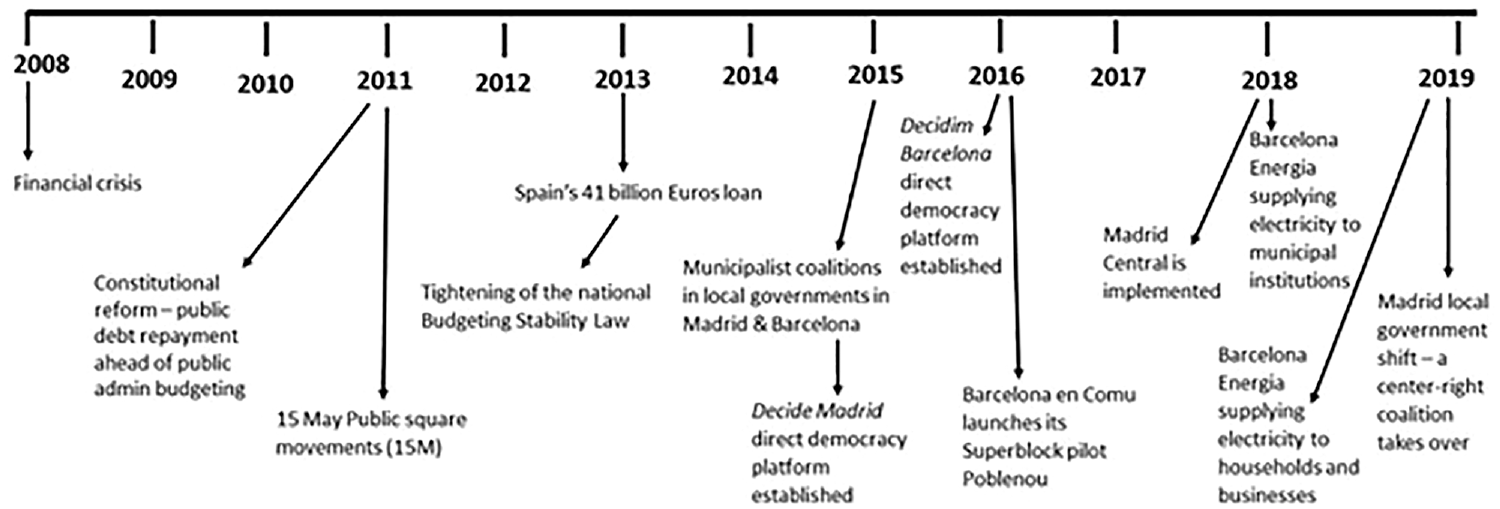
Timeline of key events relating to the case examples and to financial, social and regulatory changes since the 2008 financial crisis.
Open-source digital platforms for direct democracy
Open-source digital platforms are an innovation for citizen engagement and participation applied by both Ahora Madrid and Barcelona en Comú. These relate directly to concerns of inclusion and self-determination in reorienting urban development trajectories; they also raise questions of alignment if citizen priorities veer significantly away from national policy priorities, with adequate budgetary weighting for new norms to emerge at municipal scales and lead to tensions with agendas at higher governance levels. The direct democracy platform Decide Madrid was launched in 2015, followed by Decidim Barcelona in 2016 (Smith and Martín, 2021). Both platforms enable anyone to comment and participate in debates. However, creating proposals and voting requires verified local residence, with a minimum age of 16 in Madrid (Royo et al., 2020) and 14 in Barcelona (see Decidim Barcelona, 2021).
On Decidim Barcelona, key participation activities include participatory budgeting and inputs to development plans. In participatory budgeting, residents can view and vote on projects and associated budgets by district, including developments like play areas and parks, bike lanes, better signage and pedestrian crossings. Ongoing participatory processes include a climate change plan and a gender justice plan. Here citizens can engage to validate strategic frameworks, and propose and prioritise actions through online engagement.
On Decide Madrid, proposals from residents that secure 1% support are voted upon in the city council (Royo et al., 2020). One such proposal, ‘Madrid 100% sustainable’, was approved in 2017, and has been hailed by the city as having catalysed adoption of many environmental measures (see City of Madrid, 2021).
Participatory budgeting was a key feature on Decide Madrid, with residents deciding 2% of the city budget, approximately €100 million (Mayne and Nicolini, 2020). However, the new minority centre-right government discontinued participatory budgeting in 2019 (Mayne and Nicolini, 2020). While Decide Madrid still functions and citizens can submit and debate proposals, the platform has weakened without budgetary weight. Moreover, inputs on new regulations routinely take place through digital debate on pre-defined questions, a modality that reduces the scope of possibilities.
Remunicipalising energy services in Barcelona
Part of Barcelona en Comú ’s emancipatory urban agenda is remunicipalising electricity. This connects directly to concerns of inclusive infrastructural change, in line with recognised ownership models but with a more democratic structure to increase public benefit. A metropolitan public electricity company, Barcelona Energia, was established to control the means of production, creating an alternative to private utilities (Angel, 2021). This has built urban capacity for renewable energy production. Barcelona Energia produces 100% renewable energy locally; in 2019, it extended supply beyond city council facilities to citizens and companies (see Barcelona Energia, 2021). Its current capacity can serve about 20,000 households (March et al., 2019).
However, remunicipalisation has proved challenging. The energy producer has not taken on the management and ownership structures as intended. Contrary to initial intentions, Barcelona Energia workers and users are not on the governing board, and residents are not co-owners, which points to challenges of institutionalisation. Furthermore, expanding public ownership beyond generation has been difficult to navigate; transmission, distribution and retailing remain with private utilities (Angel, 2021). Thus, incumbency in ownership of and control over tightly connected infrastructure poses intractable limits to the advance of a publicly-owned and -led low-carbon orientation.
Transformative spatial plans
Both Madrid and Barcelona have introduced transformative spatial plans with a joint climate adaptation and mitigation focus: the Barcelona Superblocks in Barcelona, and the Plan A in Madrid, which features the Low Emission Zone (LEZ) of Madrid Central. These embody low-carbon changes in practices to reconstitute urban metabolisms, making urban space less consumptive and more inclusive to a wider set of publics.
Plan A tackles local air pollution challenges, with measures such as lowering speed limits and introducing an electric bus route. The Madrid Central component of Plan A was implemented in November 2018 as a flagship policy measure of Ahora Madrid, with climate mitigation co-benefits. It comprises five square kilometres in Madrid’s historic centre, restricting access by private cars based on pollution levels, and features shared mobility solutions with bikes and electric cars, mopeds and kick scooters (Tarriño-Ortiz et al., 2021). In 2019, the centre-right coalition that took over local government attempted to repeal the fining of motorists who broke the rule, but encountered opposition from Madrilenos and the local court. The future of Madrid Central is uncertain, as the Madrid regional high court found that the LEZ law had been approved without a public disclosure process and economic impact report (Mayne and Nicolini, 2020), an instance of limited policy and legislative alignment due to the lack of joined-up institutional mechanisms and the politicisation of transport policy.
The Barcelona Superblocks build on earlier urban spatial plans, including Plan Cerda of the 19th century, Plan Macia of 1932, and recent local plans (López et al., 2020). Barcelona envisions over 500 superblocks as a fundamental city-wide design (López et al., 2020). These are 400 m2 polygonal grids of basic roads, where motorised vehicles navigate the exterior and are largely prohibited within the superblock. This creates micro-neighbourhoods and an efficient layout for an orthogonal bus system (López et al., 2020). Important features include redesigned private and public space centred on public participation (López et al., 2020). Barcelona en Comú ’s first superblock pilot was launched in 2016 (Zografos et al., 2020). Its role in reducing transport emissions and the urban heat island effect make it a centrepiece of Barcelona’s Climate Action Plan and Climate Commitment initiative (Zografos et al., 2020). Predictably, implementation has encountered opposition and controversy linked to political struggles for local authority (Zografos et al., 2020) and – ironically – for claiming credit (López et al., 2020).
Assessing new municipalism and governance shifts in urban transformation cases
We now analyse the key domains using the three governance shifts, in three corresponding sub-sections below themed on inclusion, alignment, and orientation (with an infrastructural emphasis). We consider whether new municipalism can (i) shift to inclusive and innovative decision-making and policy development, (ii) shift to aligned policy and legislation with multi-scalar coherence and (iii) shift underlying processes and mechanisms away from incumbent governance with concrete implications for low-carbon infrastructure, as a form of socio-technical regime destabilisation (Turnheim and Geels, 2012) to institute transformative forms of urban governance.
Inclusion: Can municipalism enable inclusive and innovative decision-making and policy development?
The Guide to the Global Municipalist Movement (Barcelona en Comú, 2019) outlines how new municipalism envisages bringing the strength of the people into play as a core component of politics. The strength of the people refers to the transformation of public institutions for collective self-governance (Russell, 2019). Inclusivity is thus at the core of new municipalist thinking: as creating a more inclusive city (Janoschka and Mota, 2021), enabling social inclusion (Blanco et al., 2020), and producing inclusive local economies – fostered using inclusive decision-making and participation as key tools (Sharp in Barcelona en Comú, 2019).
Take the examples of Decide Madrid and Decidim Barcelona. The digital platforms’ roots in technopolitical thought recognise that there are no ‘neutral’ technological tools; developers are explicitly aware that platform application must be informed by and incorporate critical interrogation of control, participation, democracy and representation before and during implementation (Smith and Martín, 2021).
The platforms provide innovative participation forums; both are open for comment and debate. Proof of city residence and an age limit are applicable to submit proposals and vote. However, engagement with these online platforms does not emerge in a vacuum. Real-life activities are important precursors and motivate Madrid citizens to engage (Smith and Martín, 2021). Lack of involvement ‘on the ground’ through social networks, or a lack of online literacy, are potential barriers to participation that may remain hidden in such participatory ‘fixes’.
An important feature is that discussions and deliberation can evolve. As Aragón et al. (2017) note, Decidim Barcelona provides a hybrid interface to discuss and deliberate openly, while enabling decision-makers to distinguish between positive and negative comments through categorisation. Bravo et al. (2019) find that genuine citizen deliberation can occur on Decidim Barcelona, but argue that a lack of reflexivity and civility as well as repetition in comments adversely impact the quality of deliberation.
Decidim Barcelona thus provides a citizen engagement policy forum. It enables participation in policy-making; citizens can propose and prioritise actions. These platform activities intertwine with diverse cognate real-life activities and debates (see Decidim Barcelona, 2021). The preliminary experience with Decidim Barcelona thus indicates a relatively successful move towards opening up policy-making to diverse actors through hybrid modes, constituting an unconventional, open-ended and inclusive approach to planning.
The continuation of Decide Madrid after 2019 indicates its institutionalisation (Royo et al., 2020). However, platform activity has shifted, with the disbandment of participatory budgeting (Mayne and Nicolini, 2020), and a move towards consultative engagement, with pre-defined questions (see City of Madrid, 2021). Such engagement is not without merit, as research indicates that Ahora Madrid’s time in office and platform use have facilitated a progressive shift for civil servants and politicians to be more favourably disposed to direct citizen participation (Royo et al., 2020). Thus, the movement has made some progress on shifting norms, routines and habits of policy-making, even as its effectiveness has been reduced by losing control over direct resource allocation.
Residents of Barcelona – and to a lesser extent in Madrid – can directly influence some budget allocations, policy frameworks and actions, and table issues for deliberation by local government. Thus, new municipalism offers a real alternative for inclusive and innovative local decision-making and policy development. New municipalists indeed challenge the notion of ‘the expert’ as someone with a university degree or someone who holds public office, instead centring local residents and recognising their local knowledge as expert knowledge (Perez, in Barcelona en Comú, 2019). In complex sustainability transitions, including perspectives from a diversity of lived experience opens the door to context-specific insights and transformative pathways, and lessens the chance of policy blind spots and unintended consequences. These insights and pathways need not necessarily be more sustainable in and of themselves, yet they do provide a more evidenced and inclusive basis for decision-making, and if the collectively-mandated orientation of such processes is to low-carbon futures, then advancing urban sustainability is likely.
However, such collective decision-making and policy development alternatives must grapple with embedment in administrative, managerial and legislative state apparatuses, and act on infrastructural legacies that often support high-carbon practices. In both Barcelona and Madrid, new municipalism thus encounters the challenge of bureaucratic red tape and embodied attitudes and protocols of actors well-versed with ‘traditional’ structures and processes. There is some alignment across scales, but the removal of public control over factional municipal resource allocation in Madrid signals difficulty in institutionalising inclusion within formal governance mechanisms. We return to this element of path dependence and inertia in the third sub-section on incumbency and infrastructural legacies.
Alignment: Can municipalism align policy and legislation with multi-scalar coherence?
As Larson and Ribot (2004) have established, national and regional levels exercise substantial top-down influence on local government policy. In Spanish cities, European Union (EU) membership has further top-down implications, while bottom-up influence is less evident.
On electricity remunicipalisation in Barcelona, we argue that a transformative urban agenda towards broader ownership and control in the public interest is restricted by misalignment with top-down policy. This is evident in the barriers to Barcelona Energia. Spain is subject to EU energy liberalisation directives, including electricity sector unbundling. This entails separating electricity into generation, transmission, distribution and retailing (Angel, 2021). Remunicipalisation thus requires engaging with and taking ownership of four separate sectoral segments. While Barcelona Energia has entered generation and retail, it holds no stake in the Barcelona distribution network, a segment whose material infrastructure remains privately controlled, and which is considered ‘almost impossible’ to enter by an energy advisor to Barcelona en Comú (Angel, 2021: 537).
Top-down policy challenges to remunicipalisation extend beyond unbundling. They include EU and Spanish competition law. The former prevents the city council from directly supporting Barcelona Energia, as this would be deemed illegal market interference. The latter creates a stumbling block for photovoltaic panels on municipal rooftops, which need to follow formal tendering processes, where Barcelona Energia is hard put to compete with larger, established companies that have superior access to financial capital and economies of scale (Angel, 2021). Thus, alignment also concerns financial mechanisms and ways of valuing roles of diverse actors in a changing sector across scales, with laws, policies and finance framed at supra-urban governance levels.
National austerity measures, imposed to curtail municipal expenditure, posed further constraints. While the imposed prioritisation of municipal debt repayment limited staff recruitment (Blanco et al., 2020), austerity measures under the 2012 EU bailout of Spanish banks imposed a national moratorium on new municipal enterprises (Angel, 2021). This meant that Barcelona Energia had to be established as part of an existing waste management company, Tersa. Setting up an energy company within an existing company’s management history and institutional culture complicated the implementation of an ‘uncustomary’ approach with user- and worker-centred management and ownership (Angel, 2021).
Thus, diverse top-down policies rendered urban scale remunicipalisation difficult. The Barcelona case illustrates barriers to urban transformation due to misalignment between progressive local governance approaches and higher governance levels. It highlights how a complex policy and legislative assemblage makes major changes to the nature and form of management of urban metabolisms difficult to mobilise and align across scales and governance levels.
Governance structures at the urban scale typically aim to secure that decisions stem from political majorities, negotiations and political coalitions, with extra-political influence by interest groups. Despite strong city council representation, Barcelona en Comú’s influence to transform local policy is kept in check (Blanco et al., 2020). Despite holding 6 out of 10 districts and its candidate becoming the mayor in 2015, its attempts to transform urban governance and the energy sector were frustrated by a complex multi-scalar policy and legislative assemblage. We therefore argue that creating vertical policy alignment and coherence from below, without representation across levels of government, is extremely challenging. A bottom-up induced shift in such policy, in this case largely EU directives, remains an elusive vision without broad political support across Spain and other EU countries or cities through translocal networks of urban governance.
Thus, the city-based focus of new municipalism presents a challenge for alignment. Without supportive external impetus for centralised state bureaucracies to evolve – which new municipalism aims to catalyse – the movement’s focus on urban transformation is stymied by entrenched protocols that lean in favour of higher scales. An organic pathway to transformation requires a range of such movements to branch out into regional and national politics; yet without critical mass this may dilute their core of local agency. Over time, as new municipalism reshapes local structures, it may well open up scope for horizontal influence by clarifying the institutional attribution of responsibility, to create pathways for impact through engaged democratic practice.
Orientation: Can municipalism move underlying processes and mechanisms away from incumbency and infrastructural legacies?
The transformative spatial plans – Barcelona Superblocks and Madrid Central (as part of Plan A) – enable us to consider the extent to which new municipalist movements have shifted the underlying processes and mechanisms away from the status quo and infrastructural legacies. Both plans attempt to change urban visions and narratives, as well as infrastructural legacies and the metabolisms they engender, away from influential incumbent interests in aspects like automobility. We deduce that this orientation is in large part the cause for vocal opposition to their implementation. In Barcelona, the new municipalist version of the superblock widened its focus to a triple bottom-line approach cognisant of economic, social and environmental issues (López et al., 2020). Those in favour of the narrowly economically oriented version introduced by the municipalist mayor’s predecessor regard a broader and more holistic focus as an existential threat (Zografos et al., 2020). The former mayor represented the business-friendly centre-right party Convergència i Unió (CiU), and introduced superblocks as a business-friendly mobility intervention within a smart city model to attract high-end residents and developers (Zografos et al., 2020). The new municipalist leadership subverted this inequitable orientation towards gentrification, reconstituting superblocks as generating broad public benefits. Despite these opposing visions, the essential importance of superblocks is recognised across the different political factions, with more recent divides in city government notably related to which political party receives credit for this highly popular intervention (López et al., 2020). Thus, the infrastructural change embodied in this intervention has engendered socio-political contestation and reorientation.
The Madrid Central LEZ component of Plan A became a political hot potato. The centre-right coalition government that replaced the new municipalist coalition in 2019 tried to stop fining motorists who contravened the LEZ implemented by its predecessor (Mayne and Nicolini, 2020), then launched their own new mobility plan, ‘Madrid 360’. While this changed some operational and functional aspects, it maintained key elements of Madrid Central, firming up the new orientation despite political upheaval. Tarriño-Ortiz et al. (2021) find a strong relationship between political ideology and the public acceptance of Madrid Central, with acceptance potentially relating more to political alignment than to objective judgement. Thus, while the details may vary with political modulation over time, the underlying vision of change in urban design and purpose is gradually becoming entrenched in a low-carbon direction.
Analysis of both transformative spatial plans elucidates how resistance to progressive change is anchored in both a practical difference – a bias in favour of business and economic elites – and ideological differences observable through political affiliation. However, neither Madrid Central nor the superblocks were completely out of step with the opposition; in fact, the opposition claimed some form of credit in both cases and even called for alignment with new municipalist plans. This supports Blanco et al.’s (2020) argument about Barcelona en Comú ’s first two years of government – that rather than creating a radical rupture, it is gradually birthing a new political agenda that constitutes a reorientation of politics towards low-carbon urban infrastructure and mechanisms to support this shift. The broad public legitimacy of such a shift is undergirded by the infrastructural property of low-carbon interventions in the mobility sector as yielding clear public benefits.
Impacted by austerity politics, public discourse in Spain is cognisant of state capture and hollowing out by neoliberal forces (Hölscher et al., 2019). For neoliberalism – a socio-political process centred on market-based solutions, intense commodification and profit-making (Martí-Costa and Tomàs, 2017) – cities constitute an important battleground (Blanco et al., 2020) as they spatially concentrate and accelerate resource metabolisms. We find that Barcelona en Comú and Ahora Madrid show a strong intent backed by practical efforts to push back against this status quo through the city machinery, shifts in public services, citizen engagement and spatial plans. These challenges to incumbency and entrenched forces, incorporated within the assemblage of urban governance, show potential to endure across party lines to enable reorientation towards low-carbon urban transformation.
Conclusion: New municipalism and low-carbon urban transformation
Through three case studies across two cities and our tripartite heuristic of inclusion, alignment and orientation, we have systematically interrogated the extent to which new municipalism can provide a means of leadership and participatory institutional arrangements for governance shifts crucial to low-carbon urban transformation. We find that new municipalism offers a governance structure based in participatory praxis, and constitutes a real alternative for inclusion and innovation through citizen-led decision-making and policy development, with the potential to translate experimental knowledge and learning into decision-making, policy impact and changes in urban infrastructure and metabolisms.
Yet, as Janoschka and Mota (2021) caution, inclusive neighbourhood-oriented decision-making does not in itself constitute a model of urban governance that fundamentally challenges the drivers of neoliberal governance. Questions of scale and boundaries merit close attention. New municipalism encounters limits in relation to policy and legislative alignment and coherence across vertical and horizontal scales, and struggles to move underlying mechanisms and processes away from incumbency even as it advances low-carbon urban infrastructure. Like Janoschka and Mota (2021), our analysis indicates that emergent local pushes for deep political change during 2015–2020, including the remunicipalisation of services and more just urban development, were frustrated by the multi-scalar nature of governance, and by the pervasive influence of powerful neoliberal mechanisms (also see Swyngedouw and Kaika, 2014).
This speaks to the argument by Ostrom (2012) on the need for a polycentric approach, where policy efforts are made through the many elements of a system at and across multiple scales, recognising and harnessing overlapping domains of authority. Ostrom (2012) argued against major reliance on centrally steered global climate change efforts through the Conference of the Parties and the Paris Agreement, and for an explicitly polycentric approach. We level a congruent argument from the opposite end, pointing out that while local government can and must play a central role to promote and enable urban transformation, fundamental change requires coordinated thrusts and support across the governance assemblage at multiple scales. There is emerging recognition of this fact in urban transformation scholarship on the scaling, embedding and institutionalisation of change (Bouzarovski and Haarstad, 2019; Kivimaa and Rogge, 2022). Along with the strong emphasis on urban agency and leadership in this research stream (see, e.g. Smeds and Acuto, 2018), we highlight the importance of an accompanying push for greater multi-level coordination across scales of action. Here, our heuristic categories of inclusion, alignment and orientation have shown promise as a means to unpack the tensions and dynamics of governance shifts.
To enable urban transformations, new municipalists offer both a how – an inclusive, participatory and experimental approach to governance – and a what – a firm push against fundamental neoliberal drivers that dictate governance through market logics for profit-driven politics. Upon constituting local government, however, they have limited power to change management and policy, beset by entrenched institutional structures, infrastructures and urban metabolisms that prove intractable without central support (Guy et al., 2001). The potentiality of new municipalist approaches to stabilise citizen-centric governance in place of local ruptures must be complemented by an effort by multiple such groupings to destabilise central regimes (Turnheim and Geels, 2012) towards the embodiment of similar collective decision-making mechanisms. We view institutionalisation as the current main challenge for new municipalism to grow beyond local pockets and let a thousand flowers bloom, gathering critical mass for national and global effect. Further, we call for a concerted effort to ensure federal support to decentralised initiatives. Federal support is often steered from the national level, which can unduly limit situated action for urban transformation; this remains a vital piece of governance puzzles to unlock and institutionalise virtuous aspects of new municipalism.
In closing, our study did not discern a strong push within new municipalist agendas in practice to enable climate and energy related urban transformations. Examples such as the car-free superblocks of Barcelona and the LEZ of Madrid, as well as the remunicipalisation of urban electricity to increase flows of public benefit in Barcelona, are nonetheless emergent and hold promise. Thus, while the critical governance shifts identified in urban transformation scholarship have proved generative to extend our understanding of new municipalism, a pressing concern for future research at the intersection of progressive governance shifts and energy transitions is to consider how the promise of new municipalism can be harnessed for the time-bound, ambitious contributions cities must make to low-carbon transformation.
Footnotes
Acknowledgements
The authors are grateful to new municipalism seminar series participants, Sveinung Legard, special issue editors Matthew Thompson, Bertie Russell and Laura Roth, and anonymous reviewers for perceptive and useful feedback; and to JPI Climate and the Research Council of Norway for funding the ROLES project that enabled it.
Declaration of conflicting interests
The author(s) declared no potential conflicts of interest with respect to the research, authorship, and/or publication of this article.
Funding
The author(s) disclosed receipt of the following financial support for the research, authorship, and/or publication of this article: JPI Climate, ROLES (Responsive Organising for Low Emission Societies) project, and the Research Council of Norway, grant 321421 (ROLES).
