




Abstract
Studies of neighbourhood effects increasingly research the neighbourhood histories of individuals. It is difficult to compare the outcomes of these studies as they all use different datasets, conceptualisations and operationalisations of neighbourhood characteristics and outcome variables. This paper contributes to the literature by studying educational attainment and comparing the effects of the timing, accumulation, duration and sequencing of exposure to neighbourhood poverty. We use longitudinal register data to study the population of children born in the Netherlands in 1995 and follow them until the age of 23. Our findings show that it is important to separate the early adult years (age 18–22) when constructing individual histories of exposure to neighbourhood poverty. We find that the effect of exposure to neighbourhood deprivation on educational attainment during adolescence is slightly stronger than the effect of exposure during childhood. We conclude that the observed relationship between neighbourhood poverty and educational attainment depends on how exposure to the neighbourhood effect is conceptualised and measured; choosing just one dimension could lead to under- or overestimation of the importance of exposure to neighbourhood poverty.
Introduction
The idea that the social status and performance of individuals is influenced by their spatial context has been researched within social sciences for many decades (see Wirth, 1938). Many studies have examined neighbourhood effects on socio-economic outcomes, including educational achievement (e.g. Andersson and Subramanian, 2006; Andersson et al., 2021; Nieuwenhuis and Hooimeijer, 2016; Sykes and Musterd, 2011). Neighbourhood effects theory places great emphasis on the importance of time. Wilson (1987) suggested that not just the current neighbourhood, but also the neighbourhood history of an individual might be important to understand neighbourhood effects. Generally it is assumed that the longer someone is exposed to poor neighbourhood conditions, the more detrimental the effects will be on individual outcomes (Galster, 2012). This also applies to the social-interactive effects of the neighbourhood on educational achievement. Extra-curricular activities, use of language and interpersonal attitudes typical for the neighbourhood can strongly influence one’s graduation prospects, and that influence, which is transmitted by mechanisms such as role models and the social norms of peer groups, grows with time (Lareau, 2011). Richer and better educated neighbours not only promote ambitious social attitudes, but also invest in local community initiatives (Leventhal and Brooks-Gunn, 2003; Sykes and Kuyper, 2009). The lack of such resources in poorer neighbourhoods can be more influential the longer an individual lives in them.
Despite these insights, many studies have used point-in-time operationalisations of neighbourhood conditions, largely because of a lack of information on the neighbourhood histories of individuals in available data. Due to new developments in the availability of longitudinal data, there is now a growing literature on neighbourhood effects which takes the duration of exposure to deprived neighbourhoods into account (see Hedman et al., 2015; Musterd et al., 2012; Sharkey, 2008).
The ways in which neighbourhood histories of individuals can matter for individual outcomes are complex. Aspects like the accumulation, duration, timing, and sequencing of exposure to neighbourhood characteristics of interest could provide crucial information about the relationship between place and individual outcomes such as educational achievement or health (Pearce, 2018). People are born in a neighbourhood with certain characteristics, and over time the neighbourhood context can change because someone moves to a different type of neighbourhood, or because the neighbourhood context they live in changes. Sometimes the effect of early neighbourhood influence becomes apparent after many years (Glass and Bilal, 2016). Making neighbourhood histories operational from longitudinal data can be challenging (van Ham et al., 2014), as many decisions need to be made on operationalising deprivation and the neighbourhood itself, on whether only changes due to residential moves are taken into account, or also in-situ changes in the neighbourhood.
Previous studies have made several aspects of neighbourhood histories operational. The effects of timing have been studied by health researchers, focussing on exposure at different ages or developmental periods of children and adults (Cherrie et al., 2018; Pearce et al., 2018). Other research considered the accumulation of exposure to neighbourhood characteristics within the studied period (Hystad et al., 2013). More socially- and economically-oriented urban studies focussed on the timing of exposure (Chetty et al., 2016), and the influence of the sequencing of neighbourhood deprivation on neighbourhood poverty in adulthood (van Ham et al., 2014) and problem behaviour in adolescence (Kleinepier and van Ham, 2018). In the studies on the spatial effects on education, researchers have focussed on the effects in different stages of childhood development (Brooks-Gunn et al., 1993; Leventhal and Brooks-Gunn, 2003), as well as the duration of exposure (Nieuwenhuis et al., 2021).
Although there is now a wealth of research on the effects of neighbourhood histories on individual outcomes, it is difficult to compare the outcomes of these studies as they all use different datasets, conceptualisations and operationalisations of neighbourhood characteristics and outcome variables. This makes it hard to assess the relative importance of different temporal aspects of exposure to neighbourhood deprivation.
The main research question of this study is in what way neighbourhood poverty is related to educational attainment. We contribute to the literature by investigating four different temporal conceptualisations of individuals’ exposure to neighbourhood poverty: accumulation, duration, timing and sequencing. We use geo-coded longitudinal register data from the Netherlands to study the population of children born in the Netherlands in 1995 and follow them until age 23. By comparing the different approaches modelled on the same data, we can investigate whether they result in different observed effects, what these differences are and what they can teach us about the temporal dimensions of exposure to neighbourhood poverty from childhood to early adulthood.
Theory and literature
Neighbourhood context and educational attainment
The idea of spatial life-paths has been widely studied since the end of the 1980s in the neighbourhood effects field (Hagerstrand, 1982). Some of the studied neighbourhood effects, mostly falling into what Galster (2012) calls an ‘institutional mechanisms’ category (related to distance from and quality of schools and other institutions), obviously constrain the paths an individual might take. The neighbourhood can be far away from relevant workplaces, or have no amenities like healthy food shops or libraries; the local schools can also receive less funding and attract fewer highly qualified teachers (Otero et al., 2021), which is especially problematic in the Netherlands because of a shortage of teachers (Den Brok et al., 2017). However, many neighbourhood effects are related to the ‘social-interactive mechanisms’: how neighbours influence each other. To see social interactions as creating possible constraints, powerful enough to shape future life-paths, one can use Bourdieu’s concept of habitus (Bourdieu, 1977): the way people perceive the world and their possible paths within it is shaped by their socio-economic background, partially through imitating others during their socialisation. For example, technically in a country with free higher education it is possible for every young person to attend university; but someone who does not know anyone with a university degree growing up will not see it as a real option, and will not follow this path. A disruption of such an individual’s habitus, for example a friendly neighbour who wants to attend university and suggests studying together, is needed to add attending a university as a possible space on the life-path. Lareau (2011) describes how the habitus of a social class influences young people’s attitude to institutions, by teaching them how to interact with certain types of people (affluent children are taught how to talk to unknown adults in formalised settings by their extracurricular activities) and institutions (poorer parents do not show assertiveness while dealing with the authorities).
The spatially determined class-related processes can play a role in the eventual educational attainment, over and above the role of parental education and occupation (Andersson and Malmberg, 2015). Both the resulting theoretical models and the empirical investigation of these influences are complicated by all of these factors being related to each other: the local school often acts as the spatial nexus where people get to know their neighbours (pupils and their families), and the quality of the school as well as the green areas and sport facilities in the neighbourhood depends on the level of financial investment the local community has to offer. Richer neighbourhoods tend to have better quality schools (better test results, a higher teacher per student ratio) and other education-related facilities, like libraries (Hastings, 2009). Furthermore, with a larger percentage of higher educated people in the neighbourhood there is also a bigger chance that a child makes acquaintance with such people, whether they are parents of their classmates, local entrepreneurs or volunteers. Because of these interlinkages, the average socio-economic status (SES) of a neighbourhood often acts as a proxy for its more specific characteristics (Custers, 2019).
Children can be influenced by the neighbourhood through their parents who might follow the example of other local parents by signing up their children for structured activities or allow them to spend their free time in an unstructured way (Lareau, 2011). While having a large amount of unstructured free time and spontaneous play, which is typical for poorer children, has advantages (such as developing creativity), in general the formalised extracurricular activities popular among affluent children lead to the development of skills more useful in the education system. The common attitudes in the neighbourhood can influence children even without parental mediation: for example, skipping school may be unnoticed in places where people do not attach much value to education (Nieuwenhuis et al., 2015). Fewer social ties and weaker institutions in poorer neighbourhoods can also lead to less effective supervision and inability to enforce social norms related to education; in general, the social expectations of educational achievement are less clear in disadvantaged neighbourhoods because of the greater heterogeneity of cultural approaches to schooling (Harding, 2011).
Many neighbourhood effects studies claim that the effects on children are the strongest, since they are exposed to the neighbourhood environment during the crucial developmental phases of their lives, and are more likely than adults to befriend their same-aged neighbours (Nieuwenhuis et al., 2015). Education remains one of the most important factors in intergenerational social mobility, and it is the key link between the neighbourhood characteristics experienced in childhood and outcomes later in life (Toft and Ljunggren, 2016). However, the contextual effects experienced by individuals are often even more complicated than the already intricate context of a single neighbourhood: families move around and neighbourhoods change over time. Because of that, it is important to compare the effects of the accumulation, duration, timing and sequencing of exposure to neighbourhood poverty.
Exposure to neighbourhood poverty over time (accumulation and duration)
Whether the accumulation (being exposed to a particularly high level of a variable of interest) or duration (living in a certain neighbourhood for a long time) is more important depends on the predictor and outcome. In the case of neighbourhood poverty and educational attainment, duration might be crucial since education-related habits and behaviours need to be developed and sustained over many years (Galster, 2012). Nieuwenhuis et al. (2021) and Wodtke et al. (2011) provide evidence for a longer duration of exposure to poverty having an influence on education, while in the same context a shorter duration does not. On the other hand, in a rich country like the Netherlands, average and even slightly poorer than average neighbourhoods can often still provide a motivating, peaceful learning environment, so it might be that the neighbourhood effects can only be observed for individuals exposed to a relatively extreme accumulation of poverty.
These theoretical considerations lead to opposing hypotheses: we could expect that the accumulation of exposure to neighbourhood poverty will predict the educational outcomes better than the duration of exposure, but the opposite could also be true.
Exposure at different stages of development (timing)
The idea of timing entails that exposure to neighbourhood poverty is more influential during certain periods, such as early childhood or, conversely, adolescence. According to Guo (1998), exposure during earlier childhood is more important for developing cognitive ability than during adolescence, but when it comes to actual educational achievements, the exposure during adolescence is more influential. On the other hand, Chetty et al. (2016) observed that only children who were younger than 12 at the time of a move into an affluent neighbourhood experienced the positive effects of the move, as evidenced by their higher educational attainment in early adulthood (measured by college attendance) and higher earnings compared to the control group (the children who remained in impoverished neighbourhoods). Still, Casciano and Massey (2012) find positive indirect effects of moving to an affluent neighbourhood on school results for teenagers aged 12–18. Also, Brooks-Gunn et al. (1993) and Leventhal and Brooks-Gunn (2003) observe significant effects of neighbourhood poverty for both young children and adolescents. Similarly, Nieuwenhuis and Hooimeijer (2016) report no significant differences between age groups in their meta-analysis of studies analysing the influence of neighbourhood poverty on education.
For the Netherlands it can be expected that exposure to neighbourhood poverty before the age of 12 is more decisive for the eventual educational attainment than exposure at later stages, since the Dutch schooling system is highly stratified with early tracking. Already at the age of 12 students are allocated into educational tracks: vwo, preparing them for studies at a research university (wo), havo, which leads to a more vocation-oriented university of applied sciences (hbo), and mavo, which ends with a vocational secondary degree (mbo). Although it is possible to move between these different tracks, in practice most pupils stay in their designated track. 1 As children form their academic habits during early childhood, any setbacks experienced during that period can lead to major difficulties later on, regardless of tracking outcome at age 12. Still, it can also be argued that exposure to neighbourhood poverty during adolescence is more important for educational attainment. Kleinepier and van Ham (2018) show that adolescence might be a particularly important period for neighbourhood influence. According to their findings, children exposed to neighbourhood deprivation only during adolescence are even more likely to drop out of school than those exposed to deprivation throughout their entire childhood. During the adolescent years, peers become more important, and can influence one’s attitudes and behaviours (Guo, 1998). Both neighbourhood effects on education for children below 12 (Kuyvenhoven and Boterman, 2021) and teenagers (Nieuwenhuis et al., 2021) have been observed in the European context.
Therefore, here we could formulate opposing hypotheses also, as there are arguments for both early childhood and adolescence being the most crucial period of neighbourhood poverty exposure.
Improving or deteriorating neighbourhood conditions (sequencing)
Some studies suggested that the sequence of exposure to neighbourhood poverty can affect the strength and results of neighbourhood influence (Goldsmith et al., 2017). It could matter whether an individual is exposed to consistent affluence or deprivation, or whether the neighbourhood conditions are improving or deteriorating over time, because they move to a different neighbourhood (or the neighbourhood itself changes) at some point in their lives (Kleinepier and van Ham, 2018).
As mentioned above, both childhood and adolescence can be periods of vulnerability for certain neighbourhood effects; the idea behind the significance of sequencing is that by growing up in a certain type of neighbourhood since early childhood its inhabitants learn to be resilient to its negative aspects (see Galster, 2012, about the neighbourhood effect ‘dosage’). Therefore, a move to a poorer neighbourhood can leave a child vulnerable to local behaviours and social norms, such as the greater tolerance of delinquency or dropping out of school in order to quickly access low-income jobs. On the other hand, a move to a richer neighbourhood might leave a child alienated, unable to access neighbourhood facilities and social networks because of the lack of skills and local gatekeeping. This is because of the phenomenon of relative deprivation (Galster, 2012), which has been studied in the Dutch context by Nieuwenhuis et al. (2017), who found that moving to a richer neighbourhood ‘was related to increased levels of depression, social phobia, aggression, and conflict with fathers and mothers’ (p. 1891). To sum up, rising neighbourhood sequences (poor to less poor neighbourhoods) could potentially result in both better or worse educational outcomes.
Data and methods
We used individual level, longitudinal geo-coded register data from the Statistics Netherlands’ Social Statistical Database (SSD), which covers the entire population of the Netherlands. We have identified 149,558 individuals born in 1995 without gaps in their neighbourhood histories between 1995 and 2017, when they are around 22 years old, and without missing information on other variables (except for parental education).
Education level
Our dependent variable is the level of education obtained at age 23. For individuals who were still following education in the final year of observation, we measured the level of education that they were following at that time. Education level is measured in years officially needed to reach that level, with an extra year added for research universities (wo) to distinguish them from universities of applied science (hbo). The minimum is two years for unfinished primary education, and the maximum is the 23 years needed to obtain a doctoral degree (only 10 such cases), with a mean of 16.5 years.
Contextual poverty
Contextual poverty is measured as a ratio and based on the Eurostat definition of the at-risk-of-poverty rate, which is defined as the share of households with an equivalised disposable household income below the at-risk-of-poverty threshold, which is set at 60% of the national median equivalised disposable income. 2 Even though in our data the detailed household income goes back only to 2003, we were able to trace people’s residential location back to 1995. For the years 1995–2002, we created measures of contextual poverty using income data from 2003. It is important to stress that the residential location of the (1995 born) individuals does change every year for the years 1995–2002; only we use the 2003 poverty ratio of the neighbourhood they are in. This means for creating the poverty ratio in years 1995–2002, we use the household income and the neighbourhood composition of households as they were in 2003. As neighbourhoods themselves transform less dynamically than households (because of career changes, marriages, separations etc.), using the 2003 neighbourhood incomes gives an accurate approximation of the neighbourhood income situation in earlier years
The geocoded data shows where each person lived at a spatial resolution of 100 × 100 m2. We created bespoke measures of neighbourhood poverty including the 200 nearest neighbouring households using EquiPop, a specialised software-program for the calculation of the k-nearest neighbours (Östh, 2014). EquiPop calculates the proportion of the k-nearest neighbours that meet user-set criteria. Based on this, a ratio of the neighbours meeting a criterion within the 200-households bespoke neighbourhoods is calculated for each year of an individual’s life. These ratios are the building blocks of our neighbourhood history variables, which are described in more detail below. The 200 nearest neighbours method should lead to more accurate measurements both in densely and sparsely populated areas, which is important in this study, since we use the data from the whole country. Furthermore, as most of our predictors are based on social interaction, it is appropriate to focus on people rather than space while operationalising the variables. The method also allows for setting a custom income criterion, which we adjusted for the median income in each year: households with an income below 60% of median household income were classified as at-risk-of-poverty (‘poor’). If an individual scores 0.15, for example, on their 2005 neighbourhood poverty variable, this means that in 2005, 15% of the 200 nearest households were poor.
We chose the nearest 200 households to reflect a social space in which people are likely to meet each other and interact with each other. The scale of spatial research should be chosen according to the theoretical assumptions of the study (Petrović et al., 2018), and in our case we focussed on relatively small-scale, social-interactive neighbourhood effects which would happen in neighbourhoods of about 200 households.
Operationalisation of time effects
In our study, the accumulation of neighbourhood poverty is measured by adding up the poverty rate over the years divided by the number of years. We calculated the accumulation over two different periods: from birth to age 17 and from birth to age 23. The first period ends with the likely move-out of the parental home around the age of 18; the second period is the longest we could capture with the available data. Duration of exposure to neighbourhood poverty is measured by adding up the years in which an individual lived in the top 20% neighbourhoods with the highest poverty rates. Duration of exposure to poverty was measured for the same time periods as accumulation: from birth to age 17 and from birth to age 23. Timing of exposure to neighbourhood poverty is measured by adding up the poverty rate in three different developmental periods: childhood (ages 0–12), adolescence (13–17), and young adulthood (18–22). Sequencing of exposure to neighbourhood poverty was measured by 11 trajectories. As a first step, all neighbourhoods were divided into top, middle and bottom. The top consists of the top 20% of neighbourhoods with the lowest poverty rate (the least poor neighbourhoods), the bottom consists of the bottom 20% of neighbourhoods with the highest poverty rate (most poor), and the middle consists of the 60% between these. Knowing in which type of neighbourhood an individual lived per year, we constructed 11 different sequences: three trajectories that indicate that the individual lived constantly (at least 15 years) in either a low, medium or high poverty neighbourhood, six trajectories that indicate that the neighbourhood poverty rate changed over time (e.g. moving from a poor to a medium-poor neighbourhood), one trajectory indicating that the individual lived in all three types of neighbourhoods (at least two years in each of the categories), and one trajectory indicating frequent moves of the individual between neighbourhood categories, classified as ‘other’. The six sequences that indicate change over time – low to medium poverty, medium to low, medium to high, high to medium, high to low and low to high – were identified as neighbourhood histories which first had an uninterrupted period of at least three, at most 15 years in one category and then such a period in the other (e.g, ‘low to medium’ indicates a period of 3–15 years in low poverty neighbourhoods, and subsequently 3–15 years in medium poverty neighbourhoods). Our classification of these categories is quite strict, not allowing for even one year in a different category for each of these periods (that would classify the sequence as ‘other’, or ‘constant’ in the case that there is at least a 15-year-long uninterrupted period in one of the categories). Our approach to classifying sequences is motivated by its clarity; a similar manual classification approach to ‘residential mobility biographies’ has been used by Coulter and van Ham (2013).
Control variables
As control variables we included an individual’s gender (female or male) and their migration background, which can be native Dutch (both parents born in the Netherlands), Western or non-Western. 3 Parental characteristics are controlled for by household income, measured in 2003, 2007 and 2011, and parental education level (low, middle, high, and data separate category when this variable is missing, as in 28% of cases). The highest educational level achieved by any of the two parents is recorded on this variable. We also included the contextual level of urbanity measured as address density on the municipal level. It is based on the proportion of years between 1999 and 2017 (for which the address density data was available) an individual has lived in an urban environment (see Table 1 for descriptive statistics of all variables).
Descriptive statistics of the variables (n = 149,558).
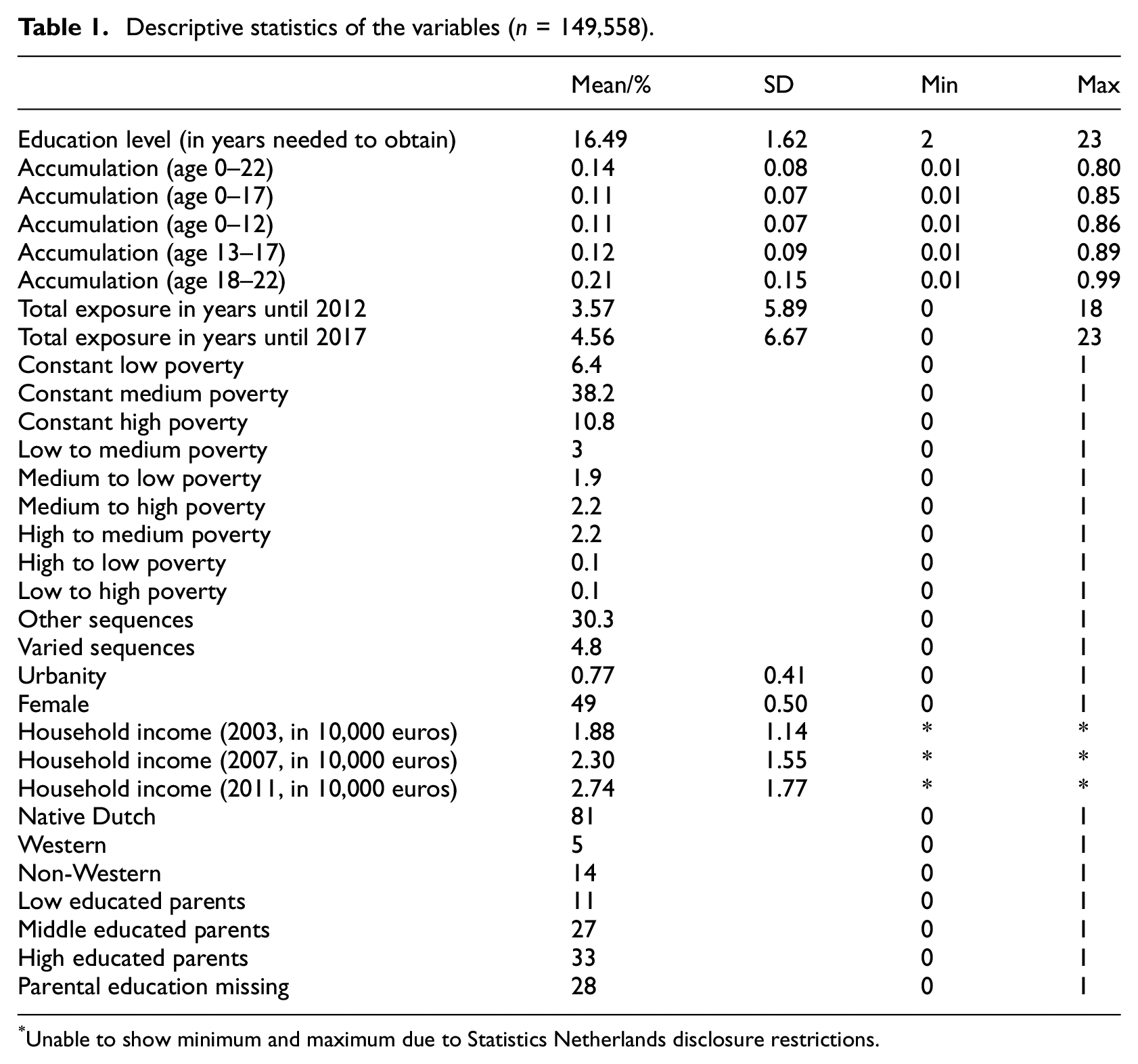
Unable to show minimum and maximum due to Statistics Netherlands disclosure restrictions.
Analytical approach
We estimate a series of linear regression models with educational level at age 23 as the dependent variable. All models are estimated on the same sample of 149,558 individuals, and contain the same control variables. We run separate models for accumulation, duration, timing, and sequencing of exposure to neighbourhood poverty and compare their results.
It can be difficult to compare the effect of sequencing to the effects of other time dimensions, such as timing of exposure, because of the different operationalisation of the predictor required to construct them (simple categories, such as bottom, middle and top, are needed to keep the sequence types from getting too complex). Still, by running the sequence analysis on the same dataset, we can determine whether sequencing provides new insights into how contextual effects work or largely repeats the findings already present in the simpler timing, accumulation and duration models.
Given the nested structure of our data, the use of multilevel modelling appears logical. However, there are two reasons why we have not used this type of model. Firstly, individuals are nested in neighbourhoods which can change every year. Therefore, the complex hierarchical structure inhibits model convergence. This is further exacerbated by the second reason, whereby there is no strict hierarchy because of the multiple membership of individuals in the bespoke neighbourhoods (the neighbourhoods are overlapping with each other). Furthermore, because of bespoke neighbourhoods which are constructed for each individual every year, and only including people born in 1995 in the sample, a large number of individuals are ‘nested’ alone or with just one other person in their neighbourhood (73,367; 49%), which is another obstacle to estimating a hierarchical fixed effects structure.
Results
Accumulation of exposure to neighbourhood poverty
The first model (Table 2) presents the accumulation model which includes the average exposure to neighbourhood poverty from birth to age 22 (Model 1), and from birth to age 17 (Model 2). Surprisingly, the effect of accumulated exposure to neighbourhood poverty for the whole period is positive and significant (b = 0.560, p<0.001, beta = 0.028), meaning that the higher the rate of neighbourhood poverty an individual was exposed to over the years, the higher their individual educational attainment. This contradicts findings from previous literature. However, when we run the model on the childhood years only – from age 0 to 17 – we see that the effect is negative and significant (b =−1.941, p<0.001, beta =−0.084). The different outcomes by these two models can be explained by the exposure to neighbourhood poverty during the last few years, from age 18 to 22. Exposure during this period is positively related to obtained education and biases the accumulation effect for the complete period, from age 0 to 22 (see the section on timing models).
Effects of accumulation of exposure to neighbourhood deprivation on educational level (n = 149,558).
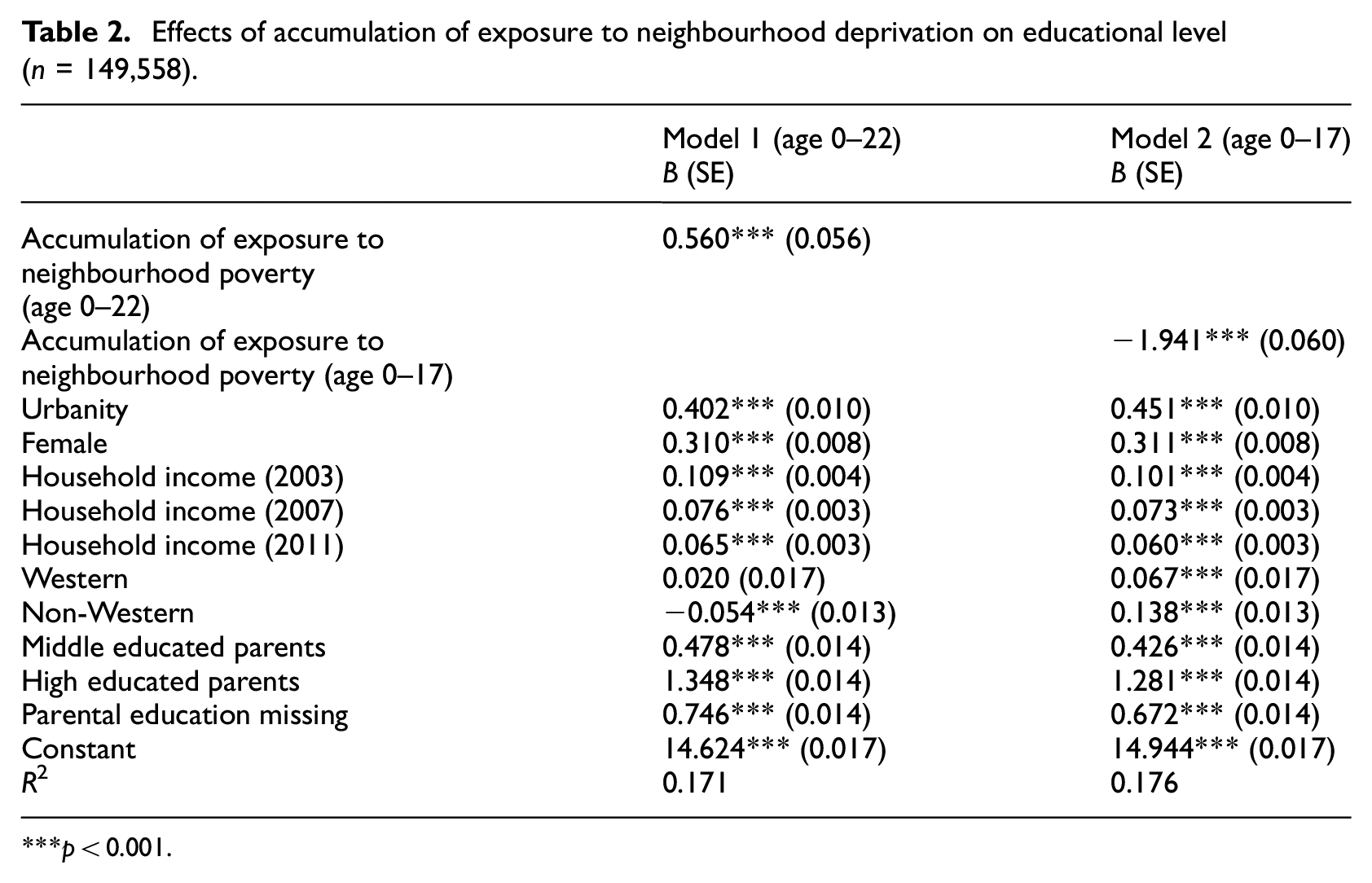
***p<0.001.
The control variables have the expected effects, with females having a slightly higher level of education level than males, non-Western ethnic minorities having a slightly lower educational level compared to native Dutch individuals, and with household income and parental education being positively related to education level. The share of years spent living in an urban setting also has a significant positive effect, consistent with an easier access to multiple types of schools and high-skilled white-collar jobs being more prevalent, and therefore seen as the norm, in cities.
Duration of exposure to neighbourhood poverty
Table 3 presents the results from the duration models, which include the number of years in which an individual lived in the top 20% of neighbourhoods with the highest poverty rates. We estimated two separate models, one examining the effect of the duration of exposure between birth and age 22, and the other between birth and age 17. Contrary to the findings from the accumulation model (Table 2), the effects of the duration of exposure to neighbourhood poverty are both negative and significant (b =−0.023, p<0.001, beta =−0.084 and b =−0.007, p<0.001, beta =−0.029). The effect for the model of ages 0–22 is smaller than in the 0–17 model; however, it does not change its direction as is the case for the accumulation model of the same time range. A possible explanation is that the accumulation model is more sensitive to extreme poverty rates than the duration model, which is based on the number of years in top 20% poorest neighbourhoods.
Effects of duration of exposure to neighbourhood deprivation on educational level (n = 149,558).
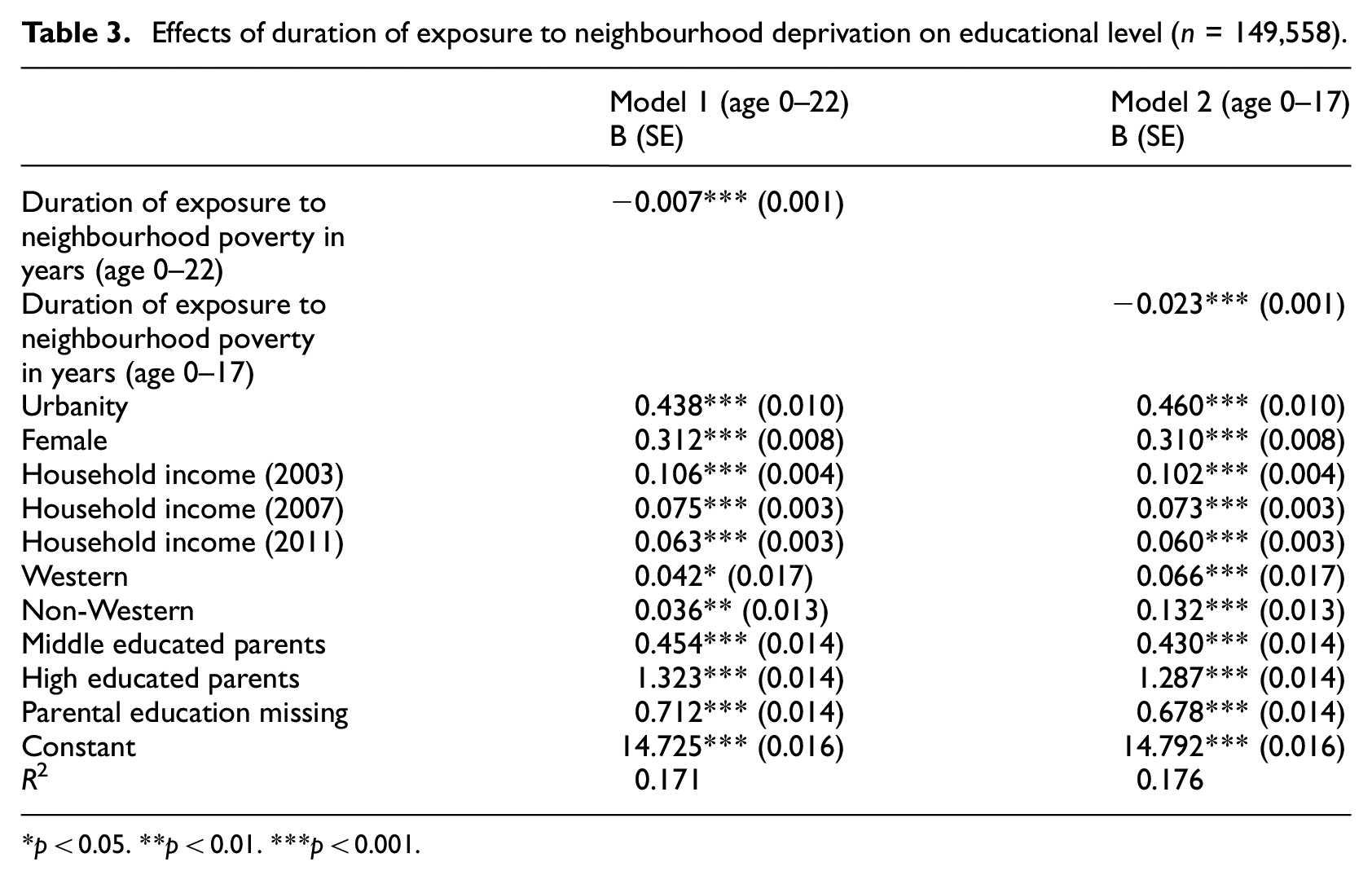
p<0.05. **p<0.01. ***p<0.001.
Timing of exposure to neighbourhood poverty
In the next sets of models (Table 4) we examined the effect of timing of exposure to neighbourhood poverty, in order to examine whether exposure at certain ages is more strongly related to obtained educational level compared to other periods. We estimated the effect of exposure to neighbourhood poverty during childhood (age 0–12), adolescence (age 13–17), and early adulthood (age 18–22) when children start moving out of the parental home. The results from the models show that the effect of exposure during childhood and adolescence is negatively related to obtained educational level (b =−1.790, p < 0.001, beta =−0.077, and b =−1.593, p < 0.001, beta =−0.089 respectively). The difference in the effects of exposure during childhood and adolescence is small, but statistically significant; exposure during adolescence is slightly stronger negatively related to education attainment.
Effects of timing of exposure to neighbourhood deprivation on educational level (n = 149,558).
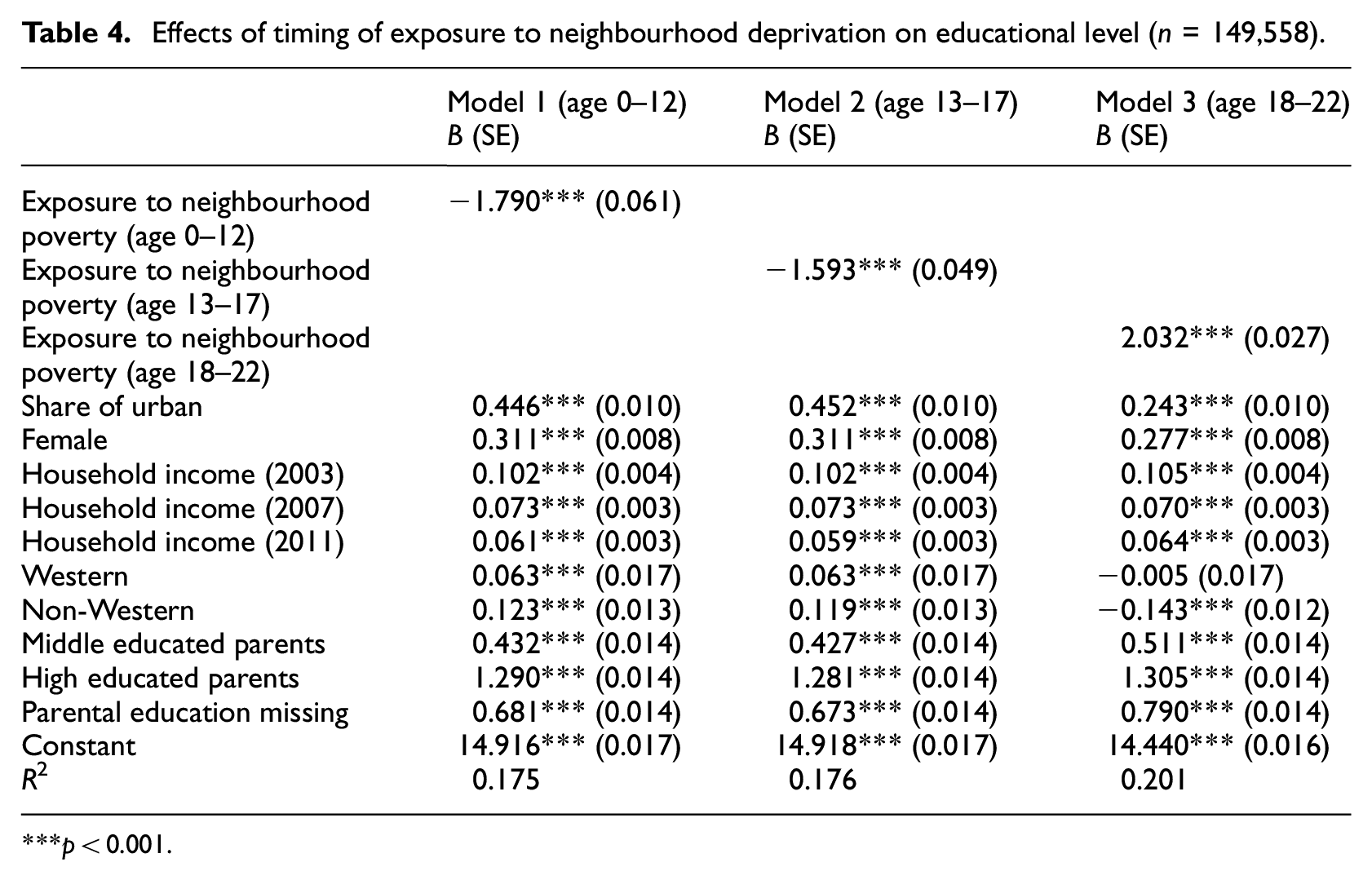
p<0.001.
Exposure to neighbourhood poverty during early adulthood, on the other hand, is positively related to obtained educational level (b = 2.032, p < 0.001, beta = 0.188). This positive effect can be explained by the fact that at these ages, individuals are likely to move out of the parental home into city centres and student housing to follow higher education, where the proportion of low-income households is high. More importantly, this different effect for exposure to poverty during early adulthood explains the small positive effect we found in the accumulation model (ages 0–23). Including these last four years changes the effect so that the negative influence of exposure to poverty in childhood can no longer be detected.
When it comes to migration background, we find that individuals with a non-Western migration background have a higher educational level compared to individuals without a migration background in the models including neighbourhood poverty from age 0 to 17. In models including neighbourhood poverty from age 18 to 22, however, we find an effect in the opposite direction, indicating that individuals with a non-Western migration background have a lower educational level. This might be related to different residential trends for non-Western minorities, such as living with their parents for a longer time (de Valk and Liefbroer, 2007). Controlling for the variables such as parental income, education and urban environment could explain why the often observed negative influence of having an immigrant background is not always present in our models.
Trajectories of exposure to neighbourhood poverty
Finally, the sequencing model (Table 5) not only takes into account the duration of exposure to neighbourhood poverty, but also whether the level of neighbourhood poverty was stable over time, improving or deteriorating. Based on the findings from the previous models, we measured the trajectories from birth to age 17. We present three models differing in the reference trajectory: constant in medium poverty (Model 1), constant in high poverty (Model 2), and constant in low poverty (Model 3). The findings from Model 1 show that individuals who consistently lived in neighbourhoods with the highest poverty rates have a lower educational level compared to individuals who lived consistently in moderately and low poverty neighbourhoods (on average 0.3 and 0.5 year lower respectively).
Effects of different trajectories of exposure to neighbourhood poverty on educational level (n = 149,558).
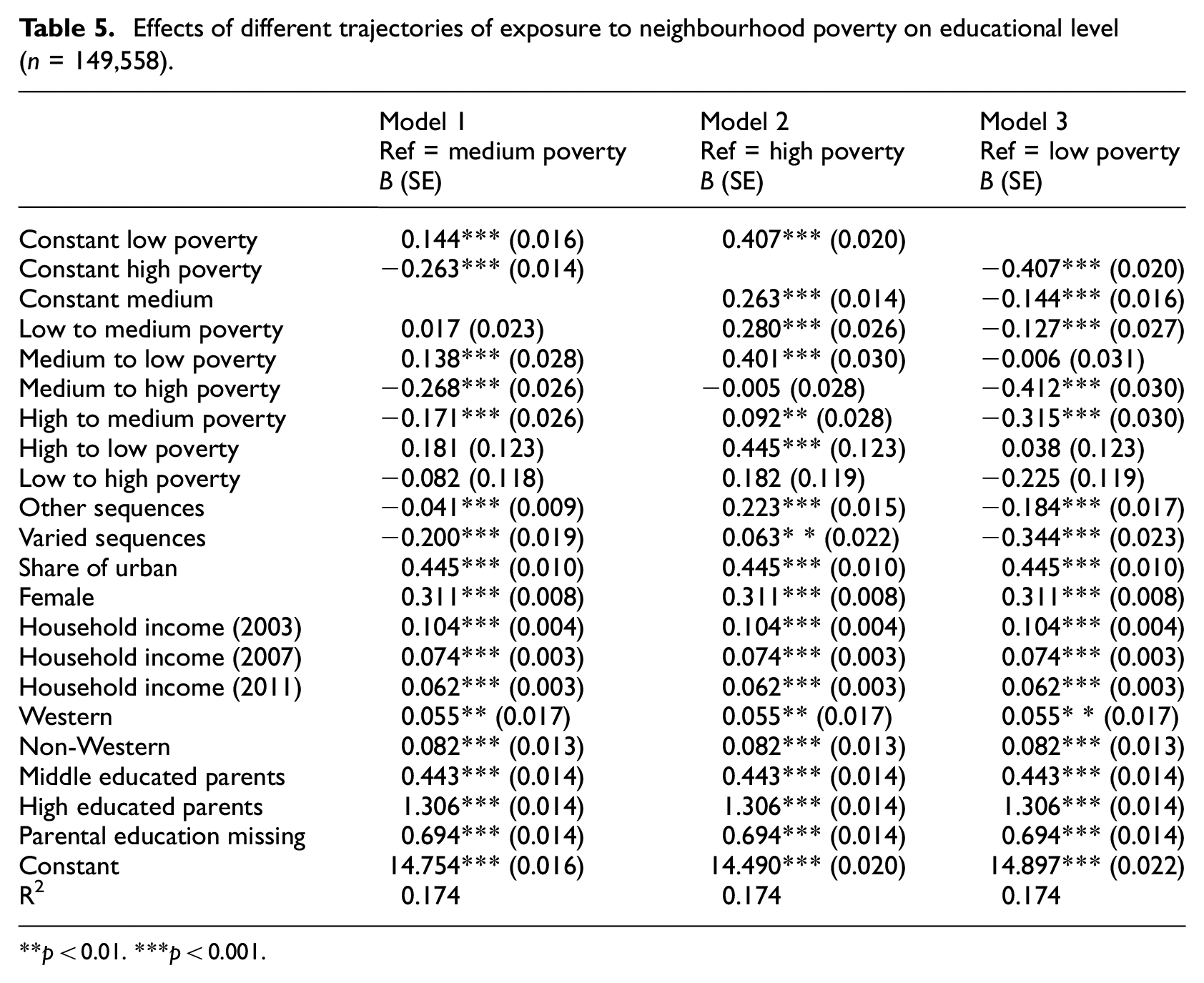
**p<0.01. ***p<0.001.
Individuals for whom the neighbourhood context improved over time have on average higher educational levels. Individuals for whom the neighbourhood context changed from high poverty to medium or low levels of poverty are on average 0.1 and 0.5 years respectively higher educated than those who lived constantly in neighbourhoods with high poverty levels. Those who move from medium to low poverty neighbourhoods are on average 0.1 year higher educated than those who lived in medium poverty neighbourhoods constantly.
Those individuals for whom the neighbourhood poverty rate increased over time have on average lower educational levels. Individuals who lived in low poverty neighbourhoods and moved to medium poverty neighbourhoods are on average 0.1 year lower educated than those who remained in low poverty neighbourhoods. Changing conditions from low to high poverty, however, has a stronger negative effect. Individuals who experience this change are on average 0.2 years lower educated than those in constant low poverty neighbourhoods. Interestingly, moving from medium neighbourhood poverty to the high poverty neighbourhoods has a stronger effect. Those who experience this change are on average 0.3 years lower educated than those who remain in neighbourhoods with moderate poverty levels. Both other sequences and varied sequences, characterised by a high number of moves, have a negative effect on educational attainment compared to constant medium (b =−0.041, p<0.001 and b = 0.200, p<0.001, respectively).
Finally, when comparing all of the models (Tables 2–4), we see that the explained variance (R-squared) is similar – around 17–18% – across all models, except for the third one of the timing models (influence of neighbourhood poverty at ages 18–22, R-squared at 20%).
Conclusions and discussion
The aim of this study was to come to a better understanding of the relationship between exposure to neighbourhood poverty and educational attainment. We have conceptualised four dimensions of exposure to neighbourhood poverty – accumulation, duration, timing and sequencing – and estimated their effects on educational attainment. Using register data from the Netherlands, we studied the population of children born in 1995, and followed them until age 23. Our findings show that the observed relationship between neighbourhood poverty and educational attainment depends on how exposure to the neighbourhood effects is conceptualised and measured.
We found that it is important to separate exposure in early adult years (age 18–22) from exposure in earlier childhood years. The effect of exposure to neighbourhood poverty during these years was positively related to educational attainment, whereas exposure up to the age of 17 was negatively related. This can be explained by these early adult years representing a very different stage in the life course during which individuals move out of the parental home towards city centres and student housing, where the proportion of households with a low income is higher – especially if their move is related to enrolling into higher education. Including these years in a measure of exposure to poverty from birth to age 23 distorted the results with a type of selection bias, caused by students selecting to move into neighbourhoods with their peers and other inhabitants of cheap housing. This bias was stronger in the accumulation model than in the duration model, which is less sensitive to extreme values. Researchers have to avoid the temptation of including generalised measures of as many years as possible, considering these years can span different stages of the life course, and test the influence of various theoretically implicated time periods. That is true even though the cumulative effect of exposure at ages 0–17 was stronger than that of ages 0–12 or 13–17, which is similar to the findings of studies of other spatial effects over time (Musterd et al., 2012).
With regard to the timing of exposure to neighbourhood poverty at different stages of development, we find that exposure during adolescence has a slightly stronger relation to educational attainment than exposure during childhood. There are multiple explanations for this effect, mainly related to the influence of parents diminishing as adolescents strive for more independence, with the influence of (local) peer groups increasing during adolescence (Janssen et al., 2016; Smetana et al., 2006). Both of these time periods being influential confirms the findings from earlier studies (Kuyvenhoven and Boterman, 2021; Nieuwenhuis et al., 2021).
The sequencing model highlights the importance of not only cumulative exposure to neighbourhood poverty, but also whether the neighbourhood conditions are improving or deteriorating. We find that individuals with improving conditions reached a higher educational level compared to those who remained in neighbourhoods with the highest poverty rates. In cases of the most varied sequences, the effect is almost as big as constantly living in the poorest neighbourhoods. This points to the distinctive role of volatile moving histories. Future research could study this type of trajectory, which has proven influential in other studies (Coulter and van Ham, 2013), as well as investigate moving within the same neighbourhood categories – something that could be another influential dimension of neighbourhood histories because of the resulting breakage of social ties.
A possible limitation of our study is that in addition to the neighbourhood context, the school context plays an important role when it comes to educational attainment. Previous research has, however, indicated that the effect of school can be a mediating factor in the neighbourhood effect on educational achievement in the Netherlands (Sykes and Musterd, 2011). Moreover, neighbourhoods have been theorised as encompassing the school context in similar studies (Toft and Ljunggren, 2016); even though there is no strict catchment area policy in the Netherlands, in most cases it is easiest to sign up for a local school and private schools are not popular (Boterman, 2012). Another possible shortcoming is that we have focussed on neighbourhood poverty only. Other characteristics could play an important role for educational attainment, such as neighbourhood employment and education level. We chose a single measure of poverty, which is to some extent necessitated by the complex predictors in the study. Comparing the effects at different spatial scales could also lead to more insights – for example, duration of exposure being more important than accumulation at larger scales, because at that level local institutions could matter more than personal contacts and one needs more time to be affected by their quality.
In conclusion, our findings show that the observed relationship between neighbourhood poverty and educational attainment depends on how exposure to neighbourhood poverty is conceptualised and measured, as well as on the life course stage of the studied individuals. While it cannot be said that one dimension – accumulation, timing, duration or sequencing – is more important than the others, researchers should carefully choose an approach that fits their theoretical interests, and preferably test different operationalisations and compare their outcomes. The main message of our study is that choosing just one dimension or operationalisation may lead to the underestimation or overestimation of the importance of exposure to neighbourhood poverty.
Footnotes
Acknowledgements
We would like to thank David Manley for his help and support in the final stages of working on this paper, and thank the reviewers and the Urban Studies editors for their helpful comments.
Declaration of conflicting interests
The author(s) declared no potential conflicts of interest with respect to the research, authorship, and/or publication of this article.
Funding
The author(s) disclosed receipt of the following financial support for the research, authorship, and/or publication of this article: The research leading to these results has received funding from the European Research Council under the European Union’s Seventh Framework Pro-gramme (FP/2007-2013) / ERC Grant Agreement n. 615159 (ERC Consolidator Grant DEPRI VEDHOODS, Socio-spatial inequality, deprived neighbourhoods, and neighbourhood effects), as well as from European Union’s Horizon 2020 research and innovation programme under Grant Agreement n. 727097 (RELOCAL).
