




Abstract
In Germany, the electoral success of the Alternative for Germany (AfD) party is one of the most obvious signs of the rise of the far right. In public debates this tends to be associated with Eastern Germany and rural regions. What is neglected is the fact that the party was also remarkably successful in less privileged urban districts across Germany. In this paper I focus on the urban conditions for the rise of the far right. I do so by presenting first results of ethnographic research in two neighbourhoods of Frankfurt am Main. Both – Riederwald and Nied – are marginalised and the AfD gained considerable support there in the 2017 general elections. In the accounts given in 14 expert interviews I identify three crucial urban processes: austerity urbanism, post-democracy and gentrification. Relating them to findings of long-term studies on right-wing attitudes as well as to the concept of ‘downward mobility’, I argue that these processes increase the competition for resources and strengthen feelings of being left behind as well as experiences of being abandoned by political representatives – which are driving forces for the rise of the far right. And yet these experiences alone do not provide sufficient reason to explain the rise of the far right. They are general processes in the neighbourhoods. However, it seems that intersections with existing group-focused enmities drive a shift from social to regressive collectivity, which raises the potential for far-right political subjectification.
Introduction
Nationalist, racist and authoritarian parties and movements are gaining ground worldwide. In Germany, besides right-wing mass demonstrations and a growing prevalence of far-right hate crime and violence (BMI, 2019), the electoral success of the Alternative for Germany (Alternative für Deutschland) (AfD) party is the most obvious sign of this development. Because of the electoral geography of the AfD and the geographies of hate crime, in public debates the rise of the far right in Germany is mostly associated with Eastern Germany and rural regions (cf. Bernet et al., 2019: 13; Förtner et al., 2019). In the general elections of 2017, for example, the party scored roughly 20% in East German states (but 27% in Saxony), and even achieved results of almost 40% in some smaller towns and rural regions. However, the party made gains in every electoral district, including around 10% in each West German state. What is often neglected in studying the AfD’s success is that the party also gained relatively strong support in less privileged urban districts (Bernet et al. 2019). In this paper I focus on the latter and discuss urban conditions for the rise of the far right, for three reasons.
First, following Hall (2006), it is in less privileged urban neighbourhoods that – owing to urban processes of simultaneity and encounter as well as capitalist accumulation crises – political conflicts and struggles over culture and identity are articulated with full force (cf. Förtner et al., 2019: 38f). In these settings, spatial patterns can be found which – not exclusively but definitely – aid the rise of the far right. Second, despite the first argument, in German urban studies efforts have only recently been undertaken to understand the rise of the far right in its interdependence with urban life (cf. Bernet et al., 2019; Bürk, 2012; Förtner et al., 2019; Grau and Heitmeyer, 2013; Podesta, 2018; Üblacker and Lukas, 2019). Third, critical urban theorists, including myself, have long emphasised the emancipatory potential of urban subjectification and everyday life (cf. Harvey, 2012; Lefebvre, 1968; Mayer, 2009; Mullis, 2014, 2017). Today we have to assume that urban experiences may also support regressive political manifestations – not only in the form of revanchist policies (Uitermark and Duyvendak, 2008) but also at the level of political subjectification processes.
In this paper I will present first results of ongoing ethnographic research in two neighbourhoods of Frankfurt am Main: Riederwald and Nied. Both are marginalised according to statistics and the AfD was rather successful there in the 2017 general elections. The empirical basis of the argument consists of 14 expert interviews with local politicians, religious leaders and social workers. In the interviews I focused on social conflicts, experiences of crisis, the quality of local infrastructure and the unfolding political dynamics in the neighbourhoods. What became evident during the analysis of the accounts in a qualitative mapping process (Clarke, 2005: 86–109) is the importance of urban processes, especially austerity urbanism, post-democracy and gentrification. The aim of this paper is therefore to engage with the accounts and to relate them to debates on the rise of the far right. For the latter I rely on Nachtwey’s (2016) arguments on ‘downward mobility’ as well as on Heitmeyer’s (2018) analysis of far-right attitudes in society. The empirical scope of the argument is limited: this is due to the small number of interviews and the scarcity of similar research with which to engage. Therefore, I do not claim to give final answers. Rather, I aim to support an emerging debate with empirically grounded reflections and explorative hypotheses.
In the following I will first provide a brief introduction on the rise of the AfD, findings of research on far-right attitudes and the concept of ‘downward mobility’. Second, I will reflect on the present developments in the two selected neighbourhoods. And third, I will relate my findings to debates on the rise of the far right in order to trace the urban conditions. I will conclude with the hypothesis that we are witnessing a shift from social to regressivecollectivity in German society (and beyond).
The rise of the AfD, downward mobility and right-wing attitudes
The AfD was founded in 2013, in the midst of the European debt crisis, as a conservative neoliberal and ‘eurosceptic’ party (Weiß, 2017: 83). In the course of the so-called refugee crisis of 2015, the party increasingly focused on immigration and national identity. This development did not curtail the party’s potential; on the contrary, in the 2013 federal election the AfD received 4.7% of the vote and remained below the 5% threshold required to enter parliament. Four years later, the party won 12.6% of the votes and became the third force behind the conservative CDU/CSU (32.9%) and the social democratic SPD (20.5%) parties. In election polls in August 2019, the AfD achieved 14.5%, the CDU/CSU dropped to 27.5% relative to the general election of 2017 (−5.4%) and the SPD to 12% (−8.5%). The major beneficiary was the Green Party, which increased its share from 8.9% in 2017 to 23.5%.
Historically, right-wing parties have occasionally been successful in West Germany: in the 1960s, the National Democratic Party of Germany (NPD) achieved results around 8% in elections at the state level. In the 1990s, again below the federal level, The Republicans (REP) achieved results around 10%. In both cases the success was explained by economic crisis, a general feeling of uncertainty and, especially in the 1990s, also by widespread attitudes against immigration (Jaschke, 1993). These factors are resurfacing in today’s analyses of the electoral successes of the AfD (cf. Geiselberger, 2017; Heitmeyer, 2018). However, in contrast to the aforementioned cases, the AfD managed to enter the federal parliament, every single state parliament as well as the European Parliament – and the party is consolidating.
Commentators agree that we are witnessing a ‘Great Regression’ which ‘may be the product of a collaboration between the risks of globalisation and neoliberalism’ (Geiselberger, 2017: xiv). What is empirically evident, though, is, as Hilmer et al. (2017: 12, own translation) show, that far-right attitudes are strongly related to ‘subjective experiences’ of being ‘slighted’ and ‘losing control’ (cf. for similar results Franz et al., 2018; Richter and Bösch, 2017; Vehrkamp and Wegschaider, 2017). These feelings do not necessarily lead to the success of the far right, but they often do (cf. Decker and Brähler, 2018; Heitmeyer, 2018; Zick et al., 2019). The debate on the fundamental reason unfolds between two poles: on the one hand, it is argued that growing economic insecurity and social deprivation fuel popular resentment against elites and migrants among those left behind. On the other hand, it is argued that we are witnessing a cultural backlash which turns against the normative grounds of multicultural society as well as gender equality and laments a perceived loss of national identity (Inglehart and Norris, 2016: 2f). In this paper I focus on the argument of Nachtwey (2016) as well as Heitmeyer (2018), both of whom argue, by and large, in terms of economic insecurity. But I agree with Bernet et al. (2019: 12f) that a strict division of the positions is not helpful for understanding the rise of the far right and that rather, arguments from both ends of the spectrum have to be taken into account and studied with a view to their interdependencies.
As already indicated, far-right attitudes have been latent in post-war Germany. Long-term studies launched in the early 2000s show that group-focused enmities and authoritarian and anti-democratic thought are well-rooted amidst East and West German society (‘Leipziger Mitte-Studien’ [Leipzig Centre Studies], conducted biennially since 2002, from 2018 on ‘Leipziger Autoritarismus-Studie’ [Leipzig Study on Authoritarianism] by a team headed by Decker; ‘Deutsche Zustände’ [The German State of Affairs] between 2002 and 2011 under Heitmeyer). Recent results indicate that 24.1% (East: 30.9%/West: 22.3%) of the population share deeply hostile attitudes toward foreigners (Decker and Brähler, 2018: 83).
For the past 15 years, two main trends can be summarised: on the one hand, German society has altogether become more tolerant and liberal-minded towards diverse lifestyles (Decker and Brähler, 2018: 135–151). On the other hand, group-focused enmities towards Muslims, Roma and Sinti, refugees as well as the long-term unemployed are on the rise (Zick et al., 2019: 79–84). Heitmeyer (2002) used the term ‘group-focused enmity’ to describe ideologies of inequality that are less linked to the concept and terminology of race in the German context than in the Anglo-Saxon world (Meyer, 2017: 15–17). ‘Group-focused enmity’ is a term that combines cultural, class and racial prejudices with claims to privileges that are derived from the assumption that some people are more entitled to – because they are more established at – certain places than others.
Regarding the reasons for the increase of far-right political representations, Heitmeyer (2018: 197) focuses on three dimensions: increasing pressure from a competitive and globalised ‘authoritarian capitalism’, processes of social disintegration and shrinking space for democratic participation. Together, these circumstances are prone to cause fragmentation, social division, individualisation, isolation and a general feeling of being abandoned. Authoritarian and far-right political solutions can be interpreted as attempts to get back control of one’s own life as well as of national society.
Nachtwey’s (2016) concept of downward mobility, which he develops following debates on the precarisation of contemporary labour, places Heitmeyer’s research in a wider context and, at the same time, provides an explanation for the growing feelings of uncertainty. Analysing recent developments in Germany, Nachtwey (2016: Chapters 3 and 4) describes a societal change which he sees at work in all advanced capitalist societies: Collective upward mobility and social integration used to be the dominant pattern of social modernity (post-war Fordism), although the associated processes were always also selective. By contrast, in the age of regressive modernity (neoliberalism), socio-economic downward mobility and polarisation dominate. Nachtwey suggests that this results in fears of social exclusion and feelings of vulnerability being universalised: Individually downward mobility or social decline have not become a mass phenomenon yet, nor is it impossible to climb up the social ladder. Collectively though, downward mobility for ordinary workers is a fact, and social inequality between the rich and the poor is growing. (Nachtwey, 2016: 127, own translation)
Nachtwey and Heitmeyer develop their arguments foremost regarding economic transitions. However, further research reveals (cf. Charim, 2018; Eribon, 2013; Gest, 2016; Hark and Villa, 2017; Inglehart and Norris, 2016; Lengfeld, 2018; McGarvey, 2017) that feelings of losing control, loss of identity and experiences of downward mobility intersect with gender, immigration and political participation. To illustrate this: experiences of downward mobility reflect more than losing a certain economic position. They also include males feeling diminished in the course of growing gender equality, white people experiencing that they are a race ‘among others and no longer supreme’, etc. It is therefore not sufficient to focus just on economic positions. Still, it is important to acknowledge that the processes of intersection (Meyer, 2017) unfold in modern capitalist societies, which are class-divided and unequal societies, and that far-right patterns, even if they can emerge in all of society, are not equally distributed in society (Heitmeyer, 2018: 131, 144). Lower classes are not per se the place where right-wing attitudes arise, but the exposure to economic worries, pluralisation, the shift of gender relations and the dismantling of the welfare state is much higher than in wealthier classes, which increases the probability.
Tales of two neighbourhoods
I will now turn to two neighbourhoods of Frankfurt where the AfD succeeded in the 2017 federal elections and which, as I will show below, are marginalised according to statistical data: Riederwald and Nied. I will focus here on the accounts given in the 14 expert interviews (seven in each neighbourhood). I will highlight perceived changes in the social composition of the neighbourhoods, current conflicts and tensions as well as modes of political engagement.
But first I shall introduce some information on Frankfurt. In the post-war era, the city has steadily gained significance as a financial centre, and since the late 1980s it has held the status of Global City. Frankfurt is proud of its cultural diversity (Rodatz, 2014). This was not always the case: as the proportion of foreigners rose from 4.6% in 1961 to 22.1% in 1981, conservative politicians called for zero-immigration policies (Schacht, 1986: 143). This never gained a majority; in 2017, 29.5% of Frankfurt’s 742,000 inhabitants were not German citizens (one of the highest proportions in any German city), and 46.5% of these were citizens of other European Union (EU) member states.
From the 1960s to the 1980s, left-wing extra-parliamentary politics had a stronghold in the city. But also, more recently Frankfurt was the site of the largest anti-austerity protests held in Germany between 2012 and 2015 (Mullis et al., 2016). Anti-racist as well as tenant movements are constantly present in the city. Financially, Frankfurt prospered even after the global financial crisis of 2007/2008, but by 2017 the city budget had run a deficit and cuts were expected. Socio-economically, Frankfurt is strongly segregated (vom Berge et al., 2014): unlike in other large cities such as Munich, Hamburg or Cologne, average available incomes are below the federal average and poverty and wealth are in close proximity (Stadt Frankfurt, 2018a, 2018b).
In the 2017 federal elections, the AfD won 8.6% of the votes in Frankfurt, significantly below the party’s countrywide score of 12.6%. Nevertheless, in several neighbourhoods which are mostly marginalised according to statistics the AfD gained significant support (see Figure 1). Goerres et al. (2018) argue that the AfD’s current strongholds correlate with those of earlier right-wing parties. This is also true for Frankfurt, where in the municipal elections of 1968 the NPD won 5.8%, scoring up to 17.4% of the vote in some working-class districts (Gunzert, 1969: 28f). In 1993, The Republicans won 9.3% in Frankfurt: Riederwald (13.1%) was a stronghold, but the party also performed well in Nied (10.8%) (Stadt Frankfurt, 1993: 45f).
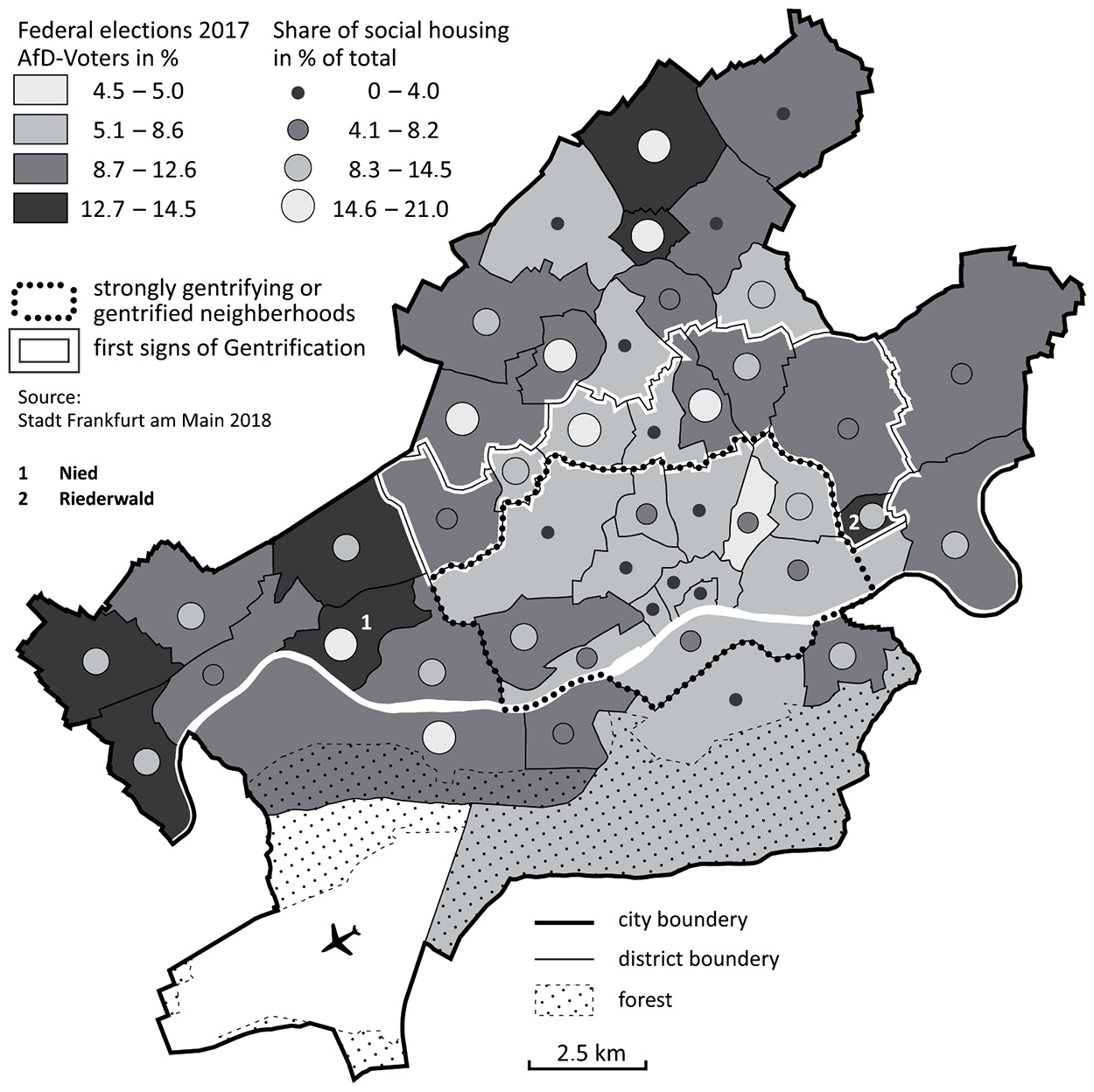
AfD support in Frankfurt am Main: Federal elections 2017.
In the 2017 federal elections in Riederwald (4849 residents), the AfD won 13.1% of the vote, and in Nied (19,788 residents) 14.2%. The Riederwald constituencies are split in two. In the west of the neighbourhood, the SPD obtained 28.1% and the party The Left 20.3%, while the AfD received ‘only’ 10.6%, whereas in the eastern part of the district, the AfD won 17.5%, the SPD 24.8% and The Left 18.8%. The highest of the AfD’s results in Nied’s nine highly fragmented constituencies was 17.3%.
Both neighbourhoods have traditionally been working-class, and they are marked by the city’s de-industrialisation and the structural changes of the last 45 years (Keil and Lieser, 1992; Ronneberger and Keil, 1995). In Riederwald 21.3% and in Nied 17.6% of the inhabitants rely on basic social security provision, whereas in Frankfurt the average is 12.8% (Stadt Frankfurt, 2019). The populations of both Riederwald and Nied are somewhat older than average, and over one-third of Nied and over one-quarter of Riederwald residents are not German citizens. In 2017, voter turnout was 67.8% in Riederwald and 68.7% in Nied – in Frankfurt overall 74.8%.
Even today, Riederwald is still referred to as the ‘Red Riederwald’. In the 1920s communists and social democrats had a stronghold in the neighbourhood. After the war and the end of fascism the SPD dominated again. Over time, however, the social democrats lost support. In the 1972 municipal elections, the party won 67.4% (citywide: 50.1%), and even in 1981, when the SPD only received 34% at the national level, it still scored 53.9% in Riederwald (Schacht, 1986: 37, 71f). The social democrats lost dramatically in 2017 and won only 29.6%, down by 11.2% from 2013. As for Nied, it was historically split between the SPD and the CDU (Schacht, 1986: 54–57). In the 2017 federal elections, the CDU secured 26.7%, dropping 8.7% from its 2013 result, but was ahead of the SPD’s 24.5%, down by 6.2%. Besides the AfD, the centre-right liberals (FDP) and The Left made gains in both neighbourhoods.
The transformation of social milieus
According to the interviewees, until a few decades ago both Riederwald and Nied were experienced as more homogeneous than they are today. Male residents worked for the main local industrial employers. Migration had already been an issue between the wars, although this mostly concerned the influx of ‘foreigners from other federal states’ (Nied, 3 August 2017) such as from catholic Bavaria, which was frowned upon by the protestant majority. The confessional aspect of the ‘immigration’ did not result in major conflicts, but it remained an aspect of societal division that is still present today. Both neighbourhoods were described as formerly being like villages, where everybody knew each other and shared everyday patterns. After 1955, an influx of ‘guest workers’ from southern Europe began to change the local composition of the population.
In the last three decades, however, neoliberal structural changes, an exclusionary urban development and migration have created fault lines. One interlocutor (Nied, 25 October 2017) argues that people have become isolated and alone, which reduces solidarity among the citizens. Another informant (Riederwald, 12 July 2017) stresses that peoples’ everyday struggles have become more difficult and that most people feel they are alone with their worries related to private life, such as family issues, money troubles, alcohol or drug abuse, as well as with the loss of employment. Additionally, especially in Nied, a growing fear of crime committed by foreigners is articulated; and anger about abandoned piles of waste. People, it is said, now tend to live by themselves. Rather than sharing the routines of one industrial employer, residents now work for a variety of employers under very dissimilar conditions. This restricts the time available for family and collectivity: I remember a young couple. They lived together but saw each other at best 6 hours a week, because he went to work when she came from university, and she was asleep or already gone again when he came home. This loss of family time due to ever more diverging working hours and ever longer ways to work is a general phenomenon. Some years ago, people would have started a revolution, but today the economy demands and everybody obeys. (Nied, 25 October 2017)
Clear barriers of language, class – which materialises in the division of housing estates – and religion – especially regarding Muslims – are said to exist. Concerning the presence of the far right, it is highlighted that of course there are individuals known for their attitudes but the AfD has no active presence, and in general their voters are absent from public life: ‘There is no AfD here’ (Nied, 8 August 2017).
As regards community life, both Riederwald and Nied appear well off, but the active groups are small and face limits: there are all sorts of clubs and associations, sometimes tenant organisations and, especially in Riederwald, a local democracy committee. But ‘we have problems reaching poor people and migrants’ summed up one interlocutor in Riederwald (18 July 2017). Civil society engagement seems to be a middle-class ‘German’ thing, as one interviewee put it (Riederwald, 25 October 2017). Interlocutors from both Riederwald and Nied report with some resignation that there is in fact no lack of democratic commitment, but that it is either just not heard, or dismissed. People seem alienated from democratic politics and lethargic (Nied, 17 July 2017). One interlocutor in Nied relates this to very concrete experiences: There has been this initiative, with the goal to revive the central street and square of Nied. They really tried hard but they ended up getting a bloody nose. The city of Frankfurt would not listen at all, they just don’t care about the people here. (Nied, 17 July 2017)
Similar stories of feeling neglected by city politics are told in Riederwald using the examples of current attempts to stop the construction of a highway or of attempts to stop the demolition of the neighbourhood’s People’s House at the end of the 1990s or of the municipal library’s closing down in the 2000s.
Little investment in infrastructure
Interlocutors in both neighbourhoods deplored the run-down state of rental apartments, the lack of retail shops and pubs, the scruffy urban landscape and reduced social offers. For Riederwald the situation was described as follows: One by one all the shops have shut down. They were all small retail stores, a grocery, a dairy, a bakery or whatever, but they could not compete with the supermarkets and big suppliers. In Riederwald this has certainly been exacerbated by the fact that people do not have much money and are restricted to cheap offers. (Riederwald, 18 July 2017)
‘In Frankfurt one can have the feeling that the neighbourhoods outside of the centre are being left behind’ another interlocutor phrased it (Riederwald, 6 July 2017). By contrast, ‘the centre is being developed, be it with the construction of museums, the reconstruction of the old town, the beautification of the central railway station or the construction of luxurious high-rises’ (Riederwald, 6 July 2017).
Nied used to be typified by company flats constructed for the German railway and postal service and the adjacent chemical plant, which not only provided housing but also supported the district’s social infrastructure, festivals and associations. Around the turn of the century, privatisation commodified the housing stock and the corporations reduced their social engagement – two changes that are still deplored by the interviewees. Although Nied has grown, there has been no investment in its infrastructure for years: ‘Nied has just gone steadily downhill’ (Nied, 17 July 2017). In Riederwald, where the decline of the SPD is felt, as the party used to be an important door opener to the city council and played an important role in collective life, nowadays ‘going downhill’ is foremost related to the scruffy urban landscape and political abandonment (Riederwald, 19 July 2017).
An issue that bothers residents and that was raised in almost all interviews is the lack of public space and community centres that enable social encounters. In reality this topic concerns many major issues: it is viewed as one sign of public disinvestment, because these places used to exist; the decisions to shut them down are associated with an unwillingness of the city council to listen to the demands of the local people; and the absence of such places is, at the same time, considered a reason for the residents’ growing isolation. It was highlighted that ‘places are needed where people can meet informally and exchange ideas’ (Nied, 20 July 2017), or places where social contacts can develop so that ‘more can come about’ (Riederwald, 13 July 2017).
The case of the People’s House in Riederwald is exemplary. The building was reconstructed after the Second World War and inaugurated in 1963. Despite public protest, the city-owned company sold it to an investor in 1998, who demolished it the following year. According to an interlocutor who had witnessed the inauguration, this was a great loss. The house had been a place of public life, community and encounters in the centre of the neighbourhood (Riederwald, 1 August 2017). To compensate for the loss of public space, the city council promised not to close the public library. Nevertheless, this was also closed as a result of centralising processes in 2011 (Riederwald, 6 July 2017), thus eliminating both the easy access to books and a space ‘where people could meet’ (Riederwald, 12 July 2017). Given the previous ‘deal’, the closing down of the library further damaged the trust people had in the municipal government.
Exclusionary urban development
For years, people with average and even low incomes moved to Riederwald and Nied. Some interviewees in Nied criticised the constant influx of economically less privileged tenants, which (had) sometimes caused tension, whereas interviewees in Riederwald rather mentioned growing fears of being displaced.
Interviewees in Nied criticised the city council for a social housing policy that segregated people with low incomes: ‘You can’t say, “Just move there”– and lump all the deprived people together’ (Nied, 8 August 2017). However, when read between the lines, ‘all the deprived people’ refers to poor migrants: in 2016, the announcement that refugee accommodation was going to be built in the neighbourhood stimulated xenophobic and racist protests. However, my interlocutors stressed that the protests never gained any momentum and were, in the end, sidelined by an active ‘welcoming culture’. But it still seems to be an issue in the neighbourhood that refugees are catered for with cheap housing while poor Germans have to wait to be assigned an apartment: ‘In the context of the current situation with the asylum seekers, I hear people saying “They get their flat paid, and we get nothing.” Of course, such things play a role here’ (Nied, 8 August 2017).
In Riederwald, the urban development dynamic is different and the neighbourhood is, rather, confronted with incipient displacement. Already today, and despite the fact that investment in the existing housing stock is lagging behind, people sometimes live ‘in groups of six in two-room apartments’ to afford the rent (Riederwald, 12 July 2017). Recently, however, modernisation has commenced, with smaller units merged to create larger apartments, leading to rent hikes of more than 70%. One interviewee said, ‘The residents of Riederwald are being shut out’ (Riederwald, 12 July 2017).
Fear about one’s own living situation is cited as a significant explanation for the AfD’s strong showing in Riederwald. Two types of housing tenure mark the district: one half belongs to a cooperative and the other half is owned by a profit-oriented public-housing company. In the first area, where renovations of the housing stock were carried out in a socially acceptable manner, the SPD and The Left remained strong, and the community of residents seems to be lively. In the latter, where residential units have been modernised, smaller flats merged to create bigger ones and rents increased, the AfD scored 17.5% in the 2017 federal elections. Many of my interlocutors attributed this to the residents’ fear of being displaced as well as a feeling of growing competition over affordable housing in the course of immigration: ‘I have no other explanation.’ The AfD’s strong showing ‘must be due to uncertainty over housing because there is no other big difference in the statistical data’ (Riederwald, 6 July 2017).
Urban processes and authoritarian regression
After providing an introduction to the accounts given in the interviews on the dynamics that unfold in the two neighbourhoods, I will now trace possible interrelations of the urban experience with the rise of the far right. To that end, in a first step I relate the findings from Riederwald and Nied to relevant debates in urban studies: in the accounts I find close links to debates on austerity urbanism, post-democracy and gentrification. In a second step, I trace possible relations of these processes and the rise of the far right. I do this by assessing them in the light of long-term studies on right-wing attitudes and the concept of ‘downward mobility’. I will conclude with the hypothesis that we are witnessing a shift from social to regressive collectivity in German society (and beyond).
Austerity urbanism, post-democracy and gentrification
The loss of public infrastructure and a general pullback of the welfare state are important aspects in the interviews I conducted. Such dynamics are neither unique nor new to debates in urban studies. In fact, following discussions on neoliberalising urban spaces (cf. Belina et al., 2013; Brenner and Theodore, 2002; Mullis, 2011), ‘austerity urbanism’ has become an important issue. It has been discussed as an elite-driven process with the aim to push forward a neoliberal restructuring of the social, economic and political order (cf. Jones et al., 2016; Peck, 2012; Schönig and Schipper, 2016). Austerity measures have dramatically expanded economic logics to almost all parts of society, along with what Harvey (2012: 53–57) calls ‘accumulation by dispossession’ and what Sassen (2014: 12–79) describes as ‘expulsions’.
In Germany, austerity entered the constitution in 2009 with the ‘balanced budget amendment’. According to this law, the federal state is bound to restrict the structural deficit to a maximum of 0.35% of GDP per annum. The states are granted a period of transition from 2016 to 2020 before structural deficits will be entirely forbidden (Eicker-Wolf and Himpele, 2011: 199). But municipalities had long before been subjected to strict budget guidelines. Wiegand (2016: 77) argues in line with Petzold (2018) that the enforcement of municipal austerity was not implemented as a ‘shock doctrine’, but rather in a long-term process which has extended over the last 30 to 40 years. In economically weak regions, the changes were applied without any democratic co-determination and triggered a constant downward spiral. With an eye to the case of Frankfurt, it is striking that austerity also impacts an economically strong city. Uneven development emerges on a very small scale here, it is in neighbourhoods rather than the entire city ‘where austerity bites’ (Peck, 2012: 629).
A second dominant narrative I encountered in the interviews concerns the loss of opportunities for democratic participation. While only a minority of residents participate in local initiatives, those who do so were said to see themselves as largely ignored. In urban studies, ‘post-democracy’ (Crouch, 2005; Rancière, 1999) has become the keyword for discussing such processes (Mullis and Schipper, 2013; Swyngedouw, 2011).
‘Post-democracy’ signifies a social order that is strongly related to the neoliberal turn of the late 1970s and the economisation of both the political and the social. Although democratic processes may remain in place or even be increased through participation programmes, they are rendered meaningless by shifting power relations and the re-scaling of decision-making. Swyngedouw puts it like this: Agonistic debate is increasingly replaced by disputes over the mobilization of a series of new governmental technologies, managerial dispositifs and institutional forms, articulated around reflexive risk-calculation (self-assessment), accountancy rules and accountancy based disciplining, quantification and benchmarking of performance. ‘Doing politics’ is reduced to a form of institutionalised social management, whereby problems are dealt with through enrolling managerial technologies and administrative procedures. (Swyngedouw, 2011: 372)
International examples help to see that experiences of post-democracy in Frankfurt are linked to austerity urbanism. Jones et al. (2016) stress that austerity heavily impacts communities in deprived areas and decreases their possibilities to participate both democratically and socially. Gest (2016) argues in his analysis of two working-class neighbourhoods of East London that ‘civic circumstances’ are crucial for the existence (or lack) of social organisation.
Whereas unions and other working-class groups once overcame divisions to pursue professional goals, the deterioration of these organisations and their manifestations in workingman’s clubs, union halls, pubs and clubhouses removed a venue for the development of working class consciousness. (Gest, 2016: 139)
Mason (2017: 93) argues similarly when he highlights that public-spending cuts in England have led to the closing down of community centres and have driven pubs and clubs out of business because of the lack of customers. In total, all this results in the loss of places where people can meet, where collectivity is produced and a sense of belonging can grow.
The third issue I wish to address, based on the accounts provided in the interviews, is gentrification (Lees et al., 2008) and its flip side, exclusion (Kronauer, 2010; Wacquant, 2008). Since the financial crisis of 2007/2008, Frankfurt’s housing market of mostly rental apartments has undergone powerful processes of gentrification (cf. Mösgen and Schipper, 2017; Schipper, 2013; Schipper and Wiegand, 2015). Between 2006 and 2016, average market rents for apartments rose by 41.4% and those for existing leases by 24.9% (Stadt Frankfurt, 2018a: 42). Since the late 2000s, gentrification in Riederwald and Nied has created an explosive situation. Both neighbourhoods still feature large housing estates. Around 10–20% of all apartments are social housing there, compared with a proportion of 0–5% in Frankfurt’s downtown neighbourhoods (see Figure 1). The lack of affordable housing in Frankfurt has been exacerbated by the huge drop in the total number of social housing units – from around 70,000 in 1990 to 32,000 in 2016. In 2017, only 8.5% of Frankfurt’s total rental stock is social housing (Stadt Frankfurt, 2018a: 48) – even though already in 2014, 49% of all tenant households were entitled by income to social housing (IWU, 2015: 13). Hence, in 2017 nearly 10,000 households are on the waiting list for subsidised apartments (Stadt Frankfurt, 2018a: 44). What is emerging is a ‘new housing question’ (Schönig, 2013).
What the examples from Riederwald and Nied show is that a generalised process of gentrification as it can be observed in the centre of Frankfurt (see Figure 1) has different impacts on neighbourhoods. In Riederwald, the pressure of displacement is growing in the area, the construction of the new headquarters of the European Central Bank especially has stimulated urban redevelopment in the entire east of Frankfurt (Mösgen and Schipper, 2017); whereas the development in Nied is still rather marked by the influx of less privileged people, who are displaced from other parts of the city. Both lead (along different paths) to uncertainty and anger about the influx into the neighbourhoods.
The rise of the far right
Now I will relate the sketched urban dynamics – austerity urbanism, post-democracy and gentrification – to findings of the long-term studies on right-wing attitudes as well as the concept of downward mobility. As noted in the introduction, I do not claim to give a final explanation but wish to contribute to the debate on the rise of the far right in an urban setting with empirically grounded reflections.
To begin with, austerity urbanism highlights two distinct dimensions: first, the cases of Riederwald and Nied suggest that the pullback of the welfare state and the lack of investment in social infrastructure have increased feelings of being left behind and of exclusion. Heitmeyer (2018: 124) argues that even if no direct links to the rise of the far right were to exist, such feelings create a fertile ground. When they meet with other patterns of prejudice, they increase the risk of far-right articulations. A twofold mechanism is at work: on the one hand, people aim to regain status and certainty by devaluing the alleged ‘other’ (cf. Charim, 2018); on the other hand, strong leadership offered by the far right allows projections of ‘hope’ to be directed (Heitmeyer, 2018: 141). Second, ideologies of neoliberal austerity intensify what Zick et al. (2016: 21) call ‘economic extremism’: neoliberal subjectification strengthens economic assessments of subjects which run along the line between ‘useful’ and ‘useless’ (Zick et al., 2016: 177). Accordingly, when it comes to public spending and social welfare, distinctions are made between subjects considered as worthy and unworthy of gaining social benefits. People considered less worthy are long-term unemployed, migrants and asylum seekers, as well as Sinti and Roma (Zick et al., 2019: 79–84). For Fekete (2018: 5f), it is therefore clear that contemporary austerity-driven governance has effected changes in the social structure and destroyed patterns of solidarity – both of which offer fertile ground for the rise of the far right.
Democracy’s credibility has likewise come under pressure with this change in public investment policies. While 92.8% of Germans claimed they were in favour of democracy, only 54.9% stated that they were happy with the current order (Decker and Brähler, 2018: 96f). Many people feel alienated, powerless and neglected by political leaders: a good 70% of citizens in Germany agree that ‘people like me’ have no influence on government actions, and 58% feel that it makes no sense to engage politically (Decker and Brähler, 2018: 98). These perceptions, as can be argued when considering the accounts made in the interviews on Riederwald and Nied, do not come out of the blue. They mirror real experiences people have – or at least believe they have – in their everyday lives. In general, Heitmeyer (2018: 186–196) argues, such feelings appear to have intensified through the various crises since 2007/2008, first transforming fears into silent refusal and then, combined with the so-called refugee crisis in 2015, leading to open anger. The AfD successfully collected these feelings of political deprivation by promising a nationalist (basically racist) option to regain political recognition.
Finally, concerning gentrification, the housing question has historically been a fertile ground for political mobilisation also from the right. In the 1920s and 1930s, the shortage of affordable housing in German cities was used by the Nazis to propose a differentiation between Germans, who were seen as entitled, and the ‘others’, who were to give way (Bernet et al., 2019: 14). Housing is a crucial resource for this instrumental construction of entitlements, and it has been used by the far right repeatedly: in his analyses of The Republicans, Jaschke (1993: 129–136) emphasises that changes in urban everyday life, isolation and fragmentation influenced people to vote for the party. A comparative study in seven European countries on the relationship between right-wing attitudes and socio-economic change shows that the new housing question is an important issue and fosters right-wing attitudes (SIREN, 2006: 68f). In the same vein, Üblacker and Lukas (2019: 107) have recently related gentrification to the rise of the far right in Düsseldorf, Germany. They show that in exposed neighbourhoods 40% fear their own displacement (27% in the city overall) and even 68% are afraid of rent increases (compared with 41% overall). The authors recognise a window of opportunity for right-wing ‘political actors who address these fears’ (Üblacker and Lukas, 2019: 113).
At the same time, under the current conditions of social polarisation the influx of newcomers creates feelings of being left behind and of the elites not caring about ‘the established’ and therefore more entitled citizens. Gest (2016: 16) highlights for the case of East London that ‘many white working-class people feel like the victims of discrimination’. Unlike migrants, they feel they have less access to social housing, welfare programmes and education – although they may in fact not be disadvantaged at all. He shows that economic deprivation in marginalised neighbourhoods impacts people equally, and that especially young white men turn to the far right if they view themselves as being attacked and collectively reduced (Gest, 2016: 178f). This fits with the finding that 37.7% of Germans held the opinion that people who have lived in the country longer should have more rights than newcomers (Zick et al., 2019: 84). Accordingly, as Hillje (2018: 9) shows, group-focused enmity tends to be politically articulated in the context of growing conflicts over the allocation of social benefits and diminishing possibilities of participating socially.
Regarding the accounts on Riederwald and Nied, it can be suggested that gentrification and exclusion from social interaction in these neighbourhoods contributes to dismantling a sense of community. Gentrification impacts the way in which society is locally perceived. Newman et al. (2012) underscore that the pace of socio-demographic change is a key determinant for intolerance. Accordingly, gentrification in the context of the emerging new housing question can stimulate prejudice and far-right attitudes, especially in a city such as Frankfurt, where urban renewal and gentrification have not only been high on the city council’s agenda of urban development and global city formation for the past 30 years (Schipper, 2014) but where the pace of gentrification is also high.
From social to regressive collectivity
My empirical research in Frankfurt suggests that expanding ‘authoritarian capitalism’ (Heitmeyer, 2018: 30, 118), social disintegration and the decline of democracy have political effects and are articulated in right-wing attitudes. However, the question of why this is the case remains unanswered, as the core shift from social to regressive modernity (Nachtwey, 2016) actually affects society in total. Eribon (2013) makes an important observation in this regard. He emphasises that although racism was present where he lived as a child, everyone voted for the French communist party. Racism was not the unifying topic; the dominant social category for producing collectivity was class: ‘The claim could be made that voting communist represented a positive form of self-affirmation, whereas voting Front National [today] represented a negative one’ (Eribon, 2013: 133).
Following this I argue that advanced capitalist societies are undergoing a fundamental transformation in the way collectivity comes to be possible and that we are witnessing what I identify, with reference to Nachtwey (2016), as a transition from social to regressive collectivity. What seems to emerge is a type of collectivity that is largely produced through negative emotions such as prejudice, political impotence, loss of status and even racism, misogyny and anti-semitism. The collective experience of being alone is not articulated collectively but alone. There is a collective experience at work, but this does not transform into solidarity but remains in singular voices. This type of collectivity invites far-right politics, which offers forms of belonging to a collective without everyday social bonds, such as nationalism, chauvinism and ideologies of inequality and division.
However, the transformations described not only stimulate far-right politics but also largely eliminate opportunities to develop collectivity based on solidarity. In their basic terms, they undermine ideals of human rights, equality and collective emancipation. Significantly, while patterns of regressive collectivity may affect and can actually be detected in all of society, regressive collectivity is not a class-neutral phenomenon. It mostly unleashes its devastating power in the less privileged strata of society.
Conclusion
In this article, based on ethnographic research in two neighbourhoods of Frankfurt, I have traced processes of austerity urbanism, post-democracy as well as gentrification. The accounts in the interviews indicated that these processes have a tangible effect on everyday life and social reality in these neighbourhoods. In a second step, I have related these accounts to debates on the rise of the far right. I suggest that austerity may foster feelings of downward mobility by increasing social division and an increased competition over resources. Post-democracy intensifies the sense of impotence and of having no voice. Gentrification under the conditions of the new housing question furthermore increases economic worries, damages social cohesion and may also produce hostile feelings towards migrants. Together, these processes can be understood as important catalysts for far-right attitudes.
However, as the discussed processes are nearly equally tangible for all the residents in the neighbourhoods, no direct link can be drawn to the rise of the far right; other political responses such as migrant solidarity networks, tenant organisations or local democracy committees can also be found. Still, the rise of the far right is a reality also in these neighbourhoods, and is linked to the urban experience. It has to be acknowledged that urban everyday life not only subjectivises in progressive ways and intensifies a generalised struggle over the right to the city (Harvey, 2012; Lefebvre, 1968; Mayer, 2009; Mullis, 2014, 2017), but also produces regressive answers to current tensions in society. I therefore suggest a further engagement with the links between urban processes and the production of far-right attitudes. I believe that the mechanisms of post-democratic urban politics, gentrification and austerity have to be analysed in their interdependence to better understand contemporary modes of political subjectification (cf. Mullis and Zschocke, 2019). This must include a reflection on class divisions, racism as well as the transition from social to regressive collectivity. This would serve not only to enable a better understanding of current political developments, but also to give political answers to the rise of the far right.
