




Abstract
This article’s overall purpose is to contribute to the recent discussion between the literatures of valuation studies and urban studies. The paper aims to do this by generating knowledge on the framing of urban values and qualities in inter-organisational settings making up wider urban development projects. The paper makes use of a recent framework by Metzger and Wiberg published in 2017 in Urban Studies, although employing it in inter-organisational settings, rather than in the intra-organisational settings of those authors. It also adds a systematic focus on issues of value plurality. The paper pursues its aim by interrogating a recent case of inter-organisational ground floor planning in Gothenburg, Sweden. The article demonstrates how several organisational actors with different reasons for joining the scheme, repeatedly came to shift between different practices, scales, and devices of valuation. One implication of the paper is that the study of inter-organisational valuation allows the researcher to explore the plurality of ways in which actors with different goals evaluate development alternatives to keep the process going. Having said this, the paper also touches upon the fact that the value-agnostic sensibility of valuation studies risks making the researcher neglect power asymmetries.
Introduction
Values and valuation have a prominent history within the field of urban studies. In this journal, for example, papers have recently been published on subject matters such as valuation of density and the politics of value during the COVID-19 pandemic (McFarlane, 2021), the moral values of urban planners in environmental decision making (Pineda Pinto, 2020), investment valuation in property markets (Crosby and Henneberry, 2016), and the values inherent in urban livability discourses (McArthur and Robin, 2019). In addition, the field experienced a rise in studies exploring valuation as a socio-material practice, as defined within the emerging interdisciplinary field of valuation studies (Helgesson and Muniesa, 2013). However, the numbers of studies employing this perspective are still few, an article published in this journal by Metzger and Wiberg in 2017 being one of the exceptions (see also Eranti, 2017; Farías, 2015; Glucksberg, 2014; Kornberger et al., 2011; Lindblad, 2020; Rydin, 2016).
In this paper, Metzger and Wiberg (2017) put valuation studies in dialogue with theories on framing (Goffman, 1986 [1974]) and qualification (Callon et al., 2002). The authors do this as a means of exploring the practices through which the urban qualities and values of an old slaughterhouse district in Stockholm, Sweden, were framed throughout several years of regeneration. The authors analyse the separate framing practices of actors (the municipal authorities, a local business association, an artist studio collective, a citizen group, and an urban activist network), including instances when their framings overlapped and diverged.
Yet, as has been argued by leading valuation studies scholar David Stark (2009), many of the valuations performed in today’s project-based work do not happen in activities arranged by single organisations, but in settings where members from several organisations partake. It is this problem of how one can understand valuation in inter-organisational settings, in comparison with the intra-organisational settings of Metzger and Wiberg (2017) that this paper will explore, building on the theoretical framework of the authors in question. Thus, the paper aims to generate knowledge on the framing of urban values and qualities in inter-organisational settings making up wider urban development projects. By exploring this, the paper not only contributes to nuancing the work of Metzger and Wiberg (2017) but also to the wider discussion between the fields of valuation studies and urban studies.
The text pursues its aim by interrogating the recent redevelopment of the Masthuggskajen district, in the city of Gothenburg, Sweden. More specifically, the article examines how the Municipality and several property companies over a 10-year period tried to create facilities in the ground floors of newly constructed buildings featuring a mix of rent-levels and types of tenants – an aspiration which, at least in a Swedish context, is difficult to live up to. This case is of interest as it reveals how organisational actors with different reasons for joining the process, over time repeatedly came to shift their modes of valuation. One implication of the paper is that the study of inter-organisational valuation allows the researcher to explore the plurality of ways in which actors with different goals evaluate development alternatives to keep the process going. Having said this, the paper also touches upon the fact that the value-agnostic sensibility of valuation studies risks making the researcher neglect power asymmetries.
This article is structured as follows: The next section outlines the theoretical framework and is followed by a methodology section. The subsequent section presents the case study, which will move beyond the strictly descriptive, and put the core theoretical concepts to work in relation to the empirics. The discussion expands on the theoretical implications of the study with regards to how valuation in urban development can be understood; this is followed by a short conclusion.
Theoretical framework: Valuation and qualification as framing practices
In this journal, Metzger and Wiberg (2017) presented one of the few studies drawing upon valuation studies with regards to urban development projects. In their account, the authors state that at the field’s core is a focus on practices and devices through which ‘“things are made valuable” in practice’ (p. 2303). To this, the authors add the distinction of Vatin (2013), between valuation as the process of assessing the already existing value of some entity (in this paper called evaluation), and that of actively adding value to some entity (in this paper called valorisation).
To this one can add that the field of valuation studies puts focus on issues of value plurality (Lamont, 2012), a term denoting how situational participants often draw from a variety of forms of value in parallel, such as economic, moral, green, aesthetic, and cultural-historical. Here, different forms of value have different value scales and value devices associated with them that actors use to perform valuations (Aspers and Beckert, 2011). Thus, when human actors enter a situation they – whatever their background and interests – tend to adapt their modes of valuing to the situation.
In addition to drawing upon valuation studies, Metzger and Wiberg’s (2017) framework uses the terms quality and qualification, as developed by Callon et al. (2002). For Callon and colleagues, qualification is a process through which the qualities (characteristics) of an entity are established, at least temporarily. Applying it to an urban development context, Metzger and Wiberg (2017) argue that the term quality captures any articulation ‘of what a thing “is” […] such as a place or urban area’ (p. 2304).
Last but not least, Metzger and Wiberg (2017) connect theories of framing in urban studies and policy studies (e.g. Elliott et al., 2004; McCann, 2003; van Hulst and Yanow, 2016), to those on valuation and qualification. The authors argue that frames, by the means of framing practices, articulate certain ‘statements of what a thing “is” (its qualities)’ but also of ‘what is important and not (hierarchies of values)’, while similarly ‘contesting others’ descriptions of qualities and value hierarchies’ (p. 2304).
In their paper on the regeneration of an old slaughterhouse area in Stockholm, Sweden, Metzger and Wiberg (2017) use their framework to analyse how each of several organisations separately framed the inherent and future qualities and values of the area. In particular, the authors focus on instances where framings came in conflict, as well as various attempts at negotiating such conflicts. The authors, for example, show that while some members of the artist studio viewed the ‘run-down shabbiness’ (p. 2310) of the area as a valuable urban quality, other parties, such as the municipal authorities (at least during a certain period), maintained that this quality needed to be removed.
This paper will use Metzger and Wiberg’s (2017) framework to analyse how the values and qualities of Masthuggskajen’s existing and future ground floors were framed over 10 years of redevelopment. However, by adding a focus on value plurality, operationalised through the notion of value scales, the paper will provide additional nuances to the framework. Furthermore, the paper moves on from Metzger and Wiberg’s (2017) focus on framings as carried out by separate organisations, to one of framings in inter-organisational activities, in which members from different organisations partake.
Notes on methods and data
This is a single case study focusing on the first ten years (2008–2018) of the redevelopment of the area of Masthuggskajen. This period roughly stretches from early visioning up until the adoption of a legally binding land-use plan. Thus, the case does not cover the periods of building permit applications and construction work that is, at the time of writing, still ongoing.
This ethnographically inspired case study of valuation (Dussauge et al., 2015) encompasses approximately 50 hours of participant observation of professionals engaged in meetings, workshops, and seminars, as well as in informal discussions taking place in various physical settings as well as over email. The largest part of the material covers the period between early 2017 and late 2018. However, the material also features observational data going back as far as the year 2013 that the author collected as part of other research projects. During 2017 and 2018, the author also conducted 23 thematically open interviews (Aspers, 2007) with public officials, politicians, property developers, and consultants. Furthermore, a total of 129 public documents, internal documents, meeting notes, and PowerPoint presentations were collected and analysed. Approximately 100 of these covered the period of 2008 through 2016, thus pre-dating the period of participant observation, whilst the rest covered the years 2017 and 2018. The material was coded in an empirically driven fashion and analysed with the help of static-dynamic analysis (Aspers, 2007).
The article does not provide an all-encompassing analysis of the redevelopment process. However, it does capture some tendencies in terms of how ground floor values and qualities were framed. Furthermore, when almost completed, a version of the analysis was presented in an internal report. The report was read and authenticated by one person centrally located in the redevelopment scheme, and one more peripherally positioned person. This review from professionals with insight into the process increases the study’s trustworthiness (Aspers, 2007).
Background to the case
Masthuggskajen (‘Mast cutting wharf’) is an 18-ha area located in central Gothenburg, Sweden. After having functioned as a dockyard for centuries, most of the area’s physical structures were demolished in the 1960s and onwards. These were subsequently replaced with roads, outdoor parking spaces, a couple of car parks, and a few patches of grass. A handful of buildings were also erected which since then have mainly catered for offices, but also to some extent for shops at ground floor level. Only a couple of the buildings dating back to the dockyards period remain (Göteborgs Stad, 2010) (see Figure 1 for an aerial image of Masthuggskajen pre-development).
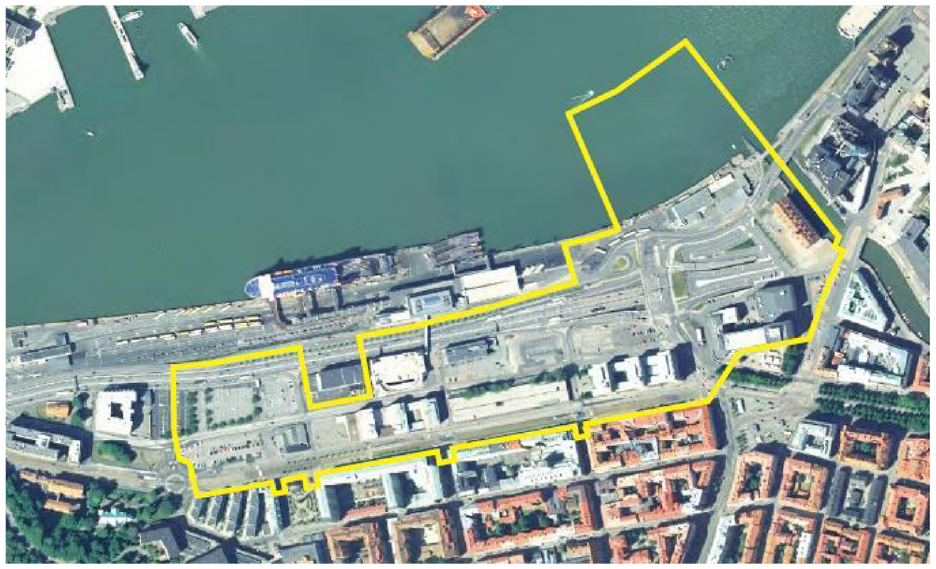
Masthuggskajen pre-development. The approximate area subjected to development can be seen within the markings (Göteborgs Stad, 2017b). Directly to the south one can discern the area of Linnéstaden with its popular Långgatorna quarters.
Directly to the north, a major expressway and a ferry terminal cut off Masthuggskajen from the river of Göta Älv. On the opposite side of the river is the old dockyards area Norra Älvstranden (‘North Riverbank’), which has also experienced massive constructions of multi-family housing and office buildings in the past decades. Yet, the new developments have received critique over the years, including that they lack contact with the surrounding areas, that they do not offer enough of an architecturally varied streetscape and mix of functions, as well as the fact that they have not led to enough of a mix in terms of residents and visitors (Forsemalm, 2011; Thörn and Holgersson, 2016).
According to some, the popular district directly to the south of Masthuggskajen called Linnéstaden (‘City of Linné’), especially the quarters called Långgatorna (‘The Long Streets’), lives up to the types of qualities that Norra Älvstranden does not (Forsemalm, 2011). Substantial parts of Linnéstaden are characterised by an orthogonal and architecturally varied streetscape. Furthermore, large parts of the building stock feature facilities at street level catering for shops, restaurants, and cafés, as well as for artists, culture, public sector services, non-governmental organisations, small businesses, etc.
Framing the qualities and values of Masthuggskajen’s ground floors
With the help of the theoretical framework, this section will provide a chronological exposé of how the values and qualities of Masthuggskajen’s existing and future ground floors were framed over 10 years of redevelopment. The analysis will specifically focus on inter-organisational activities, as well as the plurality of modes of valuation taking place as part of these.
2008–2010: Parallel visions of a future Masthuggskajen
The redevelopment of Masthuggskajen began in 2008. At this point the politicians in the Municipality of Gothenburg (from here on, ‘the Municipality’) assigned to the City Planning Department the task of producing a vision document (‘Planprogram’ in Swedish) defining what a future ‘inner-city area with a mixed character’ with new housing, offices, and public spaces could look like, just like the surrounding Linnéstaden district (see Background section) (Göteborgs Stad, 2010: 2). The vision (as well as several supplementary documents and calculations) was produced by a team of civil servants with input from consultants, citizens, and local property owners.
The vision document adopted two years later proposed that around twenty new buildings should be constructed in the area, arranged in an orthogonal, grid-like, structure. It also proposed that both old and new buildings should feature facilities at street level, as illustrated in several site plans. On top of this, the vision advocated that these facilities should cater to shops, cafés, restaurants, and other commercial establishments. It also advocated that the ground floors should be public, alive, interesting, and feature a mix of uses, associating such characteristics with an attractive, economically robust area with plenty of street life. The vision stated that schools, kindergartens, and similar services could potentially be located at ground floor level. However, as such functions already exist in adjacent areas, their role in Masthuggskajen is seen as limited.
In parallel, several local property owners prepared visions of their own. The property owner Folkets Hus expressed an interest in building a hotel, whilst Elof Hansson Properties wanted to create a cluster of office towers with a focus on international business and trade. The firms Stena Property and Riksbyggen were interested in investing in apartment buildings. As indicated by both observational data from the period and later interviews, several firms uttered scepticism towards the Municipality’s redevelopment plans. In some cases, this had to do with the property developer in question having more of a modernist style in mind for the area with mono-functional office and/or apartment buildings, akin to the Norra Älvstranden district at the opposite side of the river (see Background section). In other cases, the scepticism had to do with each developer wanting to focus on its own plans, thus having little interest in taking a holistic perspective on the entire area.
With the help of the theoretical framework, several wider points can be made about the first two years of the regeneration scheme. To begin with, the above-mentioned practices and devices of the Municipality framed future Masthuggskajen as an area with the kinds of urban qualities (Callon et al., 2002) typically associated with the term ‘active frontages’, such as public facilities, commercial uses, interactivity and transparency (Heffernan et al., 2014; Kickert, 2016). In comparison, non-commercial uses were actively devalued (Glucksberg, 2014), as in the case of schools and kindergartens, or left out of the frame (Goffman, (1986 [1974]), as with non-profits and social enterprises. Furthermore, municipal valuations drew upon at least four value scales (Aspers and Beckert, 2011), namely those of attractivity, street life vitality, economy, and cultural history. This illustrates the wider argument of valuation studies: that single actors and settings often are characterised by value plurality (Lamont, 2012). It should also be noted that the Municipality’s valuations were carried out by the means of several value devices (Aspers and Beckert, 2011), the vision document playing the most pronounced role of these.
In comparison, the framing practices of the property owners differed from each other in their diverging spatial qualifications, as each mainly zoomed in on its own buildings, leaving the qualities of other parts of the area out of the frame. Furthermore, the embracing of modernist urban qualities from the side of several property owners is an example of Vatin’s (2013)valorisation. Finally, it must be noted that these particular valorisations came in conflict with that of the Municipality, given the latter’s valorisation of Masthuggskajen as a traditional inner style area with active ground floor facilities.
2012–2015: A working group, a retail study, and a place identity
In the year 2012, the Municipality commenced turning its vision into a legally binding land-use plan (‘Detaljplan’ in Swedish), a process that would take six years to complete. The Municipality’s responsibility was also one of developing Masthuggskajen’s public open spaces: streets, docks, parks, and squares.
The development of the plan was carried out in cooperation with a newly formed property development consortium (from here on, ‘the Consortium’) featuring the four local property owners mentioned in the previous section, plus a municipally-owned property development company called Älvstranden Utveckling, and a multinational firm named NCC Property Development. During the upcoming years, the Consortium got involved in a range of activities relating to different aspects of the land-use plan. One of these was the forming of a working group with consortium representatives, named the Active Frontages Team, the objective of which was to enforce active frontages in the area.
Leaving the empirical material aside for a moment, it can be argued that the forming of the Consortium (and its Active Frontages Team) resulted in the establishment of a shared frame among the companies, which, in Vatin’s (2013) sense, valorised active ground floors as an urban quality of Masthuggskajen. This means that the framings of the property developers and the Municipality had by now moved closer to each other. Thus, the value conflict described in the previous section had to some extent been resolved.
Soon after the Active Frontages Team had been formed, it decided to commission the retail consultant WSP to carry out a study on ground floor uses in Masthuggskajen relating to restaurants and shops. The consultant analysed the area’s current stock of retail outlets, bars, and restaurants, as well as creating future scenarios, including appraisals of their economic viability. The consultant concluded that there was a market for certain types of shops, restaurants, and bars in the district, whilst other markets, such as that for grocery shopping, was relatively saturated (WSP, 2014: 14).
As a next step, the Active Frontages Team commissioned the place branding firm Invinn and the retail consultant TAM Retail to formulate an ‘identity’ for Masthuggskajen, based on an assessment of its so-called ‘commercial functions’. The consultants spent several months analysing the area’s history and characteristics. They also arranged a series of workshops with the Consortium. Soon, however, friction arose. Whilst some of the participants had a district in mind with commercial and prime real estate, others pictured something more akin to the previously mentioned Långgatorna quarters, with its diversity of uses, users, functions, and rent-levels. As will be seen below, the identity that the actors came to agree upon in the end, in fact, featured both prime commercial real estate and ambitions of social and functional mix. This would be a good way of positioning the area in relation to other districts in Gothenburg, the argument went (Invinn, 2015).
Once again taking a step back from the empirical material, it can be argued that the Consortium’s move to employ the two consultancy teams functioned as a means of filling the above-mentioned frame focused on Masthuggskajen’s commercial uses with meaning. Furthermore, by looking at the work of the consultants with the help of Vatin’s (2013) concept pair, it becomes evident that their work not only involved practices of evaluating existing ground floor qualities in the area, but also of valorising certain qualities whilst devaluing (Glucksberg, 2014) others, as, for example, can be exemplified by WSP’s future scenarios. Furthermore, the notion of value plurality (Lamont, 2012) once again shed light on how the valuation practices of a specific type of organisational actor (in this case: ‘The Consultant’) made use of several types of value scales in parallel, including those of attractivity, street life-vitality, economy, and cultural history. Finally, the fact that the Municipality made use of the same value scales (as described in the previous section), illustrates how actors, even though they have different goals, still can draw from the same types of value when evaluating plans and designs
2013–2016: A sustainable Masthuggskajen
In parallel to the creation of the Active Frontages Team, the Consortium formed another working group featuring consortium representatives with the objective of settling the sustainability ambitions of the entire regeneration scheme (Älvstranden Utveckling, 2015; Wernstedt, 2015). The team eventually formulated nine sustainability goals that defined what a sustainable Masthuggskajen should be (Älvstranden Utveckling, 2015). Amongst many other things, the goals argued that a sustainable Masthuggskajen should feature ground floor facilities with plenty of activity day and night and a mix of tenants and rent-levels. Such ground floors, the argument went, would attract consumers and visitors from all over the city, as well as stimulating environmentally sustainable lifestyles.
The production of the goals, however, led to friction in the Consortium. According to several interviewees, this friction, amongst other things, arose out of a suggestion from some members of enforcing a mix of rent-levels in Masthuggskajen. The Consortium members did eventually agree on this ambition, in large part by leaving the question of how it would be achieved in practice unanswered. Instead, the Consortium, this time together with the Municipality, continued the process of elaborating upon the goals in a major strategy document called the Sustainability Programme (Göteborgs Stad, 2017a). The programme, which was adopted in 2017, contained an action plan with several actions that needed to be taken if the ambition of active frontages was to be turned into reality. These included:
To carry out a dialogue with a broader group of stakeholders than previously had been the case (arts, culture, non-profits, etc.);
To create and trial new methods and business models that would allow for a greater mix of tenants and rent-levels in Masthuggskajen; and
To produce an innovative model for how the property owners collectively could govern and manage Masthuggskajen’s ground floor facilities over the long run.
It can be argued that the practices described in this section enforced a partly different way of framing Masthuggskajen’s ground floors among the Consortium parties, from that of the previous section. This frame not only valorised active frontages as a quality of a sustainable district but also included a broader set of qualities, most notably those of tenant and rent-level mix. Once more, a plurality of value scales was employed by the Consortium parties. Most notably, value scales relating to environmental issues, social mix, and inclusion got a more pronounced role at this point. Another thing worth noting is the important role that the sustainability goals came to play as a form of value device (Aspers and Beckert, 2011). First, the goals helped valorise the ground floor qualities just mentioned by materialising these into a shared document. Secondly, the goals helped spread this valorisation to a broader set of organisational actors when the goals were integrated into the Sustainability Programme. Lastly, it can be noted that even though the parties had accepted the shared frame, conflicts could still arise between specific valuations, of which the above-mentioned conflict between economic returns and rent-level mix is an example.
2015–2017: Defining Masthuggskajen’s urban qualities
In parallel to the creation of the Sustainability Programme, the Consortium and the Municipality decided to produce a strategic document called the Quality Programme (Göteborgs Stad, 2017b), the objective of which was to define the ‘qualities’ of a future Masthuggskajen, especially those relating to architecture and programming of outdoor spaces and facilities.
The Consortium gave this task to an architecture firm by the name of Kanozi Architects, and an engineering company named ÅF. The consultants carried out their task through an iterative process where designs were continually presented to, and discussed with, municipal employees and consortium representatives. Additional teams of architects and engineers commissioned by each property developer played a role in materialising the wills of each property firm into individual design briefs. The material shows proof of repeated moments of friction not only between organisational actors, but also between individuals employed by a single organisation, for example, an individual property firm.
The Quality Programme that was adopted in the year 2017 proposed a broad range of urban qualities. This was done in relation to a variety of spatial scales (the entire area, sub-areas, individual buildings, etc.) and subject matters (such as housing, sound environment, greenery, and stormwater design). Amongst others, the programme included a range of site plans proposing geographic locations for ground floor facilities, including appropriate types of tenants, such as grocery stores, restaurants, bars and cafés, maker spaces, spaces for artists, and community spaces (see Figure 2 for an example of a site plan illustrating the distribution of public facilities and additional functions). The programme also proposed a range of architectural and aesthetic ground floor qualities, including those of transparency, openness, ample doors and windows, indented entrances, contrasting aesthetic expressions, and a feeling of intimacy and inclusion. Such qualities, it was argued, would contribute to an area that is dynamic, interesting, stimulating, full of contrasts, and attractive to a wealth of people, belonging to different economic and cultural backgrounds, age groups, and gender identities.
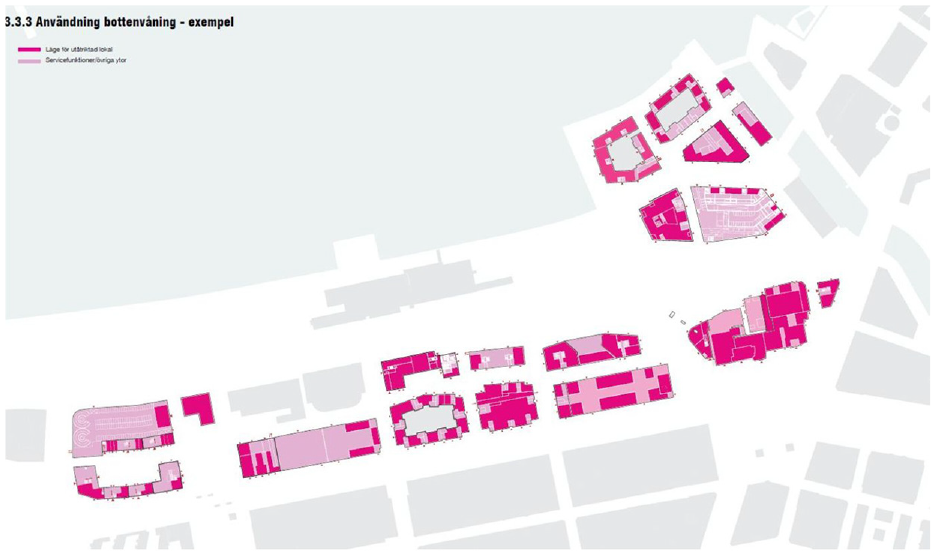
Site plan extracted from the Quality Programme exemplifying how public facilities and other functions (e.g., entrances) can be distributed over Masthuggskajen’s ground floors (Göteborgs Stad, 2017b).
Leaving the empirical material aside for a moment, it can be argued that the creation of the Quality Programme involved yet another way of framing the qualities and values of Masthuggskajen’s ground floors. One thing that distinguishes this mode of framing from that of previous activities is its diverging spatial focus on architectural design, aesthetic details, and programming of public spaces and facilities. Another thing that distinguishes it is the central role that architects and their visual representations played throughout the production of the Quality Programme. In fact, the site plans and renderings produced by architects functioned as value devices in a similar way to what the Sustainability Goals had previously done. In all this, value scales related to the aesthetic appearance (aesthetic value) and physical design (architectural value) played a more pronounced role than they had before, alongside scales having to do with attractivity, economy, environment, cultural history, inclusion and social mix.
2016: Involving stakeholders
In 2016, the Active Frontages Team carried out a stakeholder dialogue process, as had previously been suggested in the Sustainability Programme (Urban Innovation, 2017). The team formed several working groups with consortium members, consultants, and stakeholders, each asked to represent the interests of one of the following sectors: retail and restaurants, culture, non-profits, offices, housing, and municipal services. After several months of deskwork and discussions, each working group had produced a report presenting its main conclusions. Each report described and discussed the role that the stakeholder group in question currently played in Masthuggskajen, as well as the kind of role it could play in the future. The report from the culture working group, for example, both mapped cultural actors that were presently active in the district and suggested future investments, such as building a house for dance, creating a ‘horizontal cultural house’ distributed over the area’s ground floors, and providing facilities with low rents. The other groups produced similar reports.
The events described in this section introduced yet another mode of framing Masthuggskajen’s ground floors, namely from the perspective of specific stakeholder groups. One thing that is especially interesting from a valuation studies perspective is how the format of the stakeholder process had individuals from different types of organisations engaged in evaluating ground floor qualities based on what was deemed good or bad for ‘their’ stakeholder group. This means that suddenly, individuals that were employed by the same organisation, but at this specific moment ‘belonged’ to different stakeholder groups, now diverged from each other in terms of modes of valuation. This confirms the core argument of valuation studies: that actors, whatever goals they have, typically shift practices and criteria of valuation depending on the situation. Another thing worth noting is how the working groups, even though they engaged in diverging modes of valuation, made use of similar value scales (economy, attractivity, social mix, cultural history, environment, etc.). This once again illustrates the argument of valuation studies that actors, even though they have different goals, can still make use of the same value scales when performing valuations.
2016–2017: Programming the ground floors
After the stakeholder process had been finished, the Active Frontages Team started producing a so-called Strategic Masterplan, the objective of which was to translate the results of the stakeholder dialogue into ground floor programming (Rstudio and TAM Retail, 2018). This time the Active Frontages Team commissioned the retail consultant TAM Retail and the architecture firm Rstudio, to create the document.
The adopted document includes a variety of site plans, describing possible ways of designing the ground floors in different parts of Masthuggskajen and suitable tenants and rent-levels for each facility. However, as suggested by observational data from this period, the process was permeated by underlying issues of market competition, something which reduced the motivation of each property developer to give away too much information about their plans. Allegedly, this is one reason why the production of the masterplan instead put focus on the clustering of different types of tenants and appropriate rent-levels for each cluster. The final version of the plan describes several such clusters. It proposes that whilst the eastern parts of the area will house retail and culture clusters, the western part will house clusters of nightlife, circular economy, and local services (such as pharmacies and community spaces).
The framing practices described above focused on the programming of Masthuggskajen’s ground floors. Thus, valuation practices largely revolved around the question of what types of tenants should be integrated into what facilities. The focus on programming, as well as the central role of architects and visual representations, is something that the Strategic Masterplan shared with the production of the Quality Programme. Although for the former, in comparison with the latter, the framing practices now had an exclusive focus on street-level qualities, leaving other types of qualities, such as those relating to housing, stormwater management, and sound environment, out of the frame. Another difference compared with the earlier inter-organisational initiatives is that the production of the masterplan involved economic valuations, as in the above-mentioned attribution of rent-levels to different facilities. It is noteworthy that this mode of valuation hitherto had been predominantly left out of the frame. On top of this, the valuation practices performed at this point once again drew from a plurality of values, such as those of street-life vitality, social mix, inclusion, architecture, environment, and aesthetics.
2017: Ground floor governance and an adopted land-use plan
In 2017, the Active Frontages Team pursued one more of the actions from the Sustainability Programme, namely that of creating a model for long-term ground floor governance. As a way of achieving this, yet another working group was formed, this time consisting solely of representatives of the Consortium organisations.
After several months of deskwork, consultations with experts, and discussions within the Consortium, the Active Frontages Team adopted a short document presenting the model. The document described the consortium companies’ intention to form a partnership organisation directed at Masthuggskajen’s future property owners. The organisation’s objective would be to govern, manage, and perhaps also own, the entire set of ground floor facilities in the area. It also proposed that the organisation would handle rental requests, as well as be responsible for selecting tenants for each facility. The group would do this by drawing upon plans and strategies such as the Sustainability Programme and the Strategic Masterplan, thus making sure that future tenants could contribute to making Masthuggskajen a living, attractive and inclusive area in the long run.
However, even after the model had been adopted, several uncertainties and sources of friction remained. One of these concerns was how below-market rents could be enforced in newly built facilities, without each property owner having to compromise too much of its economic returns on investment. As a means of resolving this uncertainty, the working group started exploring various business models, including:
To have the Municipality subsidise rents;
To have facilities with higher rents subsidise the rents of other facilities; and
To stimulate the sharing of facilities as a means of lowering rents for individual tenants.
This episode illustrates the rise of yet another mode of ground floor valuation. This mode can, after Helgesson and Muniesa (2013), be seen as involving a shift in the object of valuation, from one of ground floor qualities to one of ground floor governance and management. Consequently, valuation practices at this point focused on valuing potential models for facilities management, rather than potential ground floor qualities. Having said this, it’s important to note that several of the value criteria that had hitherto been stabilised into plans, calculations, and other examples of Aspers and Beckert’s (2011) value devices, still played an important role in the work that the Consortium did on evaluating facilities management models. Another important point to make is that these value criteria were further stabilised when they were integrated into yet another value device, namely the model of ground floor governance.
In the middle of 2018, the legally binding land-use plan, work on which had begun six years earlier, was finally adopted by the municipal politicians (Göteborgs Stad, 2019). The plan, amongst others, emphasised that all buildings in Masthuggskajen should have public facilities at ground floor level. It also defined a range of technical and architectural characteristics that the ground floors in the area would have to live up to, including that street-level entrances should face the street, that distances between entrances should be a maximum of 22 metres, and that at least 50% of the ground floor façades should be made of glass.
The adoption of the land-use plan meant that the framing that had been proposed by the Municipality ten years earlier had now become legally valorised. Seen through the lens of the theoretical framework, the plan functioned as a value device (Aspers and Beckert, 2011) stabilising several architectural and technical qualities. One thing that distinguished this value device from those previously discussed in the paper is how the values that it articulated were in fact, from a legal perspective, non-negotiable. All parties to the scheme would have to live up to them. At the same time, it is worth noting that the land-use plan left most of the ground floor valuations that had been agreed upon previously in the scheme out of the frame (Goffman, (1986 [1974]). Consequently, this means that several of the most pressing value conflicts had, in fact, been suspended into the future: most noteworthy, that relating to rent-level mix.
Discussion
The aim of this paper has been to generate knowledge on the framing of urban values and qualities in inter-organisational settings making up wider urban development projects. The following section will discuss several theoretical implications of the study.
To begin with, in inter-organisational settings, actors can be expected to change modes of valuation with the situation. The case study has shown how organisational actors that initially entered the process with diverging goals, over time came to develop a shared object of valuation, namely ‘the active frontage’. Furthermore, on repeated occasions, the actors could be seen collectively shifting the ways in which the qualities of this object were framed. This can, for instance, be seen in the above-mentioned shifts from a primarily-commercial framing to framings related to sustainability, stakeholders, programming, etc. Thus, a focus on inter-organisational settings seems to draw the researcher’s attention toward the practices and criteria of valuation that are shared by several organisational actors. This to some extent marks a contrast to the analysis of Metzger and Wiberg (2017) which highlights differences between organisational actors. Having said this, a downside to focusing on inter-organisational valuation seems to be that differences between actors may not be as apparent as they might be in studies focusing on intra-organisational valuation.
Furthermore, this study of Masthuggskajen has not had one single valuation practice or value device as its object of analysis. Instead, it has covered the unfolding of a range of practices and devices over a period of 10 years. Using the words of Brandtner (2017), it can be argued that the study has had a focus on evaluative landscapes, defined as the collectivity of valuation practices that happen in a specific context. This focus is, in fact, something that also can be said to characterise Metzger and Wiberg’s (2017) paper, even though they do not explicitly draw attention to this fact. Regardless, based on the Masthuggskajen case it can be argued that studying wider landscapes of valuation brings to light other aspects of urban development processes than does the study of single valuation practices. The former approach brings to light broader relationships between actors, practices, and devices and, therefore, it can also be expected to generate a less detailed description than an approach that would, for example, apply Metzger and Wiberg’s (2017) framework to the study of a single valuation practice or device (see e.g. Lindblad, 2020).
In urban development processes, modes of valuation can be expected to constantly morph. This paper has focused on a specific object of valuation, namely ‘the active frontage’. Yet, over the course of the 10-year redevelopment scheme, this object experienced repeated transformations. Firstly, the case illustrates how the framing of urban values and qualities can jump back and forth between different spatial levels. Secondly, the case has shown how the framing of urban values and qualities can take place at different temporal levels. This mirrors a classical distinction between frames that diagnose the present and frames that prognose the future, as can be exemplified by a recent study on urban framing by Lau (2018).
The notion of value scales allows one to extrapolate and compare different higher-order forms of value drawn upon in an urban development process. Firstly, the case has exemplified how organisational actors in specific settings can carry out valuations by the means of a plurality of value scales. Secondly, the case has illustrated how organisational actors over time may shift value scales. Thirdly, the case has shown how the same value scale can be employed in different ways in different situations, for example, as seen in how the scale of economy was used in different ways in Masthuggskajen.
The empirical case has revealed how different types of value (and thus value scales) were important at different times in Masthuggskajen. No forms of value or valuation practices were put at the centre of attention by the researcher. This, named here as evaluative agnosticism, has strengthened the argument made in the article’s introduction that the field of valuation studies has indeed a role to play vis-à-vis other strands of research that, in comparison, put specific forms of value and valuation procedures at the centre of attention, such as environmental value or financial valuation. Thus, it can be argued that a focus on value plurality might keep the researcher from making a priori decisions on what values are driving a particular urban development process. In other words, it seems to keep certain types of value from being treated as an insidious and taken-for-granted ‘dark matter’ (Metzger et al., 2017), paraphrasing a recent critique of how the concept of power has traditionally been employed in urban literature. Yet, it must also be noted that there is a downside to focusing on value plurality, namely that by levelling the playing field between different forms of value, the researcher risks losing sight of the power dynamics that are always a part of the development of our cities.
Conclusions
This article has demonstrated how the valuation studies approach can be used in urban studies, interrogating the recent redevelopment of the Masthuggskajen district. In this inter-organisational setting, repeated shifts took place regarding how the qualities and values of the area’s ground floors were framed. As the case study has shown, this process started during early visioning, in which the Municipality framed active frontages as an important quality of a future inner-city style district, while local property owners tended to devalue this quality. However, over time ‘the active frontage’ became collectively valorised among the parties, at the same time as its qualifications shifted. The story ends with the adoption of a legally binding land-use plan, in which the quality of ‘ground floor activity’ was finally valorised from a judicial perspective, whilst other qualifications were left out of the frame, such as that of rent-level mix.
So, what are the wider theoretical implications of this paper? Firstly, the paper has hopefully illustrated the fruitfulness of using Metzger and Wiberg’s (2017) framework to analyse the framing of urban values and qualities in inter-organisational settings. Yet, as has been discussed above, a downside to such an approach is that it risks downplaying differences between organisational actors, in its focus on shared modes of valuation. Secondly, the approach of studying inter-organisational valuation, in comparison to that of studying intra-organisational valuation, allows the researcher to see how different actors sometimes employ the same types of value scales and practices of valuation even though they have quite different goals. Thirdly, the paper has shown the merits of augmenting Metzger and Wiberg’s framework with a systematic focus on value plurality. However, the paper has also touched upon the risk that the evaluative agnosticism that often follows from the study of value plurality, might risk making the researcher neglect power asymmetries. Hence, it is imperative for future research to examine why it is that, in situations of value plurality, some values end up having performative effects, while others fall out of frame.
Footnotes
Acknowledgements
The author would like to thank the editor and the reviewers for their helpful comments. The author would also like to thank the City of Gothenburg and Mistra Urban Futures for being part of the research.
Declaration of conflicting interests
The author declared no potential conflicts of interest with respect to the research, authorship, and/or publication of this article.
Funding
The author disclosed receipt of the following financial support for the research, authorship, and/or publication of this article: This research has been funded by Centre for Management of the Built Environment at Chalmers University of Technology.
