




Abstract
As China encourages urbanisation, a necessary process is the urbanisation of its people, granting local-urban hukou, or local citizenship, to migrant populations. But reforms encouraging urbanisation are dependent on migrant populations wanting to become formal, registered urban residents. What is the demand for hukou? Based on a unique probabilistically-sampled contingent valuation survey of over 900 migrants in Beijing and Changsha, we use migrants’ willingness-to-pay for hukou as a measure of demand for urbanisation. We find that migrants in Beijing are willing to give up between 9% and 14% of their income over five years to gain local-urban hukou. Migrants in Changsha are much less willing to pay for hukou with a willingness-to-pay indistinguishable from zero, and rural migrants have a negative willingness-to-pay. This study contributes to the broader literature on the impact of China’s hukou system by providing a unique test of migrant workers’ willingness-to-pay for local citizenship.
Introduction
Urbanisation is a primary driver of economic development in China. Research on Chinese urbanisation often focuses on industrial policy and the drive to urbanise land, especially as land provides important financial resources for local development (Cai et al., 2021; Huang and Du, 2017; Su and Tao, 2017). Following the urbanisation of land and capital, however, is the urbanisation of people. Domestic migrants in China are considered outsiders when they move to cities. Moving to and working in an urban setting neither makes you urban in the eyes of the state nor entitles you to urban citizenship rights including local welfare and political rights. Migrants are bureaucratically excluded from local government services because they do not have local-urban household registration status, or hukou (Chan, 2009; Cheng and Selden, 1994; Solinger, 1999; Vortherms, 2015; Woodman, 2016).
A hereditary identity document, the hukou labels individuals as urban or rural and assigns them to one locality. Welfare programmes were traditionally divided by urban and rural types and citizens were only entitled to permanent access to these benefits in the municipality of registration. When workers migrate and do not change their hukou, they become second-class citizens in their own country. The continued division of the population by hukou registration segregates China’s labour market, disrupts migration, and denies domestic migrants access to government services.
The central government has long pressured local governments to open hukou transfer policies, allowing more migrants to obtain local-urban hukou. But even if programmes are opened, migrants themselves must apply to change their hukou. Transferring one’s status provides access to government services and programmes, but not all migrants wish to become local because it also requires relinquishing any previously held hukou and affiliated rights. How much are migrants willing to give up to gain local-urban status? What types of migrants are more willing to become local-urban? If migrant workers are unwilling to change their hukou, policies meant to increase labour market fluidity in cities will have little impact. If individuals have agency over the decision to change their hukou status, the success of China’s urbanisation policies will depend on migrant demand for access to hukou.
Our analysis uses a multi-method approach, drawing on semi-structured interviews with policy makers, human resource managers, and migrants themselves conducted between 2012 and 2017. 1 Interviews inform an original, probabilistically-sampled survey of 909 migrants and rural workers in Beijing and Changsha to measure willingness-to-pay (WTP) for local-urban hukou through a common process we call ‘hukou as benefits’. We estimate both the impact of hukou on wages for migrants willing to pay for a hukou transfer and the overall WTP for hukou among migrants. We find that migrants are willing to forego 9%–14% of their wages for five years to get local hukou. Aggregate WTP is approximately 13% in Beijing but neither positive nor negative in Changsha. Fully controlled models show that the value of migrants’ existing rights have different impacts in our two sample cities. This suggests that the influence of family resources on local naturalisation depends on the local context.
This analysis contributes to the broader literature on hukou by highlighting variation in demand for local-urban citizenship in China. Many bureaucrats and policymakers assume high demand for local-urban citizenship when writing urbanisation policies, without taking into consideration the fact that permanent migration via hukou transfer is, in the end, dependent on the migrant themselves.
Implications of this research are particularly important as the Chinese central government advances hukou reform. Recent reforms pressure local governments to formalise hukou transfer policies and increase migrant naturalisation. Six years after a major central reform in 2014, estimates suggested the reforms have had little impact on integrating the ‘floating population’ by encouraging hukou transfers (Chan, 2021). In 2019, an estimated 290 million migrant workers still lacked access to urban citizenship in China, a country that holds almost one fifth of the world’s urban population. The success or failure of these reforms depends on migrant workers’ desire to change their hukou status.
Hukou system
A key pillar of the command economy fully cemented in 1958, 2 the hukou is an identity document that distinguishes individuals as urban or rural based on their family’s work unit in the 1950s and assigns them to one geographic location (Cheng and Selden, 1994). As a hereditary, caste-like institution, status is passed down from parent to child regardless of the family’s current employment or physical location. During the Mao era, people were not allowed to move or work outside of their area of registration. Reforms in the 1980s and 1990s broke down these mobility barriers, but the complex institutions governing local provision of welfare and a wide range of citizenship rights remain tied to hukou registration (Solinger, 1999; Vortherms, 2015; Woodman, 2016). Permanent entitlement to government services, such as public education, health insurance plans, and property rights, still depend on where you are registered (Chan, 2009; Cheng and Selden, 1994). Migrants now live and work in every city in China but face significant barriers to accessing government services in their place of residence.
Since the late 1990s reform to the hukou system focussed on easing transfers by institutionalising processes for changing one’s hukou, or the process of urbanising people in the hukou system. In the 1990s, ‘blue-print’hukou were granted to individuals who invested locally, although this status did not bestow as many rights as local-urban status (Chan, 2015). Local governments also began a rural-to-urban transfer system to integrate rural populations to urban status when beneficial for urbanisation processes (Chan, 2009).
After 2001, local governments controlled who is allowed to transfer their hukou registration in processes akin to international immigrant naturalisation (Vortherms, 2015). Migrants must qualify for local naturalisation; go through an application process involving four levels of government which can include upwards of 100 documents; secure one of the limited quota for transfers; and cancel their previous status. 3 More like a citizenship document than a driver’s licence, it is difficult to change your registration and most of China’s migrant workers never get the opportunity.
The 2000s and early 2010s saw greater institutionalisation of transfer programmes related to firms and labour recruitment. Cities in Guangdong as well as other large cities in other provinces implemented a point-based system whereby individuals with higher education, training, or investment experience could apply for local status, much like Canada’s Skilled Worker Visa (Zhang, 2012). Further reform in 2014 pushed lower barriers for transfers in small and medium cities, greater institutionalisation in large cities, and stricter policies in extra-large cities. National-level reforms, including those in 2001, 2011 and 2014, however, explicitly delegate authority over policy details to municipal and county governments, which lead to superficial reforms and significant variation in the impact of reforms on liberalising the system (Chan, 2014; Chan and Buckingham, 2008; Wallace, 2014). In practice, national reforms led to a proliferation of pathways to transfer hukou. These represent an intentional layering effect on institutional reform rather than a full displacement of institutions. 4
Reforms in 2014 also encouraged localities to expand social services outside of the hukou system. There has been some progress integrating urban and rural medical programmes, but many of these programmes remain segregated by hukou and even successful cases of integration are highly varied below the national level (Huang, 2020; Yang, 2021). Similarly, the 2014 reform encouraged cities to implement a residency card on top of the existing hukou. Easier to obtain than hukou, they entitle holders to limited social welfare. These cards existed well before the 2014 reform in many cities, including in Guangzhou and Shanghai, and research routinely finds they do not fully replace the fundamental divisions in the hukou system (Guo, 2010; Wang, 2014). As one article argues, residency cards are ‘old wine in new bottles’ with full, permanent access to welfare policies still dependent on hukou status (Li et al., 2010).
Demand for hukou
Uptake of national reform – the actual integration of migrants in the hukou system – depends on demand for hukou at the individual level. Just how valuable is local citizenship through the hukou system?
Choosing to naturalise locally, to change one’s hukou, is akin to an international naturalisation decision, especially for those who have already migrated. One can move, live, and work, but remain an outsider – a ruralite or a non-local. Why naturalise? If reforms to mitigate differences in hukou status were successful, is hukou still in high demand for some people?
Why migrants naturalise in one country after immigration provides a theoretical framework to understand demand for hukou. International naturalisation is a cost-benefit decision (Bevelander and DeVoretz, 2008). Structural economic, household, and individual factors all contribute to the cost-benefit calculation of migrants moving and settling in new locations (Massey et al., 1993). Based on the international literature, costs are primarily driven by bureaucratic barriers to naturalisation (Dronkers and Vink, 2012; Peters et al., 2016) and the challenge of assimilation. When assimilation into society is difficult for migrants, naturalisation is less likely (Diehl and Blohm, 2003; Yang, 1994). Benefits of naturalisation primarily come from greater access to rights and economic opportunities (Bevelander and DeVoretz, 2008; Jasso and Rosenzweig, 1986; Kahanec and Tosun, 2009; Nam and Kim, 2012). And migrants may choose to naturalise to avoid discrimination and pass a privileged identity to their children (Logan et al., 2012; Street, 2014; Yang, 1994).
Naturalisation in the hukou system
We expect demand for hukou to follow a similar cost-benefit calculation as international naturalisation. In the domestic context, the costs of hukou transfer are expected to be lower because assimilation should be easier due to a shared national identity. But there is still variation in demand in the domestic context. Benefits of transferring one’s hukou include greater access to local-urban welfare rights, economic opportunity, and social status. Costs of transferring one’s hukou include relinquishing existing rights – including land-use rights – and increasing the difficulty of returning home.
The greatest benefit of transferring one’s hukou is access to local citizenship rights. Accessing citizenship rights, including social and political rights, increases the benefits to naturalisation (Jasso and Rosenzweig, 1990). Naturalisation rates among elderly immigrants in the US, for example, increased when welfare reform made it more difficult to access public assistance for non-citizens (Nam and Kim, 2012). Local-urban citizenship provides access to a variety of local services such as local schools, certain pensions, minimum wages, and healthcare, as well as administrative services such as getting national ID cards and passports. Formal employment can provide some access to social security systems, but as few as a quarter of migrant workers secure permanent job contracts (CHIPS 2013). Even transferable benefits like pensions have limits for migrant workers, including incomplete transferability (Zhang and Li, 2018).
Economically, naturalisation can improve labour market outcomes (DeVoretz and Pivnenko, 2005; Diehl and Blohm, 2003). In the Chinese context specifically, migrants experience greater turnover and mobility across industries (Ou and Kondo, 2013). Both non-local and rural migrants face wage and hiring discrimination (Cheng et al., 2013; Gagnon et al., 2014; Hlásny, 2017; Knight and Song, 1999; Lee, 2012; Lu and Wang, 2013; Song, 2016; Zhang, 2011). Gaining local-urban hukou, even at a cost, can open job opportunities that favour locals. As one migrant said, ‘eat a little bitterness today to ensure tomorrow’s opportunities’. 5
In addition to accessing government services and economic opportunities, local hukou status provides symbolic value that can impact social status. Migrants from rural areas and lesser-developed cities are often considered ‘uncivilised’ in large, coastal cities. Local-urban hukou from a desirable place can be a prerequisite for marriage. Hukou from Xinjiang, a province stigmatised for being dangerous because of its minority Muslim population, face job and social discrimination. 6 Employers often outright refuse non-locals for fear they will need to leave town for long stretches for medical treatment. 7 This problem also amplifies gender differences, as employers expect women to return home more, meaning non-local woman candidates are often not considered for jobs. 8
Demand for hukou, however, is not always a given. Reforms that provide services outside of hukou transfers reduce some of the benefits of transferring. Migrants who have already moved may not wish to integrate because local naturalisation requires relinquishing existing rights. Because social and political rights are tied to hukou status, changing one’s status means giving up any existing rights at home. This includes health insurance, housing assistance, and individual claims to family land-use rights, which, in most municipalities, is still limited to local-rural hukou holders. This is often seen as a significant loss given that land acts as social security for rural populations (Cai, 2016). 9 Giving up one’s rural status may mean giving up access to this land and this livelihood guarantee. Similarly, before family planning reform allowed more birth quota across the country, many ruralites wished to keep their rural status because they were eligible to have two children. 10 If a migrant prefers the rights provided by their current status, local naturalisation is less appealing.
Urban hukou status may not alleviate the social and market exclusion currently faced by rural migrants, reducing incentives to naturalise locally. Discrimination against rural migrants is already deeply rooted and urban status change is unlikely to change their position in society if they have other identifiable markers, such as speaking a dialect. Therefore, while discrimination creates incentives for status transfers, it also lowers demand.
Naturalising in the new location also makes it difficult to return home. There is no standard for “right of return” to one’s original hukou. Around the time of the 2014 reform, there were almost no formal processes for recovering an old hukou once relinquished. 11 While naturalised migrants can always physically return home, they lack legitimate claims to government services and rights. Village committees are incentivised to keep their populations small to increase redistribution of land and dividends from local enterprises. This prevents backflow into the rural areas once urbanisation policies are implemented, but also reduces incentives for migrants to formally naturalise because transfer has more permanent consequences than migrating without transferring.
Method and data
To assess variation in demand for hukou and its potential impact on wages, we implemented a probability sample survey with experimental questions in Beijing and Changsha, Hunan, in 2015 and 2016. The survey was co-sponsored by Peking University’s China Center for Health Economic Research and hosted locally by Hunan University in Changsha. Beijing and Changsha were chosen purposefully to provide contrast. Beijing is an extreme case of migration and the value of local citizenship is high. Beijing hukou is often depicted as the most valuable in the country. Estimates from Beijing should provide an upper bound of hukou value. Changsha, on the other hand, is a regional hub of migration. Changsha draws a significant number of migrants – 1.4 million migrants identified in the 2010 census – primarily, but not solely, from its surrounding province of Hunan.
Sampling strategy: Defining and sampling migrants
The target population for the survey includeds all those excluded from full urban benefits in their place of residence. Each city’s population can be divided in to four groups based on their hukou location and status: local/non-local and urban/rural. Only local-urban residents enjoy the full set of welfare benefits provided by the city in the location in which they live. The other three categories are excluded from full local citizenship in some way, either because they are not local or not urban. Because of this, local-urban residents were excluded from the target population, but residents in the other three categories were included. The target population can be understood as bureaucratic migrants in the destination location. This includes non-local migrants – those who move across municipal boundaries – and local-rural migrants – those registered in the municipality of Beijing or Changsha, but whose hukou is registered in a different county than where they live and have rural status and are urbanised rural populations. 12
To avoid sampling error related to identifying migrants via household lists (Landry and Shen, 2005), our survey’s sampling strategy employed multi-stage spatial probability sampling. The sampling method resulted in 484 respondents from Changsha and 459 respondents from Beijing. Of these, a total of 909 respondents answered all necessary questions for the analysis. In the Beijing sample, migrants came from 27 different provinces. Changsha migrants were also from a wide range of provinces but local Hunan migrants were the majority. The sample was highly educated compared with expectation of migrants: 38% of the migrants in the sample had a college degree. A 2015 government survey of migrant workers estimates the number with a college degree around 8%. 13 There are two reasons for this discrepancy, first, government reports sometimes do not include urban migrants. Second, the random sample drawn is geographically urban, with relatively few villages being selected into the sample and factory dorms being excluded from the sample due to access limitations. Because migrants often cluster geographically, this sampling strategy increased the possibility of a skewed sample. 14 A summary table of statistics is available in the Appendix.
WTP design
China’s hukou is a non-market good. There are no observable markets where individuals can purchase a hukou other than the black market (Wang, 2010), where a local hukou can cost anywhere between 30,000 and 300,000 RMB (US$4800–US$48,000) depending on the level of city. 15 Without a market, we cannot use revealed preferences to estimate demand. Previous attempts to value hukou use the value of government services granted by hukou status (Liu, 2005; Zhang and Li, 2016). While such calculations help estimate the government burden of potential hukou changes, this strategy misses both important symbolic and non-quantifiable value innate to local-urban hukou– access to the local privileged class – and it does not account for the trade-offs of what individuals lose when giving up their previous status. Because of this, we instead used a hypothetical valuation strategy.
This study employed a dichotomous choice method contingent valuation technique used widely in public policy and environmental studies. 16 In contingent valuation studies, survey respondents are asked how much they are willing to pay for a given good, service or policy. In a dichotomous choice model, survey respondents are presented with one price randomly assigned by researchers from a predetermined range of bid prices. Respondents either accept the stated price or reject it to keep the status quo, mimicking a market purchase decision. Acceptance at different prices then creates an estimated demand curve. Dichotomous choice contingent valuation, or referendum method, is the closest to market decisions and introduces the least amount of design bias (Arrow et al., 1993). A more detailed discussion of this is available in the Appendix.
Hukou as benefits
Based on our analysis of hukou transfer policies across the country, one of the most consistent and accessible processes for hukou transfers was through firm-based transfers. We use this common context of firm-sponsored hukou transfers in our valuation question. Each year the local government provides firms with a quota of how many employees they can sponsor to gain local-urban hukou. The number of quotas a firm receives depends on its ownership status, size, industry, and relations with the local government. 17 These broad policies are called ‘recruitment of high-skilled labour’. Firms use these allotments to either recruit or promote employees, especially those with specialised skills or experience. 18 Even after the reforms in 2001, 2011, and 2014 that encouraged hukou reform, most municipalities still encouraged hukou transfers through firm-based sponsorship, including in Beijing where a human resources officer of a state-owned enterprise reported using hukou in promotion packages after the roll out of point-based systems. 19
Because local-urban status is difficult to obtain for many people, a firm that can offer local-urban status can use this process as part of a benefits package. As a perk of employment, the employee is sponsored by their firm in their application for local-urban status. Because this transfer sponsorship is assumed valuable to potential employees, the firm with access to hukou transfers can act strategically and offer a lower salary with a hukou transfer. If the employee values hukou transfer enough, they would be willing to accept lower wages for an opportunity to get a local-urban hukou. There are many anecdotal accounts of this hukou-as-benefits process, but few attempts to measure to what degree hukou-as-benefits reduces wages.
The elicitation question presented respondents with a prompt that explains how some firms can help employees gain local-urban status. While most individuals know that this work-based transfer system occurs, the prompt giving the basic information was used to ensure that all respondents were at least familiar with the general process. Respondents were then asked to imagine that they were looking for a job and had received two job offers in the same industry at approximately the same type and size of firm. Both firms offered 5-year contracts. To prevent income effects, Company A, which could not provide a hukou transfer, always offered the current income. Company B offered a salary lower than that offered by Company A by a random percent. Each questionnaire was randomised to a bid price [2.5%, 10%, 25%, 50%, 75%, 90%] which represents the gap between the monthly salaries of company A and B. Respondents were then asked which company’s offer they would accept.
The standard model for WTP is
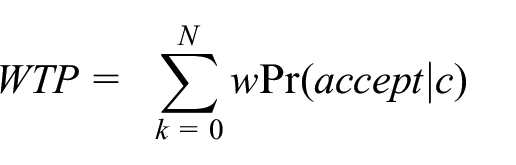
which estimates the cumulative distribution of the probability of accepting the lower wage c across individuals weighted by the bid price variation w. We define this value as the effect of hukou on wages.
The standard WTP model assumes positive demand and pools all respondents who decline the price at zero. When valuing a private good, however, demand could be negative. In the context of hukou, changing one’s status necessitates relinquishing one’s existing status. It is possible that the government would have to pay some individuals to give up their existing status. To account for this, aggregate WTP was calculated as weighted sum of probit coefficients times the sample means over the wage gap coefficient. Thus, we will present the findings in two ways: impact on wages, which allows for a non-monotonic demand curve, and overall WTP which does not assume positive demand.
Below we present pooled sample, sub-sample, and full models for WTP for hukou. In all models, household-level sampling weights are included to account for design effects of the sample. As a robustness check, we calculated the models with individual- and area-level sampling weights. The results remain robust to these specifications.
Results and discussion
Impact on wages
Figure 1 depicts the overall acceptance rates for the Beijing, and Changsha samples, respectively, representing our estimates of hukou impact on wages. The relatively low levels of acceptance at the lower income-gap levels suggest that some populations would never want hukou. There is some evidence that hukou is a non-normal good. For example, acceptance for urban migrants in Beijing is not linear. This suggests that demand is inelastic to price: there are some populations that would be willing to give up their entire income to get local-urban hukou and there are some who would never change their hukou. This is not altogether surprising: when calculating the WTP for a private good, negative WTP is possible, meaning for some populations, the government could have to pay respondents to change their status.
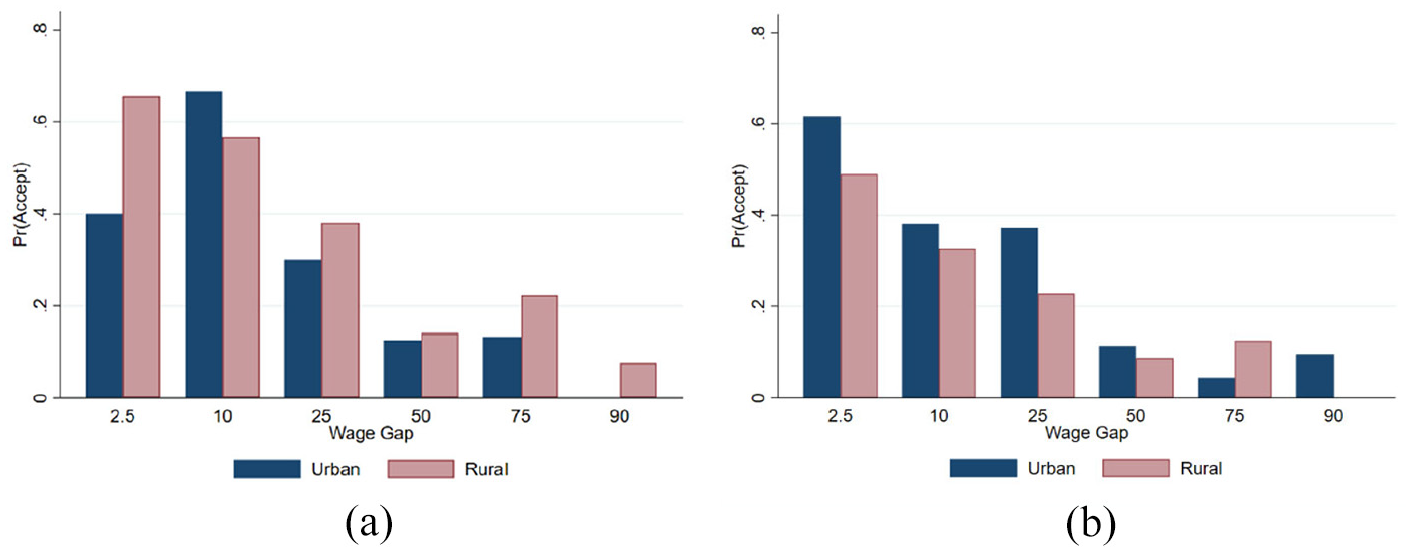
Acceptance rate of wage differences by sample. (a) Beijing. (b) Changsha.
Calculating the impact of hukou on wages as the area under the demand curve, pooled sample estimates access to hukou reduces wages by 12% in aggregate, 13% in Beijing, and 10% in Changsha (Table 1). These values represent the average monthly income survey respondents were willing to give up to work for a company that could help them change their hukou. As expected, the higher impact in Beijing reflects the higher value of Beijing hukou compared with Changsha hukou.
Estimates of hukou impact on wages.
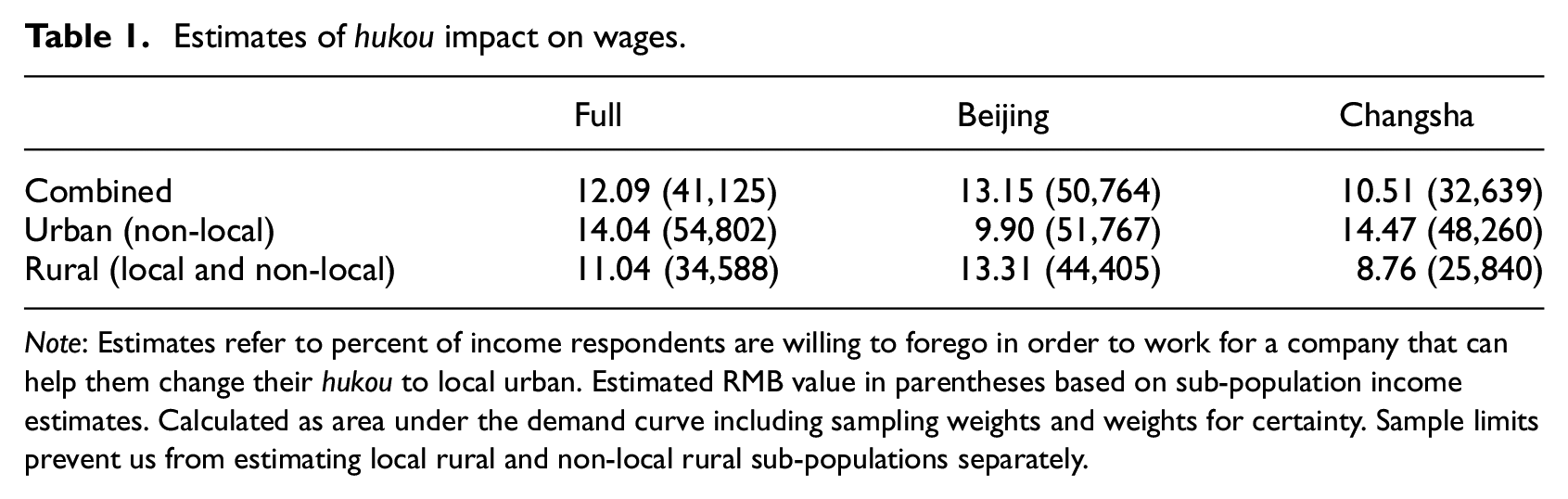
Note: Estimates refer to percent of income respondents are willing to forego in order to work for a company that can help them change their hukou to local urban. Estimated RMB value in parentheses based on sub-population income estimates. Calculated as area under the demand curve including sampling weights and weights for certainty. Sample limits prevent us from estimating local rural and non-local rural sub-populations separately.
When dividing the sample between urban and rural hukou holders, however, we see differences in demand. In Beijing, rural migrants are relatively more willing to give up salary for hukou than urban migrants. In Changsha, the opposite is true: urban-to-urban migrants are willing to take a larger pay cut for access to hukou. This result may be surprising at first glance, but there are a few explanations. First, in this sample specifically, the average monthly income of urban migrants in Changsha is the same as rural migrants in the Beijing sample. This means in absolute value calculated as foregone wages in RMB, urban migrants in Beijing have the highest WTP, followed by urban migrants in Changsha, then rural migrants in Beijing and Changsha, respectively. This suggests that economic variables, like current household socio-economic status, are more important than identity variables, such as urban or rural. Second, bid acceptance rates suggest hukou is a non-normal good for urban migrants in Beijing. This suggests this population may not be directly comparable to other sub-populations. Logically this is plausible because wealthier migrants are less dependent on hukou-based access to government services. Money can substitute for hukou transfer. This then means the transfer decision is less dependent on economics, leading to lower sensitivity to price.
This valuation of hukou should be understood as the impact of hukou on wages, not the overall value of the hukou. Migrants who do not want a change their status would not accept lower wages and the demand curve would be left-censored.
Overall WTP
While assuming a kinked demand curve above provides the impact of hukou on wages, aggregate WTP assumes a monotonic demand curve that allows for WTP to be negative. If WTP is negative, the government would have to pay migrants to change their status. Table 2 presents the aggregate WTP estimates. In the combined sample, only urban residents have positive and significant WTP for local-urban hukou. Non-local urban respondents were willing to forego almost 14% of their monthly income (average 590 RMB, 95 USD per month based on average wages in our sample) for five years. Rural populations have a WTP indistinguishable from zero.
Baseline WTP estimates and 95% confidence intervals.
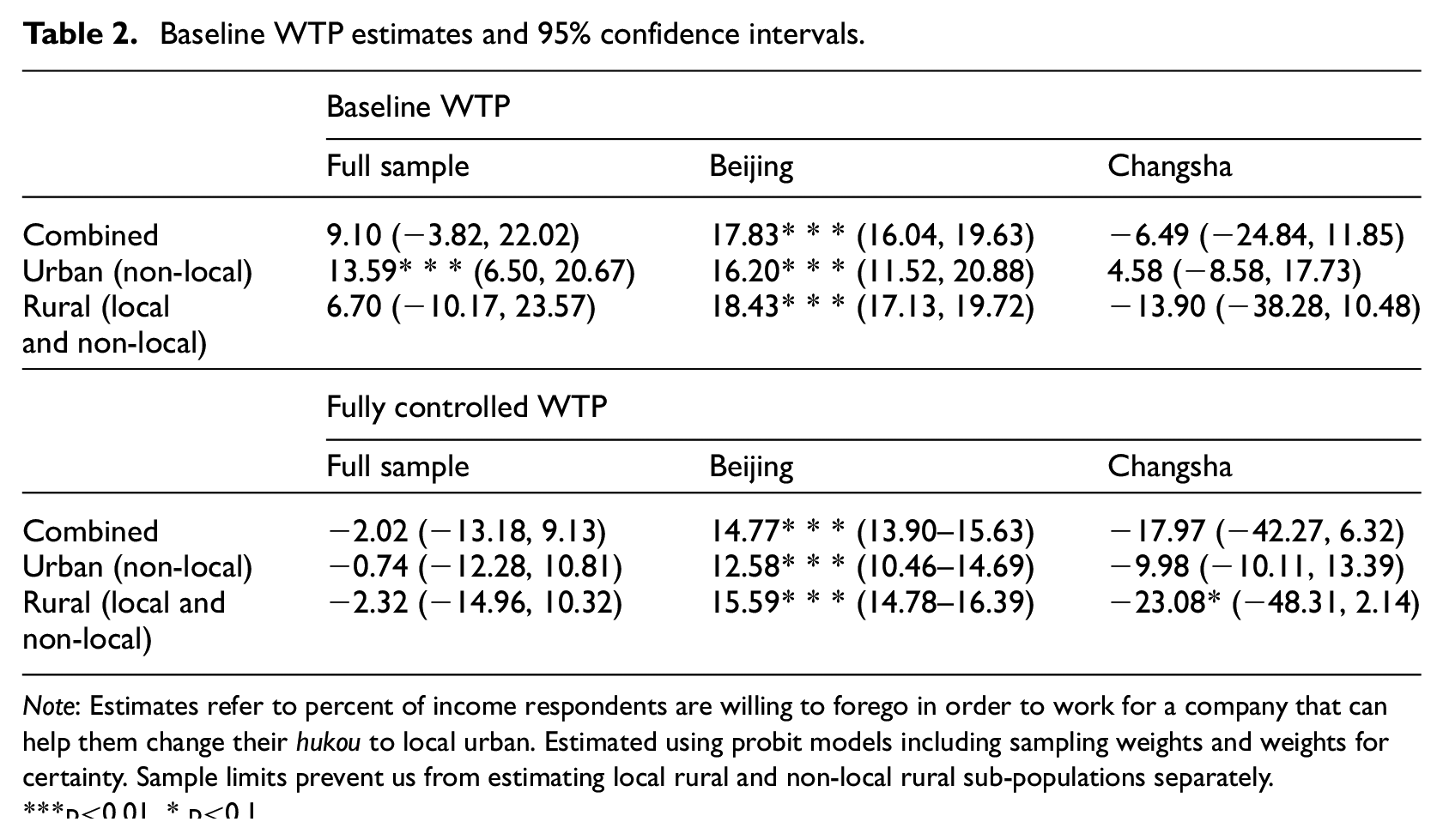
Note: Estimates refer to percent of income respondents are willing to forego in order to work for a company that can help them change their hukou to local urban. Estimated using probit models including sampling weights and weights for certainty. Sample limits prevent us from estimating local rural and non-local rural sub-populations separately.***p<0.01, * p<0.1.
In Beijing, both the aggregate population and each of the sub-populations has a positive and significant WTP. Across the pooled sub-sample, the average WTP was 18%. WTP for urban hukou holders and rural hukou holders is 16% and 18% (763 and 800 RMB per month), respectively. These estimates are not statistically distinct from each other, in large part because of high variance among urban migrants.
In the Changsha sample, no population has a WTP statistically different from zero. This means that aggregate WTP in Changsha is neither positive nor negative. There are three possible explanations for this. First, there could be zero demand for hukou. If there were no demand for hukou, however, we would not find positive responses to our elicitation question depicted in Figure 1. Second, there could be a kinked demand curve, where anyone who rejected the bid price has an actual WTP of zero. This would be the best explanation if the hukou was a public good where the minimum possible WTP is zero. But the third explanation is the most conceivable: because hukou is a private good, an identity status held by individuals, WTP could be negative, with the demand curve extending to the left of zero on the x-axis. 20 The results suggest that while some people are willing to forego significant wages, others have a negative WTP, creating a zero result on balance. As we can see in Table 2, a non-zero portion of the population is willing to accept lower wages in exchange for a hukou, but this population is not large enough to balance out those with negative demand.
The lower panel of Table 2 presents WTP estimates by sub-population and sample with fully controlled models. Among non-local urban populations, only the Beijing sample has a WTP statistically distinct from zero at 12%. Similarly, among rural populations, only those in Beijing have a positive WTP at 15%, which is significantly higher than the non-local urban sub-population.
In Changsha, rural migrants have a much lower WTP than any other sample with a negative WTP. While variance is high, the average WTP is −23%. Rural migrants in Changsha are unwilling to pay for Changsha hukou and would potentially have to be paid if the city attempted to integrate all migrants into the local hukou system.
Overall, migrants in Beijing and rural migrants have the highest WTP for hukou. Rural migrants in Changsha have the lowest WTP, with a negative WTP, suggesting rural migrants in Changsha value their current hukou more than potentially obtaining Changsha hukou. This means that urban migrants in Changsha have higher WTP than rural migrants, although still lower than all migrants in Beijing.
Correlates of demand
The marginal effects for the control variables are presented in Figure 2. Like the WTP estimates, we see different patterns in our two sample cities.
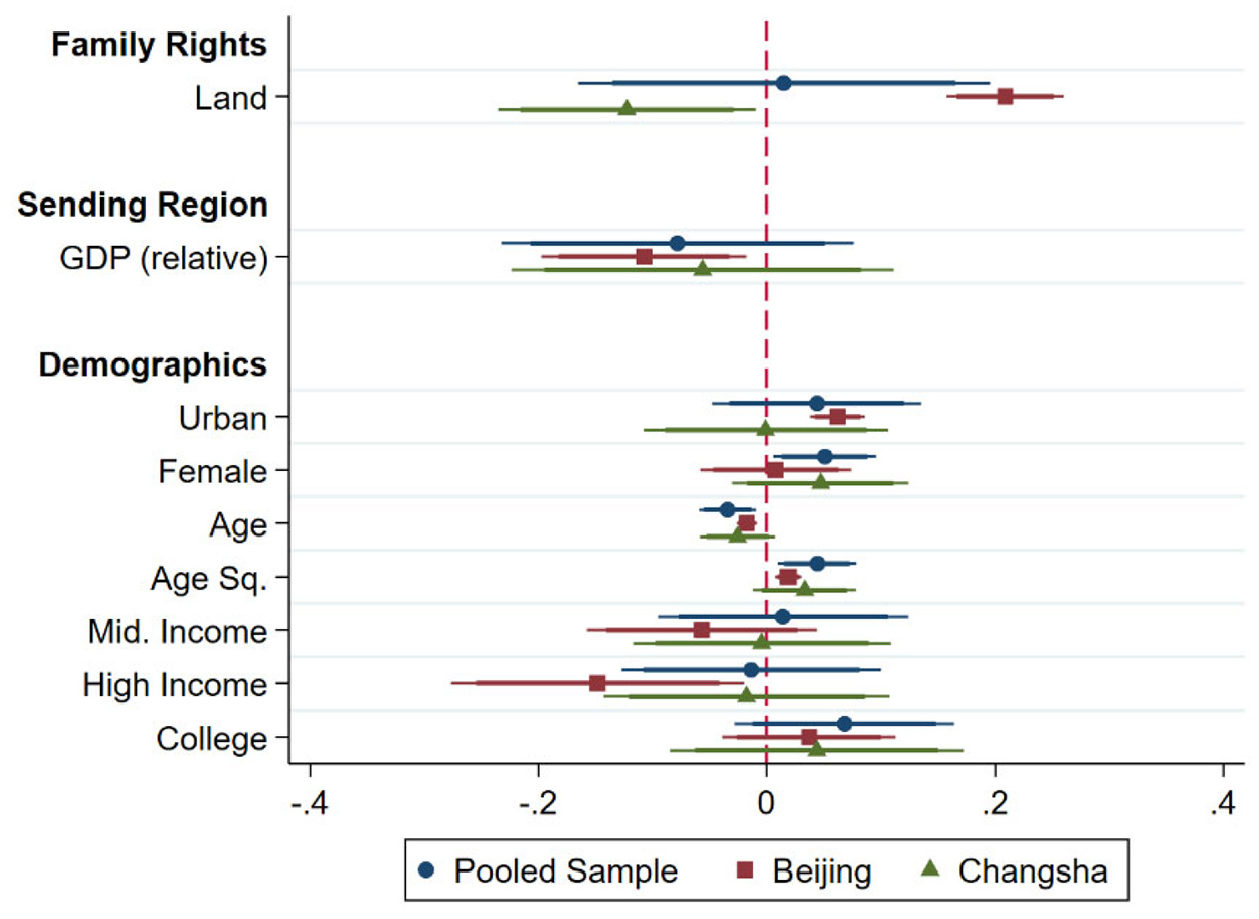
Marginal effects of control variables, by sample.
Family land-use rights have a positive and significant effect in Beijing but a negative and significant effect in Changsha. Those with land have higher WTP in Beijing while those without land have higher WTP in Changsha. This divergent result suggests that the value of a migrant’s land-use rights at home is contextually dependent. Land-use rights can signal greater household resources that could cushion risks and costs associated with hukou transfer, which would be particularly important in more expensive and competitive Beijing. Most importantly, this result shows the need to take city context seriously. Respondents whose hometown had higher levels of economic development were less likely to accept lower wage in exchange for local-urban hukou than those from poorer sending areas, although this is only significant in Beijing.
When the two cities are pooled together, female respondents are more likely to accept lower wages than males are, but this effect is not statistically significant in either of the two sub-samples. Age is negatively correlated with WTP and there is a non-linear effect. This means respondents in a middle age range are most likely to want hukou. College degree has no effect on WTP in any sample. Respondents in the highest third of the income distribution in Beijing were less willing to forego income for local urban hukou than those in the lowest third. This provides more evidence that financial resources may act as a partial substitute for hukou.
The findings presented above represent a unique snapshot of measuring both the value of local urban hukou and its potential impact on wages. It is important to interpret these results in context of the research design. First, the sample is not representative of the entire country. Second, WTP is inherently a hypothetical valuation technique. Care was taken to design the survey instrument to reduce hypothetical bias. We argue this hypothetical valuation provides valuable insight into the variation in WTP across the population in the two sample cities. Third, one key population omitted from this study is the population of migrants who were able to successfully transfer their hukou. Results should only be generalised to the population currently living in China without access to local-urban hukou rather than an aggregate valuation of the hukou system. Future research should pair hypothetical foregone wages with employment decisions made by migrants who have already converted their status. Similarly, survey results do not speak to would-be migrants who have chosen not to migrate because of existing hukou restrictions.
Discussion
As the country pushes towards higher levels of urbanisation, the process of urbanising China’s people by integrating the hukou system becomes a more pressing concern. Reforms have the potential to mitigate decades-long wage inequalities, but greater urbanisation might, in the short run, continue to depress wages as long as programmes like hukou-as-benefits continue. Overall, access to hukou transfers reduces wages by approximately 12% in our hypothetical evaluation of the hukou system. This is a sizable impact both in the short run, and if current wages affect future wage levels.
Most importantly, results presented here highlight significant variation in demand for hukou. We see positive demand for hukou in the Beijing sample and balanced aggregate demand in the Changsha sample, leading to an overall WTP indistinguishable from zero in the Changsha sample. This suggests there are a significant number of people who do not want to change their hukou in Changsha. Rural migrants in Changsha would have to be paid to change their hukou with overall negative WTP, which means urban migrants in Changsha have higher WTP than rural migrants. In Beijing, migrants whose family hold land-use rights, those with urban registration, those with lower income, and middle age ranges are all more likely to want to buy hukou, indicating higher demand. In Changsha, we see very different patterns. Migrants without land are more likely to want to buy hukou and many individual characteristics are not statistically significant, although migrants in middle age ranges are more willing to buy hukou. These results are most robust for more educated migrants with more formal work experience because these populations are most likely to have knowledge of hukou transfer policies.
Future research is needed to understand demand for hukou from the individual’s perspective. It is likely that individual experiences and backgrounds affect demand for hukou, but such a detailed analysis is beyond the scope of this article. Similarly, more research is needed on hukou switchers, those who were able to successfully change their status and how they vary from those locked out of the system.
One of the most important implications of the results presented here is variation. Understanding this variation not only within migrant populations but also across migration contexts is essential for understanding the potential impact of continuing reforms to the hukou system. The most recent reforms emphasise the need to ensure voluntarism in hukou conversions (2014 Reform, Article 2, paragraph 2). Creating space for migrants to choose to change their hukou or not means the progress of reform towards deconstructing the hukou system depends on demand for hukou. Results presented here show low demand in Changsha compared with Beijing. Populations with a WTP indistinguishable from zero or with a negative WTP are likely to be resistant to reform, resulting in a continuation of the hukou system in dividing the population. Additional recent evidence corroborates the varied findings here. Evidence from the 2020 census and the National Bureau of Statistics’ Migrant Monitoring Reports all suggest a growing – not shrinking – migrant population (Chan, 2021; National Bureau of Statistics, 2021). This project provides one explanation for why national reforms have had a smaller impact than optimists hoped for by showing significant variation in demand.
Reforms that integrate social services outside of the hukou system both alleviate the consequences of the hukou system while also potentially exacerbating it. Early evidence suggests that local governments have improved health insurance integration, but other social insurance programmes have done little to integrate migrant workers outside of the hukou system. 21 True reform to the hukou system is dependent not only on the welfare integration, but also on removing institutional distinctions all together. As long as local governments manipulate transfer policies and welfare policies, systemic inequality will persist.
Supplemental Material
sj-docx-1-usj-10.1177_00420980221074911 – Supplemental material for Hukou as benefits: Demand for hukou and wages in China
Supplemental material, sj-docx-1-usj-10.1177_00420980221074911 for Hukou as benefits: Demand for hukou and wages in China by Samantha A Vortherms and Gordon G Liu in Urban Studies
Footnotes
Acknowledgements
The authors would like to thank the participants of the MIT Urban China Workshop and four anonymous reviewers for comments on this article. Special thanks to Yao Yao, Guan Haijing, other members of the China Center for Health Economic Research of Peking University and the Hunan University research team for assistance during survey implementation. All errors remain our own.
Declaration of conflicting interests
The authors declared no potential conflicts of interest with respect to the research, authorship, and/or publication of this article.
Funding
The authors disclosed receipt of the following financial support for the research, authorship, and/or publication of this article: Funding for this project comes from the National Science Foundation (award number 1323974, Co-PI: Vortherms) and the China Medical Board (PI: Gordon G. Liu).

Supplemental material
Supplemental material for this article is available online.
Notes
References

Supplementary Material
Please find the following supplemental material available below.
For Open Access articles published under a Creative Commons License, all supplemental material carries the same license as the article it is associated with.
For non-Open Access articles published, all supplemental material carries a non-exclusive license, and permission requests for re-use of supplemental material or any part of supplemental material shall be sent directly to the copyright owner as specified in the copyright notice associated with the article.
