



Abstract
This article revisits comparative urban studies produced during the Cold War in the framework of ‘socialist worldmaking’, or multiple, evolving and sometimes antagonistic practices of cooperation between socialist countries in Eastern Europe and decolonising countries in Africa and Asia. Much like the recent ‘new comparative urbanism’, these studies extended the candidates, terms and positionalities of comparison beyond the Global North. This article focuses on operative concepts employed by Soviet, Eastern European, African and Asian scholars and professionals in economic and spatial planning across diverse locations, and shows how they were produced by means of ‘adaptive’ and ‘appropriative’ comparison. While adaptive comparison was instrumental in the application of Soviet concepts in countries embarking on the socialist development path, appropriative comparison juxtaposed concepts from various contexts – whether the ‘West’ or the ‘East’ – in order to select those best suitable for the means and needs on the ground. This article argues that this conceptual production was conditioned by the political economy of socialist worldmaking and shows how these experiences are useful for a more critical advancement of comparative urban research today.
Introduction
In 1961, the newspaper The Ghanaian Times published an account from Frunze (today: Bishkek), the capital of the Kirghiz Soviet Socialist Republic (Savage, 1961). Its author, Ghanaian journalist JNK Savage, accompanied Ghana’s president Kwame Nkrumah, one of many leaders from newly independent countries in Africa and Asia who accepted Soviet technical assistance. While the dismantling of Western European empires opened up the decolonising territories towards an expertise beyond Western centres, rivalry in the Global Cold War (Westad, 2005) mobilised the Soviet Union to offer such expertise. In this context, the Soviets showcased Central Asia as an example of socialist modernisation in a non-European context, and encouraged delegations from Africa and Asia to draw parallels with their own aims, needs and means. Along these lines, Savage tried to convince his readers in Accra that ‘Kirgizia in many features is like tropical Africa’ (Savage, 1961: 5).
Far from being mere propaganda, by the early 1960s such comparisons between socialist and decolonising countries had become central to the mobilities of developmental knowledge between Eastern Europe, Africa and Asia. It included knowledge about cities and urbanisation produced by scholars and practitioners – among them a team of Soviet planners who followed Nkrumah to Accra after his visit to the Soviet Union. Much of this production took place in the newly independent countries as part of economic and spatial planning which referred to experiences from the socialist countries. These references often led to comparisons between places that rarely before had been thought together, among them Frunze and Accra, Warsaw and Baghdad, Sofia and Abu Dhabi, the Hungarian plains and the Nigerian countryside.
This knowledge production reverberates with current debates in urban studies about the possibility of ‘“new geographies” of imagination and epistemology in the production of urban and regional theory’ (Roy, 2009: 819). During the last two decades, scholars have challenged the universalistic assumptions of concepts derived from debates, experiences and imaginations of the ‘First’ world or the ‘Global North’ – families of terms which I use in this article in their historically specific meaning, stemming from the Cold War period (McCann et al., 2013; Parnell and Oldfield, 2014; Parnell and Pieterse, 2016; Robinson, 2011, 2016a, 2016b, 2016c; Ward, 2010). Contributors to this ‘“new” comparative urbanism’ (Lees, 2012: 155–156) called for a ‘more global urban studies’ within which all cities, including those in the ‘Global South’, are sites of conceptual production (Robinson, 2016a).
Scholars and practitioners who compared Frunze and Accra, and other cities in the ‘Second’ and the ‘Third’ worlds, had been doing just that. Yet these attempts to diversify urban knowledge beyond Western paradigms have not been registered in debates around new comparative urbanism. This article revisits this largely forgotten history of comparative studies with three aims in view. First, to bring to the fore the conceptual production that informed these studies. Second, to show how political and economic concerns of socialist and postcolonial countries impacted this conceptual production, including its institutional frameworks, methodologies and positionalities. This historical perspective offers, thirdly, an opportunity for a critical view on the political economy of comparative urbanisms, both old and new.
With these aims in view, this article foregrounds ‘operative’ concepts, or concepts that were employed in economic planning as well as in regional, urban and architectural planning. The entanglement of urban knowledge production with planning practices was not specific for the exchanges between socialist and postcolonial countries. In particular, comparative urbanism with a global scope was pioneered by urban planning professionals in the context of British and French imperial developmentalism (RIBA, 1911; Royer, 1932), and by the end of the Cold War comparative research was instrumental for the circulation of urban knowledge at the intersection of planning, policymaking and globalisation (cf. Baker and Temenos, 2015). While focusing on exchanges that bypassed the Global North, this article points at such broader, and under-researched, production of comparative urban knowledge stemming from encounters between ‘geographers who study cities and practical city builders’ – as one Soviet scholar put it (Pokshishevskij, cited in Fuchs, 1964: 278).
In what follows, I argue that the circulation of operative concepts was central to the production of comparative urban knowledge across the Second and the Third worlds. Such concepts combined descriptive and analytical modalities with critical and projective ones. The projective performance of operative concepts in planning practice depended on their analytical capacity to account for the reality on the ground. Accordingly, when concepts which accounted for Soviet and Eastern European urbanisation were applied in Africa and Asia, such applications put these locations into comparative relationships, whether implicitly or explicitly. These comparative relationships were reflected in the adaptations of operative concepts to the places of their application, but also in new conceptual production by urban scholars and professionals who worked across socialist and postcolonial countries.
This article uncovers such comparative operations by rereading my research on architectural and planning mobilities between the Second and the Third worlds during the Cold War, based on surveys in private and public archives as well as on interviews in Eastern Europe, Ghana, Nigeria, Iraq, the UAE and Kuwait. My recent monograph (Stanek, 2020) has advanced current debates in architectural and planning history beyond discussions of late colonial and postcolonial networks (Chang, 2016; Crinson, 2003; Nasr and Volait, 2003), networks of international institutions based in the US and Western Europe (De Raedt, 2014) and capitalist globalisation (Cody, 2003; Ren, 2011). While historians of architectural and planning concepts addressed their mobilities in terms of ‘borrowing’ (Ward, 2003) and ‘editing’ (Beeckmans, 2013), in what follows I argue that the possibility of these ‘borrowings’ and ‘edits’ was conditioned by comparative operations. Bridging two disciplinary debates, this article reconsiders recent discussions in architectural and planning history through questions posed by new comparative urbanism, and expands the latter’s understanding of what counts as comparative practice to operative planning concepts.
I will begin by revisiting two traditions of comparative urban research against and within which the project of new comparative urbanism has been developed: global cities research and postcolonial urbanism. These traditions have reflected on worldwide urbanisation as facilitated by globalisation and colonialism, which I understand as processes of ‘worldmaking’, or historically specific ways of practising the world. I argue that comparative research between socialist and postcolonial countries was facilitated by an alternative – socialist – worldmaking. By this I mean multiple, evolving and sometimes antagonistic exchanges between the Second and the Third worlds during the Cold War.
Socialist worldmaking informed two modes of comparative research, which I will call ‘adaptive’ and ‘appropriative’. The first aimed at adapting Soviet operative concepts to conditions abroad, notably in countries embarking on the socialist development path. The second compared urban knowledges from various contexts – whether the ‘West’ or the ‘East’ – in order to appropriate them to the needs and means on the ground.
Both adaptive and appropriative comparisons were fundamentally shaped by the political economy of socialist worldmaking, which is the focus of the final part of this article. While the rest of the article foregrounds Soviet and Eastern European scholars, its final part pays more attention to professionals and decision-makers in West Africa and the Middle East. They practised comparison in ways that were both emancipatory and risky, and often straddled multiple worldmaking processes. I conclude with cues for current comparative urban research. I argue that the concept of worldmaking is useful to critically account for the political economy of comparative urbanism, to reconsider the positionalities of urban scholars and to open comparative research towards the multiple forms that comparison might take.
Comparative worlds
At the heart of new comparative urbanism lies a call for a ‘more global’ perspective on urbanisation (Robinson, 2016a) that would reflect urban experiences beyond Western Europe and North America (Bunnell, 2013; Lees, 2012; McFarlane, 2010; Nijman, 2007; Parnell and Pieterse, 2016; Robinson, 2011, 2016b, 2016c; Schmid et al., 2018; Ward, 2010; Watson, 2009). Other scholars called for reconceptualising cities in a ‘global-relational context’ (McCann et al., 2013: 582) and explored their new ‘ways of being global’ (Ong, 2011: 23) in order to account for increasingly complex and interdependent urbanisation processes (Brenner and Schmid, 2015).
This scholarship took issue with earlier comparative debates and their conceptualisation of the global dimension. Scholars challenged the ‘world cities’ and ‘global cities’ research (Robinson, 2016c), largely based on the world-systems theory. By dividing the capitalist world economy into centres, semi-peripheries and peripheries, this research classified world city regions according to ‘their mode of integration with the world economy’ (Friedmann and Wolff, 1982: 329).
In response to this restrictive framework, scholars looked at other ways in which cities, in particular those in the South, become nodes of global connections (McCann et al., 2013; Ong, 2011; Ong and Roy, 2011). They found allies in various strands of postcolonial urbanism, or studies of the consequences of the colonial encounter for the production, representation and lived experiences of spaces (Jazeel, 2019; Simone, 2001). Further impulses came from studies of racialised capitalism (Bhattacharyya, 2018), and feminist and queer geographies, in particular in subaltern contexts (Blunt and Rose, 1994; Buckley and Strauss, 2016; Peake, 2016).
Global cities research and postcolonial urbanism conceptualise worldwide urbanisation through global mobilities and connections which originated from two intertwined historical processes: Western-dominated globalisation and Western European colonialism. In this reading, connections within the world-capitalist economy and those stemming from the colonial encounter define and legitimise the ‘third parts’ of comparison that establish commonality between compared cities (Jacobs, 2012: 905), the ‘critical variables’ for their classification (Friedmann and Wolff, 1982: 329) and the theorising of difference that inform the comparative work (Robinson, 2016a). These comparative terms function as criteria which determine for any city whether or not it is an eligible candidate for comparison.
Eastern European cities have rarely met these comparative criteria. During the Cold War, world-systems scholars did not conclusively agree on the position of the socialist countries in their theoretical framework (Bradshaw, 2001; Navarro, 1982). While Friedmann and Wolff (1982: 310) initially considered this position an open question, it largely disappeared from the debates that followed (Friedmann, 1986; cf. Müller, 2020). Some urban scholars (Kennedy and Smith, 1989: 599) moved from a ‘relational’ definition of semi-periphery to its ‘attributional’ definition, thus conceptually detaching socialist countries from a networked world economy. These debates rarely intersected with attempts to address the impact of world-market relations on urbanisation in ‘socialist developing countries’ in Africa and Asia (Mingione, 1987). By the end of the Cold War, most world-systems researchers interested in Eastern Europe left these debates behind and moved on to study the capitalist expansion in the region (Bradshaw, 2001).
Similarly, Eastern Europe has rarely been on the radar of postcolonial urbanism. During the last two decades, calls to interrelate postcolonial and postsocialist scholarship (Chari and Verdery, 2009) were answered by several scholars of Eastern Europe, who applied concepts from postcolonial and subaltern studies to the region (Kovačević, 2008; Močnik, 2002). Others sought to deterritorialise concepts derived from socialist and postsocialist urbanism (Tuvikene, 2016) in order to bring them into wider conversations, including those about urbanisation in the Global South (Hirt et al., 2016). Scholars argued that some among these concepts can facilitate a more general understanding of the legacies of state-centred urbanisation (Stenning and Hörschelmann, 2008), including infrastructure (Bouzarovski et al., 2016; Collier, 2011), gentrification (Bernt, 2016) and inequalities in academic knowledge production (Ferenčuhová, 2016). Only recently have these ideas begun to reverberate with scholars working on the Global South (cf. Gillespie, 2016).
This short overview makes it clear that Eastern Europe has rarely been mapped by scholars of global cities research and postcolonial urbanism as part of the world of cities that they saw as emerging from the colonial encounter and globalisation. Yet this mapping is at odds with the historical reality of decolonisation and globalisation, and their impact on urbanisation of the Second and Third worlds. Historians of the Global Cold War have shown that socialist Eastern Europe engaged in extensive exchanges with the decolonising Global South and has participated, albeit in an uneven and liminal manner, in globalisation processes since the 1970s (Boden, 2008; Ginelli, 2018; Gutmann, 2011; Kalinovsky, 2018; Mark et al., 2020; Sanchez-Sibony, 2014). This scholarship suggests the need for a more critical rethinking of the comparative terms of global cities research and postcolonial urbanism and, in general, for a more historically grounded understanding of the conceptual decisions of comparative urbanism.
I argue that such understanding is afforded by the concept of worldmaking. My historical-materialist reading of this concept draws on Lefebvre (2009) and Glissant’s (1997) theorising of the world as a contested dimension of practice, experience and imagination (Stanek, 2020; cf. Ong and Roy, 2011; Simone, 2001). In this reading, colonialism and globalisation are worldmaking processes, or historically specific ways of practising the world (cf. Getachew, 2019; Mbembe, 2021). This perspective stresses that the political economies of colonialism and globalisation were shaping historically distinct visions of the world. In turn, it emphasises that these visions themselves were informing the multitude of social practices that took place within colonialism and globalisation.
In what follows, I use this perspective to argue that the production of comparative urban knowledge by professionals and scholars from the Second and the Third worlds during the Cold War was facilitated by ‘socialist worldmaking’ that was distinct from colonial and globalist worldmaking. In this way, I historicise this production as both informed by specific visions of the world and shaping them, and I study the conditioning of this process by the political economy of the exchanges between socialist and postcolonial countries. In particular, I review the consequences of this political economy for the conceptual decisions of comparative research and their terms, methodologies, institutions and positionalities. This review will foreground the distinct character of this knowledge production, while also showing how this production intersected with other worldmaking processes, thus signalling a possible revision of the comparative terms of postcolonial urbanism and global cities research.
Socialist worldmaking
By ‘socialist worldmaking’ I understand the myriad exchanges between the socialist Second world and the post-independence Third world during the Cold War. Socialist worldmaking was established and sustained by a variety of institutions, political discourses, systems of foreign trade, modes of technology transfer and situated, everyday experiences of collaboration in the course of which the official narrative of socialist internationalism was negotiated, confirmed, refuted or transgressed (Stanek, 2020).
Between the 1950s and the end of the Cold War, socialist worldmaking was differentiated by ruptures between the Soviet ‘bloc’ and Yugoslavia (1948), then China (1960s), as well as by evolving geopolitical interests and economic priorities of particular socialist countries and their counterparts in Africa and Asia. Under Khrushchev, the Soviets and their satellites offered free or subsidised assistance to decolonising countries as part of the ‘competitive coexistence’ with the United States and their Western allies. During the later decades, many socialist countries emphasised mercantile aims. In particular, in the wake of the 1973 oil embargo and the debt crisis that followed, many Eastern European governments signed preferential trade agreements with several Global South countries in the hope of acquiring convertible currency.
The motivations of countries in the Third world to enter such collaborations were equally differentiated. They varied between southern Comecon members (Mongolia, Vietnam, Cuba), deeply dependent on Soviet resources, and countries pursuing independent variants of socialist development such as Ghana under Nkrumah, Iraq under the Baath party or Chile under Salvador Allende. Even governments of countries with elites hostile to socialism, such as Nigeria and the Gulf states, used resources from socialist countries for state building and economic development, while guarding their sovereignty in internal and foreign policy. Straddling gift diplomacy, technical assistance and preferential trade agreements, socialist worldmaking often reflected opportunistic responses to geopolitical openings and economic expediencies. In other words, these exchanges were informed by multiple, diverging and negotiable visions of the world which were shaped and reshaped by political and economic contingencies.
The centrality of economic and spatial development and planning in these exchanges boosted the demand in Eastern Europe for knowledge on urbanisation in the Global South. In the Soviet Union, this knowledge was produced by the Africa Institute and the Institute of Oriental Studies in Moscow, as well as by departments of geography, ethnography, economy, urban and regional planning and architecture, notably at the Patrice Lumumba Peoples’ Friendship University in Moscow (Katsakioris, 2019), and at higher education institutions in Tashkent, Alma-Ata (today: Almaty) and elsewhere. Specialised research centres were founded in satellite countries too, among them the International Postgraduate Course of Urban and Regional Planning for Developing Countries in Szczecin and the Institute for Tropical Architectural Research in Gdańsk, both in Poland (Gzowska and Bujas, 2020; Orlińska, 1984). Eastern European scholars were delegated to newly established planning and research institutions in Ghana, Nigeria, Algeria, Syria, Iraq, Mongolia and elsewhere. At these institutions they worked with local scholars, gathered empirical material and accessed international literature, which included heterodox Marxists critical of the Soviet Union, such as Samir Amin (cf. Milewski et al., 1987).
Africans and Asians were offered scholarships to study and research at institutions in the socialist countries. They wrote doctoral dissertations which, for example, assessed the applicability of Eastern European methods of building conservation (Al-Ahmar, 1991) and housing prefabrication systems (Said, 1982) in the Middle East. African participants of the Postgraduate Course in Szczecin, for instance, studied the development of Addis Ababa (Ashagri Assafa), the Volta region in Ghana (CY Biaku), integrated physical planning in Kenya (Johnstone Eliud Nyandoya Alela), the regionalisation of Egypt (Mohamed El Sayed Ismail), the planning machinery of Lagos State (Raheem Badeboh Ayoola), the development of coastal regions in Tanzania (TPN Kyaruzi), the urban development of Port Sudan (Hassan Gamal el-Din Ibrahim), the transportation system in Somalia (Gulaid Abdikarim Egeh), regional development in Zambia (Glynn A. Khonje) and residential planning in Kampala (Kalifa Jackson) (Topical list of the final papers 1970–1982, 1984). The impact of this research on planning practice and urban scholarship in Africa requires further study.
Urbanisation processes in developing countries were debated in Eastern European journals in architecture, planning, sociology and geography. For example, the leading Soviet geographical journal Voprosy Geografii (Geographical Questions) routinely included articles about Africa, Asia and Latin America from the early 1960s onwards. They were featured in themed issues focused on transport and economic development (61/1963), the geography of world population (71/1966), the economics of location and the ‘scientific-technical revolution’ (112/1979) and the geography of the ‘world capitalist economy’ (130/1987), as well as two issues focused on urbanisation, titled ‘Cities of the World’ (66/1965) and ‘Urbanisation of the World’ (96/1974). Voprosy Geografii also published themed issues on ‘tropical’ (68/1965) and developing countries (76/1968). Their authors included Soviet geographers such as Michail Borisovich Gornung who researched Africa (Gornung et al., 1983), Iakov Grigorievich Mashbits who studied Latin America (Mashbits, 1985) and Valerii Alekseevich Pulyarkin who wrote on Central Asia, in particular Afghanistan (Ozerova and Pokshishevskij, 1981).
Much of this scholarship addressed entire continents and often reads as very general. More specific and empirically based were studies written by authors with direct experience on the ground, among them medical professionals, geographers, geologists, economists, architects and planners. The operative concepts employed in their work testified to the entanglement between professional practice and urban research in the framework of socialist worldmaking. The review of several such concepts will show how their production was informed by two modes of comparative operations, which I call ‘adaptive’ and ‘appropriative’.
Adaptive comparison
Adaptive comparison comes to the fore in the work of professionals who were applying Soviet operative concepts in African and Asian countries embarking on the socialist development path – in other words, countries on their way to join the socialist world. Typical in this respect were studies of economic regionalisation, or the ‘delimitation of economic administrative regions for regional planning purposes’ (Belo-Giwa, 1967: vii). They were based on the Soviet concept of the region which combined empirical analyses of existing conditions (natural resources, transportation networks, population distribution, division of labour) with visions of their optimalisation within a centrally planned economy (Alampiyev et al., 1962; Zeitlin, 1981).
Soviet and local scholars argued that ‘the basic methodological principles of Socialist economic regionalization are the same’ for all socialist countries (Alampiyev et al., 1962: 18), including Africa and Asia (cf. Bhat et al., 1963; Voprosy Geografii, 76/1968). Yet they also agreed that each application of these principles necessitated their adaptation to the local specificity. For example, a Soviet-Mongolian team argued that ‘the specific solution of regionalization problems differed by countries in accordance with their economic, historical and other conditions and characteristics’ (Alampiyev et al., 1962: 18). While the application of the Soviet concept of the region was based on the fact that Mongolia followed the Soviet Union on the path of socialist development, its adaptation in Mongolia resulted in a comparison between urbanisation processes in these two countries. Differences between them pointed at the necessity to adapt this concept to the conditions on the ground and guided the principles of such adaptation. Accordingly, what was mobilised together with Soviet operative concepts were categories of geographic difference which served as comparative terms that captured similarities and differences between the locations compared.
These categories often originated from Soviet debates on urbanisation processes that took place across the huge territory of the Soviet Union (Fuchs, 1964; Whitehead, 1989). Soviet scholars differentiated these processes according to climatic, geological and seismic conditions, as well as historical development (Fuchs, 1964; Zeitlin, 1981). Theorisation of geographical difference was also inspired by ethnographic concepts (Rawski, 2017), among them that of ‘ways of life’ which informed research on Soviet urbanisation processes and their ‘regional differences’ (Leykina and Pokshishevskiy, 1979: 276). This included research by scholars who studied urbanisation in Central Asia and urged planners to account for ‘typical, positive and valuable orientations of the indigenous population’ and ‘local architectural traditions’ (Listengurt and Vasilchenko, cited in Whitehead, 1989: 18–19, 46). Such a call reverberated with architectural debates on ‘local’ and ‘national traditions’ in Central Asia since the 1920s (Ginzburg, 1926).
Adaptive comparison had multiple parallels with comparison practised in the framework of Western European colonialism which ‘produced equivalences based on a mix of prescribed similitudes and cued distinctions—and the implicit mandate that others be ignored’ (Stoler, 2002: 207; cf. Beeckmans, 2013; Chang, 2016; Crinson, 2003; Nasr and Volait, 2003; Ward, 2003). The Soviets rejected such parallels, and instead presented the USSR as an anticolonial power. In particular, they showcased Central Asia as a territory ‘liberated’ from tsarist colonial oppression and shepherded towards economic modernisation, social emancipation and revival of national cultures of the indigenous populations.
The concepts of ways of life and national traditions were put forward in support of this claim. For example, Soviet planner and educator Anatolij Nikolaevich Rimsha argued that these concepts distinguished Soviet planning from some of its Western competitors (cf. Rimsha, 1976: 217). In his book Town Planning in Hot Climates, Rimsha (1975, 1976) substantiated this argument by discussing Soviet planning of Tashkent, Dushanbe, Yerevan and Tbilisi, as well as the translations of these experiences into plans for Kabul and Accra. Never free of racialised phantasies, paternalistic attitudes and formulaic uses, the concepts of ways of life and national traditions – and the planning practices that referred to them – conveyed a tension between the ultimate aim of merging various ethnic groups in the USSR and the carefully controlled promotion of local languages, customs, traditions and Islamic religion (Lubin, 1984; cf. Demchenko, 2018; Kalinovsky, 2018; Stronski, 2010).
This tension also characterised the work of Soviet planners abroad. For example, the planners of Kabul in the 1960s argued that Afghan national traditions and ways of life were something to be both ‘overcome’ and ‘taken into account’ (Figure 1) (Kibirev et al., 1965: 49; Smirnova, 1965: 28). Such dialectics, according to which the past needed to be both removed and preserved as a modernising resource, might have been the closest approximation of a specifically Soviet understanding of postcolonial difference (Chukhovich, 2014). It shaped Soviet housing designs abroad, which negotiated the implementation of Soviet prefabricated panel technology with site-specific adaptations of apartment layouts that ranged from a balcony used to freeze meat supplies during winter in Ulaanbaatar (Typ ’92-07C-UB, 1973), to the accommodation of the West African practice of outdoor cooking in Accra (Dwelling Houses in Accra and Tema, 1964). These plans were sometimes based on surveys of vernacular, colonial and contemporary building practices, typologies, construction materials and everyday customs of the inhabitants (Filippovich, 1964; Voronina, 1964). Among their authors was Veronika Voronina (1964, 1973) – one of many Soviet and Eastern European professional women working in the Global South – who drew on her earlier studies of architecture in Central Asia (Voronina, 1951).
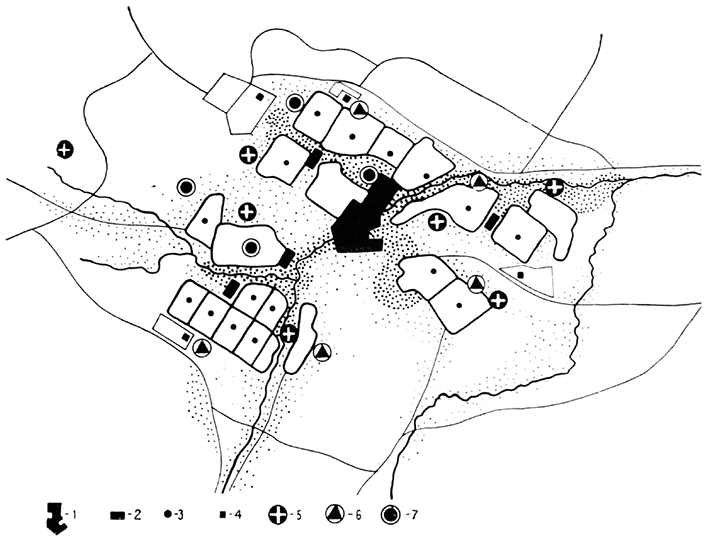
General plan of Kabul. ‘Scheme of the spatial arrangement of social centres’, 1964. CNIIP gradostroitel’stva (Soviet Union). Description: 1) city centre, 2) district centres, 3) centres of residential neighbourhoods, 4) centres of industrial districts, 5) medical centres, 6) technical and vocational schools, 7) higher education institutions.
Soviet anticolonial credentials were often rejected by authors in the West (Giese, 1979), Soviet Central Asia (Kalinovsky, 2018) and the newly independent countries. These critics likened the Soviet political and economic objectives in Asia and Africa to those of Western colonial powers – a concern to which I will return in the last section of this article. But Soviet anticolonial claims were also contested by several scholars from the satellite countries in Eastern Europe, who considered the Soviet Union a successor rather than a gravedigger of the tsarist empire (Polónyi, 2000: 45–46). This dispute not only testified to the heterogeneity of socialist worldmaking, but also inspired comparative practices beyond adaptive comparison.
Appropriative comparison
Professionals and scholars from Czechoslovakia, Hungary and Poland who circulated in the framework of socialist worldmaking rarely saw themselves and their local counterparts as inhabitants of one socialist world. Instead, some among them claimed a shared positionality with Africans and Asians within a larger world: a world inhabited by peoples striving to overcome political subordination, economic exploitation and cultural devalorisation by external empires. This claim was based on historical analogies between Central Europe (post-Habsburg space), Africa and Asia during the long 19th century. While often myopic to Central Europe’s own history of external expansion and ‘internal colonisation’, notably in Poland, such imagined affinities reverberated in the work of Central European scholars, in particular in countries that were governed by nominally socialist parties but did not follow the Soviet development model, including Algeria (Jałowiecki, 1978), Libya (Wadeco, 1983), Syria (Seibert, 1978) and Iraq (Gräfe, 1974; Miastoprojekt-Kraków, n.d.; Nowakowska, 1986).
Rather than adapting the experience of socialist planning, these professionals and scholars often drew upon a larger spectrum of urban knowledge. This included operative concepts and planning methods that had been part of modernisation efforts in Central Europe since the 19th century, of which socialist modernisation was just the most recent instalment. Examples included the theorising of the rural–urban continuum by Hungarian architect Károly (Charles) Polónyi, who drew on 1930s Central European debates about rural underdevelopment (‘backwardness’). Polónyi had advanced this concept in post-war rural Hungary and then in Ghana and Nigeria (Polónyi, 2000). The focus on intertwined rural and urban development informed the study on Algiers by the Polish sociologist Jałowiecki (1978). Written during his employment by Algerian planning institutions, it focused on Algiers’ post-independence transformations and reconceptualised its bidonvilles beyond Western orientalist imaginaries (Jałowiecki, 1978). Rural development was also studied by Piotr Zaremba, head of the Postgraduate Course in Szczecin and advisor to governments in West Africa, the Middle East and South and South-East Asia. Zaremba drew parallels between the accelerated urbanisation in these regions and 20th-century Eastern Europe (Gzowska and Bujas, 2020; Zaremba, 1959, 1967). A similar argument was made by Wiktor Richert, the Polish planner at the University of Science and Technology in Kumasi (Ghana) and teacher at the University’s Postgraduate Course in Regional Planning, which he convened together with Ghanaian sociologist and urban planner Austin Tetteh (Richert, 1973).
The teaching method of the Postgraduate Course in Kumasi illustrates the difference between the comparative work of these scholars and adaptive comparison. The course provided an overview of research and planning methods in various countries ‘with different forms of government’ in order to select those most suitable for Ghana (Richert, 1973: 80; cf. Tetteh, 1980). This method was followed by Ghanaian planner Nasiru Sakibu Belo-Giwa in his master’s dissertation on ‘The Problem of Regionalization in Ghana’ (1967), supervised by Richert. Belo-Giwa (1967: viii) compared ‘approaches to and concepts of economic regionalization in […] Britain, Poland, and the U.S.S.R.’ in order to establish criteria for a revision of economic administrative regions in Ghana that were specific and appropriate to the country.
Like Belo-Giwa and Richert, so Polónyi, Jałowiecki and Zaremba shared with the Soviet proponents of adaptive comparison the belief that Eastern European planning knowledge was useful for the newly independent countries, provided that it was adjusted to their local conditions. But these scholars did not start with any particular concept from Eastern Europe in order to modify it according to its intrinsic parameters of geographic difference (such as ‘ways of life’). Rather than considering the socialist countries as a source of authoritative knowledge, they compared Eastern European concepts with those stemming from other contexts. By means of such juxtapositions, scholars made visible the theoretical assumptions of each concept and assessed its explanatory potential beyond the place of its original application, in order to appropriate it according to the needs on the ground.
Proponents of such appropriative comparison believed that Central Europe and the newly independent countries shared a ‘peripheral’ position with regard to Northern centres of knowledge production. They valorised the periphery as a privileged place from which ideas forged in these centres are questioned, tested, modified and appropriated. Such strategic self-peripheralisation subscribed to an intellectual tradition in Central Europe that distinguished between ‘periphery’ and ‘province’. According to this tradition, provincial cultural production was characterised by an influence of one powerful centre; in contrast, a Central European, peripheral thinker receives impulses from many centres, and mixes and develops them (Białostocki, 1989; Moravánszky, 2012; Šerman, 2016). Along these lines, Polónyi acknowledged the delays, distortions and echoes that characterised peripheral production of knowledge, but he also saw them as an opportunity for scepticism, relativism and a pragmatic appropriation of ideas for the specific purposes at hand (Moravánszky, 2012: 335; Polónyi, 2000). Reflecting on his African work, Polónyi (2000) argued that independence transformed the formerly colonised territories from a province to a periphery, not unlike Central Europe. While a postcolonial reading would reveal nuance, hybridity and mimicry in what might appear to be a mere provincial imitation (cf. Bhabha, 1991), this perspective emphasised the shift in the conditions of the production of urban knowledge brought about by decolonisation in Africa and Asia.
This reading is confirmed by accounts of several Ghanaian, Nigerian and Iraqi scholars and professionals. They experienced collaboration with Eastern Europeans as part of a multiplication of flows of knowledge and a widening of horizons of choice. Yet the same accounts show how this collaboration involved both emancipatory potentials and risks that were specific to the political economy of socialist worldmaking. The last section of this article will discuss how this political economy shaped and reshaped comparison, both adaptive and appropriative, as practised in Accra, Calabar and Baghdad.
Practising comparison
Contrary to Soviet propaganda, the resources offered by the Soviets and Eastern Europeans to African and Asian governments in the framework of socialist worldmaking did come with political and economic leverage. However, recent historical scholarship has demonstrated that far from being Soviet ‘proxies’, these governments used resources from abroad to advance economic development, state building and regional diplomatic aims (Boden, 2008; Sanchez-Sibony, 2014). For example, during Nkrumah’s association with the Soviets, Ghanaian officials repeatedly stressed that they did not seek to replace an old colonial master with a new one, and assured the public that they were ‘in full and absolute control of every single project’ (Schwartz, 1962: 5).
Archival documents from Accra and Moscow often support this claim. A case in point was the ‘technical guidelines’ for projects carried out in Ghana by Soviet organisations with the technical assistance of the Soviet Union (Glavstrojproekt, 1962). These construction standards were obligatory for Soviet design institutes and construction companies operating in Ghana. Prepared in Moscow, they were then revised by Ghanaian architect EYS Engmann at the Ministry of Public Works in Accra. His corrections were translated into Russian and included in the revised guidelines (Glavstrojproekt, 1962: 75–77). Minutes of meetings confirm that the Soviets often yielded to the demands of Ghanaian professionals, who exploited their counterparts’ need to balance imminent geopolitical objectives with future economic gains (Stanek, 2020: 75–78).
African and Asian decision-makers who had little sympathy for things socialist were particularly assertive, as Polónyi recalled about his work on the master plan for Calabar, Nigeria (Figure 2) (Tesco-Közti, 1969). After the plan’s presentation to Nigerian decision-makers including Michael O Ogar, Commissioner for Surveys and Town Planning, the Hungarian team was challenged: ‘You are Hungarians. You never had colonies. You don’t have any tropical experience. Do you consider yourselves competent to prepare a master plan for a city in West Africa?’ (Polónyi, 2000: 82). This question revealed that the encounter between Africans and Eastern Europeans was mediated by the spectre of colonialism and its double bind, where the condemnation of colonial exploitation went hand in hand with the appreciation of colonial expertise.
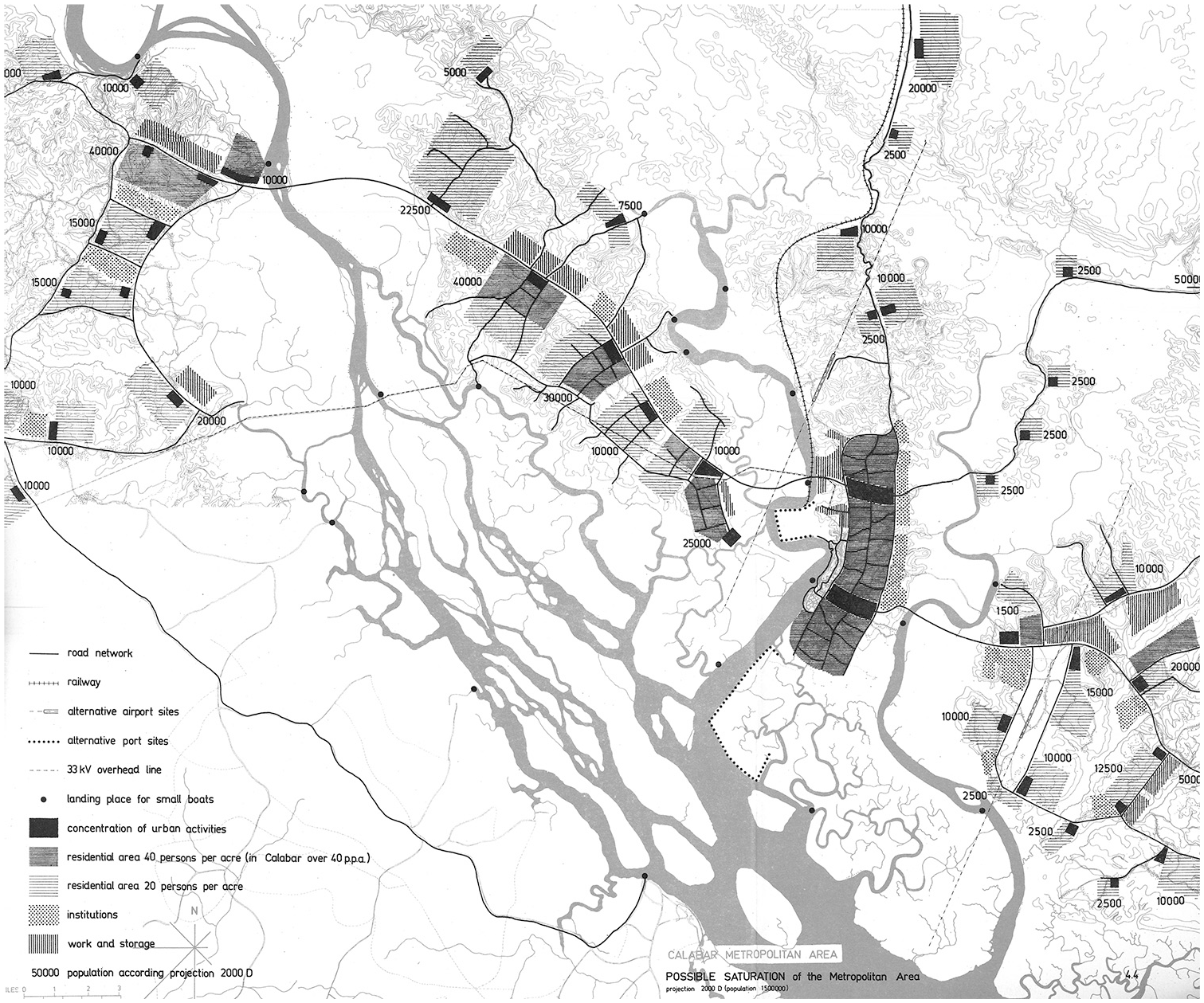
Survey and development plan for Calabar. ‘Calabar Metropolitan Area. Possible Saturation of the Metropolitan Area’, 1969. KÖZTI: Design Institute for Public Buildings (Hungary).
At the same time, these encounters triangulated the racialised dichotomy between the colonised and the coloniser in ways that impacted the dynamics of collaboration between professionals from the Second and the Third worlds. As scholars have shown, the Soviets and Eastern Europeans generally underappreciated the centrality of race in anticolonial struggles, and their professional exchanges with Africans and Asians were not free from racial tensions (Matusevich, 2000). The racialised gaze occasionally directed towards Africans and Asians by Central Europeans was reinforced by their ambiguous memory of Central Europe’s internal colonisation (cf. Domosławski, 2010: 24). In turn, African and Asian professionals were sometimes sceptical about Eastern European expertise. This was particularly true about members of the elites educated in the former colonial metropolises, where some among them had absorbed the racialised perception of Eastern Europe as Western Europe’s first Orient (cf. Wolff, 1994).
In order to navigate these complex dynamics at the intersection between socialist and colonial worldmaking, professionals and scholars from the Second and the Third worlds mobilised comparison. A case in point were the Polish-delivered master plans of Baghdad (1967, 1973). Their first iteration was criticised by Indian planner and UN expert Sayed Shafi, who challenged the planners’ ‘arbitrary’ decisions, unreliable data and insufficient understanding of Iraqi society and economy (Shafi, 1972: 42–47). In order to advance their work and substantiate it, the Polish planners turned to comparison, both adaptive and appropriative. Their adaptation of Polish methods of building conservation was supported by the argument that Baghdad was like Warsaw after its reconstruction in the wake of the Second World War: Baghdad’s monuments and urban fabric had an important role to play in ‘educating the Iraqi nation in the spirit of studying and appreciating their great national heritage’ (Figure 3) (Miastoprojekt-Kraków, n.d.: 345). Their proposed urban standards for Baghdad (e.g. number of hospital beds per 1000 inhabitants) appropriated standards from India, the Middle East and Western and Eastern Europe, which the planners compared with data from Iraq (Municipality of Baghdad, 1973: 151–152, 163–164). These examples show the multiple uses of comparison. Besides its use as an analytical procedure, Eastern European planners applied comparison to demonstrate to the Municipality of Baghdad their professional knowledge, to substantiate the relevance of their earlier experiences, to document each step of the surveys in ways that opened them up to scrutiny, to evidence their forecasts about Baghdad’s urbanisation and to build trust between them and their local counterparts (Miastoprojekt-Kraków, n.d.).
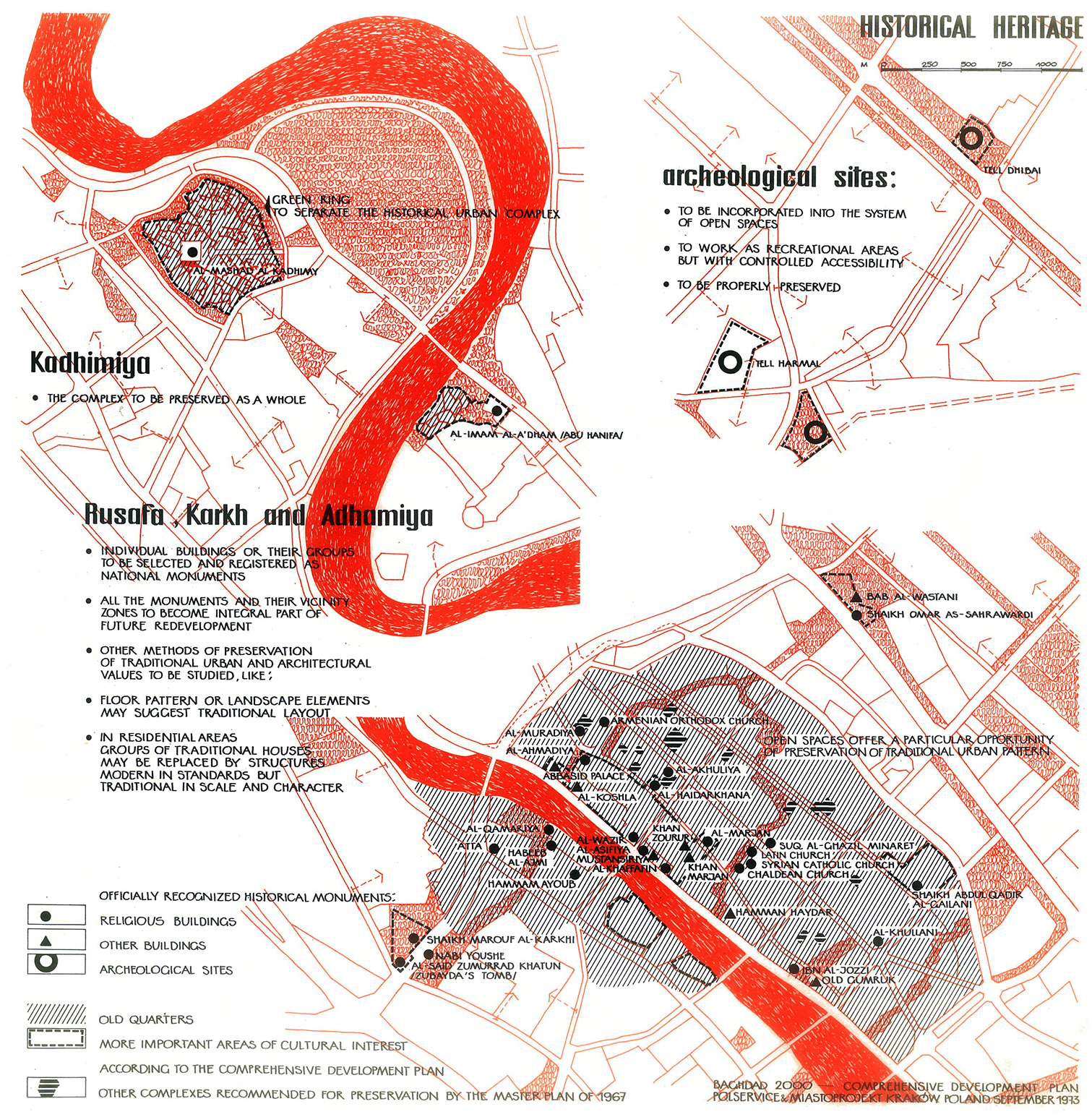
Comprehensive Development Plan for Baghdad 2000. ‘Historical Heritage’, 1973. Miastoprojekt-Kraków (Poland).
These uses of comparison were deeply intertwined with the political economy of socialist worldmaking. Polish planners were amenable to the requests of Shafi and the Municipality because they were under constant pressure from their party and state leadership, eager to boost Poland’s convertible currency revenue. The large size of the Polish team, its interdisciplinary composition and its lengthy stay in Baghdad were possible because of the planners’ liminal position, situated across the political economy of state-socialist foreign trade and the emerging global market of consultancy services. For example, by exploiting the differences between two incommensurable monetary systems – the inconvertible Polish złoty and the Iraqi dinar, pegged to the US dollar – Polish decision-makers secured funding for the extensive urban surveys requested by Baghdad’s Municipality and for additional staff to be embedded in the Municipality’s Planning Department. These conditions of work across socialist and globalist worldmaking both allowed for and facilitated a planning methodology that was more empirical, interdisciplinary, collaborative and scenario-based than Baghdad’s previous master plan (Stanek, 2020: 173–210).
Comparison was both emancipatory and risky for Engmann, Ogar, Shafi and other African and Asian professionals and administrators. It was emancipatory because it challenged the prestige of the former colonial centre, and it put former colonial subjects into a position of appraisers of metropolitan knowledge. It undermined the presumed coherence of Western knowledge by dismantling its components, modifying them and combining them with expertise from other sources. But comparison was also risky, as it was performed against the constraints of time and budget, accompanied by the huge expectations of the local population and based on often manipulated data about social and economic development fuelled by Cold War propaganda.
These examples of comparison as practised in Ghana, Nigeria and Iraq by local and foreign professionals and scholars showed how they tried to avoid the obstacles and to exploit the opportunities stemming from the political economy of socialist worldmaking. But these examples also demonstrated how these actors confronted other worldmaking processes, including path-dependencies of colonialism and pressures of the emerging, Western-dominated globalisation. Accordingly, the study of their work not only expands comparative urban scholarship beyond postcolonial urbanism and global cities research, but also allows for revision of the comparative terms of these two perspectives. This includes triangulating the racialised dynamics of the postcolonial encounter beyond its colonial precedent, and accounting for the active roles that the Second and Third worlds have played in the globalisation processes since the 1970s (Stanek, forthcoming).
Conclusions: Political economies of comparison
Urban knowledge coproduced by scholars and professionals from socialist and postcolonial countries continues to be vividly remembered in the Global South (Adeyemi, 2012; Huwysh, 1988). During the Cold War, this knowledge was on the radar of interested Western scholars, even if their access to it was filtered and often biased. By contrast, this knowledge has been actively forgotten in the Global North since the end of state socialism. This forgetting has not been undone by new comparative urbanism, in spite of many similarities between its postulates and the comparative work discussed in this article. These similarities included the extension of candidates for comparison, the diversification of the terms of comparison and the expansion of the positionalities of those undertaking comparison.
These similarities notwithstanding, the aim of this article was not to extend the pedigree of new comparative urbanism towards the Cold War period. On the contrary: new comparative urbanism needs to be seen as a response to the specific, historical conditions of academic knowledge production during the first decade after the Cold War ended. This decade was marked by the unchecked hegemony of North American and Western European institutions, accompanied by the crisis of state-socialist research infrastructures in the former Soviet Union and Eastern Europe, and their disconnection from the Global South. Yet while promising to dislocate the candidates of comparison beyond London, Paris, New York and Los Angeles, new comparative urbanism rarely challenged the hegemony of these centres of academic knowledge in urban studies. Their hegemony has been supported by the historical continuities of colonial and globalist worldmaking in the Global North, including continuities of resources, networks and institutions.
The geographies of comparative research discussed in this article were not only different, but were also facilitated by distinct, if intertwined, worldmaking practices. Socialist worldmaking both shaped urbanisation processes in myriad locations and brought about new infrastructures of knowledge production about these processes. This production was conditioned by political economies different from those that gave rise to new comparative urbanism, and by positionalities that are unavailable to it. And yet these differences and the epistemic distance that they create between comparative urbanisms old and new suggest opportunities for historicising current urban research and for advancing it. I will conclude with three such suggestions.
First, the historical-materialist perspective offered by the concept of worldmaking brought to the fore the political and economic conditions of comparative knowledge production. In particular, this article showed how the political economy of socialist worldmaking – the evolving geopolitics and foreign trade of the socialist countries and the newly independent countries – impacted the production of comparative concepts, both adaptive and appropriative. This included the selection of candidates for comparison, the size and composition of research teams, the length of their stays abroad, the resources available to them and thus the feasibility of some, rather than other, methodologies. While socialist worldmaking confronted scholars with specific risks and opportunities, its political economy did not overdetermine this scholarship. This was because of the differentiated and dynamic character of socialist worldmaking, and because of the fact that Eastern European, African and Asian scholars worked across several worldmaking regimes. While the pressures faced by urban scholars are different today, this article urges comparative urbanists to interrelate their core concern for conceptual innovation with a more critical understanding of the political economies which condition the production of urban knowledge.
Second, the concept of worldmaking offers an opportunity for urban scholars to rethink their positionality, in particular when they collaborate with scholars from contexts different to their own. This article showed that while socialist worldmaking came with specific claims to the positionality of Eastern Europeans – including Soviet anticolonial credentials and speculations about historical affinities between Central Europeans, Africans and Asians – these claims were often contested by Global South actors. Yet precisely such contestations became opportunities for some among these scholars to reposition themselves within and across competing worldmaking processes in ways that opened their work to new impulses and inspirations. A case in point was the Central European concept of the periphery, by means of which scholars strategically redefined their relationship to dominant centres of knowledge production. This redefinition did not remove the hegemony of these centres – no conceptual decision possibly could – but offered ways to understand how horizons of research emerge in the confrontation, antagonism and negotiation between various regimes of knowledge production. This is a useful lesson for today’s comparative urbanism, as scholars register the end of the unipolar international order led by the United States and rethink their positionality within and across competing worldmaking processes, both existing and arising.
Third, this article emphasised the ways in which comparative urbanism was entangled with practices of economic and spatial planning. This perspective made it clear that comparative research may take many forms. While the scholarship reviewed above did include academic publications, my focus on operative concepts led me to consider less conventional sources, such as technical standards, master plans, regionalisation studies and minutes of meetings. These sources, which today might be termed ‘translational’ (Parnell and Pieterse, 2016), contributed to wider academic debates in Eastern Europe, Asia and Africa, and were informed by broader theoretical concerns, including the specifically Soviet understanding of postcolonial difference. Beyond historical studies such as this article, these sources point to the multitude of comparative practices that are being performed outside of conventional academic frameworks by professionals, administrators and embedded scholars. Together with a more critical appreciation of the political economy of comparative urbanism and a more rigorous study of the positionalities of urban scholars, such broader understanding of what counts as comparative research and the various forms it might take is necessary for a more global urban theory today.
Footnotes
Acknowledgements
I would like to thank Jennifer Robinson and the three anonymous reviewers for their very helpful comments.
Declaration of conflicting interests
The author declared no potential conflicts of interest with respect to the research, authorship, and/or publication of this article.
Funding
The author received no financial support for the research, authorship, and/or publication of this article.
