




Abstract
There are many ways of moving through a city. Cycling is one which has received considerable attention from urban scholars. Yet it has remained largely neglected within the burgeoning literature on the post-socialist urbanisms of Central and Eastern Europe. This paper uses a case study from Sofia, Bulgaria to address this gap in urban research. By exploring the practices and affordances of cycling, we offer a discussion of everyday mobility, public life and urban space in post-socialist Sofia. This case study incorporates ethnography and in-depth interviews with regular cyclists. Through a discussion of bicycling spaces and practices, this paper complicates the notion of post-socialist cities as places defined by the decline of public sensibilities.
Introduction
The post-socialist cities of Central and Eastern Europe (CEE) have been recognised as sites of rapid and far-reaching socio-spatial transformations since the end of state socialism in the late 1980s and early 1990s (Hirt, 2012; Wiest, 2012; Wilson, 2013). Even though post-socialist urbanism has largely eluded attempts at a strict definition, the skyline of prefabricated panel residential high-rises, the distinctive land use patterns, the ostentatious socialist-era public buildings and the erosion of public ownership of assets are some of its recognisable features. At the same time, there is no broad consensus on the analytical utility of the concept, now less than ever, as in the two and a half decades since the collapse of state socialism the practices of everyday life have underlined the complexities and differences, as much as the shared histories of Central and Eastern European post-socialist cities.
In this context, the aim of the present article is twofold. First, we aim to show how attending to the particular set of practices and affordances of cycling in Sofia offers insights into the experiences of post-socialist urbanism. Second, and relatedly, we argue that a close empirical study of cycling challenges the dominant views of the decline of the public in post-socialist cities. Using a case study of Sofia, the capital of Bulgaria, we seek to revisit and build upon the findings of Hirt (2012), who has provided an in-depth analysis of the contraction of the public realm in post-socialist Sofia. We argue that rather than a straightforward withdrawal from the public domain, the growing popularity of cycling reveals a dynamic geography of inhabiting, sharing, contesting and enjoying the city’s public spaces.
While cycling is a global and familiar practice, it includes human and non-human elements which are also highly contingent and locally specific. Aspects of cycling in Sofia are particular to the city. In recent years, the Bulgarian capital has witnessed changes in every aspect of cycling, including the share of bicycle trips, the development of cycling infrastructure, the social and cultural significance of the bicycle as a mode of urban transport, among others. By drawing attention to the situated, embodied, mundane and ambiguous elements of cycling in Sofia, we seek to show that it is not only a manifestation of post-socialist urbanism, but a force which is itself shaping contemporary Sofia.
This article is based on data collected during several research visits between September 2012 and January 2014. The data discussed here were collected through in-depth interviews and observations. A total of 25 interviews were conducted with 15 residents of Sofia, 13 of whom had regularly travelled by bicycle in the last year. Respondents were recruited as part of an on-going research project on commuting in Sofia. They were all Bulgarian nationals, aged between 25 and 40 years old. Eight of them were female and seven were male. They have lived in Sofia for varying amounts of time and their residential locations cover Sofia’s main residential neighbourhoods. They have income levels covering all income quintiles, and diverse occupations, including an academic worker, an advertising executive, a gardener, and a student.
The interviews focused on respondents’ use of the bicycle as a means of transport. Cycling as a leisure activity or a means for keeping fit is outside the scope of this paper. Follow-up interviews were conducted with 10 of the respondents, 6 to 12 months after the original interview, in order to discuss any changes in their own cycling practices and the infrastructures and cultures of Sofia’s urban mobility.
The observations were carried out on a series of weekdays between 7 a.m. and 9 a.m. during October, November, and December 2013. 1 These were conducted at the second-busiest junction in central Sofia in terms of cycling traffic (Petrova et al., 2012: 21). The intersection was selected because it brings together busy car, bicycle and pedestrian traffic with all but one of Sofia’s public transport modes represented (metro, bus and tram, but no trolleybus). It was thus an opportunity to observe how users of these different modes share urban space. On the busiest morning we observed 142 cyclists traversing the junction and on the least-busiest, 99 cyclists were observed. Data were recorded using time–space diagrams, detailed descriptions, and photographs were produced on each of the research visits.
The article is organised as follows. The next section offers a brief introduction to contemporary Sofia and an overview of its urban mobility arrangements. We then turn to positioning our research in relation to existing scholarship on post-socialist urbanism. The following section discusses our findings on the individual skills and public affordances of cycling in Sofia. Finally, we look at the policy implications of our findings for Sofia and other cities in the CEE region.
Urban mobility in Sofia
Sofia was named Bulgaria’s capital in 1879, and during the 20th century gradually became the centre of most of the country’s economic, political and cultural life. Demographically too, contemporary Sofia is the most significant settlement in Bulgaria, with 1.3 million inhabitants, or 17.5% of the total population in 2011 (National Statistical Institute, 2012).
Public transport in Bulgaria experienced a boom in development in the first half of the 20th century. There has been a steady decline since as a result of long-term underinvestment in infrastructure and the rise of automobility. Although after the fall of state socialism in 1989 the decline of public transport was felt especially acutely, the network of bus, trolleybus, tram, mini-bus, and since 1998 metro, is relatively comprehensive and integrated between modes.
A feature of post-socialist urbanism has been the dramatic increase in personal car ownership. There were over 700,000 private cars in Sofia in 2010, their numbers having doubled since 1995 (Grozdanov, 2011: 266). Car dependence has become a major challenge for the city, with 57.1 cars per 1000 inhabitants in 2009, compared to 28.5 in Berlin, 34.0 in Budapest, and 50.8 in Prague (Eurostat, 2014). The heavy traffic and the poorly managed parking of cars has proved detrimental in terms of environmental degradation, public health, and equality of access to urban spaces and resources. Air pollution in Sofia exceeds European Union limits (particulate matter concentrations exceed 50 µg/m3) on approximately 176 days of the year (Eurostat, 2013a). In addition, recent survey findings have classified 39.3% of the Bulgarian population as overweight, and a further 11.5% as obese (Eurostat, 2009), and reliance on car transport is often seen as a key factor in low physical activity rates.
Although no published studies on the topic are available, anecdotal evidence suggests that cycling rates in socialist Sofia were low, mainly as a result of the limited availability of cycling infrastructure, the extensive public transport network and the low status of cycling in relation to the aspirational image of the private car. It was only after 2000 that the position of cycling began changing from marginality to relative visibility. This was felt in the city streets, but also in the rhetoric of local politicians, in media coverage, and in everyday conversations. The share of cycling in 2010 was 1.1% of all journeys (Petrova et al., 2012: 16).
The challenges presented by everyday cycling in cities have often been discussed in terms of the insufficient or inadequate provision of cycling lanes (Sofia Municipality, 2012). This point certainly resonates with Sofia’s residents, as the city provided only 27km of cycling lanes in 2011 (Petrova et al., 2012: 14). Even these existing lanes are often barely useable, with some two-way lanes under 2m in width, while others traverse pavement curbs and descend via stairs into pedestrian underpasses (see Figure 1). The combination of heavy motorised traffic, the competition between pedestrians and parked vehicles for the footpaths, the poor condition of many of the street surfaces and the absence of bicycle lanes paints a bleak picture of the state of cycling in the city. And yet, the prominence of cyclists’ pressure groups in local politics, the presence of cyclists in virtually all neighbourhoods and the proliferation of businesses offering goods and services for cyclists indicate there is a growing enthusiasm for cycling.
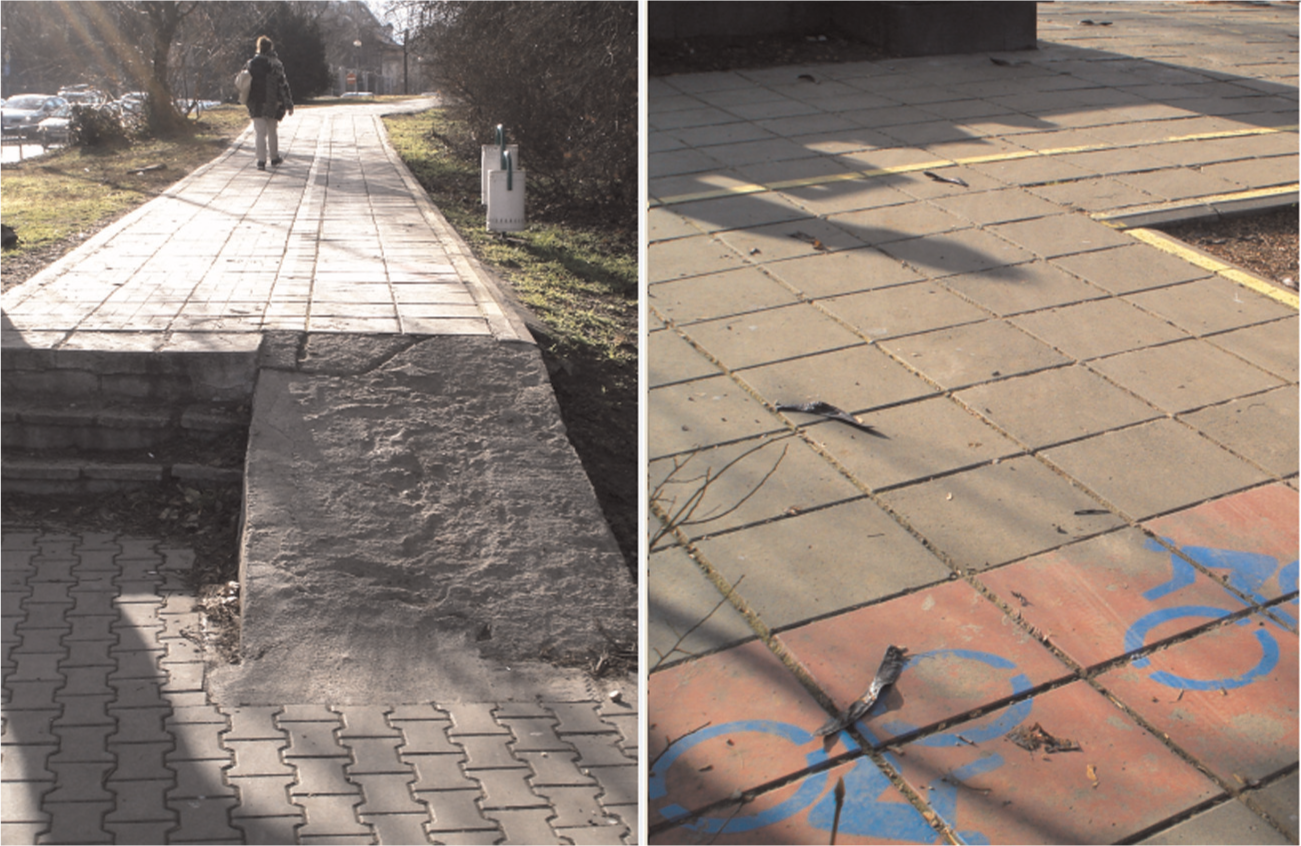
Cycle paths in central Sofia.
Post-socialist urbanism
Cities in Central and Eastern Europe (CEE) have borne witness to a whole host of physical, social, economic, and cultural changes over the last 25 years. There are a number of important contributions in urban studies that aim to explain and provide a framework for grappling with this ‘transition’ (e.g. Hirt, 2012; Stanilov, 2007; Sýkora and Bouzarovski, 2012; Tsenkova, 2006). The changes which manifest themselves through planning, redevelopment policies, and processes of reconfiguring the urban landscape have received considerable attention (Kovacs, 2014; Kovacs and Hegedűs, 2014; Light and Young, 2010).
One of the biggest processes of urban change in CEE post-socialism is residential suburbanisation. This is particularly evident in the major metropolitan areas and capital cities of the region (Borén and Gentile, 2007; Sýkora and Cermák, 1998; Tammaru and Kontuly, 2011). Suburbanisation has partly been driven by significant rural to urban migration, itself an outcome of deregulation and the shift from primarily industrial and agricultural employment to service-sector employment (Andrusz, 1996; Kährik et al., 2012). Tsenkova (2006) explains that with 67% of the CEE population (roughly 300 million) living in cities, the share of urban population in post-socialist countries is similar to Western Europe and North America.
Changes in types, places, and numbers of dwellings are characteristic of urban developments that are occurring across post-socialist cities (Bodnar and Molnar, 2010). These changes have led to an increase in gated-houses and communities, associated with a narrative of growing urban alienation and a decline in public life (Hirt, 2012; Smigiel, 2013). There are further changes that have been identified in post-socialist urban features, including the varying functional uses of Soviet-era car garages (Tuvikene, 2010), re-appropriation of high-rise housing developments (Muliuolytė, 2013), and the redevelopment of ‘left-over’ grand building projects (Light and Young, 2013).
Sofia has largely remained a compact city with a vibrant centre and numerous shared, green spaces despite attempts during various regimes to expand the city (Hirt, 2007a). This has come under threat with the emergence of ‘peri-urban’ development in the form of ‘rural urbanisation’ (Hirt, 2007b: 775). The reduced density of the population (1047 people per km2, Eurostat 2013) and greater property market flexibility have influenced urban mobility patterns in Sofia, shaping the spaces, practices, and materiality of travel. In Sofia trends such as rapid growth in automobility, public transport decline, and more recently, an increase in cycling rates mirror the rest of the CEE region (Krisjane et al., 2012; Silm et al., 2013).
Post-socialist urbanism does not merely consist of physical changes in the urban fabric. Indeed, Hirt (2012: 3) argues that: changes in the urban environment are not only dependent on post-socialist changes in politics and economics. Rather, to the extent which space is a medium of culture, the changing urbanity of Sofia is the story of the post-socialist cultural condition.
This socio-cultural condition Hirt labels ‘privatism’: the secession from public space and public affordances. The decline in public sensibilities is evident, argues Hirt, in all sorts of post-socialist practices including corruption and tax evasion. As a result, a socio-cultural sensibility such as privatism could be argued to be behind the dramatic rise in individual transportation in the form of the private car, and decreasing public transport use in Sofia. Whether, and in what way, this argument can be extended to cycling as a means of transport, remains an understudied question in post-socialist urban studies.
The decline in public sensibilities and affordances is a condition that has been argued as characteristic of post-socialist societies (Kharkhordin, 1995). Bodnaŕ (2001) describes this as the dramatic reduction in the importance of the notion of public acts in all forms. Similarly, Matei (2004) argues, in relation to post-socialist Romania, that indifference to public actions affects routine everyday activities and behaviour. This is a reflection of a mass frustration and entrenched behaviours that have carried over from socialist to post-socialist societies, one that continuously abates the symbolic act of public oriented affordances. However, these accounts of a decline in public life and growing privatism also have important limitations. Firstly, they rely on an implicit idealised notion of public life under state socialism. Secondly, they reduce the relationship between private and public to a simple quantitative measure. In our discussion of bicycling in Sofia, we aim to address both of these shortcomings.
In the post-socialist urban context, cycling could be read as a plainly individualistic mode of transport. However, the increase in cycling does not fit easily into this framework of post-socialist privatism (Hirt, 2012; Matei, 2004). In fact, we would suggest that the concept of privatism does not adequately describe the range of experiences of post-socialist urban mobility in Sofia. As argued by Jungnickel and Aldred (2014: 245), urban cyclists are uniquely immersed in the urban environment through the senses, the skills, and the materialities of the moving body and bicycle. Therefore, the study of the practices of bicycling opens avenues to more nuanced theorisations of everyday life interactions in the post-socialist city.
Bicycling in cities
While cycling may be seen as one identifiable practice involving a relatively stable set of movements and technologies, it can in fact take a number of distinct forms each requiring different skills, materials, and spaces (Heinen et al., 2010; Horton and Parkin, 2012; Zhao, 2014). This is especially true of bicycling in a post-socialist city, where both the physical and the social infrastructures of urban mobility are likely to be undergoing frequent changes.
As mentioned above, the bicyclist has unparalleled contact with the urban environment, which produces both richer and more diverse sensory landscapes (Jungnickel and Aldred, 2014). While this sensory immersion is also characteristic of walking, as a result of the higher speeds and often ambiguous practices of sharing space with motorised vehicles, the bicycle journey can involve a greater sense of danger and vulnerability, whether real or perceived (Gatersleben and Uzzell, 2007). The well-practised bicyclist develops extra-sensory awareness, such as the feel of air when a vehicle is passing-by too closely (Jones, 2012), or the pleasures of taking particular routes for the sensory or affective capacities that they generate (Spinney, 2007).
Cycling as an everyday practice is thus defined by a particular set of interactions with the urban environment journeys. While urban bicyclists may spend extensive periods of time on their bike, they may not see this as an expression of a particular identity or set of beliefs (Aldred, 2013: 197). Cycling in cities involves not only a human and a bicycle, but also the demands on carrying and wearing placed by daily tasks. This can generate pleasant experiences, but also the need for various trade-offs and displeasures, including weather, light and darkness, noise, air pollution, and other moving bodies. It also generates the necessity to develop a cycling-specific embodied intelligence of movement, capable of dealing with traffic and traffic signals, the built environment, other people, as well as the cyclist’s own embodied self (Schwanen et al., 2012).
The parking of the bicycle when not in use raises questions about the long-term convenience, effectiveness, financial implications, and safety of bicycling. Not only does the bicycle need to be secured against theft, it must also be accessible and kept in a place so that it does not cause hindrance. As Aldred and Jungnickel (2013: 619) have argued, ‘once regularly used, it [a bike] must simultaneously be readily accessible and secure, often in the process becoming out of place.’
The bicycles used in cities vary considerably in price, design, and functionalities. There is an array of clothing, locks or securing devices, and accessories. This makes cycling a relatively affordable, inclusive, and democratic mode of transport, albeit within multiple socio-material constraints.
Developing skills to cycle in Sofia
The junction of Grafa and Evlogi 2 is a busy traffic intersection that accommodates motorised vehicles, public trams, buses, a limited cycle path, and pedestrians (see Figure 2). The cycle path follows the Perlovska River and is interrupted by the traffic junction, forcing cyclists using the pathway to join the rest of the traffic at the junction. We chose the Grafa and Evlogi junction as the site of our observations because it provides examples of the everyday challenges and skills that are developed in order to participate in cycling in Sofia. Cycling is a form of movement culture that is enacted in the city through the body, the bicycle, and urban space. However, some of the skills that bicyclists develop on their journeys are the result of attempting to engage in a type of movement that most of the urban landscape of Sofia is not designed for (see Figure 3). Some of the challenges of cycling in Sofia are due to the constraints of urban forms and norms. For example, the Grafa and Evlogi junction is not well lit in the early morning, and cyclists are forced to make a choice between cycling with heavy traffic, cycling on the footpath, and using the cycle path which is interrupted at various sections to allow vehicular traffic to have priority. The cycle path also has other issues, such as poor quality of surface, narrow width, and that it is also used by pedestrians (Figure 1).
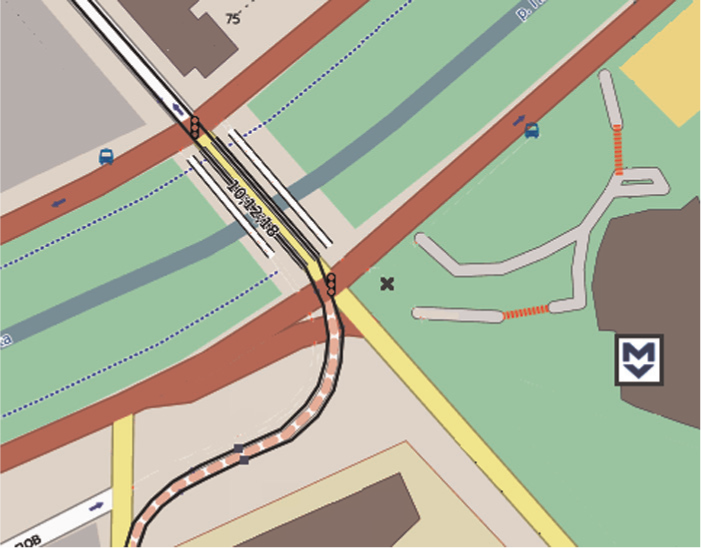
Map of Grafa and Evlogi junction, central Sofia, including roads, metro station, cycle paths and tram route. ‘X’ indicates the position of the researcher during the observations. The dotted line indicates the cycle paths
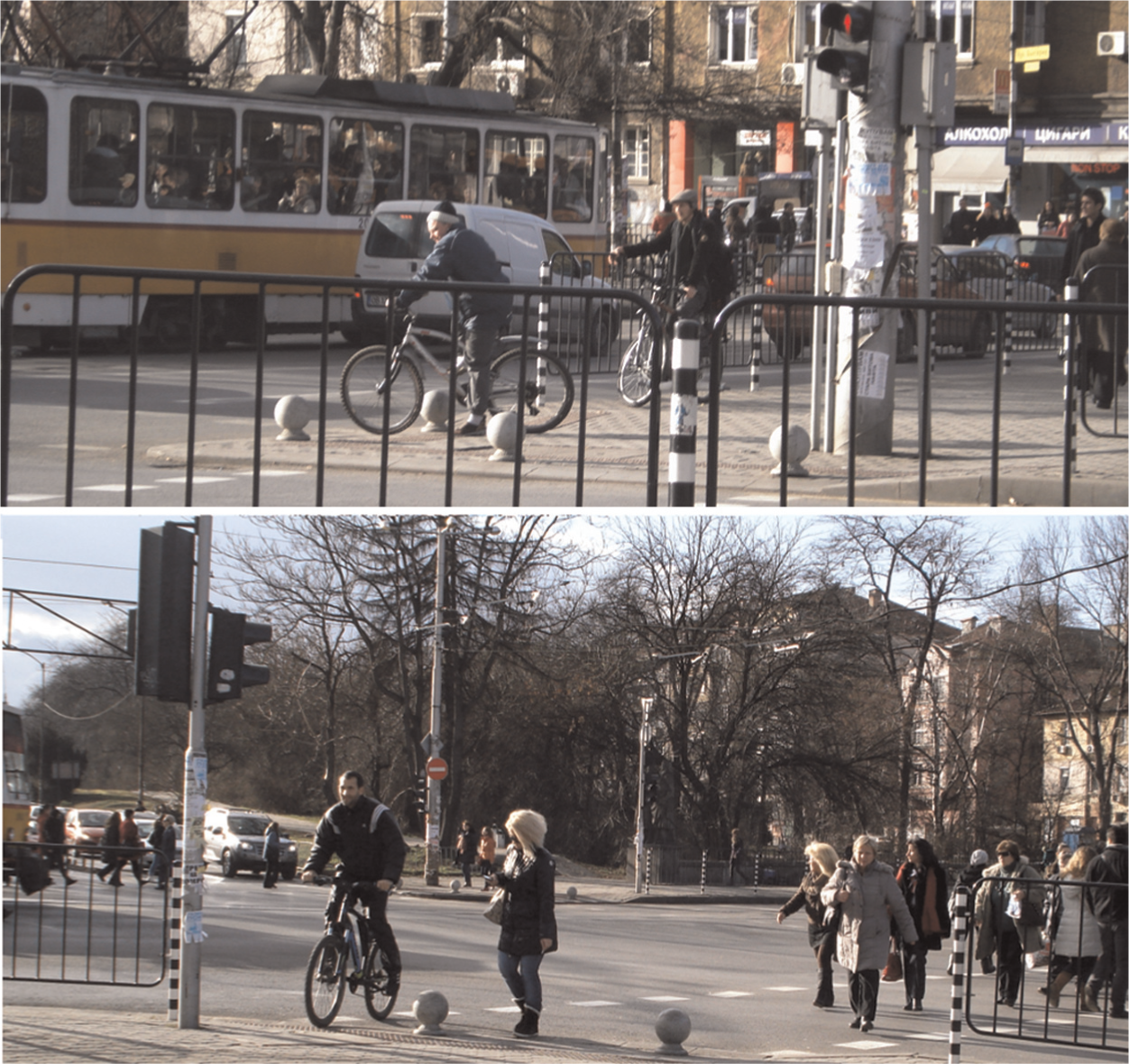
Tactics of crossing the Grafa and Evlogi junction, central Sofia.
In one of the interviews we conducted, Maria 3 drew attention to the issues facing cyclists. These include traffic, difficulties of route-making, and fitting the journey into a daily routine. As our observations of the rush hour at the Grafa and Evlogi junction highlighted, cycle paths are not universally used. The concern raised by Maria, below, in relation to the cycle path identifies a particular problem. The cycle path she discusses is in fact a newly demarcated and resurfaced section of the existing footpath. This part of the cycle path travels past the central train station, coach station, and a number of hotels. However, pedestrians use the cycle path to walk on, especially if pulling luggage due to the smoothness of the surface compared to the footpath. The roundabout that is mentioned is a new junction that was built with the needs of car traffic in mind; it is very busy and steep to climb by bicycle.
I could have borrowed a bike to try out the trip to work – it is long and often scary, overall. The roundabout in Nadezhda is a challenge. There are cycling lanes and parks along the route; the cycle path on Maria Louisa Boulevard is the hardest part. I sometimes avoid it, going instead via Parliament. After that I cycle along [the recently pedestrianised] Vitosha Street, where it’s relaxed. (Maria, F, 32)
To participate in the act of cycling differs between cities in subtle and not so subtle ways (see Latham and Wood (2015), as an example on bicycle journeys in London). In Sofia this includes more than simply the selection of a cycle path as Maria discussed in her interview. This is not only due to the way the cyclist navigates the difficult terrain and other hazards, but also dealing with seasons and weather, encountering the abundance of new construction, and developing fitness and agility. Several respondents drew directly upon the act of finding and managing the route. For Martin, the bike paths are a particular issue as the behaviour of cyclists is not always considerate: I don’t use bike paths because once on a path, cyclists become the way car drivers are in Bulgaria – everyone is in their way! I choose secondary streets and parks to get around. A bell is to warn a pedestrian you are coming – it’s not a device intended to tell him he should move out of the way! (Martin, M, 37)
The lack of perceived adequate behaviour has forced Martin to change his own movements, adapting his route to include streets that are not busy but do not have any specific cycling space.
The issue of security was raised by several of the interview respondents. As Aldred and Jungnickel (2013) have discussed, a bicycle’s materiality does not cease once it is no longer in use. The bicycle needs to be safely locked in a place. Sofia, as with other post-socialist cities in the CEE region, saw a steep increase in crime rates after 1989 (Hirt, 2012). Aldred and Jungnickel’s (2013) point on parking a bicycle in a way which also does not cause a hindrance seems to be of lesser importance in Sofia, where both the Municipality and private property owners are yet to communicate any restrictions to chaining bicycles. Martin discussed the difficulties of securing a bicycle when it is not in use.
Definitely more people are cycling; I see it – of all ages. Even people [who are] wearing suits who work in offices. I guess they have a place to leave [their bicycles]. Sometimes they are worried about arriving all sweaty though. However, for most people the main worry is where to leave the bike. A friend’s bike was stolen from a rack, and even though there was CCTV there, no one did anything. A bicycle is expensive in Bulgaria, BGN 500–600 [EUR 250–300], that’s a [monthly] salary. I would never leave my bike in a place like that. (Martin, M, 37)
Mihaela also elucidated on the difficulties of security and the changes in other behaviours and material aspects of everyday life that it creates.
I would love to cycle, but there is nowhere safe for me to keep the bike. I live in a small apartment with my brother, so we would need storage for two bikes. He has even been talking about designing a special suspension system, to hang his bike from the ceiling, above his bed. Crazy. (Mihaela, F, 33)
During socialist years, many of the pre-fabricated panel apartment blocks had facilities for bicycle storage. These consisted of small annexes with the space for eight to ten bicycles at each stairwell entrance. However, during the early years of post-socialism many of these spaces were converted into unauthorised shops or small stores (Hirt, 2012). Although most of these shops have since closed down, the bicycle parking facilities have not been restored to their original purpose. These spaces are an enduring legacy of socialist era housing and their unrealised potential is particular to the materiality of post-socialist urban cycling.
Despite the constraints in cycling, there are aspects that enrich the experience. For one respondent, the construction works in his neighbourhood opened his eyes to the potential and even enjoyment of cycling; the pleasures of moving through the urban space and traffic of Sofia: During the construction of the metro in our neighbourhood, there was a reduced number of traffic lanes because of the construction, there were such serious traffic jams. I would cycle past all the blocked traffic using the space alongside the actual construction works – even though it wasn’t paved; the previous cyclists had made a route. (Lyubo, M, 28)
Set against the narrative of the post-socialist disposition of ‘privatism’ the interviews and observations of cyclists revealed through the development of skills a deeper engagement with public life. The secession from public-centred affordances does not present the full spectrum of post-socialist society in Sofia. The many subtle and not so subtle skills required to navigate the urban landscape demonstrates that cycling in Sofia is about being part of different publics in multiple ways.
Public nature of cycling in Sofia
Cycling is an individual form of transport, which is often seen as a means for the urban dweller to circumvent the costs and inconveniences of motorised transport, and in the case of post-socialist Sofia, from the severe shortcoming of the public transportation system (Śliwa and Riach, 2012). From this perspective, the rise in cycling rates can be interpreted as another example of secession from public space and rise of privatism and alienation in the post-socialist city (Hirt, 2012). However, we argue that the growing popularity of cycling is giving rise to new ways of cohabiting in post-socialist urban space.
Looking beyond post-socialist cities, research on cycling has demonstrated its rich sensory qualities, which involves being alert to, and engaged with, urban life (Gatersleben and Uzzell, 2007: 422). The cyclist is intimately interconnected with the city as they pedal through largely unprotected. During the observations at Grafa and Evlogi junction, the closest interaction in terms of spatial proximity was between the cyclists and the pedestrians. Although research has tended to focus on the interaction between cyclists and drivers in urban space, we found bicycling in Sofia involves various forms of interaction also with pedestrians. The near-absence of infrastructural provision for cycling, and the ambiguities of cycling codes of conduct, has produced in Sofia a particular kind of sociality. The public nature of cycling the post-socialist city is often about unspoken negotiation and compromise between these two groups, whose physical proximity on the footpath is not mediated by the shells of motorised vehicles.
There isn’t much verbal interaction between pedestrians and cyclists. The cyclists do not ask the pedestrians to move out of the way. However, both do accommodate the other in two ways. First, at the point of cyclists re-joining the footpath the pedestrians allow the cyclists more room to be able to swing themselves and their bike onto the footpath. Second, while waiting at the crossing, the pedestrians position themselves to the centre of the space so cyclists can lean against railings and take up positions near the front of the crossing allowing them to cross first. (Research diary, 5 December 2013)
By making this argument about cycling and public sensibilities in post-socialist cities, we do not suggest that the shortcomings of infrastructural provision make a positive contribution to public life. The deficit in cycling lanes puts in danger both cyclists and pedestrians, and adds to the daily stresses of both kinds of urban journeys. However, while the post-socialist urban fabric is undergoing transformations these kinds of interactions help to sustain an ethics of care towards other urban dwellers. The focus on post-socialist cities as being highly informal and lawless spaces has overlooked the consideration shown towards others in daily interactions.
And yet, ambiguity around rules and regulations should not be underplayed as a defining aspect of cycling in Sofia. It is characteristic both of the physical spaces and the legal provisions which underpin this mode of transport. The ambiguous nature of the legal framework is explicitly discussed by Lyubo who is a regular cyclist in Sofia and has even been employed as a cycle courier.
I don’t know if we’re obliged to stop at a red light – I don’t do it, even in front of a police car. I’ve never been stopped over anything like that, or about not wearing a high-visibility jacket. (Lyubo, M, 28)
Lyubo also identified problems associated with the cycle paths being inserted into original footpath space. He articulates the frustrations at the lack of clarity associated with cycling space in Sofia. This relates to the type of clothing required, the rules and laws to follow, and how to interact with other road users.
One of the worst things is people jumping out onto the cycling lane because they are trying to flag down a minibus, and they don’t even see anyone is coming. If you are daydreaming, it can get dangerous. I’ve had some close calls with buses and drivers. I try to avoid situations like that, I don’t like the feeling when a bus is honking at you and everyone knows it is you. (Lyubo, M, 28)
As to the lack of spatial provision, it is evident at the Grafa and Evlogi junction where cyclists are numerous, but no formal arrangements for crossing are made for them. They do not have priority over either pedestrians or vehicular traffic at any point at the junction. There is no demarcated space for cyclists on the road. Therefore, the Grafa and Evlogi junction provides a particularly visible example of how cycling space in Sofia often comprises of ‘encroaching’ onto other space. The sharing of the junction between cyclists, pedestrians, and motorised transport is not based upon an equal priority. Rather, the act of sharing involves imposing one type of transport onto another, rubbing up against each other in a confined space that was designed for a single type of use.
Finally, the growing number of people on bikes has also enriched the interactions between urban dwellers in other domains of everyday life. The increase in cycling rates has given rise to political and civic engagement where post-socialism has frequently been associated with political apathy and indifference (IIDEA, 2002). Activism for better cycling provisions has been a particularly visible presence in Sofia’s urban politics in recent years. This is second only to protests against the dramatic increase in construction in Bulgaria’s protected nature reserves (Capital Weekly, 2013). The rise of a dedicated community of regular cyclists has not only re-engaged some urban dwellers with local politics, but has also begun to make a difference in the quantity and quality of cycling infrastructure. This provides a further example of the public affordances generated through cycling in Sofia, a point emphasised by Grigor in one of his interviews: The cyclists’ community is very active and even when the authorities are very bad in the construction of cycling lanes etc., they write letters, organise campaigns, and the municipal authorities do respond and take action. (Grigor, M, 27)
Conclusion: Cycling in post-socialist cities
Our aim with this paper was twofold. First, we aimed to demonstrate how the particular set of practices and affordances of cycling in Sofia offers insights into post-socialist urbanism. Our second aim was to argue that a study of cycling challenges the dominant narrative of decline of publicness in post-socialist cities. We addressed these aims by observing cycling practices at a busy junction in central Sofia, and by interviewing regular bicyclists in the city. We have found that cyclists in Sofia are skilled at navigating the city in various ways. At the same time, our findings show that travelling by bicycle in Sofia remains both challenging and dangerous.
In the introduction we outlined our intention to contribute to the critical conversation about post-socialist urbanism. In researching the public nature of urban mobility, we were able to explore the practices of how everyday public life is made in a post-socialist city. Our findings complicate the documented secession from urban public life and growing alienation between urban dwellers, referred to as privatism (Bodnaŕ, 2001; Hirt, 2012; Matei, 2004). For instance, several of our respondents commented on the rise of cycling activism in Sofia. As one of the respondents concluded their interview, activism has produced tangible results which make a difference to the cycling provisions in the city: Do you need a ticket to take the bicycle on the metro? I don’t know how it is nowadays. For years, you couldn’t take one on the metro at all. But two and a half years ago, I and a friend started a petition [to allow bicycles on the metro on weekends and after 9 p.m. on weekdays], collected 1250 signatures, submitted it to the Municipality, and it got accepted within a month. Good example that it’s not true you can’t change anything in Bulgaria. (Lyubo, M, 28)
Cycling in post-socialist Central and Eastern European cities cannot simply be reduced to dealing with inferior infrastructure or lower cycling rates compared to Western European cities. Although we found that the provision of cycling infrastructure in Sofia is far from adequate, we have similarly sought to recognise the challenges of inserting cycling facilities into the existing urban fabric. Our findings suggest that increasing the role of cycling in a city is not simply about developing one mode of transport at the expense of another. While much research on cycling focuses on the competition for urban space between cyclists and car users, the example of Sofia illustrates that cycling provision is equally about integrating different transport modes (Schwanen et al., 2004). Moving around cities is inherently about combining different modes of transport, and bicyclists are not defined by a singular modal identity (Lavery et al., 2013: 38). At present, bicycles are only allowed on the Sofia metro after 9 p.m. and are not allowed at all on buses, trolleys buses, or trams. The ability to travel with a bicycle on public transport at more times, and greater public awareness of these regulations, would make a real difference to cycling provision in Sofia, as suggested by one of our respondents: The bicycle lets me relax. Otherwise I am just sitting down all the time. That is also why I don’t like the metro very much. Sometimes people on the metro react when [I get on it with] the bike; I have to explain that I am allowed by law to be there after 9 p.m. (Martin, M, 37)
Similarly, studying the situated, embodied and often ambiguous act of urban cycling in Sofia showed that the stationary bike has not received adequate attention from the city’s transport authorities (Aldred and Jungnickel, 2013). Furthermore, our research argues that the focus on the bicycle-in-motion exemplified by the construction of cycling paths should be matched by efforts to introduce – or, in the case of socialist-era high-rises, restore – provisions for the secure and convenient storage of bicycles at home, work, and leisure spaces.
When discussing new cycling infrastructure, we often tend to think in terms of inserting new infrastructure into a pre-existing urban fabric. However, when talking about post-socialist cities, it is important to emphasise the continuously changing nature of the urban environment. The shortages and shortcomings of cycling infrastructure are a major challenge for everyday cyclists in Sofia, but by no means the only one. The discussion above aimed to show that many different aspects of the built environment, the cyclist, the people around them, and the many objects they interact with, are part of the practice of cycling. As a result, the improvement of cycling infrastructure provision in post-socialist cities depends to a great extent on developing a more detailed understanding of the skills and spaces of cycling.
Footnotes
Acknowledgements
We would like to thank Tauri Tuvikene for his thought-provoking comments on an early draft of this paper. We are grateful to Alan Latham for many insightful discussions. We would also like to thank the anonymous reviewers and the editor for their considered comments and suggestions.
Funding
Anna Plyushteva would like to acknowledge financial support from the Economic and Social Research Council (grant number ES/J500185/1).