



Abstract
This article places those working for change in urban neighbourhoods at the centre of debates on urban transformation, directing attention to the importance of human agency in the work of assembling urban transformation. Drawing on cross-national qualitative fieldwork undertaken over 30 months shadowing 40 urban practitioners in neighbourhoods across four European cities – Amsterdam, Birmingham, Copenhagen and Glasgow – our research revealed the catalytic, embodied roles of situated agents in this assembling. Through exemplar vignettes, we present practices in a diverse range of socio-material assemblages aimed to address complex problems and unmet needs in the urban environment. The practices we studied were not those of daily routines, but were instead a purposeful assembling that included nurturing and developing of heterogeneous resources such as relationships, knowledges and materials, framed through an emerging vision to inform, mobilise and channel action. This article brings together assemblage-theoretical and practice-theoretical ideas, with rich empirical insight to advance our understanding of how the city may be re-made.
Introduction
The understanding of urban transformations as ‘fundamental shifts in human and environmental interactions’ (Hölscher et al., 2018: 1), that is, abstract or macro-level changes or irreversible processes of evolution, remains influential. Yet, the complex and messy nature of urban contexts presents a serious critique (Brenner and Schmid, 2015; Pickett et al., 2013) of the idea that cities progress through particular stages to develop in a predetermined direction, or that urban transformations come from straightforward stimuli plotted in a master governance plan (Scott, 1998).
Over the last decade, assemblage theory has offered a contrasting and fruitful way to conceptualise urban contexts and their transformation (Anderson and McFarlane, 2011; DeLanda, 2019; Li, 2007; McFarlane, 2011a, 2011b, 2011c; Newman, 2014). Assemblage theory considers the urban environment in terms of emergent entities ‘composed of heterogeneous elements that may be human and non-human, organic and inorganic, technical and natural’ (Anderson and McFarlane, 2011: 124). It is ‘alive to the complexities and messiness of urban processes’ (Swanton, 2011: 345), and helps us to understand how such heterogeneous elements are held together in processes of variable duration and impact (DeLanda, 2019; Newman, 2014; Tafti, 2020; Ureta, 2014; Yetiskul and Demirel, 2018). Assemblage theorists seek to render this messiness of the urban condition amenable to interpretation by paying attention to contingency, emergence and interaction (Buchanan, 2020). Assemblage theory thus foregrounds transformation as a continuous process rather than as an effect, and invites us to understand change by moving away from ‘closed totalities towards open-ended and always-becoming multiplicities’ (Ghoddousi and Page, 2020: 6).
Assemblage theorists, however, have been criticised for underplaying the role of human intentionality and agency (Storper and Scott, 2016: 1127). We share the observation of critical theorists, that ‘ontological forms of assemblage thinking are not well equipped to identify the specific human agents and social forces that might engage in the process of social transformation’ (Brenner et al., 2011: 236). We believe that assemblage thinking currently under-theorises the more purposive assembling work that situated agents may develop at the level of everyday human (inter)action. Inspired by McFarlane (2011b, 2011c), who combines assemblage and dwelling, we bring together assemblage-theoretical ideas with practice-theoretical ones (Feldman, 2004; Sandberg and Tsoukas, 2011; Schatzki, 2002; Yanow and Tsoukas, 2009) to address this point. In doing so, we contribute to the questions of who and what has the capacity to assemble the city (McFarlane, 2011c: 668; see also Koster and Van Leynseele, 2018).
In this article, we draw upon a 30-month study conducted in neighbourhoods in four European cities, which focused on the practices of 40 urban practitioners who, ‘[b]y virtue of their reputation, skills and imputed connections, provide services, connectivity and knowledge’ to other citizens, and help to create new spaces of action (Beveridge and Koch, 2017). Using qualitative research strategies common to urban studies (Bartels, 2017; Parizeau, 2017; Van Holstein, 2020), we analysed the practices of urban practitioners, such as active citizens, community leaders, elected representatives, front-line workers, social entrepreneurs and artists. We show how these urban practitioners may be understood as ‘catalysts’ (Waddock and Post, 1991) within an assemblage, and how they work the assemblages that contribute to the ongoing transformation of the urban environment. Our empirical study shows the transformative potential of urban practices that are based on assembling socio-material resources in pursuit of a vision that aims to address a complex problem or unmet need. We demonstrate how the work of urban practitioners lies not only in assembling diverse resources, but also in developing them (Feldman, 2004).
Our second contribution is the application and further development of the concept of assemblage for critical and practice-theoretical urban theory (e.g. Bartels, 2020; Beveridge and Koch, 2017; Blanco et al., 2014; Brenner and Schmid, 2015; Verloo, 2018). Practice theories help to see how human activities are needed for the urban to be (re)produced and transformed. As Brenner and Schmid observe, urban space is defined by the people who use, appropriate and transform it through their daily routines and practices, which frequently involve struggles regarding the very form and content of the urban itself, at once as a site and stake of social experience. (2015: 171)
In contrast to the approach of many practice theorists (Bartels, 2020; Yanow and Tsoukas, 2009), however, we do not start from the stable daily routines of formal organisations or in the unintended transformations that the practices of ordinary citizens amount to. Our starting point is the assembling we observed in the heart of ever-transforming urban contexts. Such assembling demonstrates a capacity for change through ‘the creation of new connections, generation of new encounters and disruption of the usual patterns’ (Yetiskul and Demirel, 2018: 3349; see also, Schatzki, 2002: 73–74). Combining assemblage theory with practice theory also helps to overcome the trappings of hierarchical thinking or overreliance on constructs like the state or market, which can limit our understanding of human agency as a key driver of transforming (Dovey et al., 2018; Koster and Van Leynseele, 2018).
We first consider the intersection of assemblage, practice and resources in further detail as an analytical framing for our data analysis. We then set out our methodology, before sharing a series of exemplar vignettes, through which we present the practices of four urban practitioners in a diverse range of socio-material assemblages. Assemblage theory directs our attention to the link between the actual and the possible in urban transformations (McFarlane, 2011a: 221). As we will illustrate, these urban practitioners not only seek to do things today that move towards a better tomorrow, they also enact practices that characterise that desired tomorrow in the here and now.
Assemblage, practices and resources
The concept of assemblage, and its emphasis on relational complexity and emergence, has gained influence within urban studies (Anderson et al., 2012a; McFarlane, 2011a, 2011b; Moragues-Faus and Sonnino, 2019; Newman, 2014). Assemblage refers to the composition of diverse elements into emergent and provisional socio-spatial formations (Anderson and McFarlane, 2011). Assemblage theory therefore invites a shift in focus from the study of reified entities in social and political life, to the ongoing socio-material processes that constitute, reproduce or change those entities. For example, Newman talks of networks of people, flows of ideas and also about the associations between objects, and how these ‘may be assembled in new ways […] changing the meanings or other properties of individual components drawn into interactive practices’ (Newman, 2014: 3293). In understanding assemblages as ‘heterogeneous, contingent, unstable, partial and situated’ (Collier and Ong, 2005: 12), assemblage theorists (Bennett, 2005; DeLanda, 2019) take seriously not only non-human materials, but the distributed nature of agency, giving emphasis to ‘the process of arranging or fitting together a set of heterogeneous elements’ (Anderson and McFarlane, 2011: 125). This puts ‘relational politics’ in the analytical spotlight in shaping urban life (Ghoddousi and Page, 2020: 5).
As Li (2007) points out, assemblage thinking ‘flags agency, the hard work required to draw heterogeneous elements together, forge connections between them and sustain these connections’ (p. 264). In this article, we share Li’s interest in assembling as the practices and agency of situated human agents. We aim to ‘finesse questions of agency by recognising the situated subjects who do the work of pulling together disparate elements without attributing to them a master-mind or a totalising plan’ (Li, 2007: 265). In doing so, we also heed Koster and Van Leynseele’s (2018) approach to deepening assemblage theory by throwing into sharper relief the ‘acts of assembling done by brokers’ (p. 804). We thus want to understand assembling work, the doing (McFarlane, 2011c: 655), without granting the situated human agents a kind of ‘heroism’ in deciding what, when and how assembling takes place (Durose et al., 2016; Meijer, 2014). Our take on assemblage expects transformations to grow from and manifest themselves in ‘both the emergent dynamics of city life which alter the urban experience and more directed interventions attempting to achieve urban change’ (Robinson, 2006: 251). Responding to a call from assemblage theorists ‘to examine practices on the ground’ (McFarlane, 2011a: 209), this article thus illustrates a more human-centric use of assemblage theory.
As implied here, ‘assemblage links directly to a practice, to assemble’ (Li, 2007: 264, emphasis added), yet such practices often remain implicit. We argue that practice theory usefully picks up precisely where assemblage theory remains under-developed: the everyday work at the frontlines of urban transformation (see also Koster and Van Leynseele, 2018). Practices, as we define them here, are bundles of activities aimed at particular objectives (Sandberg and Tsoukas, 2011). Urban scholars have been developing valuable ‘interactive and dynamic analyses of micro-practices enacted in-between stakeholders implicated in complex situations and embedded in dense webs of contingent interconnections’ (Bartels, 2017: 3793; Gilchrist, 2019). Situated agents ‘transform their own urban worlds through everyday practices, discourses and struggles, leading to the formation not only of new urban configurations, but of new visions of the potentials being produced and claimed through their activities’ (Brenner and Schmid, 2015: 178; Parizeau, 2017). For situated agents, the diverse elements that are brought together (assembled) are socio-material resources they work with. The agency that brings practices to life, can be seen as the ability agents have to act on the situation at hand (Yanow and Tsoukas, 2009).
What then do the assemblages we study look like and consist of? Even if we stress process and emergence, we can label assemblages and point at assembled elements – matched or fitted together (DeLanda, 2016: 1) – in one way or another. For example, Li (2007) identifies ‘things’, ‘socially situated subjects’, ‘objectives’ and an array of ‘knowledges’ (p. 266). To situated agents such as those we studied, these elements are resources that can be assembled to make their projects, enterprises or organisations work (Feldman, 2004). Like Koster and Van Leynseele (2018), we expect practices to depend on a range of situated subjects, and social relationships, including networks and reputation. Materials (the ‘things’ Li talks about) like buildings, equipment or funding, are also relevant. Furthermore, we should expect an important role for a vision– including the ‘objectives’ that Li (2007) and practice theorists point at – that drive these projects, enterprises and organisations. In contrast to large bureaucratic organisations (DeLanda, 2019), the assemblages we look at mobilise resources that do not necessarily include and are not tied together by organisational routines, formal procedures and legal contracts. There are, however, different knowledges that emerge from and constitute the assemblage, for example, the local knowledge of a city or urban neighbourhood. All these resources can be made part of different kinds of urban action, and we expect their properties and the properties of the assemblage they contribute to, to be emergent.
In sum, we are concerned with what is ‘apparent in the practices of everyday life, the creation of new spaces of action’ (Beveridge and Koch, 2019: 151), as well as the potential for challenge and change (McFarlane, 2011a: 209). The practices studied in this article are not the routines of formal organisations or ordinary residents, but those of practitioners developing alternative practices that are prefigurative of urban transformations in the sense that the actual seeks to embody and enact the possible (Raekstad and Gradin, 2020). Our approach seeks to demystify how urban practitioners contribute to urban transformations through their assembling practices. This perspective then offers a novel intersection between practice research and assemblage theory, making good on the latter’s aim to offer insights into assembling processes rather than just assembled entities (see also Koster and Van Leynseele, 2018; cf. McFarlane, 2011c: 651). The next section describes how we approached these practitioners and their practices, by explaining how we conducted our qualitative fieldwork.
Methodology
Our cross-national qualitative research design was developed to gain insights into the practices of situated agents in four North-Western European cities. We started from a broad interest in practices of agents who were reputed to ‘make a difference’ (Durose et al., 2016). We wanted to empirically understand how they developed, sustained and adapted their work practices. We first identified neighbourhoods where urban development had been targeted, for example through government-led interventions, often related to socio-economic disadvantage, or a reputation for community action. We drew upon the insight of our co-operation partners (national and local organisations knowledgeable in the field of urban governance and regeneration), which informed our selection of Balsall Heath and Sparkbrook (Birmingham), Govan (Glasgow), Nieuw-West (Amsterdam) and Nord Vest (Copenhagen) as our four anchor neighbourhoods.
We started by using a ‘snowballing’ technique, initially informed by our co-operation partners, to generate a database of approximately 200 potential participants across the four neighbourhoods. We then worked iteratively to identify urban practitioners to participate in the study. In doing so, we aimed to ensure diversity in both position – including, for example, active citizens, community leaders, elected representatives, front-line workers, social entrepreneurs and artists, as well as relationship to the neighbourhood, for example, living or being professionally engaged there. We recruited a cohort of practitioners that was gender balanced and reflected the neighbourhoods in terms of ethnic diversity. The cohort was more ethnically diverse in Birmingham and Amsterdam than in Glasgow and Copenhagen, reflecting the demographic profile of those cities. Across the sample, there was an under-representation of younger people, which may reflect the time taken to establish a repertoire of practice, but may also be seen as a limitation of the research.
We shadowed and interviewed 40 practitioners across the four neighbourhoods over a 30-month period. Each practitioner was shadowed individually (McDonald, 2005) at two different time points, where the researcher observed and recounted practices, and documented conversations by ‘running commentaries’ and ‘jotting notes’ (Emerson et al., 2011). Shadowing was concluded with a documented reflective conversation. Before and after the shadowing phase, we conducted semi-structured interviews to understand what these practitioners do, how they do it and what enables and hinders them in making a difference. Across the research period, we brought practitioners together locally and cross-nationally in series of interactive workshops to reflect on emerging insights from the research. This resulted in a dataset including notes on around 640 hours of shadowing, 80 reflective conversations, 20 interactive workshops and a total of 80 interviews.
Our interpretive epistemology encouraged us to work abductively (Schwartz-Shea and Yanow, 2012), and follow leads (Charmaz, 2014: 25). Our data was coded locally in the language of each site (Strauss and Corbin, 1990), according to a shared codebook. We used memos to share and deepen analysis on emerging themes across sites. A key emergent theme was the ‘assembling’ of resources for urban transformations. We decided to both engage with the relevant literature and further analyse this theme through focusing on exemplar cases from within the cohort.
The understanding that we present in this paper highlights different but overlapping ways in which the urban practitioners we studied operated. As Ureta (2014) argues, ‘assemblage urbanism tends to favour the study of the very concrete practices through which the urban is continually produced, no matter how small or context-specific’ (p. 244). We recognise that the urban practitioners that we study assembled different resources and worked on different issues, but what they do can be understood as assembling practices, as we propose and demonstrate. Here, following Gioia et al. (2013), we recognise that ‘many concepts and processes are similar […] across domains’, and their extraction ‘allows our findings to address a larger audience’ (p. 24).
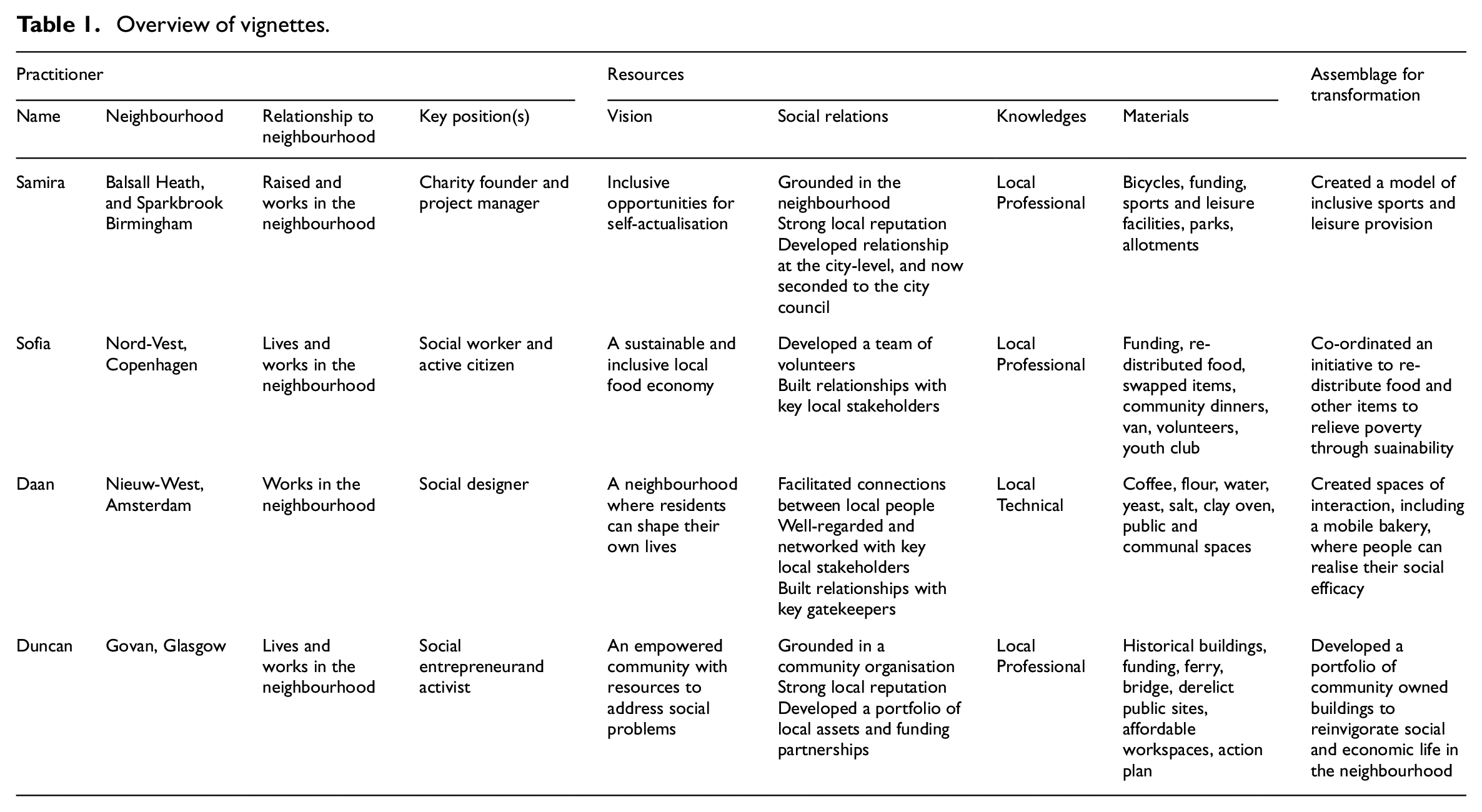
To illustrate practices of assembling, we present and analyse a series of four ‘vignettes’ or stories about urban practitioners, their assemblage and context. The vignettes allow an in-depth analysis of the phenomenon being explored, through ‘detailed qualitative description’ (Miller and Brewer, 2003: 340). Table 1 provides an overview of four vignettes as ‘exemplars’ of our wider dataset of socio-material assemblages (Miller and Brewer, 2003). The vignettes drew from the data sources noted, and from across our four research sites. The practitioners in each vignette reflect the demographic, positional and relational diversity of the wider cohort. The vignettes are pseudonymised, but some projects and practitioners may be identifiable. The practitioners involved gave their consent to be identified as participants in the project to allow for the detail and nuance of their assembling to be expressed.
Overview of vignettes.
Vignettes
Vignette 1: Samira
Samira – an immigrant woman of Pakistani heritage – grew up and raised her children in Balsall Heath, Birmingham. After leaving an arranged marriage, Samira became active in the women’s group of the neighbourhood forum. When encouraged to apply for a paid role at the forum, she worked to develop an idea from the women’s group: to create inclusive sports and leisure provision in the neighbourhood, run by women for women. Samira thus founded an initiative providing healthy lifestyle activities for women from under-served communities in Balsall Heath. In one example, she led a team of 25 women to train and take part in a local cycling festival. Samira worked with the festival organisers to allow the women to participate on a shortened route – nicknamed the ‘Ramadan Special’– to help maintain their fast.
Samira’s own family’s experience of heart disease and type-two diabetes meant that she was acutely aware of poor health outcomes in the community. Her experience of poverty, and the impact of cultural tradition, led to a recognition of the importance of creating spaces and opportunities for women. Initially, Samira was ‘brushed off by absolutely everyone’. But she wanted to challenge ‘a perception and a belief by the local authority that Asian women didn’t want to do exercise and fitness’ and ‘decided to do things and become something’. After a pilot in Balsall Heath led to the project’s registration as a charity, the group secured significant national funding to expand. Over a 20-year period, the project grew to reach 1500 women a year from three wellbeing hubs across the city. As project manager, Samira supported this ongoing development, which included delivering commissioned services to support women managing long-term health conditions, and offering gentler activities for older women, including allotment gardening and ‘crochet and chai’ sessions.
Samira reflected that her project meant, ‘women across the inner city for the first time ever, will do some exercise, fitness and enjoy it … and then they’ll start to do other things’. As she noted, ‘we’re trying to give women a journey no matter how big or how small it is’. For example, following their participation in the project, a number of women took up voluntary positions or employment – including within the project. In parallel, Samira got involved in different city-level fora. She felt that development in neighbourhoods like Balsall Heath had been ‘stifled’ by the ‘old boys’ network’ that dominated the city council, and meant that people who lived in the neighbourhood weren’t ‘given the stepping stones’ to realise their potential. Samira felt ‘happy to keep on challenging a lot of decision-makers that don’t know what it’s like to be on the poverty line’, and began to be seen as someone who ‘knows what she’s talking about’. Samira’s project modelled her belief that ‘communities should be supported to pilot ideas’ and ‘grow them if they work’. She was recognised as a ‘doer’, which she related to ‘know[ing] how people work’: ‘You know who to avoid, you know who to go to’ and ‘you can galvanise people’. But Samira also learned that ‘it’s easier to make things happen’ when you ‘take them with you’. As her reputation for authenticity and effectiveness grew, Samira was seconded by the city council to run a targeted city-wide project to encourage people to start running. Samira is now focused on a further collaboration to bring employment-related training for women into neighbourhoods like Balsall Heath.
Samira reflected that her work has ‘helped Birmingham to change the way provision is delivered for women’: ‘we’re a trailblazer … we set the standard, we demonstrate the difference that can be made and we show how to do it’.
Vignette 2: Sofia
Sofia is a social worker and community activist who ran a project to make ‘better use’ of food waste, as a means to develop a more inclusive and sustainable food economy in Copenhagen’s Nord Vest, where she lived with her young family.
Sofia worked as a social worker within the municipality, but tired of the ‘strict scope of what you can do’. Following a Masters degree in Social Entrepreneurship, Sofia began work for a charity in Nord Vest supporting people experiencing homelessness. The faith-based ethos of the charity, which emphasised the importance of each individual, resonated with her own inclusive approach. Sofia secured funding from the municipality’s area-based initiative (ABI), which was aiming to renew public space in Nord Vest, and foster community. The funding was used to support projects that brought together service users and local residents, such as the development of a community garden in front of the shelter. Sofia heard about a project developed by a local political candidate to redistribute food waste from supermarkets within the community. When he failed to be elected and the project’s continuation was at risk, Sofia took on the project during her maternity leave.
At the food distributions, Sofia was keen to create an atmosphere that was welcoming. Different people used the project, including those experiencing food poverty, and those who wanted to live more sustainably. All were encouraged to take only what they needed, but there was no means testing or conditionality. By linking poverty with sustainability, Sofia was able to both recognise the chronic nature of food insecurity and frame the project in a way that reduced stigma for those who use it. As she reflected: ‘It is important that we present the food in a manner where it looks nice. It is about dignity.’
To continue the project, Sofia recognised she needed to collaborate: ‘I have to be aware of what I can do and what can be delegated.’ Sofia identified clear roles for volunteers, so it was easy to get involved, and described her role as one of ‘framing how co-operation can work’. The volunteers came from different walks of life: people new to the neighbourhood and longer-term residents, old and young, those motivated to help others, and those seeking employment experience. Some got involved through social media, others through word-of-mouth. For Sofia, recruitment of ‘a small but dedicated group of volunteers’‘made the difference’, and helped the project to ‘come to life’. Sofia reflected that, ‘every participant has to gain something by collaborating’ and worked to find common ground between the volunteers on how to develop the project. In recognition of their contributions, she supported them to sustain the project and its future access to funding.
ABI funding also enabled Sofia to expand the project. Healthy community dinners, which used food remaining from the redistribution, brought together those using the project with the wider community. Sofia also convened ‘swap shops’ where residents exchanged un-wanted items, such as clothes and toys. Through negotiating the funding process, Sofia was introduced to the leader of a local youth club who wanted to develop it as a ‘community hub’. He agreed to host the food project over the longer term, and offered the use of a van and a driver to aid the redistributions. Through the food waste project and its expansion, Sofia created spaces where people felt part of a community; she reflected that ‘when you get to know each other it is easier to collaborate or offer your resources’.
Vignette 3: Daan
Daan described himself as a ‘social designer’. He created a mobile bakery in Amsterdam Nieuw-West, which offered a ‘safe space’ to build community in a neighbourhood where ‘social cohesion is under pressure’. By baking and breaking bread together, residents got to know each other, and found out what they could do together to – in Daan’s words –‘design their own lives’.
Daan lived elsewhere in Amsterdam, but worked and spent time in Nieuw-West over a 15 year period. His ‘yes, we can’ attitude resonated with a neighbourhood where many of those new to the city first make their home. The mobile bakery that Daan designed and built consisted of a construction trailer with a wood-fired clay oven, which was towed by car to different places in the neighbourhood. Once set-up, the clay oven was well-recognised in a diverse neighbourhood where many ‘still bake[d] their own bread’. Preparing the dough, waiting for it to rise and bake, offered opportunities to meet others from the neighbourhood, as Daan reflected: ‘People can help us or just have a look around or have a chat.’ Daan found that kneading, in particular, took people out of their comfort zone and led to different conversations, often about the neighbourhood, and the needs and hopes of those present.
When he ran the bakery, Daan focused on ‘creat[ing] a good atmosphere’ for people to interact: that the fire was burning well, the dough was well-risen, that the coffee was fresh, and the bread was shared. He often remained in the background, he listened carefully to the conversations which took place, and asked questions to move the conversation along without dominating it. Daan appreciated the simplicity of bread-making, the beauty of which was instilled in him by his mother and furthered in his design training: ‘It consists merely of water, flour, yeast and salt … it’s a simple process, but shouldn’t be underestimated.’ The bakery’s stays were temporary, but the conversations sparked had a powerful legacy in the neighbourhood by instilling a sense amongst residents of ‘what they can do together, how they can shape their future’.
Daan and the bakery have facilitated community conversations across the Netherlands, but have remained a regular feature of community events in Nieuw-West. That the oven offered a ‘completely different approach’ in reaching marginalised groups was recognised by the municipality. They sought out Daan and the bakery to help reach informal caregivers in the neighbourhood who were reticent to seek support. Daan’s bakery offered a space for the carers to come together, share their ideas for services that would help them, and to be directed to existing support.
A local housing co-operative also approached Daan to develop a permanent oven in a Nieuw-West community centre. Daan recognised some initial resistance to the oven from the older people who used the centre, and worked to bring people round: he invested time and effort at the centre –‘always leaving the place cleaner than it was when we entered’– and built a relationship with the ‘local Queen’– a ‘gatekeeper’– who helped to get the older people on board. The community centre oven is now run weekly by local students. Daan noted that ‘the other day, there was an apple-pie next to a Turkish bread in the oven’, which for him symbolised the role of the oven in building social cohesion.
Daan creates environments where people can come together and forge solutions to the challenges they face. Inspired by the success of the bakery, Daan founded a permanent space on a formerly derelict site in Nieuw-West to provide opportunities for people to exchange resources and skills – such as workshops on bicycle repair and trades like welding.
Vignette 4: Duncan
Duncan is a social entrepreneur and activist involved in community-led restoration of historic buildings to regenerate Glasgow’s Govan neighbourhood, which he described as ‘the former shipbuilder to the world’.
Duncan first got involved in urban regeneration as part of a group that rescued and repaired a derelict Govan school in the early 1980s. They secured funds from a national programme to turn the school buildings into affordable workspaces to rent commercially. The school was a ‘test’, to show that local renewal did not always have to mean demolition. Despite the success of the project, Duncan reflected that the local authority wanted to ‘choke it’, and introduced a significant charge that undermined the commercial rental. Duncan’s group fought this decision, and eventually secured a loan to purchase the building. This was the first step towards a community interest company (CIC) which – with Duncan as Director – has pieced together funding to ‘buy up run down sites’ in Govan and ‘give them a new life’ as affordable workspaces. The CIC’s workspaces are now let to over 100 local businesses, which employ over 500 people, many of them local. They provide a visible articulation that Govan is ‘open for business’ and offer a counter-narrative to the orthodoxy of urban renewal through gentrification. The CIC’s portfolio of community-owned buildings and land in Govan has positioned the CIC as a key local investor and developer, uncompromisingly oriented towards community benefit.
Duncan grew up in Glasgow and moved to Govan in the late 1970s. He was determined to address the ‘reputational damage’ to Govan, which he felt had been ‘written off’ in the wake of de-industrialisation. Duncan lamented the ‘lack of vision’ from local government, which had led to the demolition of many historical buildings in Govan. For him, cultural heritage offered a ‘lever for local regeneration’ that both preserved the past, and inspired and embodied the future of the neighbourhood. For Duncan, community ownership of these buildings offered a means to ‘combat local poverty, social injustice and social exclusion’, through ‘resources reaching the community, more directly, to tackle those problems’. For Duncan, whilst regeneration should ‘bring new people in’ it should also ‘work with the people who are the community’. He argued that ‘in order to regenerate a community, you’ve got to understand the community and the community has got to be on board’ or ‘the wrong decisions will get made’.
The reputation, skills and portfolio of assets forged over time have allowed Duncan to develop complementary projects. For example, the CIC has obtained significant grants to support the development of derelict landmarks in the neighbourhood as tourist destinations. The CIC also took over the local ferry that connected Govan to Glasgow’s West End after it was discontinued by the local authority for lack of demand. The success of the ferry under community management has led the local authority to plan a new bridge, which Duncan believes will be ‘pretty transformational’ for Govan. Duncan saw these projects as examples of the local community offering leadership and vision to the local authority. Whilst willing to challenge decisions made against the community’s interests, the CIC has collaborated with the local authority – for example on the Central Govan Action Plan (2006 to 2022) to regenerate public space – but only when there is shared belief ‘in the absolute need to work with the community’.
Duncan has enabled community leadership and ownership, but also set new standards and expectations for official regeneration initiatives. He perceived regeneration as ‘more than granite cobbles and starting up buildings’, and recognised ‘it’s got to be about people’. For Duncan, his practice is part of ‘the struggle to grab power for poor communities. It is unashamedly political, in the true sense of that word.’
Analysing practices of assembling
Drawing on Li (2007), we focus on the significance of four kinds of resources within the different assemblages:
vision (identification and framing of an issue as a basis for action);
social relationships (using reputation and networks to engage other situated subjects);
knowledges (diverse ways of knowing, including professional, technical and local knowledge); and,
materials (including bodies, funding and physical spaces such as buildings).
Importantly, the vignettes demonstrate that assembling is not only about bringing socio-material resources together but also about developing and nurturing them in particular contexts or places. We discuss each of the resources and how they are ‘worked’ by the practitioners in turn.
Vision as resource
These practitioners showed how the development and nurturing of a vision for action was, in itself, part of igniting transformation in the urban environment. Practitioners focused on complex and contested issues, such as social fragmentation, food poverty, urban degradation and poor health outcomes. Such issues reflected unmet needs, failure in previous interventions or emerging aspirations in the neighbourhood. The practitioners identified and named issues in a way that resonated with their local manifestation, but also re-narrated issues in a way that informed, mobilised and channelled action. For example, Samira’s project gave women an inclusive ‘journey’ towards self-actualisation. Sofia used sustainability to contribute to an inclusive local food economy. Daan used social design to create spaces for new interactions which enabled people to ‘design their own lives’. Duncan worked towards an empowered community with the resources to address its social problems. Vision was thus less about an individual practitioner’s own view, than about the relational development and interplay of an emergent set of ideas that others could relate to, and that offered a collective narrative for the future.
Social relationships as resources
The vignettes demonstrated how the reputation of the practitioner – being seen as credible, or as someone who can get things done – was important as a means to open up new relational opportunities, and broaden the scale of the assemblage. For example, Samira’s initiative grew to reach across the city, and led to a secondment to work on a parallel city-wide project. Whilst Daan’s practice focused on creating spaces for others to interact, his respectful engagement with local people built credibility, so he was then approached to work with the municipality and a local housing co-operative. Duncan’s initial successes in re-purposing historic buildings as workspaces provided a platform for him to then take on larger-scale and more significant regeneration projects. These practitioners purposively nurtured personal relationships and developed diverse networks – often across organisational, cultural or social boundaries – as a means to mobilise or engage others in the assemblage, and enable its ongoing development. For example, Sofia brought together supermarket owners, sustainability activists, the youth club leader interested in developing a community hub, and those who have experienced food poverty. She also depended on her volunteers, and invested in the relationships with and between them, actively recognising their work and ideas for developing the project. In sum, the vignettes show that whilst the work of assembling may be ignited by particular catalysts, it is ultimately a distributed and relational endeavour that relies on ongoing engagement with others.
Knowledges as resource
These practitioners continually developed the knowledges that allowed them to do their work effectively. Some practitioners lived or worked in their neighbourhood for decades, which gave them the detailed local knowledge that comes from interacting with a place and its people over time. For example, Samira’s personal experience of being raised as part of a diasporic community in a neighbourhood where people, and particularly women, were not given the ‘stepping stones’ to realise their potential, gave her a rootedness, empathy and insight, which allowed her to forge a tailored and transformative ‘journey’ for other women. Duncan’s acute understanding of the history of the neighbourhood, fostered through his connection to it for several decades, was a crucial resource in how he (re)framed the past, present, and the future of Govan. Others were able to draw upon their professional or technical knowledge and use it as a resource in their practice. For example, Daan’s expertise as a social designer allowed him to recognise the power of a particular kind of interaction in addressing social cohesion. These examples illustrate how the work of assembling entailed developing and mobilising various ways of knowing that emerged by drawing together past and future, and the here and now, and what may be.
Materials as resource
The vignettes – featuring bicycles, allotments and chai tea in Balsall Heath, the re-distributed food, community dinners and ‘swap shop’ in Nord Vest, the mobile bakery in Nieuw-West, and the historical buildings in Govan – affirm the importance of materials in assemblages. An important emphasis for these practitioners lay in re-purposing or reinvigorating material resources. The financial resources available to them were limited, which often forced them to work creatively to develop the material resources that they could access, such as the food re-distributed by Sofia and her volunteers, Daan’s construction of the mobile bakery in an old trailer, and the derelict buildings re-purposed by Duncan’s community group. The vignettes showed how the value of materials was realised through their assembly. Sofia, for instance, used the re-distributed food, swapped items and community dinners to model a sustainable and inclusive food economy. Daan used dough and an oven to create conversations. The vignettes provide a clear illustration of the socio-material nexus that anchors assemblage theory, and in particular of the relational thinking that recasts agency as a distributed force emerging from the interaction between diverse elements.
Transforming through assembling
Whilst the vignettes revealed instances of contestation and collaboration with formal institutions and decision-makers of urban governance, their broader message was that urban transforming does not necessarily have to begin with, focus upon, or end with the formal institutions of urban governance (Koster and Van Leynseele, 2018; McFarlane, 2011c). Indeed, the visions of urban transformation articulated, rather than centring formal governance, often reflected its limits – such as the lack of local and inclusive leisure provision in Balsall Heath or the local authority’s strategy of demolition or gentrification in Govan.
The practices we have studied relied upon a purposeful assembling of heterogeneous resources: relationships, knowledges and materials, framed through an emerging vision of how to re-make the city. If seen from the perspective of the city as a whole, these assemblages may be seen as ‘small wins’ (Weick, 1984), but one can also understand these practices collectively as part of a broader ongoing struggle to demonstrate ‘how relations might be assembled otherwise’ in the city (McFarlane, 2011a: 210). We specifically characterise this alternative assembling in four key ways: an emphasis on pre-figuration, nurturing and development of resources, fostering collective action and social solidarity in place, and a re-distribution of resources and opportunities.
First, the vignettes demonstrated that vision in urban transformation was not a distant goal but a prefigurative process of assembling – where the actual sought to embody and enact the possible – and which served to generate a longer-term field for action and interaction. The visions illustrated were not step-by-step strategic plans that securely defined problems and coupled them to solutions. Instead, visions worked to infuse activities with meaning. They offered a narrative which indicated what was of importance, and created a pathway towards a more liveable neighbourhood. In this manner, visions, and the situated agents who embodied them, catalysed the change that the assembled resources produced.
Second, the vignettes also revealed that care taken in assembling extended to the treatment of resources. Resources were not extracted but instead enhanced through careful nurture and development, which showed how these practitioners were resourcing their activities (Feldman, 2004) in pursuit of urban transformation. For example, Samira’s acknowledgement of the unrealised potential of women in under-served communities, and Duncan’s recognition of the value of buildings that would otherwise be demolished, provided a starting point for change. Such examples illustrate how resources became agents: bicycles that symbolised self-actualisation, food that imbued dignity, a bakery that united people in difference, or buildings that re-claimed power for the community.
Furthermore, the vignettes also emphasised social solidarity and collective action as a platform for urban transformation and worked to forge a sense of shared identity and belonging within communities, importantly, in place. The vignettes related practices of engagement that recognised people’s humanity – for example, as members of a community, indeed as ‘dwellers’ of the city (McFarlane, 2011c) – and sought to empower rather than pathologise. Urban neighbourhoods are not fixed, but emergent, and a key aspect of the assembling we documented was crucially concerned with transforming collectives and communities, often across traditional socio-economic and cultural barriers (see also, Ghoddousi and Page, 2020: 5). There was a central emphasis in the vignettes on diversity, interconnectedness and inclusivity – whether in Samira’s modelling of service provision, Sofia’s emphasis on an inclusive food economy, or the focus on a mixed rather than gentrified community in Duncan’s vignette. Assembling as we encountered it, was therefore not only about gathering and holding heterogeneous elements and identities together, but about nurturing and developing processes that could generate new identities that may in turn develop new assemblages.
Finally, whilst individual practitioners might not have been able to single-handedly transform the urban environment, they were able to draw upon and deploy knowledges that other actors in urban governance may not have been able to access. The practices studied relied on a deeply situated understanding, and so were able to both symbolise and demonstrate efforts to remake neighbourhoods which were appropriate to, and grounded in, those places (Blanco et al., 2014). The assemblages studied also reinforced the value of cross-cutting creativity to address social problems (for example, using sports and leisure to realise women’s potential, using sustainability as a means to address poverty, using baking to address social cohesion), which differed from traditional approaches of formal governance institutions. The demonstration within the vignettes of the valuable contributions to social innovation from these urban practitioners and the communities they are situated within, showed the potential value of a wider re-distribution of resources and opportunities within the urban environment. These practices, then, were guided by both a belief in the necessity to strive for change that builds power for communities, and by visions that work as shared narratives of the future, which then – through purposeful practice – developed over time. This theoretical understanding of change as constant, partly purposive and partly unintended, recursive and that encompasses agents’ understandings, reflects both practice theory (Sandberg and Tsoukas, 2011; Schatzki, 2002) and an assemblage theory (Li, 2007) that takes human agency into account.
Conclusion
Our research directs attention to theimportance of human agency, and not just socio-material interaction, in the work of assembling. Whilst assemblage theory was founded on relationality, and approaches agency as an emergent process distributed across both social and material elements, our research revealed the catalytic roles of situated agents in assembling, and their ability to respond to emergent dynamics. In our research, human agents embodied the assemblage and the assemblage was shaped by their experience and expertise. Their vision, nurture and development of resources, effort to humanise and to centre inclusive community making, with an orientation towards a re-distribution of resources, power and opportunities, were crucial to catalyse the assemblages, and gave direction to transforming their neighbourhoods. In recognising the complementarity of an actor orientation with assemblage as an analytical-interpretive tool, we were able to interrogate the work of assembling, and gain crucial insight into the complex messiness of transforming the urban environment.
Understanding agency as distributed across an assemblage helped us to understand, paradoxically, both their robustness and fragility. Robust, because removing or introducing one element would not necessarily destroy the whole, but also fragile in the sense that urban assemblages are emergent and contingent. Our study showed the value to urban transformations of the visions, relationships, knowledges and materials as well as the situated agency that helped to assemble them. Yet, these resources and the work of assembling were often precarious, hidden, unvalued and yet hard to replace; which made their contribution to transformations special but also brittle.
Nurturing and developing these assemblages required time and space to experiment, to fail and to reflect. We have to be critical and realistic about this, which includes acknowledging that such opportunities are under severe pressure, for example from fiscal uncertainty and austerity, perverse funding regimes that can enforce short-termism and competition, and the risk of burnout. These practitioners were able to develop authentic assemblages due to their rootedness in their neighbourhood. A more elaborate and critical study of their position and the privileges that may have informed their ability to dedicate themselves to their practice, and those who may not have the opportunity to do so, would help to understand which assemblages come to life and for whom, and which do not.
These constraints and affordances shaped the field of practice for our situated agents and could skew it towards urban replication, rather than urban transformation. Nonetheless, as we have shown, their work was quintessentially prefigurative: the resources that were assembled were crucibles of history and potential, of the actual and the possible. By offering insight into practices of assembling and the development of resources, we hope to contribute to ongoing learning and critical imagination conducive to urban transformation.
Footnotes
Acknowledgements
The authors thank our co-operation partners and participants in Balsall Heath and Sparkbrook, Birmingham, Govan, Glasgow, Amsterdam Nieuw-West and Nord Vest Copenhagen for their insights and invaluable contributions to this research. The authors acknowledge the contributions of Alison Gilchrist, Louise Glerup Aner, James Henderson, Ellen Højgaard, Elisabetta Mocca, Anne Tortzen, and Ny Weisser to the research. We thank Koen Bartels (University of Birmingham) and Freek de Haan (Erasmus University Rotterdam) for their insightful comments on an earlier draft. We are also grateful for the constructive reviews provided by our three anonymous referees.
Declaration of conflicting interests
The author(s) declared no potential conflicts of interest with respect to the research, authorship, and/or publication of this article.
Funding
The author(s) disclosed receipt of the following financial support for the research, authorship, and/or publication of this article: The research underpinning this article was supported by the ERA-NET Cofund Smart Urban Futures programme award, ‘Smart Urban Intermediaries: Trans-European Research, Learning, and Action’ (438-16-405). National funders were NWO (the Netherlands), IFD (Denmark) and ESRC (UK).
